LOCAL ANESTHESIA
CHAPTER 5
( ( B A S I C T E C H N I Q U E S O F D E N T A L
L O C A L A N E S T H E S I A ) )
D R . H AY D A R M U N I R S A L I H
B D S , P H D ( B O A R D C E R T I F I E D )
A VARIETY OF TECHNIQUES USED IN
ADMINISTRATION AND DEPOSITION OF LOCAL
ANESTHESIA:
1. Topical anesthesia
2. Infiltration anesthesia
3. Field block anesthesia
4. Regional block anesthesia
• In general, the infiltration anesthesia used for the
maxilla and the anterior portion of the mandible,
while nerve block is indicated for the posterior
portion of the mandible.
TOPICAL OR SURFACE ANESTHESIA
• Small terminal nerves in the surface area of the intact
mucosa or the skin (superficial nerve ending) up to
the depth of about 2 mm are anesthetized by
application of topical anesthetic agent directly to the
area
• This method commonly used to:
1. Obtain anesthesia of mucosa prior to injection,
making the insertion of the needle less painful.
2. Prior to carrying out incision and drainage of
abscesses.
EXAMPLES OF TOPICAL ANESTHESIA'S
PREPARATION
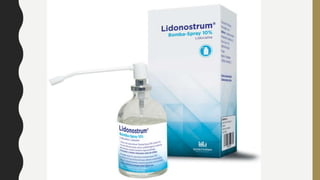
• Lidocaine Spray: The active ingredient is 10% or 15% lidocaine
hydrochloride in a water base, which have rapid onset (1 minute),
and the duration of anesthesia is approximately 10 minutes.
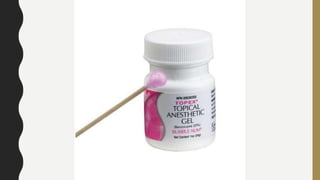
• Ointments: containing 5 % lidocaine hydrochloride, it takes 3 - 4
minutes to produce surface anesthesia.
• Ethyl chloride spray: when sprayed on to either skin or mucosa,
quickly produces anesthesia by refrigeration. This technique is of
limited value but it occasionally used to produce surface
anesthesia prior to the incision of fluctuant abscesses.
INFILTRATION
ANESTHESIA
INFILTRATION ANESTHESIA
• In this method, the anesthetic solution deposited near
the terminal fibers of any nerve. It will infiltrate through
the tissue to reach the nerve fibers and thus produce
anesthesia of the localized area served by them.
• The maxilla has thin labial / buccal cortical plate, shows
sites of porosity, which aid in the absorption of the local
anesthetic solution. These factors, therefore, make the
maxilla more favorable for infiltration anesthesia.
• only the anterior part of the mandible presents sufficient
porosity, which is favorable for the infiltration
ADVANTAGES:
1. Easy and simple injection
2. Very high success rate
3. Good control of bleeding
Disadvantage: its action is limited to a small area;
hence, a considerable amount of solution has to be
injected with multiple penetrations when large field is
to be anesthetized.
TECHNIQUE:
• the bevel of the needle should be facing the bone
• The needle is inserted in the middle of the area to be
operated
• the point of the needle insertion is at an angle of 45
degrees to the long axis of the tooth to be
anesthetized
• The depth of penetration is beneath the mucous
membrane into the connective tissue
CARE SHOULD BE TAKEN TO AVOID
INJURY TO THE TISSUE IN THE
FOLLOWING WAYS:
1. Avoid injecting the solution too rapidly.
2. Avoid injecting too large volume of the local
anesthetic solution.
3. Avoid injecting too superficially.
TYPES OF INFILTRATION ANESTHESIA
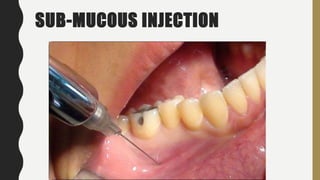
1. Sub-mucous injection: the solution deposited just
beneath the mucous membrane; the solution
diffuses through the interstitial tissue and reaches
the terminal fibers of the nerve in the area of
deposition.
• This technique is unlikely to produce anesthesia of the
dental pulp it is often employed to anesthetize the
long buccal nerve prior to the extraction of
mandibular molars or for soft tissue surgery.
SUB-MUCOUS INJECTION
TYPES OF INFILTRATION ANESTHESIA
2. Supra-periosteal injection: in some sites, such as
maxilla, the outer cortical plate of alveolar bone is thin
and perforated by tiny vascular canals. In these areas
when the anesthetic solution is deposited outside the
periosteum. It will infiltrate through the periosteum,
cortical plate and medullary bone to the nerve fibers.
By this means, anesthesia of the dental pulp can be
obtained by injecting near the tooth apex. The supra-
periosteal injection is the technique most frequently
SUPRA-PERIOSTEAL INJECTION
TYPES OF INFILTRATION ANESTHESIA
3. Sub-periosteal injection: the solution is deposited
between the periosteum and the cortical plate. This
technique is painful since the periosteum is firmly
attached to the cortical plate.
SUB-PERIOSTEAL INJECTION
FIELD BLOCK
Local anesthetic is deposited near the larger terminal
nerve branches so the anesthetized area will be
circumscribed. Incision (or treatment) is then made into
an area away from the site of injection of the
anesthetic.
Maxillary injections administered above the apex of the
tooth to be treated are properly termed field blocks
(although common usage identifies them as
infiltration).
REGIONAL BLOCK ANESTHESIA:
• In this technique, the anesthetic solution deposited
near the main nerve trunk, usually at a distance from
the site of the surgical procedure and this will lead to
blocking all impulses and produce anesthesia of the
area supplied by that nerve.
LOCAL ANESTHESIA IN THE MAXILLA
• Anesthesia for the upper molar teeth The pulps of
the upper molars with the exception of the
mesiobuccal root of the first molar are innervated by
the posterior superior alveolar nerve. This nerve is also
also responsible for innervations of the alveolar bone,
buccal gingiva in the molar region and the
mucoperiosteum attached to them
INFILTRATION TECHNIQUE AS
FOLLOWS
1. Hold the syringe at an angle of 45 degrees with the
long axis of the tooth to be anesthetized, with the bevel
of the needle facing the bone.
2. Insert the needle into the mucobuccal fold over the
target tooth.
3.Advance the needle for few millimeters.
Inject slowly, slowly withdraw the syringe and cover the
needle.
5. Wait for 2-3 minutes, check for the sign and
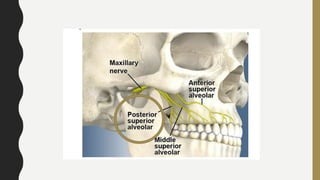
POSTERIOR SUPERIOR ALVEOLAR
NERVE BLOCK
• The PSA nerve block is a commonly used dental nerve block. Although it is
a highly successful technique (>95%), several issues should be weighed
when its use is considered. These include the extent of anesthesia
produced and the potential for hematoma formation.
• When used to achieve pulpal anesthesia, the PSA nerve block is effective
for the maxillary third, second, and first molars (first molar in 77% to 100%
of patients)
• However, the mesio-buccal root of the maxillary first molar is not
consistently innervated by the PSA nerve. therefore, a second injection,
usually supraperiosteal, is indicated after the PSA nerve block when
effective anesthesia of the first molar does not develop
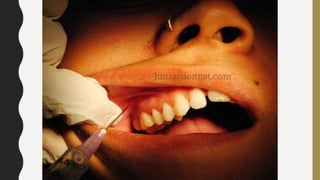
TECHNIQUE:
1. partially open the patient's mouth
2. retract the patient's cheek with your finger
3. insert the needle into the height of the mucobuccal
fold opposite to the distal surface of the maxillary
second molar
4. advance the needle in upward, inward and backward
direction.
5. deposit 1-2 ml of the anesthetic solution
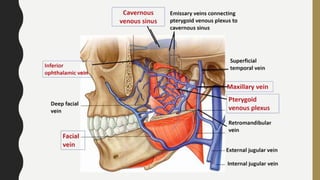
DISADVANTAGE
One of the disadvantages of this technique is the
possibility of damaging the pterygoid venous plexus
and the risk of hematoma formation.
As a means of decreasing the risk of hematoma
formation after a PSA nerve block, use of a “short”
dental needle is recommended for all but the largest of
patients
LOCAL ANESTHESIA IN THE MAXILLA
• Anesthesia of the upper premolar teeth: The
mesiobuccal root of the upper first molar, both
premolars, and buccal supporting tissue and
mucoperiosteum related to them are innervated via
the middle superior alveolar nerve. Infiltration
technique is usually employed to anesthetize these
structures.
LOCAL ANESTHESIA IN THE MAXILLA
• Anesthesia of the upper anterior teeth: The upper
canine, central and lateral incisors, labial supporting
tissue and mucoperiosteum related to them are
innervated via anterior superior alveolar never.
Infiltration technique is usually employed to
anesthetize these structures.
MIDDLE SUPERIOR ALVEOLAR NERVE
BLOCK
• The MSA nerve is present in about 28% of the
population, thereby limiting the clinical usefulness of
the MSA nerve block.
• However, when the ASA nerve block fails to provide
pulpal anesthesia distal to the maxillary canine, the
MSA nerve block is indicated for procedures on
premolars and the mesio-buccal root of the maxillary
first molar. The success rate of the MSA nerve block is
TECHNIQUE
1. A 27-gauge short needle is recommended.
2. Area of insertion: height of the mucobuccal fold above
the maxillary second premolar.
3. Target area: maxillary bone above the apex of the
maxillary second premolar
4. Landmark: mucobuccal fold above the maxillary second
premolar.
5. Orientation of the bevel: toward bone.
MIDDLE SUPERIOR ALVEOLAR NERVE
BLOCK
MIDDLE SUPERIOR ALVEOLAR NERVE
BLOCK
ANESTHESIA OF THE UPPER ANTERIOR
TEETH
• The upper canine, central and lateral incisors, labial
supporting tissue and mucoperiosteum related to
them are innervated via anterior superior alveolar
never. Infiltration technique is usually employed to
anesthetize these structures.
ANESTHESIA OF THE PALATAL TISSUE
• Anesthesia of the posterior portion of the palate
could be achieved by infiltration technique (the
solution is deposited in the palatal tissue about half
way between the midline and the gingival margin of
the target tooth at an angle of 45 to the bony surface)
• by using greater palatine nerve block (the solution is
deposited near the greater palatine foramen, located
just distal to the maxillary second molar about 1 cm
toward the midline)
ANESTHESIA OF THE PALATAL TISSUE ANESTHESIA
OF THE POSTERIOR PORTION OF THE PALATE COULD
BE ACHIEVED BY INFILTRATION TECHNIQUE
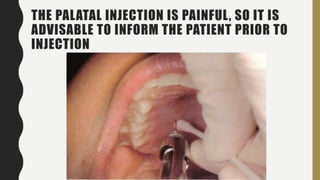
THE PALATAL INJECTION IS PAINFUL, SO IT IS
ADVISABLE TO INFORM THE PATIENT PRIOR TO
INJECTION
GREATER PALATINE NERVE BLOCK
• The greater palatine nerve block is useful for dental
procedures involving the palatal soft tissues distal to
the canine. Minimum volumes of solution (0.45 to 0.6
mL) provide profound hard and soft tissue anesthesia.
Although potentially traumatic, the greater palatine
nerve block is less so than the nasopalatine nerve
block because tissues surrounding the greater
palatine foramen are not as firmly adherent to bone
and therefore are better able to accommodate the
recommended volume of anesthetic solution
GREATER PALATINE NERVE BLOCK
ANESTHESIA OF THE PALATAL TISSUE
• Local infiltration of the palate will anesthetize the
palatal soft and hard tissues.
• Anesthesia of the anterior portion of the palate could
be achieved by infiltration technique, just next to the
target tooth, or by nasopalatine nerve block, where the
solution is deposited near the incisive foramen
(located in the midline of the palate about 1 cm
posterior to the maxillary central incisors)
NASOPALATINE NERVE BLOCK
• Nasopalatine nerve block is an invaluable technique
for palatal pain control in that, with administration of
a minimum volume of anesthetic solution (maximally
one-quarter of a cartridge), a wide area of palatal soft
tissue anesthesia is achieved, thereby minimizing the
need for multiple palatal injections. Unfortunately, the
nasopalatine nerve block has the distinction of being
a potentially highly traumatic (e.g., painful) injection
ANESTHESIA OF THE ANTERIOR PORTION OF THE PALATE
COULD BE ACHIEVED BY INFILTRATION TECHNIQUE, JUST
NEXT TO THE TARGET TOOTH, OR BY NASOPALATINE
NERVE BLOCK
ANESTHESIA OF THE PALATAL TISSUE
• The palatal muco-periosteum is firm in consistency
and is closely adapted to the bone, making the
injection of the local anesthetic solution performed
under great pressure.
• The palatal injection is painful, so it is advisable to
inform the patient prior to injection. When the needle
touches the bone, gently, withdraw the needle by 1
mm (to avoid painful subperiosteal injection) and
deposit about 0.25 - 0.5 ml of the solution in the area
to be anesthetized, withdraw the needle slowly.
THE STEPS IN THE ATRAUMATIC
ADMINISTRATION OF PALATAL ANESTHESIA
ARE:
1. Provide adequate topical anesthesia at the site of needle
penetration.
2. Use pressure anesthesia at the site both before and during
needle insertion and the deposition of solution.
3. Maintain control over the needle.
4. Deposit the anesthetic solution slowly.
5. Trust in yourself...that you can complete the procedure a
traumatically
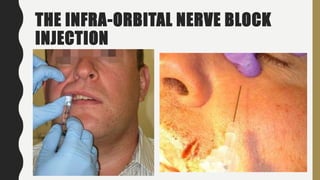
THE INFRA-ORBITAL NERVE BLOCK
INJECTION
• This technique is rarely used since the infiltration
techniques are so effective in the maxilla,
• however, it may be of value if numerous extractions or
extensive surgery are to be undertaken in the
maxillary incisor and canine regions. It may also be
employed for anesthetizing an anterior tooth where
the use of infiltration technique is precluded by the
presence of infection at the site of injection.
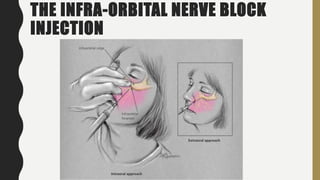
TECHNIQUE
• The solution deposited at the orifice of the infra-
orbital foramen passes along the canal. The anterior
superior alveolar nerve, middle superior alveolar
nerve and the infraorbital nerve with its terminal
branches will be anesthetized.
• The technique is performed Intra-orally. The
infraorbital foramen site is palpated, the upper lip is
reflected and the tip of a long needle is inserted into
the height of the mucobuccal fold over the first molar
with the bevel facing the bone. The needle is
advanced in line with the long axis of this tooth to a
depth of 1.5 - 2 cm then 1 ml of anesthetic solution is
given which is enough in most instances.
• The extra-oral approach is rarely used and involve
direct injection through the skin to the foramen
THE INFRA-ORBITAL NERVE BLOCK
INJECTION
THE INFRA-ORBITAL NERVE BLOCK
INJECTION
LOCAL ANESTHESIA IN THE MANDIBLE
• Anesthesia of the lower anterior teeth
The lower anterior teeth are supplied by the terminal
branch of the inferior alveolar nerve (incisive nerve).
Fortunately, the labial alveolar plate in this region is
thinner and more porous than elsewhere in the
mandible and because of that, the infiltration technique
could be used in this area. This is achieved by
deposition of about 1 ml of the solution in the labial
sulcus adjacent to the target tooth to anesthetize the
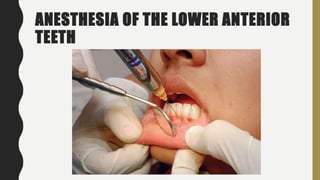
ANESTHESIA OF THE LOWER ANTERIOR
TEETH
LOCAL ANESTHESIA IN THE MANDIBLE
Anesthesia of the lower premolars and molars
• To extract the lower premolar and molars we should
anesthetize the inferior alveolar nerve (supply the pulp of
these teeth with their periodontium and the bony socket), the
lingual nerve (supply the lingual soft tissue adjacent to them)
and the long buccal nerve (supply the buccal soft tissue).
• In children, multiple vascular canals perforate the thin
labial/buccal alveolar plate. For this reason, infiltration
techniques are highly effective in producing anesthesia of
upper and lower deciduous teeth. Care should be taken to
avoid the misjudging the length of the roots and inserting the
INFERIOR ALVEOLAR NERVE BLOCK
• The IAN, along with its terminal branches (incisive and
mental nerves) are anesthetized by this technique
(anesthesia of the pulp of all mandibular teeth in the
same side of injection, the skin of the chin and the
skin and mucosa of the lower lip).
• This is achieved by the deposition of the solution
around the mandibular foramen in the
pterygomandibular space.
BOUNDARIES OF THE
PTERYGOMANDIBULAR SPACE
• This space is bounded anteriorly by the
pterygomandibular raphe and the fibers of superior
constrictor and buccinators muscles that are inserted
into it.
• The posterior boundary is formed by the parotid gland.
• The ramus of the mandible forms the lateral wall while,
• The medial pterygoid muscle forms the medial wall.
• The lateral pterygoid muscle forms the roof of the space
THE INFERIOR ALVEOLAR NERVE
BLOCK TECHNIQUE
• The success of this technique is entirely dependent
upon the accurate deposition of the solution; this
technique will anesthetize the inferior alveolar nerve
and its terminal branches.
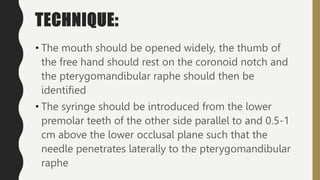
TECHNIQUE:
• The mouth should be opened widely, the thumb of
the free hand should rest on the coronoid notch and
the pterygomandibular raphe should then be
identified
• The syringe should be introduced from the lower
premolar teeth of the other side parallel to and 0.5-1
cm above the lower occlusal plane such that the
needle penetrates laterally to the pterygomandibular
raphe
TECHNIQUE:
• The long dental needle should be advanced about 2-2.5
mm + until the bone is touched lightly, the needle should
then be withdrawn a millimeter or two, the local
anesthetic should then be deposited slowly using most of
the cartridge's solution.
• The lingual nerve, which lies anteromedial to the inferior
alveolar nerve is anesthetized by slowly withdrawing the
syringe until approximately half the needle's length
remains within the tissue, deposit few drops of the
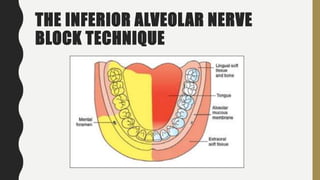
THE INFERIOR ALVEOLAR NERVE BLOCK
TECHNIQUE
THE INFERIOR ALVEOLAR NERVE
BLOCK TECHNIQUE
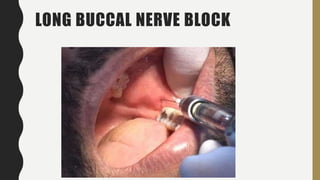
LONG BUCCAL NERVE BLOCK
• The long buccal nerve provides sensory innervations to
the buccal soft tissue adjacent to the mandibular molar
teeth, vestibular mucosa and mucosa of the retromolar
fossa.
• A long buccal nerve block is achieved by means of a
sub-mucous injection in which the solution is deposited
(few drops) just posterior and buccal to the last molar
tooth in the arch (between the external and the internal
oblique ridge). Infiltration technique for the long buccal
nerve is achieved by deposition of the solution in the
LONG BUCCAL NERVE BLOCK
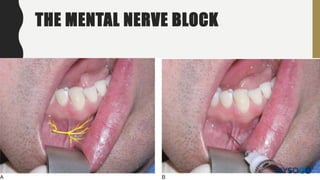
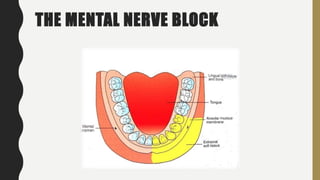
THE MENTAL NERVE BLOCK
This block will anesthetize the pulp and periodontal membrane
of the lower incisors, canine, first premolar and sometimes the
second premolar (incisive nerve), labial mucous membrane
anterior to the mental foramen and the skin of the chin and the
skin and mucosa of the lower lip (mental nerve). In dentate
patient, the mental foramen lies below and between apices of
the lower premolar teeth, approximately halfway between the
cervical margin of the teeth and the lower border of the
mandible. The solution is deposited at or near the foramen
(about 1 ml). In edentulous patients, the foramen may lie near
the crest of the ridge because of bone resorption.
THE MENTAL NERVE BLOCK
INCISIVE NERVE BLOCK
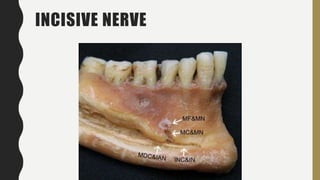
• The incisive nerve is a terminal branch of the inferior
alveolar nerve. Originating as a direct continuation of
the IAN at the mental foramen, the incisive nerve
travels anteriorly in the incisive canal, providing
sensory innervation to those teeth located anterior to
the mental foramen.
• The nerve is always anesthetized when an inferior
alveolar or mandibular nerve block is successful;
therefore the incisive nerve block is not necessary
when these blocks are administered.
INCISIVE NERVE
INCISIVE NERVE BLOCK
• The premolars, canine, and lateral and central incisors,
including their buccal soft tissues and bone, are
anesthetized when the incisive nerve block is
administered
• An important indication for the incisive nerve block is
when the procedure contemplated involves both the
right side and the left side of the mandible. It is this
author’s belief that bilateral inferior alveolar or
mandibular nerve blocks are seldom needed (except in
the case of bilateral surgical procedures in the mandible)
because of the degree of discomfort and the
TECHNIQUE
1. A 27-gauge short needle is recommended.
2. Area of insertion: mucobuccal fold at or just anterior
to
the mental foramen.
3. Target area: mental foramen, through which the
mental nerve exits and inside of which the incisive
nerve is
located.
4. Landmarks: Mandibular premolars and mucobuccal
MANDIBULAR NERVE BLOCK
The mandibular nerve could be blocked by
1. Intra-oral approach as in Gow-Gates mandibular
nerve block and Akinosi (closed mouth) mandibular
nerve block.
2. Extra-oral mandibular nerve block.
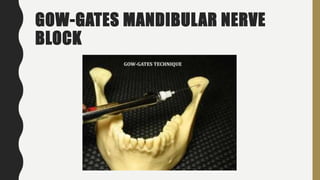
GOW-GATES MANDIBULAR NERVE
BLOCK
1. A 25- or 27-gauge long needle recommended.
2. Area of insertion: mucous membrane on the mesial aspect of the
mandibular ramus, on a line from the inter- tragic notch to the corner of
the mouth, just distal to the maxillary second molar.
3. Target area: lateral side of the condylar neck, just below the insertion
of the lateral pterygoid muscle
4. Landmarks:
a. Extraoral:
i. The intertragic notch (lower border of the tragus).
The correct landmark is the center of the external auditory meatus, which
is concealed by the tragus; therefore its lower border is adopted as a
visual aid
.
GOW-GATES MANDIBULAR NERVE
BLOCK
ii. Corner of the mouth on the contralateral side. b. Intraoral:
i. Height of injection established by placement of the needle tip
just below the mesiolingual (mesio- palatal) cusp of the
maxillary second molar
ii. Penetration of soft tissues just distal to the maxillary second
molar at the height established in the preceding step
5. Orientation of the bevel: not critical.
This technique is indicated when the conventional inferior
alveolar nerve block is unsuccessful
GOW-GATES MANDIBULAR NERVE
BLOCK
GOW-GATES MANDIBULAR NERVE
BLOCK
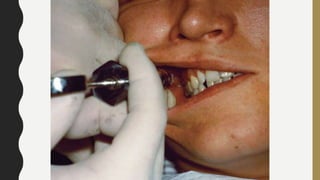
AKINOSI (CLOSED MOUTH)
MANDIBULAR NERVE BLOCK
1. A 25-gauge long needle is recommended (although
a 27-gauge long may be preferred in patients whose
ramus flares laterally more than usual).
2. Area of insertion: soft tissue overlying the medial
(lingual) border of the mandibular ramus directly
adjacent to the maxillary tuberosity at the height of the
mucogingival junction adjacent to the maxillary third
AKINOSI (CLOSED MOUTH)
MANDIBULAR NERVE BLOCK
3. Target area: soft tissue on the medial (lingual) border
of the ramus in the region of the inferior alveolar,
lingual, and mylohyoid nerves as they run inferiorly
from the foramen ovale toward the mandibular
foramen (the height of injection with the Vazirani-
Akinosi closed- mouth mandibular nerve block being
below that of the Gow-Gates mandibular nerve block
but above that of the IANB).
AKINOSI (CLOSED MOUTH)
MANDIBULAR NERVE BLOCK
4. Landmarks:
a. Mucogingival junction of the maxillary third (or second)
molar.
b. Maxillary tuberosity.
c. Coronoid notch on the mandibular ramus.
5. Orientation of the bevel (bevel orientation in the closed-
mouth mandibular block is very important): the bevel must be
oriented away from the bone of the mandibular ramus (e.g.,
bevel faces toward the midline).
AKINOSI (CLOSED MOUTH)
MANDIBULAR NERVE BLOCK
EXTRA-ORAL MANDIBULAR NERVE
BLOCK
• This technique is indicated when there is an acute
infection at the site of injection for the subdivisions of
the mandibular nerve, when there is need to
anesthetize the entire mandibular nerve and its
branches with one single penetration and minimum
amount of local anesthetic solution, and for
diagnostic and therapeutic purposes as in trigeminal
neuralgia.
SUPPLEMENTARY INJECTIONS:
1. Intra-ligamentary (periodontal) injection: the
local anesthetic solution is deposited into the
periodontal ligament, using small amount of local
anesthetic solution, The single rooted tooth should be
injected on the mesial and the distal sides while the
multi rooted teeth are injected over each root
2. lntrapulpal anesthesia: put a cotton ball soaked in
a local anesthetic solution in the cavity, wait for a
minute and then a needle is inserted firmly directly into
the pulp chamber or to the root canal
SUPPLEMENTARY INJECTIONS:
3. lntraosseous injection: In this rarely used method,
the local anesthetic solution is deposited directly into
the cancellous bone adjacent to the tooth to be
anesthetized. An incision is made in the mucosa and
the periosteum, a small opening is made in the outer
cortical layer of the bone. The needle is inserted into
the opening created, and approximately 0.5-1 ml of
solution is slowly injected under pressure. Anesthesia
by the intraosseous method will not be of very long
duration, possibly between 10 -20 minutes.
SUPPLEMENTARY INJECTIONS:
• Speed of injection Rapid injection of the solution may cause
tissue distension and discomfort or actual cellular damage
and pain when sensation returns, also the risk of toxic
reactions is greater if a quantity of anesthetic solution is
injected rapidly, a slow rate of injection is thus essential.
• Testing for anesthesia Altered sensation in itself does not
guarantee that anesthesia has been achieved, prior to
extraction under local anesthesia a dental probe may be
pushed into the gingival crevice on both the labia-buccal and
the lingual surface of the tooth. The patient should be told
that pressure might be felt and asked to state if sharpness is
noted, the presence of sharpness is an indication of a further
injection
lec 17.pptx

lec 17.pptx

  • 1.
    LOCAL ANESTHESIA CHAPTER 5 (( B A S I C T E C H N I Q U E S O F D E N T A L L O C A L A N E S T H E S I A ) ) D R . H AY D A R M U N I R S A L I H B D S , P H D ( B O A R D C E R T I F I E D )
  • 2.
    A VARIETY OFTECHNIQUES USED IN ADMINISTRATION AND DEPOSITION OF LOCAL ANESTHESIA: 1. Topical anesthesia 2. Infiltration anesthesia 3. Field block anesthesia 4. Regional block anesthesia • In general, the infiltration anesthesia used for the maxilla and the anterior portion of the mandible, while nerve block is indicated for the posterior portion of the mandible.
  • 3.
    TOPICAL OR SURFACEANESTHESIA • Small terminal nerves in the surface area of the intact mucosa or the skin (superficial nerve ending) up to the depth of about 2 mm are anesthetized by application of topical anesthetic agent directly to the area • This method commonly used to: 1. Obtain anesthesia of mucosa prior to injection, making the insertion of the needle less painful. 2. Prior to carrying out incision and drainage of abscesses.
  • 4.
    EXAMPLES OF TOPICALANESTHESIA'S PREPARATION • Lidocaine Spray: The active ingredient is 10% or 15% lidocaine hydrochloride in a water base, which have rapid onset (1 minute), and the duration of anesthesia is approximately 10 minutes. • Ointments: containing 5 % lidocaine hydrochloride, it takes 3 - 4 minutes to produce surface anesthesia. • Ethyl chloride spray: when sprayed on to either skin or mucosa, quickly produces anesthesia by refrigeration. This technique is of limited value but it occasionally used to produce surface anesthesia prior to the incision of fluctuant abscesses.
  • 8.
  • 9.
    INFILTRATION ANESTHESIA • Inthis method, the anesthetic solution deposited near the terminal fibers of any nerve. It will infiltrate through the tissue to reach the nerve fibers and thus produce anesthesia of the localized area served by them. • The maxilla has thin labial / buccal cortical plate, shows sites of porosity, which aid in the absorption of the local anesthetic solution. These factors, therefore, make the maxilla more favorable for infiltration anesthesia. • only the anterior part of the mandible presents sufficient porosity, which is favorable for the infiltration
  • 11.
    ADVANTAGES: 1. Easy andsimple injection 2. Very high success rate 3. Good control of bleeding Disadvantage: its action is limited to a small area; hence, a considerable amount of solution has to be injected with multiple penetrations when large field is to be anesthetized.
  • 12.
    TECHNIQUE: • the bevelof the needle should be facing the bone • The needle is inserted in the middle of the area to be operated • the point of the needle insertion is at an angle of 45 degrees to the long axis of the tooth to be anesthetized • The depth of penetration is beneath the mucous membrane into the connective tissue
  • 14.
    CARE SHOULD BETAKEN TO AVOID INJURY TO THE TISSUE IN THE FOLLOWING WAYS: 1. Avoid injecting the solution too rapidly. 2. Avoid injecting too large volume of the local anesthetic solution. 3. Avoid injecting too superficially.
  • 15.
    TYPES OF INFILTRATIONANESTHESIA 1. Sub-mucous injection: the solution deposited just beneath the mucous membrane; the solution diffuses through the interstitial tissue and reaches the terminal fibers of the nerve in the area of deposition. • This technique is unlikely to produce anesthesia of the dental pulp it is often employed to anesthetize the long buccal nerve prior to the extraction of mandibular molars or for soft tissue surgery.
  • 16.
  • 17.
    TYPES OF INFILTRATIONANESTHESIA 2. Supra-periosteal injection: in some sites, such as maxilla, the outer cortical plate of alveolar bone is thin and perforated by tiny vascular canals. In these areas when the anesthetic solution is deposited outside the periosteum. It will infiltrate through the periosteum, cortical plate and medullary bone to the nerve fibers. By this means, anesthesia of the dental pulp can be obtained by injecting near the tooth apex. The supra- periosteal injection is the technique most frequently
  • 18.
  • 19.
    TYPES OF INFILTRATIONANESTHESIA 3. Sub-periosteal injection: the solution is deposited between the periosteum and the cortical plate. This technique is painful since the periosteum is firmly attached to the cortical plate.
  • 20.
  • 21.
    FIELD BLOCK Local anestheticis deposited near the larger terminal nerve branches so the anesthetized area will be circumscribed. Incision (or treatment) is then made into an area away from the site of injection of the anesthetic. Maxillary injections administered above the apex of the tooth to be treated are properly termed field blocks (although common usage identifies them as infiltration).
  • 22.
    REGIONAL BLOCK ANESTHESIA: •In this technique, the anesthetic solution deposited near the main nerve trunk, usually at a distance from the site of the surgical procedure and this will lead to blocking all impulses and produce anesthesia of the area supplied by that nerve.
  • 23.
    LOCAL ANESTHESIA INTHE MAXILLA • Anesthesia for the upper molar teeth The pulps of the upper molars with the exception of the mesiobuccal root of the first molar are innervated by the posterior superior alveolar nerve. This nerve is also also responsible for innervations of the alveolar bone, buccal gingiva in the molar region and the mucoperiosteum attached to them
  • 24.
    INFILTRATION TECHNIQUE AS FOLLOWS 1.Hold the syringe at an angle of 45 degrees with the long axis of the tooth to be anesthetized, with the bevel of the needle facing the bone. 2. Insert the needle into the mucobuccal fold over the target tooth. 3.Advance the needle for few millimeters. Inject slowly, slowly withdraw the syringe and cover the needle. 5. Wait for 2-3 minutes, check for the sign and
  • 25.
    POSTERIOR SUPERIOR ALVEOLAR NERVEBLOCK • The PSA nerve block is a commonly used dental nerve block. Although it is a highly successful technique (>95%), several issues should be weighed when its use is considered. These include the extent of anesthesia produced and the potential for hematoma formation. • When used to achieve pulpal anesthesia, the PSA nerve block is effective for the maxillary third, second, and first molars (first molar in 77% to 100% of patients) • However, the mesio-buccal root of the maxillary first molar is not consistently innervated by the PSA nerve. therefore, a second injection, usually supraperiosteal, is indicated after the PSA nerve block when effective anesthesia of the first molar does not develop
  • 26.
    TECHNIQUE: 1. partially openthe patient's mouth 2. retract the patient's cheek with your finger 3. insert the needle into the height of the mucobuccal fold opposite to the distal surface of the maxillary second molar 4. advance the needle in upward, inward and backward direction. 5. deposit 1-2 ml of the anesthetic solution
  • 29.
    DISADVANTAGE One of thedisadvantages of this technique is the possibility of damaging the pterygoid venous plexus and the risk of hematoma formation. As a means of decreasing the risk of hematoma formation after a PSA nerve block, use of a “short” dental needle is recommended for all but the largest of patients
  • 31.
    LOCAL ANESTHESIA INTHE MAXILLA • Anesthesia of the upper premolar teeth: The mesiobuccal root of the upper first molar, both premolars, and buccal supporting tissue and mucoperiosteum related to them are innervated via the middle superior alveolar nerve. Infiltration technique is usually employed to anesthetize these structures.
  • 32.
    LOCAL ANESTHESIA INTHE MAXILLA • Anesthesia of the upper anterior teeth: The upper canine, central and lateral incisors, labial supporting tissue and mucoperiosteum related to them are innervated via anterior superior alveolar never. Infiltration technique is usually employed to anesthetize these structures.
  • 33.
    MIDDLE SUPERIOR ALVEOLARNERVE BLOCK • The MSA nerve is present in about 28% of the population, thereby limiting the clinical usefulness of the MSA nerve block. • However, when the ASA nerve block fails to provide pulpal anesthesia distal to the maxillary canine, the MSA nerve block is indicated for procedures on premolars and the mesio-buccal root of the maxillary first molar. The success rate of the MSA nerve block is
  • 34.
    TECHNIQUE 1. A 27-gaugeshort needle is recommended. 2. Area of insertion: height of the mucobuccal fold above the maxillary second premolar. 3. Target area: maxillary bone above the apex of the maxillary second premolar 4. Landmark: mucobuccal fold above the maxillary second premolar. 5. Orientation of the bevel: toward bone.
  • 35.
  • 36.
  • 37.
    ANESTHESIA OF THEUPPER ANTERIOR TEETH • The upper canine, central and lateral incisors, labial supporting tissue and mucoperiosteum related to them are innervated via anterior superior alveolar never. Infiltration technique is usually employed to anesthetize these structures.
  • 38.
    ANESTHESIA OF THEPALATAL TISSUE • Anesthesia of the posterior portion of the palate could be achieved by infiltration technique (the solution is deposited in the palatal tissue about half way between the midline and the gingival margin of the target tooth at an angle of 45 to the bony surface) • by using greater palatine nerve block (the solution is deposited near the greater palatine foramen, located just distal to the maxillary second molar about 1 cm toward the midline)
  • 39.
    ANESTHESIA OF THEPALATAL TISSUE ANESTHESIA OF THE POSTERIOR PORTION OF THE PALATE COULD BE ACHIEVED BY INFILTRATION TECHNIQUE
  • 40.
    THE PALATAL INJECTIONIS PAINFUL, SO IT IS ADVISABLE TO INFORM THE PATIENT PRIOR TO INJECTION
  • 41.
    GREATER PALATINE NERVEBLOCK • The greater palatine nerve block is useful for dental procedures involving the palatal soft tissues distal to the canine. Minimum volumes of solution (0.45 to 0.6 mL) provide profound hard and soft tissue anesthesia. Although potentially traumatic, the greater palatine nerve block is less so than the nasopalatine nerve block because tissues surrounding the greater palatine foramen are not as firmly adherent to bone and therefore are better able to accommodate the recommended volume of anesthetic solution
  • 42.
  • 43.
    ANESTHESIA OF THEPALATAL TISSUE • Local infiltration of the palate will anesthetize the palatal soft and hard tissues. • Anesthesia of the anterior portion of the palate could be achieved by infiltration technique, just next to the target tooth, or by nasopalatine nerve block, where the solution is deposited near the incisive foramen (located in the midline of the palate about 1 cm posterior to the maxillary central incisors)
  • 44.
    NASOPALATINE NERVE BLOCK •Nasopalatine nerve block is an invaluable technique for palatal pain control in that, with administration of a minimum volume of anesthetic solution (maximally one-quarter of a cartridge), a wide area of palatal soft tissue anesthesia is achieved, thereby minimizing the need for multiple palatal injections. Unfortunately, the nasopalatine nerve block has the distinction of being a potentially highly traumatic (e.g., painful) injection
  • 45.
    ANESTHESIA OF THEANTERIOR PORTION OF THE PALATE COULD BE ACHIEVED BY INFILTRATION TECHNIQUE, JUST NEXT TO THE TARGET TOOTH, OR BY NASOPALATINE NERVE BLOCK
  • 46.
    ANESTHESIA OF THEPALATAL TISSUE • The palatal muco-periosteum is firm in consistency and is closely adapted to the bone, making the injection of the local anesthetic solution performed under great pressure. • The palatal injection is painful, so it is advisable to inform the patient prior to injection. When the needle touches the bone, gently, withdraw the needle by 1 mm (to avoid painful subperiosteal injection) and deposit about 0.25 - 0.5 ml of the solution in the area to be anesthetized, withdraw the needle slowly.
  • 47.
    THE STEPS INTHE ATRAUMATIC ADMINISTRATION OF PALATAL ANESTHESIA ARE: 1. Provide adequate topical anesthesia at the site of needle penetration. 2. Use pressure anesthesia at the site both before and during needle insertion and the deposition of solution. 3. Maintain control over the needle. 4. Deposit the anesthetic solution slowly. 5. Trust in yourself...that you can complete the procedure a traumatically
  • 48.
    THE INFRA-ORBITAL NERVEBLOCK INJECTION • This technique is rarely used since the infiltration techniques are so effective in the maxilla, • however, it may be of value if numerous extractions or extensive surgery are to be undertaken in the maxillary incisor and canine regions. It may also be employed for anesthetizing an anterior tooth where the use of infiltration technique is precluded by the presence of infection at the site of injection.
  • 49.
    TECHNIQUE • The solutiondeposited at the orifice of the infra- orbital foramen passes along the canal. The anterior superior alveolar nerve, middle superior alveolar nerve and the infraorbital nerve with its terminal branches will be anesthetized.
  • 50.
    • The techniqueis performed Intra-orally. The infraorbital foramen site is palpated, the upper lip is reflected and the tip of a long needle is inserted into the height of the mucobuccal fold over the first molar with the bevel facing the bone. The needle is advanced in line with the long axis of this tooth to a depth of 1.5 - 2 cm then 1 ml of anesthetic solution is given which is enough in most instances. • The extra-oral approach is rarely used and involve direct injection through the skin to the foramen
  • 51.
    THE INFRA-ORBITAL NERVEBLOCK INJECTION
  • 52.
    THE INFRA-ORBITAL NERVEBLOCK INJECTION
  • 53.
    LOCAL ANESTHESIA INTHE MANDIBLE • Anesthesia of the lower anterior teeth The lower anterior teeth are supplied by the terminal branch of the inferior alveolar nerve (incisive nerve). Fortunately, the labial alveolar plate in this region is thinner and more porous than elsewhere in the mandible and because of that, the infiltration technique could be used in this area. This is achieved by deposition of about 1 ml of the solution in the labial sulcus adjacent to the target tooth to anesthetize the
  • 54.
    ANESTHESIA OF THELOWER ANTERIOR TEETH
  • 55.
    LOCAL ANESTHESIA INTHE MANDIBLE Anesthesia of the lower premolars and molars • To extract the lower premolar and molars we should anesthetize the inferior alveolar nerve (supply the pulp of these teeth with their periodontium and the bony socket), the lingual nerve (supply the lingual soft tissue adjacent to them) and the long buccal nerve (supply the buccal soft tissue). • In children, multiple vascular canals perforate the thin labial/buccal alveolar plate. For this reason, infiltration techniques are highly effective in producing anesthesia of upper and lower deciduous teeth. Care should be taken to avoid the misjudging the length of the roots and inserting the
  • 56.
    INFERIOR ALVEOLAR NERVEBLOCK • The IAN, along with its terminal branches (incisive and mental nerves) are anesthetized by this technique (anesthesia of the pulp of all mandibular teeth in the same side of injection, the skin of the chin and the skin and mucosa of the lower lip). • This is achieved by the deposition of the solution around the mandibular foramen in the pterygomandibular space.
  • 57.
    BOUNDARIES OF THE PTERYGOMANDIBULARSPACE • This space is bounded anteriorly by the pterygomandibular raphe and the fibers of superior constrictor and buccinators muscles that are inserted into it. • The posterior boundary is formed by the parotid gland. • The ramus of the mandible forms the lateral wall while, • The medial pterygoid muscle forms the medial wall. • The lateral pterygoid muscle forms the roof of the space
  • 59.
    THE INFERIOR ALVEOLARNERVE BLOCK TECHNIQUE • The success of this technique is entirely dependent upon the accurate deposition of the solution; this technique will anesthetize the inferior alveolar nerve and its terminal branches.
  • 60.
    TECHNIQUE: • The mouthshould be opened widely, the thumb of the free hand should rest on the coronoid notch and the pterygomandibular raphe should then be identified • The syringe should be introduced from the lower premolar teeth of the other side parallel to and 0.5-1 cm above the lower occlusal plane such that the needle penetrates laterally to the pterygomandibular raphe
  • 61.
    TECHNIQUE: • The longdental needle should be advanced about 2-2.5 mm + until the bone is touched lightly, the needle should then be withdrawn a millimeter or two, the local anesthetic should then be deposited slowly using most of the cartridge's solution. • The lingual nerve, which lies anteromedial to the inferior alveolar nerve is anesthetized by slowly withdrawing the syringe until approximately half the needle's length remains within the tissue, deposit few drops of the
  • 62.
    THE INFERIOR ALVEOLARNERVE BLOCK TECHNIQUE
  • 64.
    THE INFERIOR ALVEOLARNERVE BLOCK TECHNIQUE
  • 65.
    LONG BUCCAL NERVEBLOCK • The long buccal nerve provides sensory innervations to the buccal soft tissue adjacent to the mandibular molar teeth, vestibular mucosa and mucosa of the retromolar fossa. • A long buccal nerve block is achieved by means of a sub-mucous injection in which the solution is deposited (few drops) just posterior and buccal to the last molar tooth in the arch (between the external and the internal oblique ridge). Infiltration technique for the long buccal nerve is achieved by deposition of the solution in the
  • 66.
  • 68.
    THE MENTAL NERVEBLOCK This block will anesthetize the pulp and periodontal membrane of the lower incisors, canine, first premolar and sometimes the second premolar (incisive nerve), labial mucous membrane anterior to the mental foramen and the skin of the chin and the skin and mucosa of the lower lip (mental nerve). In dentate patient, the mental foramen lies below and between apices of the lower premolar teeth, approximately halfway between the cervical margin of the teeth and the lower border of the mandible. The solution is deposited at or near the foramen (about 1 ml). In edentulous patients, the foramen may lie near the crest of the ridge because of bone resorption.
  • 69.
  • 70.
  • 71.
    INCISIVE NERVE BLOCK •The incisive nerve is a terminal branch of the inferior alveolar nerve. Originating as a direct continuation of the IAN at the mental foramen, the incisive nerve travels anteriorly in the incisive canal, providing sensory innervation to those teeth located anterior to the mental foramen. • The nerve is always anesthetized when an inferior alveolar or mandibular nerve block is successful; therefore the incisive nerve block is not necessary when these blocks are administered.
  • 72.
  • 73.
    INCISIVE NERVE BLOCK •The premolars, canine, and lateral and central incisors, including their buccal soft tissues and bone, are anesthetized when the incisive nerve block is administered • An important indication for the incisive nerve block is when the procedure contemplated involves both the right side and the left side of the mandible. It is this author’s belief that bilateral inferior alveolar or mandibular nerve blocks are seldom needed (except in the case of bilateral surgical procedures in the mandible) because of the degree of discomfort and the
  • 74.
    TECHNIQUE 1. A 27-gaugeshort needle is recommended. 2. Area of insertion: mucobuccal fold at or just anterior to the mental foramen. 3. Target area: mental foramen, through which the mental nerve exits and inside of which the incisive nerve is located. 4. Landmarks: Mandibular premolars and mucobuccal
  • 76.
    MANDIBULAR NERVE BLOCK Themandibular nerve could be blocked by 1. Intra-oral approach as in Gow-Gates mandibular nerve block and Akinosi (closed mouth) mandibular nerve block. 2. Extra-oral mandibular nerve block.
  • 77.
    GOW-GATES MANDIBULAR NERVE BLOCK 1.A 25- or 27-gauge long needle recommended. 2. Area of insertion: mucous membrane on the mesial aspect of the mandibular ramus, on a line from the inter- tragic notch to the corner of the mouth, just distal to the maxillary second molar. 3. Target area: lateral side of the condylar neck, just below the insertion of the lateral pterygoid muscle 4. Landmarks: a. Extraoral: i. The intertragic notch (lower border of the tragus). The correct landmark is the center of the external auditory meatus, which is concealed by the tragus; therefore its lower border is adopted as a visual aid .
  • 78.
    GOW-GATES MANDIBULAR NERVE BLOCK ii.Corner of the mouth on the contralateral side. b. Intraoral: i. Height of injection established by placement of the needle tip just below the mesiolingual (mesio- palatal) cusp of the maxillary second molar ii. Penetration of soft tissues just distal to the maxillary second molar at the height established in the preceding step 5. Orientation of the bevel: not critical. This technique is indicated when the conventional inferior alveolar nerve block is unsuccessful
  • 79.
  • 80.
  • 81.
    AKINOSI (CLOSED MOUTH) MANDIBULARNERVE BLOCK 1. A 25-gauge long needle is recommended (although a 27-gauge long may be preferred in patients whose ramus flares laterally more than usual). 2. Area of insertion: soft tissue overlying the medial (lingual) border of the mandibular ramus directly adjacent to the maxillary tuberosity at the height of the mucogingival junction adjacent to the maxillary third
  • 82.
    AKINOSI (CLOSED MOUTH) MANDIBULARNERVE BLOCK 3. Target area: soft tissue on the medial (lingual) border of the ramus in the region of the inferior alveolar, lingual, and mylohyoid nerves as they run inferiorly from the foramen ovale toward the mandibular foramen (the height of injection with the Vazirani- Akinosi closed- mouth mandibular nerve block being below that of the Gow-Gates mandibular nerve block but above that of the IANB).
  • 83.
    AKINOSI (CLOSED MOUTH) MANDIBULARNERVE BLOCK 4. Landmarks: a. Mucogingival junction of the maxillary third (or second) molar. b. Maxillary tuberosity. c. Coronoid notch on the mandibular ramus. 5. Orientation of the bevel (bevel orientation in the closed- mouth mandibular block is very important): the bevel must be oriented away from the bone of the mandibular ramus (e.g., bevel faces toward the midline).
  • 84.
  • 86.
    EXTRA-ORAL MANDIBULAR NERVE BLOCK •This technique is indicated when there is an acute infection at the site of injection for the subdivisions of the mandibular nerve, when there is need to anesthetize the entire mandibular nerve and its branches with one single penetration and minimum amount of local anesthetic solution, and for diagnostic and therapeutic purposes as in trigeminal neuralgia.
  • 88.
    SUPPLEMENTARY INJECTIONS: 1. Intra-ligamentary(periodontal) injection: the local anesthetic solution is deposited into the periodontal ligament, using small amount of local anesthetic solution, The single rooted tooth should be injected on the mesial and the distal sides while the multi rooted teeth are injected over each root 2. lntrapulpal anesthesia: put a cotton ball soaked in a local anesthetic solution in the cavity, wait for a minute and then a needle is inserted firmly directly into the pulp chamber or to the root canal
  • 89.
    SUPPLEMENTARY INJECTIONS: 3. lntraosseousinjection: In this rarely used method, the local anesthetic solution is deposited directly into the cancellous bone adjacent to the tooth to be anesthetized. An incision is made in the mucosa and the periosteum, a small opening is made in the outer cortical layer of the bone. The needle is inserted into the opening created, and approximately 0.5-1 ml of solution is slowly injected under pressure. Anesthesia by the intraosseous method will not be of very long duration, possibly between 10 -20 minutes.
  • 90.
  • 91.
    • Speed ofinjection Rapid injection of the solution may cause tissue distension and discomfort or actual cellular damage and pain when sensation returns, also the risk of toxic reactions is greater if a quantity of anesthetic solution is injected rapidly, a slow rate of injection is thus essential. • Testing for anesthesia Altered sensation in itself does not guarantee that anesthesia has been achieved, prior to extraction under local anesthesia a dental probe may be pushed into the gingival crevice on both the labia-buccal and the lingual surface of the tooth. The patient should be told that pressure might be felt and asked to state if sharpness is noted, the presence of sharpness is an indication of a further injection