CONTENTS:
 INTRODUCTION
 PATHOPHYSIOLOGY
 PREDISPOSING FACTORS
 CLINICAL MANIFESTATION
 PREVENTION
 MANAGEMENT
 CONCLUSION
2
THYROID DYSFUNCTION: CONTENTS
INTRODUCTION:
 Thyroid gland is composed of two elongated lobes on either
side of the trachea that are joined by a thin isthmus of
thyroid tissue located at or below the level of the thyroid
cartilage
 Secretes-
― THYROXIN (T₄)
― TRI-IODOTHYRONINE (T₃)
― CALCITONIN
3
THYROID DYSFUNCTION: INTRODUCTION
INTRODUCTION:
• THYROID HORMONE HAS
* Effect on growth
* Effect on carbohydrate metabolism
* Effect on fat metabolism
* Effect on vitamin metabolism
* Effect on basal metabolic rate
* Effect on cardiovascular system
* Effect on the function of the muscle
4
THYROID DYSFUNCTION: INTRODUCTION
PATHOPHYSIOLOGY:
• Thyroid dysfunction may result due to hypo/hyper-function of thyroid
gland
• Thyroid dysfunction is the second most common glandular disorder of the
endocrine system and is increasing, predominantly among women
1. THYROTOXICOSIS / HYPERTHYROIDISM
 May be due to
 Autoimmunity
TSI (immunoglobulin antibody) induce continual
activation of cAMP system of the cells, with resultant
development of hyperthyroidism
 Adenoma
localized adenoma in the thyroid tissue & secretes large
quantities of thyroid hormone 5
THYROID DYSFUNCTION: PATHOPHYSIOLOGY
PATHOPHYSIOLOGY:
2. HYPOTHYROIDISM
 Autoimmune
 Thyroiditis precedes the autoimmune destruction of the thyroid gland
 This cause progressive deterioration and finally fibrosis of the gland,
with resultant diminished or absent secretion of thyroid hormone
6
THYROID DYSFUNCTION: PATHOPHYSIOLOGY
PREDISPOSING FACTORS:
HYPERTHYROIDISM
 Most often occur between 20 and 40 years of age, 8:1 ratio over males.
 Causes
7
THYROID DYSFUNCTION: PREDISPOSING FACTORS
 Toxic diffuse goiter (Grave’s
disease)
 Toxic multi-nodular goiter
 Toxic uni-locular goiter
 Factitious Thyrotoxicosis
 T₃ Thyrotoxicosis
 Thyrotoxicosis associated with
Thyroiditis
 Hashimoto’s Thyroiditis
 Sub-acute Thyroiditis
 Jod-Basedow phenomenon
 Metastatic follicular carcinoma
 Malignancies with circulating
thyroid stimulators
 TSH producing pituitary tumor
 Hypothalamic hyperthyroidism
PREDISPOSING FACTORS:
HYPERTHYROIDISM
 Untreated hyperthyroidism may leads to
 Thyroid storm
A sudden and severe exacerbation of the signs and symptoms of
thyrotoxicosis usually accompanied by hyperpyrexia and
precipitated by some form of stress, inter-current disease,
infection, trauma, thyroid surgery or radioactive iodine
administration
 Thyroid crisis
Extreme restlessness, nausea, vomiting, abdominal pain, fever,
profuse sweating, tachycardia, cardiac arrhythmias, pulmonary
edema, congestive heart failure leading to coma
8
THYROID DYSFUNCTION: PREDISPOSING FACTORS
PREDISPOSING FACTORS:
HYPOTHYROIDISM
 Thyroid failure usually occurs as a result of disease of
 Thyroid gland (primary hyperthyroidism)
 Pituitary gland (secondary)
 Hypothalamus (tertiary)
 Causes
Primary
9
THYROID DYSFUNCTION: PREDISPOSING FACTORS
Autoimmune hypothyroidism
Idiopathic causes
Postsurgical thyroidectomy
External radiation therapy
Radioiodine therapy
Inherited enzymatic defect
Iodine deficiency
Antithyroid drugs ( thiocyanate,
propylthiouracil, high conc. of
inorganic iodide
Lithium, phenylbutazone
PREDISPOSING FACTORS:
HYPOTHYROIDISM
 Causes
Secondary
 Pituitary tumor
 Infiltrative disease (sarcoid) of pituitary
 Hypothyroid patient’s are unusually sensitive to
 Sedatives
 Opiods (mepiridine, codeine, etc.)
 Anti-anxiety drugs
As it can result in extreme overreaction
10
THYROID DYSFUNCTION: PREDISPOSING FACTORS
CLINICAL MANIFESTATION:
11
THYROID DYSFUNCTION: CLINICAL MANIFESTATION
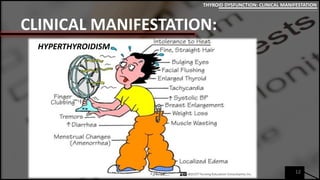
HYPERTHYROIDISM
CLINICAL MANIFESTATION:
12
THYROID DYSFUNCTION: CLINICAL MANIFESTATION
HYPERTHYROIDISM
13
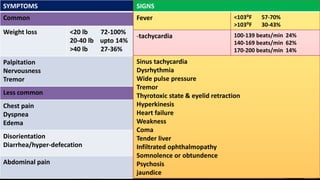
SYMPTOMS
Common
Weight loss <20 lb 72-100%
20-40 lb upto 14%
>40 lb 27-36%
Palpitation
Nervousness
Tremor
Less common
Chest pain
Dyspnea
Edema
Disorientation
Diarrhea/hyper-defecation
Abdominal pain
SIGNS
Fever <103⁰F 57-70%
>103⁰F 30-43%
‐tachycardia 100-139 beats/min 24%
140-169 beats/min 62%
170-200 beats/min 14%
Sinus tachycardia
Dysrhythmia
Wide pulse pressure
Tremor
Thyrotoxic state & eyelid retraction
Hyperkinesis
Heart failure
Weakness
Coma
Tender liver
Infiltrated ophthalmopathy
Somnolence or obtundence
Psychosis
jaundice
CLINICAL MANIFESTATION:
14
THYROID DYSFUNCTION: CLINICAL MANIFESTATION
HYPOTHYROIDISM
15
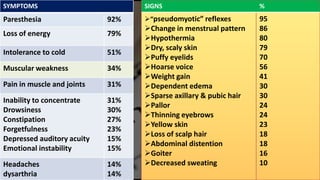
SYMPTOMS
Paresthesia 92%
Loss of energy 79%
Intolerance to cold 51%
Muscular weakness 34%
Pain in muscle and joints 31%
Inability to concentrate
Drowsiness
Constipation
Forgetfulness
Depressed auditory acuity
Emotional instability
31%
30%
27%
23%
15%
15%
Headaches
dysarthria
14%
14%
SIGNS %
“pseudomyotic” reflexes
Change in menstrual pattern
Hypothermia
Dry, scaly skin
Puffy eyelids
Hoarse voice
Weight gain
Dependent edema
Sparse axillary & pubic hair
Pallor
Thinning eyebrows
Yellow skin
Loss of scalp hair
Abdominal distention
Goiter
Decreased sweating
95
86
80
79
70
56
41
30
30
24
24
23
18
18
16
10
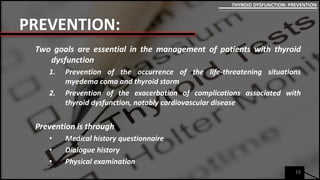
PREVENTION:
Two goals are essential in the management of patients with thyroid
dysfunction
1. Prevention of the occurrence of the life-threatening situations
myedema coma and thyroid storm
2. Prevention of the exacerbation of complications associated with
thyroid dysfunction, notably cardiovascular disease
Prevention is through
• Medical history questionnaire
• Dialogue history
• Physical examination
16
THYROID DYSFUNCTION: PREVENTION
PREVENTION:
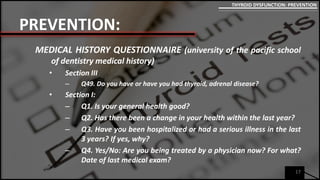
MEDICAL HISTORY QUESTIONNAIRE (university of the pacific school
of dentistry medical history)
• Section III
– Q49. Do you have or have you had thyroid, adrenal disease?
• Section I:
– Q1. Is your general health good?
– Q2. Has there been a change in your health within the last year?
– Q3. Have you been hospitalized or had a serious illness in the last
3 years? If yes, why?
– Q4. Yes/No: Are you being treated by a physician now? For what?
Date of last medical exam?
17
THYROID DYSFUNCTION: PREVENTION
PREVENTION:
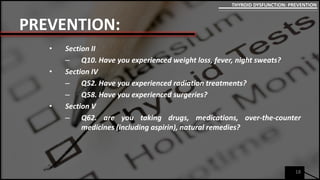
• Section II
– Q10. Have you experienced weight loss, fever, night sweats?
• Section IV
– Q52. Have you experienced radiation treatments?
– Q58. Have you experienced surgeries?
• Section V
– Q62. are you taking drugs, medications, over-the-counter
medicines (including aspirin), natural remedies?
18
THYROID DYSFUNCTION: PREVENTION
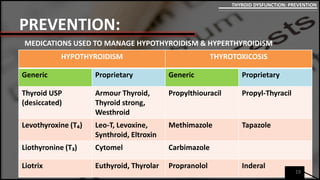
HYPOTHYROIDISM THYROTOXICOSIS
Generic Proprietary Generic Proprietary
Thyroid USP
(desiccated)
Armour Thyroid,
Thyroid strong,
Westhroid
Propylthiouracil Propyl-Thyracil
Levothyroxine (T₄) Leo-T, Levoxine,
Synthroid, Eltroxin
Methimazole Tapazole
Liothyronine (T₃) Cytomel Carbimazole
Liotrix Euthyroid, Thyrolar Propranolol Inderal
PREVENTION:
19
THYROID DYSFUNCTION: PREVENTION
MEDICATIONS USED TO MANAGE HYPOTHYROIDISM & HYPERTHYROIDISM
PREVENTION:
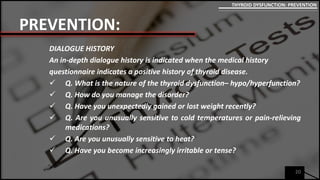
DIALOGUE HISTORY
An in-depth dialogue history is indicated when the medical history
questionnaire indicates a positive history of thyroid disease.
 Q. What is the nature of the thyroid dysfunction– hypo/hyperfunction?
 Q. How do you manage the disorder?
 Q. Have you unexpectedly gained or lost weight recently?
 Q. Are you unusually sensitive to cold temperatures or pain-relieving
medications?
 Q. Are you unusually sensitive to heat?
 Q. Have you become increasingly irritable or tense?
20
THYROID DYSFUNCTION: PREVENTION
PREVENTION:
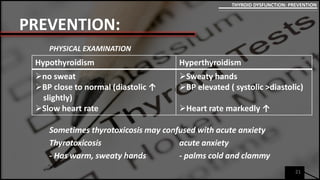
PHYSICAL EXAMINATION
Sometimes thyrotoxicosis may confused with acute anxiety
Thyrotoxicosis acute anxiety
- Has warm, sweaty hands - palms cold and clammy
21
THYROID DYSFUNCTION: PREVENTION
Hypothyroidism Hyperthyroidism
no sweat
BP close to normal (diastolic ↑
slightly)
Slow heart rate
Sweaty hands
BP elevated ( systolic >diastolic)
Heart rate markedly ↑
PREVENTION:
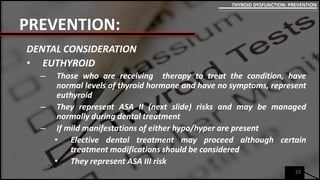
DENTAL CONSIDERATION
• EUTHYROID
– Those who are receiving therapy to treat the condition, have
normal levels of thyroid hormone and have no symptoms, represent
euthyroid
– They represent ASA II (next slide) risks and may be managed
normally during dental treatment
– If mild manifestations of either hypo/hyper are present
• Elective dental treatment may proceed although certain
treatment modifications should be considered
• They represent ASA III risk
22
THYROID DYSFUNCTION: PREVENTION
PREVENTION:
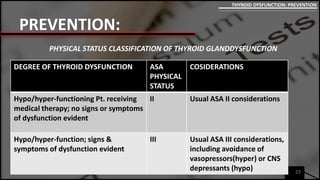
PHYSICAL STATUS CLASSIFICATION OF THYROID GLANDDYSFUNCTION
23
THYROID DYSFUNCTION: PREVENTION
DEGREE OF THYROID DYSFUNCTION ASA
PHYSICAL
STATUS
COSIDERATIONS
Hypo/hyper-functioning Pt. receiving
medical therapy; no signs or symptoms
of dysfunction evident
II Usual ASA II considerations
Hypo/hyper-function; signs &
symptoms of dysfunction evident
III Usual ASA III considerations,
including avoidance of
vasopressors(hyper) or CNS
depressants (hypo)
PREVENTION:
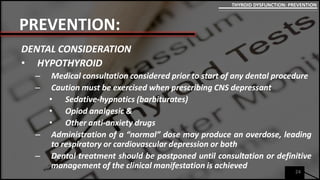
DENTAL CONSIDERATION
• HYPOTHYROID
– Medical consultation considered prior to start of any dental procedure
– Caution must be exercised when prescribing CNS depressant
• Sedative-hypnotics (barbiturates)
• Opiod analgesic &
• Other anti-anxiety drugs
– Administration of a “normal” dose may produce an overdose, leading
to respiratory or cardiovascular depression or both
– Dental treatment should be postponed until consultation or definitive
management of the clinical manifestation is achieved
24
THYROID DYSFUNCTION: PREVENTION
PREVENTION:
DENTAL CONSIDERATION
• HYPERTHYROID
– Mild degree of hyper-function may show
• Acute anxiety, with little ↑ in clinical risk
• However, various cardiovascular disorders, 1⁰ly angina pectoris,
are exaggerated during dental procedure , the management
protocol for that specific situations should be followed
– Severe hyper-function should receiving immediate medical
consultation
• Dental procedure should be postponed
– Atropine should be avoided
• Causes an ↑ in heart rate & may be a factor in precipitating thyroid
storm
25
THYROID DYSFUNCTION: PREVENTION
PREVENTION:
DENTAL CONSIDERATION
• HYPERTHYROID
– Epinephrine & other vasopressors should be used with
caution
– Vasopressors stimulate the cardiovascular system & can
precipitate cardiac dysrhythmias, tachycardia, & thyroid
storm in hyperthyroid patients whose cardiovascular system
have already been sebsitized
26
THYROID DYSFUNCTION: PREVENTION
PREVENTION:
DENTAL CONSIDERATION
• HYPERTHYROID
– However, LA with vasoconstrictors may be used when the
following precautions are taken:
• Used the least-concentrated effective solution of
epinephrine (1:200,000 is preferred to 1:100,000 which
is preferred to 1:50,000)
• Injecting the smallest effective volume of
anesthetics/vasopressors
• Aspiration prior to any injection
27
THYROID DYSFUNCTION: PREVENTION
MANAGEMENT:
HYPOTHYROID
Step 1: termination of the dental procedure.
Step 2: position
supine position with legs elevated slightly
Step 3: A-B-C, basic life support, as needed
myxedema coma must be considered, management includes
establishment of a patent airway (head-tilt-chin-lift),
assessment of breathing, administration of O₂, & assessment of
adequacy of circulation
28
THYROID DYSFUNCTION: MANAGEMENT
MANAGEMENT:
HYPOTHYROID
Step 4: Definitive care
Step 4a: summoning of medical assistance
Step 4b: establishment of an IV line
if available, an IV line of 5% dextrose & water or normal saline
may be started before the arreval of medical personnel
Step 4c: administration of O₂
Step 4d: definitive management
includes the transport of the individual to a hospital emergency
department, administration of massive dose of IV doses of thyroid
hormones
29
THYROID DYSFUNCTION: MANAGEMENT
MANAGEMENT:
HYPERTHYROID
Step 1: termination of the dental procedure.
Step 2: position
supine position with legs elevated slightly
Step 3: A-B-C, basic life support, as needed
thyroid storm must be considered, management includes
establishment of a patent airway (head-tilt-chin-lift),
assessment of breathing, administration of O₂, & assessment of
adequacy of circulation
30
THYROID DYSFUNCTION: MANAGEMENT
MANAGEMENT:
HYPERTHYROID
Step 4: Definitive care
Step 4a: summoning of medical assistance
Step 4b: establishment of an IV line
if available, an IV line of 5% dextrose & water or normal saline
may be started before the arreval of medical personnel
Step 4c: administration of O₂
31
THYROID DYSFUNCTION: MANAGEMENT
MANAGEMENT:
HYPERTHYROID
Step 4d: definitive management
• includes the transport of the individual to a hospital emergency department,
administration of large dose of anti-thyroid drugs (e.g. propylthiouracil)
• Additional includes administration of propranolol to block the adrenergic-
mediated effects of thyroid hormone
• Large doses of glucocorticoids to prevent acute adrenal insufficiency
• Other measures
– O₂
– Cold packs
– Sedation careful monitoring of hydration & electrolyte balance
32
THYROID DYSFUNCTION: MANAGEMENT
CONCLUSION :
CONCLUSION
A patient with either hyperthyroidism or hypothyroidism may
enter the Dental clinic for any dental procedure which required your
attention. For implementation of any dental procedure to this patient
required a good knowledge regarding their signs and symptoms as a
pre-procedure diagnosis can made.
33
THYROID DYSFUNCTION: CONCLUSION
Thyroid dysfunction and its management in dental office

Thyroid dysfunction and its management in dental office

  • 2.
    CONTENTS:  INTRODUCTION  PATHOPHYSIOLOGY PREDISPOSING FACTORS  CLINICAL MANIFESTATION  PREVENTION  MANAGEMENT  CONCLUSION 2 THYROID DYSFUNCTION: CONTENTS
  • 3.
    INTRODUCTION:  Thyroid glandis composed of two elongated lobes on either side of the trachea that are joined by a thin isthmus of thyroid tissue located at or below the level of the thyroid cartilage  Secretes- ― THYROXIN (T₄) ― TRI-IODOTHYRONINE (T₃) ― CALCITONIN 3 THYROID DYSFUNCTION: INTRODUCTION
  • 4.
    INTRODUCTION: • THYROID HORMONEHAS * Effect on growth * Effect on carbohydrate metabolism * Effect on fat metabolism * Effect on vitamin metabolism * Effect on basal metabolic rate * Effect on cardiovascular system * Effect on the function of the muscle 4 THYROID DYSFUNCTION: INTRODUCTION
  • 5.
    PATHOPHYSIOLOGY: • Thyroid dysfunctionmay result due to hypo/hyper-function of thyroid gland • Thyroid dysfunction is the second most common glandular disorder of the endocrine system and is increasing, predominantly among women 1. THYROTOXICOSIS / HYPERTHYROIDISM  May be due to  Autoimmunity TSI (immunoglobulin antibody) induce continual activation of cAMP system of the cells, with resultant development of hyperthyroidism  Adenoma localized adenoma in the thyroid tissue & secretes large quantities of thyroid hormone 5 THYROID DYSFUNCTION: PATHOPHYSIOLOGY
  • 6.
    PATHOPHYSIOLOGY: 2. HYPOTHYROIDISM  Autoimmune Thyroiditis precedes the autoimmune destruction of the thyroid gland  This cause progressive deterioration and finally fibrosis of the gland, with resultant diminished or absent secretion of thyroid hormone 6 THYROID DYSFUNCTION: PATHOPHYSIOLOGY
  • 7.
    PREDISPOSING FACTORS: HYPERTHYROIDISM  Mostoften occur between 20 and 40 years of age, 8:1 ratio over males.  Causes 7 THYROID DYSFUNCTION: PREDISPOSING FACTORS  Toxic diffuse goiter (Grave’s disease)  Toxic multi-nodular goiter  Toxic uni-locular goiter  Factitious Thyrotoxicosis  T₃ Thyrotoxicosis  Thyrotoxicosis associated with Thyroiditis  Hashimoto’s Thyroiditis  Sub-acute Thyroiditis  Jod-Basedow phenomenon  Metastatic follicular carcinoma  Malignancies with circulating thyroid stimulators  TSH producing pituitary tumor  Hypothalamic hyperthyroidism
  • 8.
    PREDISPOSING FACTORS: HYPERTHYROIDISM  Untreatedhyperthyroidism may leads to  Thyroid storm A sudden and severe exacerbation of the signs and symptoms of thyrotoxicosis usually accompanied by hyperpyrexia and precipitated by some form of stress, inter-current disease, infection, trauma, thyroid surgery or radioactive iodine administration  Thyroid crisis Extreme restlessness, nausea, vomiting, abdominal pain, fever, profuse sweating, tachycardia, cardiac arrhythmias, pulmonary edema, congestive heart failure leading to coma 8 THYROID DYSFUNCTION: PREDISPOSING FACTORS
  • 9.
    PREDISPOSING FACTORS: HYPOTHYROIDISM  Thyroidfailure usually occurs as a result of disease of  Thyroid gland (primary hyperthyroidism)  Pituitary gland (secondary)  Hypothalamus (tertiary)  Causes Primary 9 THYROID DYSFUNCTION: PREDISPOSING FACTORS Autoimmune hypothyroidism Idiopathic causes Postsurgical thyroidectomy External radiation therapy Radioiodine therapy Inherited enzymatic defect Iodine deficiency Antithyroid drugs ( thiocyanate, propylthiouracil, high conc. of inorganic iodide Lithium, phenylbutazone
  • 10.
    PREDISPOSING FACTORS: HYPOTHYROIDISM  Causes Secondary Pituitary tumor  Infiltrative disease (sarcoid) of pituitary  Hypothyroid patient’s are unusually sensitive to  Sedatives  Opiods (mepiridine, codeine, etc.)  Anti-anxiety drugs As it can result in extreme overreaction 10 THYROID DYSFUNCTION: PREDISPOSING FACTORS
  • 11.
    CLINICAL MANIFESTATION: 11 THYROID DYSFUNCTION:CLINICAL MANIFESTATION HYPERTHYROIDISM
  • 12.
    CLINICAL MANIFESTATION: 12 THYROID DYSFUNCTION:CLINICAL MANIFESTATION HYPERTHYROIDISM
  • 13.
    13 SYMPTOMS Common Weight loss <20lb 72-100% 20-40 lb upto 14% >40 lb 27-36% Palpitation Nervousness Tremor Less common Chest pain Dyspnea Edema Disorientation Diarrhea/hyper-defecation Abdominal pain SIGNS Fever <103⁰F 57-70% >103⁰F 30-43% ‐tachycardia 100-139 beats/min 24% 140-169 beats/min 62% 170-200 beats/min 14% Sinus tachycardia Dysrhythmia Wide pulse pressure Tremor Thyrotoxic state & eyelid retraction Hyperkinesis Heart failure Weakness Coma Tender liver Infiltrated ophthalmopathy Somnolence or obtundence Psychosis jaundice
  • 14.
    CLINICAL MANIFESTATION: 14 THYROID DYSFUNCTION:CLINICAL MANIFESTATION HYPOTHYROIDISM
  • 15.
    15 SYMPTOMS Paresthesia 92% Loss ofenergy 79% Intolerance to cold 51% Muscular weakness 34% Pain in muscle and joints 31% Inability to concentrate Drowsiness Constipation Forgetfulness Depressed auditory acuity Emotional instability 31% 30% 27% 23% 15% 15% Headaches dysarthria 14% 14% SIGNS % “pseudomyotic” reflexes Change in menstrual pattern Hypothermia Dry, scaly skin Puffy eyelids Hoarse voice Weight gain Dependent edema Sparse axillary & pubic hair Pallor Thinning eyebrows Yellow skin Loss of scalp hair Abdominal distention Goiter Decreased sweating 95 86 80 79 70 56 41 30 30 24 24 23 18 18 16 10
  • 16.
    PREVENTION: Two goals areessential in the management of patients with thyroid dysfunction 1. Prevention of the occurrence of the life-threatening situations myedema coma and thyroid storm 2. Prevention of the exacerbation of complications associated with thyroid dysfunction, notably cardiovascular disease Prevention is through • Medical history questionnaire • Dialogue history • Physical examination 16 THYROID DYSFUNCTION: PREVENTION
  • 17.
    PREVENTION: MEDICAL HISTORY QUESTIONNAIRE(university of the pacific school of dentistry medical history) • Section III – Q49. Do you have or have you had thyroid, adrenal disease? • Section I: – Q1. Is your general health good? – Q2. Has there been a change in your health within the last year? – Q3. Have you been hospitalized or had a serious illness in the last 3 years? If yes, why? – Q4. Yes/No: Are you being treated by a physician now? For what? Date of last medical exam? 17 THYROID DYSFUNCTION: PREVENTION
  • 18.
    PREVENTION: • Section II –Q10. Have you experienced weight loss, fever, night sweats? • Section IV – Q52. Have you experienced radiation treatments? – Q58. Have you experienced surgeries? • Section V – Q62. are you taking drugs, medications, over-the-counter medicines (including aspirin), natural remedies? 18 THYROID DYSFUNCTION: PREVENTION
  • 19.
    HYPOTHYROIDISM THYROTOXICOSIS Generic ProprietaryGeneric Proprietary Thyroid USP (desiccated) Armour Thyroid, Thyroid strong, Westhroid Propylthiouracil Propyl-Thyracil Levothyroxine (T₄) Leo-T, Levoxine, Synthroid, Eltroxin Methimazole Tapazole Liothyronine (T₃) Cytomel Carbimazole Liotrix Euthyroid, Thyrolar Propranolol Inderal PREVENTION: 19 THYROID DYSFUNCTION: PREVENTION MEDICATIONS USED TO MANAGE HYPOTHYROIDISM & HYPERTHYROIDISM
  • 20.
    PREVENTION: DIALOGUE HISTORY An in-depthdialogue history is indicated when the medical history questionnaire indicates a positive history of thyroid disease.  Q. What is the nature of the thyroid dysfunction– hypo/hyperfunction?  Q. How do you manage the disorder?  Q. Have you unexpectedly gained or lost weight recently?  Q. Are you unusually sensitive to cold temperatures or pain-relieving medications?  Q. Are you unusually sensitive to heat?  Q. Have you become increasingly irritable or tense? 20 THYROID DYSFUNCTION: PREVENTION
  • 21.
    PREVENTION: PHYSICAL EXAMINATION Sometimes thyrotoxicosismay confused with acute anxiety Thyrotoxicosis acute anxiety - Has warm, sweaty hands - palms cold and clammy 21 THYROID DYSFUNCTION: PREVENTION Hypothyroidism Hyperthyroidism no sweat BP close to normal (diastolic ↑ slightly) Slow heart rate Sweaty hands BP elevated ( systolic >diastolic) Heart rate markedly ↑
  • 22.
    PREVENTION: DENTAL CONSIDERATION • EUTHYROID –Those who are receiving therapy to treat the condition, have normal levels of thyroid hormone and have no symptoms, represent euthyroid – They represent ASA II (next slide) risks and may be managed normally during dental treatment – If mild manifestations of either hypo/hyper are present • Elective dental treatment may proceed although certain treatment modifications should be considered • They represent ASA III risk 22 THYROID DYSFUNCTION: PREVENTION
  • 23.
    PREVENTION: PHYSICAL STATUS CLASSIFICATIONOF THYROID GLANDDYSFUNCTION 23 THYROID DYSFUNCTION: PREVENTION DEGREE OF THYROID DYSFUNCTION ASA PHYSICAL STATUS COSIDERATIONS Hypo/hyper-functioning Pt. receiving medical therapy; no signs or symptoms of dysfunction evident II Usual ASA II considerations Hypo/hyper-function; signs & symptoms of dysfunction evident III Usual ASA III considerations, including avoidance of vasopressors(hyper) or CNS depressants (hypo)
  • 24.
    PREVENTION: DENTAL CONSIDERATION • HYPOTHYROID –Medical consultation considered prior to start of any dental procedure – Caution must be exercised when prescribing CNS depressant • Sedative-hypnotics (barbiturates) • Opiod analgesic & • Other anti-anxiety drugs – Administration of a “normal” dose may produce an overdose, leading to respiratory or cardiovascular depression or both – Dental treatment should be postponed until consultation or definitive management of the clinical manifestation is achieved 24 THYROID DYSFUNCTION: PREVENTION
  • 25.
    PREVENTION: DENTAL CONSIDERATION • HYPERTHYROID –Mild degree of hyper-function may show • Acute anxiety, with little ↑ in clinical risk • However, various cardiovascular disorders, 1⁰ly angina pectoris, are exaggerated during dental procedure , the management protocol for that specific situations should be followed – Severe hyper-function should receiving immediate medical consultation • Dental procedure should be postponed – Atropine should be avoided • Causes an ↑ in heart rate & may be a factor in precipitating thyroid storm 25 THYROID DYSFUNCTION: PREVENTION
  • 26.
    PREVENTION: DENTAL CONSIDERATION • HYPERTHYROID –Epinephrine & other vasopressors should be used with caution – Vasopressors stimulate the cardiovascular system & can precipitate cardiac dysrhythmias, tachycardia, & thyroid storm in hyperthyroid patients whose cardiovascular system have already been sebsitized 26 THYROID DYSFUNCTION: PREVENTION
  • 27.
    PREVENTION: DENTAL CONSIDERATION • HYPERTHYROID –However, LA with vasoconstrictors may be used when the following precautions are taken: • Used the least-concentrated effective solution of epinephrine (1:200,000 is preferred to 1:100,000 which is preferred to 1:50,000) • Injecting the smallest effective volume of anesthetics/vasopressors • Aspiration prior to any injection 27 THYROID DYSFUNCTION: PREVENTION
  • 28.
    MANAGEMENT: HYPOTHYROID Step 1: terminationof the dental procedure. Step 2: position supine position with legs elevated slightly Step 3: A-B-C, basic life support, as needed myxedema coma must be considered, management includes establishment of a patent airway (head-tilt-chin-lift), assessment of breathing, administration of O₂, & assessment of adequacy of circulation 28 THYROID DYSFUNCTION: MANAGEMENT
  • 29.
    MANAGEMENT: HYPOTHYROID Step 4: Definitivecare Step 4a: summoning of medical assistance Step 4b: establishment of an IV line if available, an IV line of 5% dextrose & water or normal saline may be started before the arreval of medical personnel Step 4c: administration of O₂ Step 4d: definitive management includes the transport of the individual to a hospital emergency department, administration of massive dose of IV doses of thyroid hormones 29 THYROID DYSFUNCTION: MANAGEMENT
  • 30.
    MANAGEMENT: HYPERTHYROID Step 1: terminationof the dental procedure. Step 2: position supine position with legs elevated slightly Step 3: A-B-C, basic life support, as needed thyroid storm must be considered, management includes establishment of a patent airway (head-tilt-chin-lift), assessment of breathing, administration of O₂, & assessment of adequacy of circulation 30 THYROID DYSFUNCTION: MANAGEMENT
  • 31.
    MANAGEMENT: HYPERTHYROID Step 4: Definitivecare Step 4a: summoning of medical assistance Step 4b: establishment of an IV line if available, an IV line of 5% dextrose & water or normal saline may be started before the arreval of medical personnel Step 4c: administration of O₂ 31 THYROID DYSFUNCTION: MANAGEMENT
  • 32.
    MANAGEMENT: HYPERTHYROID Step 4d: definitivemanagement • includes the transport of the individual to a hospital emergency department, administration of large dose of anti-thyroid drugs (e.g. propylthiouracil) • Additional includes administration of propranolol to block the adrenergic- mediated effects of thyroid hormone • Large doses of glucocorticoids to prevent acute adrenal insufficiency • Other measures – O₂ – Cold packs – Sedation careful monitoring of hydration & electrolyte balance 32 THYROID DYSFUNCTION: MANAGEMENT
  • 33.
    CONCLUSION : CONCLUSION A patientwith either hyperthyroidism or hypothyroidism may enter the Dental clinic for any dental procedure which required your attention. For implementation of any dental procedure to this patient required a good knowledge regarding their signs and symptoms as a pre-procedure diagnosis can made. 33 THYROID DYSFUNCTION: CONCLUSION