PALATAL ANESTHESIAPALATAL ANESTHESIA
Greater Palatine Nerve BlockGreater Palatine Nerve Block
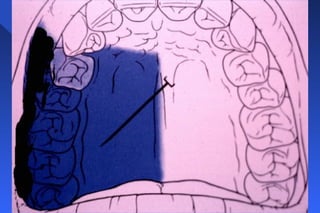
Anterior Palatine NerveAnterior Palatine Nerve
Posterior portion of hard palate andPosterior portion of hard palate and
overlying soft tissuesoverlying soft tissues
Anteriorly to 1st premolarAnteriorly to 1st premolar
Medially to midlineMedially to midline
Greater Palatine Nerve BlockGreater Palatine Nerve Block
IndicationsIndications
Pain control in posterior palatal hard and/orPain control in posterior palatal hard and/or
soft tissuessoft tissues
ContraindicationsContraindications
Inflammation / infection at injection siteInflammation / infection at injection site
Only small area necessary (eg. 1-2 teeth)Only small area necessary (eg. 1-2 teeth)
Greater Palatine Nerve BlockGreater Palatine Nerve Block
AdvantagesAdvantages
Minimizes penetrations and discomfortMinimizes penetrations and discomfort
Minimizes volume of solution (0.5 ml)Minimizes volume of solution (0.5 ml)
DisadvantagesDisadvantages
Limited hemostasisLimited hemostasis
Potentially traumaticPotentially traumatic
Greater Palatine Nerve BlockGreater Palatine Nerve Block
AlternativesAlternatives
Local infiltration in each areaLocal infiltration in each area
Maxillary Nerve BlockMaxillary Nerve Block
AspirationAspiration
< 1% positive< 1% positive
Greater Palatine Nerve BlockGreater Palatine Nerve Block
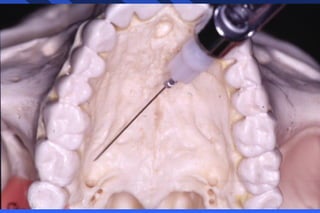
LandmarksLandmarks
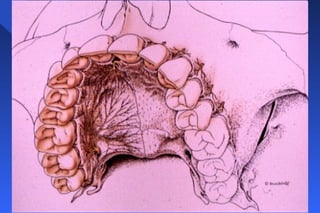
Greater palatine foramenGreater palatine foramen
Junction of alveolus and palatine boneJunction of alveolus and palatine bone
Area of InsertionArea of Insertion
Soft tissue anterior to foramen, fromSoft tissue anterior to foramen, from
opposite sideopposite side
Greater Palatine Nerve BlockGreater Palatine Nerve Block
PrecautionsPrecautions
Do notDo not enter canalenter canal
Signs & symptomsSigns & symptoms
Numb posterior palate; painfree treatmentNumb posterior palate; painfree treatment
Safety featuresSafety features
Bone contacted; aspirationBone contacted; aspiration
Greater Palatine Nerve BlockGreater Palatine Nerve Block
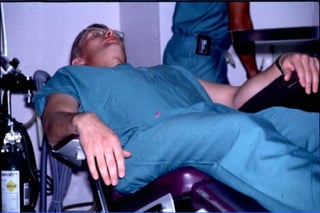
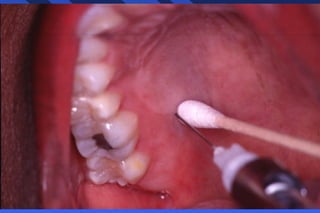
TechniqueTechnique
Position - open wide, extend & turn headPosition - open wide, extend & turn head
Cotton swab - identify landmarks, topicalCotton swab - identify landmarks, topical
Approach - bevel to tissue, advance to boneApproach - bevel to tissue, advance to bone
Aspirate; inject 0.5 ml slowlyAspirate; inject 0.5 ml slowly
Greater Palatine Nerve BlockGreater Palatine Nerve Block
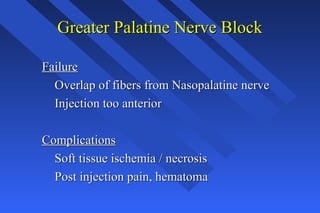
FailureFailure
Overlap of fibers from Nasopalatine nerveOverlap of fibers from Nasopalatine nerve
Injection too anteriorInjection too anterior
ComplicationsComplications
Soft tissue ischemia / necrosisSoft tissue ischemia / necrosis
Post injection pain, hematomaPost injection pain, hematoma
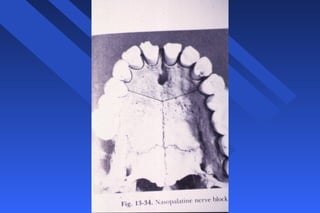
NASOPALATINE NERVE BLOCKNASOPALATINE NERVE BLOCK
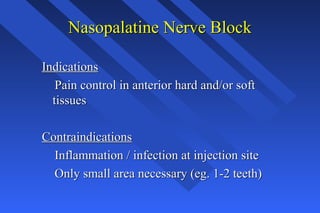
Nasopalatine Nerve BlockNasopalatine Nerve Block
IndicationsIndications
Pain control in anterior hard and/or softPain control in anterior hard and/or soft
tissuestissues
ContraindicationsContraindications
Inflammation / infection at injection siteInflammation / infection at injection site
Only small area necessary (eg. 1-2 teeth)Only small area necessary (eg. 1-2 teeth)
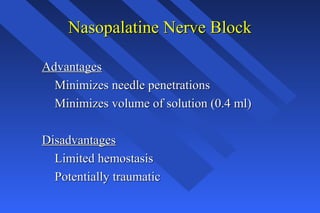
Nasopalatine Nerve BlockNasopalatine Nerve Block
AdvantagesAdvantages
Minimizes needle penetrationsMinimizes needle penetrations
Minimizes volume of solution (0.4 ml)Minimizes volume of solution (0.4 ml)
DisadvantagesDisadvantages
Limited hemostasisLimited hemostasis
Potentially traumaticPotentially traumatic
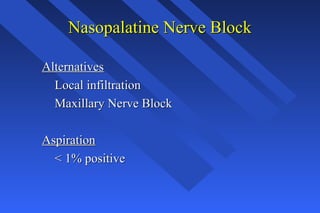
Nasopalatine Nerve BlockNasopalatine Nerve Block
AlternativesAlternatives
Local infiltrationLocal infiltration
Maxillary Nerve BlockMaxillary Nerve Block
AspirationAspiration
< 1% positive< 1% positive
Nasopalatine Nerve BlockNasopalatine Nerve Block
PrecautionsPrecautions
Do not inject directly into papilla/canalDo not inject directly into papilla/canal
Inject slowly, with small volumeInject slowly, with small volume
Signs / symptomsSigns / symptoms
Numb anterior palate; painfree treatmentNumb anterior palate; painfree treatment
Safety featuresSafety features
Bone contacted; aspirationBone contacted; aspiration
Nasopalatine Nerve BlockNasopalatine Nerve Block
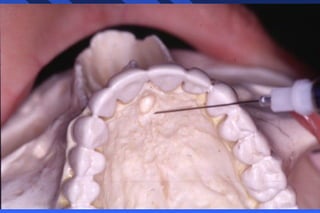
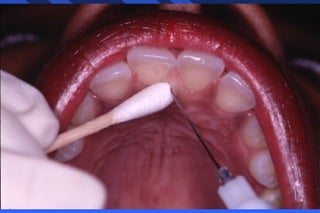
TechniqueTechnique
Position - open wide, extend headPosition - open wide, extend head
Landmarks - incisive papilla, centralLandmarks - incisive papilla, central
incisorsincisors
Approach - lateral to incisive papilla,Approach - lateral to incisive papilla,
starting with cotton swab, topicalstarting with cotton swab, topical
Deposit approx. 0.4 ml / 30 secDeposit approx. 0.4 ml / 30 sec
Nasopalatine Nerve BlockNasopalatine Nerve Block
FailureFailure
May be only unilateralMay be only unilateral
May have overlap with Greater PalatineMay have overlap with Greater Palatine
ComplicationsComplications
Ischemia, tissue necrosisIschemia, tissue necrosis
Others rareOthers rare

Maxillary Anesthesia 4

  • 1.
  • 2.
    Greater Palatine NerveBlockGreater Palatine Nerve Block Anterior Palatine NerveAnterior Palatine Nerve Posterior portion of hard palate andPosterior portion of hard palate and overlying soft tissuesoverlying soft tissues Anteriorly to 1st premolarAnteriorly to 1st premolar Medially to midlineMedially to midline
  • 5.
    Greater Palatine NerveBlockGreater Palatine Nerve Block IndicationsIndications Pain control in posterior palatal hard and/orPain control in posterior palatal hard and/or soft tissuessoft tissues ContraindicationsContraindications Inflammation / infection at injection siteInflammation / infection at injection site Only small area necessary (eg. 1-2 teeth)Only small area necessary (eg. 1-2 teeth)
  • 6.
    Greater Palatine NerveBlockGreater Palatine Nerve Block AdvantagesAdvantages Minimizes penetrations and discomfortMinimizes penetrations and discomfort Minimizes volume of solution (0.5 ml)Minimizes volume of solution (0.5 ml) DisadvantagesDisadvantages Limited hemostasisLimited hemostasis Potentially traumaticPotentially traumatic
  • 7.
    Greater Palatine NerveBlockGreater Palatine Nerve Block AlternativesAlternatives Local infiltration in each areaLocal infiltration in each area Maxillary Nerve BlockMaxillary Nerve Block AspirationAspiration < 1% positive< 1% positive
  • 8.
    Greater Palatine NerveBlockGreater Palatine Nerve Block LandmarksLandmarks Greater palatine foramenGreater palatine foramen Junction of alveolus and palatine boneJunction of alveolus and palatine bone Area of InsertionArea of Insertion Soft tissue anterior to foramen, fromSoft tissue anterior to foramen, from opposite sideopposite side
  • 9.
    Greater Palatine NerveBlockGreater Palatine Nerve Block PrecautionsPrecautions Do notDo not enter canalenter canal Signs & symptomsSigns & symptoms Numb posterior palate; painfree treatmentNumb posterior palate; painfree treatment Safety featuresSafety features Bone contacted; aspirationBone contacted; aspiration
  • 11.
    Greater Palatine NerveBlockGreater Palatine Nerve Block TechniqueTechnique Position - open wide, extend & turn headPosition - open wide, extend & turn head Cotton swab - identify landmarks, topicalCotton swab - identify landmarks, topical Approach - bevel to tissue, advance to boneApproach - bevel to tissue, advance to bone Aspirate; inject 0.5 ml slowlyAspirate; inject 0.5 ml slowly
  • 14.
    Greater Palatine NerveBlockGreater Palatine Nerve Block FailureFailure Overlap of fibers from Nasopalatine nerveOverlap of fibers from Nasopalatine nerve Injection too anteriorInjection too anterior ComplicationsComplications Soft tissue ischemia / necrosisSoft tissue ischemia / necrosis Post injection pain, hematomaPost injection pain, hematoma
  • 15.
  • 17.
    Nasopalatine Nerve BlockNasopalatineNerve Block IndicationsIndications Pain control in anterior hard and/or softPain control in anterior hard and/or soft tissuestissues ContraindicationsContraindications Inflammation / infection at injection siteInflammation / infection at injection site Only small area necessary (eg. 1-2 teeth)Only small area necessary (eg. 1-2 teeth)
  • 18.
    Nasopalatine Nerve BlockNasopalatineNerve Block AdvantagesAdvantages Minimizes needle penetrationsMinimizes needle penetrations Minimizes volume of solution (0.4 ml)Minimizes volume of solution (0.4 ml) DisadvantagesDisadvantages Limited hemostasisLimited hemostasis Potentially traumaticPotentially traumatic
  • 19.
    Nasopalatine Nerve BlockNasopalatineNerve Block AlternativesAlternatives Local infiltrationLocal infiltration Maxillary Nerve BlockMaxillary Nerve Block AspirationAspiration < 1% positive< 1% positive
  • 20.
    Nasopalatine Nerve BlockNasopalatineNerve Block PrecautionsPrecautions Do not inject directly into papilla/canalDo not inject directly into papilla/canal Inject slowly, with small volumeInject slowly, with small volume Signs / symptomsSigns / symptoms Numb anterior palate; painfree treatmentNumb anterior palate; painfree treatment Safety featuresSafety features Bone contacted; aspirationBone contacted; aspiration
  • 21.
    Nasopalatine Nerve BlockNasopalatineNerve Block TechniqueTechnique Position - open wide, extend headPosition - open wide, extend head Landmarks - incisive papilla, centralLandmarks - incisive papilla, central incisorsincisors Approach - lateral to incisive papilla,Approach - lateral to incisive papilla, starting with cotton swab, topicalstarting with cotton swab, topical Deposit approx. 0.4 ml / 30 secDeposit approx. 0.4 ml / 30 sec
  • 24.
    Nasopalatine Nerve BlockNasopalatineNerve Block FailureFailure May be only unilateralMay be only unilateral May have overlap with Greater PalatineMay have overlap with Greater Palatine ComplicationsComplications Ischemia, tissue necrosisIschemia, tissue necrosis Others rareOthers rare