Visual Inspection
Welds
Terminology
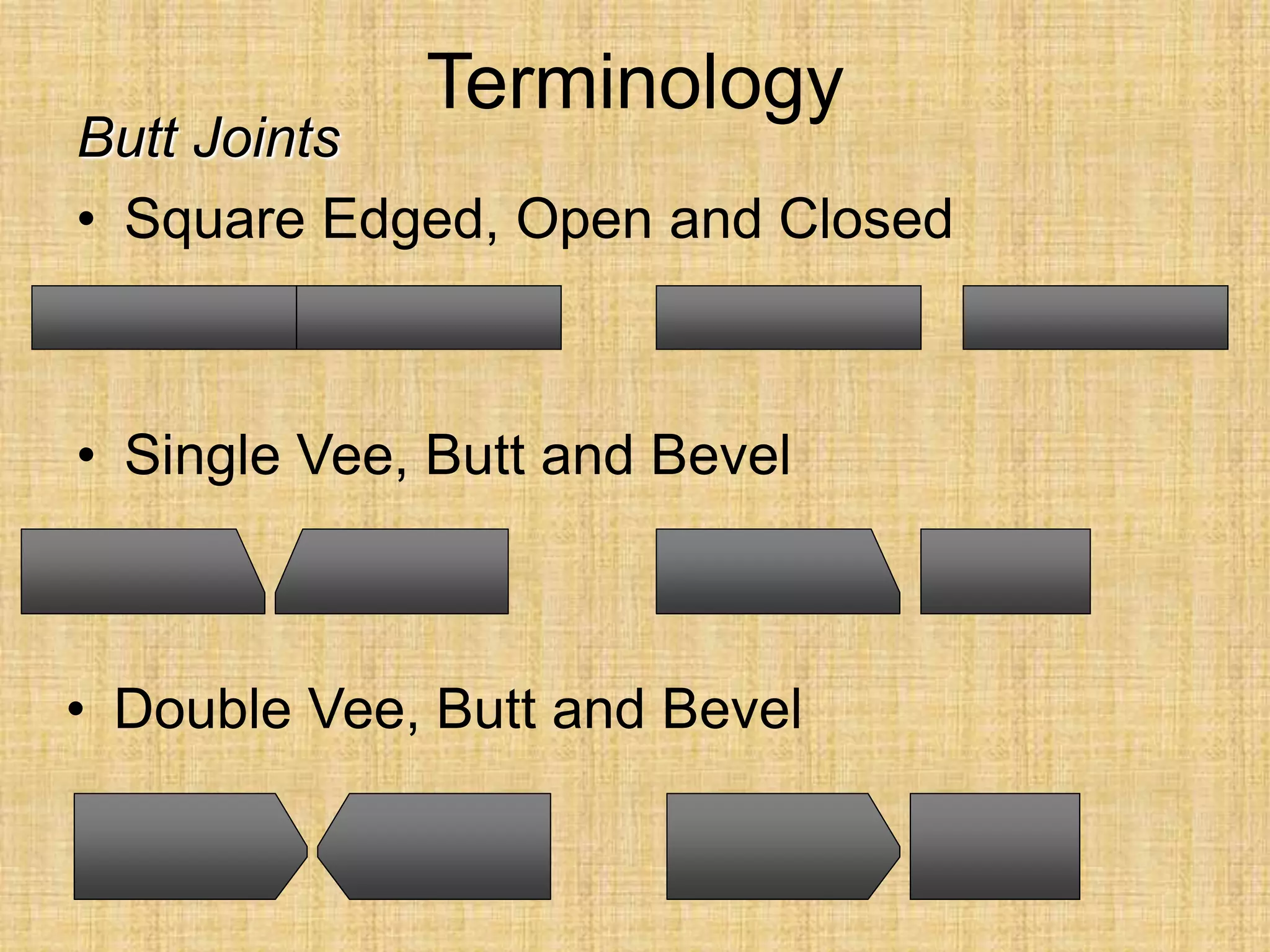
Butt Joints
• Square Edged, Open and Closed
• Single Vee, Butt and Bevel
• Double Vee, Butt and Bevel
Terminology
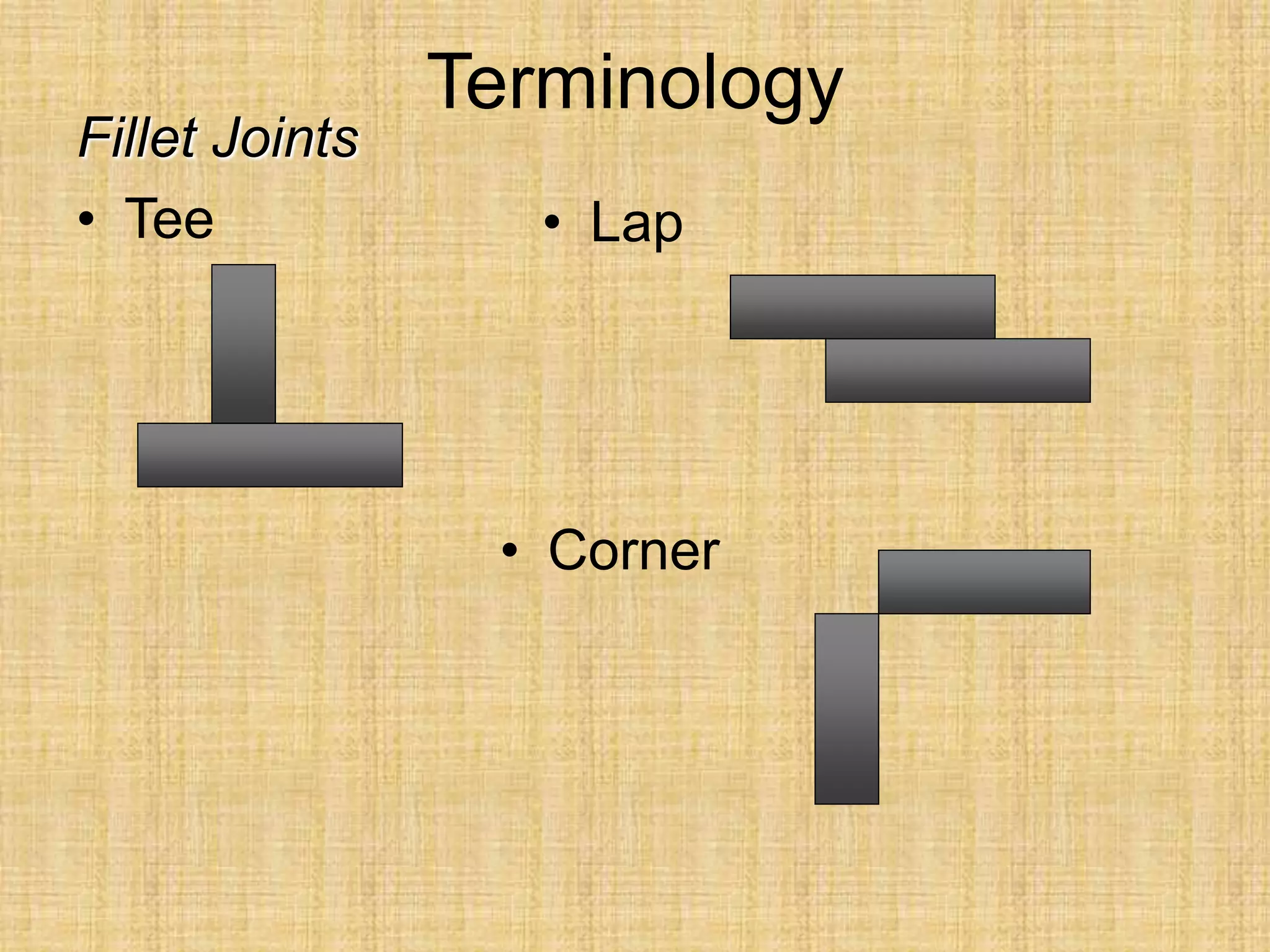
Fillet Joints
• Tee • Lap
• Corner
Terminology
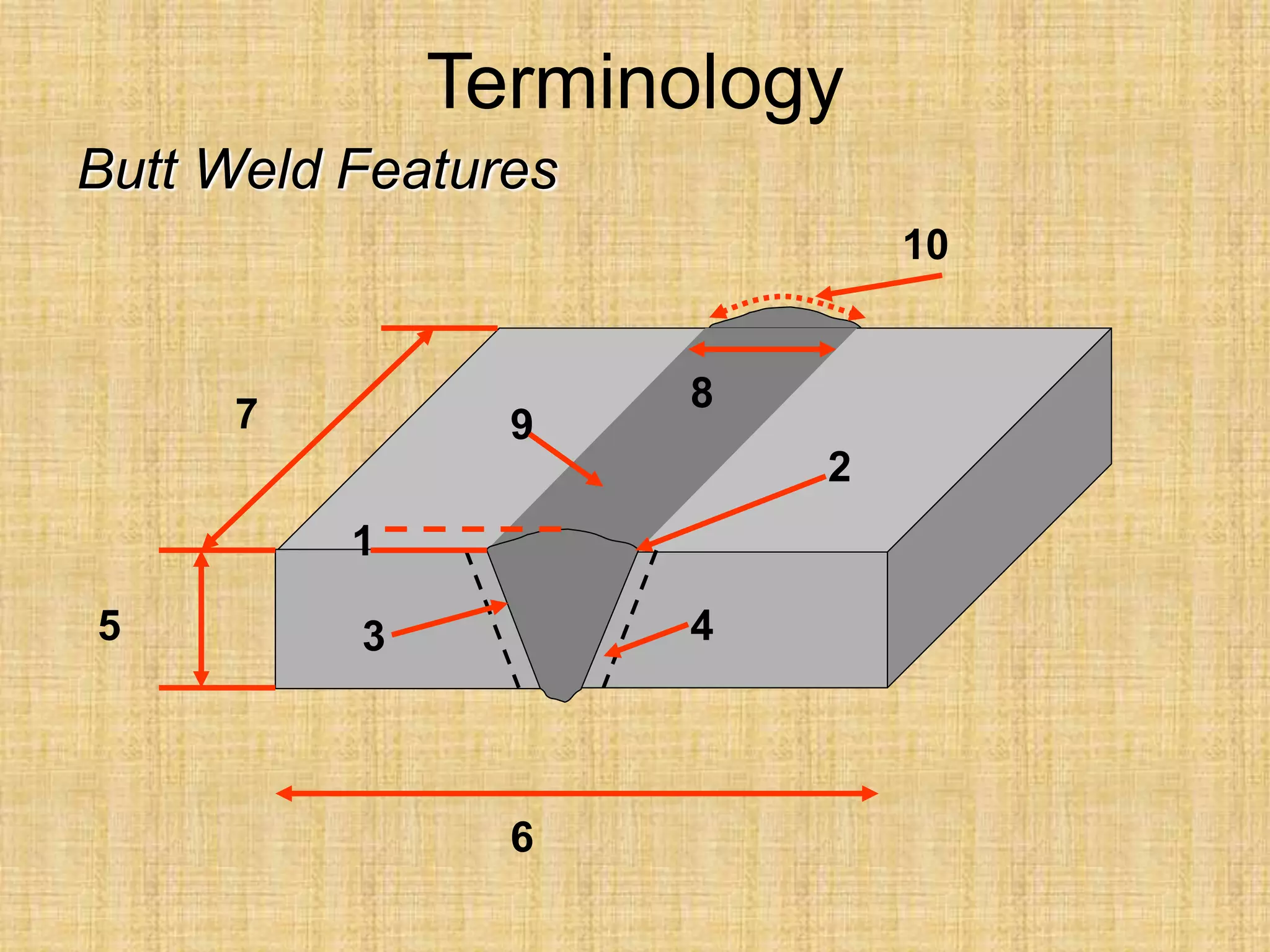
Butt Weld Features
1
2
3 4
5
6
7 8
9
10
Terminology
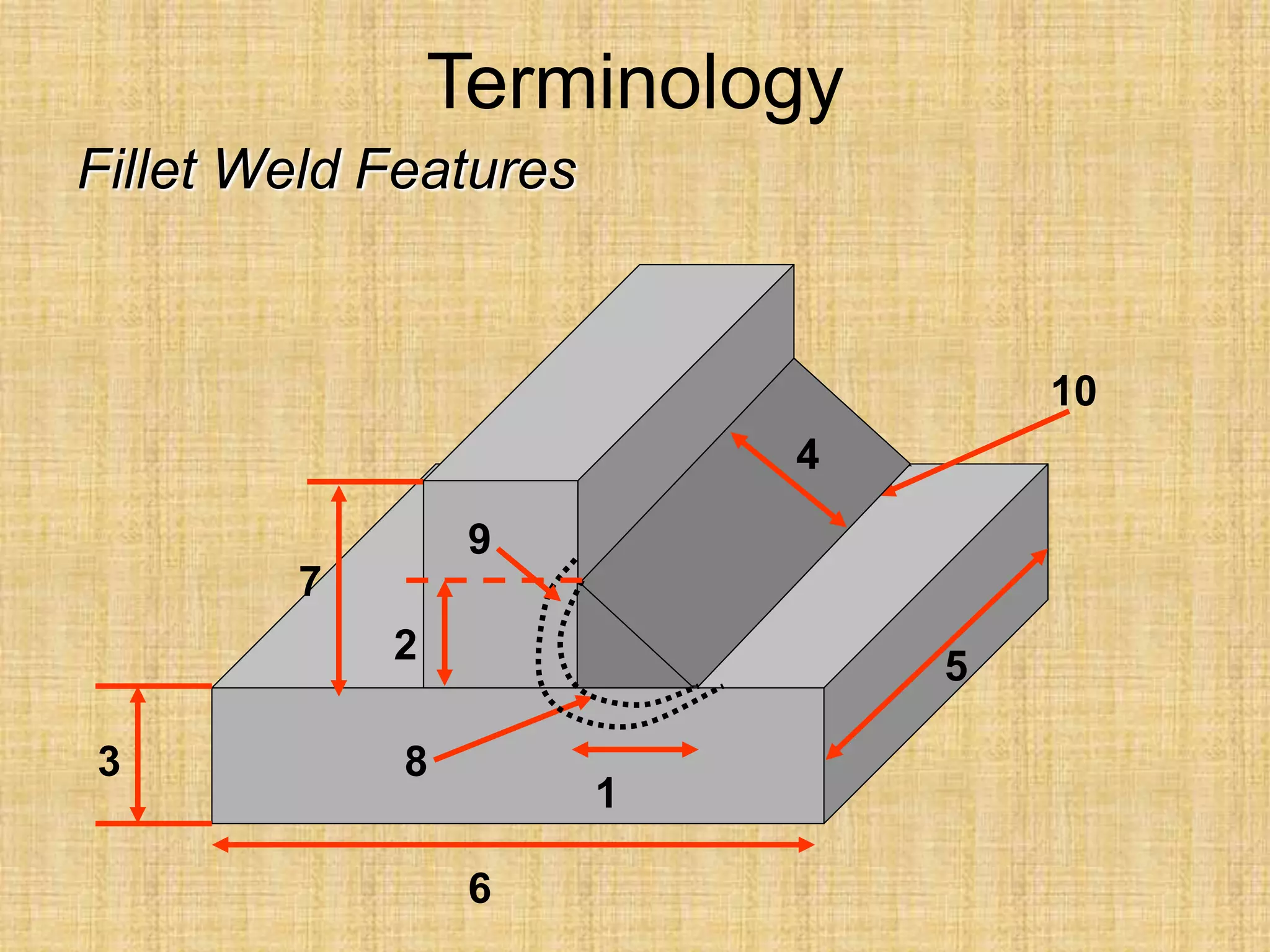
Fillet Weld Features
1
3
5
6
7
8
10
2
9
4
Visual Inspection Procedures
• What is the nature of the product?
• What operating conditions will be
present?
• What is the quality of welding required?
• Is there a code or standard available to
inspect the welds against
Welding Checklist
• Documentation
• Materials
• Weld preparations
• Fit up for welding
• Welding equipment
Before Welding Commences
Welding Checklist
• Correct parameters
• WPS at the work place
• Inter run cleanliness and quality
• Interpass temperature
• Consumable control
• Maintenance of preheat
• Process control NDE regime
• Weld records and maintenance of weld maps
During Welding
Welding Checklist
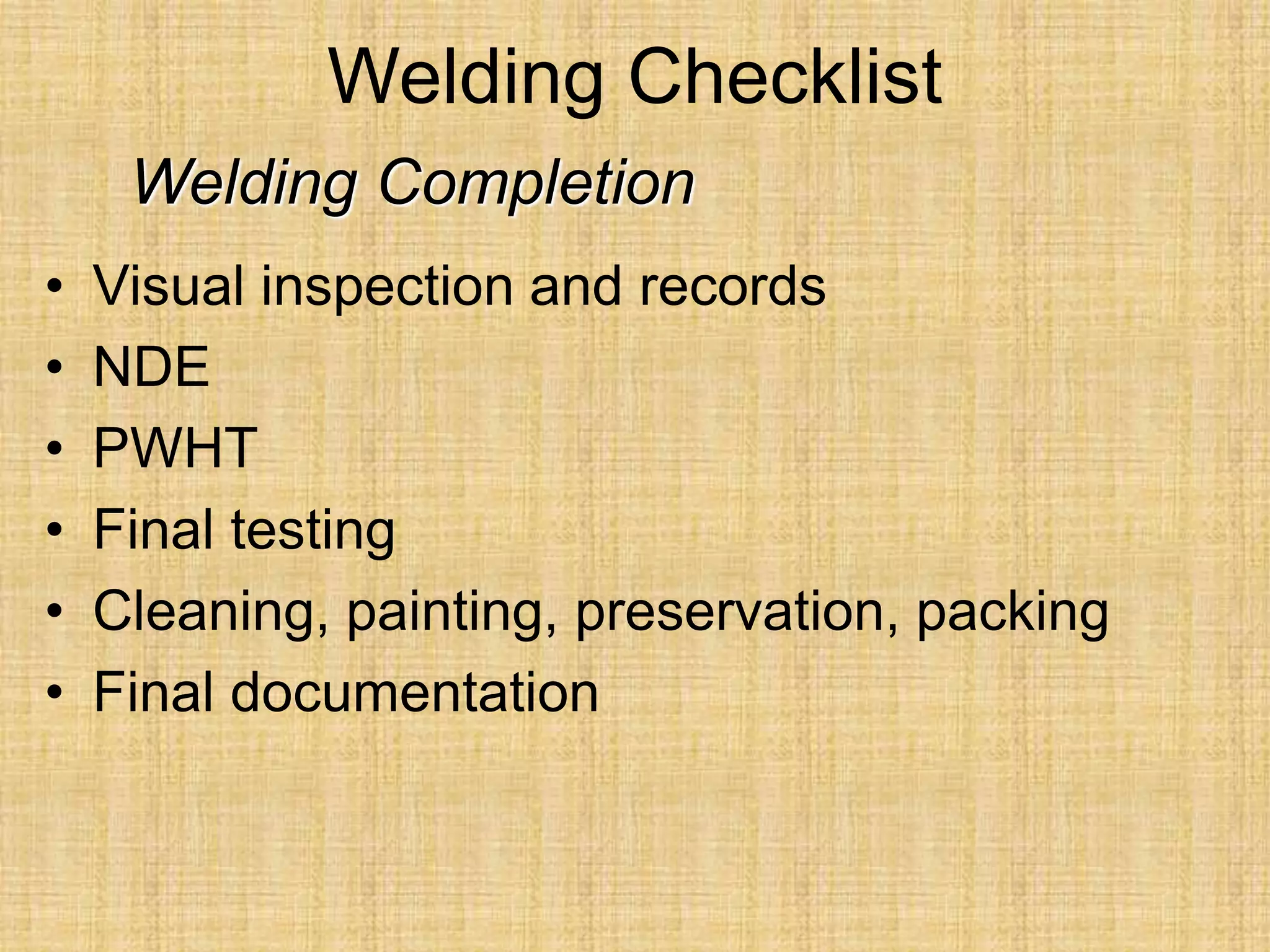
• Visual inspection and records
• NDE
• PWHT
• Final testing
• Cleaning, painting, preservation, packing
• Final documentation
Welding Completion
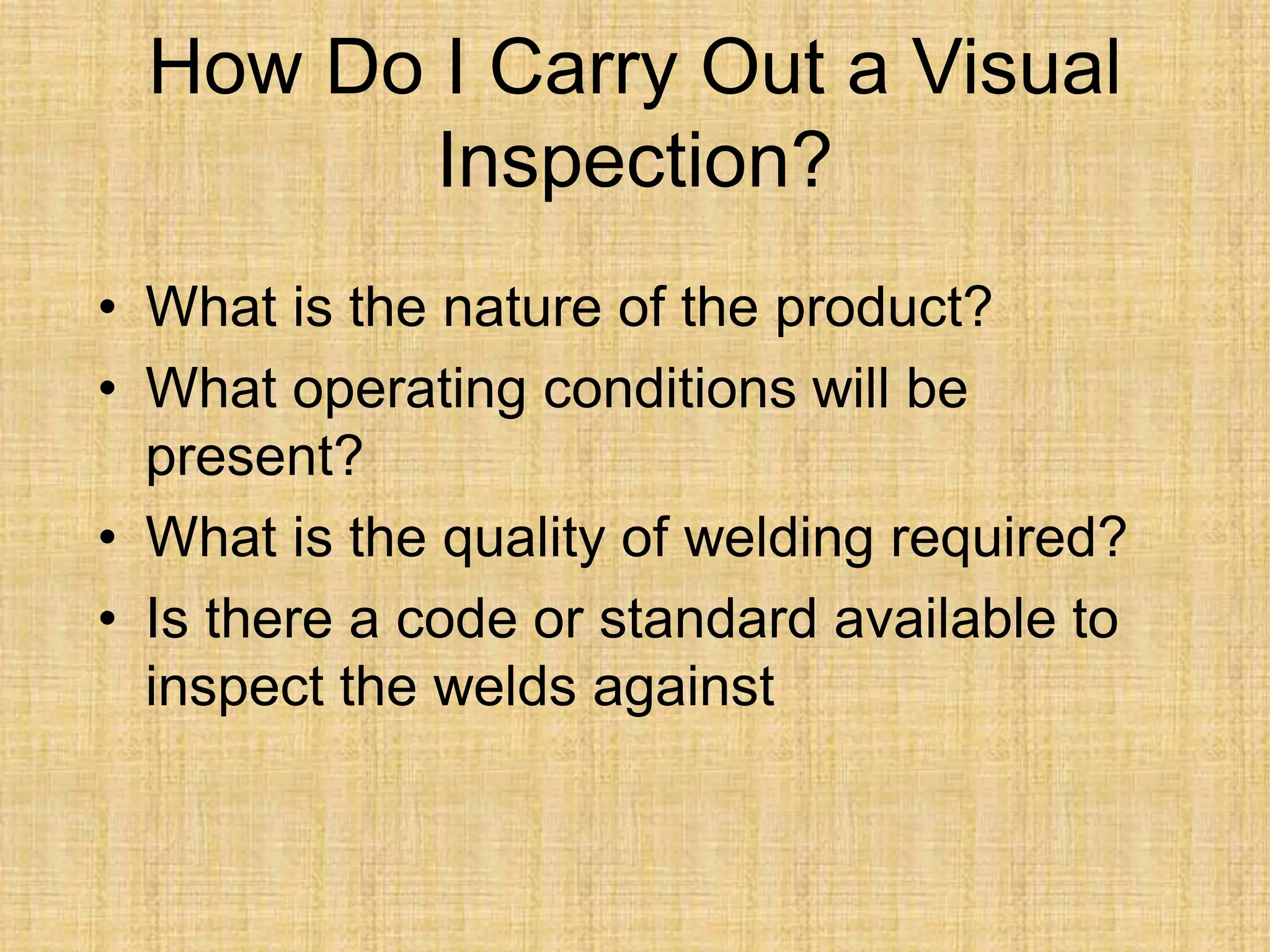
How Do I Carry Out a Visual
Inspection?
• What is the nature of the product?
• What operating conditions will be
present?
• What is the quality of welding required?
• Is there a code or standard available to
inspect the welds against
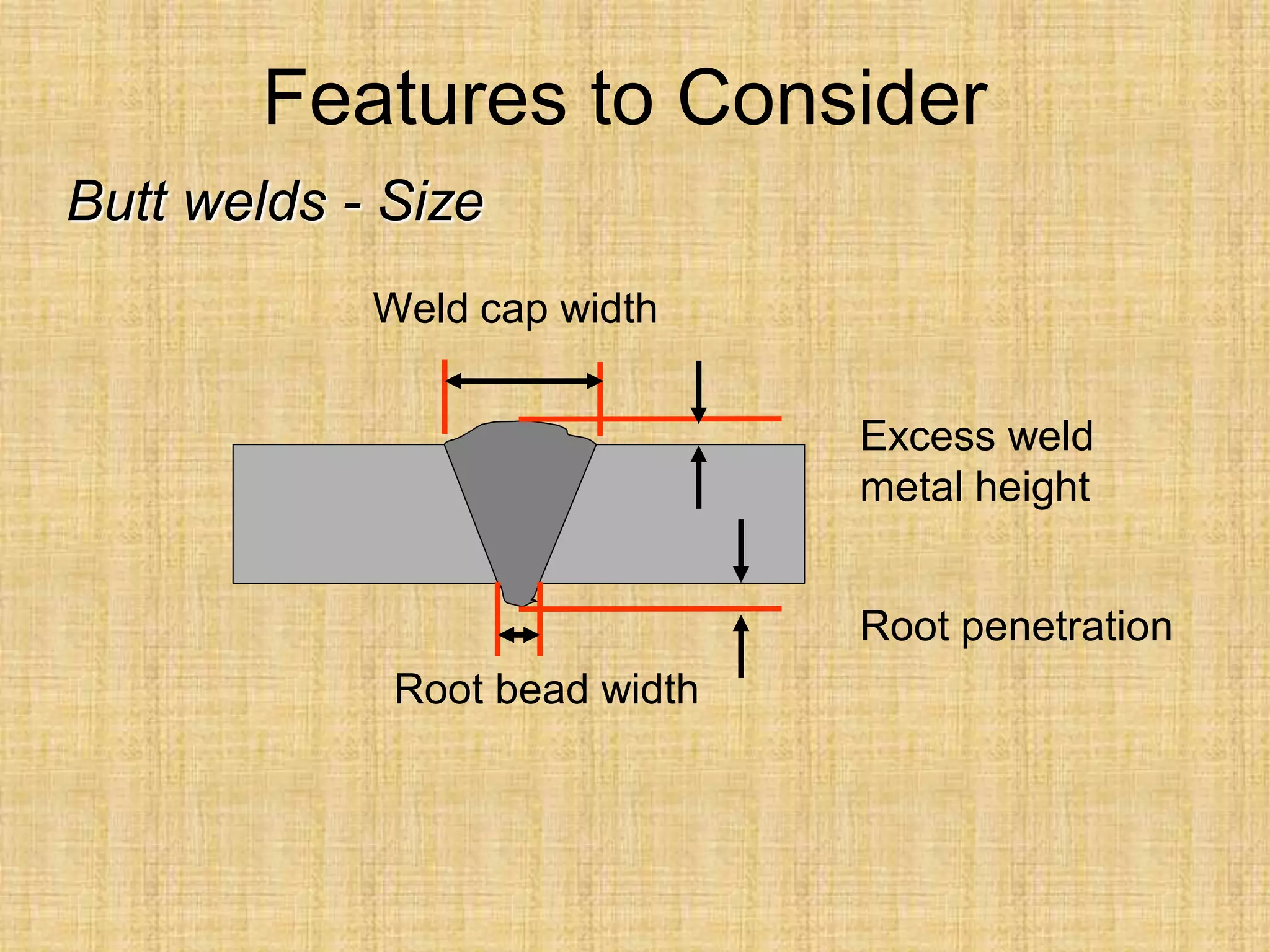
Features to Consider
Butt welds - Size
Excess weld
metal height
Root penetration
Root bead width
Weld cap width
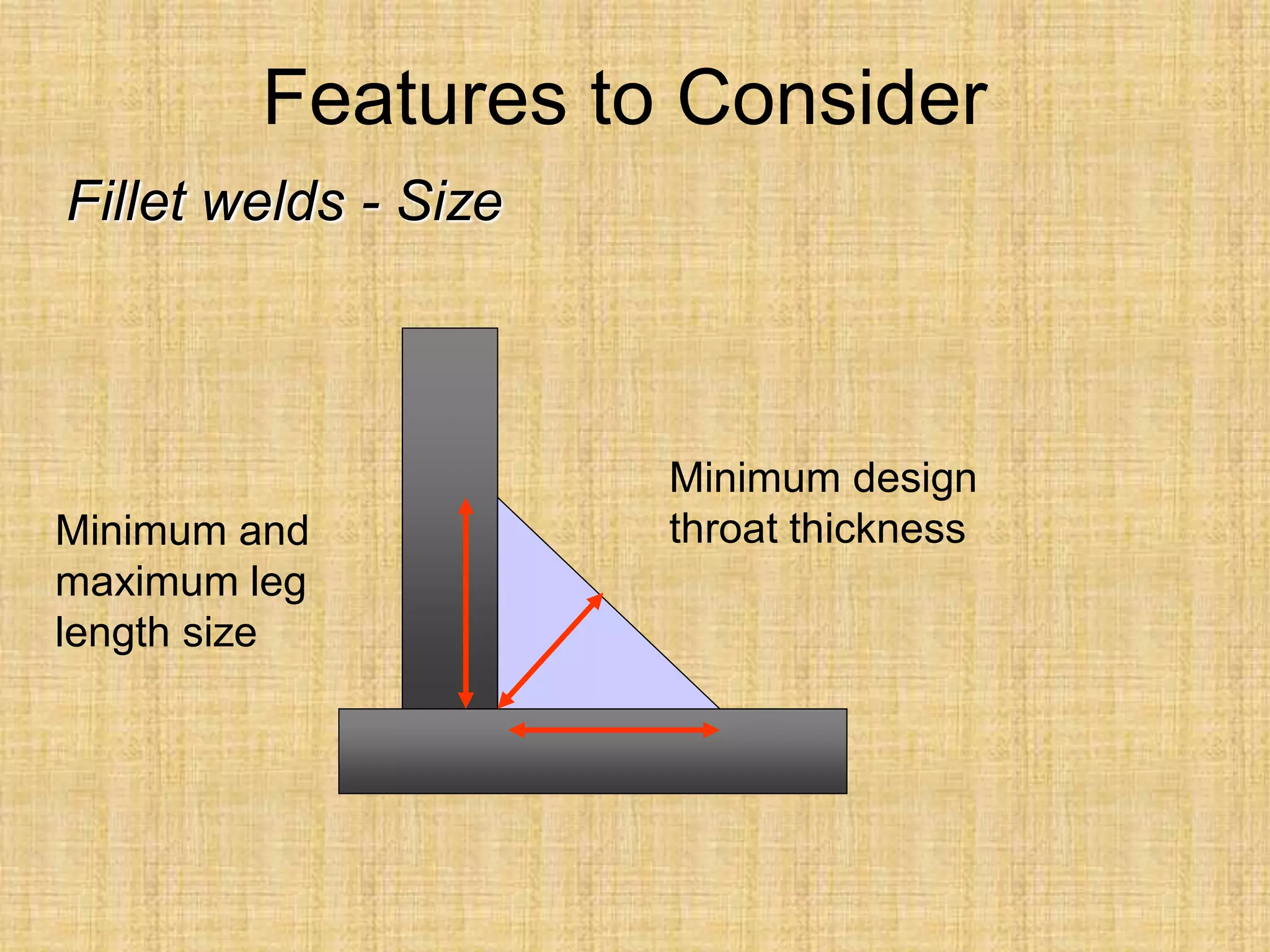
Features to Consider
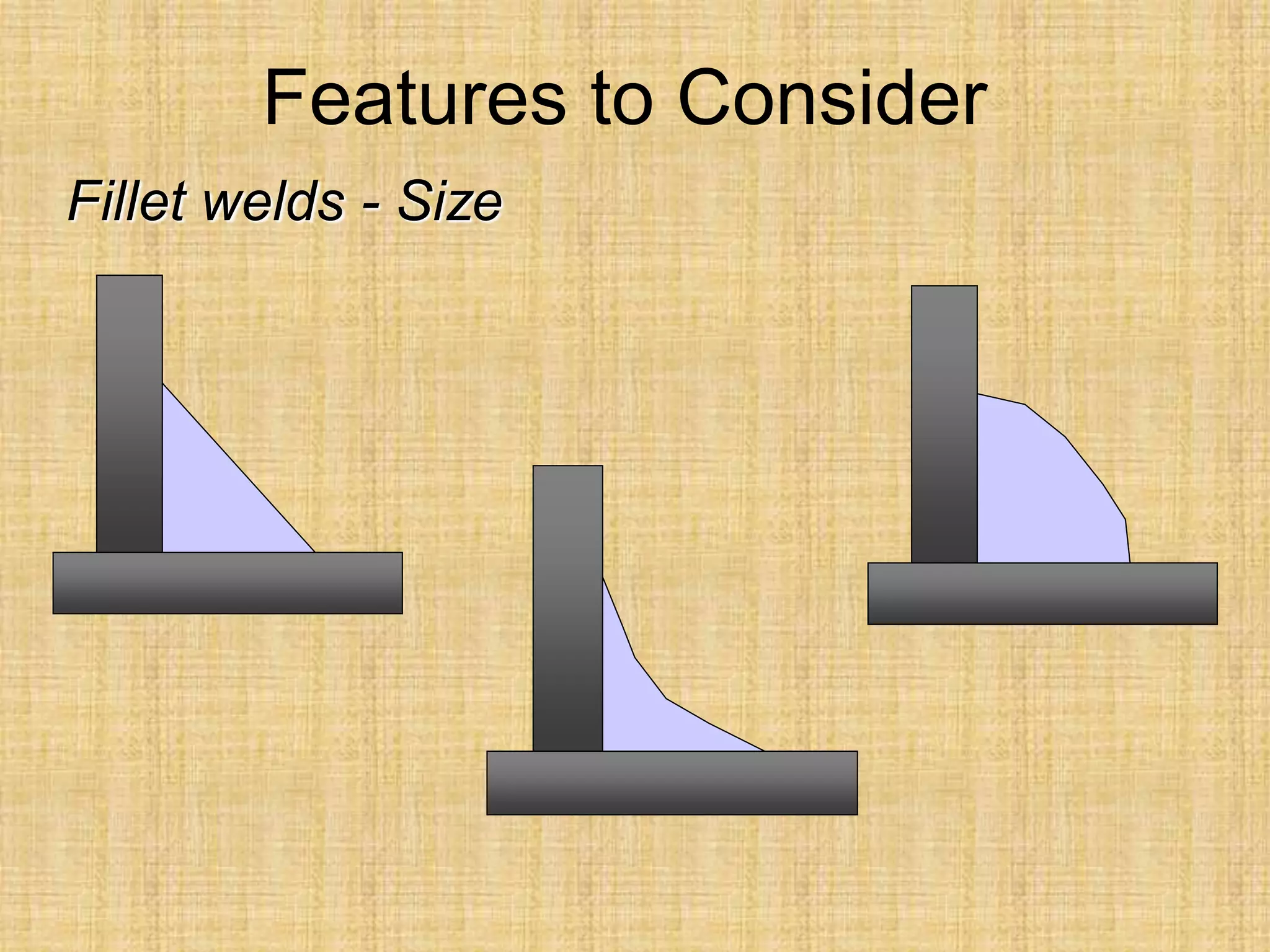
Fillet welds - Size
Minimum and
maximum leg
length size
Minimum design
throat thickness
Features to Consider
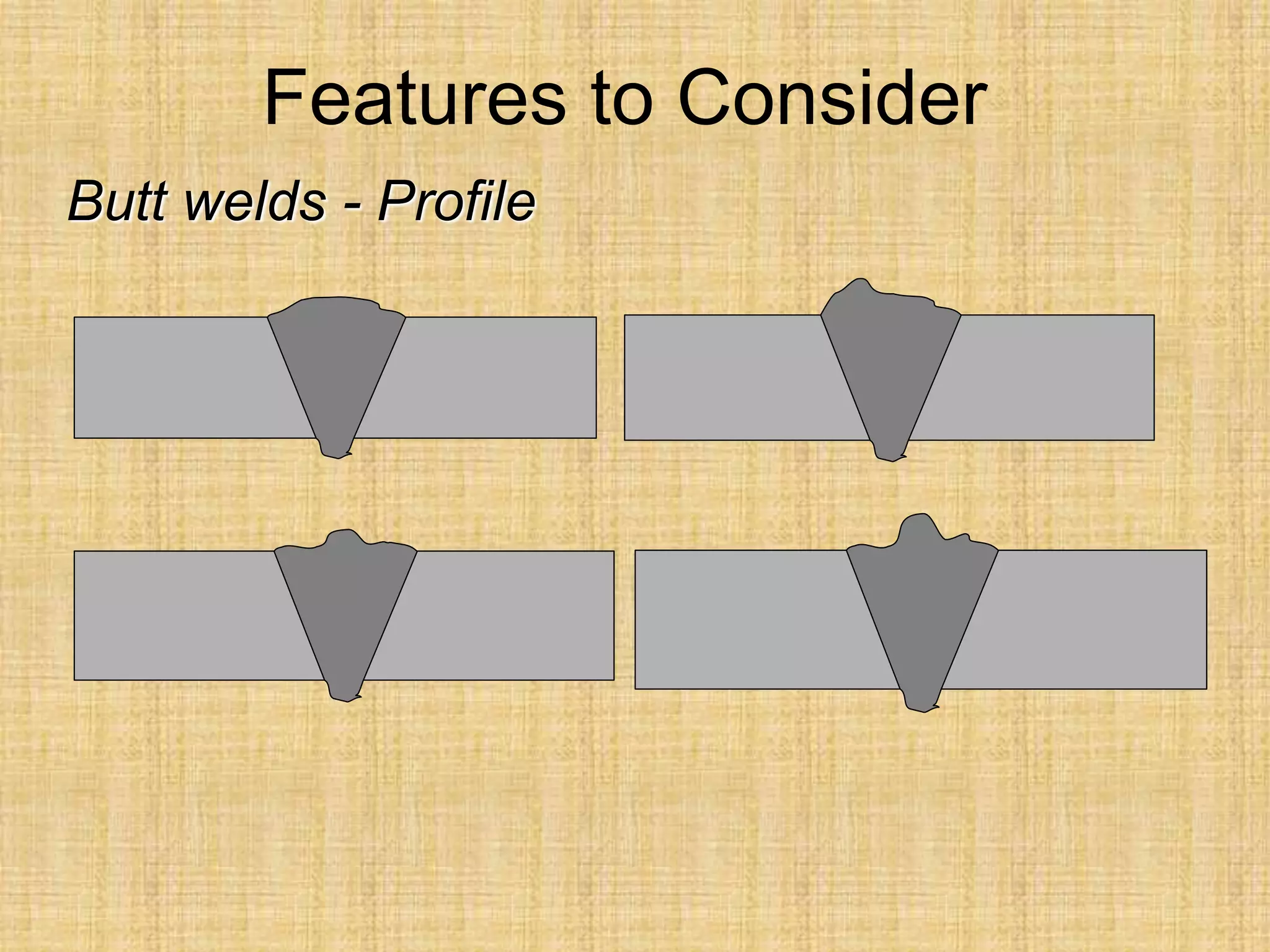
Butt welds - Profile
Features to Consider
Fillet welds - Size
Features to Consider
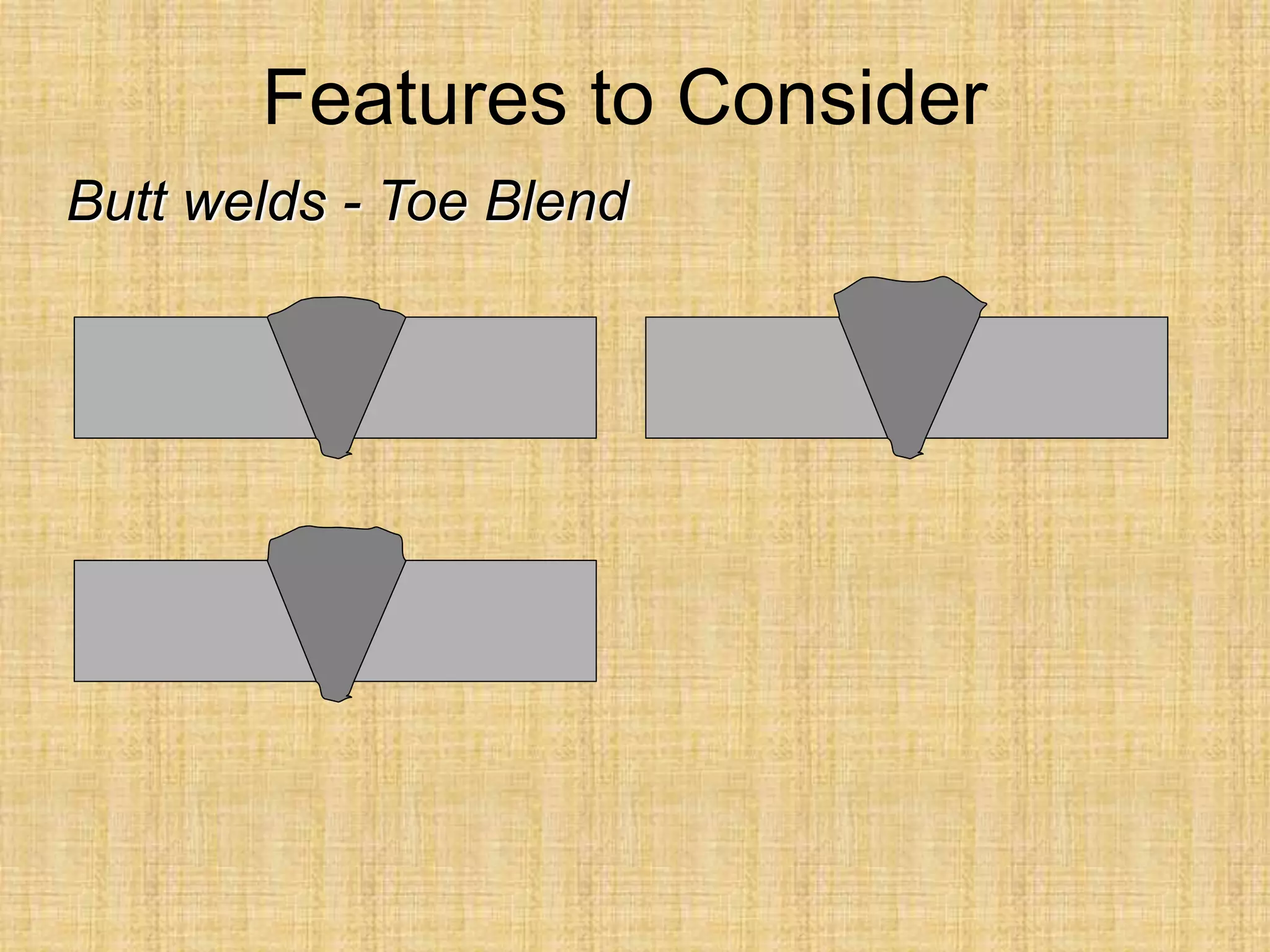
Butt welds - Toe Blend
Features to Consider
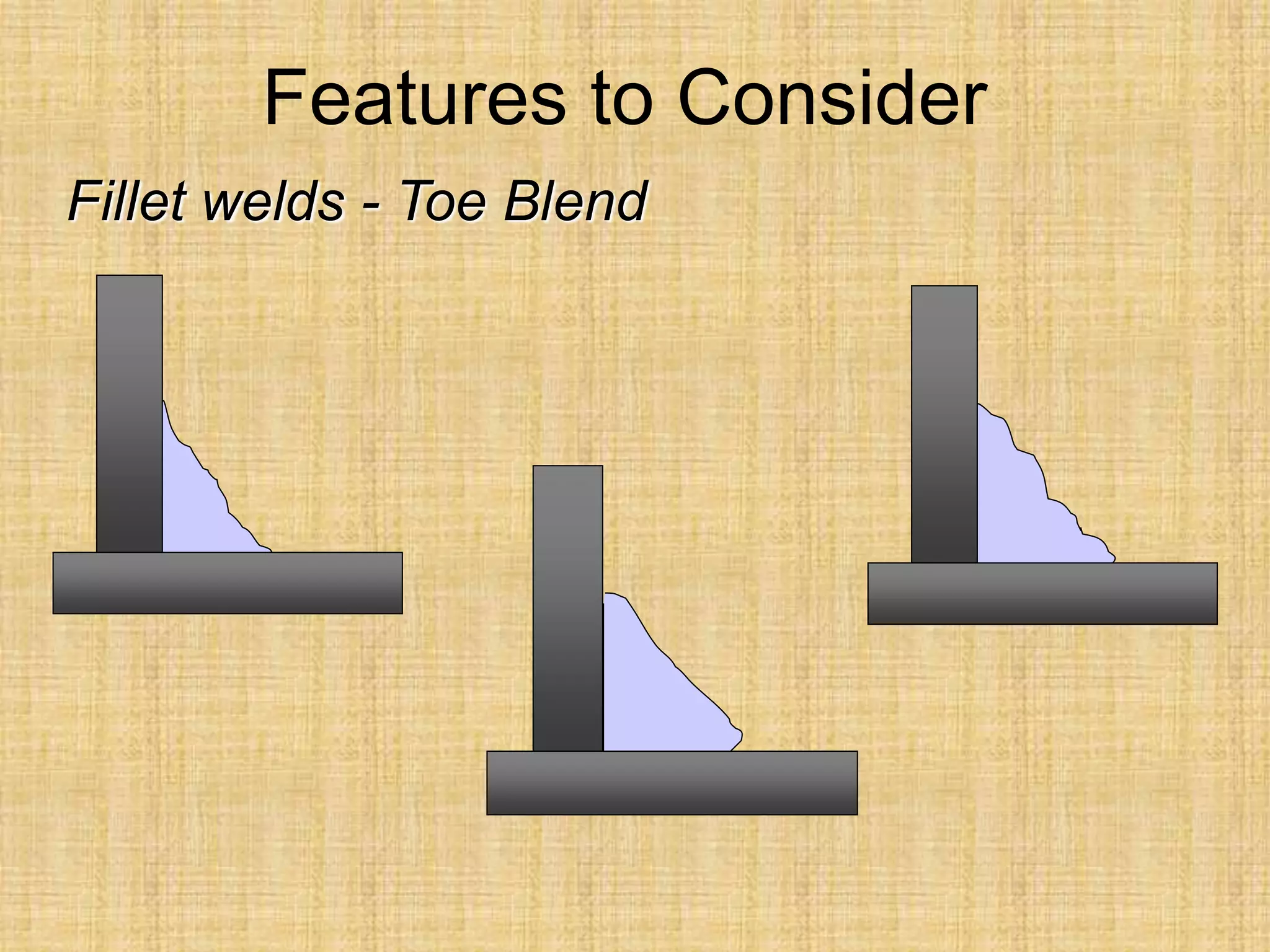
Fillet welds - Toe Blend
Features to Consider
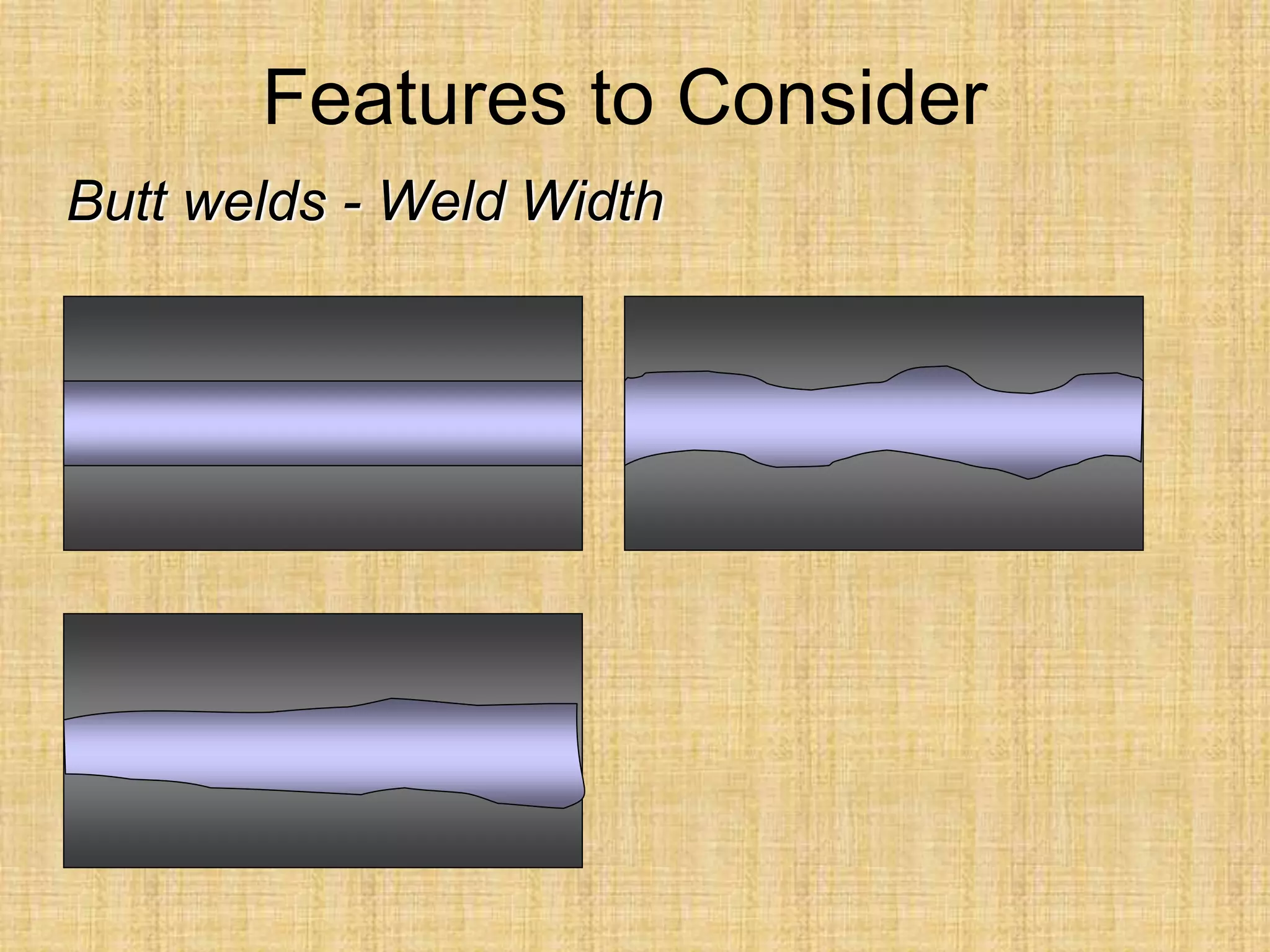
Butt welds - Weld Width
Welding Defects
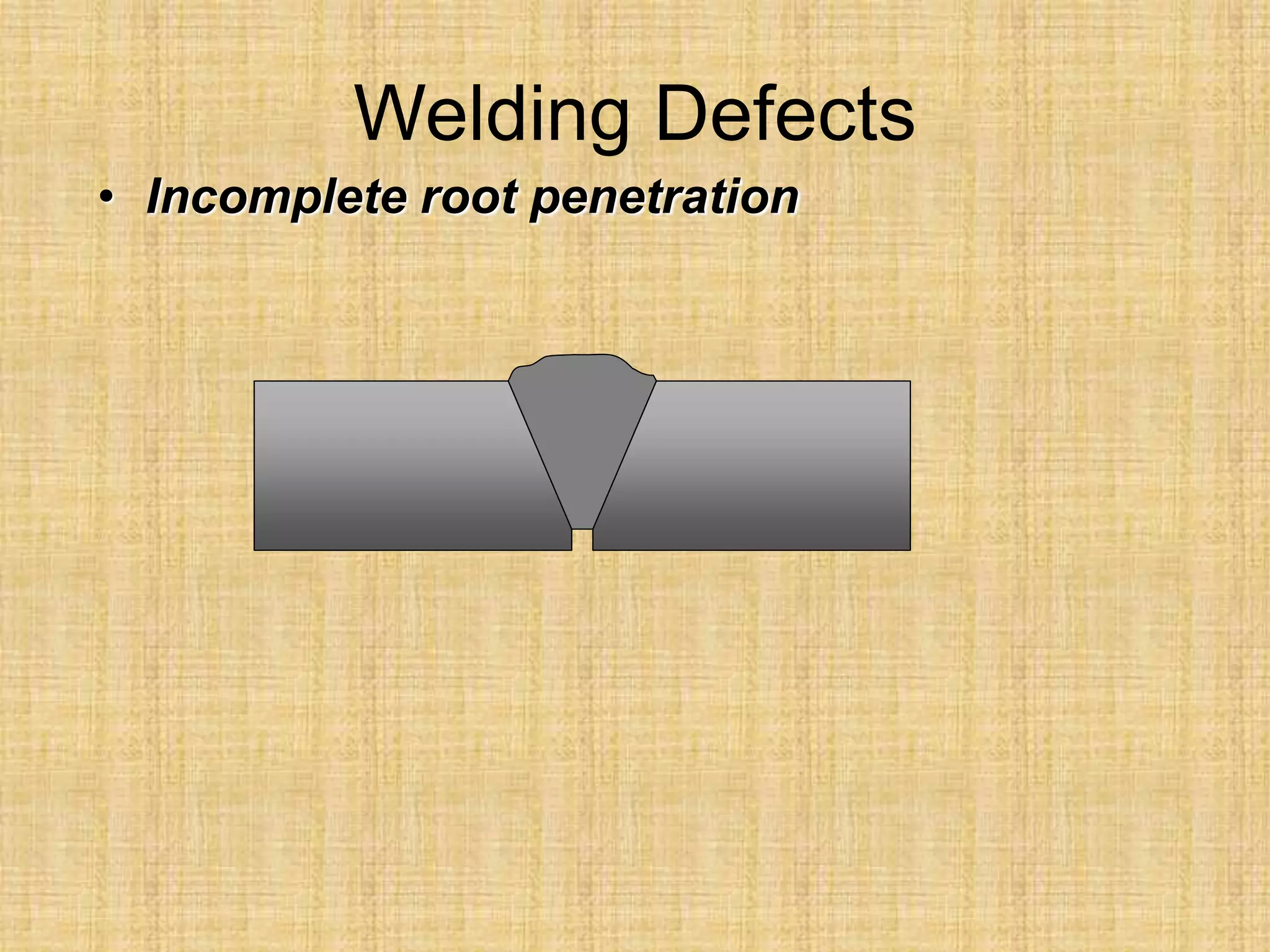
• Incomplete root penetration
Welding Defects
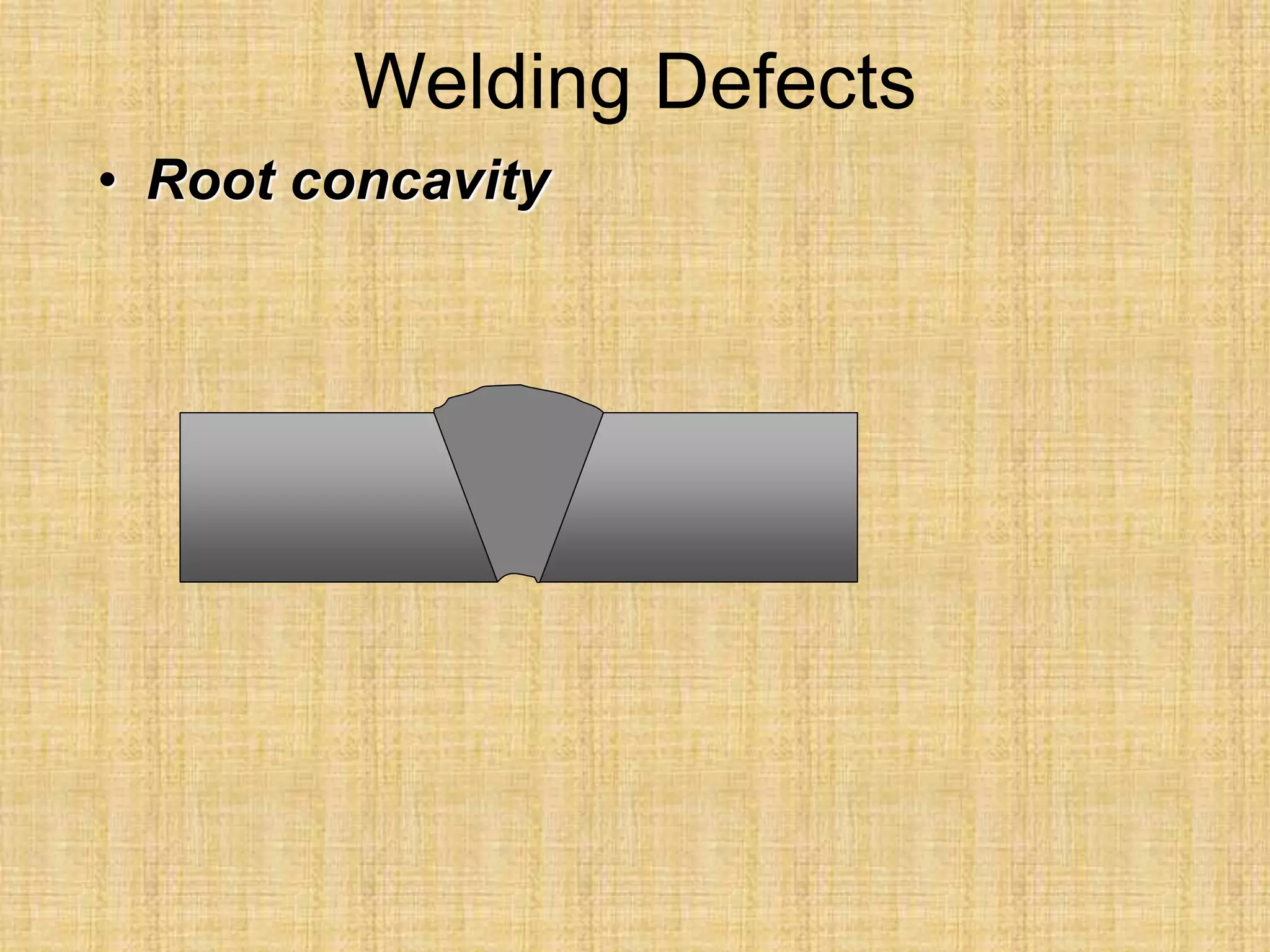
• Root concavity
Welding Defects
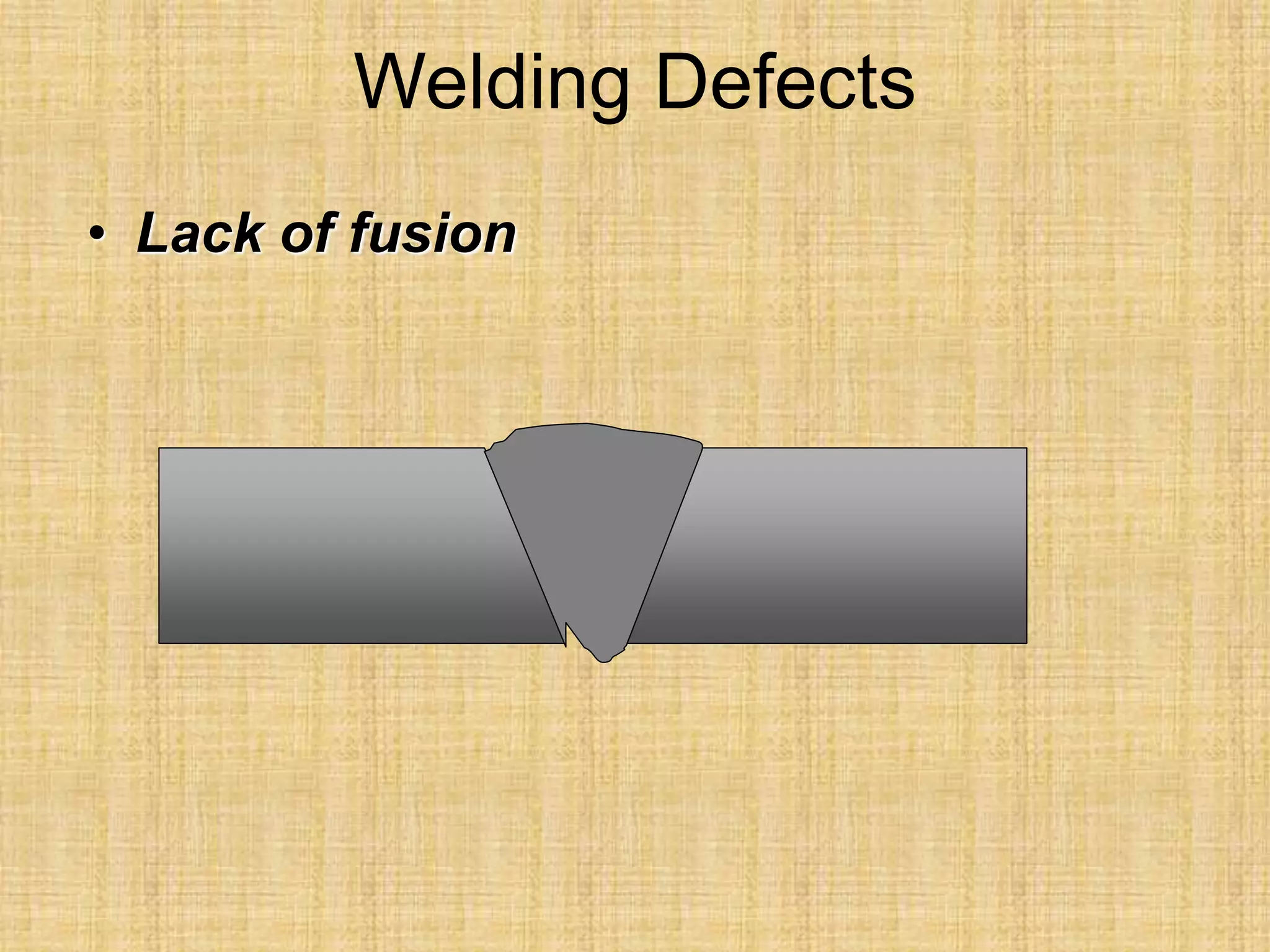
• Lack of fusion
Welding Defects
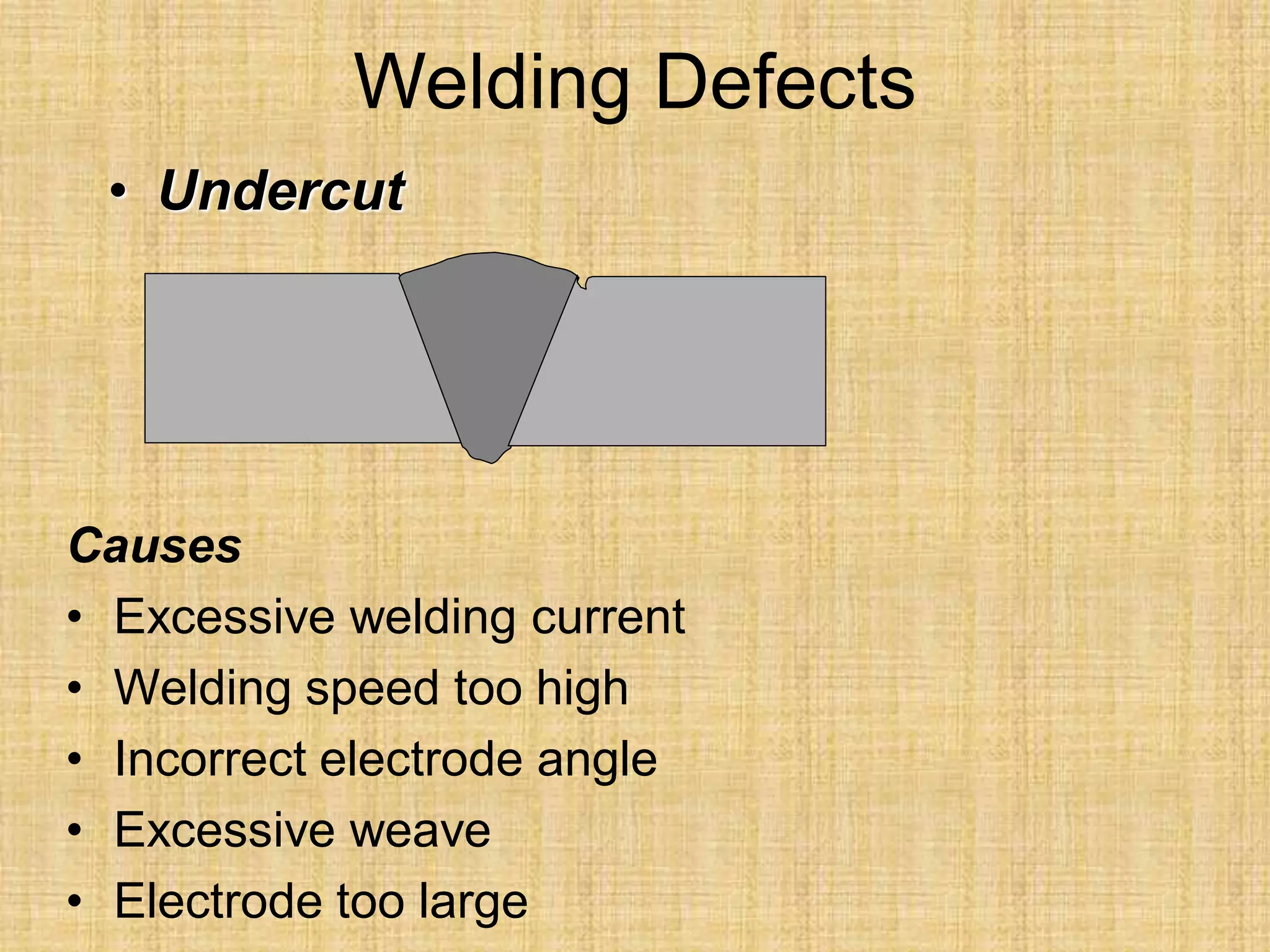
• Undercut
Causes
• Excessive welding current
• Welding speed too high
• Incorrect electrode angle
• Excessive weave
• Electrode too large
Welding Defects
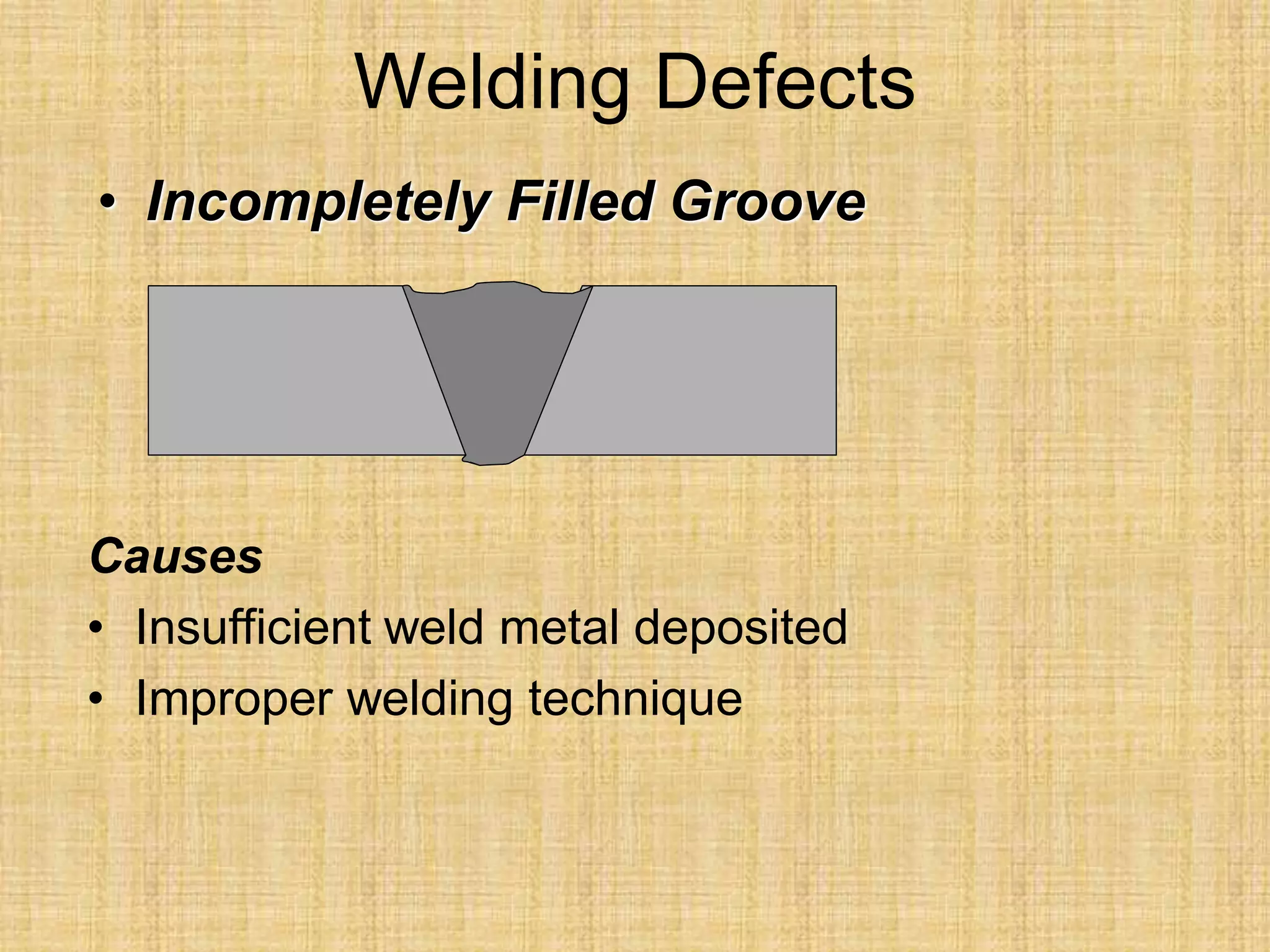
• Incompletely Filled Groove
Causes
• Insufficient weld metal deposited
• Improper welding technique
Welding Defects
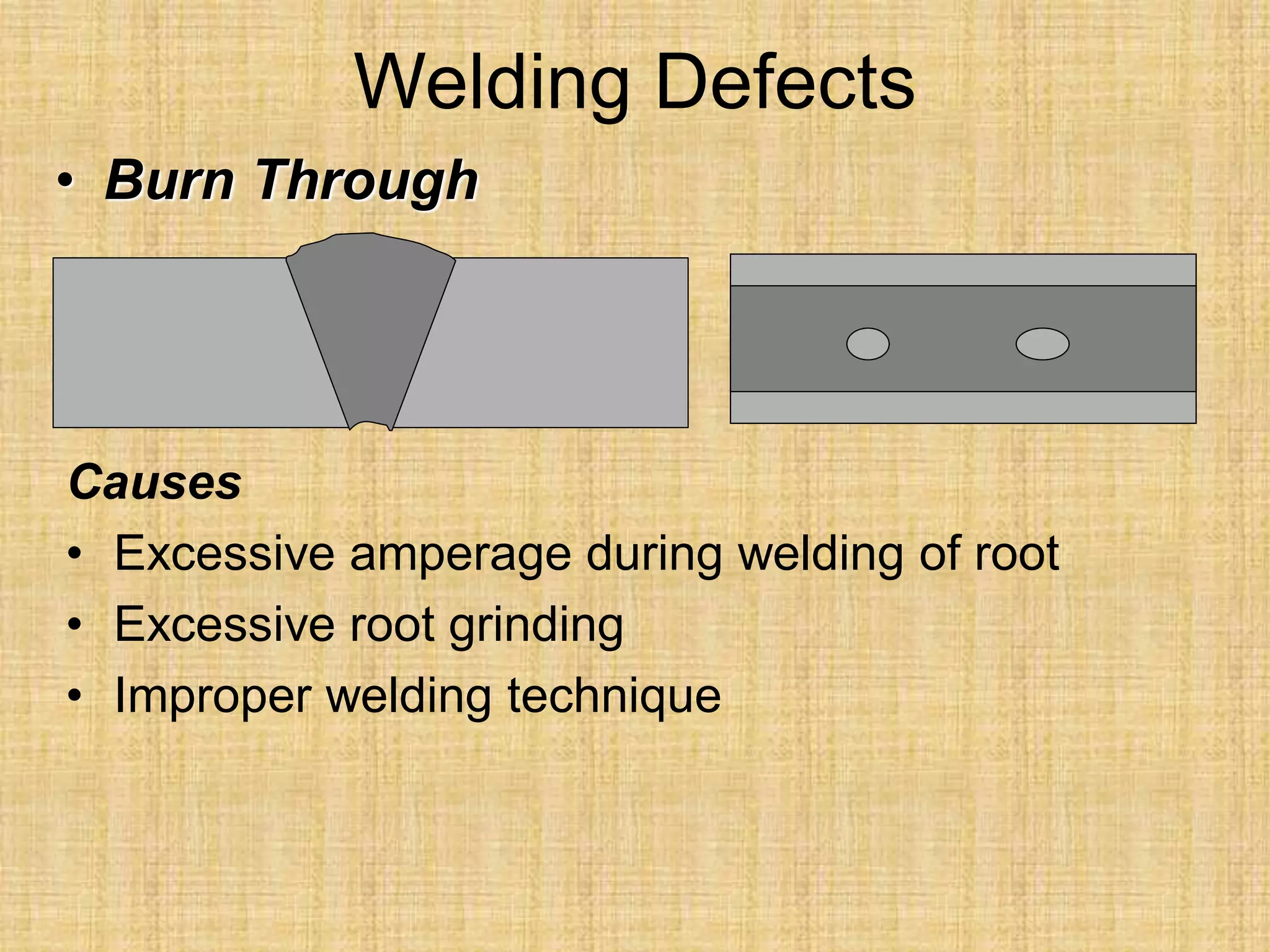
• Burn Through
Causes
• Excessive amperage during welding of root
• Excessive root grinding
• Improper welding technique
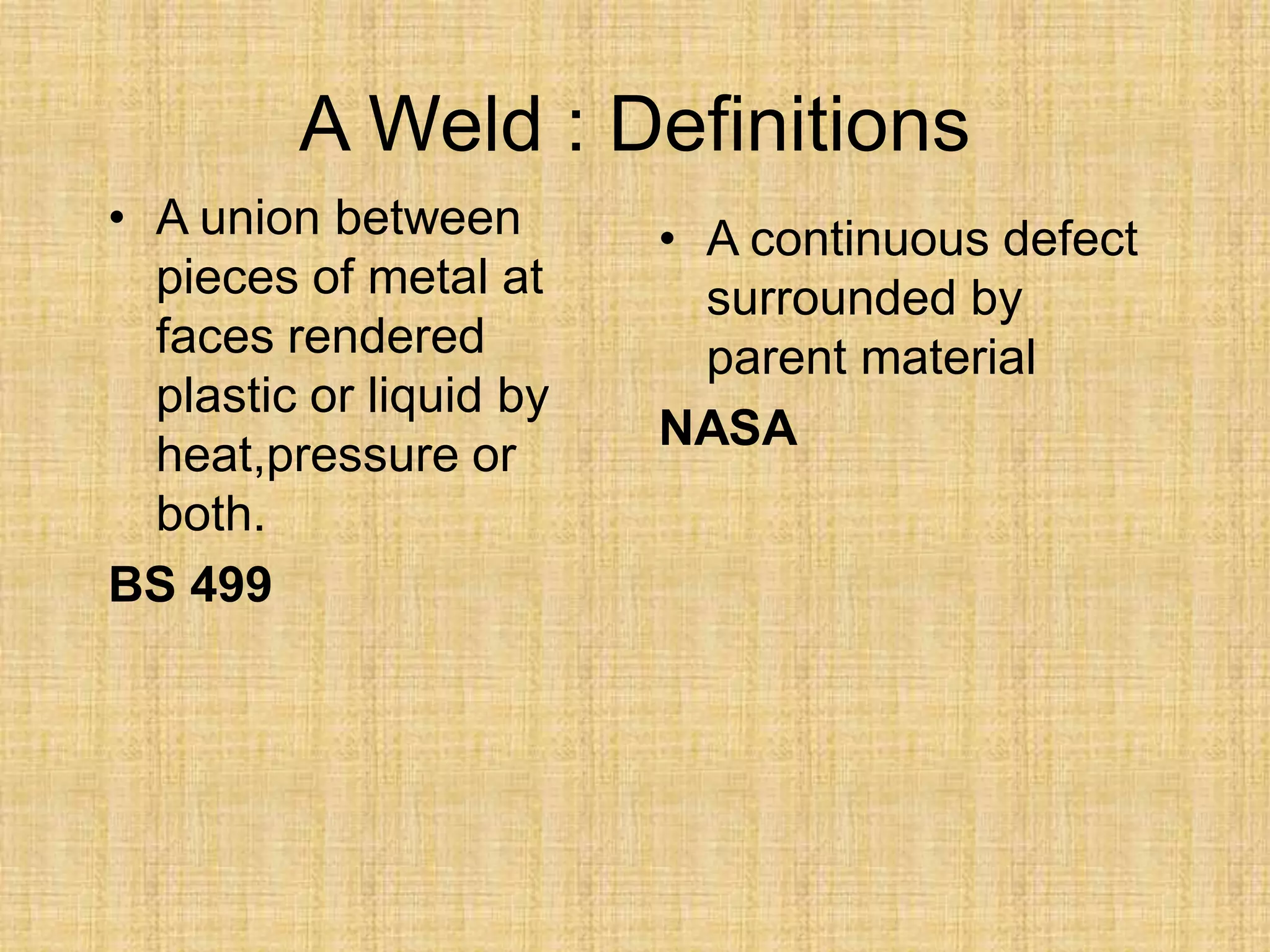
A Weld : Definitions
• A union between
pieces of metal at
faces rendered
plastic or liquid by
heat,pressure or
both.
BS 499
• A continuous defect
surrounded by
parent material
NASA
Welds
• An ideal weld must give a strong bond
between materials with the interfaces
disappearing
To achieve this
• Smooth,flat or matching surfaces
• Surfaces shall be free from contaminants
• Metals shall be free from impurities
• Metals shall have identical crystalline
structures
Welding
• A union between pieces of metal at faces
rendered plastic or liquid by heat,pressure or
both.
BS 499
• Ultrasonics
• Electron beam
• Friction
• Electric resistance
• Electric arc
Possible energy sources
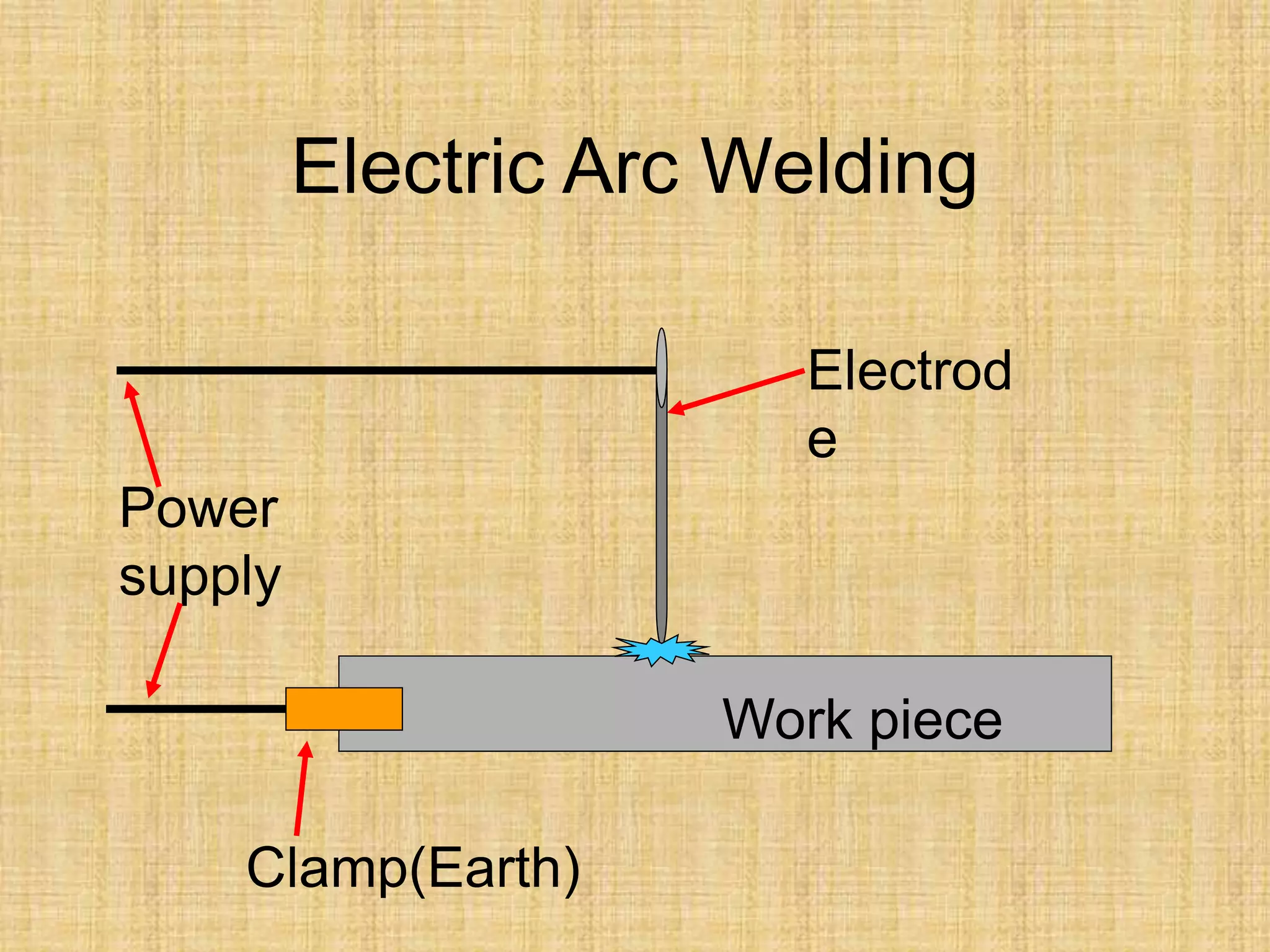
Electric Arc Welding
Power
supply
Work piece
Electrod
e
Clamp(Earth)
Electric Arc Welding
• Electric discharge produced between cathode and
anode by a potential difference (40 to 60 volts)
• Discharge ionises air and produces -ve electrons and
+ve ions
• Electrons impact upon anode, ions upon cathode
• Impact of particles converts kinetic energy to heat
(7000o C) and light
• Amperage controls number of ions and electrons,
Voltage controls their velocity
Electric Arc Welding
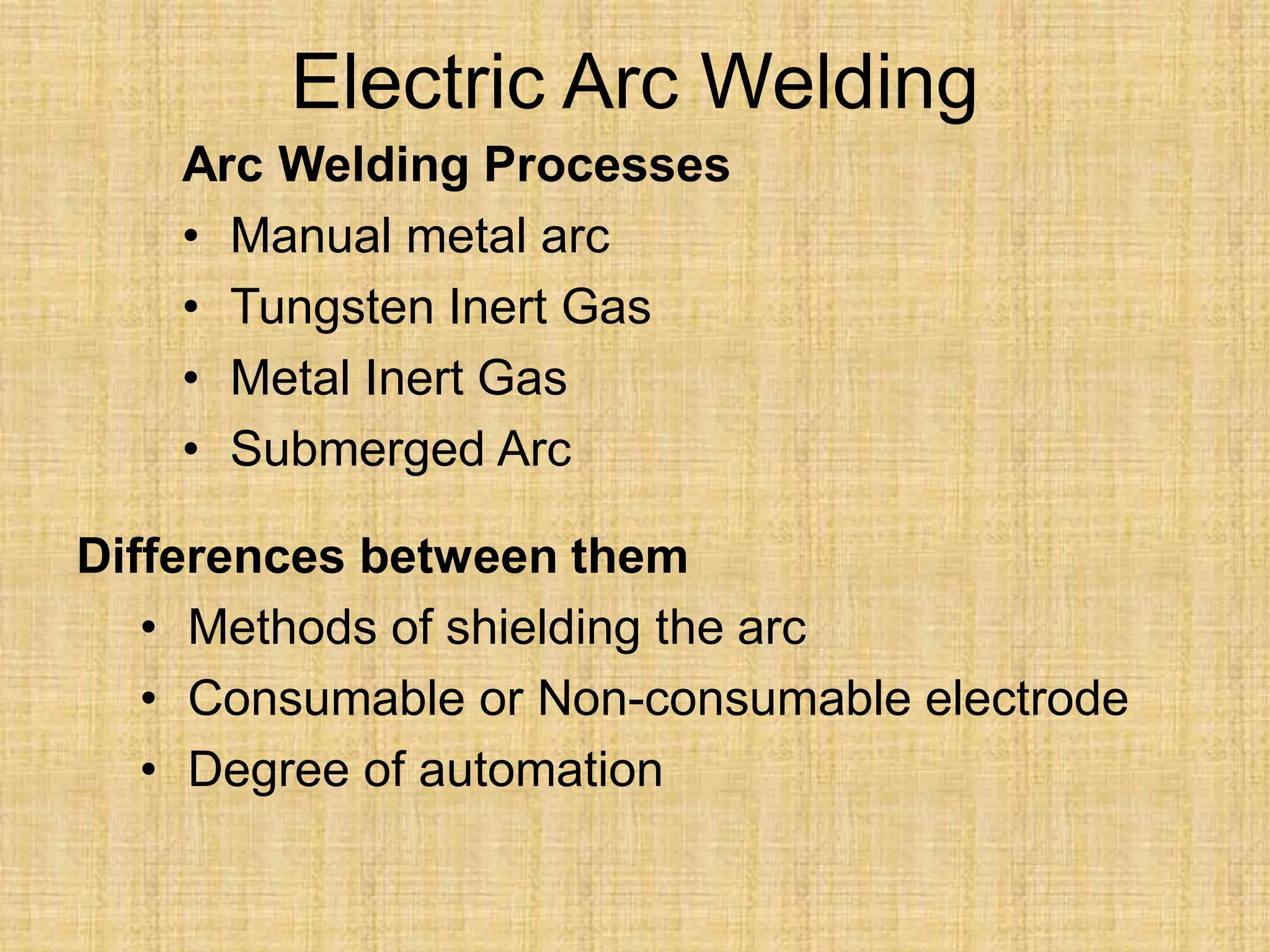
Arc Welding Processes
• Manual metal arc
• Tungsten Inert Gas
• Metal Inert Gas
• Submerged Arc
Differences between them
• Methods of shielding the arc
• Consumable or Non-consumable electrode
• Degree of automation
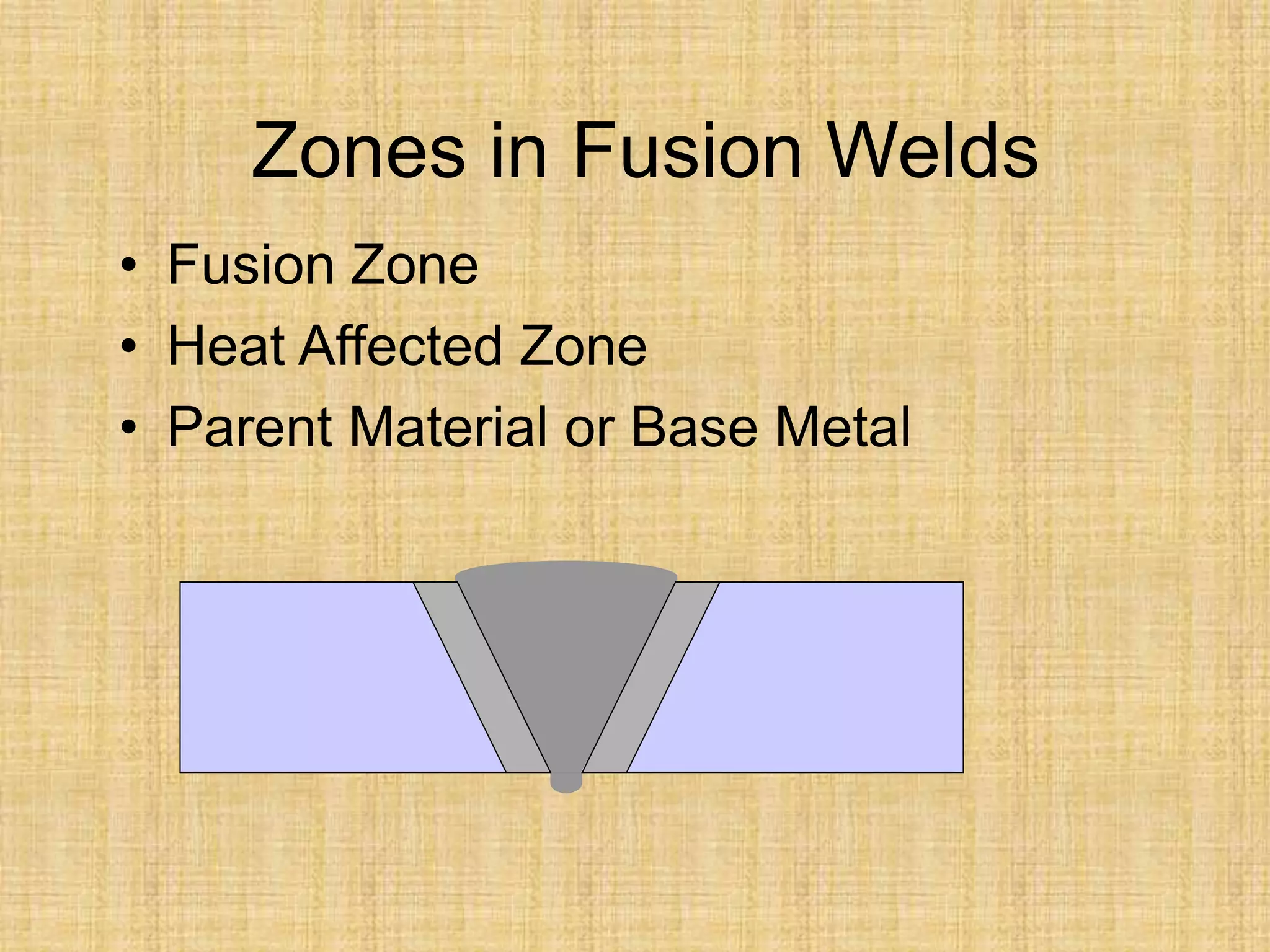
Zones in Fusion Welds
• Fusion Zone
• Heat Affected Zone
• Parent Material or Base Metal
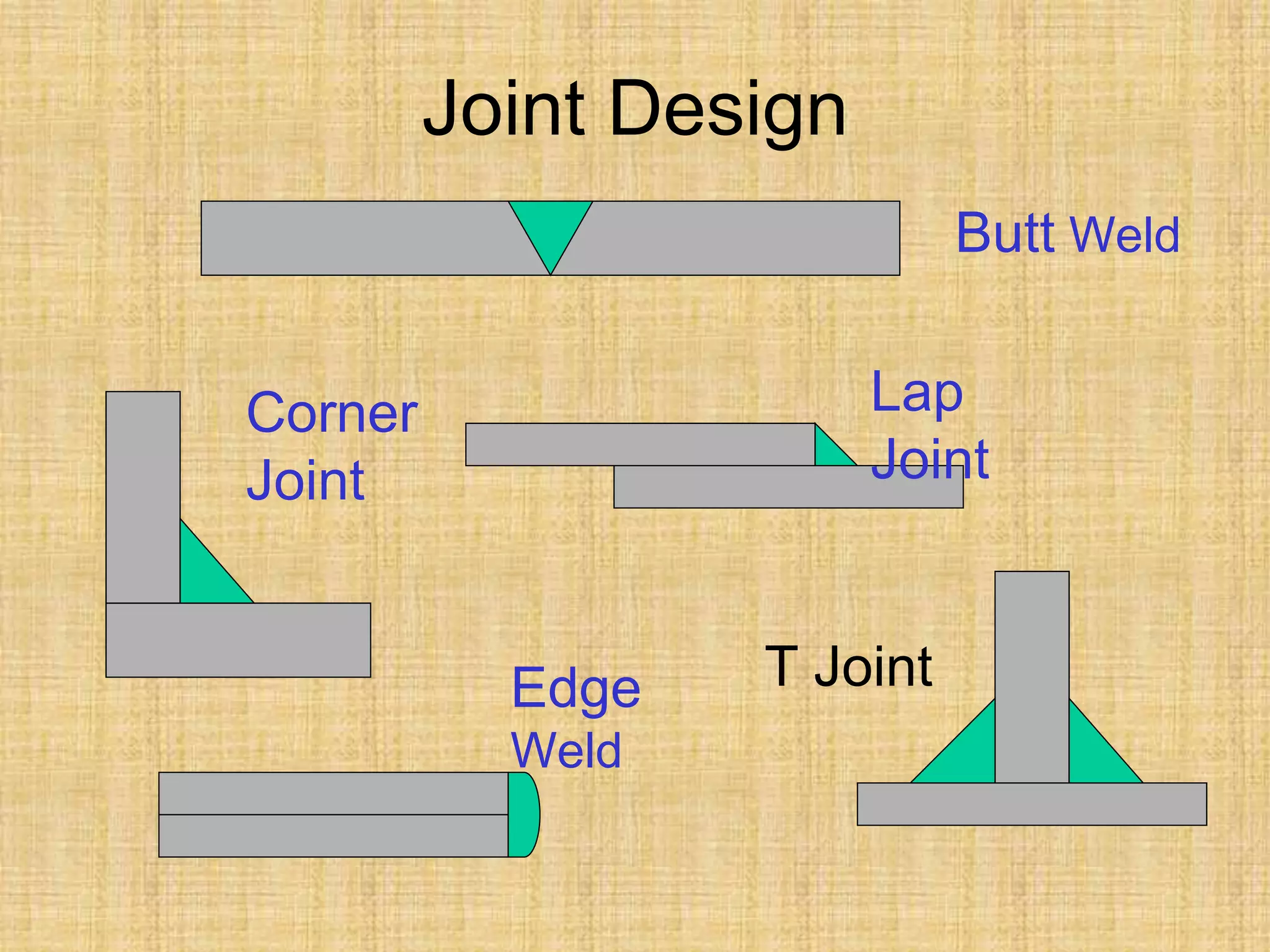
Joint Design
Butt Weld
Corner
Joint
Lap
Joint
T Joint
Edge
Weld
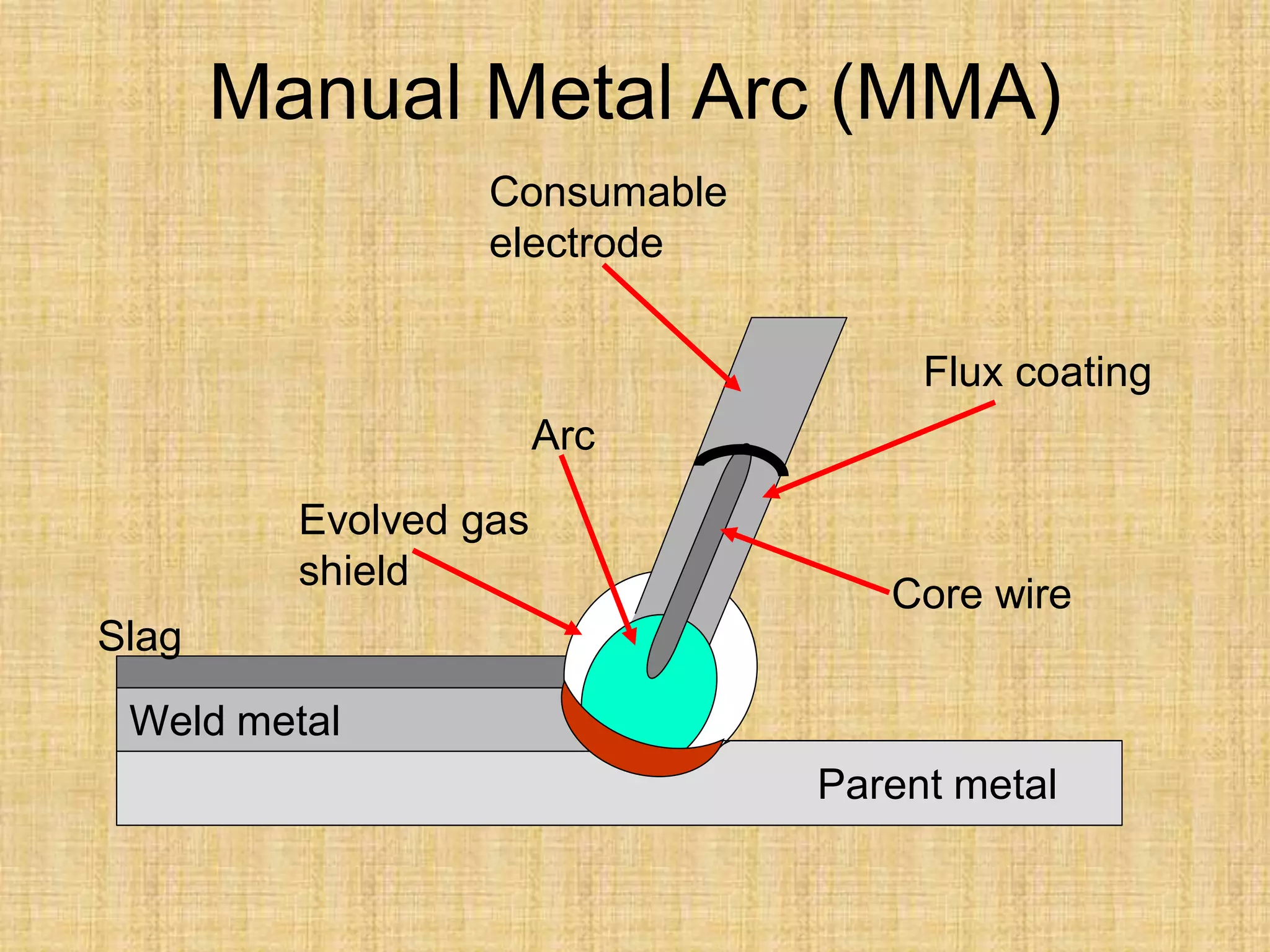
Manual Metal Arc (MMA)
Consumable
electrode
Flux coating
Core wire
Arc
Evolved gas
shield
Parent metal
Slag
Weld metal
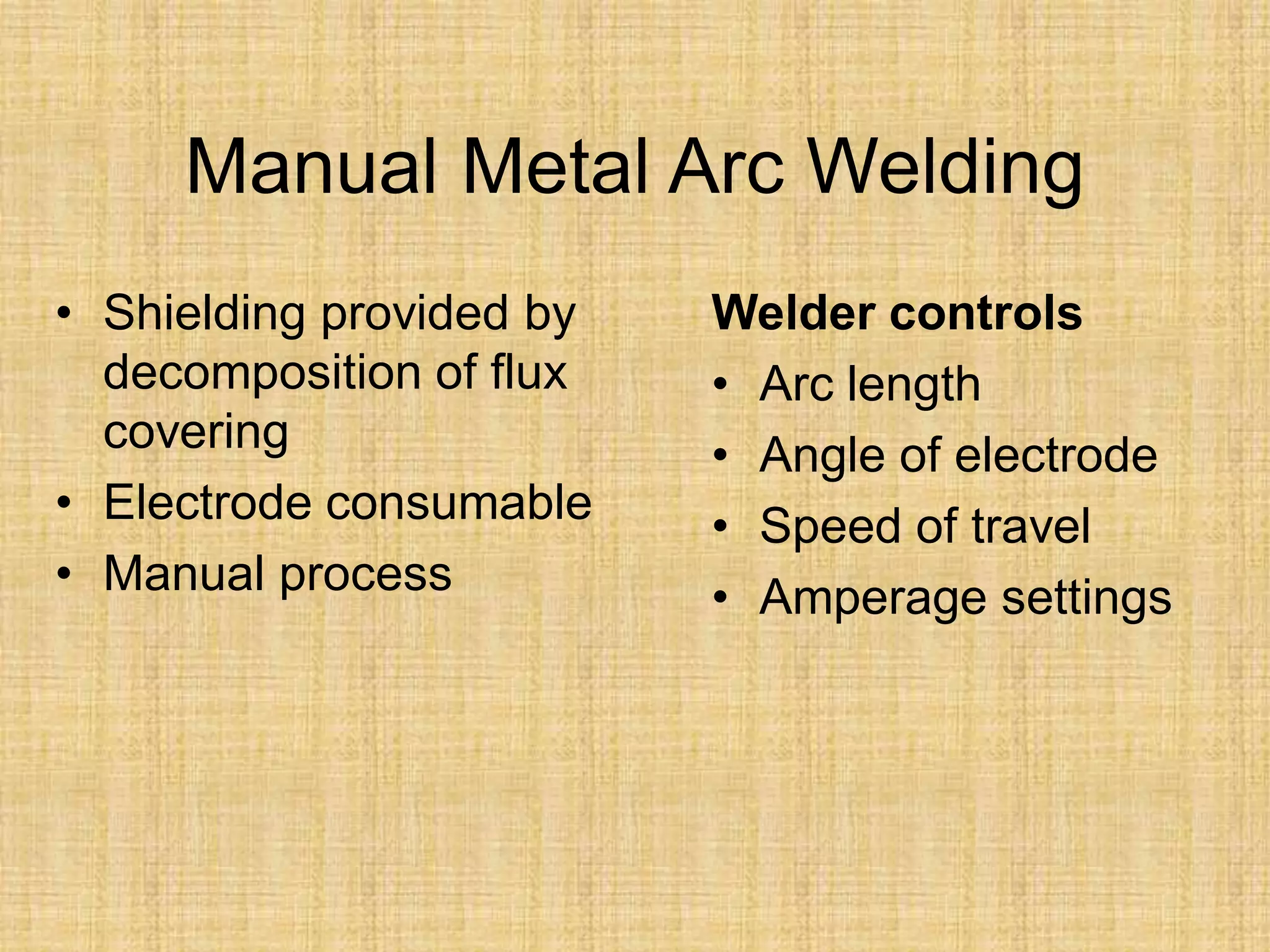
Manual Metal Arc Welding
• Shielding provided by
decomposition of flux
covering
• Electrode consumable
• Manual process
Welder controls
• Arc length
• Angle of electrode
• Speed of travel
• Amperage settings
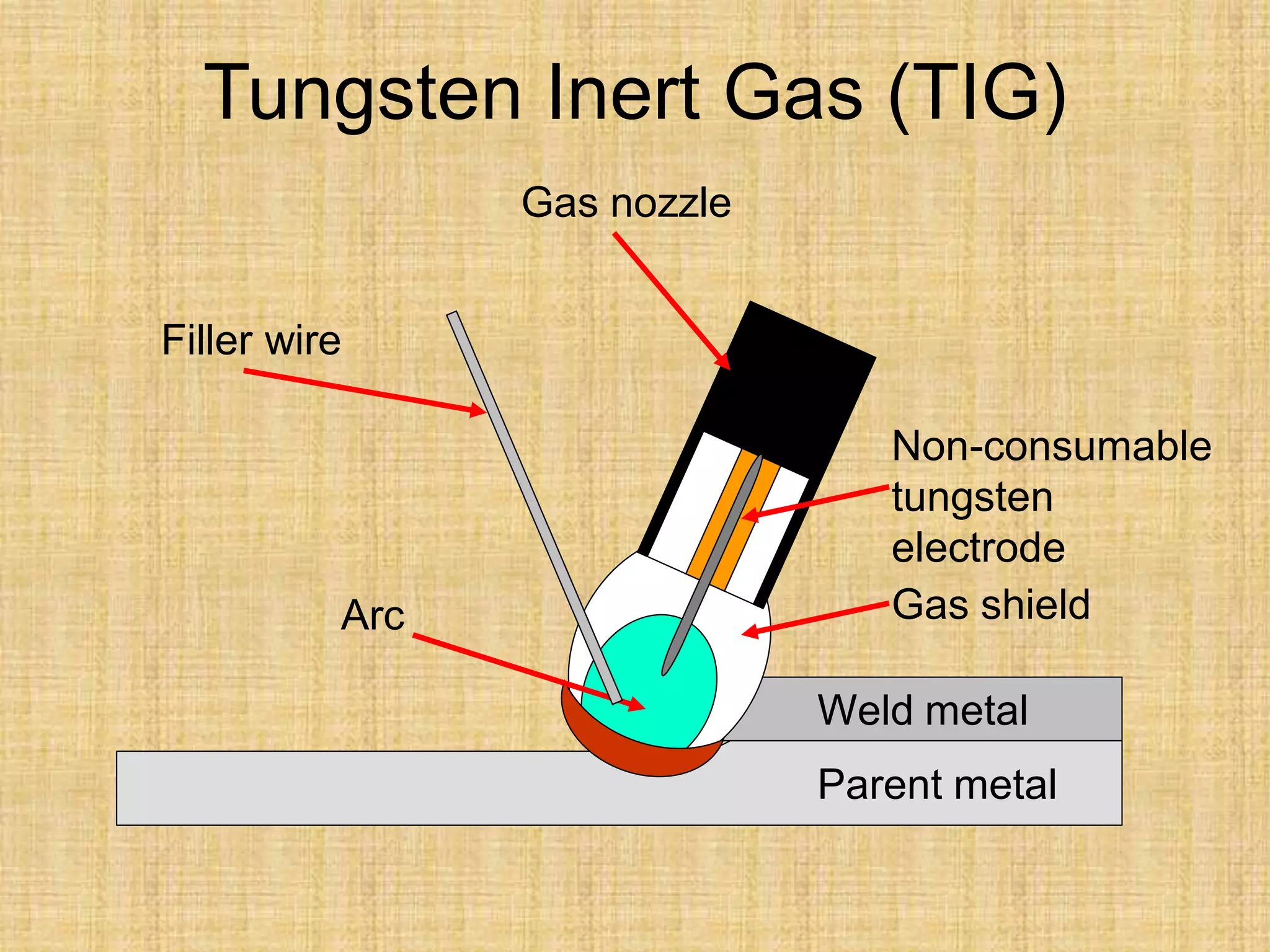
Tungsten Inert Gas (TIG)
Non-consumable
tungsten
electrode
Arc
Parent metal
Weld metal
Gas shield
Filler wire
Gas nozzle
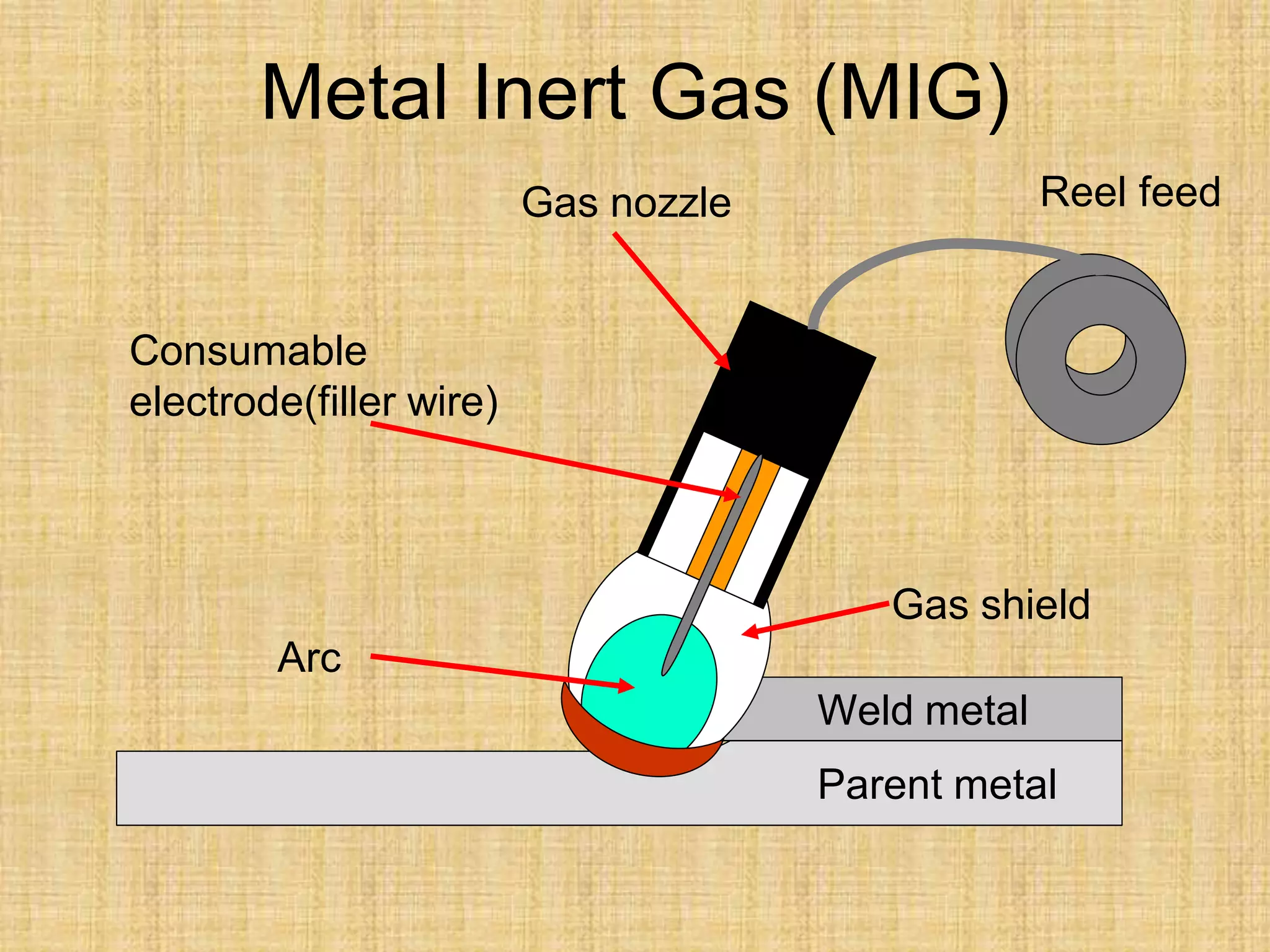
Metal Inert Gas (MIG)
Consumable
electrode(filler wire)
Arc
Parent metal
Weld metal
Gas shield
Gas nozzle Reel feed
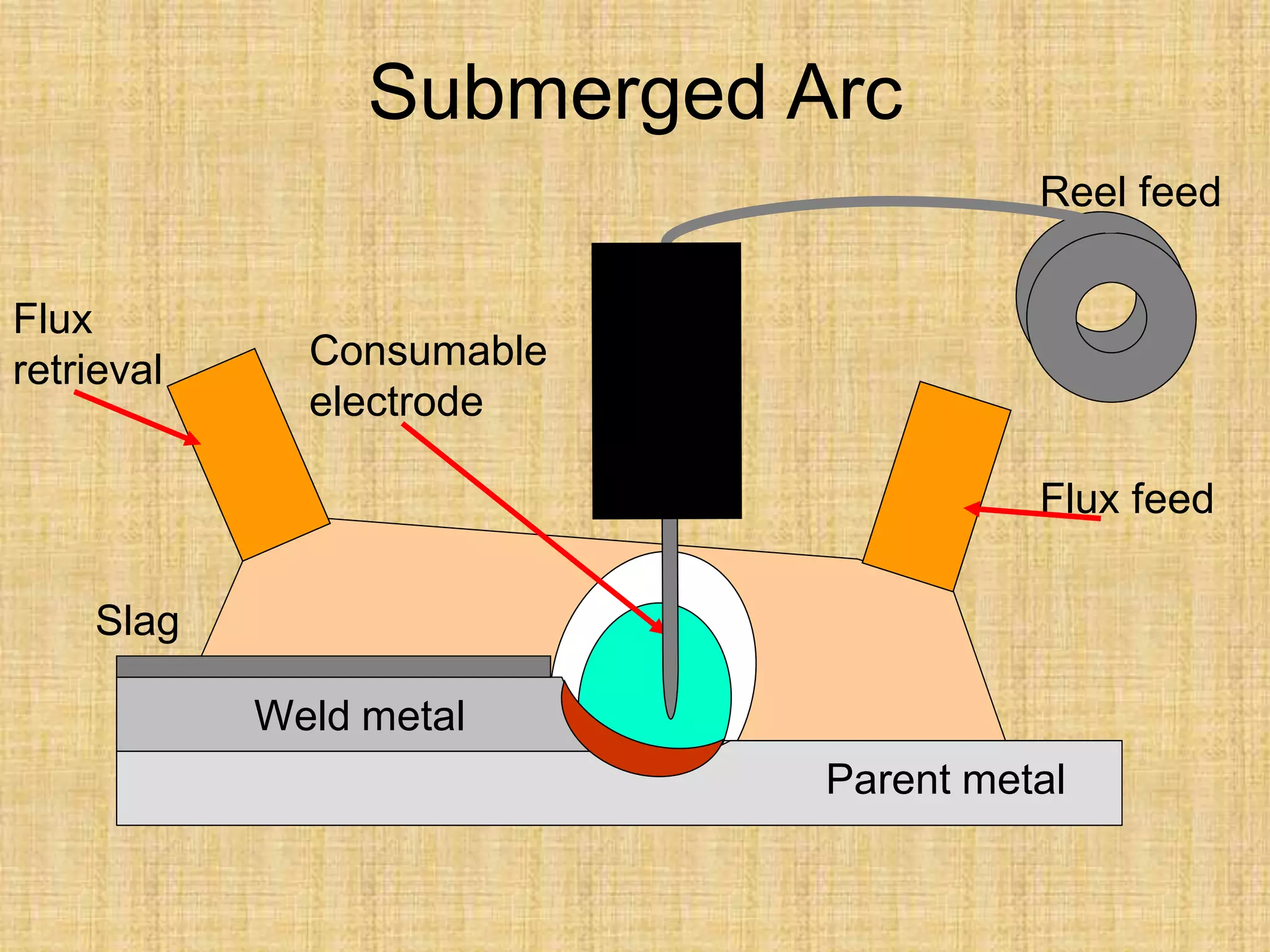
Submerged Arc
Consumable
electrode
Reel feed
Flux feed
Flux
retrieval
Parent metal
Weld metal
Slag
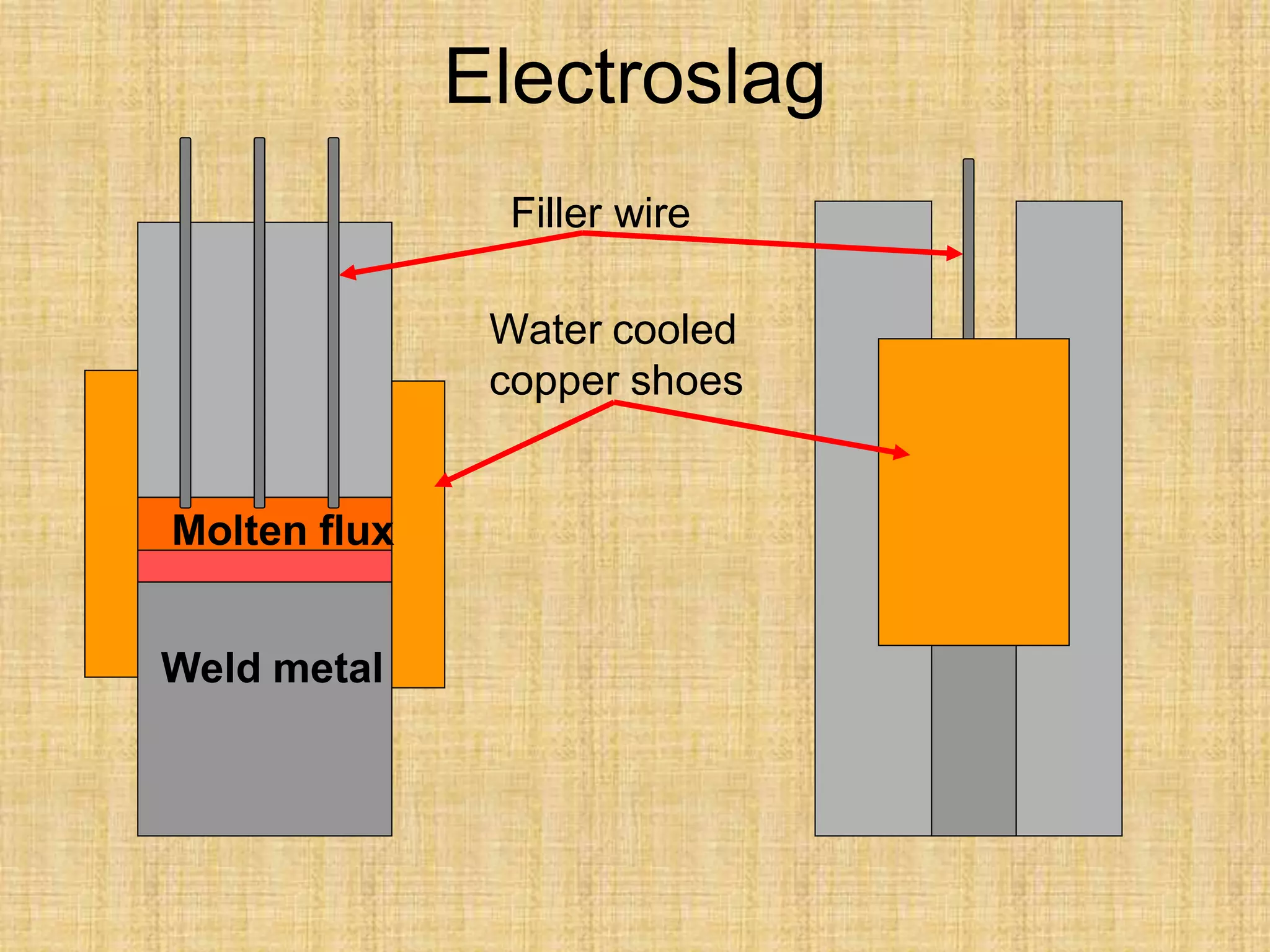
Electroslag
Filler wire
Molten flux
Weld metal
Water cooled
copper shoes
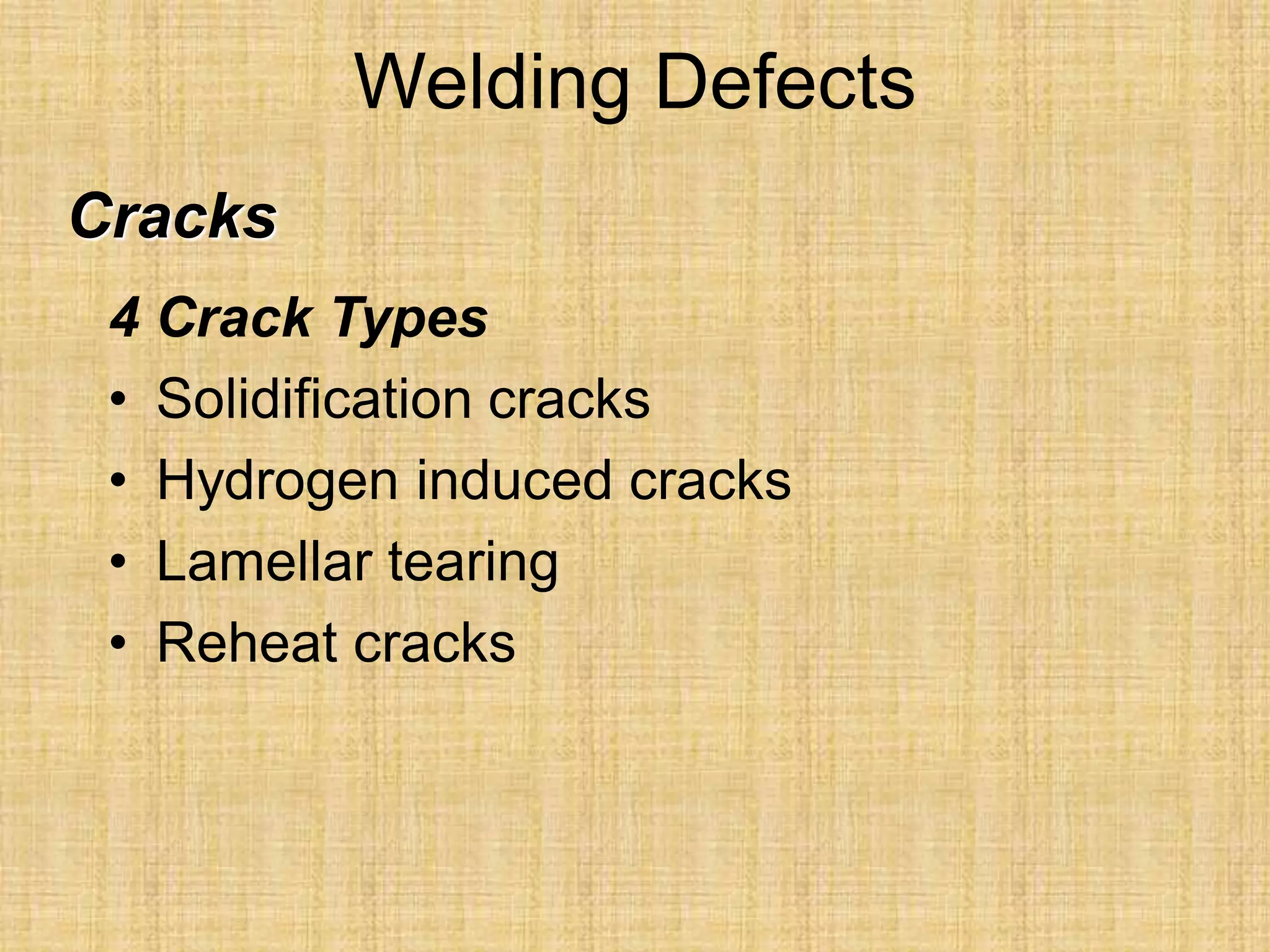
Welding Defects
4 Crack Types
• Solidification cracks
• Hydrogen induced cracks
• Lamellar tearing
• Reheat cracks
Cracks
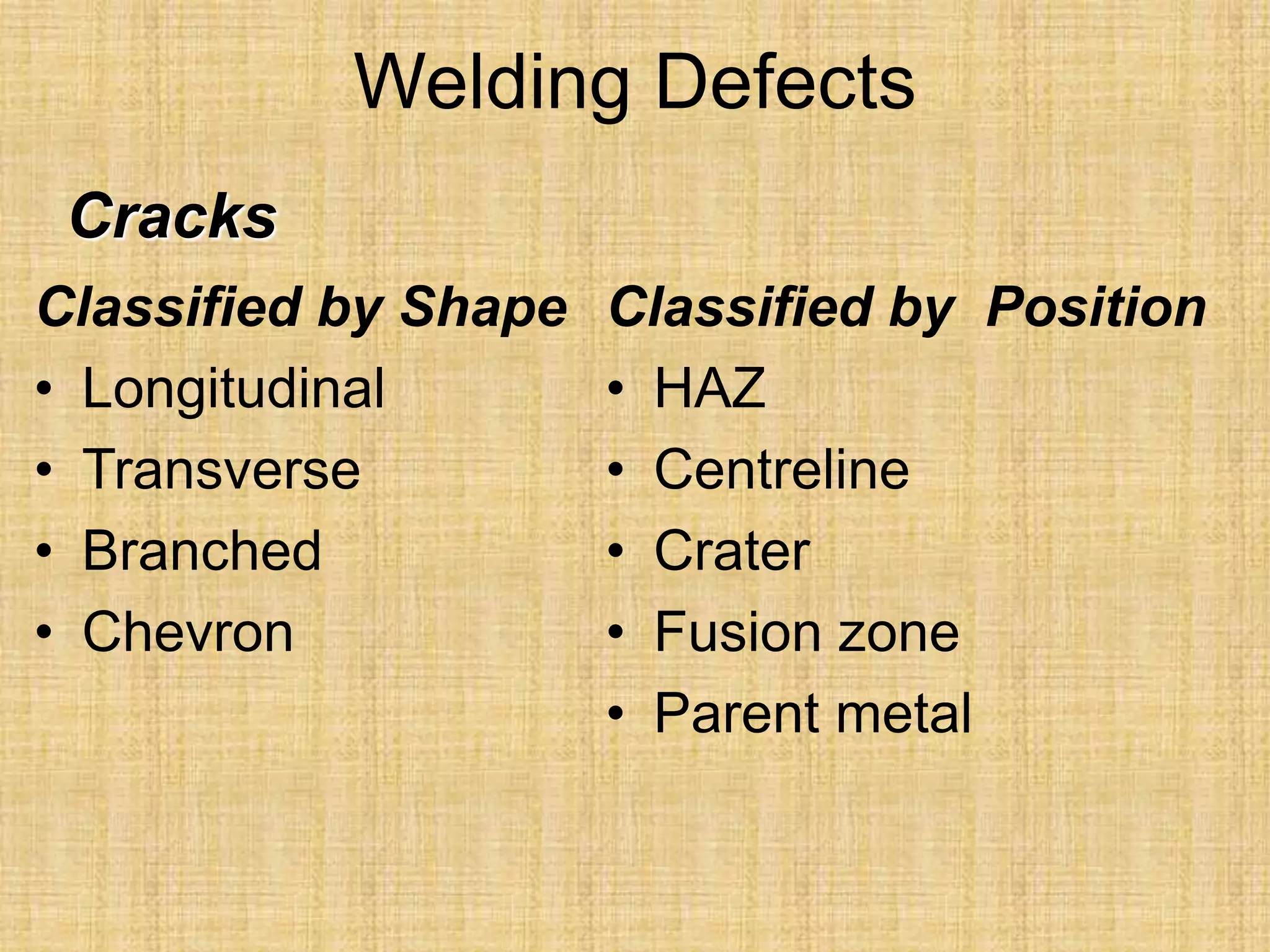
Welding Defects
Classified by Shape
• Longitudinal
• Transverse
• Branched
• Chevron
Cracks
Classified by Position
• HAZ
• Centreline
• Crater
• Fusion zone
• Parent metal
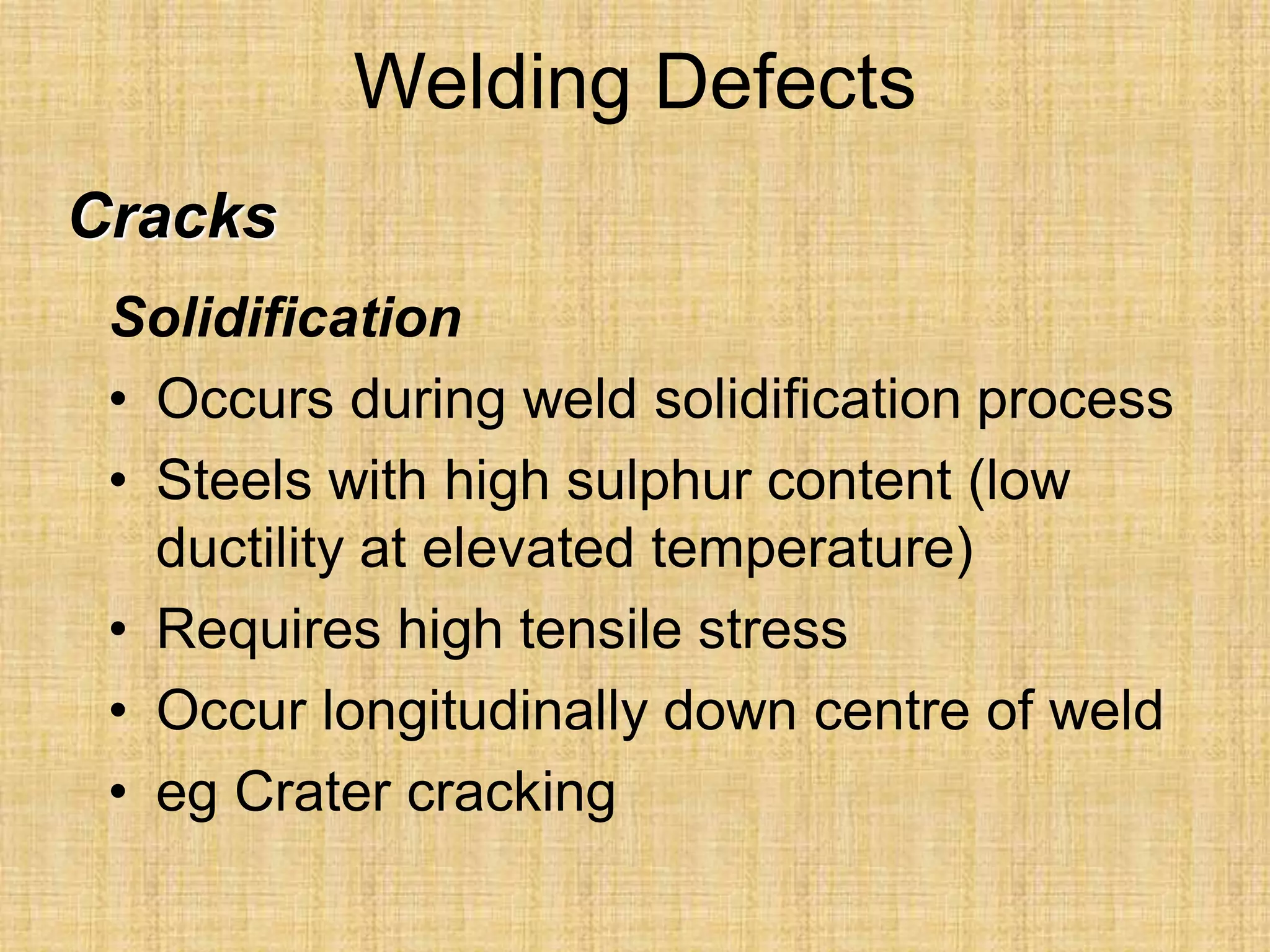
Welding Defects
Solidification
• Occurs during weld solidification process
• Steels with high sulphur content (low
ductility at elevated temperature)
• Requires high tensile stress
• Occur longitudinally down centre of weld
• eg Crater cracking
Cracks
Welding Defects
Hydrogen Induced
• Requires susceptible grain structure, stress
and hydrogen
• Hydrogen enters via welding arc
• Hydrogen source - atmosphere or
contamination of preparation or electrode
• Moisture diffuses out into parent metal on
cooling
• Most likely in HAZ
Cracks
Welding Defects
Lamellar Tearing
• Step like appearance
• Occurs in parent material or HAZ
• Only in rolled direction of the parent material
• Associated with restrained joints subjected to
through thickness stresses on corners, tees
and fillets
• Requires high sulphur or non-metallic
inclusions
Cracks
Welding Defects
Re-Heat Cracking
• Occurs mainly in HAZ of low alloy steels
during post weld heat treatment or service at
elevated temperatures
• Occurs in areas of high stress and existing
defects
• Prevented by toe grinding, elimination of poor
profile material selection and controlled post
weld heat treatment
Cracks
Welding Defects
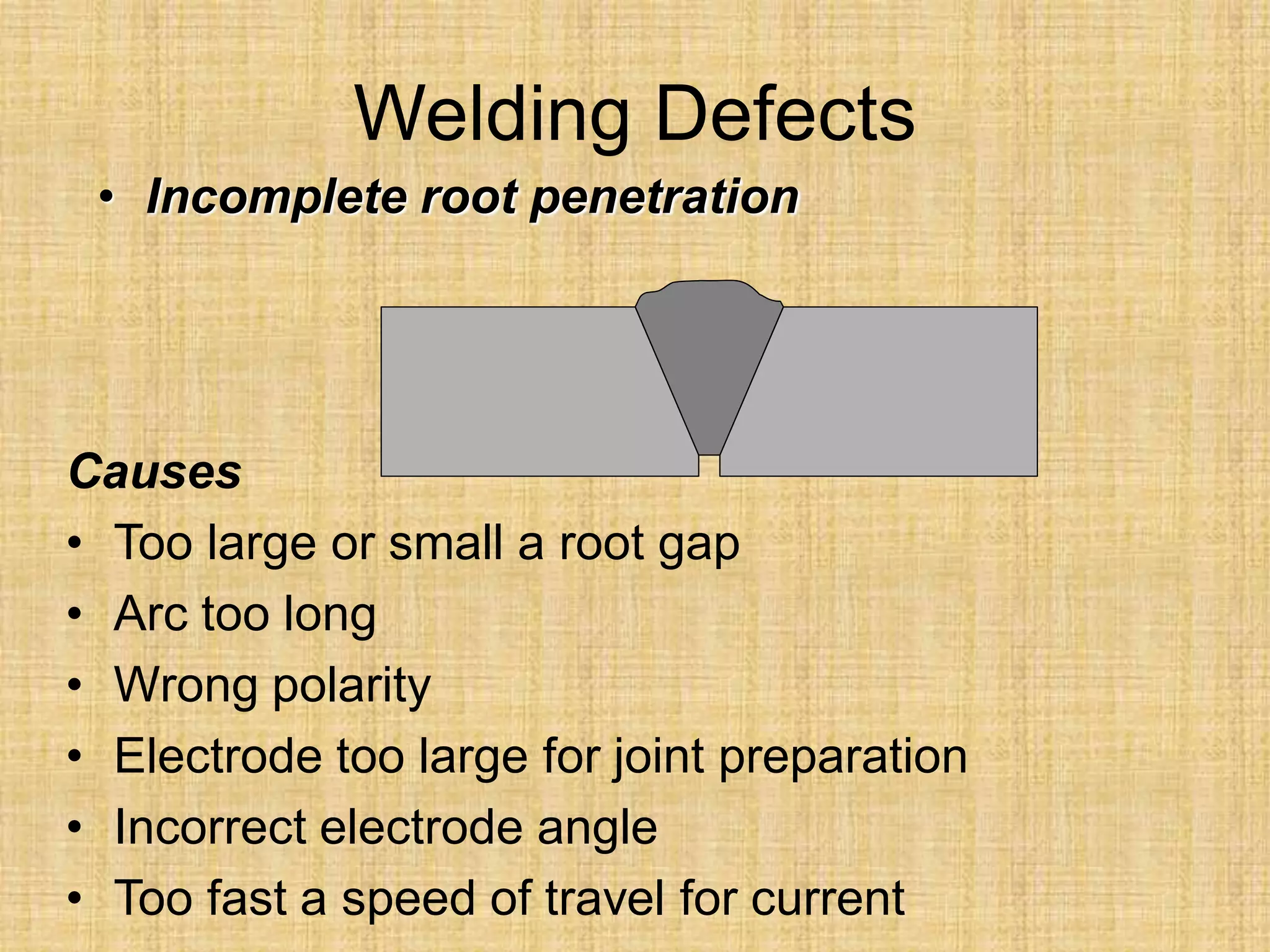
• Incomplete root penetration
Causes
• Too large or small a root gap
• Arc too long
• Wrong polarity
• Electrode too large for joint preparation
• Incorrect electrode angle
• Too fast a speed of travel for current
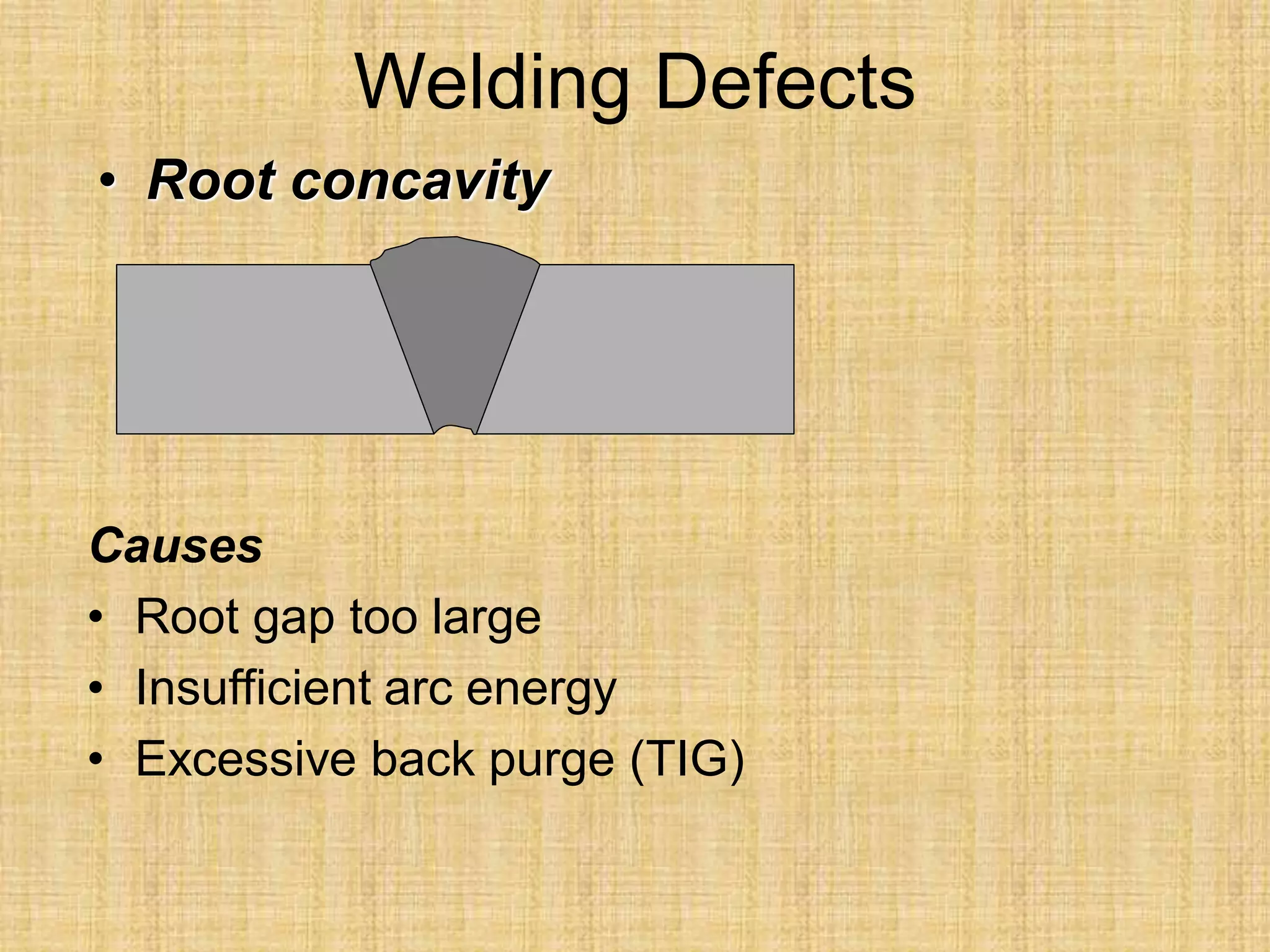
Welding Defects
• Root concavity
Causes
• Root gap too large
• Insufficient arc energy
• Excessive back purge (TIG)
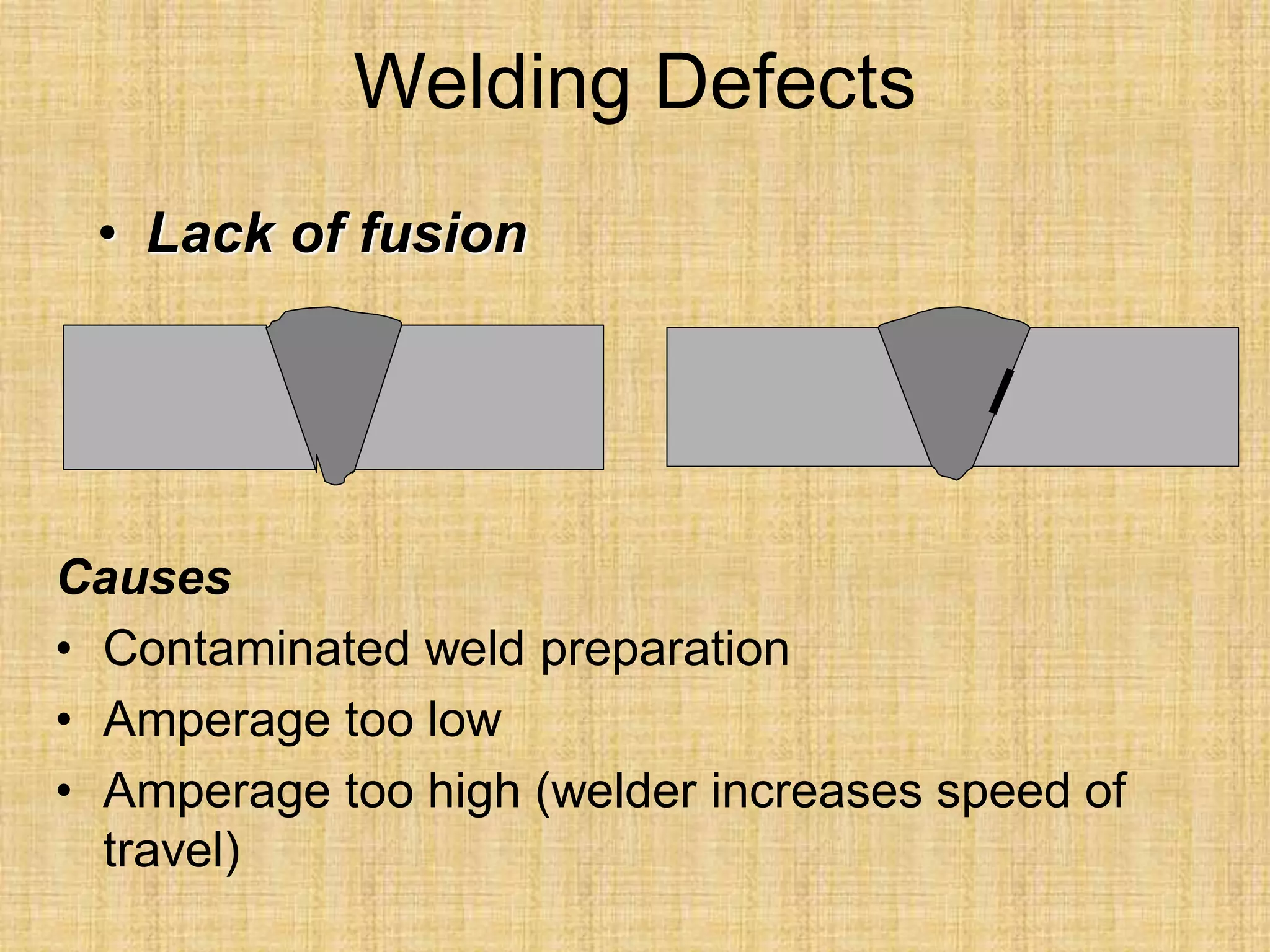
Welding Defects
• Lack of fusion
Causes
• Contaminated weld preparation
• Amperage too low
• Amperage too high (welder increases speed of
travel)
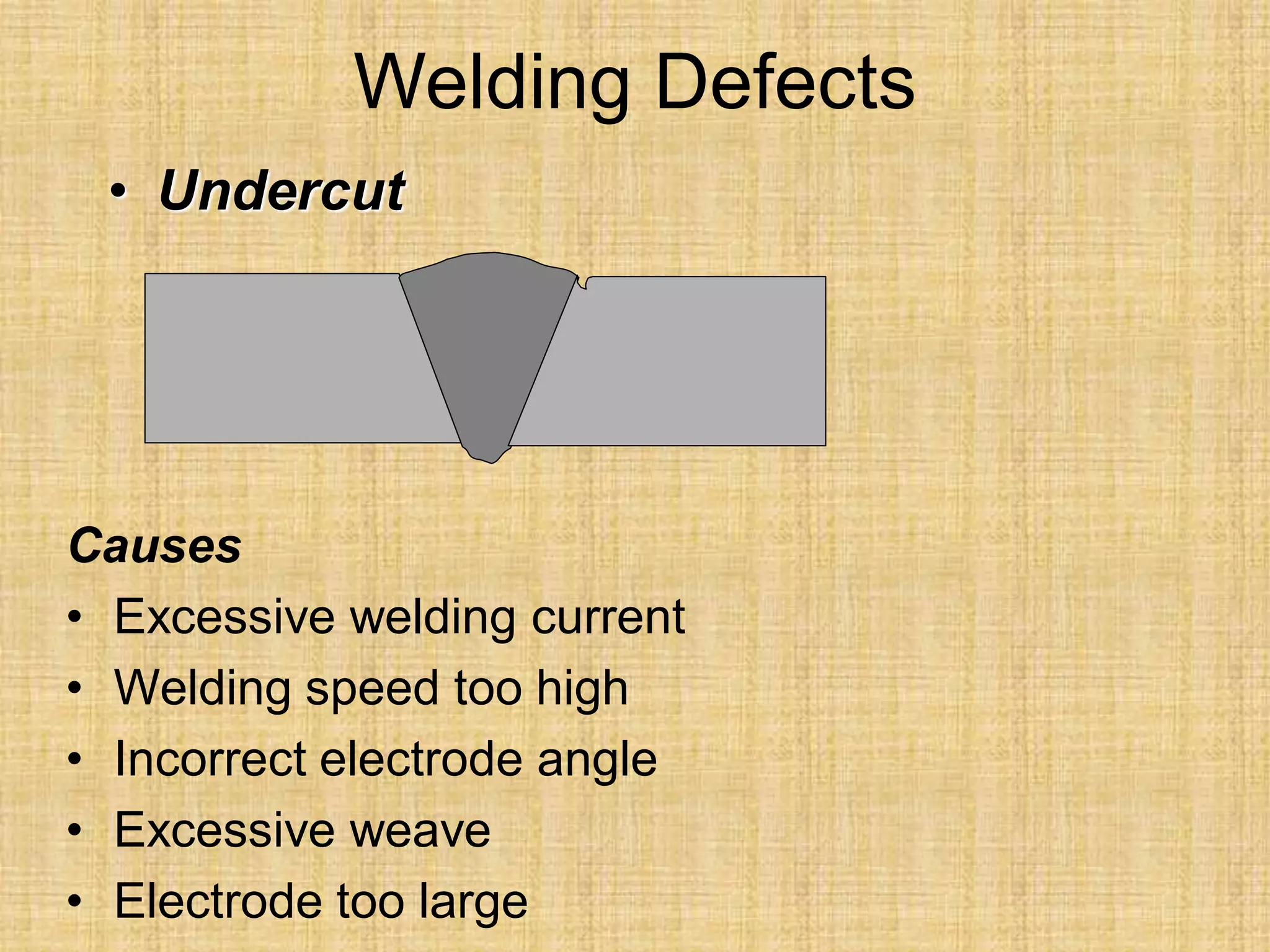
Welding Defects
• Undercut
Causes
• Excessive welding current
• Welding speed too high
• Incorrect electrode angle
• Excessive weave
• Electrode too large
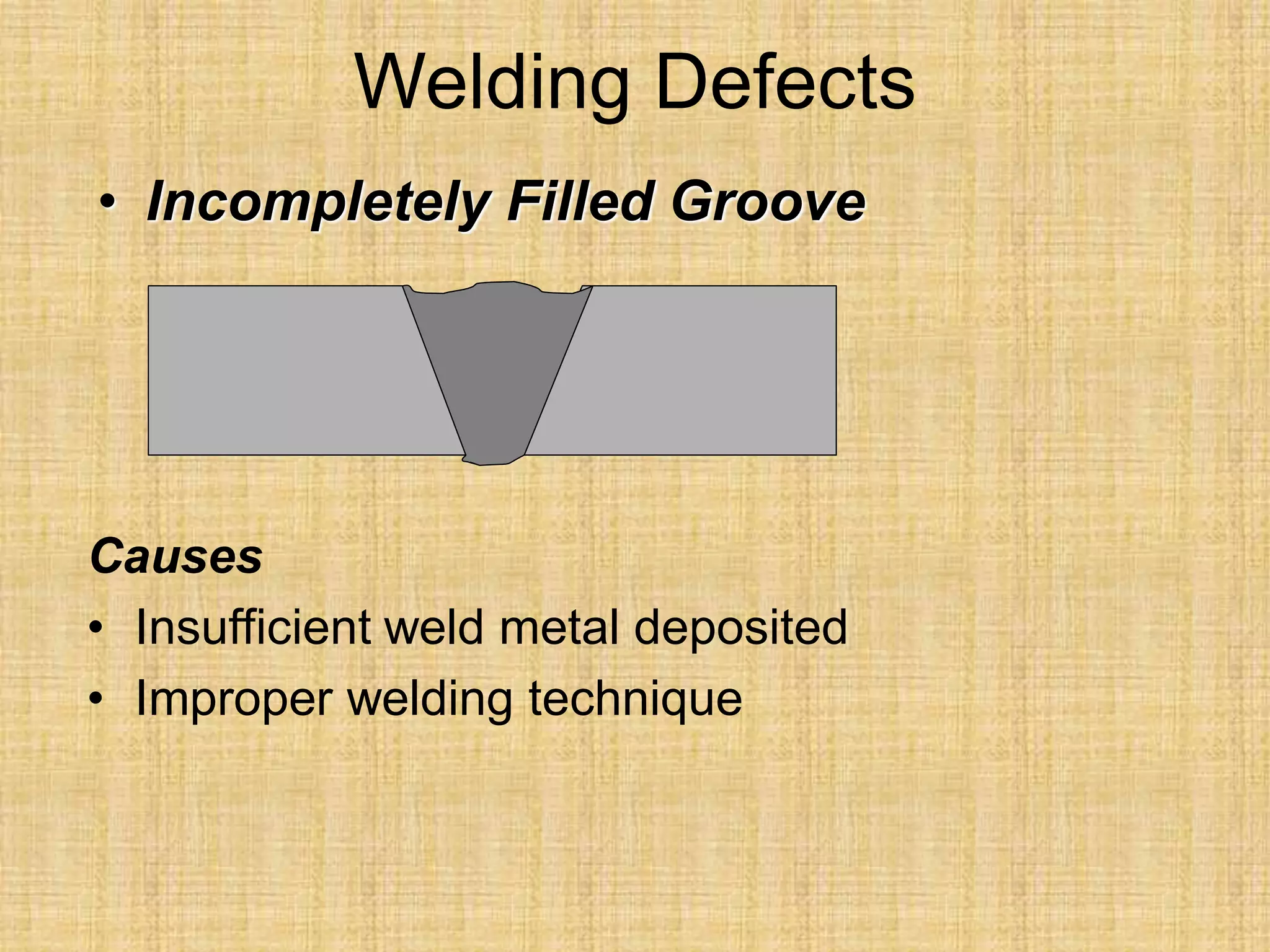
Welding Defects
• Incompletely Filled Groove
Causes
• Insufficient weld metal deposited
• Improper welding technique
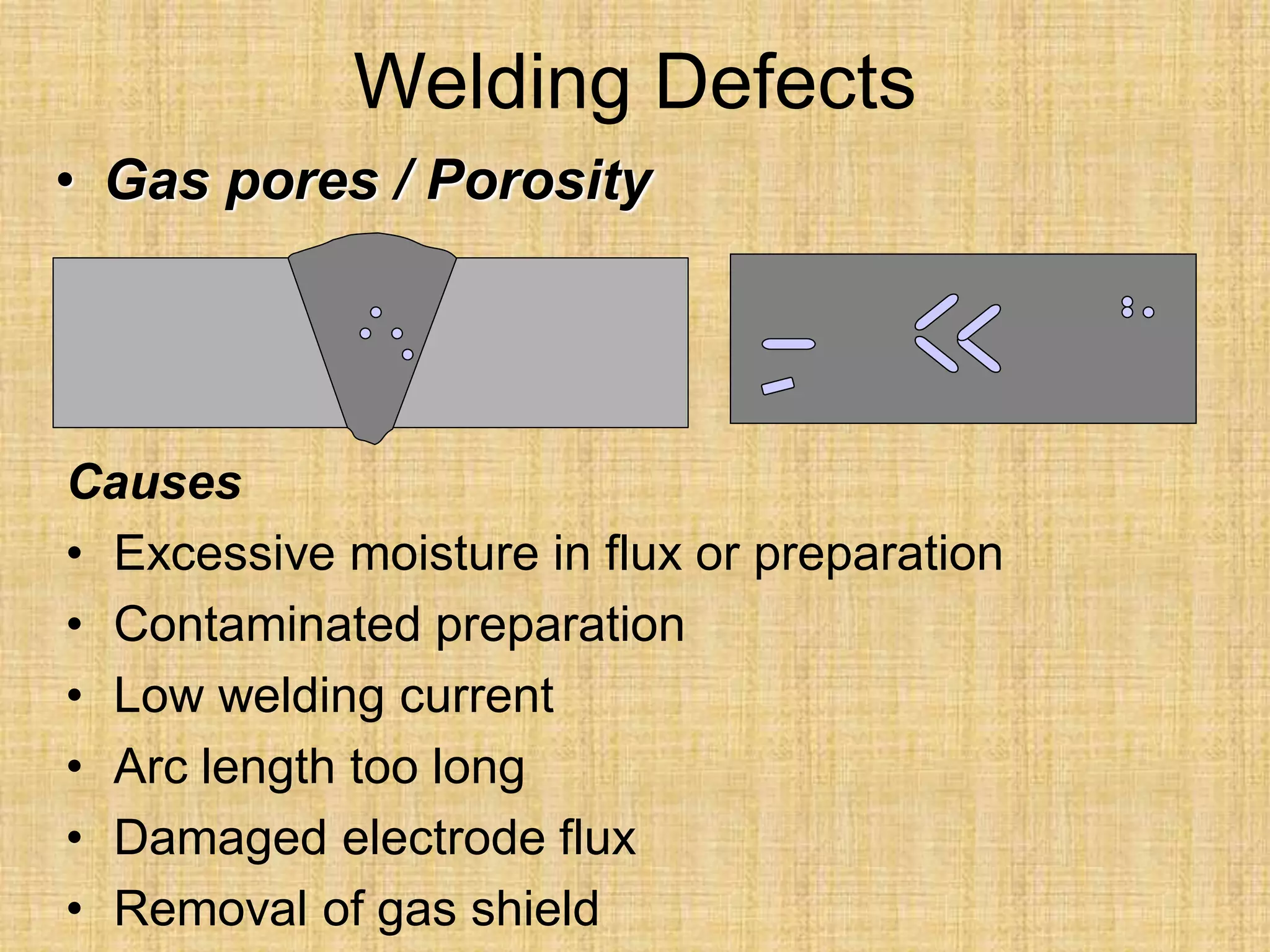
Welding Defects
• Gas pores / Porosity
Causes
• Excessive moisture in flux or preparation
• Contaminated preparation
• Low welding current
• Arc length too long
• Damaged electrode flux
• Removal of gas shield
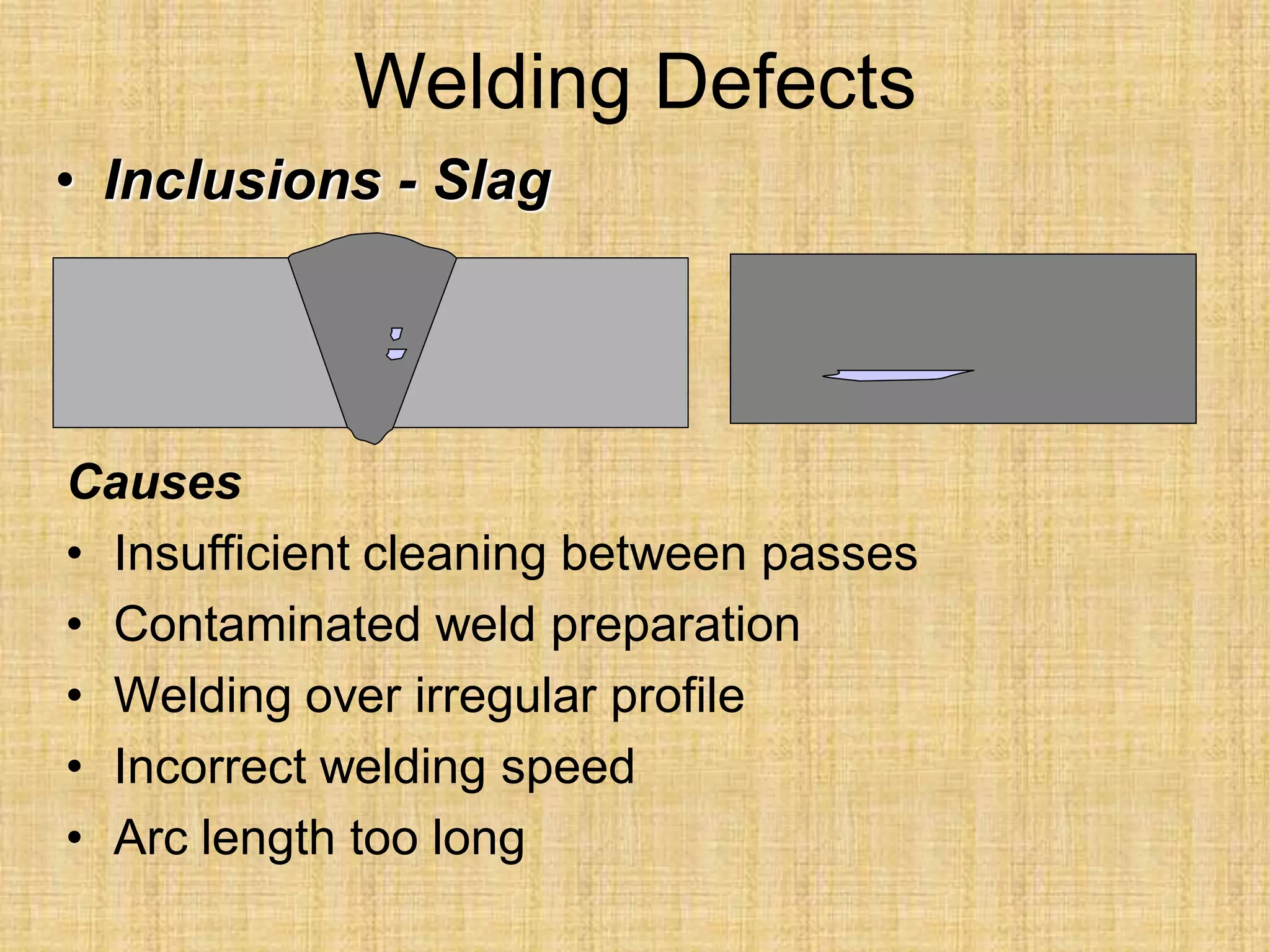
Welding Defects
• Inclusions - Slag
Causes
• Insufficient cleaning between passes
• Contaminated weld preparation
• Welding over irregular profile
• Incorrect welding speed
• Arc length too long
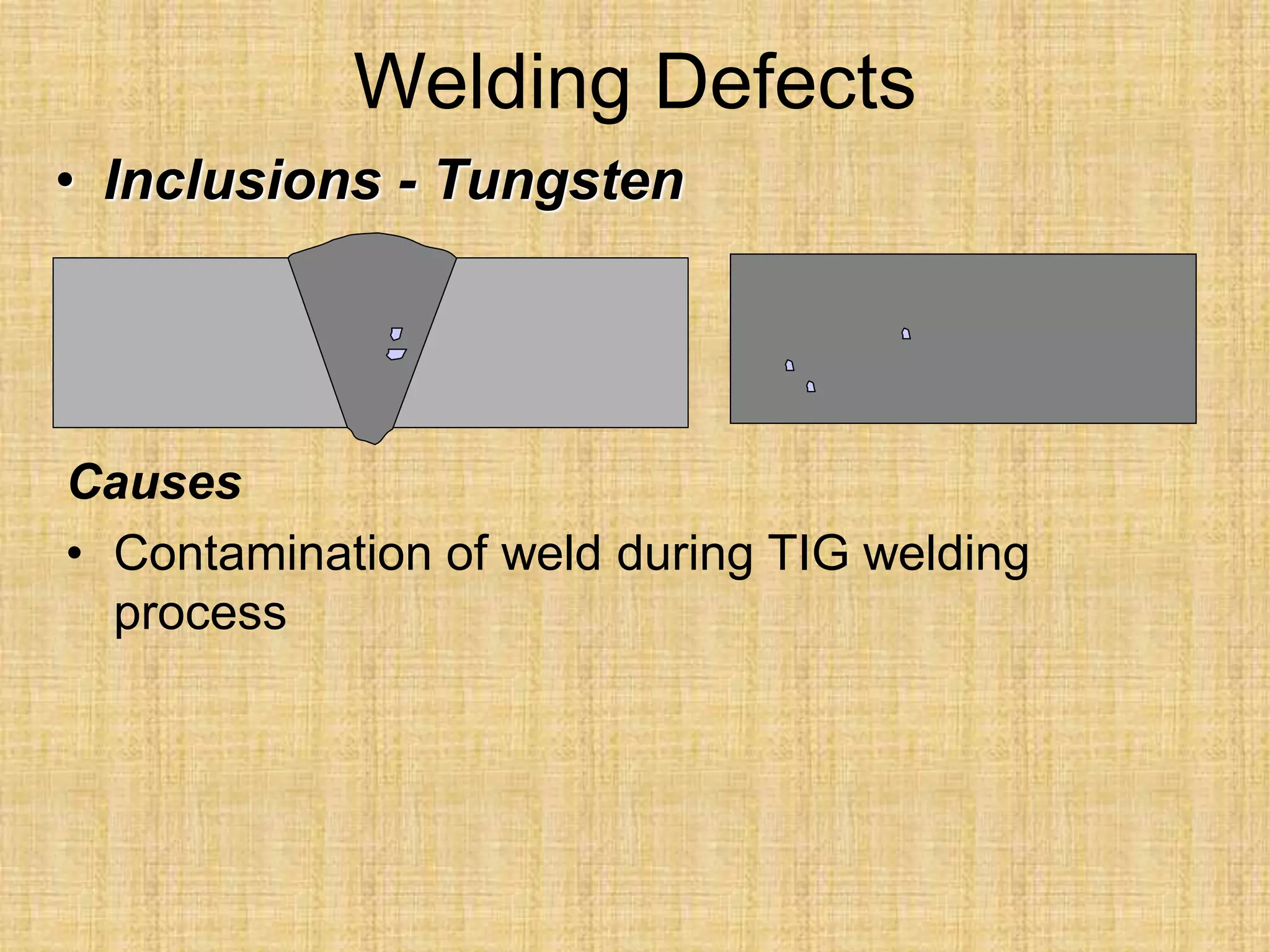
Welding Defects
• Inclusions - Tungsten
Causes
• Contamination of weld during TIG welding
process
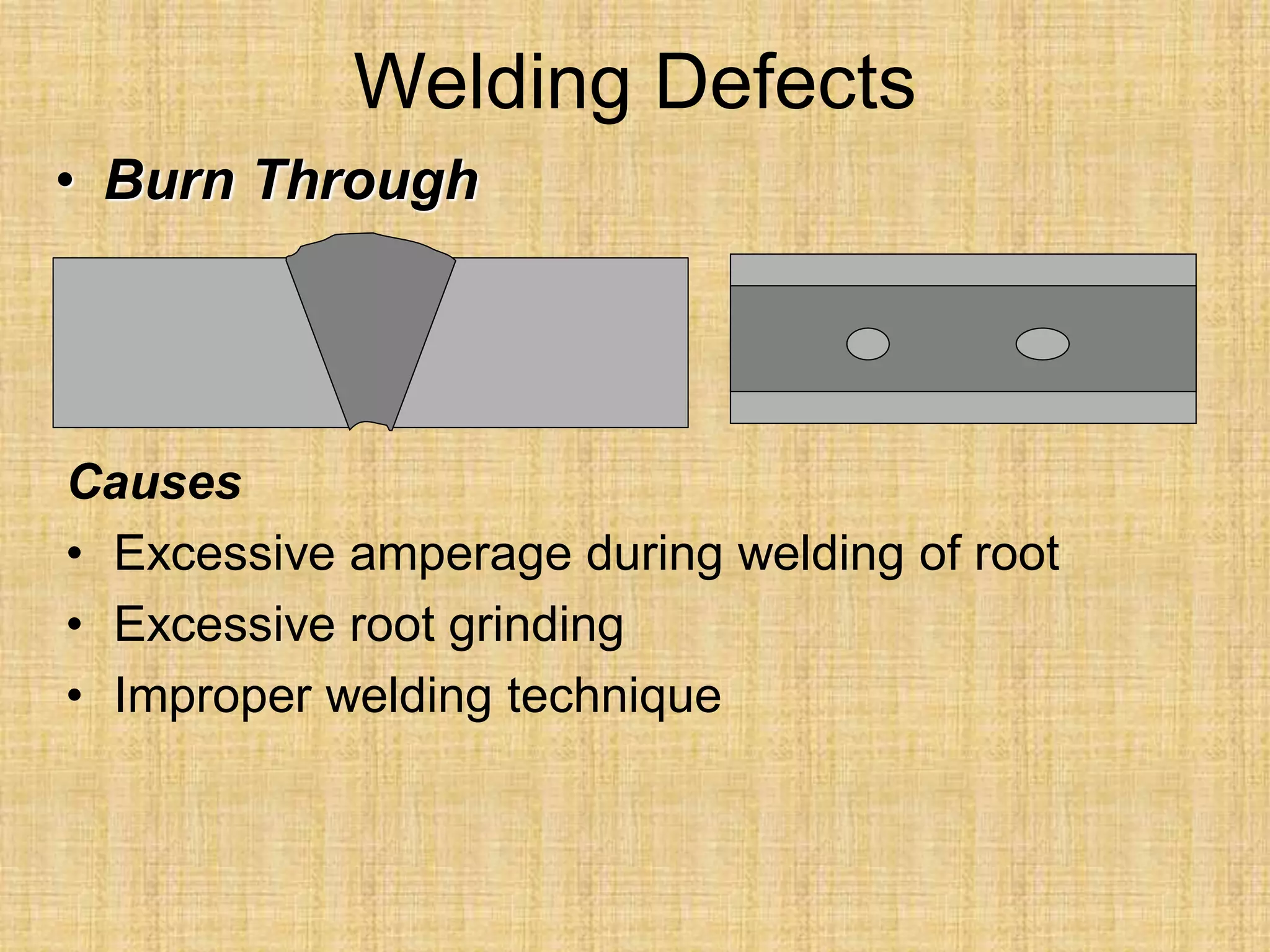
Welding Defects
• Burn Through
Causes
• Excessive amperage during welding of root
• Excessive root grinding
• Improper welding technique
Welding Defects
• Arc Strikes
Causes
• Electrode straying onto
parent metal
• Electrode holder with
poor insulation
• Poor contact of earth
clamp
• Spatter
Causes
• Excessive arc energy
• Excessive arc length
• Damp electrodes
• Arc blow

Visual Inspection of Welding Process

  • 1.
  • 2.
    Terminology Butt Joints • SquareEdged, Open and Closed • Single Vee, Butt and Bevel • Double Vee, Butt and Bevel
  • 3.
  • 4.
  • 5.
  • 6.
    Visual Inspection Procedures •What is the nature of the product? • What operating conditions will be present? • What is the quality of welding required? • Is there a code or standard available to inspect the welds against
  • 7.
    Welding Checklist • Documentation •Materials • Weld preparations • Fit up for welding • Welding equipment Before Welding Commences
  • 8.
    Welding Checklist • Correctparameters • WPS at the work place • Inter run cleanliness and quality • Interpass temperature • Consumable control • Maintenance of preheat • Process control NDE regime • Weld records and maintenance of weld maps During Welding
  • 9.
    Welding Checklist • Visualinspection and records • NDE • PWHT • Final testing • Cleaning, painting, preservation, packing • Final documentation Welding Completion
  • 10.
    How Do ICarry Out a Visual Inspection? • What is the nature of the product? • What operating conditions will be present? • What is the quality of welding required? • Is there a code or standard available to inspect the welds against
  • 11.
    Features to Consider Buttwelds - Size Excess weld metal height Root penetration Root bead width Weld cap width
  • 12.
    Features to Consider Filletwelds - Size Minimum and maximum leg length size Minimum design throat thickness
  • 13.
  • 14.
  • 15.
    Features to Consider Buttwelds - Toe Blend
  • 16.
    Features to Consider Filletwelds - Toe Blend
  • 17.
    Features to Consider Buttwelds - Weld Width
  • 18.
  • 19.
  • 20.
  • 21.
    Welding Defects • Undercut Causes •Excessive welding current • Welding speed too high • Incorrect electrode angle • Excessive weave • Electrode too large
  • 22.
    Welding Defects • IncompletelyFilled Groove Causes • Insufficient weld metal deposited • Improper welding technique
  • 23.
    Welding Defects • BurnThrough Causes • Excessive amperage during welding of root • Excessive root grinding • Improper welding technique
  • 24.
    A Weld :Definitions • A union between pieces of metal at faces rendered plastic or liquid by heat,pressure or both. BS 499 • A continuous defect surrounded by parent material NASA
  • 25.
    Welds • An idealweld must give a strong bond between materials with the interfaces disappearing To achieve this • Smooth,flat or matching surfaces • Surfaces shall be free from contaminants • Metals shall be free from impurities • Metals shall have identical crystalline structures
  • 26.
    Welding • A unionbetween pieces of metal at faces rendered plastic or liquid by heat,pressure or both. BS 499 • Ultrasonics • Electron beam • Friction • Electric resistance • Electric arc Possible energy sources
  • 27.
    Electric Arc Welding Power supply Workpiece Electrod e Clamp(Earth)
  • 28.
    Electric Arc Welding •Electric discharge produced between cathode and anode by a potential difference (40 to 60 volts) • Discharge ionises air and produces -ve electrons and +ve ions • Electrons impact upon anode, ions upon cathode • Impact of particles converts kinetic energy to heat (7000o C) and light • Amperage controls number of ions and electrons, Voltage controls their velocity
  • 29.
    Electric Arc Welding ArcWelding Processes • Manual metal arc • Tungsten Inert Gas • Metal Inert Gas • Submerged Arc Differences between them • Methods of shielding the arc • Consumable or Non-consumable electrode • Degree of automation
  • 30.
    Zones in FusionWelds • Fusion Zone • Heat Affected Zone • Parent Material or Base Metal
  • 31.
  • 32.
    Manual Metal Arc(MMA) Consumable electrode Flux coating Core wire Arc Evolved gas shield Parent metal Slag Weld metal
  • 33.
    Manual Metal ArcWelding • Shielding provided by decomposition of flux covering • Electrode consumable • Manual process Welder controls • Arc length • Angle of electrode • Speed of travel • Amperage settings
  • 34.
    Tungsten Inert Gas(TIG) Non-consumable tungsten electrode Arc Parent metal Weld metal Gas shield Filler wire Gas nozzle
  • 35.
    Metal Inert Gas(MIG) Consumable electrode(filler wire) Arc Parent metal Weld metal Gas shield Gas nozzle Reel feed
  • 36.
    Submerged Arc Consumable electrode Reel feed Fluxfeed Flux retrieval Parent metal Weld metal Slag
  • 37.
    Electroslag Filler wire Molten flux Weldmetal Water cooled copper shoes
  • 38.
    Welding Defects 4 CrackTypes • Solidification cracks • Hydrogen induced cracks • Lamellar tearing • Reheat cracks Cracks
  • 39.
    Welding Defects Classified byShape • Longitudinal • Transverse • Branched • Chevron Cracks Classified by Position • HAZ • Centreline • Crater • Fusion zone • Parent metal
  • 40.
    Welding Defects Solidification • Occursduring weld solidification process • Steels with high sulphur content (low ductility at elevated temperature) • Requires high tensile stress • Occur longitudinally down centre of weld • eg Crater cracking Cracks
  • 41.
    Welding Defects Hydrogen Induced •Requires susceptible grain structure, stress and hydrogen • Hydrogen enters via welding arc • Hydrogen source - atmosphere or contamination of preparation or electrode • Moisture diffuses out into parent metal on cooling • Most likely in HAZ Cracks
  • 42.
    Welding Defects Lamellar Tearing •Step like appearance • Occurs in parent material or HAZ • Only in rolled direction of the parent material • Associated with restrained joints subjected to through thickness stresses on corners, tees and fillets • Requires high sulphur or non-metallic inclusions Cracks
  • 43.
    Welding Defects Re-Heat Cracking •Occurs mainly in HAZ of low alloy steels during post weld heat treatment or service at elevated temperatures • Occurs in areas of high stress and existing defects • Prevented by toe grinding, elimination of poor profile material selection and controlled post weld heat treatment Cracks
  • 44.
    Welding Defects • Incompleteroot penetration Causes • Too large or small a root gap • Arc too long • Wrong polarity • Electrode too large for joint preparation • Incorrect electrode angle • Too fast a speed of travel for current
  • 45.
    Welding Defects • Rootconcavity Causes • Root gap too large • Insufficient arc energy • Excessive back purge (TIG)
  • 46.
    Welding Defects • Lackof fusion Causes • Contaminated weld preparation • Amperage too low • Amperage too high (welder increases speed of travel)
  • 47.
    Welding Defects • Undercut Causes •Excessive welding current • Welding speed too high • Incorrect electrode angle • Excessive weave • Electrode too large
  • 48.
    Welding Defects • IncompletelyFilled Groove Causes • Insufficient weld metal deposited • Improper welding technique
  • 49.
    Welding Defects • Gaspores / Porosity Causes • Excessive moisture in flux or preparation • Contaminated preparation • Low welding current • Arc length too long • Damaged electrode flux • Removal of gas shield
  • 50.
    Welding Defects • Inclusions- Slag Causes • Insufficient cleaning between passes • Contaminated weld preparation • Welding over irregular profile • Incorrect welding speed • Arc length too long
  • 51.
    Welding Defects • Inclusions- Tungsten Causes • Contamination of weld during TIG welding process
  • 52.
    Welding Defects • BurnThrough Causes • Excessive amperage during welding of root • Excessive root grinding • Improper welding technique
  • 53.
    Welding Defects • ArcStrikes Causes • Electrode straying onto parent metal • Electrode holder with poor insulation • Poor contact of earth clamp • Spatter Causes • Excessive arc energy • Excessive arc length • Damp electrodes • Arc blow