M.S.Rogers
Copyright © 2004 TWI Ltd
Weld Defects & Repairs
Radiographic Interpretation
M.S.Rogers
Copyright © 2004 TWI Ltd
Faults in Fusion Welds
M.S.Rogers
Copyright © 2004 TWI Ltd
Defects which may be detected by visual inspection
can be grouped under the following headings
 Cracks
 Solid inclusions
 Surface and profiles
 Misalignment (set-up
irregularities)
 Gas pores and porosity
 Lack of fusion
 Mechanical damage
 Parent material damage
 Miscellaneous
Faults in Fusion Welds
M.S.Rogers
Copyright © 2004 TWI Ltd
Cracks
M.S.Rogers
Copyright © 2004 TWI Ltd
Classified by Shape
 Longitudinal
 Transverse
 Branched
 Chevron
Classified by Position
 HAZ
 Centreline
 Crater
 Fusion zone
 Parent metal
Cracks that may occur in welded materials are caused
generally by many factors and may be classified by
shape and position, cracks are classed as planar.
Cracks
M.S.Rogers
Copyright © 2004 TWI Ltd
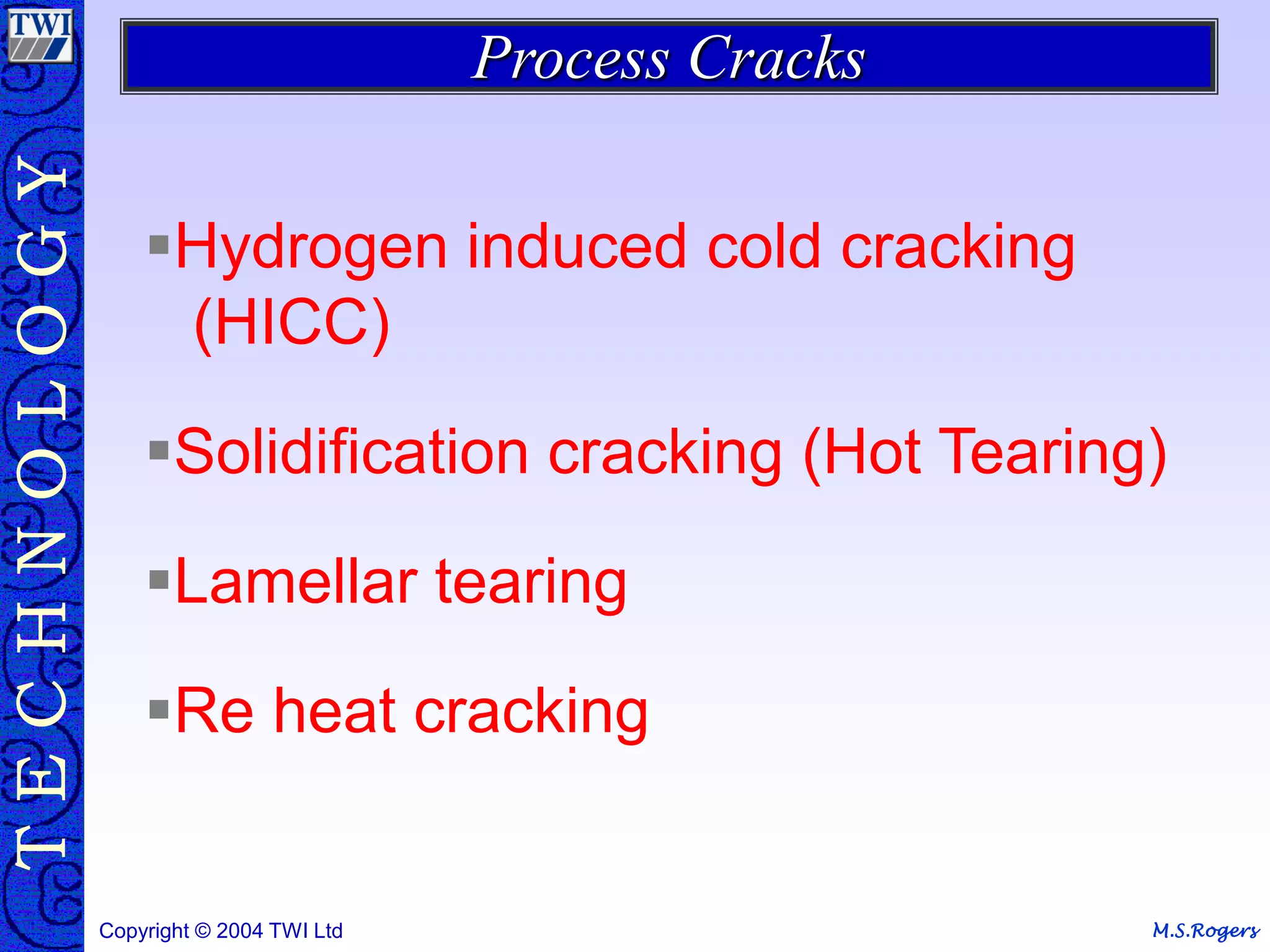
Hydrogen induced cold cracking
(HICC)
Solidification cracking (Hot Tearing)
Lamellar tearing
Re heat cracking
Process Cracks
M.S.Rogers
Copyright © 2004 TWI Ltd
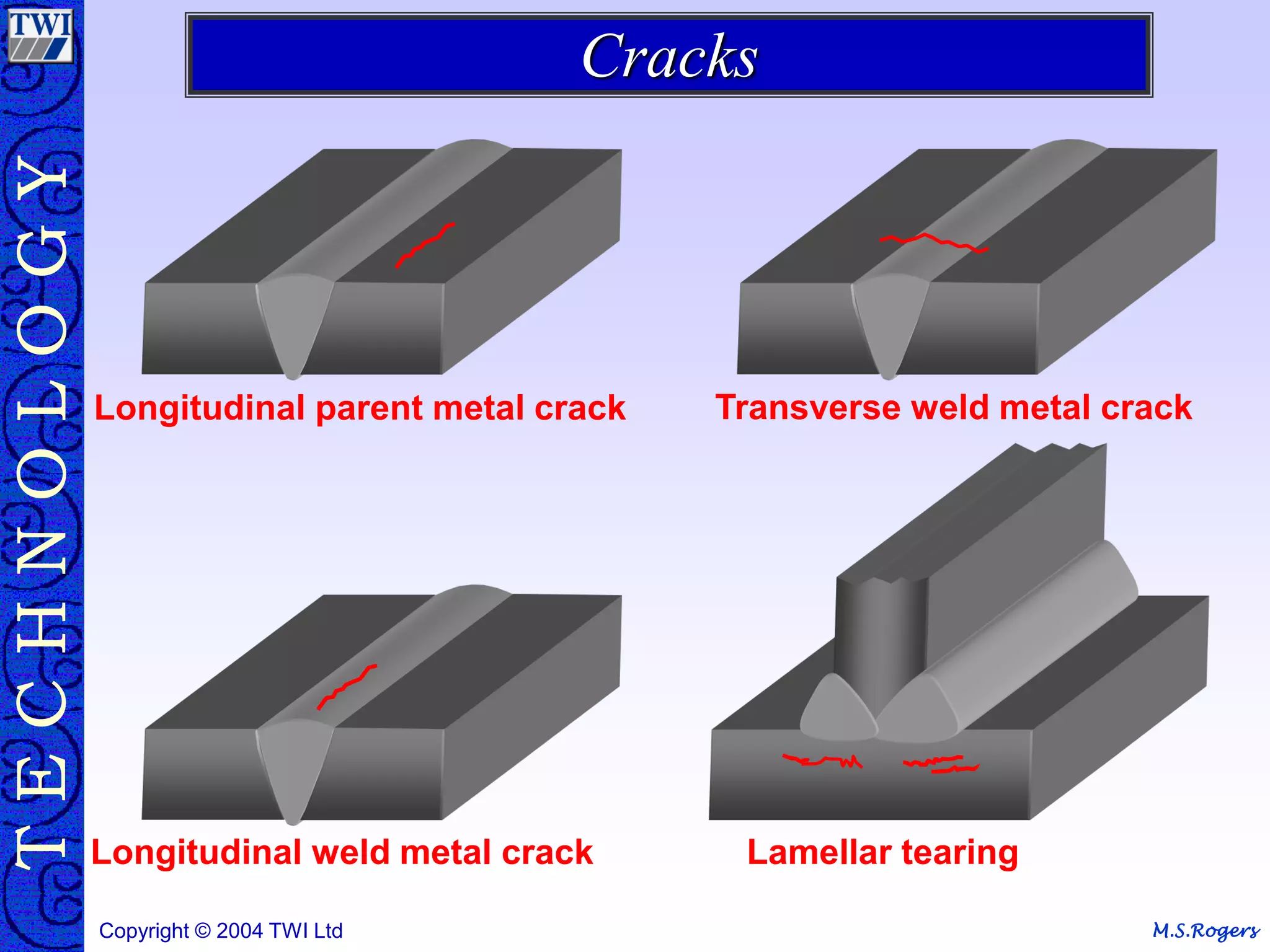
Longitudinal parent metal crack
Longitudinal weld metal crack Lamellar tearing
Transverse weld metal crack
Cracks
M.S.Rogers
Copyright © 2004 TWI Ltd
Transverse crack Longitudinal crack
M.S.Rogers
Copyright © 2004 TWI Ltd
Inclusions
M.S.Rogers
Copyright © 2004 TWI Ltd
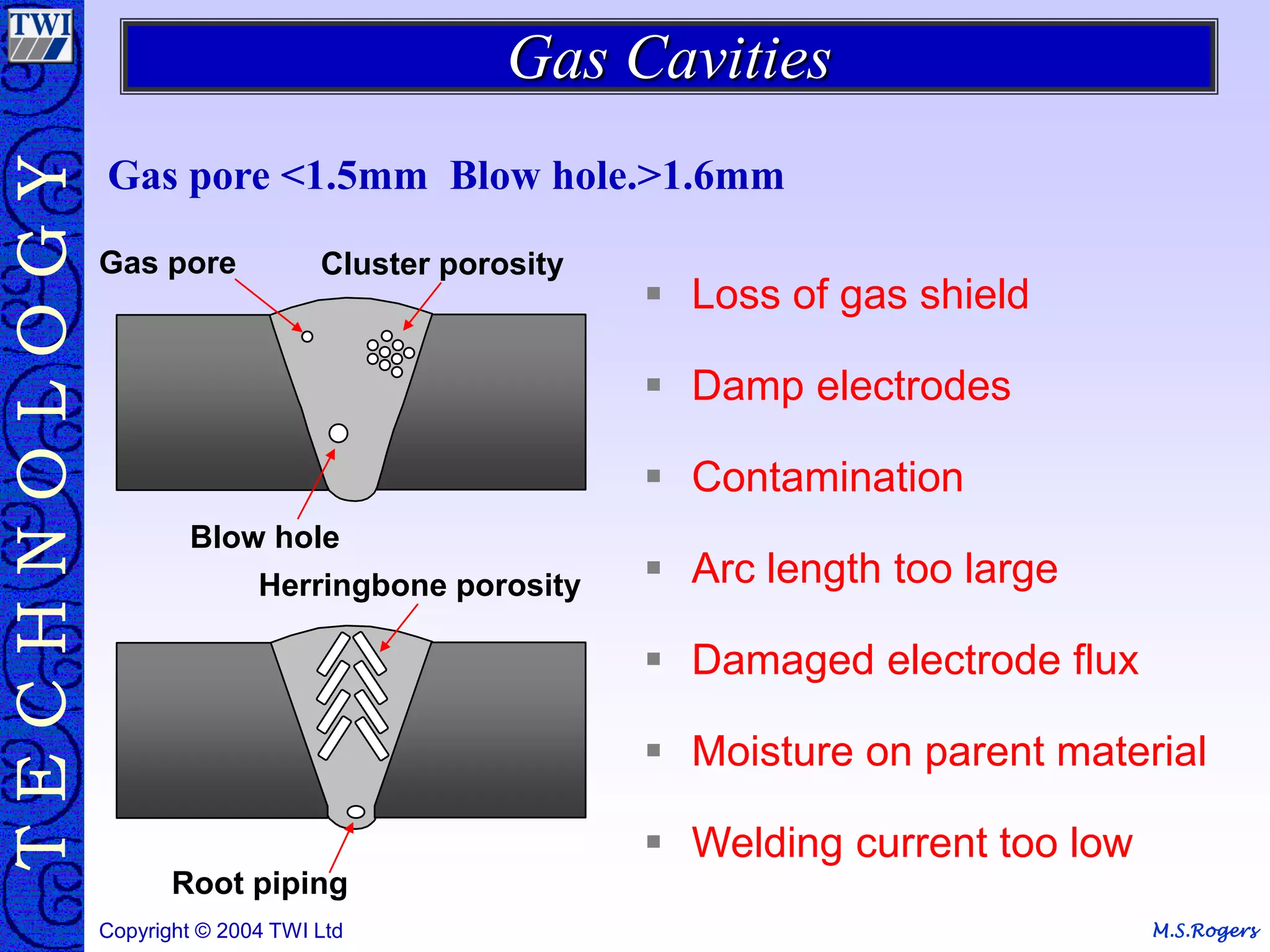
Root piping
Cluster porosity
Gas pore
Blow hole
Herringbone porosity
 Loss of gas shield
 Damp electrodes
 Contamination
 Arc length too large
 Damaged electrode flux
 Moisture on parent material
 Welding current too low
Gas pore <1.5mm Blow hole.>1.6mm
Gas Cavities
M.S.Rogers
Copyright © 2004 TWI Ltd
Root piping
Porosity
Gas Cavities
M.S.Rogers
Copyright © 2004 TWI Ltd
Cluster porosity Herringbone porosity
M.S.Rogers
Copyright © 2004 TWI Ltd
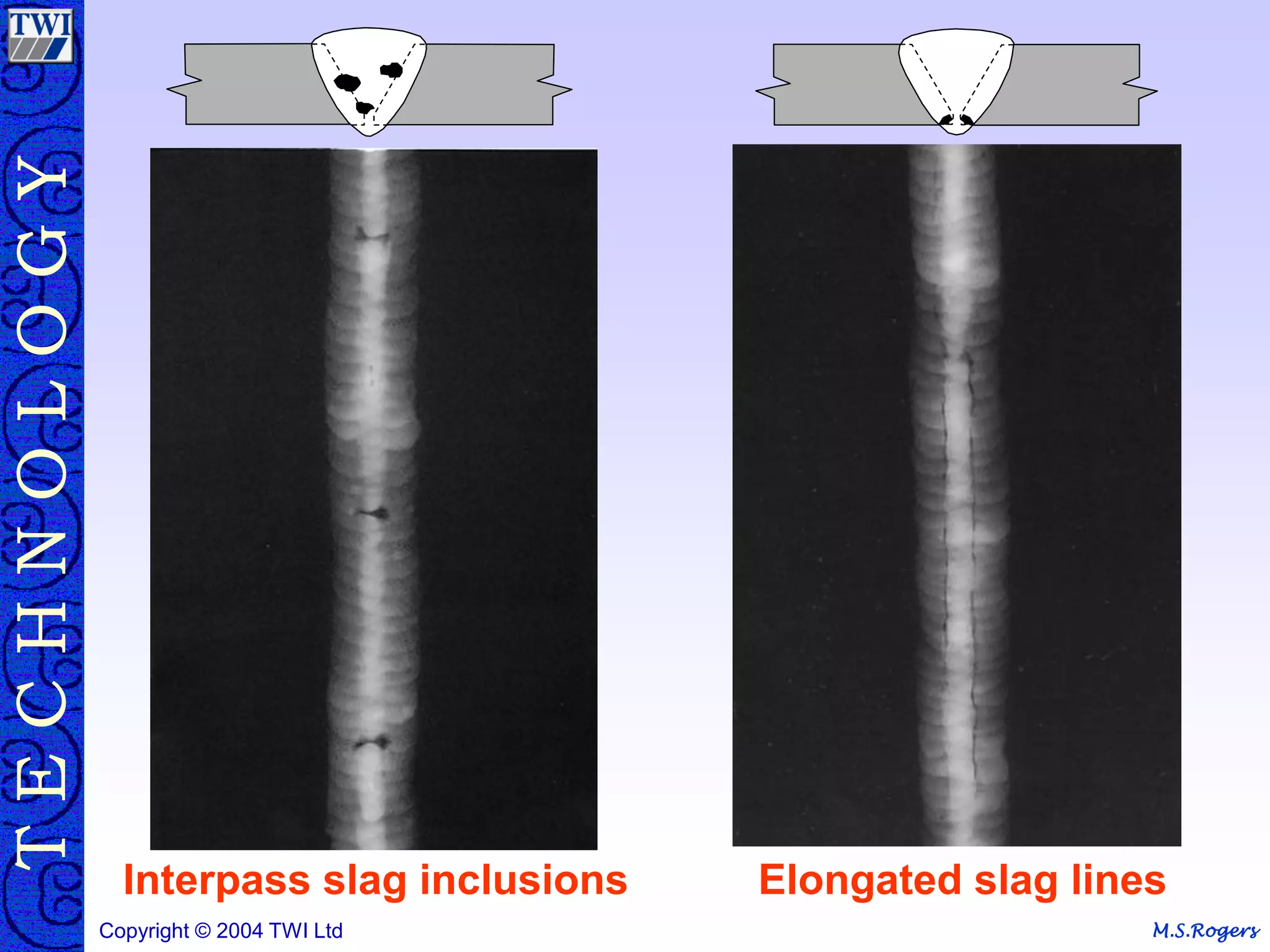
 Slag originates from welding
flux
 MAG and TIG welding
process produce silica
inclusions
 Slag is caused by
inadequate cleaning
 Other inclusions include
tungsten and copper
inclusions from the TIG and
MAG welding process
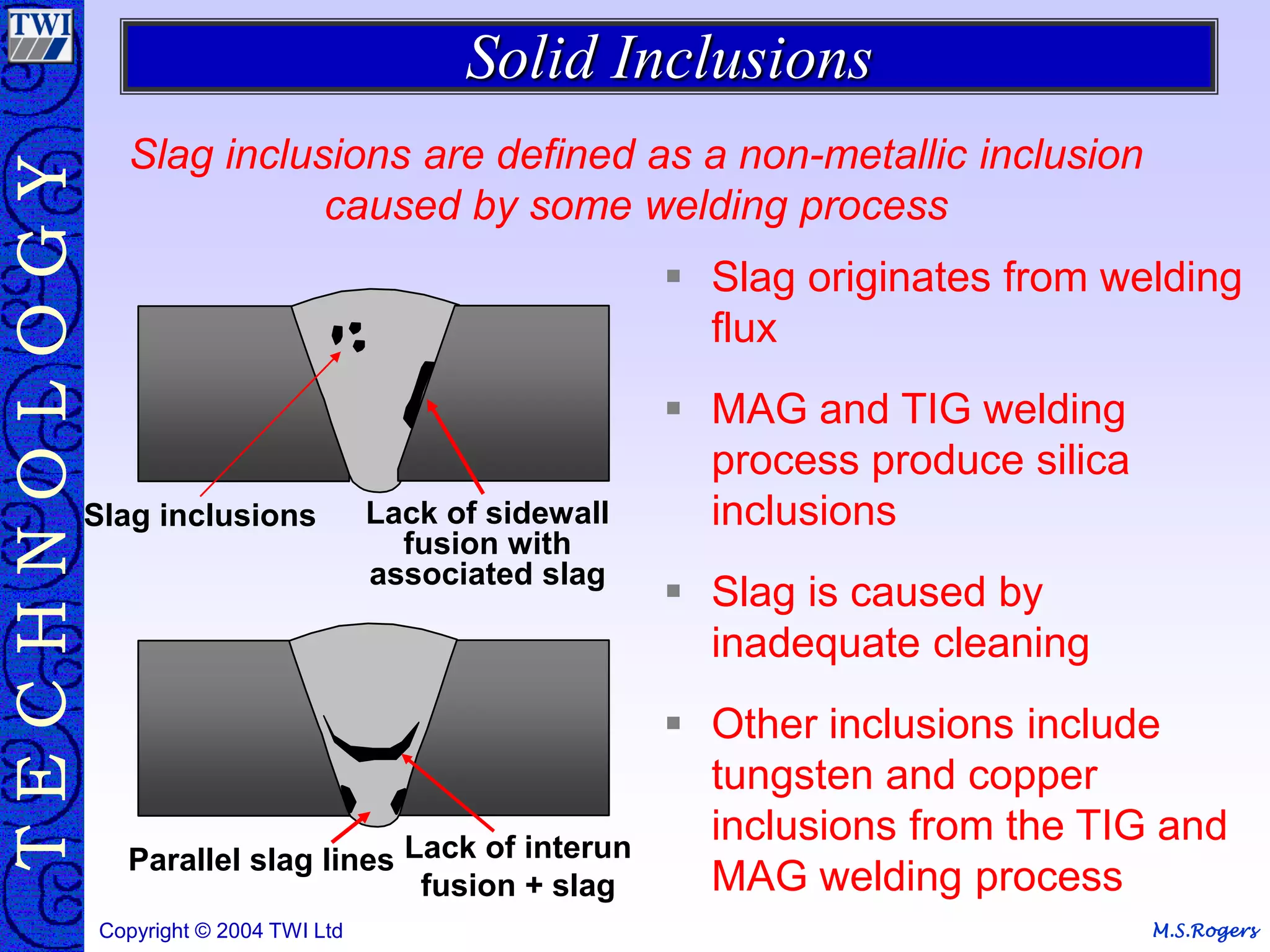
Slag inclusions are defined as a non-metallic inclusion
caused by some welding process
Slag inclusions
Parallel slag lines Lack of interun
fusion + slag
Lack of sidewall
fusion with
associated slag
Solid Inclusions
M.S.Rogers
Copyright © 2004 TWI Ltd
Elongated slag lines
Interpass slag inclusions
M.S.Rogers
Copyright © 2004 TWI Ltd
Lack of Fusion
M.S.Rogers
Copyright © 2004 TWI Ltd
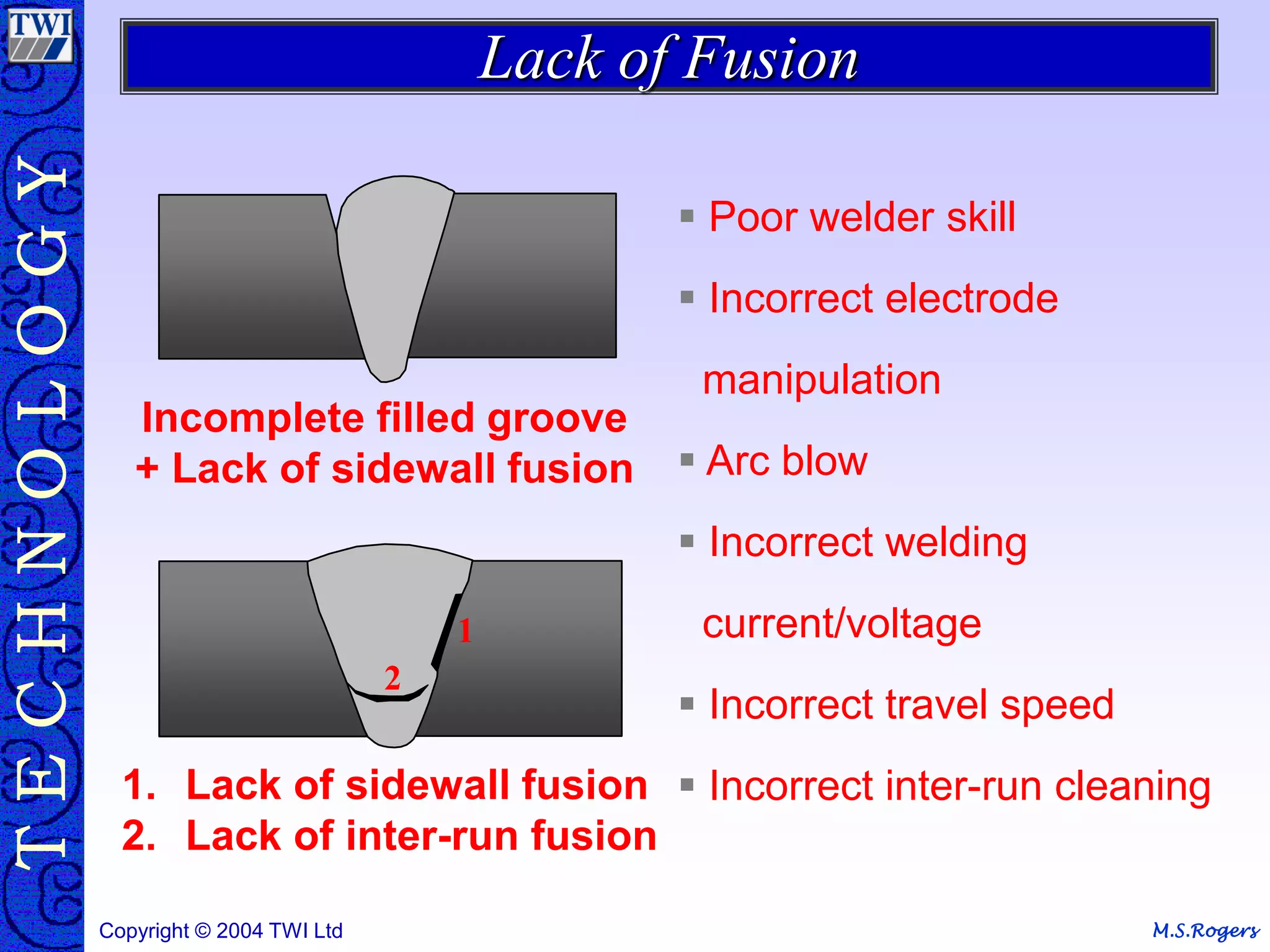
Incomplete filled groove
+ Lack of sidewall fusion
1
2
1. Lack of sidewall fusion
2. Lack of inter-run fusion
 Poor welder skill
 Incorrect electrode
manipulation
 Arc blow
 Incorrect welding
current/voltage
 Incorrect travel speed
 Incorrect inter-run cleaning
Lack of Fusion
M.S.Rogers
Copyright © 2004 TWI Ltd
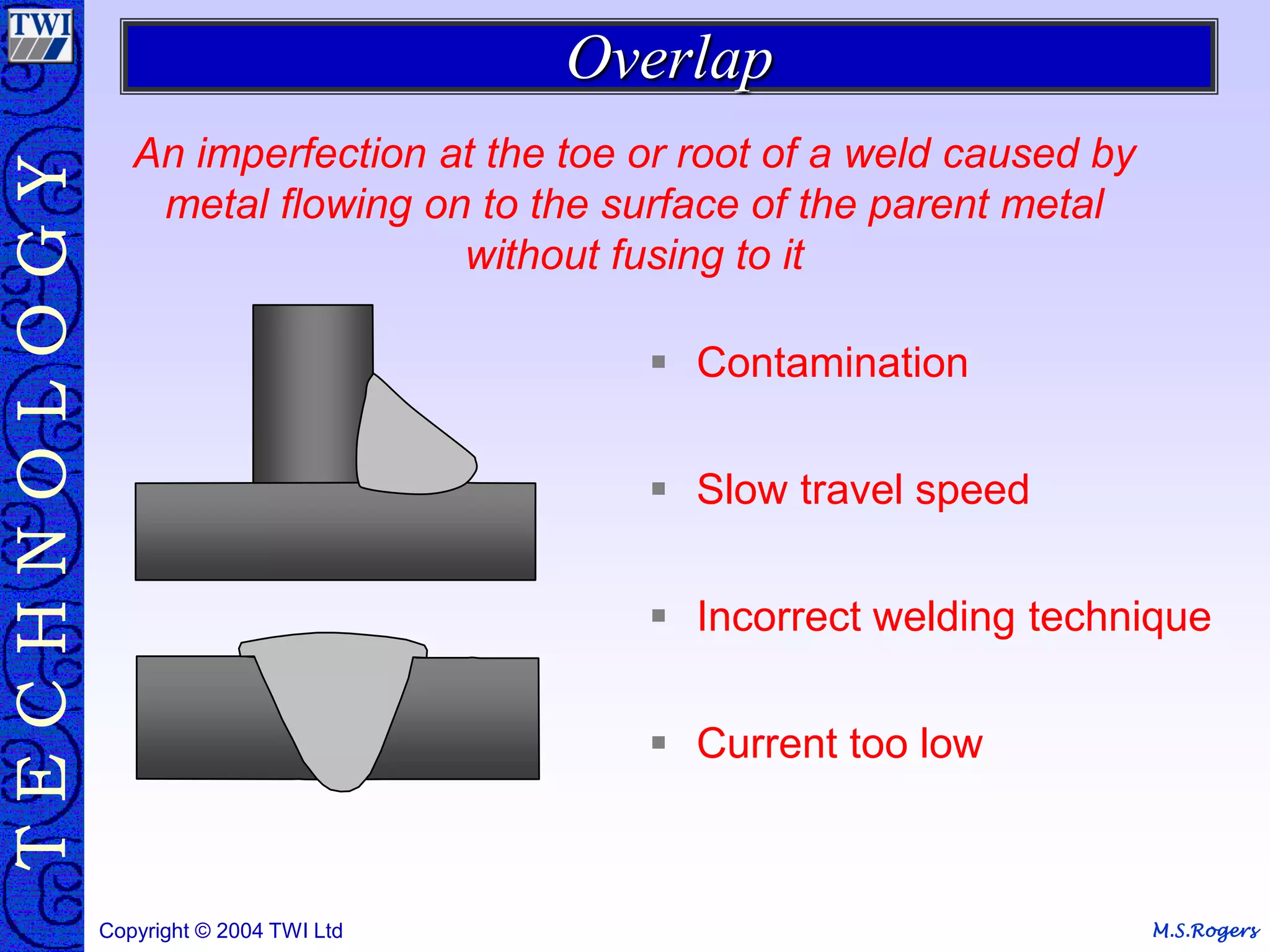
An imperfection at the toe or root of a weld caused by
metal flowing on to the surface of the parent metal
without fusing to it
 Contamination
 Slow travel speed
 Incorrect welding technique
 Current too low
Overlap
M.S.Rogers
Copyright © 2004 TWI Ltd
Toe Overlap
Fillet weld
Toe Overlap
Butt weld
Overlap
M.S.Rogers
Copyright © 2004 TWI Ltd
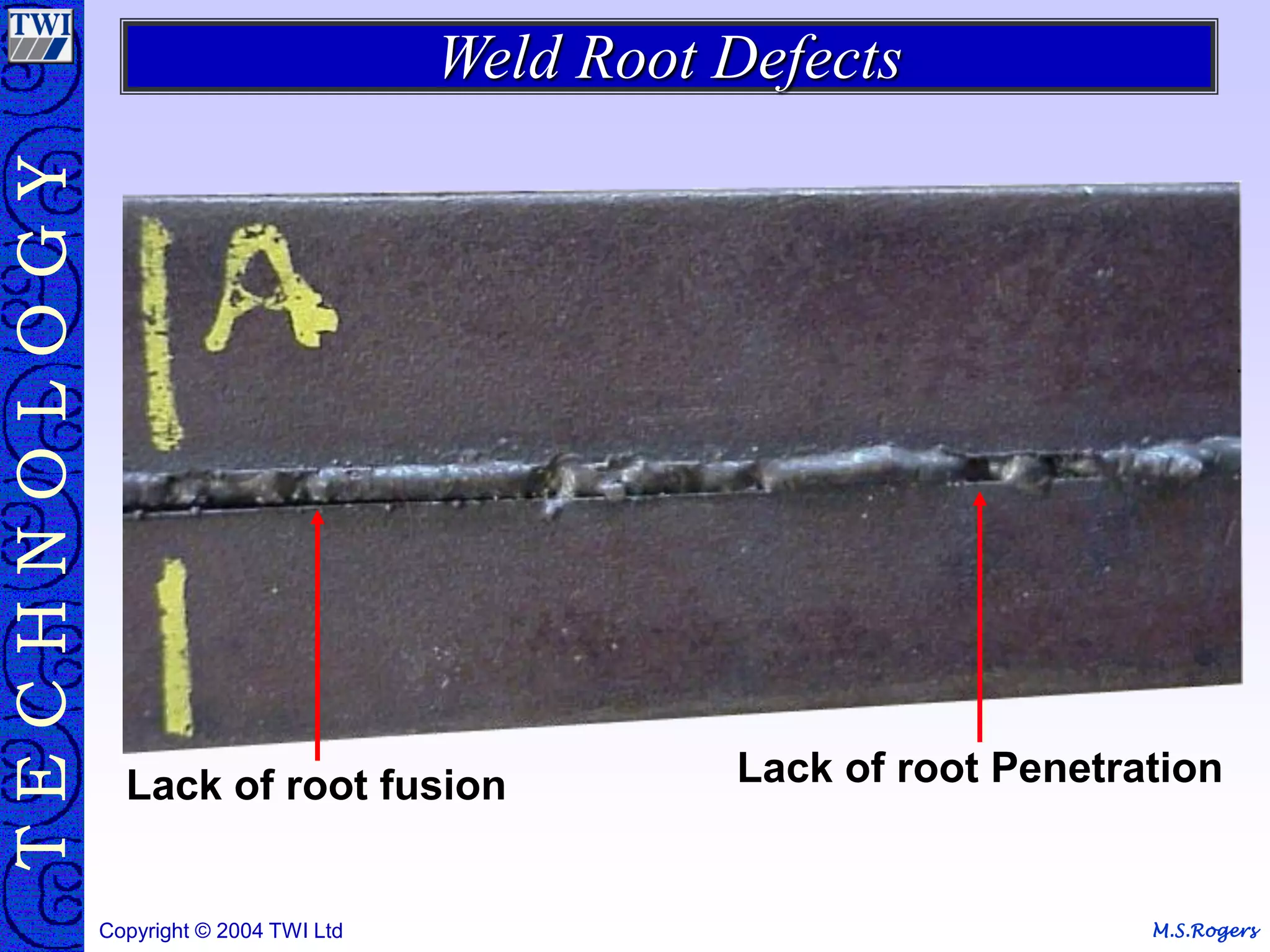
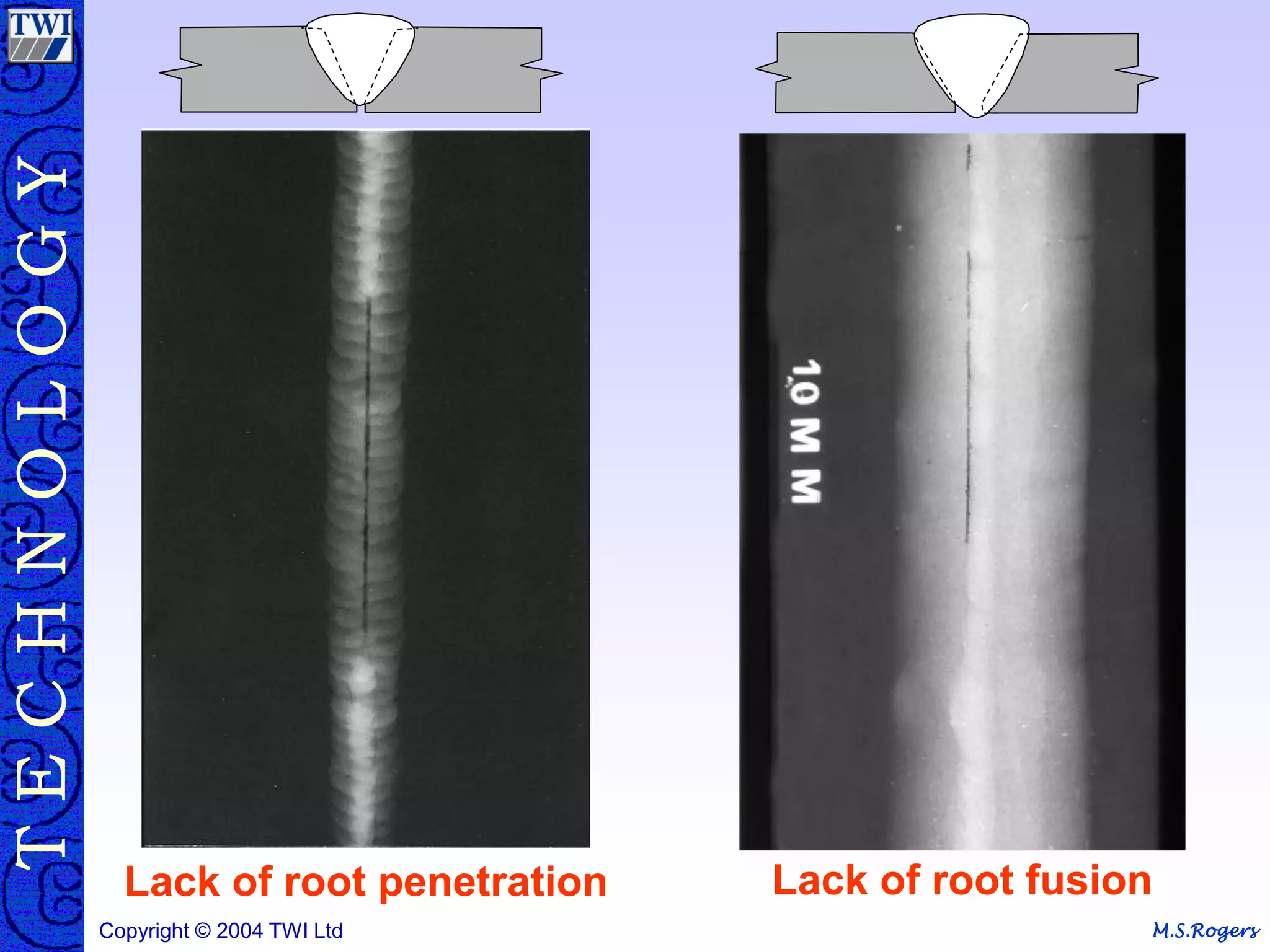
Incomplete root fusion
Incomplete root penetration
 Low Amps/volts
 Large Root face
 Small Root Gap
 Fast Travel Speed
 Incorrect Electrode Angle
 Contamination
 Arc blow
Weld Root Defects
M.S.Rogers
Copyright © 2004 TWI Ltd
Lack of root fusion Lack of root Penetration
Weld Root Defects
M.S.Rogers
Copyright © 2004 TWI Ltd
Lack of root penetration Lack of root fusion
M.S.Rogers
Copyright © 2004 TWI Ltd
Surface & Profile
M.S.Rogers
Copyright © 2004 TWI Ltd
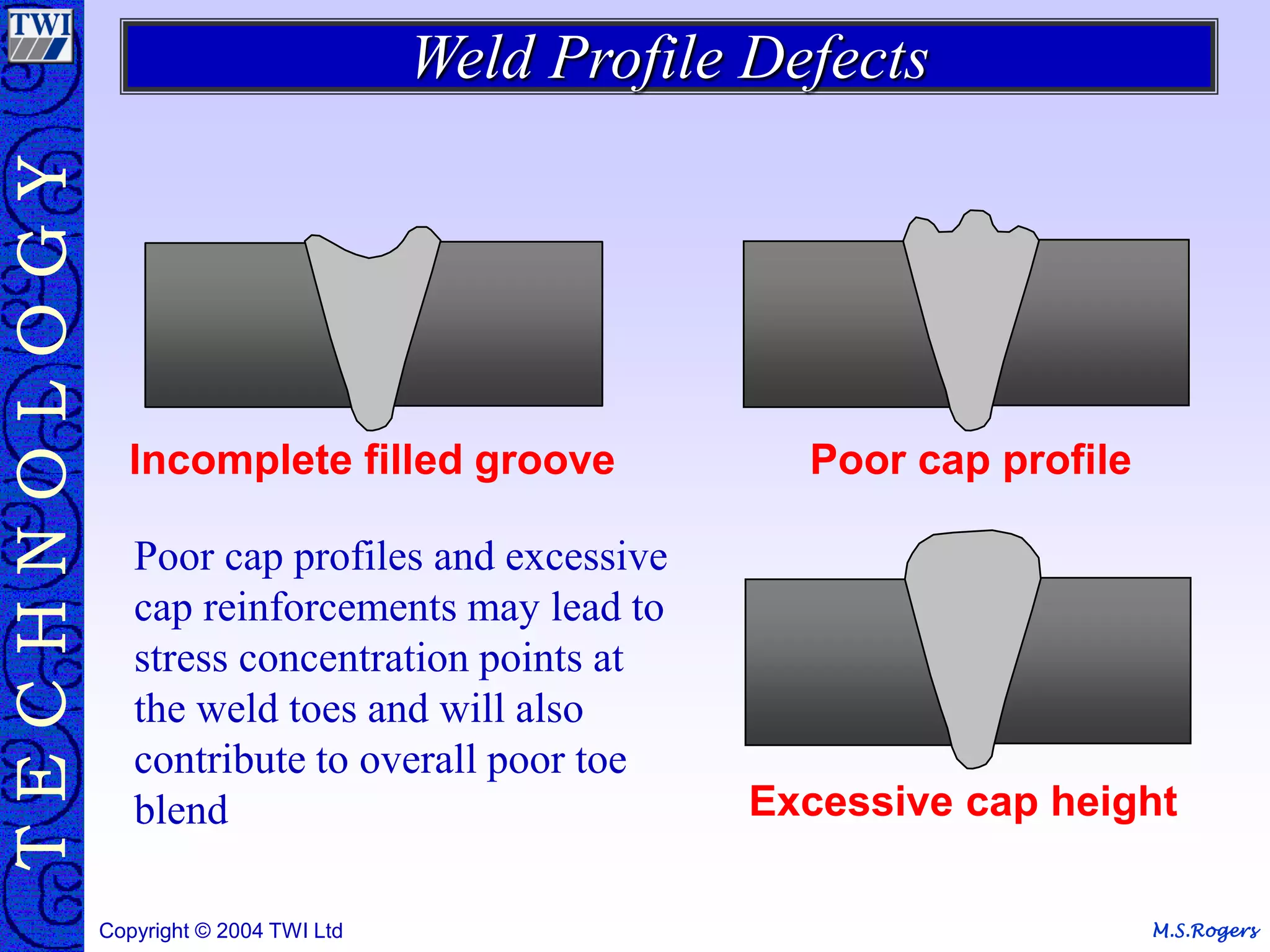
Incomplete filled groove Poor cap profile
Excessive cap height
Poor cap profiles and excessive
cap reinforcements may lead to
stress concentration points at
the weld toes and will also
contribute to overall poor toe
blend
Weld Profile Defects
M.S.Rogers
Copyright © 2004 TWI Ltd
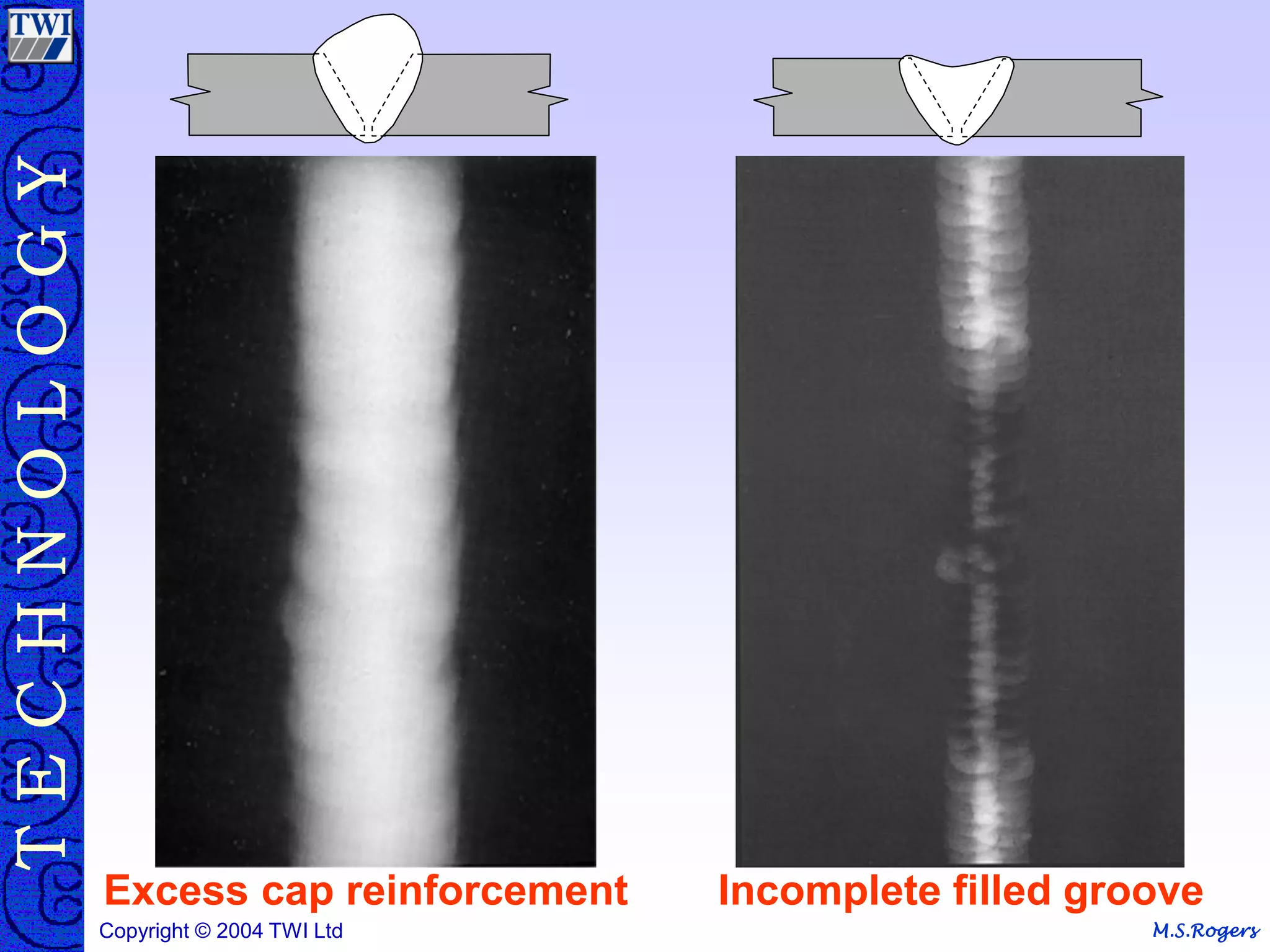
Incomplete filled groove
Excess cap reinforcement
M.S.Rogers
Copyright © 2004 TWI Ltd
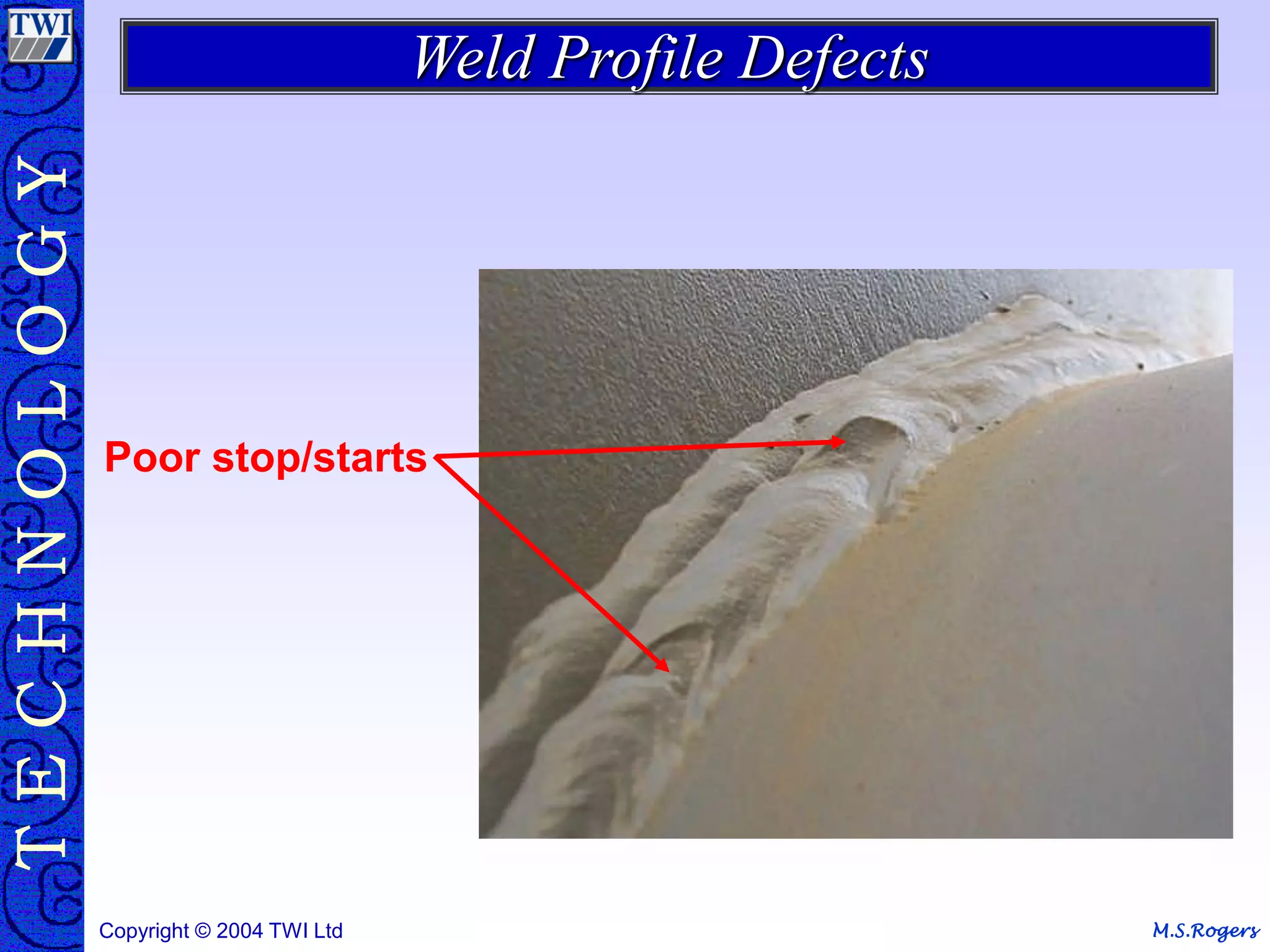
Poor stop/starts
Weld Profile Defects
M.S.Rogers
Copyright © 2004 TWI Ltd
Miscellaneous Defects
M.S.Rogers
Copyright © 2004 TWI Ltd
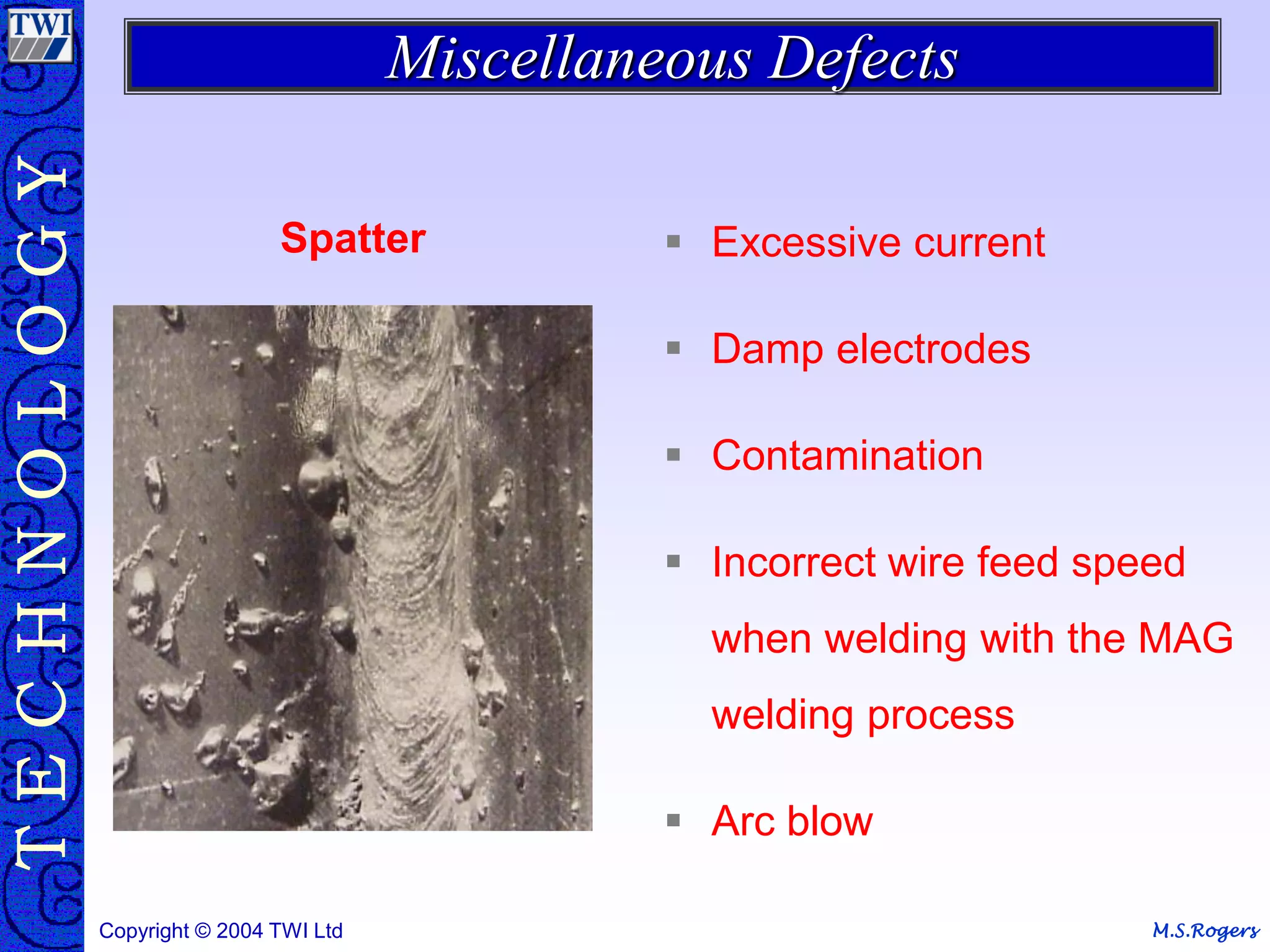
Spatter  Excessive current
 Damp electrodes
 Contamination
 Incorrect wire feed speed
when welding with the MAG
welding process
 Arc blow
Miscellaneous Defects
M.S.Rogers
Copyright © 2004 TWI Ltd
 Accidental striking of the arc
onto the parent material
 Faulty electrode holder
 Poor cable insulation
 Poor return lead clamping
Arc strike
Miscellaneous Defects
M.S.Rogers
Copyright © 2004 TWI Ltd
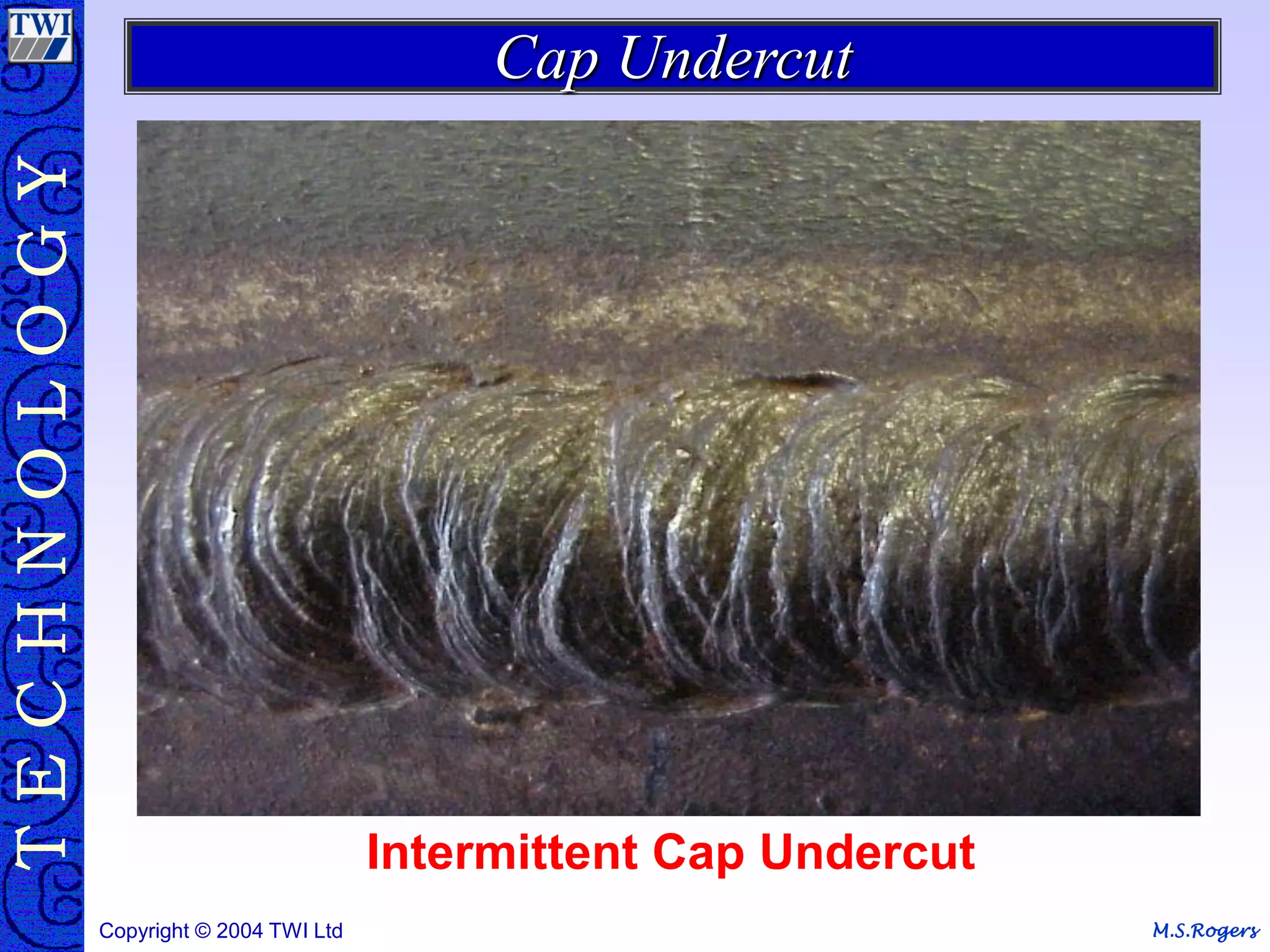
An irregular groove at the toe of a weld run in the
parent metal
 Excessive amps/volts
 Excessive travel speed
 Incorrect electrode angle
 Excessive weaving
 Incorrect welding technique
 Electrode too large
Cap & Root Undercut
M.S.Rogers
Copyright © 2004 TWI Ltd
Intermittent Cap Undercut
Cap Undercut
M.S.Rogers
Copyright © 2004 TWI Ltd M.S.Rogers
Copyright © 2003 TWI Ltd
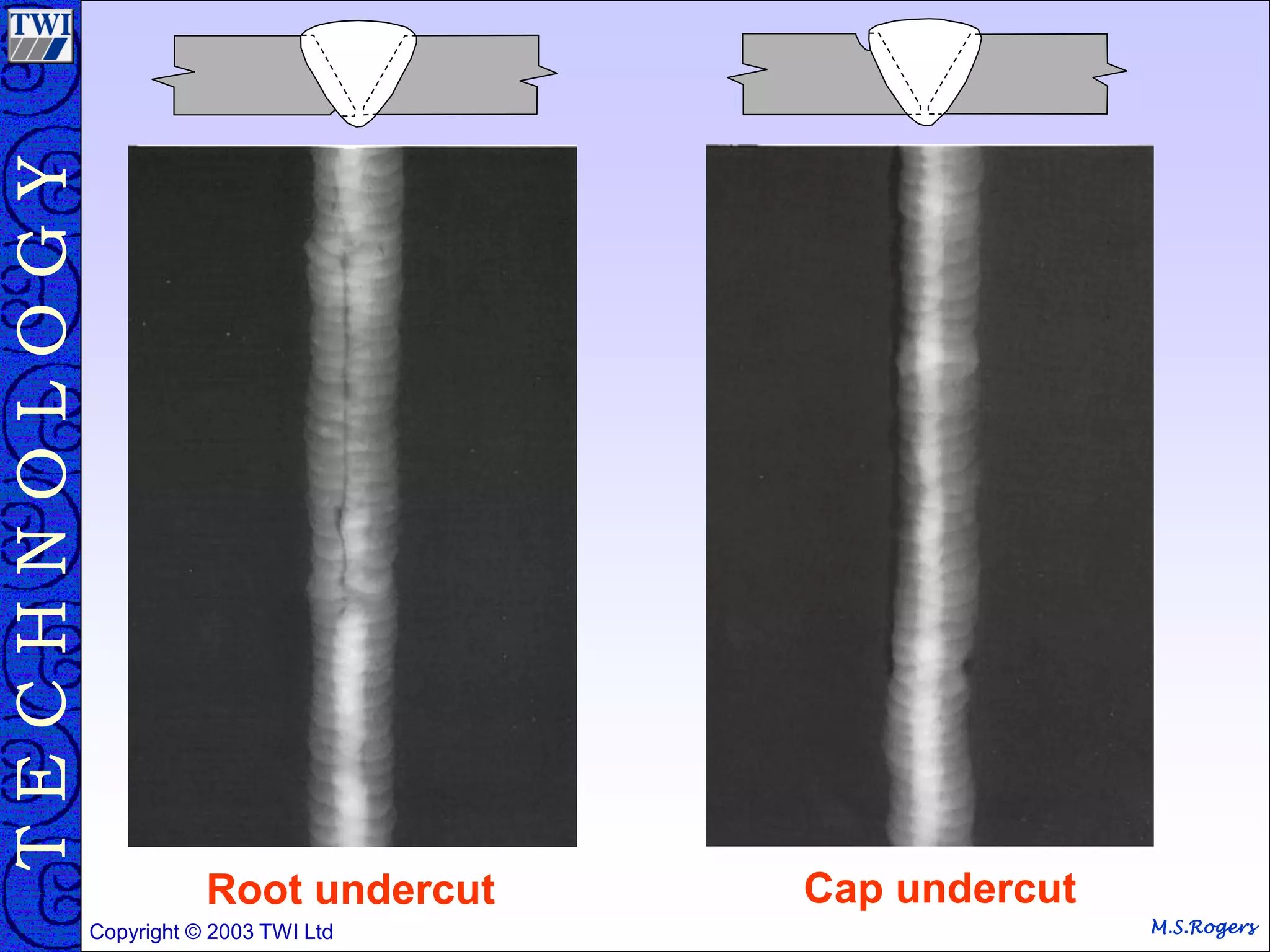
Cap undercut
Root undercut
M.S.Rogers
Copyright © 2004 TWI Ltd
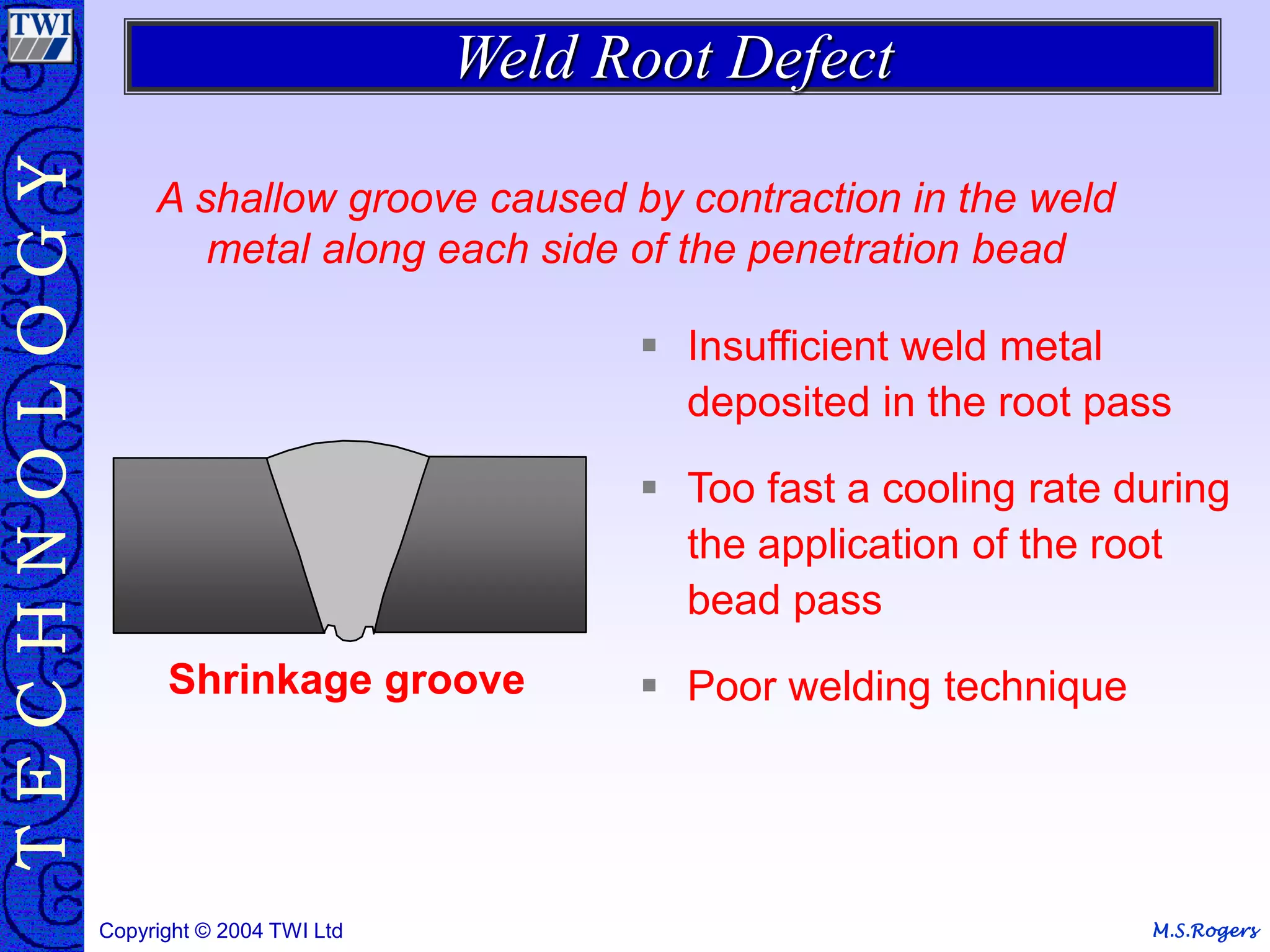
Shrinkage groove
 Insufficient weld metal
deposited in the root pass
 Too fast a cooling rate during
the application of the root
bead pass
 Poor welding technique
A shallow groove caused by contraction in the weld
metal along each side of the penetration bead
Weld Root Defect
M.S.Rogers
Copyright © 2004 TWI Ltd
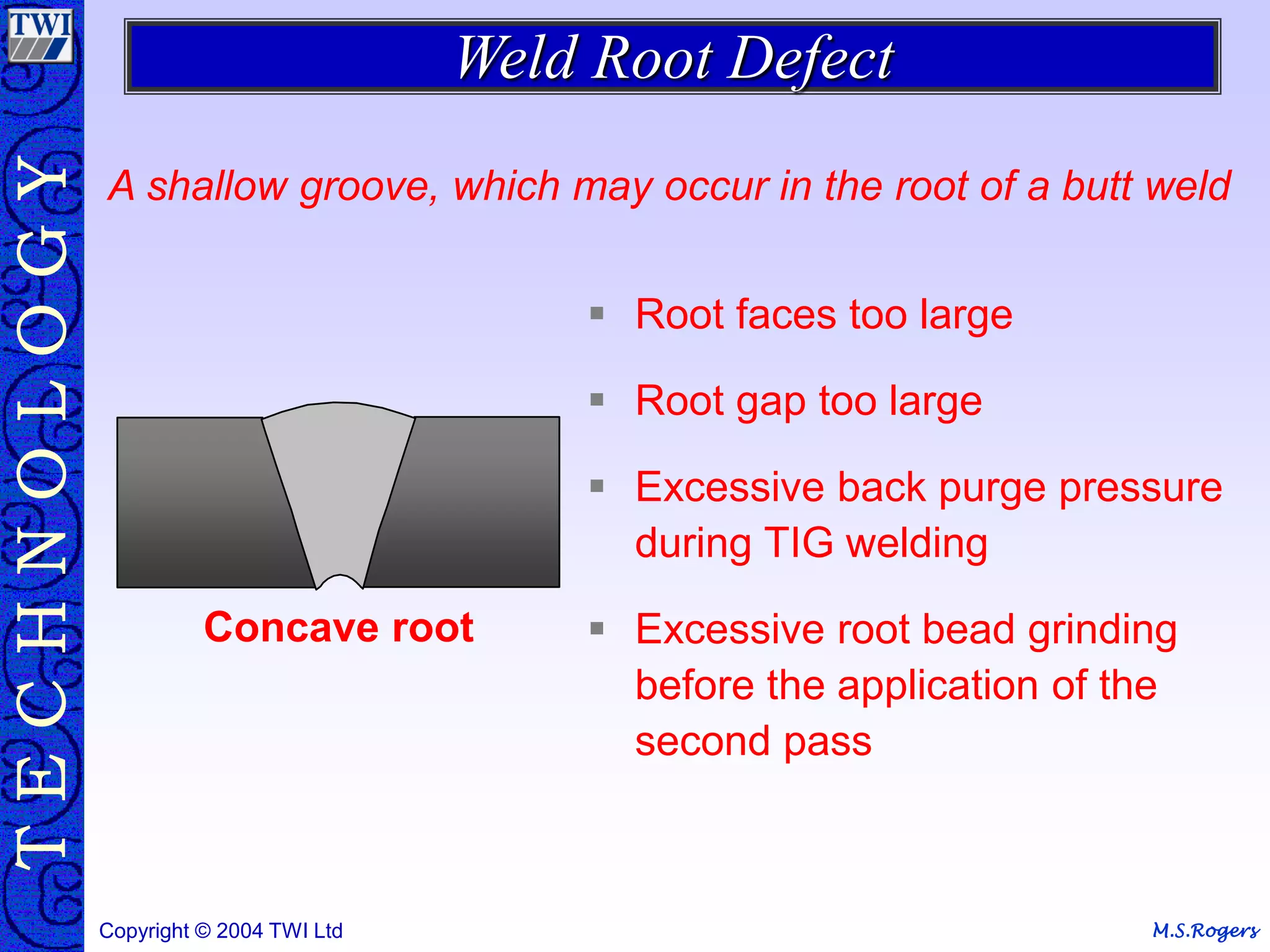
Concave root
 Root faces too large
 Root gap too large
 Excessive back purge pressure
during TIG welding
 Excessive root bead grinding
before the application of the
second pass
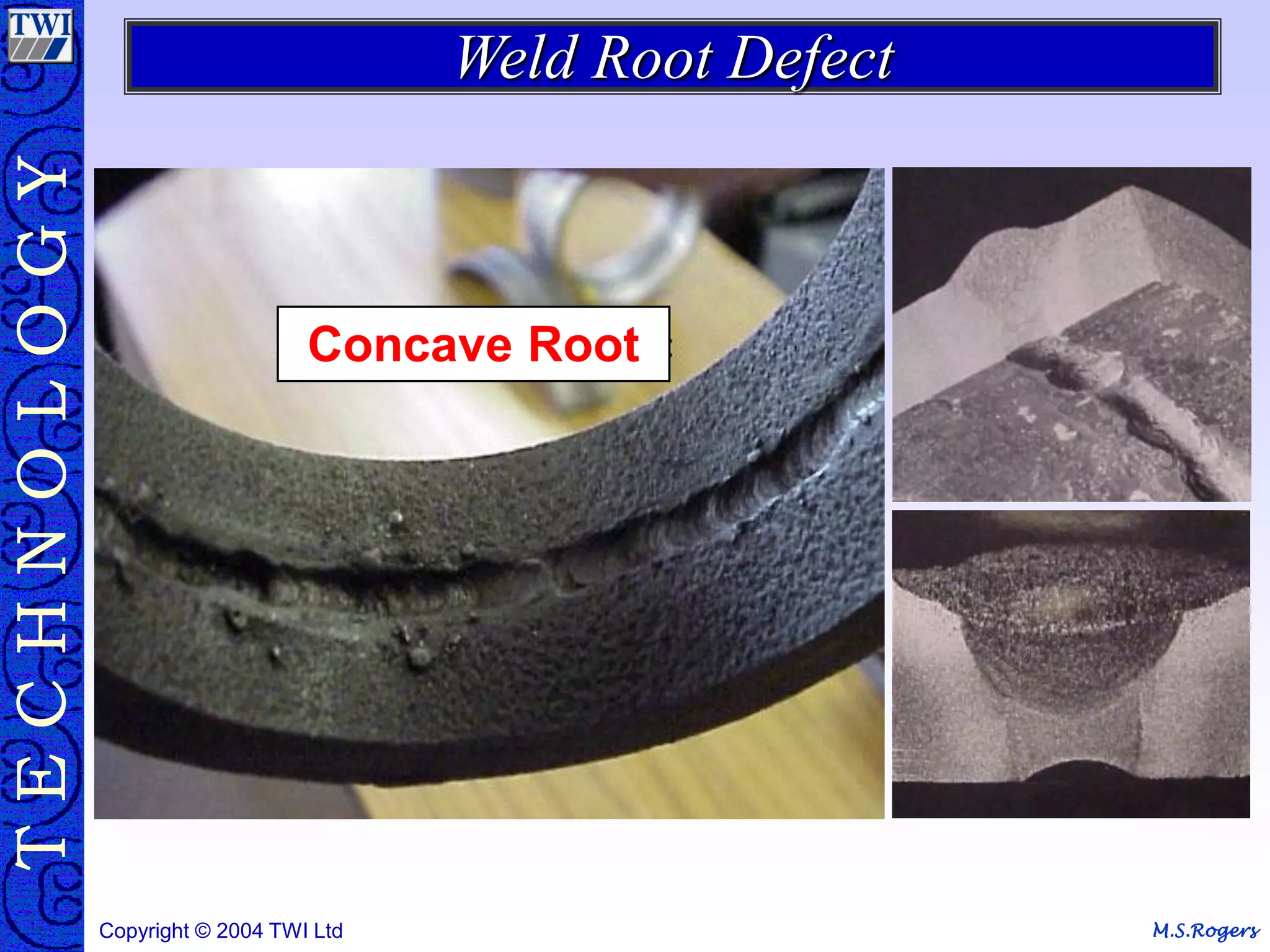
A shallow groove, which may occur in the root of a butt weld
Weld Root Defect
M.S.Rogers
Copyright © 2004 TWI Ltd
Concave Root
Weld Root Defect
M.S.Rogers
Copyright © 2004 TWI Ltd
Excessive root penetration
 Root faces too small
 Root gap too large
 Excessive amps/volts
 Slow travel speed
Root penetration bead in excess in accordance with the
relevant specification being used
Weld Root Defect
M.S.Rogers
Copyright © 2004 TWI Ltd
Weld Root Defect
Excessive root
penetration
M.S.Rogers
Copyright © 2004 TWI Ltd M.S.Rogers
Copyright © 2003 TWI Ltd
Concave root Excess root penetration
M.S.Rogers
Copyright © 2004 TWI Ltd
 High Amps/volts
 Small Root face
 Large Root Gap
 Slow Travel Speed
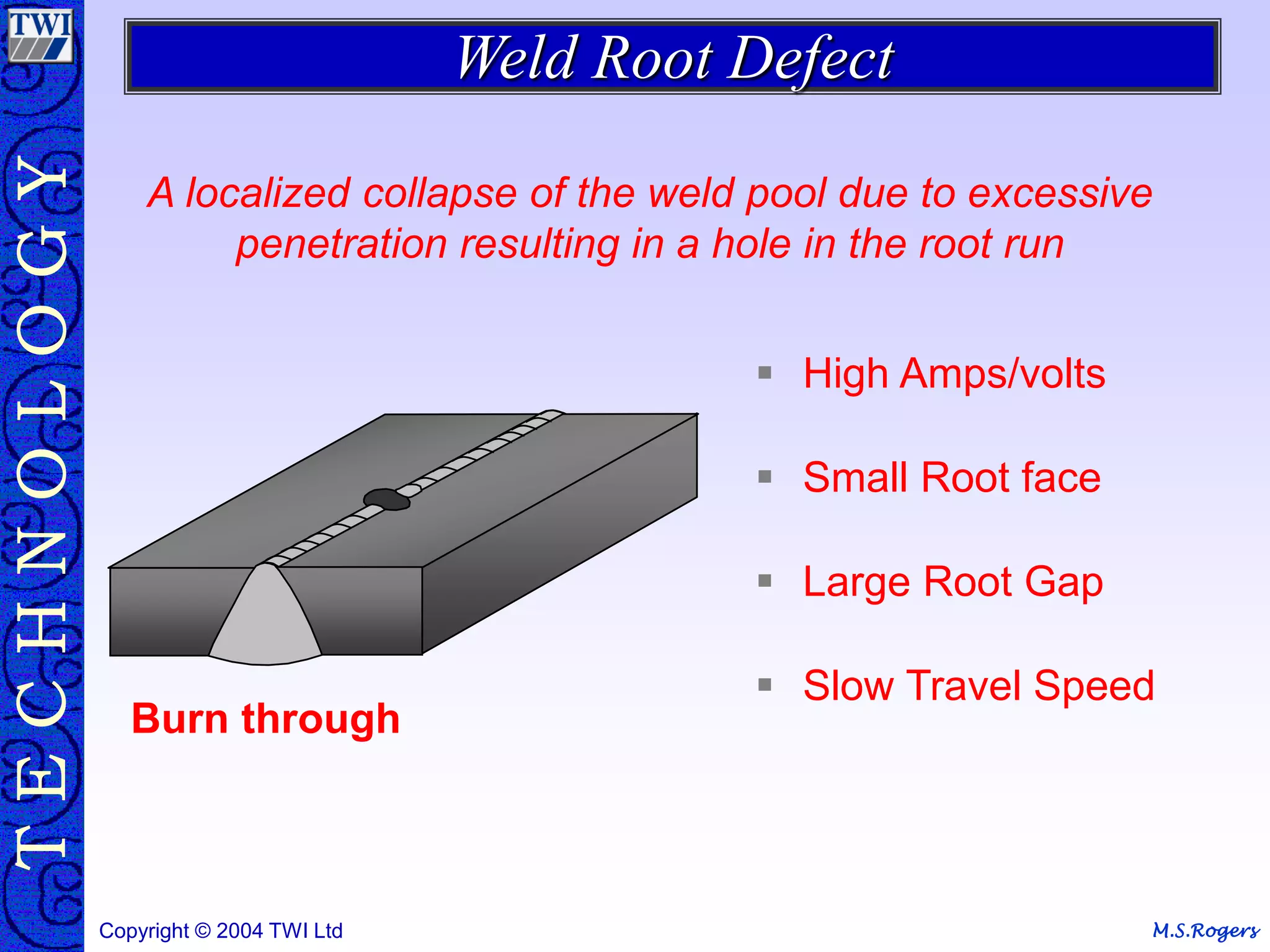
Burn through
A localized collapse of the weld pool due to excessive
penetration resulting in a hole in the root run
Weld Root Defect
M.S.Rogers
Copyright © 2004 TWI Ltd
Weld Root Defect
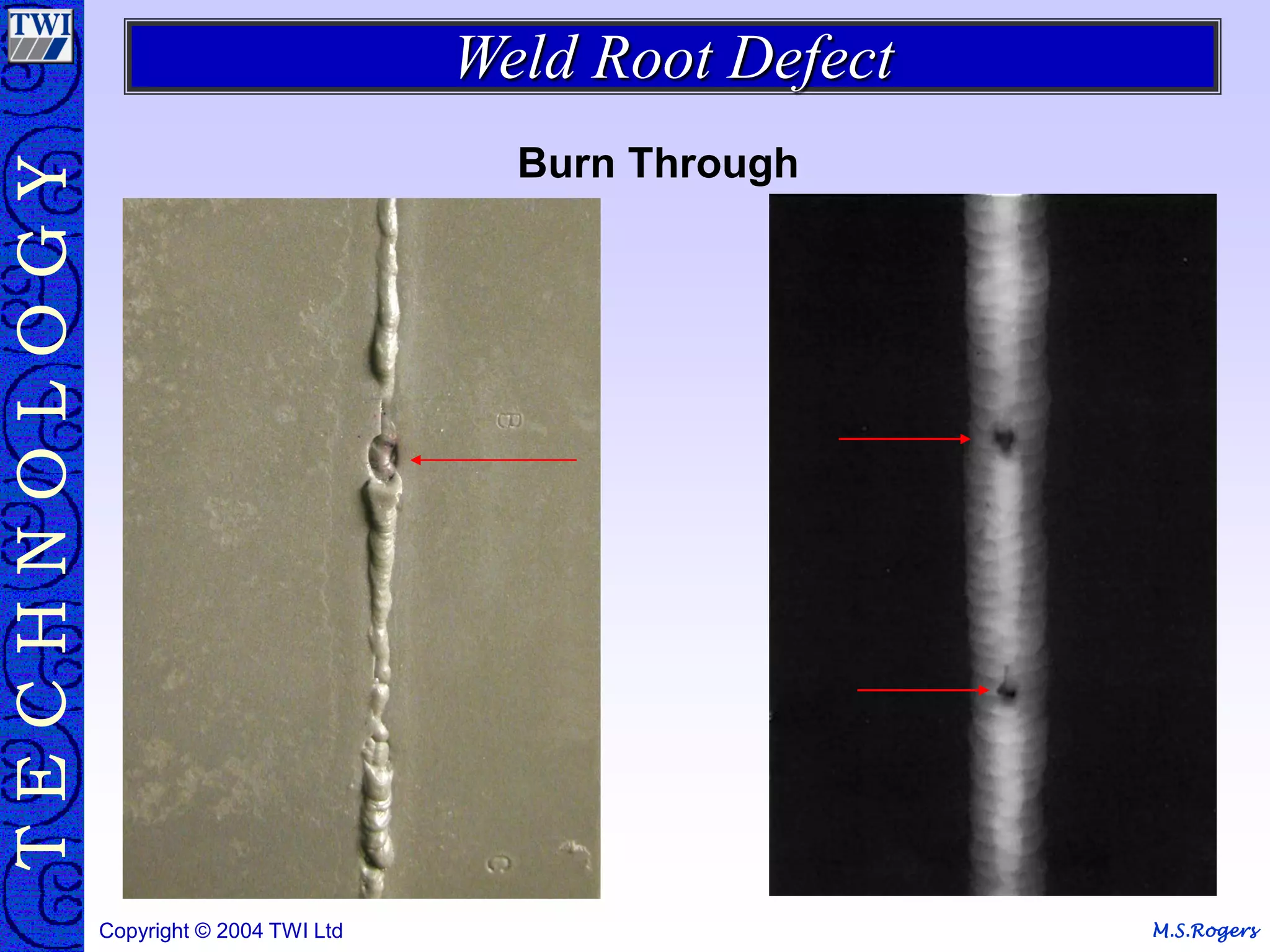
Burn Through
M.S.Rogers
Copyright © 2004 TWI Ltd
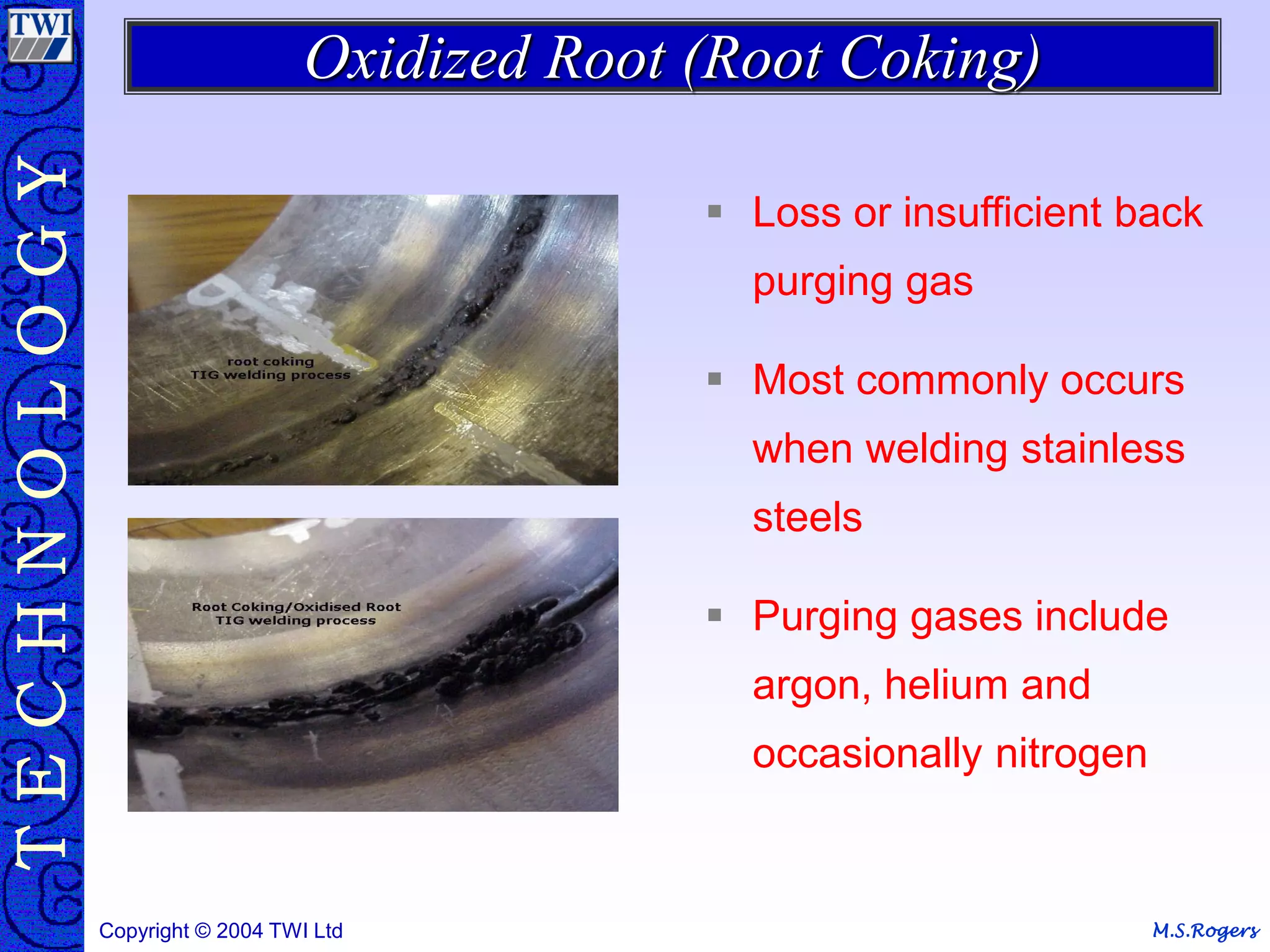
 Loss or insufficient back
purging gas
 Most commonly occurs
when welding stainless
steels
 Purging gases include
argon, helium and
occasionally nitrogen
Oxidized Root (Root Coking)
M.S.Rogers
Copyright © 2004 TWI Ltd
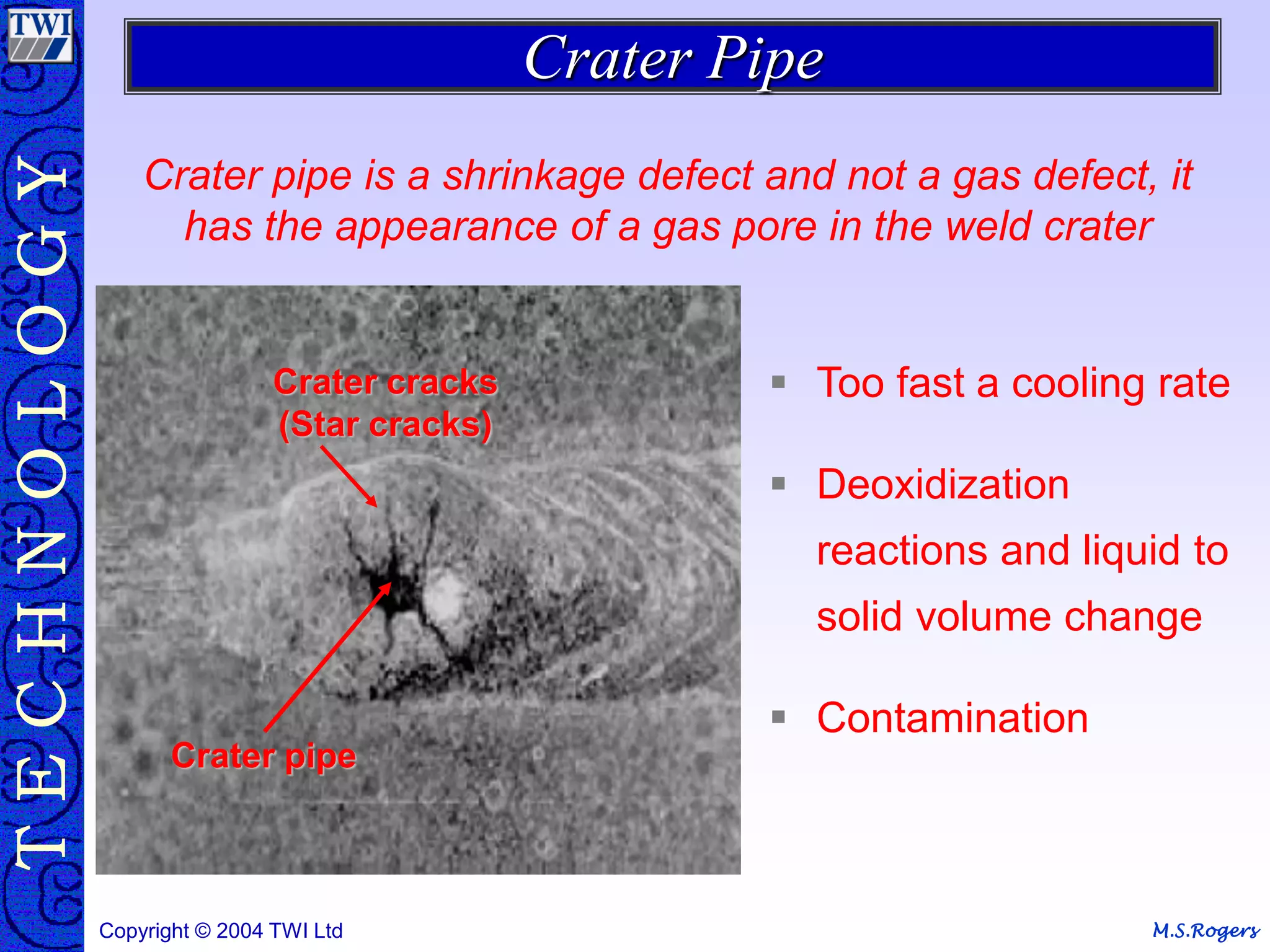
Crater pipe
Weld crater
Crater Pipe
M.S.Rogers
Copyright © 2004 TWI Ltd
Crater pipe is a shrinkage defect and not a gas defect, it
has the appearance of a gas pore in the weld crater
 Too fast a cooling rate
 Deoxidization
reactions and liquid to
solid volume change
 Contamination
Crater cracks
(Star cracks)
Crater pipe
Crater Pipe
M.S.Rogers
Copyright © 2004 TWI Ltd
Mechanical Damage
M.S.Rogers
Copyright © 2004 TWI Ltd
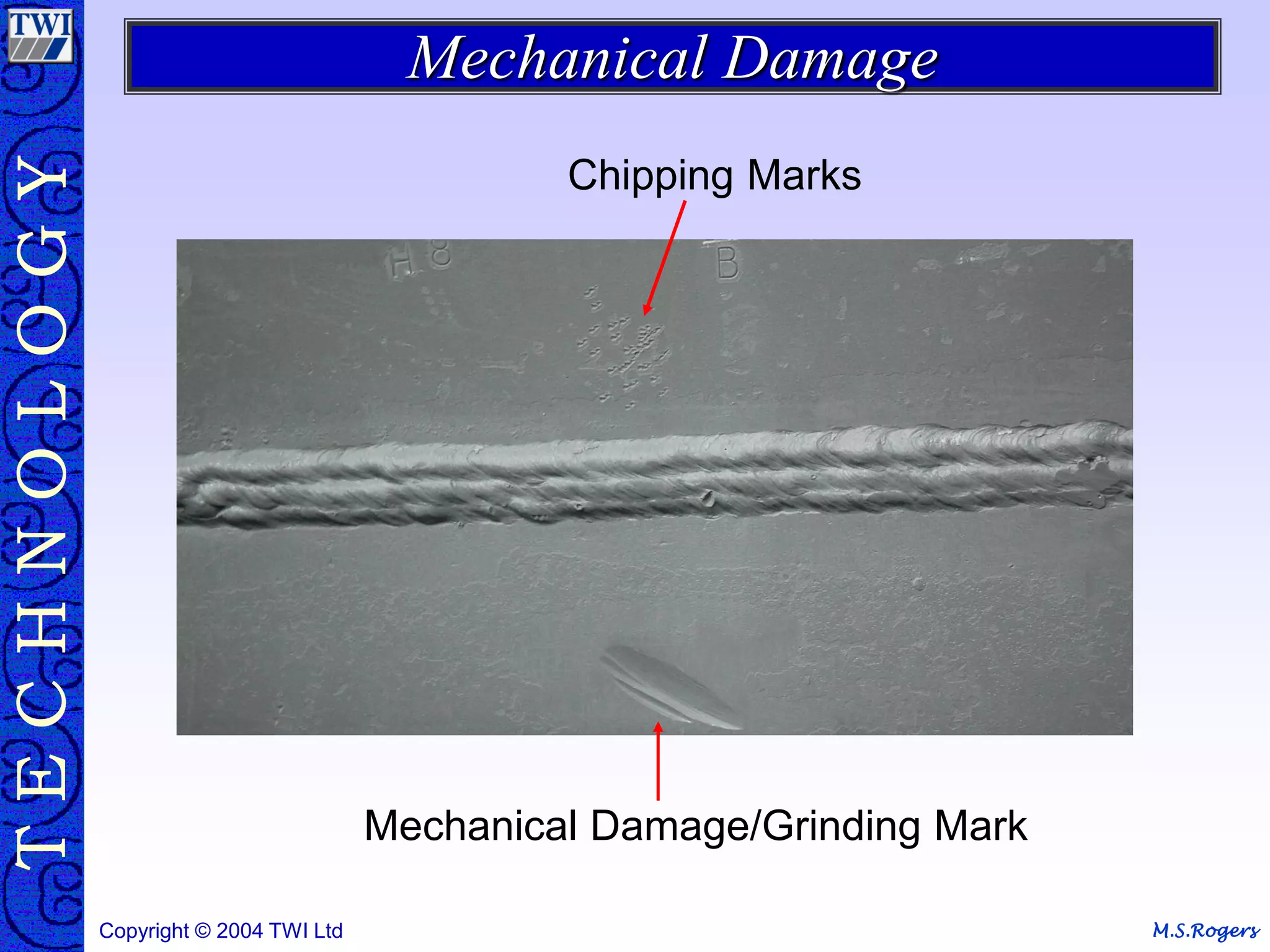
Mechanical damage can be defined as any surface material
damage cause during the manufacturing process.
This can included damage caused by:
 Grinding
 Hammering
 Chiselling
 Chipping
 Breaking off welded attachments (torn surfaces)
 Using needle guns to compress weld capping runs
Mechanical Damage
M.S.Rogers
Copyright © 2004 TWI Ltd
Mechanical Damage
Mechanical Damage/Grinding Mark
Chipping Marks
M.S.Rogers
Copyright © 2004 TWI Ltd
Set-up Irregularities
M.S.Rogers
Copyright © 2004 TWI Ltd
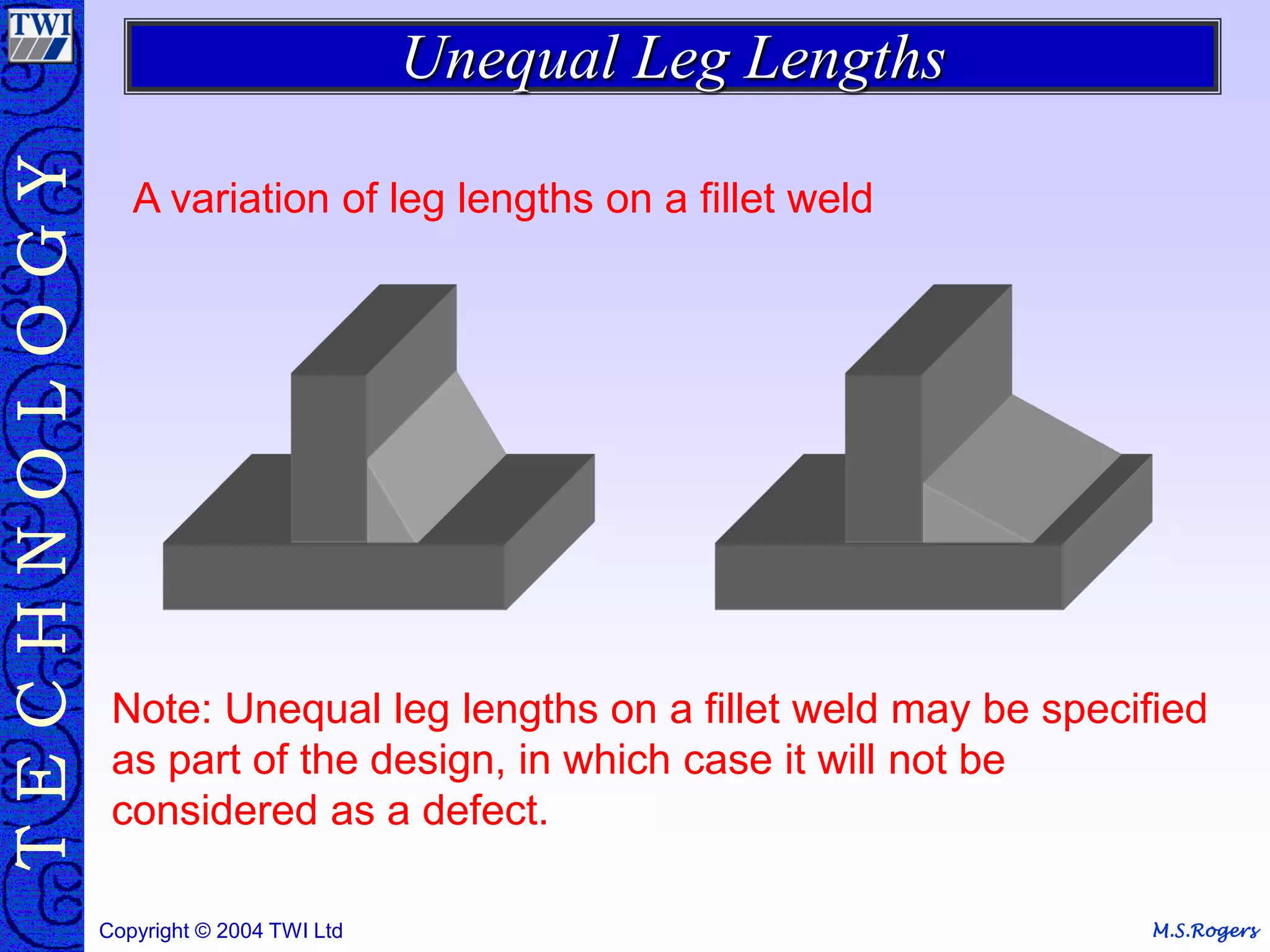
A variation of leg lengths on a fillet weld
Note: Unequal leg lengths on a fillet weld may be specified
as part of the design, in which case it will not be
considered as a defect.
Unequal Leg Lengths
M.S.Rogers
Copyright © 2004 TWI Ltd
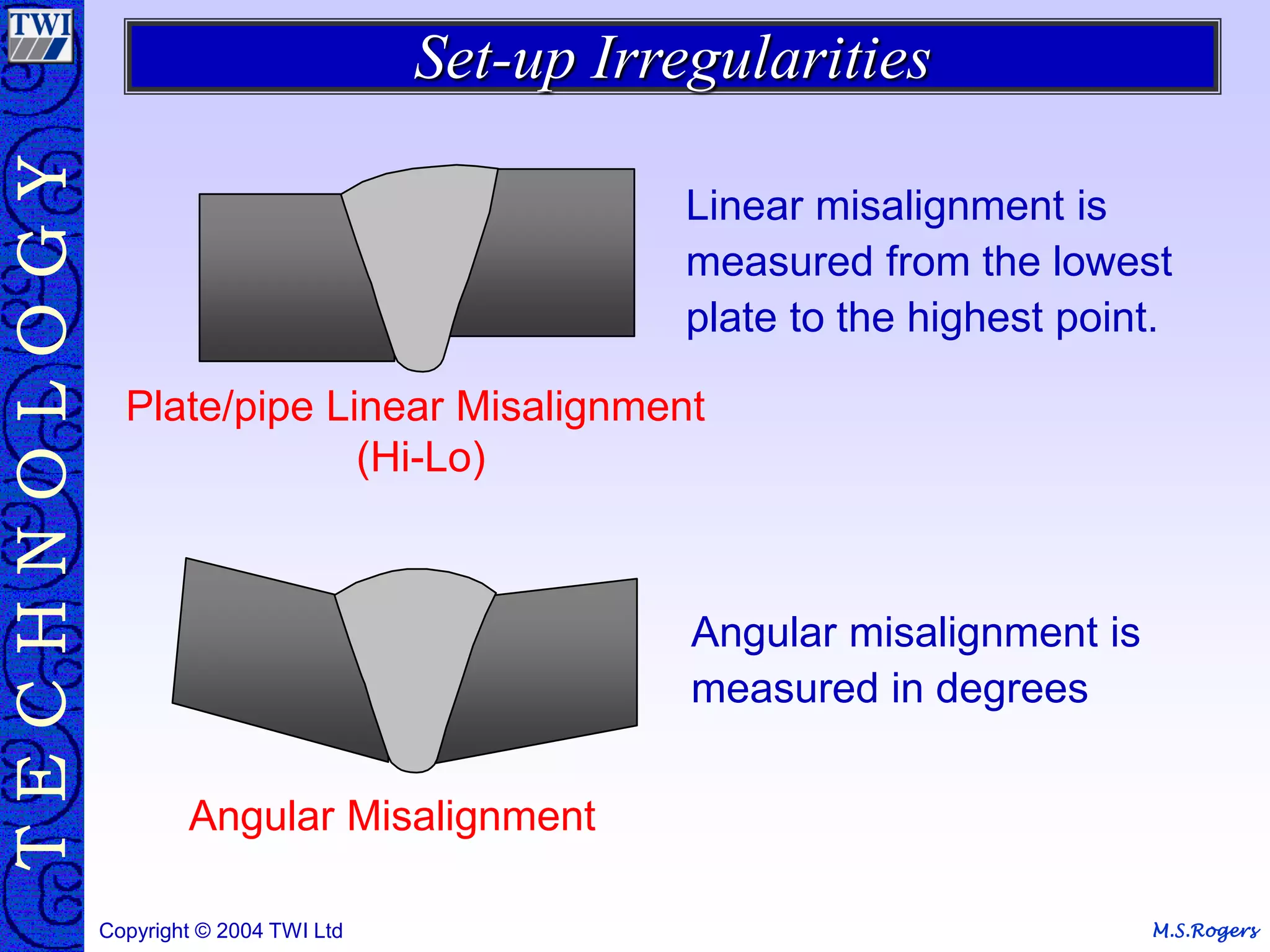
Plate/pipe Linear Misalignment
(Hi-Lo)
Angular Misalignment
Linear misalignment is
measured from the lowest
plate to the highest point.
Angular misalignment is
measured in degrees
Set-up Irregularities
M.S.Rogers
Copyright © 2004 TWI Ltd
Linear Misalignment
Set-up Irregularities
M.S.Rogers
Copyright © 2004 TWI Ltd
Linear Misalignment
Set-up Irregularities
M.S.Rogers
Copyright © 2004 TWI Ltd
Any Questions
M.S.Rogers
Copyright © 2004 TWI Ltd
QU 1. Give two main causes for the occurrence of a burn through
QU 2. Give two main causes for the occurrence of excessive root
penetration on a single-V butt weld
QU 3. Give five defects, which may occur when welding carbon
steel using the MMA welding process with the current
setting to low
QU 4. Give three possible causes for the occurrence of lack of
side wall fusion
QU 5. Sketch the following defects
a. Lack of root wall fusion b. Lack of root penetration
c. Incomplete filled groove d. Concave root
Questions
Weld Defects
M.S.Rogers
Copyright © 2004 TWI Ltd
Material Inspection
Course notes section references 6
M.S.Rogers
Copyright © 2004 TWI Ltd
All materials arriving on site should be inspected for:
 Size / dimensions
 Condition
 Type / specification
In addition other elements may need to be considered
depending on the materials form or shape
Material Inspection
M.S.Rogers
Copyright © 2004 TWI Ltd
Parent material defects include:
Lamination
Mechanical damage Lap
Segregation line
Laminations are caused in the parent plate by the steel making
process, originating from ingot casting defects.
Segregation bands occur in the centre of the plate and are low
melting point impurities such as sulphur and phosphorous.
Laps are caused during rolling when overlapping metal does not
fuse to the base material.
Material Inspection
M.S.Rogers
Copyright © 2004 TWI Ltd
Material Inspection
Plate Lamination
M.S.Rogers
Copyright © 2004 TWI Ltd M.S.Rogers
Copyright © 2004 TWI Ltd
Weld Repairs
Course notes section references 16
M.S.Rogers
Copyright © 2004 TWI Ltd
 Authorization for repair
 Removal and preparation for repair
 Testing of repair - visual and NDT
In the event of repair
Weld Repairs
M.S.Rogers
Copyright © 2004 TWI Ltd
 A weld repair may be used to improve weld profiles or
extensive metal removal
 Repairs to fabrication defects are generally easier than
repairs to service failures because the repair procedure
may be followed
 The main problem with repairing a weld is the
maintenance of mechanical properties
 During the inspection of the removed area prior to welding
the inspector must ensure that the defects have been
totally removed and the original joint profile has been
maintained as close as possible
Weld Repairs
M.S.Rogers
Copyright © 2004 TWI Ltd
The specification or procedure will govern how the defective
areas are to be removed. The method of removal may be
 Grinding
 Chipping
 Machining
 Filing
 Oxy-Gas gouging
 Arc air gouging
Weld Repairs
M.S.Rogers
Copyright © 2004 TWI Ltd
Any Questions

pdfslide.net_120174253-twi-radiographic-interpretation-weld-defects-repair.pdf

  • 1.
    M.S.Rogers Copyright © 2004TWI Ltd Weld Defects & Repairs Radiographic Interpretation
  • 2.
    M.S.Rogers Copyright © 2004TWI Ltd Faults in Fusion Welds
  • 3.
    M.S.Rogers Copyright © 2004TWI Ltd Defects which may be detected by visual inspection can be grouped under the following headings  Cracks  Solid inclusions  Surface and profiles  Misalignment (set-up irregularities)  Gas pores and porosity  Lack of fusion  Mechanical damage  Parent material damage  Miscellaneous Faults in Fusion Welds
  • 4.
  • 5.
    M.S.Rogers Copyright © 2004TWI Ltd Classified by Shape  Longitudinal  Transverse  Branched  Chevron Classified by Position  HAZ  Centreline  Crater  Fusion zone  Parent metal Cracks that may occur in welded materials are caused generally by many factors and may be classified by shape and position, cracks are classed as planar. Cracks
  • 6.
    M.S.Rogers Copyright © 2004TWI Ltd Hydrogen induced cold cracking (HICC) Solidification cracking (Hot Tearing) Lamellar tearing Re heat cracking Process Cracks
  • 7.
    M.S.Rogers Copyright © 2004TWI Ltd Longitudinal parent metal crack Longitudinal weld metal crack Lamellar tearing Transverse weld metal crack Cracks
  • 8.
    M.S.Rogers Copyright © 2004TWI Ltd Transverse crack Longitudinal crack
  • 9.
    M.S.Rogers Copyright © 2004TWI Ltd Inclusions
  • 10.
    M.S.Rogers Copyright © 2004TWI Ltd Root piping Cluster porosity Gas pore Blow hole Herringbone porosity  Loss of gas shield  Damp electrodes  Contamination  Arc length too large  Damaged electrode flux  Moisture on parent material  Welding current too low Gas pore <1.5mm Blow hole.>1.6mm Gas Cavities
  • 11.
    M.S.Rogers Copyright © 2004TWI Ltd Root piping Porosity Gas Cavities
  • 12.
    M.S.Rogers Copyright © 2004TWI Ltd Cluster porosity Herringbone porosity
  • 13.
    M.S.Rogers Copyright © 2004TWI Ltd  Slag originates from welding flux  MAG and TIG welding process produce silica inclusions  Slag is caused by inadequate cleaning  Other inclusions include tungsten and copper inclusions from the TIG and MAG welding process Slag inclusions are defined as a non-metallic inclusion caused by some welding process Slag inclusions Parallel slag lines Lack of interun fusion + slag Lack of sidewall fusion with associated slag Solid Inclusions
  • 14.
    M.S.Rogers Copyright © 2004TWI Ltd Elongated slag lines Interpass slag inclusions
  • 15.
    M.S.Rogers Copyright © 2004TWI Ltd Lack of Fusion
  • 16.
    M.S.Rogers Copyright © 2004TWI Ltd Incomplete filled groove + Lack of sidewall fusion 1 2 1. Lack of sidewall fusion 2. Lack of inter-run fusion  Poor welder skill  Incorrect electrode manipulation  Arc blow  Incorrect welding current/voltage  Incorrect travel speed  Incorrect inter-run cleaning Lack of Fusion
  • 17.
    M.S.Rogers Copyright © 2004TWI Ltd An imperfection at the toe or root of a weld caused by metal flowing on to the surface of the parent metal without fusing to it  Contamination  Slow travel speed  Incorrect welding technique  Current too low Overlap
  • 18.
    M.S.Rogers Copyright © 2004TWI Ltd Toe Overlap Fillet weld Toe Overlap Butt weld Overlap
  • 19.
    M.S.Rogers Copyright © 2004TWI Ltd Incomplete root fusion Incomplete root penetration  Low Amps/volts  Large Root face  Small Root Gap  Fast Travel Speed  Incorrect Electrode Angle  Contamination  Arc blow Weld Root Defects
  • 20.
    M.S.Rogers Copyright © 2004TWI Ltd Lack of root fusion Lack of root Penetration Weld Root Defects
  • 21.
    M.S.Rogers Copyright © 2004TWI Ltd Lack of root penetration Lack of root fusion
  • 22.
    M.S.Rogers Copyright © 2004TWI Ltd Surface & Profile
  • 23.
    M.S.Rogers Copyright © 2004TWI Ltd Incomplete filled groove Poor cap profile Excessive cap height Poor cap profiles and excessive cap reinforcements may lead to stress concentration points at the weld toes and will also contribute to overall poor toe blend Weld Profile Defects
  • 24.
    M.S.Rogers Copyright © 2004TWI Ltd Incomplete filled groove Excess cap reinforcement
  • 25.
    M.S.Rogers Copyright © 2004TWI Ltd Poor stop/starts Weld Profile Defects
  • 26.
    M.S.Rogers Copyright © 2004TWI Ltd Miscellaneous Defects
  • 27.
    M.S.Rogers Copyright © 2004TWI Ltd Spatter  Excessive current  Damp electrodes  Contamination  Incorrect wire feed speed when welding with the MAG welding process  Arc blow Miscellaneous Defects
  • 28.
    M.S.Rogers Copyright © 2004TWI Ltd  Accidental striking of the arc onto the parent material  Faulty electrode holder  Poor cable insulation  Poor return lead clamping Arc strike Miscellaneous Defects
  • 29.
    M.S.Rogers Copyright © 2004TWI Ltd An irregular groove at the toe of a weld run in the parent metal  Excessive amps/volts  Excessive travel speed  Incorrect electrode angle  Excessive weaving  Incorrect welding technique  Electrode too large Cap & Root Undercut
  • 30.
    M.S.Rogers Copyright © 2004TWI Ltd Intermittent Cap Undercut Cap Undercut
  • 31.
    M.S.Rogers Copyright © 2004TWI Ltd M.S.Rogers Copyright © 2003 TWI Ltd Cap undercut Root undercut
  • 32.
    M.S.Rogers Copyright © 2004TWI Ltd Shrinkage groove  Insufficient weld metal deposited in the root pass  Too fast a cooling rate during the application of the root bead pass  Poor welding technique A shallow groove caused by contraction in the weld metal along each side of the penetration bead Weld Root Defect
  • 33.
    M.S.Rogers Copyright © 2004TWI Ltd Concave root  Root faces too large  Root gap too large  Excessive back purge pressure during TIG welding  Excessive root bead grinding before the application of the second pass A shallow groove, which may occur in the root of a butt weld Weld Root Defect
  • 34.
    M.S.Rogers Copyright © 2004TWI Ltd Concave Root Weld Root Defect
  • 35.
    M.S.Rogers Copyright © 2004TWI Ltd Excessive root penetration  Root faces too small  Root gap too large  Excessive amps/volts  Slow travel speed Root penetration bead in excess in accordance with the relevant specification being used Weld Root Defect
  • 36.
    M.S.Rogers Copyright © 2004TWI Ltd Weld Root Defect Excessive root penetration
  • 37.
    M.S.Rogers Copyright © 2004TWI Ltd M.S.Rogers Copyright © 2003 TWI Ltd Concave root Excess root penetration
  • 38.
    M.S.Rogers Copyright © 2004TWI Ltd  High Amps/volts  Small Root face  Large Root Gap  Slow Travel Speed Burn through A localized collapse of the weld pool due to excessive penetration resulting in a hole in the root run Weld Root Defect
  • 39.
    M.S.Rogers Copyright © 2004TWI Ltd Weld Root Defect Burn Through
  • 40.
    M.S.Rogers Copyright © 2004TWI Ltd  Loss or insufficient back purging gas  Most commonly occurs when welding stainless steels  Purging gases include argon, helium and occasionally nitrogen Oxidized Root (Root Coking)
  • 41.
    M.S.Rogers Copyright © 2004TWI Ltd Crater pipe Weld crater Crater Pipe
  • 42.
    M.S.Rogers Copyright © 2004TWI Ltd Crater pipe is a shrinkage defect and not a gas defect, it has the appearance of a gas pore in the weld crater  Too fast a cooling rate  Deoxidization reactions and liquid to solid volume change  Contamination Crater cracks (Star cracks) Crater pipe Crater Pipe
  • 43.
    M.S.Rogers Copyright © 2004TWI Ltd Mechanical Damage
  • 44.
    M.S.Rogers Copyright © 2004TWI Ltd Mechanical damage can be defined as any surface material damage cause during the manufacturing process. This can included damage caused by:  Grinding  Hammering  Chiselling  Chipping  Breaking off welded attachments (torn surfaces)  Using needle guns to compress weld capping runs Mechanical Damage
  • 45.
    M.S.Rogers Copyright © 2004TWI Ltd Mechanical Damage Mechanical Damage/Grinding Mark Chipping Marks
  • 46.
    M.S.Rogers Copyright © 2004TWI Ltd Set-up Irregularities
  • 47.
    M.S.Rogers Copyright © 2004TWI Ltd A variation of leg lengths on a fillet weld Note: Unequal leg lengths on a fillet weld may be specified as part of the design, in which case it will not be considered as a defect. Unequal Leg Lengths
  • 48.
    M.S.Rogers Copyright © 2004TWI Ltd Plate/pipe Linear Misalignment (Hi-Lo) Angular Misalignment Linear misalignment is measured from the lowest plate to the highest point. Angular misalignment is measured in degrees Set-up Irregularities
  • 49.
    M.S.Rogers Copyright © 2004TWI Ltd Linear Misalignment Set-up Irregularities
  • 50.
    M.S.Rogers Copyright © 2004TWI Ltd Linear Misalignment Set-up Irregularities
  • 51.
    M.S.Rogers Copyright © 2004TWI Ltd Any Questions
  • 52.
    M.S.Rogers Copyright © 2004TWI Ltd QU 1. Give two main causes for the occurrence of a burn through QU 2. Give two main causes for the occurrence of excessive root penetration on a single-V butt weld QU 3. Give five defects, which may occur when welding carbon steel using the MMA welding process with the current setting to low QU 4. Give three possible causes for the occurrence of lack of side wall fusion QU 5. Sketch the following defects a. Lack of root wall fusion b. Lack of root penetration c. Incomplete filled groove d. Concave root Questions Weld Defects
  • 53.
    M.S.Rogers Copyright © 2004TWI Ltd Material Inspection Course notes section references 6
  • 54.
    M.S.Rogers Copyright © 2004TWI Ltd All materials arriving on site should be inspected for:  Size / dimensions  Condition  Type / specification In addition other elements may need to be considered depending on the materials form or shape Material Inspection
  • 55.
    M.S.Rogers Copyright © 2004TWI Ltd Parent material defects include: Lamination Mechanical damage Lap Segregation line Laminations are caused in the parent plate by the steel making process, originating from ingot casting defects. Segregation bands occur in the centre of the plate and are low melting point impurities such as sulphur and phosphorous. Laps are caused during rolling when overlapping metal does not fuse to the base material. Material Inspection
  • 56.
    M.S.Rogers Copyright © 2004TWI Ltd Material Inspection Plate Lamination
  • 57.
    M.S.Rogers Copyright © 2004TWI Ltd M.S.Rogers Copyright © 2004 TWI Ltd Weld Repairs Course notes section references 16
  • 58.
    M.S.Rogers Copyright © 2004TWI Ltd  Authorization for repair  Removal and preparation for repair  Testing of repair - visual and NDT In the event of repair Weld Repairs
  • 59.
    M.S.Rogers Copyright © 2004TWI Ltd  A weld repair may be used to improve weld profiles or extensive metal removal  Repairs to fabrication defects are generally easier than repairs to service failures because the repair procedure may be followed  The main problem with repairing a weld is the maintenance of mechanical properties  During the inspection of the removed area prior to welding the inspector must ensure that the defects have been totally removed and the original joint profile has been maintained as close as possible Weld Repairs
  • 60.
    M.S.Rogers Copyright © 2004TWI Ltd The specification or procedure will govern how the defective areas are to be removed. The method of removal may be  Grinding  Chipping  Machining  Filing  Oxy-Gas gouging  Arc air gouging Weld Repairs
  • 61.
    M.S.Rogers Copyright © 2004TWI Ltd Any Questions