Corrective and Preventive
Actions
(CAPA)
Classification: Internal
Corrective Actions
⚫The process of reacting to
an existing product
problem, customer
complaint or other
nonconformity and fixing it.
Classification: Internal
Preventive Actions
⚫A process for detecting
potential problems or
nonconformance’s and
eliminating them.
Classification: Internal
Why CAPA?
⚫ Regulatory Requirements
• Both FDA and ISO require an active CAPA program
as an essential element of a quality system.
⚫ Customer Satisfaction
• The ability to correct existing problems or implement
controls to prevent potential problems is essential for
continued customer satisfaction
⚫ Good Business Practice
• Quality problems can have a significant financial
impact on a company.
Classification: Internal
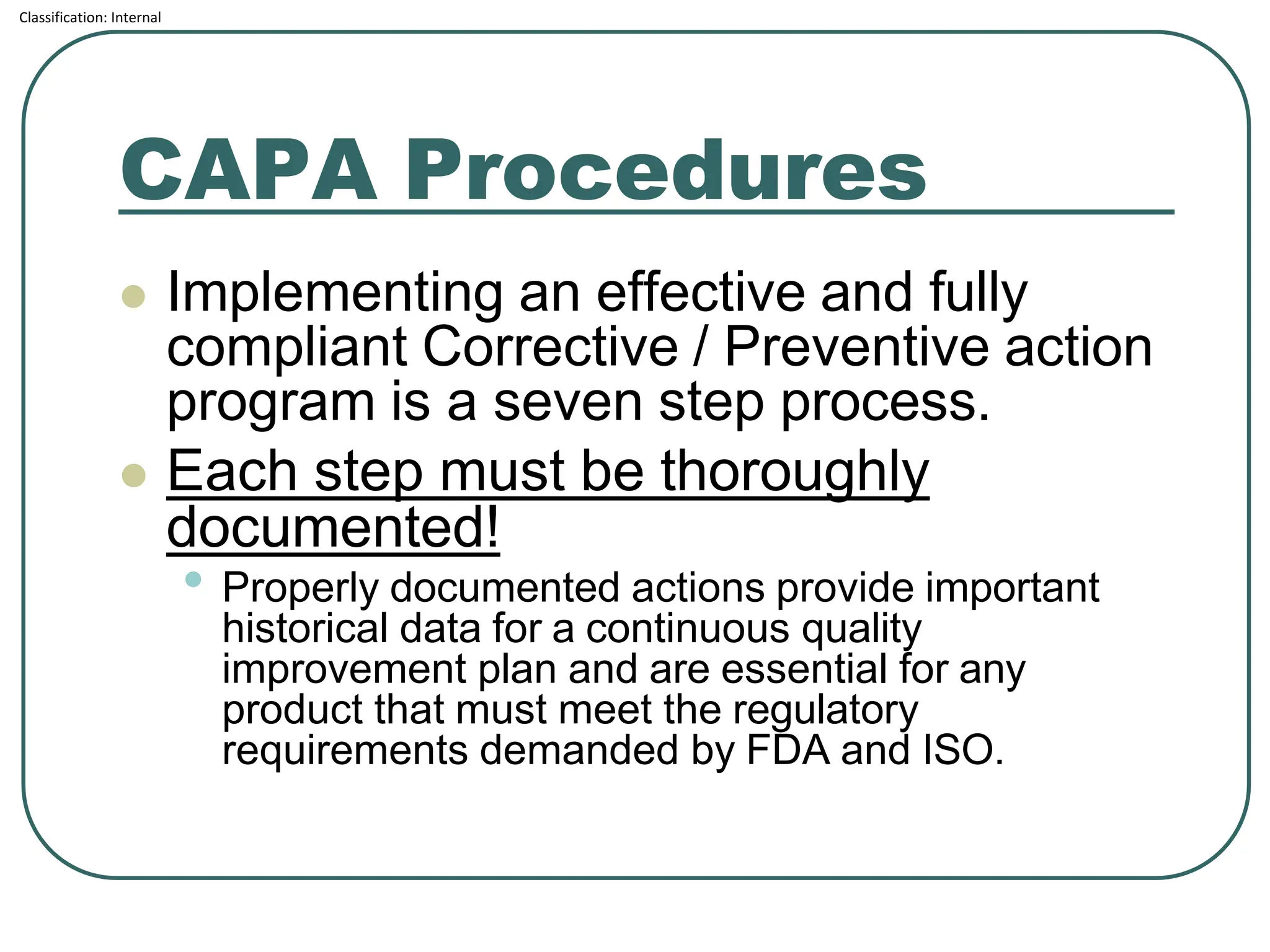
CAPA Procedures
⚫ Implementing an effective and fully
compliant Corrective / Preventive action
program is a seven step process.
⚫ Each step must be thoroughly
documented!
• Properly documented actions provide important
historical data for a continuous quality
improvement plan and are essential for any
product that must meet the regulatory
requirements demanded by FDA and ISO.
Classification: Internal
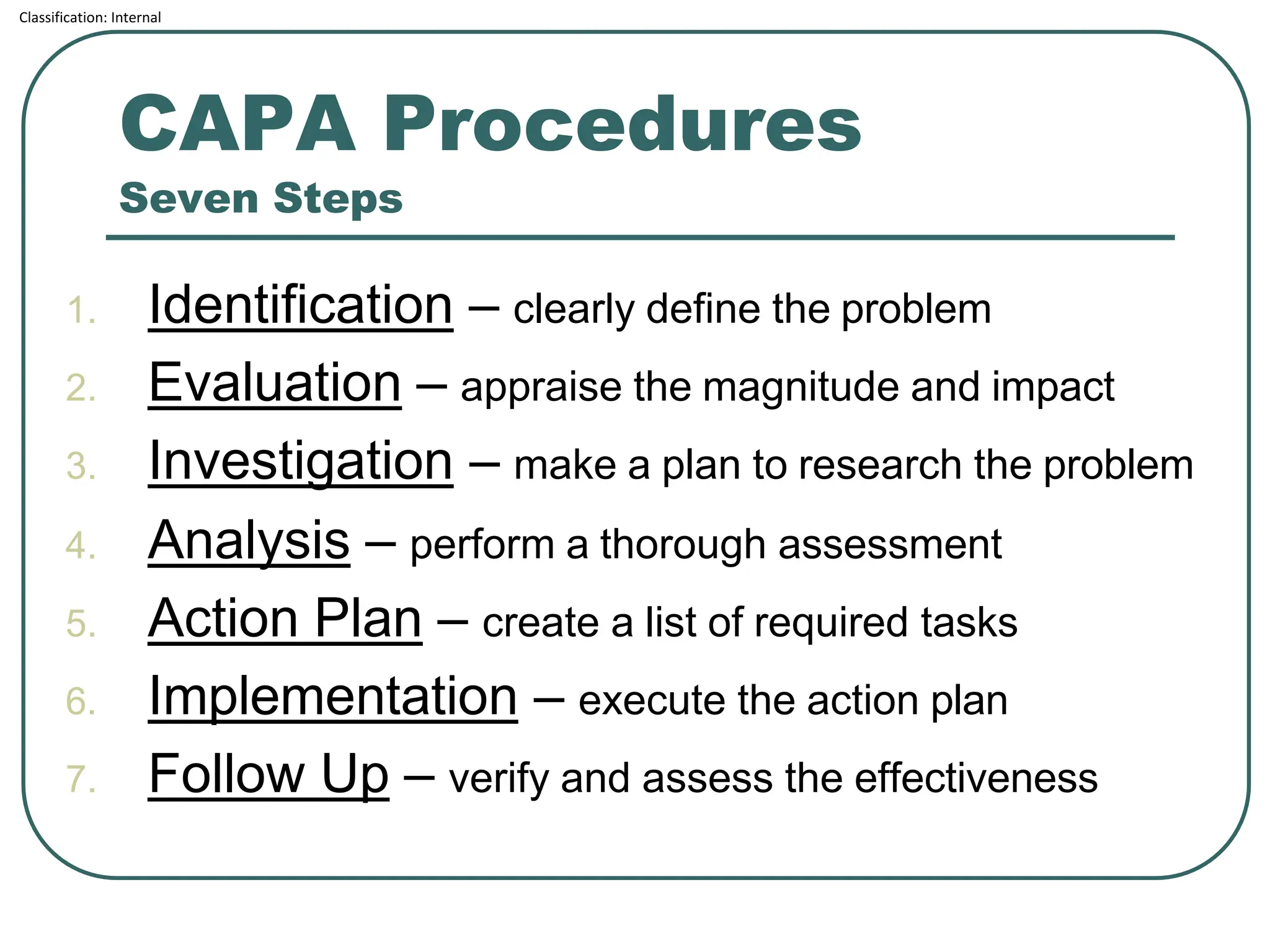
CAPA Procedures
Seven Steps
1. Identification – clearly define the problem
2. Evaluation – appraise the magnitude and impact
3. Investigation – make a plan to research the problem
4. Analysis – perform a thorough assessment
5. Action Plan – create a list of required tasks
6. Implementation – execute the action plan
7. Follow Up – verify and assess the effectiveness
Classification: Internal
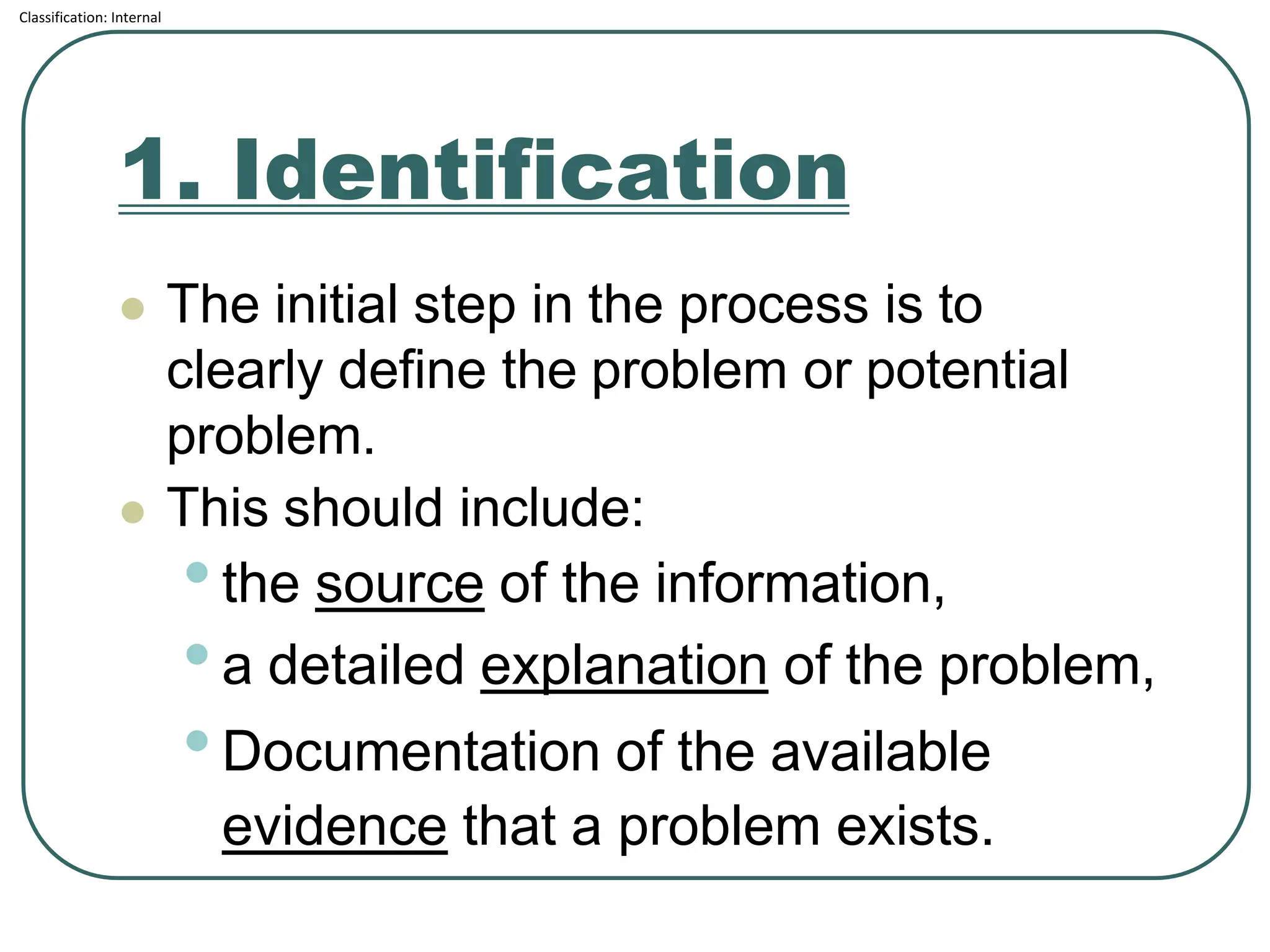
1. Identification
⚫ The initial step in the process is to
clearly define the problem or potential
problem.
⚫ This should include:
•the source of the information,
•a detailed explanation of the problem,
•Documentation of the available
evidence that a problem exists.
Classification: Internal
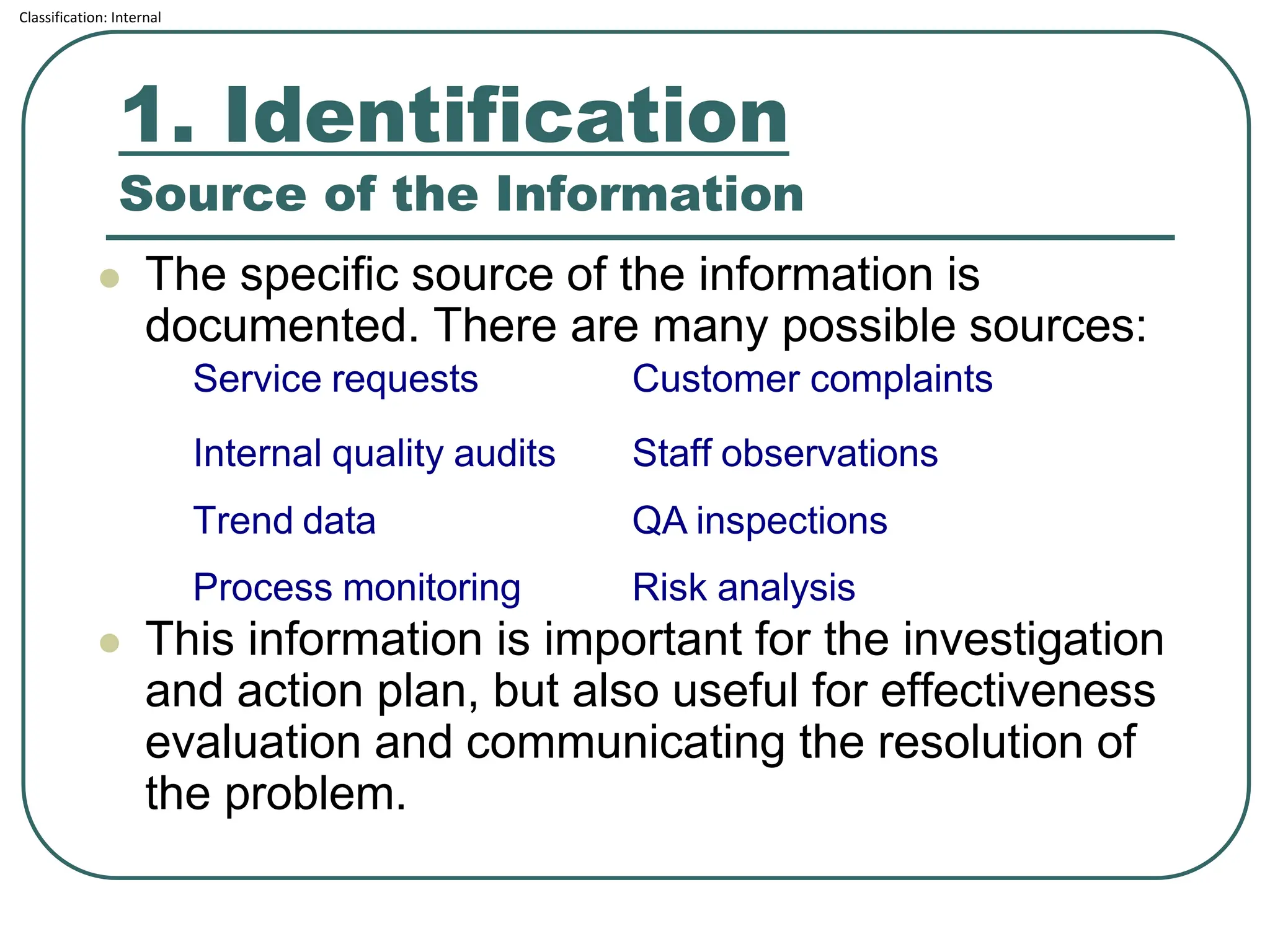
1. Identification
Source of the Information
⚫ The specific source of the information is
documented. There are many possible sources:
⚫ This information is important for the investigation
and action plan, but also useful for effectiveness
evaluation and communicating the resolution of
the problem.
Service requests Customer complaints
Internal quality audits Staff observations
Trend data QA inspections
Process monitoring Risk analysis
Classification: Internal
1. Identification
Explanation of the Problem
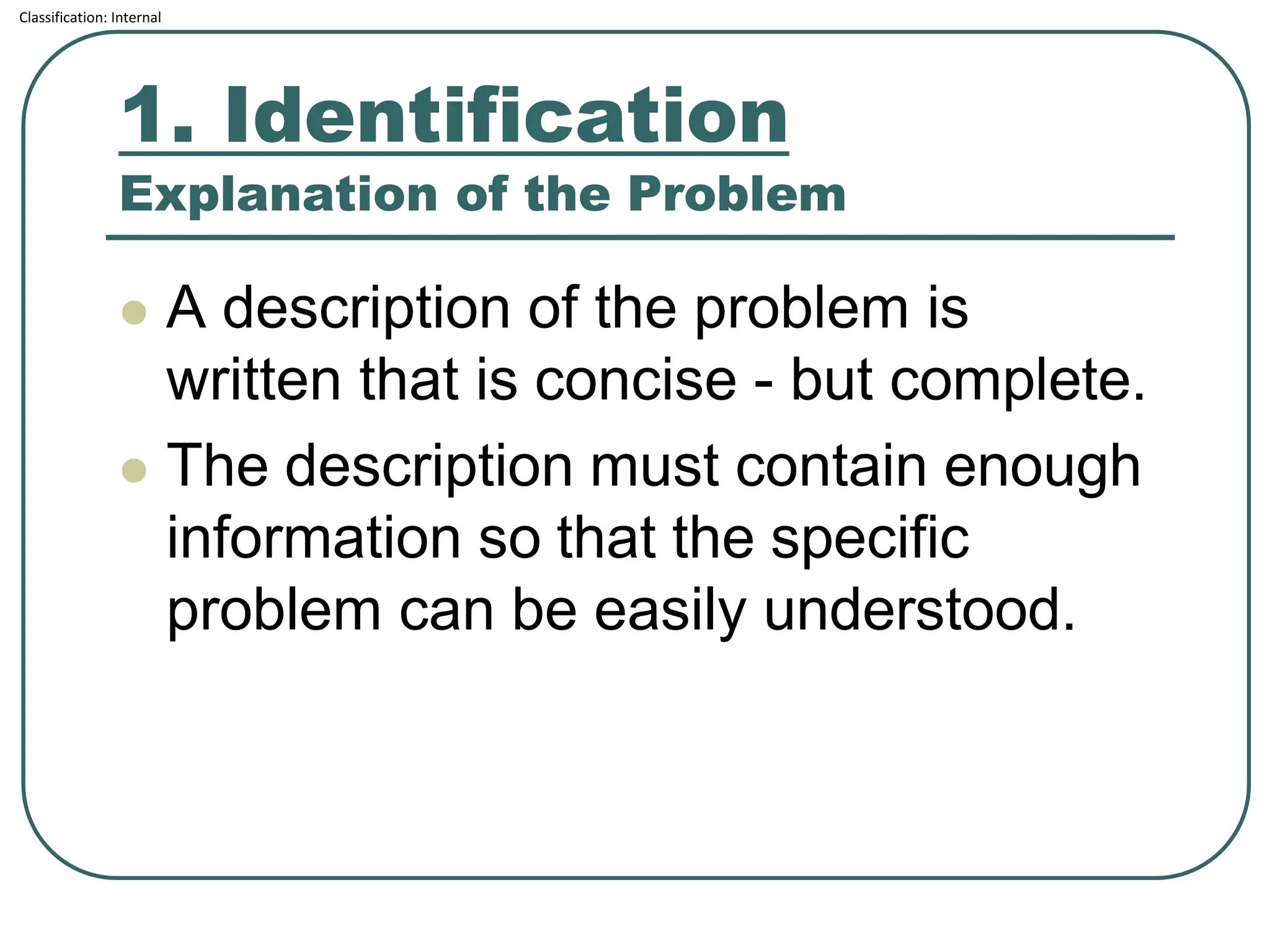
⚫ A description of the problem is
written that is concise - but complete.
⚫ The description must contain enough
information so that the specific
problem can be easily understood.
Classification: Internal
1. Identification
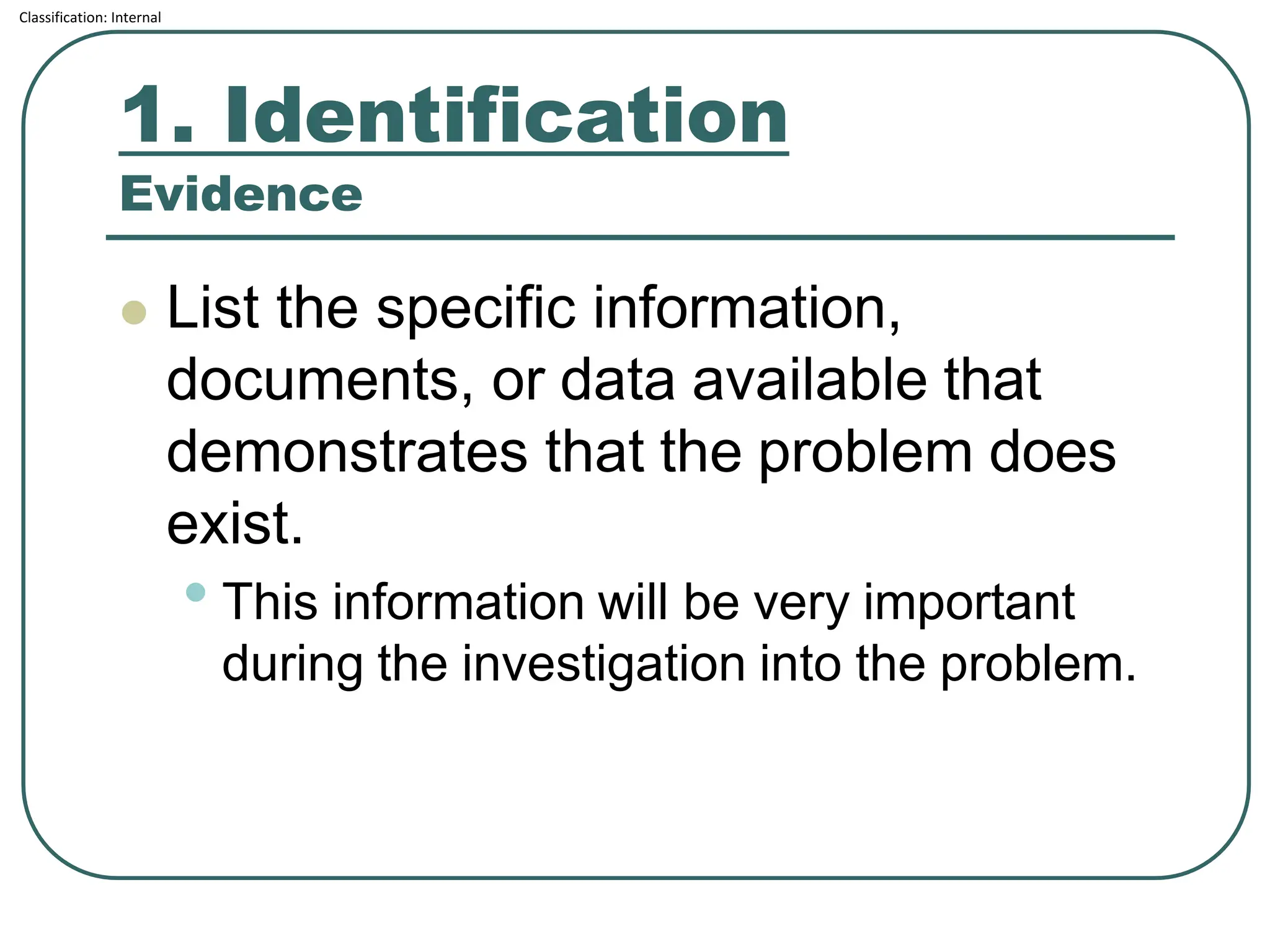
Evidence
⚫ List the specific information,
documents, or data available that
demonstrates that the problem does
exist.
• This information will be very important
during the investigation into the problem.
Classification: Internal
2. Evaluation
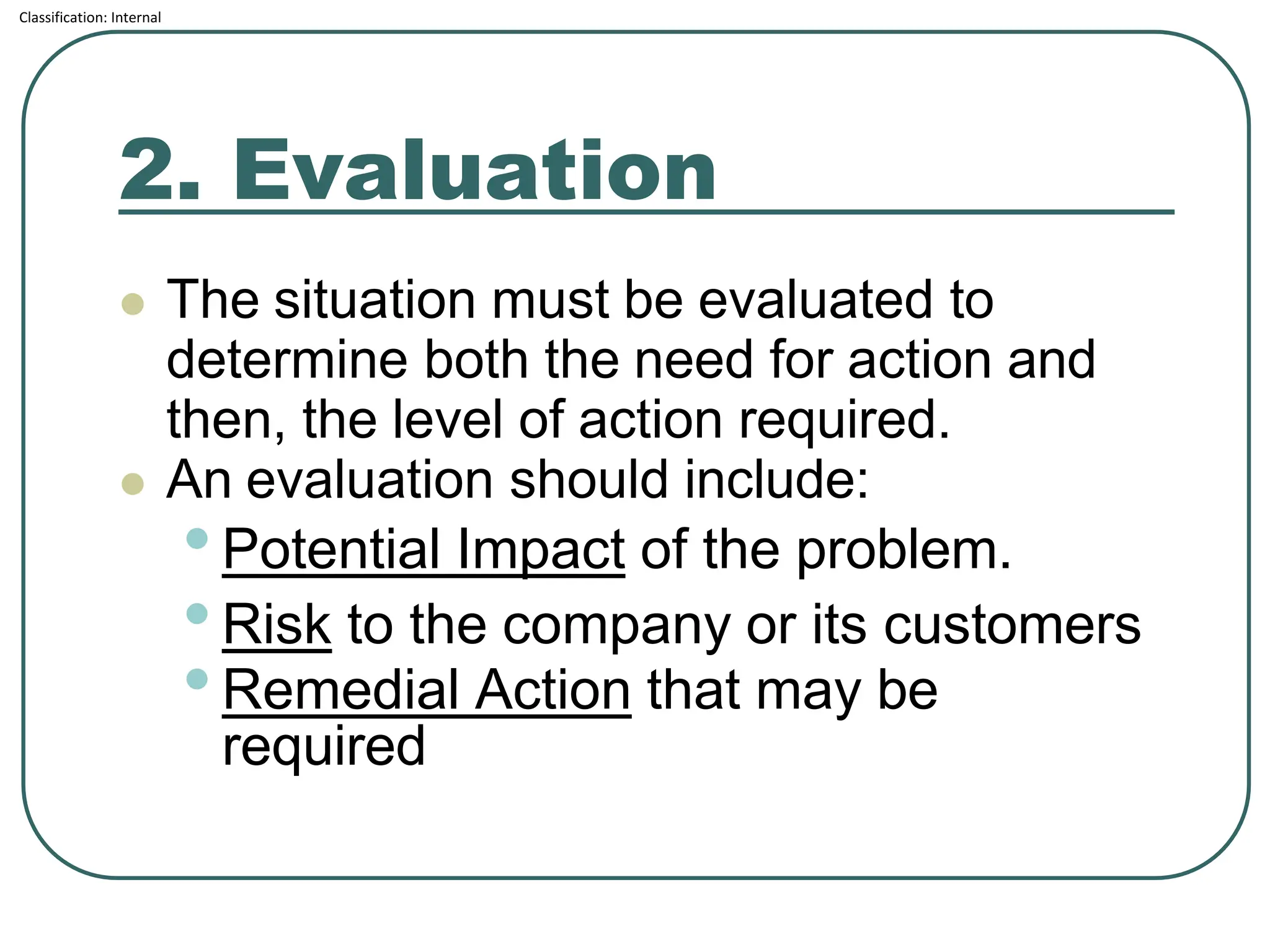
⚫ The situation must be evaluated to
determine both the need for action and
then, the level of action required.
⚫ An evaluation should include:
•Potential Impact of the problem.
•Risk to the company or its customers
•Remedial Action that may be
required
Classification: Internal
2. Evaluation
Potential Impact
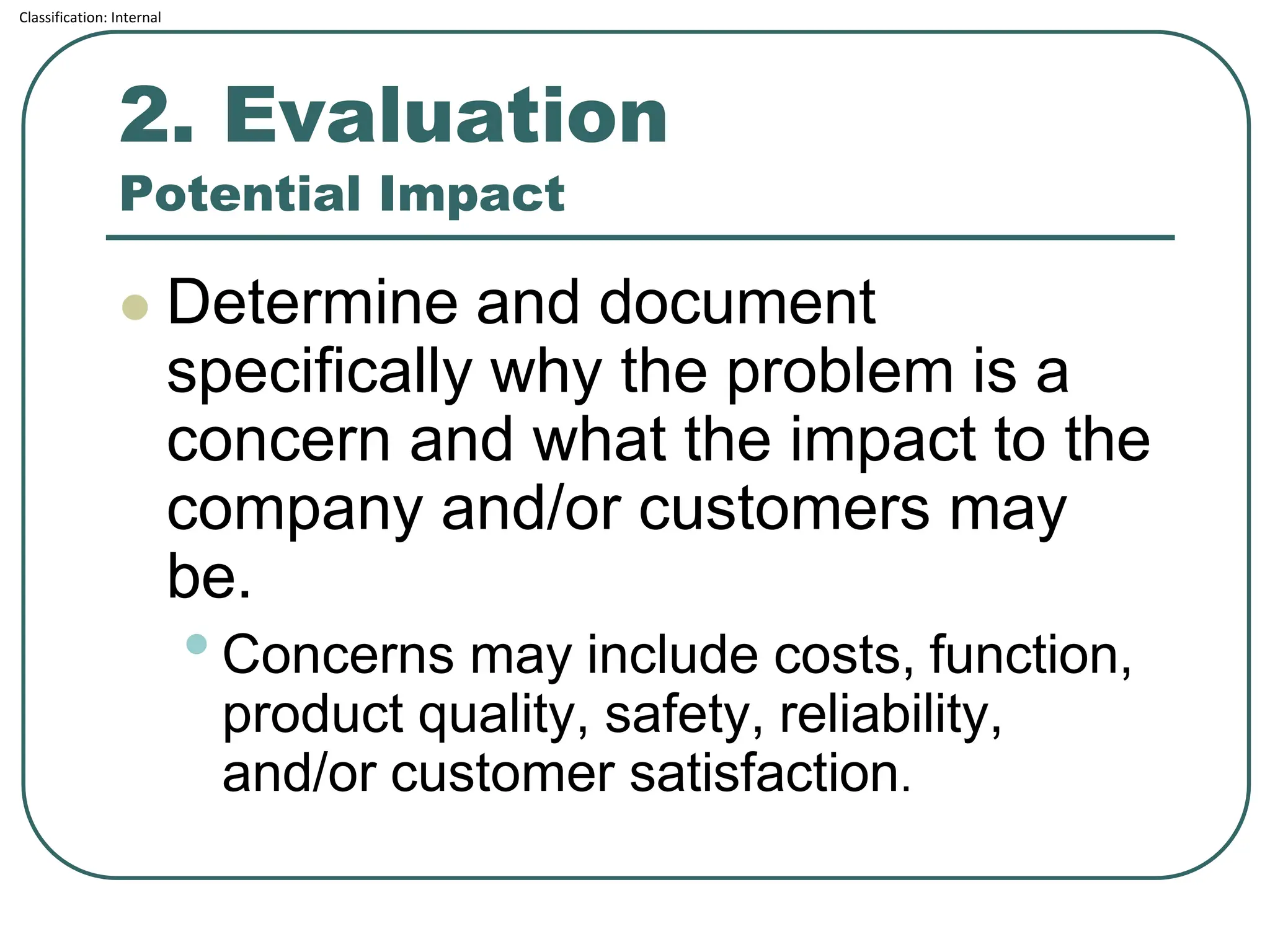
⚫ Determine and document
specifically why the problem is a
concern and what the impact to the
company and/or customers may
be.
•Concerns may include costs, function,
product quality, safety, reliability,
and/or customer satisfaction.
Classification: Internal
2. Evaluation
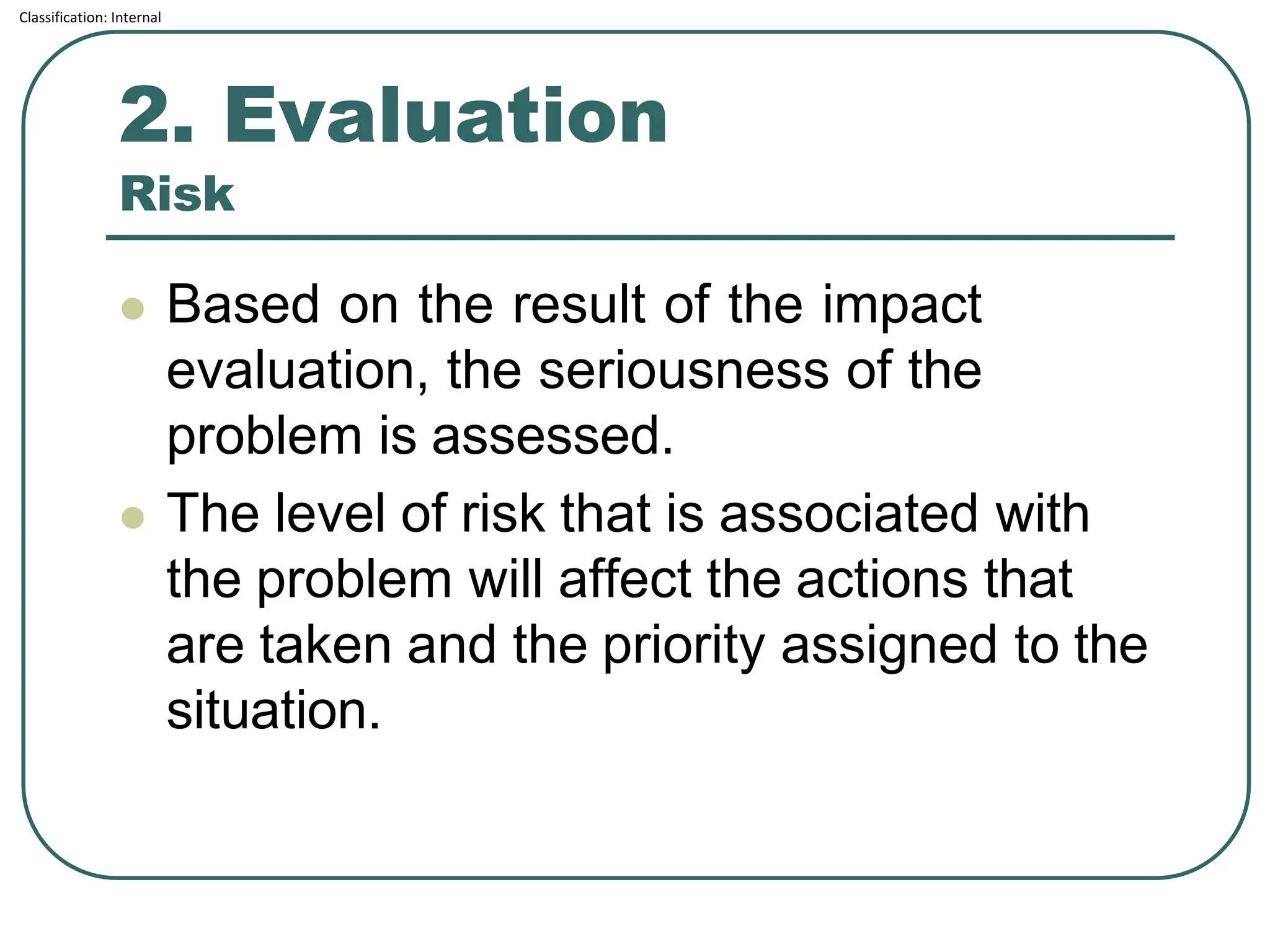
Risk
⚫ Based on the result of the impact
evaluation, the seriousness of the
problem is assessed.
⚫ The level of risk that is associated with
the problem will affect the actions that
are taken and the priority assigned to the
situation.
Classification: Internal
2. Evaluation
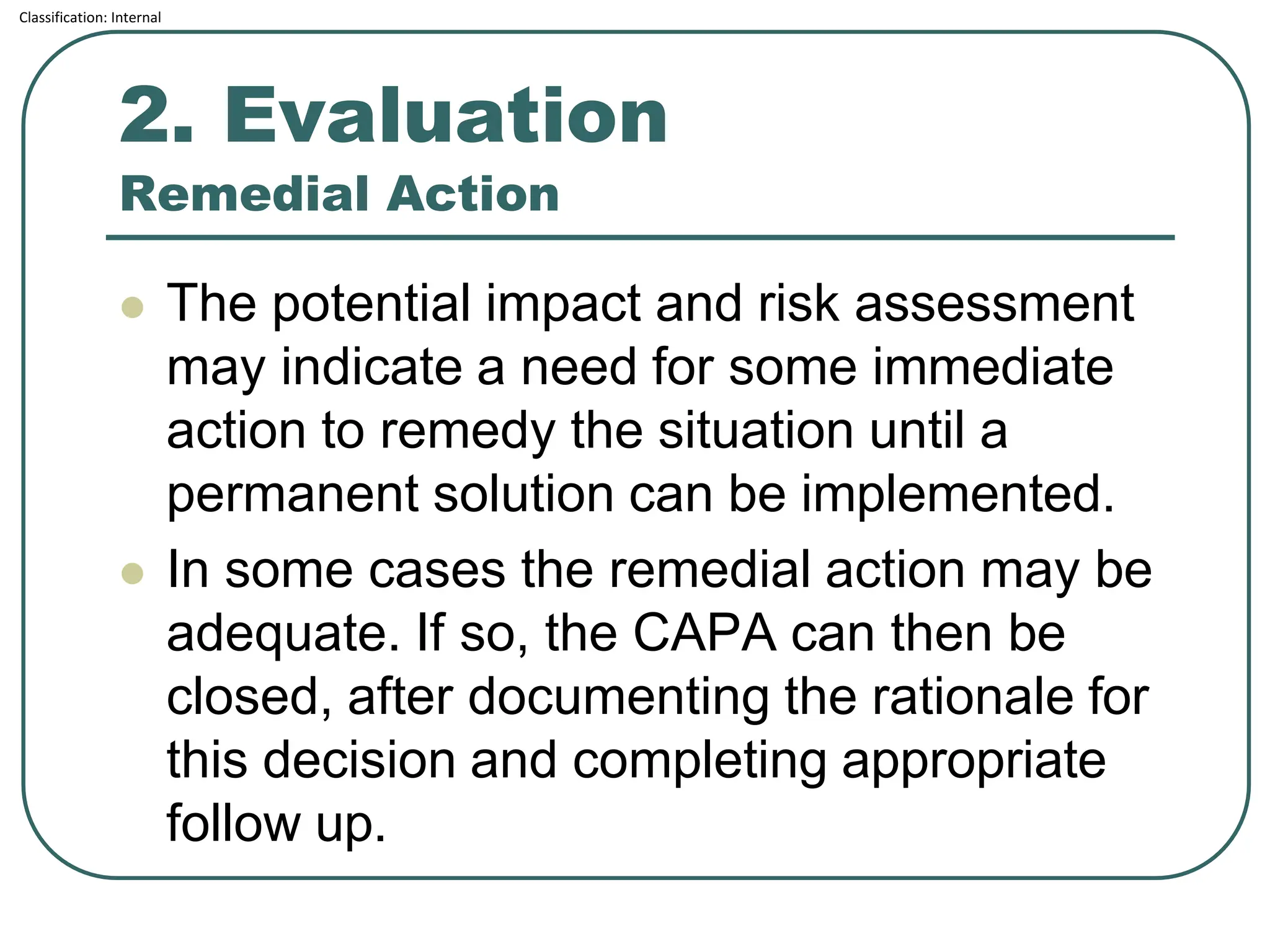
Remedial Action
⚫ The potential impact and risk assessment
may indicate a need for some immediate
action to remedy the situation until a
permanent solution can be implemented.
⚫ In some cases the remedial action may be
adequate. If so, the CAPA can then be
closed, after documenting the rationale for
this decision and completing appropriate
follow up.
Classification: Internal
3. Investigation
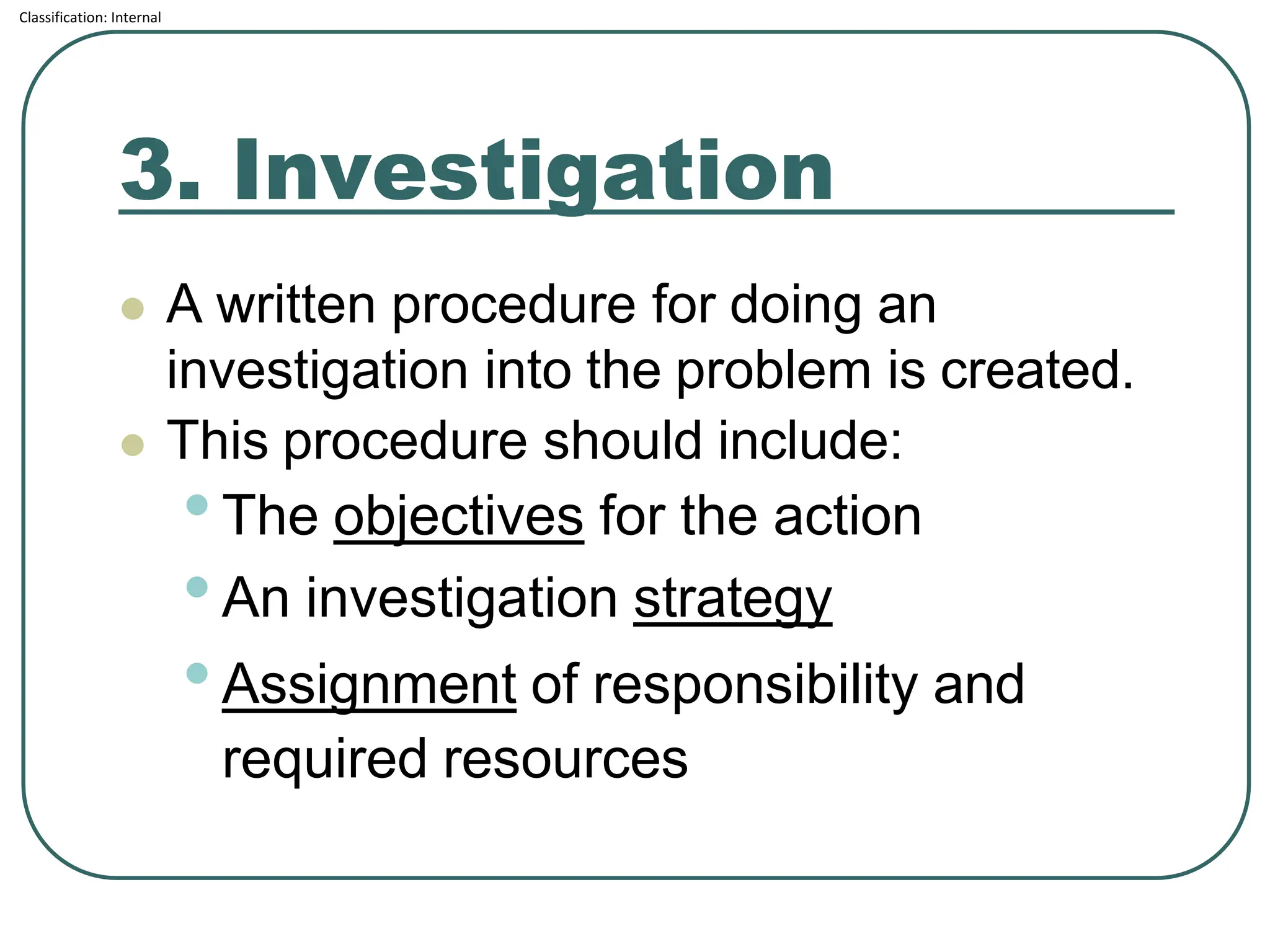
⚫ A written procedure for doing an
investigation into the problem is created.
⚫ This procedure should include:
•The objectives for the action
•An investigation strategy
•Assignment of responsibility and
required resources
Classification: Internal
3. Investigation
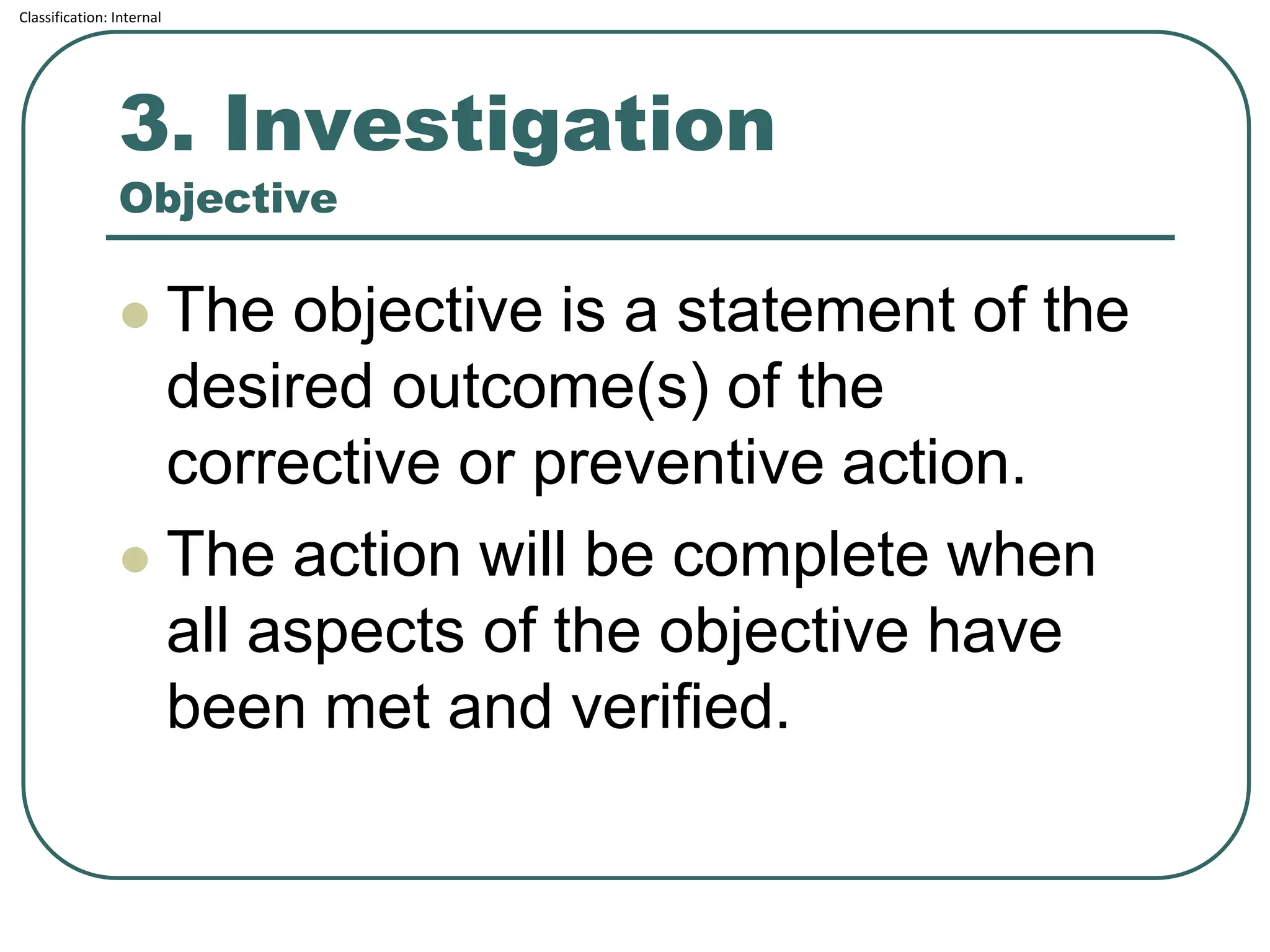
Objective
⚫ The objective is a statement of the
desired outcome(s) of the
corrective or preventive action.
⚫ The action will be complete when
all aspects of the objective have
been met and verified.
Classification: Internal
3. Investigation
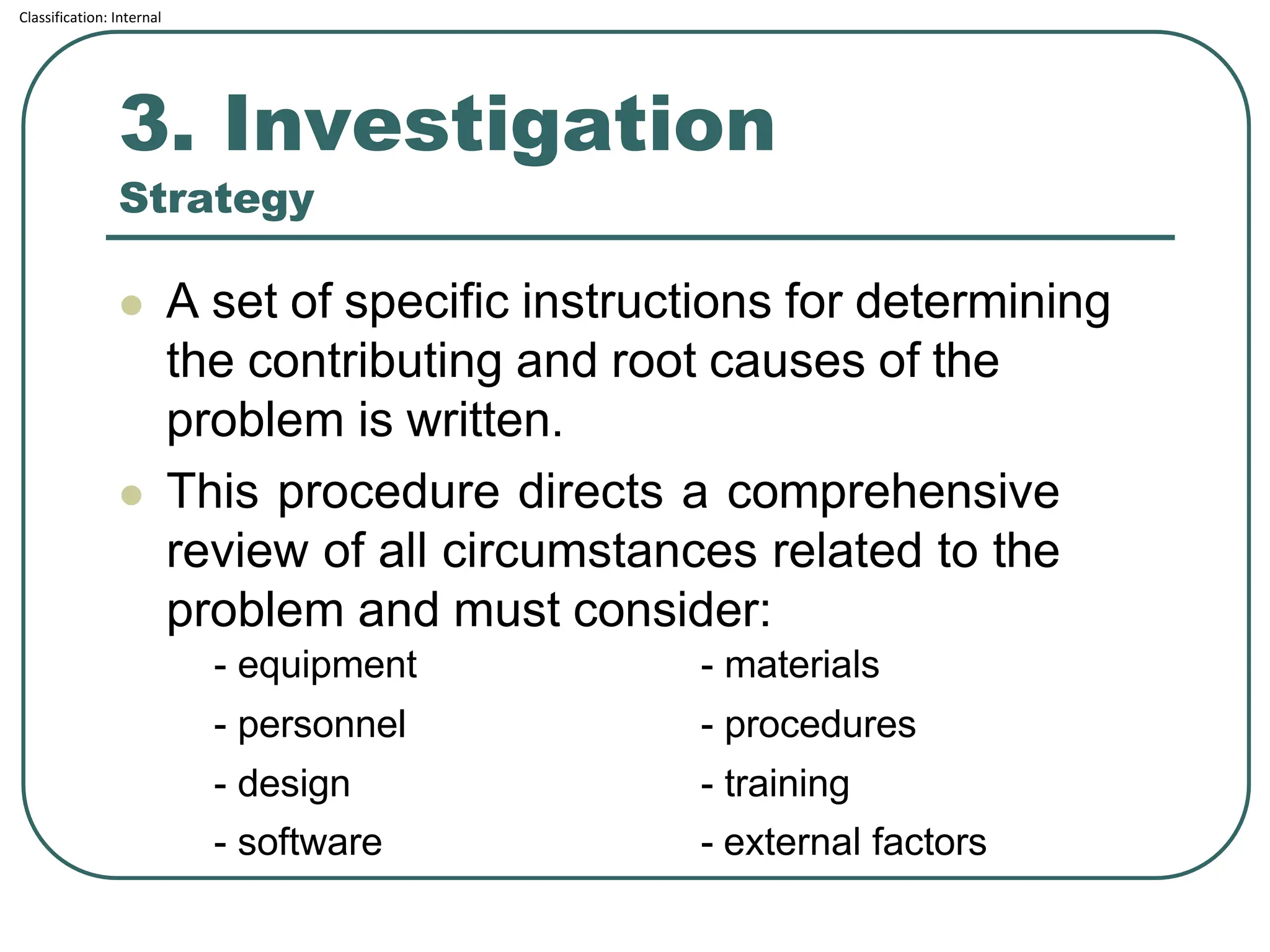
Strategy
⚫ A set of specific instructions for determining
the contributing and root causes of the
problem is written.
⚫ This procedure directs a comprehensive
review of all circumstances related to the
problem and must consider:
- equipment - materials
- personnel - procedures
- design - training
- software - external factors
Classification: Internal
3. Investigation
Assign Responsibility and Resources
⚫ It is important to assign someone
the responsibility for each aspect
of the investigation.
⚫ Any additional resources (financial,
equipment, etc) should be
identified and documented.
Classification: Internal
4. Analysis
⚫ The investigation procedure is used to conduct
the investigation into the cause of the problem.
⚫ Every possible cause is identified and
appropriate data collected.
⚫ The results of the data collection are
documented and organized.
⚫ Everything related to the problem must be
identified, but the primary goal must be to find
the root cause.
Classification: Internal
4. Analysis
Possible Causes / Data Collection
⚫ A list of all possible causes is created
which then form the basis for collecting
relevant information, test data, etc.
⚫ The necessary data and other
information is collected that will be used
to determine the primary cause of the
problem.
Classification: Internal
Analysis
Results
⚫ Data may come from a variety of sources: testing
results and/or a review of records, processes,
service information, design controls, operations, and
any other information that may lead to a
determination of the fundamental cause of the
problem.
⚫ The data collected is organized into a useable form.
⚫ The resulting documentation should address all of
the possible causes previously determined. This
information is used to determine the root cause of
the problem. The effectiveness of the analysis will
depend on the quality and thoroughness of the
information available.
Classification: Internal
4. Analysis
Root Cause Analysis
⚫ Use the data to complete a Root Cause
Analysis
⚫ This involves finding the actual cause of
the problem rather than simply dealing
with the symptoms.
⚫ Finding the primary cause is essential for
determining appropriate corrective
and/or preventive actions.
Classification: Internal
5. Action Plan
⚫ Using the results from the analysis, the best
method(s) for correcting the situation (or
preventing a future occurrence) is determined.
⚫ All of the tasks required to correct the problem
and prevent a recurrence are identified and
incorporated into an action plan.
⚫ The plan includes changes that must be made
and assigns responsibility for the tasks.
Classification: Internal
5. Action Plan
Actions to be Completed
⚫ List all activities and tasks that must be
accomplished to correct the existing
problem or eliminate a potential problem,
and prevent a recurrence.
⚫ It is very important identify all actions
necessary to address everything that
contributed to or resulted from the
situation.
Classification: Internal
5. Action Plan
Changes
⚫ Needed changes to documents,
processes, procedures, or other system
modifications should be described.
⚫ Enough detail must be included so it is
clearly understood what must be done
and what the outcome of the changes
should be.
Classification: Internal
5. Action Plan
Training
⚫ Employee training is an essential part of
any change that is made and should be
made part of the action plan.
⚫ To be effective, all modifications and
changes made must be communicated
to all persons, departments, suppliers,
etc. that were or will be affected.
Classification: Internal
6. Action Implementation!
⚫ The Action Plan that has been
developed is executed and all
identified tasks and activities
completed.
⚫ The actions that were taken are
summarized and all modifications to
documents, processes, etc. are
listed.
Classification: Internal
7. Follow up
⚫ One of the most fundamental steps in
the CAPA process is completing an
evaluation of the actions that were taken.
⚫ This evaluation must not only verify the
successful completion of the identified
tasks, but also assess the
appropriateness and effectiveness of the
actions taken.
Classification: Internal
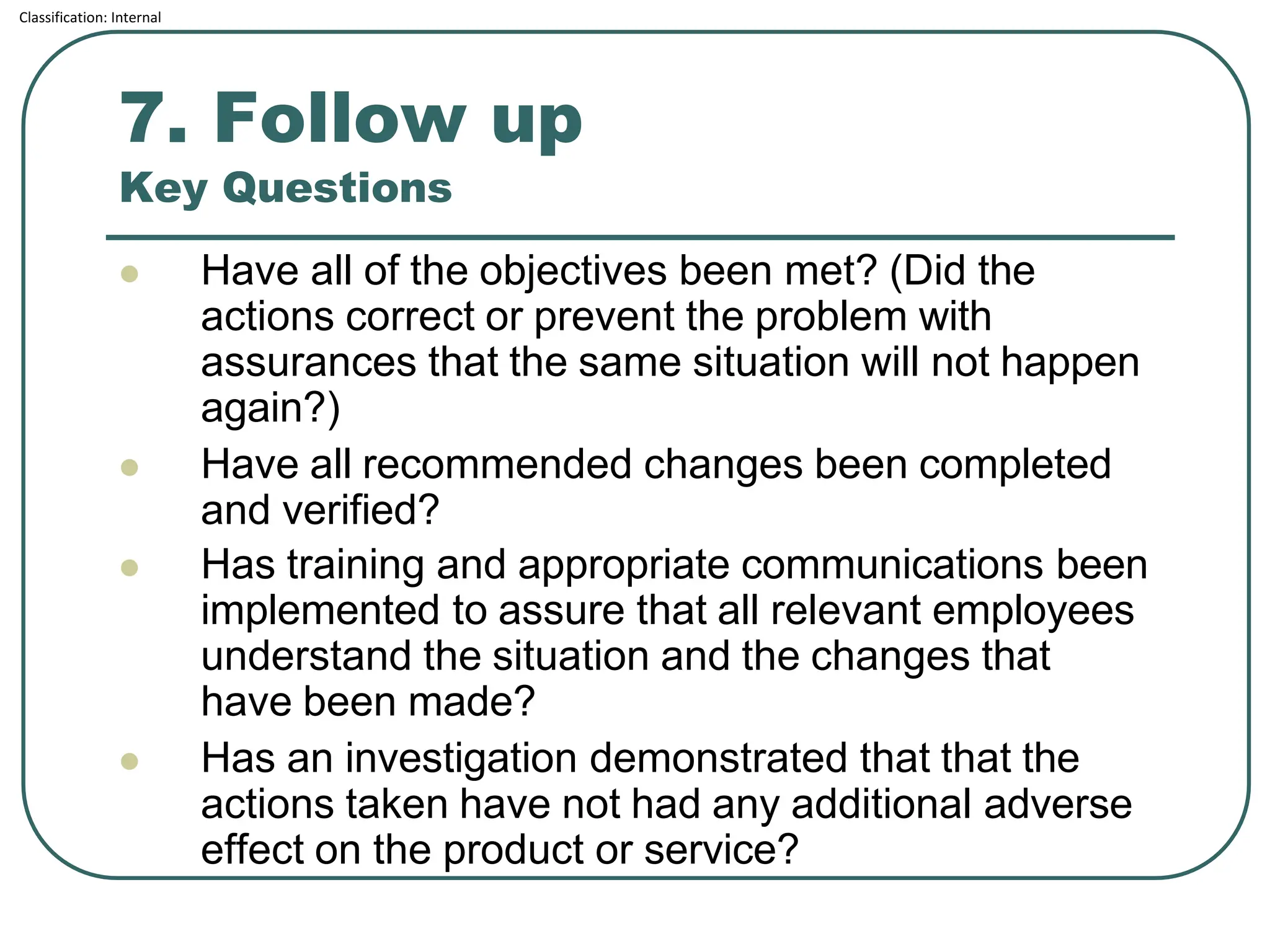
7. Follow up
Key Questions
⚫ Have all of the objectives been met? (Did the
actions correct or prevent the problem with
assurances that the same situation will not happen
again?)
⚫ Have all recommended changes been completed
and verified?
⚫ Has training and appropriate communications been
implemented to assure that all relevant employees
understand the situation and the changes that
have been made?
⚫ Has an investigation demonstrated that that the
actions taken have not had any additional adverse
effect on the product or service?
Classification: Internal
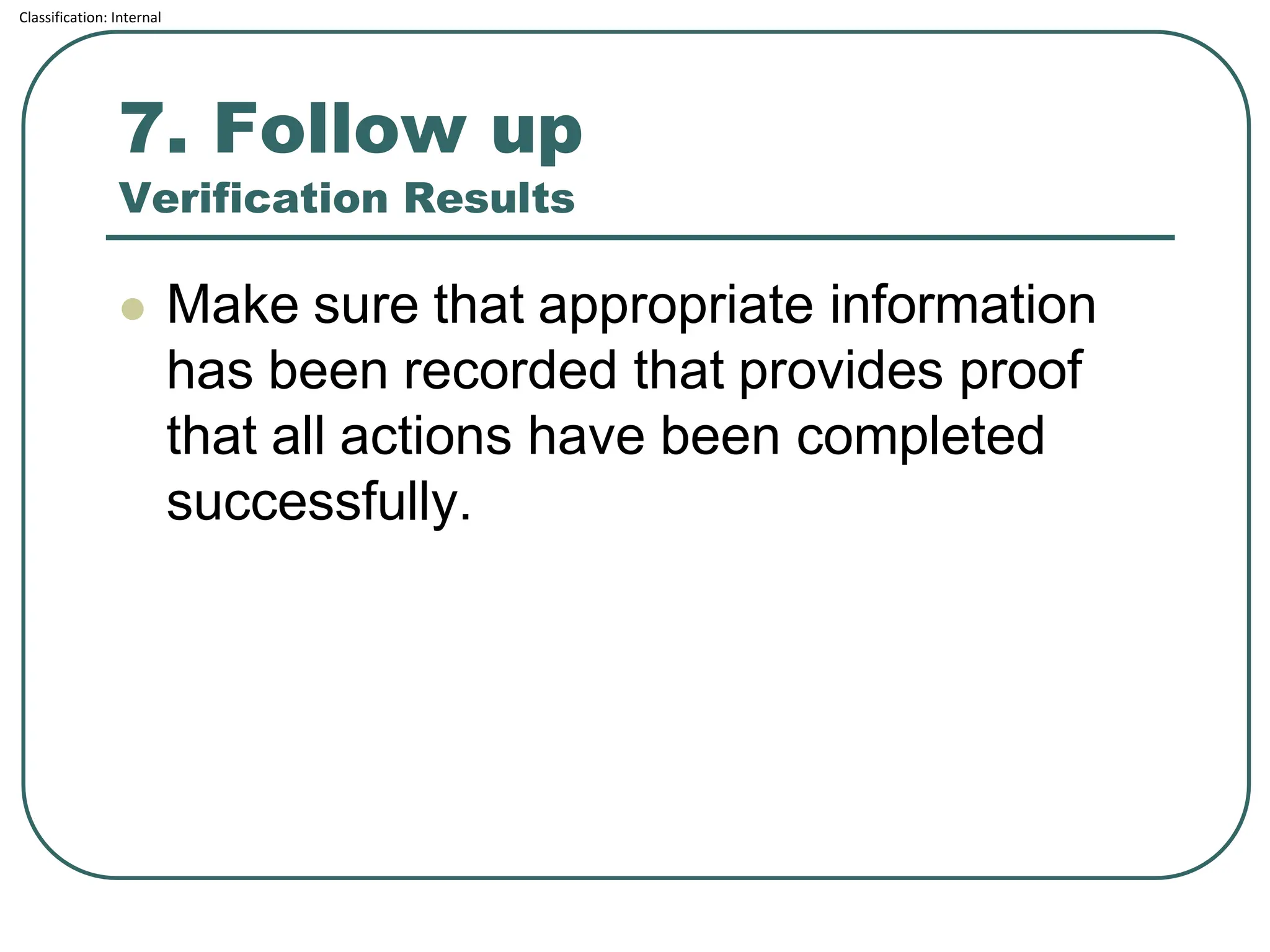
7. Follow up
Verification Results
⚫ Make sure that appropriate information
has been recorded that provides proof
that all actions have been completed
successfully.
Classification: Internal
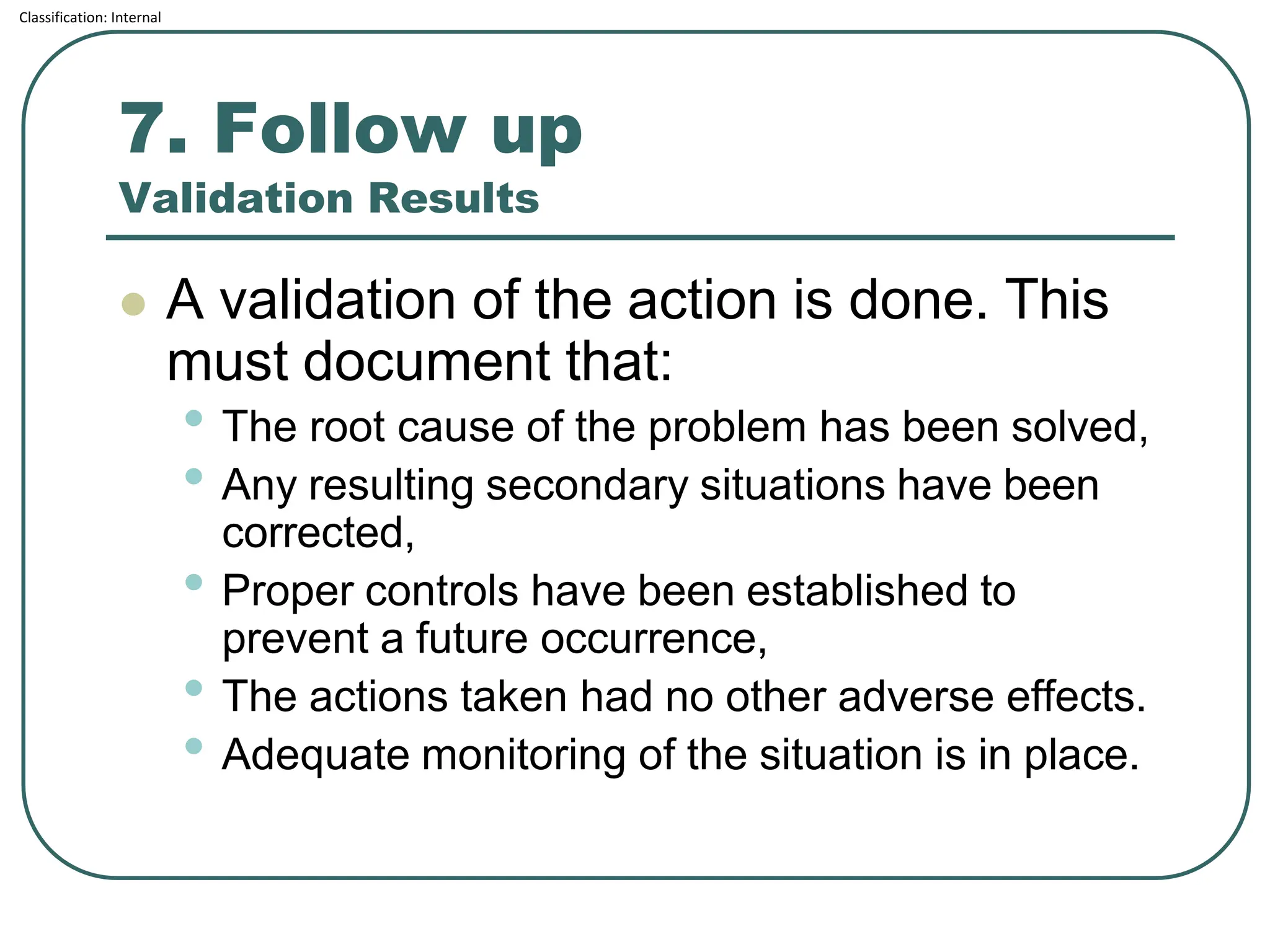
7. Follow up
Validation Results
⚫ A validation of the action is done. This
must document that:
• The root cause of the problem has been solved,
• Any resulting secondary situations have been
corrected,
• Proper controls have been established to
prevent a future occurrence,
• The actions taken had no other adverse effects.
• Adequate monitoring of the situation is in place.
Classification: Internal
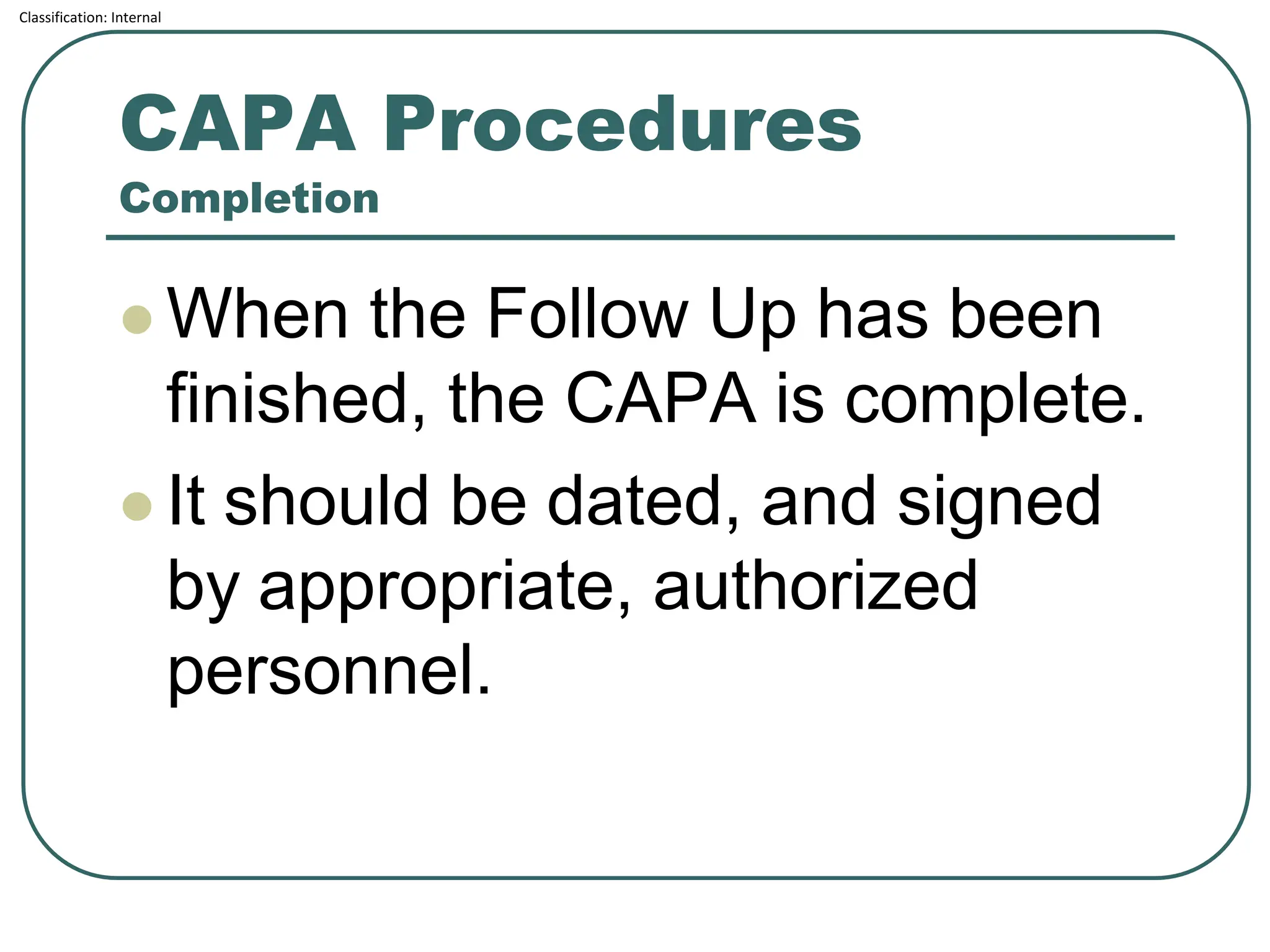
CAPA Procedures
Completion
⚫ When the Follow Up has been
finished, the CAPA is complete.
⚫ It should be dated, and signed
by appropriate, authorized
personnel.
Classification: Internal
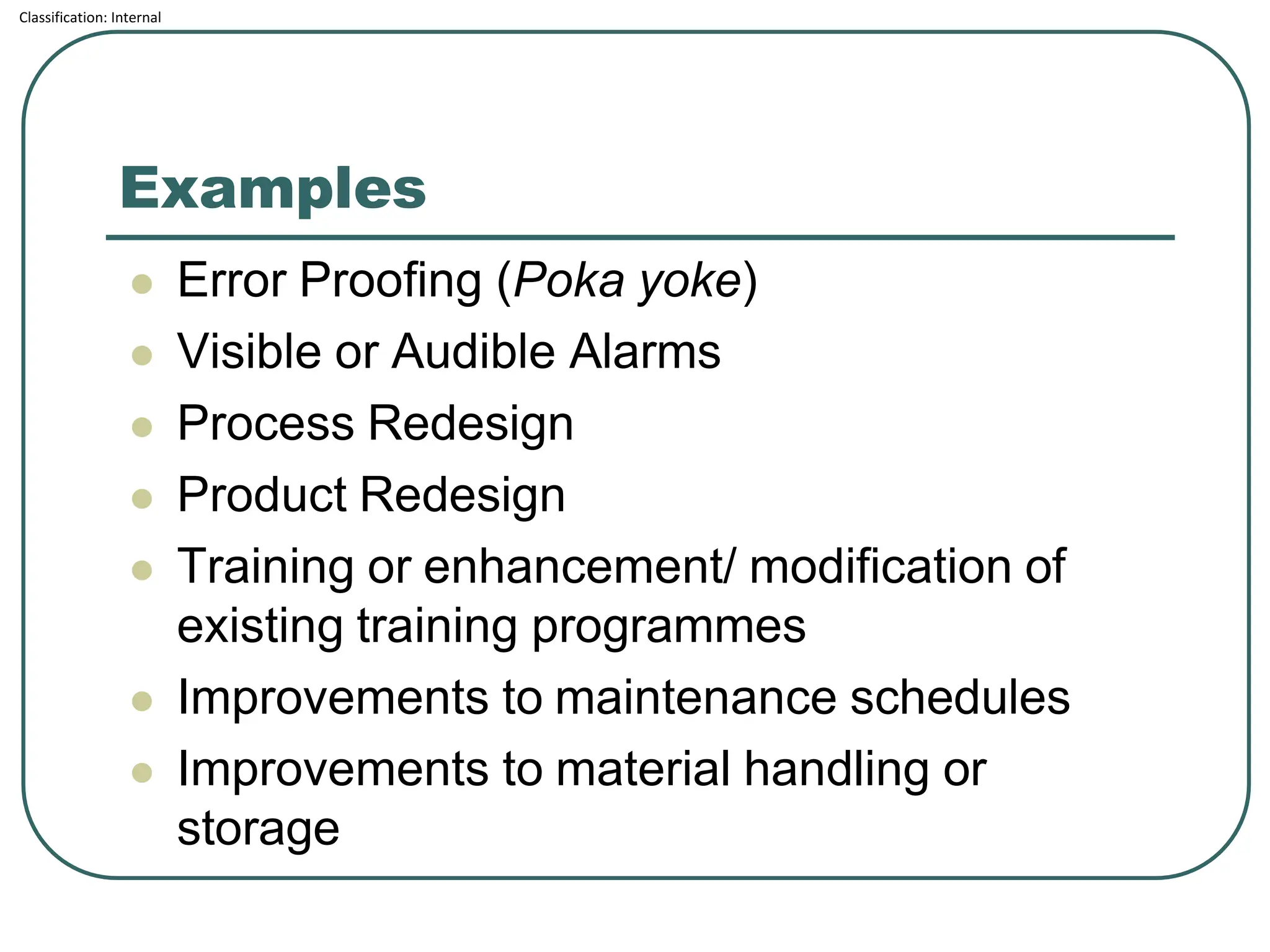
Examples
⚫ Error Proofing (Poka yoke)
⚫ Visible or Audible Alarms
⚫ Process Redesign
⚫ Product Redesign
⚫ Training or enhancement/ modification of
existing training programmes
⚫ Improvements to maintenance schedules
⚫ Improvements to material handling or
storage

Corrective and Preventive Actions | Gaurav Singh Rajput

  • 1.
  • 2.
    Classification: Internal Corrective Actions ⚫Theprocess of reacting to an existing product problem, customer complaint or other nonconformity and fixing it.
  • 3.
    Classification: Internal Preventive Actions ⚫Aprocess for detecting potential problems or nonconformance’s and eliminating them.
  • 4.
    Classification: Internal Why CAPA? ⚫Regulatory Requirements • Both FDA and ISO require an active CAPA program as an essential element of a quality system. ⚫ Customer Satisfaction • The ability to correct existing problems or implement controls to prevent potential problems is essential for continued customer satisfaction ⚫ Good Business Practice • Quality problems can have a significant financial impact on a company.
  • 5.
    Classification: Internal CAPA Procedures ⚫Implementing an effective and fully compliant Corrective / Preventive action program is a seven step process. ⚫ Each step must be thoroughly documented! • Properly documented actions provide important historical data for a continuous quality improvement plan and are essential for any product that must meet the regulatory requirements demanded by FDA and ISO.
  • 6.
    Classification: Internal CAPA Procedures SevenSteps 1. Identification – clearly define the problem 2. Evaluation – appraise the magnitude and impact 3. Investigation – make a plan to research the problem 4. Analysis – perform a thorough assessment 5. Action Plan – create a list of required tasks 6. Implementation – execute the action plan 7. Follow Up – verify and assess the effectiveness
  • 7.
    Classification: Internal 1. Identification ⚫The initial step in the process is to clearly define the problem or potential problem. ⚫ This should include: •the source of the information, •a detailed explanation of the problem, •Documentation of the available evidence that a problem exists.
  • 8.
    Classification: Internal 1. Identification Sourceof the Information ⚫ The specific source of the information is documented. There are many possible sources: ⚫ This information is important for the investigation and action plan, but also useful for effectiveness evaluation and communicating the resolution of the problem. Service requests Customer complaints Internal quality audits Staff observations Trend data QA inspections Process monitoring Risk analysis
  • 9.
    Classification: Internal 1. Identification Explanationof the Problem ⚫ A description of the problem is written that is concise - but complete. ⚫ The description must contain enough information so that the specific problem can be easily understood.
  • 10.
    Classification: Internal 1. Identification Evidence ⚫List the specific information, documents, or data available that demonstrates that the problem does exist. • This information will be very important during the investigation into the problem.
  • 11.
    Classification: Internal 2. Evaluation ⚫The situation must be evaluated to determine both the need for action and then, the level of action required. ⚫ An evaluation should include: •Potential Impact of the problem. •Risk to the company or its customers •Remedial Action that may be required
  • 12.
    Classification: Internal 2. Evaluation PotentialImpact ⚫ Determine and document specifically why the problem is a concern and what the impact to the company and/or customers may be. •Concerns may include costs, function, product quality, safety, reliability, and/or customer satisfaction.
  • 13.
    Classification: Internal 2. Evaluation Risk ⚫Based on the result of the impact evaluation, the seriousness of the problem is assessed. ⚫ The level of risk that is associated with the problem will affect the actions that are taken and the priority assigned to the situation.
  • 14.
    Classification: Internal 2. Evaluation RemedialAction ⚫ The potential impact and risk assessment may indicate a need for some immediate action to remedy the situation until a permanent solution can be implemented. ⚫ In some cases the remedial action may be adequate. If so, the CAPA can then be closed, after documenting the rationale for this decision and completing appropriate follow up.
  • 15.
    Classification: Internal 3. Investigation ⚫A written procedure for doing an investigation into the problem is created. ⚫ This procedure should include: •The objectives for the action •An investigation strategy •Assignment of responsibility and required resources
  • 16.
    Classification: Internal 3. Investigation Objective ⚫The objective is a statement of the desired outcome(s) of the corrective or preventive action. ⚫ The action will be complete when all aspects of the objective have been met and verified.
  • 17.
    Classification: Internal 3. Investigation Strategy ⚫A set of specific instructions for determining the contributing and root causes of the problem is written. ⚫ This procedure directs a comprehensive review of all circumstances related to the problem and must consider: - equipment - materials - personnel - procedures - design - training - software - external factors
  • 18.
    Classification: Internal 3. Investigation AssignResponsibility and Resources ⚫ It is important to assign someone the responsibility for each aspect of the investigation. ⚫ Any additional resources (financial, equipment, etc) should be identified and documented.
  • 19.
    Classification: Internal 4. Analysis ⚫The investigation procedure is used to conduct the investigation into the cause of the problem. ⚫ Every possible cause is identified and appropriate data collected. ⚫ The results of the data collection are documented and organized. ⚫ Everything related to the problem must be identified, but the primary goal must be to find the root cause.
  • 20.
    Classification: Internal 4. Analysis PossibleCauses / Data Collection ⚫ A list of all possible causes is created which then form the basis for collecting relevant information, test data, etc. ⚫ The necessary data and other information is collected that will be used to determine the primary cause of the problem.
  • 21.
    Classification: Internal Analysis Results ⚫ Datamay come from a variety of sources: testing results and/or a review of records, processes, service information, design controls, operations, and any other information that may lead to a determination of the fundamental cause of the problem. ⚫ The data collected is organized into a useable form. ⚫ The resulting documentation should address all of the possible causes previously determined. This information is used to determine the root cause of the problem. The effectiveness of the analysis will depend on the quality and thoroughness of the information available.
  • 22.
    Classification: Internal 4. Analysis RootCause Analysis ⚫ Use the data to complete a Root Cause Analysis ⚫ This involves finding the actual cause of the problem rather than simply dealing with the symptoms. ⚫ Finding the primary cause is essential for determining appropriate corrective and/or preventive actions.
  • 23.
    Classification: Internal 5. ActionPlan ⚫ Using the results from the analysis, the best method(s) for correcting the situation (or preventing a future occurrence) is determined. ⚫ All of the tasks required to correct the problem and prevent a recurrence are identified and incorporated into an action plan. ⚫ The plan includes changes that must be made and assigns responsibility for the tasks.
  • 24.
    Classification: Internal 5. ActionPlan Actions to be Completed ⚫ List all activities and tasks that must be accomplished to correct the existing problem or eliminate a potential problem, and prevent a recurrence. ⚫ It is very important identify all actions necessary to address everything that contributed to or resulted from the situation.
  • 25.
    Classification: Internal 5. ActionPlan Changes ⚫ Needed changes to documents, processes, procedures, or other system modifications should be described. ⚫ Enough detail must be included so it is clearly understood what must be done and what the outcome of the changes should be.
  • 26.
    Classification: Internal 5. ActionPlan Training ⚫ Employee training is an essential part of any change that is made and should be made part of the action plan. ⚫ To be effective, all modifications and changes made must be communicated to all persons, departments, suppliers, etc. that were or will be affected.
  • 27.
    Classification: Internal 6. ActionImplementation! ⚫ The Action Plan that has been developed is executed and all identified tasks and activities completed. ⚫ The actions that were taken are summarized and all modifications to documents, processes, etc. are listed.
  • 28.
    Classification: Internal 7. Followup ⚫ One of the most fundamental steps in the CAPA process is completing an evaluation of the actions that were taken. ⚫ This evaluation must not only verify the successful completion of the identified tasks, but also assess the appropriateness and effectiveness of the actions taken.
  • 29.
    Classification: Internal 7. Followup Key Questions ⚫ Have all of the objectives been met? (Did the actions correct or prevent the problem with assurances that the same situation will not happen again?) ⚫ Have all recommended changes been completed and verified? ⚫ Has training and appropriate communications been implemented to assure that all relevant employees understand the situation and the changes that have been made? ⚫ Has an investigation demonstrated that that the actions taken have not had any additional adverse effect on the product or service?
  • 30.
    Classification: Internal 7. Followup Verification Results ⚫ Make sure that appropriate information has been recorded that provides proof that all actions have been completed successfully.
  • 31.
    Classification: Internal 7. Followup Validation Results ⚫ A validation of the action is done. This must document that: • The root cause of the problem has been solved, • Any resulting secondary situations have been corrected, • Proper controls have been established to prevent a future occurrence, • The actions taken had no other adverse effects. • Adequate monitoring of the situation is in place.
  • 32.
    Classification: Internal CAPA Procedures Completion ⚫When the Follow Up has been finished, the CAPA is complete. ⚫ It should be dated, and signed by appropriate, authorized personnel.
  • 33.
    Classification: Internal Examples ⚫ ErrorProofing (Poka yoke) ⚫ Visible or Audible Alarms ⚫ Process Redesign ⚫ Product Redesign ⚫ Training or enhancement/ modification of existing training programmes ⚫ Improvements to maintenance schedules ⚫ Improvements to material handling or storage