

PLAN DO CHECK ACT
PDCA
The PDCA Cycle is a four-step model for problem
solving and continuous improvement.
It provides a simple and structured
Way for solving problems and
creating positive change.
Widely recognized as the basis of
continually improving the quality of
processes, products, and services.
PDCA
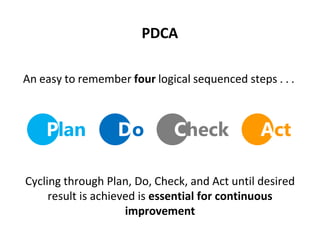
An easy to remember four logical sequenced steps . . .
Plan Do Check Act
Cycling through Plan, Do, Check, and Act until desired
result is achieved is essential for continuous
improvement
PDCA
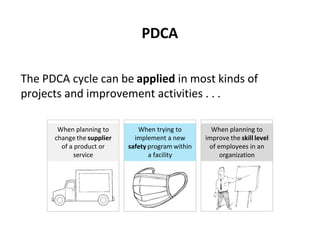
The PDCA cycle can be applied in most kinds of
projects and improvement activities . . .
When planning to
change the supplier
of a product or
service
When trying to
implement a new
safety program within
a facility
When planning to
improve the skill level
of employees in an
organization
PDCA
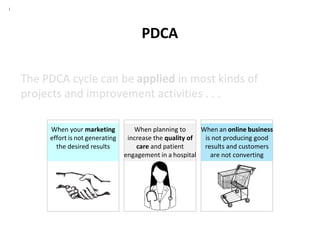
The PDCA cycle can be applied in most kinds of
projects and improvement activities . . .
When your marketing
effort is not generating
the desired results
When planning to
increase the quality of
care and patient
engagement in a hospital
When an online business
is not producing good
results and customers
are not converting
l
PDCA
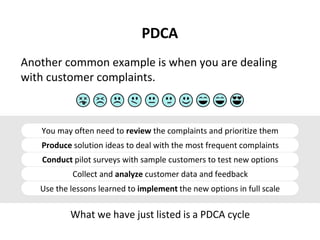
Another common example is when you are dealing
with customer complaints.
You may often need to review the complaints and prioritize them
Produce solution ideas to deal with the most frequent complaints
Conduct pilot surveys with sample customers to test new options
Collect and analyze customer data and feedback
Use the lessons learned to implement the new options in full scale
What we have just listed is a PDCA cycle
PDCA
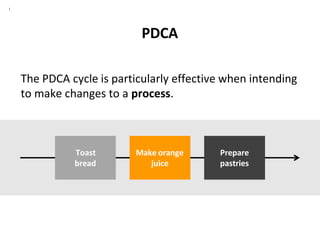
The PDCA cycle is particularly effective when intending
to make changes to a process.
Prepare
pastries
Make orange
juice
Toast
bread
l
PDCA
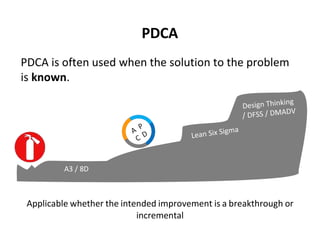
PDCA is often used when the solution to the problem
is known.
Applicable whether the intended improvement is a breakthrough or
incremental
A3 / 8D
PDCA
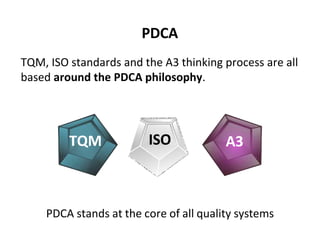
TQM, ISO standards and the A3 thinking process are all
based around the PDCA philosophy.
PDCA stands at the core of all quality systems
TQM ISO A3
PDCA
Classification: Internal
Represents the logical way of thinking we tend to
follow when solving problems or implementing
continuous improvement.
PDCA
Classification: Internal
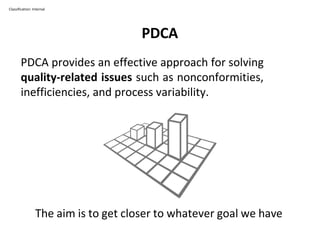
PDCA provides an effective approach for solving
quality-related issues such as nonconformities,
inefficiencies, and process variability.
The aim is to get closer to whatever goal we have
PDCA
Classification: Internal
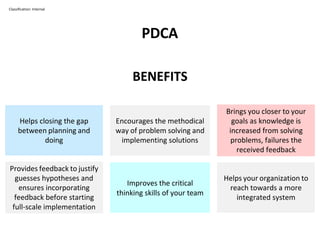
BENEFITS
Helps closing the gap
between planning and
doing
Encourages the methodical
way of problem solving and
implementing solutions
Brings you closer to your
goals as knowledge is
increased from solving
problems, failures the
received feedback
Provides feedback to justify
guesses hypotheses and
ensures incorporating
feedback before starting
full-scale implementation
Improves the critical
thinking skills of your team
Helps your organization to
reach towards a more
integrated system
PDCA
Classification: Internal
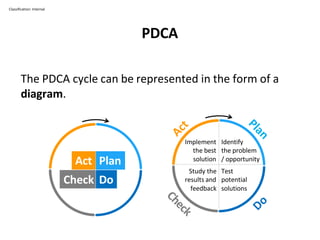
Implement Identify
the best the problem
solution / opportunity
Study the Test
results and potential
feedback solutions
The PDCA cycle can be represented in the form of a
diagram.
Plan
Do
Check
Act
PDCA
Classification: Internal
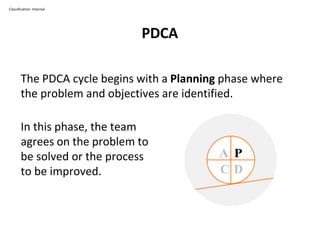
The PDCA cycle begins with a Planning phase where
the problem and objectives are identified.
In this phase, the team
agrees on the problem to
be solved or the process
to be improved.
A P
C D
PDCA
Classification: Internal
You then need to analyze the current situation,
identify solution alternatives, and select and schedule
the most promising solution.
PDCA
Classification: Internal
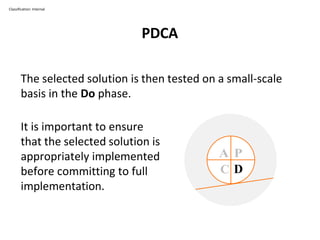
The selected solution is then tested on a small-scale
basis in the Do phase.
It is important to ensure
that the selected solution is
appropriately implemented
before committing to full
implementation.
A P
C D
PDCA
Classification: Internal
This phase also involves measuring the progress and
collecting data and feedback for later analysis.
You may need to conduct the pilot
test within a department, in a limited
geographical area, or within certain
demographic group.
PDCA
Classification: Internal
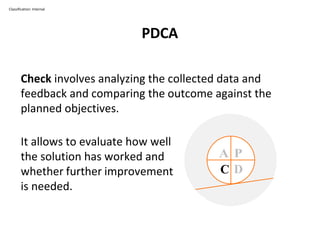
Check involves analyzing the collected data and
feedback and comparing the outcome against the
planned objectives.
It allows to evaluate how well
the solution has worked and
whether further improvement
is needed.
A P
C D
PDCA
Classification: Internal
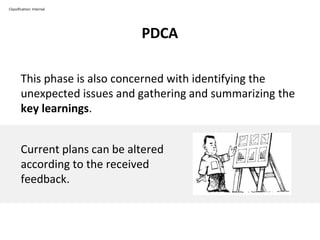
This phase is also concerned with identifying the
unexpected issues and gathering and summarizing the
key learnings.
Current plans can be altered
according to the received
feedback.
PDCA
Classification: Internal
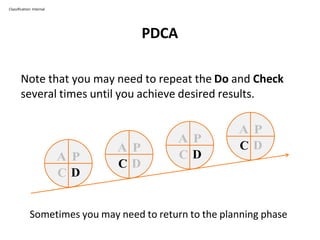
Note that you may need to repeat the Do and Check
several times until you achieve desired results.
Sometimes you may need to return to the planning phase
A P
C D
A P
C D
A P
C D
A P
C D
PDCA
Classification: Internal
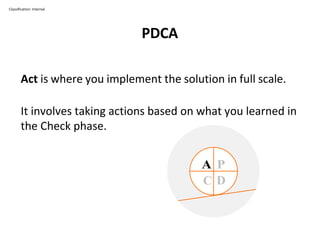
Act is where you implement the solution in full scale.
It involves taking actions based on what you learned in
the Check phase.
A P
C D
PDCA
Classification: Internal
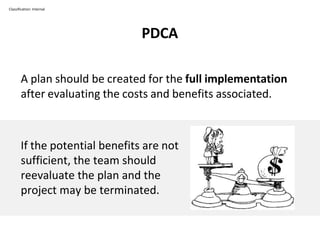
A plan should be created for the full implementation
after evaluating the costs and benefits associated.
If the potential benefits are not
sufficient, the team should
reevaluate the plan and the
project may be terminated.
PDCA
Classification: Internal
Act is also concerned with . . .
Standardizing Documenting
Sustaining the improved process
Integrating it into the organization’s system
PDCA
Classification: Internal
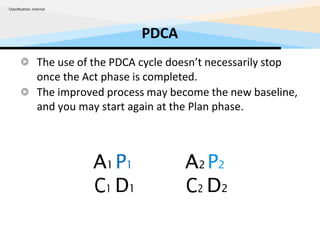
The use of the PDCA cycle doesn’t necessarily stop
once the Act phase is completed.
The improved process may become the new baseline,
and you may start again at the Plan phase.
A1 P1
C1 D1
A2 P2
C2 D2
PDCA
Classification: Internal
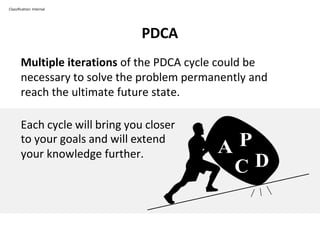
Multiple iterations of the PDCA cycle could be
necessary to solve the problem permanently and
reach the ultimate future state.
Each cycle will bring you closer
to your goals and will extend
your knowledge further. A P
C D
PDCA
Classification: Internal
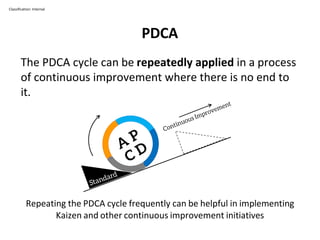
The PDCA cycle can be repeatedly applied in a process
of continuous improvement where there is no end to
it.
Repeating the PDCA cycle frequently can be helpful in implementing
Kaizen and other continuous improvement initiatives
PDCA
Classification: Internal
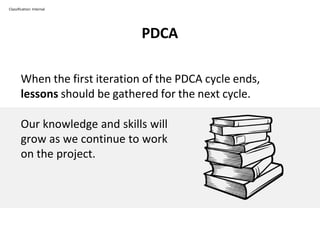
When the first iteration of the PDCA cycle ends,
lessons should be gathered for the next cycle.
Our knowledge and skills will
grow as we continue to work
on the project.
PDCA
Classification: Internal
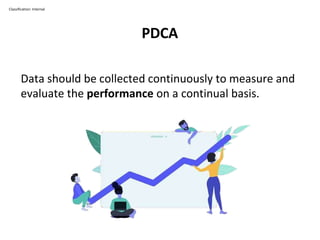
Data should be collected continuously to measure and
evaluate the performance on a continual basis.
PDCA
Classification: Internal
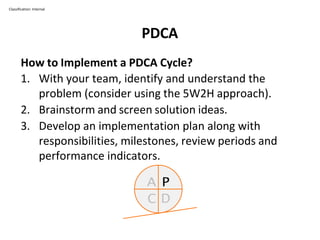
How to Implement a PDCA Cycle?
1. With your team, identify and understand the
problem (consider using the 5W2H approach).
2. Brainstorm and screen solution ideas.
3. Develop an implementation plan along with
responsibilities, milestones, review periods and
performance indicators.
A P
C D
PDCA
Classification: Internal
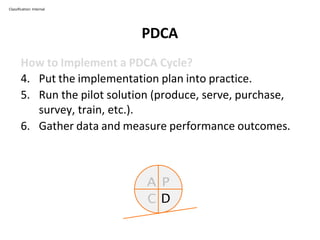
How to Implement a PDCA Cycle?
4. Put the implementation plan into practice.
5. Run the pilot solution (produce, serve, purchase,
survey, train, etc.).
6. Gather data and measure performance outcomes.
A P
C D
PDCA
Classification: Internal
How to Implement a PDCA Cycle?
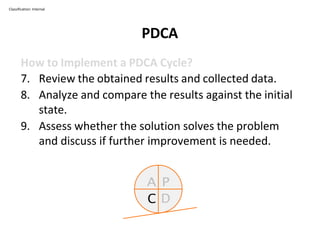
7. Review the obtained results and collected data.
8. Analyze and compare the results against the initial
state.
9. Assess whether the solution solves the problem
and discuss if further improvement is needed.
A P
C D
PDCA
Classification: Internal
How to Implement a PDCA Cycle?
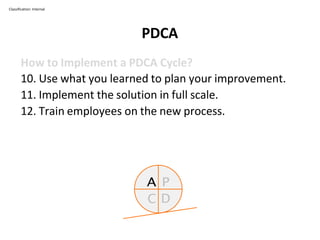
10. Use what you learned to plan your improvement.
11. Implement the solution in full scale.
12. Train employees on the new process.
A P
C D
PDCA
Classification: Internal
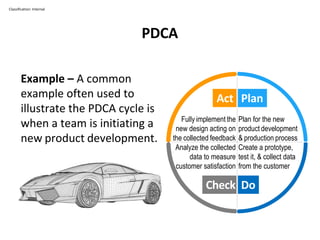
Example – A common
example often used to
illustrate the PDCA cycle is
when a team is initiating a
new product development.
Act
Fully implement the
new design acting on
the collected feedback
Analyze the collected
data to measure
customer satisfaction
Check
Plan
Plan for the new
product development
& production process
Create a prototype,
test it, & collect data
from the customer
Do
PDCA
Classification: Internal
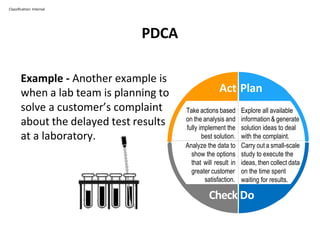
Example - Another example is
when a lab team is planning to Act Plan
solve a customer’s complaint
about the delayed test results
at a laboratory.
Take actions based
on the analysis and
fully implement the
best solution.
Analyze the data to
show the options
that will result in
greater customer
satisfaction.
Explore all available
information & generate
solution ideas to deal
with the complaint.
Carry out a small-scale
study to execute the
ideas, then collect data
on the time spent
waiting for results.
Check Do
PDCA
Classification: Internal
Further Information
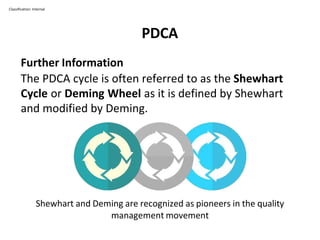
The PDCA cycle is often referred to as the Shewhart
Cycle or Deming Wheel as it is defined by Shewhart
and modified by Deming.
Shewhart and Deming are recognized as pioneers in the quality
management movement
PDCA
Classification: Internal
Further Information
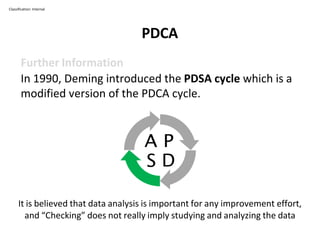
In 1990, Deming introduced the PDSA cycle which is a
modified version of the PDCA cycle.
It is believed that data analysis is important for any improvement effort,
and “Checking” does not really imply studying and analyzing the data
A P
S D
PDCA
Classification: Internal
Further Information
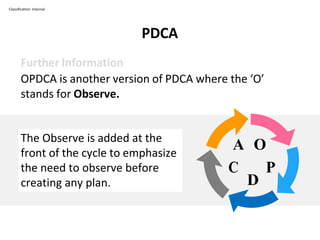
OPDCA is another version of PDCA where the ‘O’
stands for Observe.
A O
C
D
P
The Observe is added at the
front of the cycle to emphasize
the need to observe before
creating any plan.
PDCA
Classification: Internal
Further Information
PDCA relies on trial and error, however, it keeps
improving until it achieves excellence.
Going through the PDCA cycle is
not straightforward and can be
slow. PDCA is not the appropriate
approach when dealing with
urgent issues.
PDCA
Classification: Internal
Further Information
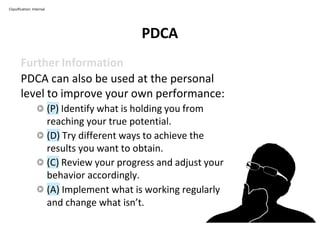
PDCA can also be used at the personal
level to improve your own performance:
(P) Identify what is holding you from
reaching your true potential.
(D) Try different ways to achieve the
results you want to obtain.
(C) Review your progress and adjust your
behavior accordingly.
(A) Implement what is working regularly
and change what isn’t.
PDCA
Classification: Internal
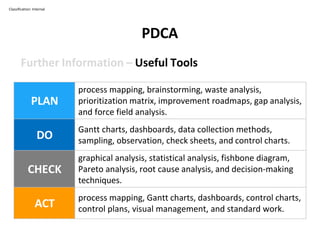
Further Information – Useful Tools
PLAN
process mapping, brainstorming, waste analysis,
prioritization matrix, improvement roadmaps, gap analysis,
and force field analysis.
DO
Gantt charts, dashboards, data collection methods,
sampling, observation, check sheets, and control charts.
CHECK
graphical analysis, statistical analysis, fishbone diagram,
Pareto analysis, root cause analysis, and decision-making
techniques.
ACT
process mapping, Gantt charts, dashboards, control charts,
control plans, visual management, and standard work.
PDCA
Classification: Internal
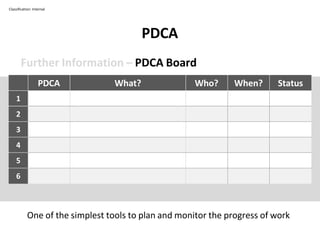
Further Information – PDCA Board
One of the simplest tools to plan and monitor the progress of work
PDCA What? Who? When? Status
1
2
3
4
5
6
PDCA Cycle | Plan Do Check Act | ISO | Gaurav Singh Rajput

PDCA Cycle | Plan Do Check Act | ISO | Gaurav Singh Rajput

  • 1.
  • 2.
    PDCA The PDCA Cycleis a four-step model for problem solving and continuous improvement. It provides a simple and structured Way for solving problems and creating positive change. Widely recognized as the basis of continually improving the quality of processes, products, and services.
  • 3.
    PDCA An easy toremember four logical sequenced steps . . . Plan Do Check Act Cycling through Plan, Do, Check, and Act until desired result is achieved is essential for continuous improvement
  • 4.
    PDCA The PDCA cyclecan be applied in most kinds of projects and improvement activities . . . When planning to change the supplier of a product or service When trying to implement a new safety program within a facility When planning to improve the skill level of employees in an organization
  • 5.
    PDCA The PDCA cyclecan be applied in most kinds of projects and improvement activities . . . When your marketing effort is not generating the desired results When planning to increase the quality of care and patient engagement in a hospital When an online business is not producing good results and customers are not converting l
  • 6.
    PDCA Another common exampleis when you are dealing with customer complaints. You may often need to review the complaints and prioritize them Produce solution ideas to deal with the most frequent complaints Conduct pilot surveys with sample customers to test new options Collect and analyze customer data and feedback Use the lessons learned to implement the new options in full scale What we have just listed is a PDCA cycle
  • 7.
    PDCA The PDCA cycleis particularly effective when intending to make changes to a process. Prepare pastries Make orange juice Toast bread l
  • 8.
    PDCA PDCA is oftenused when the solution to the problem is known. Applicable whether the intended improvement is a breakthrough or incremental A3 / 8D
  • 9.
    PDCA TQM, ISO standardsand the A3 thinking process are all based around the PDCA philosophy. PDCA stands at the core of all quality systems TQM ISO A3
  • 10.
    PDCA Classification: Internal Represents thelogical way of thinking we tend to follow when solving problems or implementing continuous improvement.
  • 11.
    PDCA Classification: Internal PDCA providesan effective approach for solving quality-related issues such as nonconformities, inefficiencies, and process variability. The aim is to get closer to whatever goal we have
  • 12.
    PDCA Classification: Internal BENEFITS Helps closingthe gap between planning and doing Encourages the methodical way of problem solving and implementing solutions Brings you closer to your goals as knowledge is increased from solving problems, failures the received feedback Provides feedback to justify guesses hypotheses and ensures incorporating feedback before starting full-scale implementation Improves the critical thinking skills of your team Helps your organization to reach towards a more integrated system
  • 13.
    PDCA Classification: Internal Implement Identify thebest the problem solution / opportunity Study the Test results and potential feedback solutions The PDCA cycle can be represented in the form of a diagram. Plan Do Check Act
  • 14.
    PDCA Classification: Internal The PDCAcycle begins with a Planning phase where the problem and objectives are identified. In this phase, the team agrees on the problem to be solved or the process to be improved. A P C D
  • 15.
    PDCA Classification: Internal You thenneed to analyze the current situation, identify solution alternatives, and select and schedule the most promising solution.
  • 16.
    PDCA Classification: Internal The selectedsolution is then tested on a small-scale basis in the Do phase. It is important to ensure that the selected solution is appropriately implemented before committing to full implementation. A P C D
  • 17.
    PDCA Classification: Internal This phasealso involves measuring the progress and collecting data and feedback for later analysis. You may need to conduct the pilot test within a department, in a limited geographical area, or within certain demographic group.
  • 18.
    PDCA Classification: Internal Check involvesanalyzing the collected data and feedback and comparing the outcome against the planned objectives. It allows to evaluate how well the solution has worked and whether further improvement is needed. A P C D
  • 19.
    PDCA Classification: Internal This phaseis also concerned with identifying the unexpected issues and gathering and summarizing the key learnings. Current plans can be altered according to the received feedback.
  • 20.
    PDCA Classification: Internal Note thatyou may need to repeat the Do and Check several times until you achieve desired results. Sometimes you may need to return to the planning phase A P C D A P C D A P C D A P C D
  • 21.
    PDCA Classification: Internal Act iswhere you implement the solution in full scale. It involves taking actions based on what you learned in the Check phase. A P C D
  • 22.
    PDCA Classification: Internal A planshould be created for the full implementation after evaluating the costs and benefits associated. If the potential benefits are not sufficient, the team should reevaluate the plan and the project may be terminated.
  • 23.
    PDCA Classification: Internal Act isalso concerned with . . . Standardizing Documenting Sustaining the improved process Integrating it into the organization’s system
  • 24.
    PDCA Classification: Internal The useof the PDCA cycle doesn’t necessarily stop once the Act phase is completed. The improved process may become the new baseline, and you may start again at the Plan phase. A1 P1 C1 D1 A2 P2 C2 D2
  • 25.
    PDCA Classification: Internal Multiple iterationsof the PDCA cycle could be necessary to solve the problem permanently and reach the ultimate future state. Each cycle will bring you closer to your goals and will extend your knowledge further. A P C D
  • 26.
    PDCA Classification: Internal The PDCAcycle can be repeatedly applied in a process of continuous improvement where there is no end to it. Repeating the PDCA cycle frequently can be helpful in implementing Kaizen and other continuous improvement initiatives
  • 27.
    PDCA Classification: Internal When thefirst iteration of the PDCA cycle ends, lessons should be gathered for the next cycle. Our knowledge and skills will grow as we continue to work on the project.
  • 28.
    PDCA Classification: Internal Data shouldbe collected continuously to measure and evaluate the performance on a continual basis.
  • 29.
    PDCA Classification: Internal How toImplement a PDCA Cycle? 1. With your team, identify and understand the problem (consider using the 5W2H approach). 2. Brainstorm and screen solution ideas. 3. Develop an implementation plan along with responsibilities, milestones, review periods and performance indicators. A P C D
  • 30.
    PDCA Classification: Internal How toImplement a PDCA Cycle? 4. Put the implementation plan into practice. 5. Run the pilot solution (produce, serve, purchase, survey, train, etc.). 6. Gather data and measure performance outcomes. A P C D
  • 31.
    PDCA Classification: Internal How toImplement a PDCA Cycle? 7. Review the obtained results and collected data. 8. Analyze and compare the results against the initial state. 9. Assess whether the solution solves the problem and discuss if further improvement is needed. A P C D
  • 32.
    PDCA Classification: Internal How toImplement a PDCA Cycle? 10. Use what you learned to plan your improvement. 11. Implement the solution in full scale. 12. Train employees on the new process. A P C D
  • 33.
    PDCA Classification: Internal Example –A common example often used to illustrate the PDCA cycle is when a team is initiating a new product development. Act Fully implement the new design acting on the collected feedback Analyze the collected data to measure customer satisfaction Check Plan Plan for the new product development & production process Create a prototype, test it, & collect data from the customer Do
  • 34.
    PDCA Classification: Internal Example -Another example is when a lab team is planning to Act Plan solve a customer’s complaint about the delayed test results at a laboratory. Take actions based on the analysis and fully implement the best solution. Analyze the data to show the options that will result in greater customer satisfaction. Explore all available information & generate solution ideas to deal with the complaint. Carry out a small-scale study to execute the ideas, then collect data on the time spent waiting for results. Check Do
  • 35.
    PDCA Classification: Internal Further Information ThePDCA cycle is often referred to as the Shewhart Cycle or Deming Wheel as it is defined by Shewhart and modified by Deming. Shewhart and Deming are recognized as pioneers in the quality management movement
  • 36.
    PDCA Classification: Internal Further Information In1990, Deming introduced the PDSA cycle which is a modified version of the PDCA cycle. It is believed that data analysis is important for any improvement effort, and “Checking” does not really imply studying and analyzing the data A P S D
  • 37.
    PDCA Classification: Internal Further Information OPDCAis another version of PDCA where the ‘O’ stands for Observe. A O C D P The Observe is added at the front of the cycle to emphasize the need to observe before creating any plan.
  • 38.
    PDCA Classification: Internal Further Information PDCArelies on trial and error, however, it keeps improving until it achieves excellence. Going through the PDCA cycle is not straightforward and can be slow. PDCA is not the appropriate approach when dealing with urgent issues.
  • 39.
    PDCA Classification: Internal Further Information PDCAcan also be used at the personal level to improve your own performance: (P) Identify what is holding you from reaching your true potential. (D) Try different ways to achieve the results you want to obtain. (C) Review your progress and adjust your behavior accordingly. (A) Implement what is working regularly and change what isn’t.
  • 40.
    PDCA Classification: Internal Further Information– Useful Tools PLAN process mapping, brainstorming, waste analysis, prioritization matrix, improvement roadmaps, gap analysis, and force field analysis. DO Gantt charts, dashboards, data collection methods, sampling, observation, check sheets, and control charts. CHECK graphical analysis, statistical analysis, fishbone diagram, Pareto analysis, root cause analysis, and decision-making techniques. ACT process mapping, Gantt charts, dashboards, control charts, control plans, visual management, and standard work.
  • 41.
    PDCA Classification: Internal Further Information– PDCA Board One of the simplest tools to plan and monitor the progress of work PDCA What? Who? When? Status 1 2 3 4 5 6