
What is Permit To Work System
2
• The PTW system is a formal written procedure used to
control access and activities of personnel in the
construction
• To ensure safety of personnel and to prevent damage
to equipment
• It also means of communication between site
management, supervisors and operators, who carry
out the work
• PTW normally implemented in a work activities near or
inside the operating facilities, there's buried or near
operational system or where the clients thinks that
PTW is deemed necessary
How is work controlled within the Permit To Work
System
Work is controlled by following various steps
detailed in the permit to work procedures and by
using special documents called WORK PERMIT.
3
Work permits are not simple permission to
carryout work, but they determine how the work
can be carried out safely.
Types of Permit To Work
• Hot Work Permit
• Confined Space Entry
Permit
• Electrical Permit
(Energizing and De-
energizing)
• Excavation Permit
• Radiography Permit
• Crane Critical Lifts
• Man-basketOperation
• Cold Work Permit
4
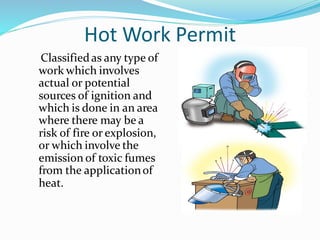
Hot Work Permit
Classifiedas any type of
work which involves
actual or potential
sources of ignition and
which is done in an area
where there may be a
risk of fire or explosion,
or which involve the
emission of toxic fumes
from the applicationof
heat.
5
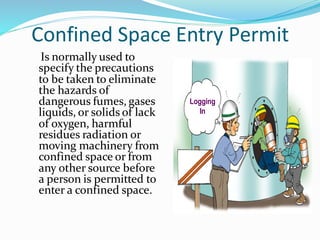
Confined Space Entry Permit
Is normally used to
specify the precautions
to be taken to eliminate
the hazards of
dangerous fumes, gases
liquids, or solids of lack
of oxygen, harmful
residues radiation or
moving machinery from
confined space or from
any other source before
a person is permitted to
enter a confined space.
6
Logging
In
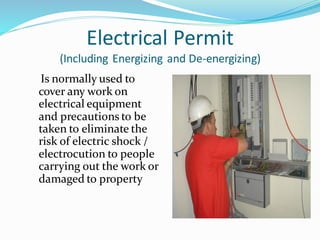
Electrical Permit
(Including Energizing and De-energizing)
Is normally used to
cover any work on
electrical equipment
and precautions to be
taken to eliminate the
risk of electric shock /
electrocution to people
carrying out the work or
damaged to property
7
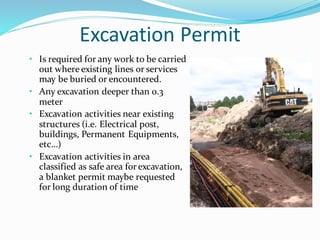
Excavation Permit
• Is required for any work to be carried
out where existing lines or services
may be buried or encountered.
• Any excavation deeper than 0.3
meter
• Excavation activities near existing
structures (i.e. Electrical post,
buildings, Permanent Equipments,
etc…)
• Excavation activities in area
classified as safe area for excavation,
a blanket permit maybe requested
for long duration of time
8
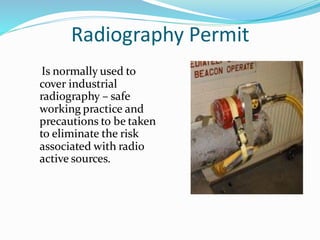
Radiography Permit
Is normally used to
cover industrial
radiography – safe
working practice and
precautions to be taken
to eliminate the risk
associated with radio
active sources.
9
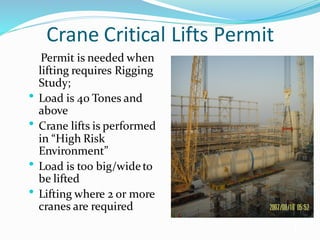
Crane Critical Lifts Permit
Permit is needed when
lifting requires Rigging
Study;
• Load is 40 Tones and
above
• Crane lifts is performed
in “High Risk
Environment”
• Load is too big/wideto
be lifted
• Lifting where 2 or more
cranes are required
10
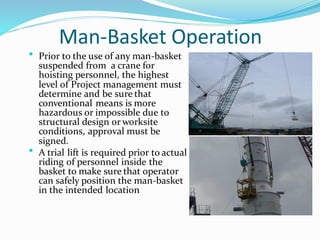
Man-Basket Operation
• Prior to the use of any man-basket
suspended from a crane for
hoisting personnel, the highest
level of Project management must
determine and be sure that
conventional means is more
hazardous or impossible due to
structural design or worksite
conditions, approval must be
signed.
• A trial lift is required prior to actual
riding of personnel inside the
basket to make sure that operator
can safely position the man-basket
in the intended location
11
Permit Issuer Responsibilities
In thecase of operational plant, theCompanynormallyhas its
own permit system. The OperationManagerof theaffected
section of the plant or hisdesignatedrepresentativeshall be
thepermit issuer. In a non-operationalarea but existing
facilitiesare alreadyin place, The ContractorArea
ConstructionManagersor CompanySection head shall be the
issuers of the permits.
 The Issuer has thesoleauthorityto issue thepermit.
 The Issuershall be fullyaware of siteconditions, thetypeof
work to be carried out and all therequirementsstated in the
permit.
 The Issuershall conduct an onsiteinspectionjointlytogether
with the Receiverto ensure thatsiteconditionsaresafe to
permit thework and all requirementsstatedin thepermit are
implementedpriorto the issuance of the permit.
 The Issuershall withholdtheissuance of the permit if the
requirementsare not met, orsiteconditionsare notsafe for the
work tocarry out.
12
Permit Issuer Responsibilities
• The Issuer shall, if noticing the presence of any other
potential hazards, risks that may jeopardize the safety of
the worker, tools or equipment advice the Receiver of
appropriate countermeasures to be taken.
• The Issuer shall ensure that all required safety-monitoring
measurements are properly done and so stated in the
permit.
• The Issuer shall ensure all personnel involved in the work
are fully aware of Emergency procedures.
• Once informed the work is completed, the Issuer shall
visit the site jointly with the Receiver to ensure that the
work is ceased and the site is kept clean and tidy without
any smouldering exist.
13
Permit Receiver Responsibilities
Task supervisorswho are directlyresponsiblefor the work stated
in thepermit shall be the Receiverof the Permit. He shall
clearlydefinethe job to be done, theexact location and nature
of thework. Also toensure that theconditionson thepermit are
met in full
 The Receivershall be fullyawareof all requirementsstatedin
thepermit and comply with themat all times.
 The Receivershall fully brief thework crew to ensure that
requirementsare clearlyunderstoodby thecrew under his
supervision.
 The Receivershall ensure thework is performed in accordance
with theconditionsspecified in thepermit. He shall remain at
thework siteto supervise thework.
 The Receivershall ensure that under no circumstances shall by
hisown discretionor hiscrew change theoriginal scopeof the
work, which isdescribed in thepermit.
14
Permit Receiver Responsibilities
 The Receivershall request a new permit in theevent a change in
thescope of thework becomes necessary.
 Wheneversiteconditionsaredrasticallychanged, theReceiver
shall immediatelystopthework and informthe Issuer of the
change for further instructionfrom him.
 Upon theoccurrence of an emergency the Receiver shall
immediatelystopthework and shut down all equipment.
 The Receivershall report thecompletion of thework or the
expirationof thevalidityof
 thepermit to the Issuerand ensure thatthe siteis kept clean
and tidywithoutanysmouldering/ignitionsources.
 If thework in progressrequires extendingthevaliditystatedin
thepermit, theReceiver shall suspend thework and request an
issuance of new permit.
15
HSE Permit Coordinator
Responsibilities
 The HSE Permit Coordinator designated by Area
Construction Managers is responsible for daily
coordination of the work permits.
 He is responsible for full clerical control of the system
including retention of the closed out Work Permits for
one-month period.
 Has the full overview of the planned, open and
suspended work permits on visual display in his permit
to work office.
16
Operational Procedures for the Work Permit System
17
1. A Work Permit consists of a set of three pages. The White page
shall be kept by the Receiver and kept at the work location,
Yellow page shall be kept by the Issuer and Green page shall be
kept by the HSE Permit Coordinator.
2. The description of the work shall be a precise statement of the
planned activity, the location of the work by identification of the
area or equipment to be worked upon. Broad scopes of work of
a general nature are not acceptable.
3. Method Statements, Risk Assessments and/or Job Safety
Analyses will be produced for critical activities and shall be
attached to and form part of the permit. Such additional
documentation shall be attached to the original of the Permit.
Operational Procedures for the Work Permit
System
18
4. Whereadditional Permits or Certificates are required, they will
be attached to and form part of the Permit to Work.
5. The Receiver shall produce the permit to Contractorresponsible
personnel for the work requested in the permit for review and
verification by 15:00 hours a day prior to the commencement of
the work
6. As soon as the review and verification has been made, the
Receiver shall bring the verified permit to the HSE Permit
Coordinator.
7. The HSE Permit Coordinator shall scrutinize the permit including
safety precautions and requirements stated in the permit and
deliver it to the Receiver. The HSE Permit Coordinator should
consult HSE personnel for professional advice or suggestions
required to work safely.
Operational Procedures for the Work Permit
System
19
8. The Receiver shall bring the permit to the Issuer who shall
review the permit to ensure that all required safety precautionary
measures are stated and authorizes the permit.
9. On the day of the work, the Issuer in the person together with
the Receiver shall go to the site to ensure that all requirements
in the permit are met and hand over the permit to the Receiver
10. Issuance of the permit to the Receiver in the office shall not take
place.
Operational Procedures for the Work Permit System
20
11. Upon receipt of the permit from the Issuer, the Receiver can
commence the work.
12. When no further work is to take place under a permit, the
Receiver shall sign off and return the permit to the Issuer to
close the permit.
13. Upon receipt of the permit, the Issuer and the Receiver shall
inspect the work site to ensure that no smouldering is present,
the work site is clean and tidy and equipment is left in a safe
condition.
The issuer shall return the invalid permit to the HSE Permit
Coordinator for file.
Revalidation of the Permit
 When the work calls for any extension of the permit,
the Receiver shall suspend the work and request an
extension of the validity to the Issuer.
 The Issuer is responsible for ensuring that all
precautions and requirements are still in place and
the conditions in the work site are maintained safe
for personnel and equipment.
 If the issuer agrees to extend the permit he shall
define the time of the expiry and sign in the permit
to authorize the extension.
 The Receiver returns the extended permit to the
work site and resumes the work.
21
Emergency Situation
 When an emergency, such as a fire incident, Toxic
Gas Release, Natural calamities has taken place the
Receiver shall immediately stop all works and shut
down all equipment.
 All permits shall be nullified and no work shall be
resumed unless new permits have been issued out by
the Issuer.
 Prior to the issuance of a new permit, the Issuer shall
visit the work site to ensure that there is no
imminent hazard/risk present and that the work site
is safe for work.
22
Work Permit Flow Chart
23
Authorize Permit
Accept Permit
Review/Verify
Permit
Originate Permit
Issuer
HSE Permit
Coordinator
Permit
Receiver
Responsible
Supervisor
Carry OutWork Work Finished?
Re-Validate
Permit
Close Permit
File Permit
PermitReceiver
& Issuer
HSE Permit
Coordinator
Yes
No
Summary
 The Permit to Work is designed to provide a safe
system of work that can be applied to works identified
by virtue of perceived risks.
 This shall be applied to the Contractor controlled
Construction activities on the Project.
 Permit requirements for activities other than those
mentioned in this procedure will be re-evaluated
especially for potentially hazardous activities where an
extra degree of work control is felt to be appropriate.
24
Permit To Work | Work Permit System | Gaurav Singh Rajput

Permit To Work | Work Permit System | Gaurav Singh Rajput

  • 2.
    What is PermitTo Work System 2 • The PTW system is a formal written procedure used to control access and activities of personnel in the construction • To ensure safety of personnel and to prevent damage to equipment • It also means of communication between site management, supervisors and operators, who carry out the work • PTW normally implemented in a work activities near or inside the operating facilities, there's buried or near operational system or where the clients thinks that PTW is deemed necessary
  • 3.
    How is workcontrolled within the Permit To Work System Work is controlled by following various steps detailed in the permit to work procedures and by using special documents called WORK PERMIT. 3 Work permits are not simple permission to carryout work, but they determine how the work can be carried out safely.
  • 4.
    Types of PermitTo Work • Hot Work Permit • Confined Space Entry Permit • Electrical Permit (Energizing and De- energizing) • Excavation Permit • Radiography Permit • Crane Critical Lifts • Man-basketOperation • Cold Work Permit 4
  • 5.
    Hot Work Permit Classifiedasany type of work which involves actual or potential sources of ignition and which is done in an area where there may be a risk of fire or explosion, or which involve the emission of toxic fumes from the applicationof heat. 5
  • 6.
    Confined Space EntryPermit Is normally used to specify the precautions to be taken to eliminate the hazards of dangerous fumes, gases liquids, or solids of lack of oxygen, harmful residues radiation or moving machinery from confined space or from any other source before a person is permitted to enter a confined space. 6 Logging In
  • 7.
    Electrical Permit (Including Energizingand De-energizing) Is normally used to cover any work on electrical equipment and precautions to be taken to eliminate the risk of electric shock / electrocution to people carrying out the work or damaged to property 7
  • 8.
    Excavation Permit • Isrequired for any work to be carried out where existing lines or services may be buried or encountered. • Any excavation deeper than 0.3 meter • Excavation activities near existing structures (i.e. Electrical post, buildings, Permanent Equipments, etc…) • Excavation activities in area classified as safe area for excavation, a blanket permit maybe requested for long duration of time 8
  • 9.
    Radiography Permit Is normallyused to cover industrial radiography – safe working practice and precautions to be taken to eliminate the risk associated with radio active sources. 9
  • 10.
    Crane Critical LiftsPermit Permit is needed when lifting requires Rigging Study; • Load is 40 Tones and above • Crane lifts is performed in “High Risk Environment” • Load is too big/wideto be lifted • Lifting where 2 or more cranes are required 10
  • 11.
    Man-Basket Operation • Priorto the use of any man-basket suspended from a crane for hoisting personnel, the highest level of Project management must determine and be sure that conventional means is more hazardous or impossible due to structural design or worksite conditions, approval must be signed. • A trial lift is required prior to actual riding of personnel inside the basket to make sure that operator can safely position the man-basket in the intended location 11
  • 12.
    Permit Issuer Responsibilities Inthecase of operational plant, theCompanynormallyhas its own permit system. The OperationManagerof theaffected section of the plant or hisdesignatedrepresentativeshall be thepermit issuer. In a non-operationalarea but existing facilitiesare alreadyin place, The ContractorArea ConstructionManagersor CompanySection head shall be the issuers of the permits.  The Issuer has thesoleauthorityto issue thepermit.  The Issuershall be fullyaware of siteconditions, thetypeof work to be carried out and all therequirementsstated in the permit.  The Issuershall conduct an onsiteinspectionjointlytogether with the Receiverto ensure thatsiteconditionsaresafe to permit thework and all requirementsstatedin thepermit are implementedpriorto the issuance of the permit.  The Issuershall withholdtheissuance of the permit if the requirementsare not met, orsiteconditionsare notsafe for the work tocarry out. 12
  • 13.
    Permit Issuer Responsibilities •The Issuer shall, if noticing the presence of any other potential hazards, risks that may jeopardize the safety of the worker, tools or equipment advice the Receiver of appropriate countermeasures to be taken. • The Issuer shall ensure that all required safety-monitoring measurements are properly done and so stated in the permit. • The Issuer shall ensure all personnel involved in the work are fully aware of Emergency procedures. • Once informed the work is completed, the Issuer shall visit the site jointly with the Receiver to ensure that the work is ceased and the site is kept clean and tidy without any smouldering exist. 13
  • 14.
    Permit Receiver Responsibilities Tasksupervisorswho are directlyresponsiblefor the work stated in thepermit shall be the Receiverof the Permit. He shall clearlydefinethe job to be done, theexact location and nature of thework. Also toensure that theconditionson thepermit are met in full  The Receivershall be fullyawareof all requirementsstatedin thepermit and comply with themat all times.  The Receivershall fully brief thework crew to ensure that requirementsare clearlyunderstoodby thecrew under his supervision.  The Receivershall ensure thework is performed in accordance with theconditionsspecified in thepermit. He shall remain at thework siteto supervise thework.  The Receivershall ensure that under no circumstances shall by hisown discretionor hiscrew change theoriginal scopeof the work, which isdescribed in thepermit. 14
  • 15.
    Permit Receiver Responsibilities The Receivershall request a new permit in theevent a change in thescope of thework becomes necessary.  Wheneversiteconditionsaredrasticallychanged, theReceiver shall immediatelystopthework and informthe Issuer of the change for further instructionfrom him.  Upon theoccurrence of an emergency the Receiver shall immediatelystopthework and shut down all equipment.  The Receivershall report thecompletion of thework or the expirationof thevalidityof  thepermit to the Issuerand ensure thatthe siteis kept clean and tidywithoutanysmouldering/ignitionsources.  If thework in progressrequires extendingthevaliditystatedin thepermit, theReceiver shall suspend thework and request an issuance of new permit. 15
  • 16.
    HSE Permit Coordinator Responsibilities The HSE Permit Coordinator designated by Area Construction Managers is responsible for daily coordination of the work permits.  He is responsible for full clerical control of the system including retention of the closed out Work Permits for one-month period.  Has the full overview of the planned, open and suspended work permits on visual display in his permit to work office. 16
  • 17.
    Operational Procedures forthe Work Permit System 17 1. A Work Permit consists of a set of three pages. The White page shall be kept by the Receiver and kept at the work location, Yellow page shall be kept by the Issuer and Green page shall be kept by the HSE Permit Coordinator. 2. The description of the work shall be a precise statement of the planned activity, the location of the work by identification of the area or equipment to be worked upon. Broad scopes of work of a general nature are not acceptable. 3. Method Statements, Risk Assessments and/or Job Safety Analyses will be produced for critical activities and shall be attached to and form part of the permit. Such additional documentation shall be attached to the original of the Permit.
  • 18.
    Operational Procedures forthe Work Permit System 18 4. Whereadditional Permits or Certificates are required, they will be attached to and form part of the Permit to Work. 5. The Receiver shall produce the permit to Contractorresponsible personnel for the work requested in the permit for review and verification by 15:00 hours a day prior to the commencement of the work 6. As soon as the review and verification has been made, the Receiver shall bring the verified permit to the HSE Permit Coordinator. 7. The HSE Permit Coordinator shall scrutinize the permit including safety precautions and requirements stated in the permit and deliver it to the Receiver. The HSE Permit Coordinator should consult HSE personnel for professional advice or suggestions required to work safely.
  • 19.
    Operational Procedures forthe Work Permit System 19 8. The Receiver shall bring the permit to the Issuer who shall review the permit to ensure that all required safety precautionary measures are stated and authorizes the permit. 9. On the day of the work, the Issuer in the person together with the Receiver shall go to the site to ensure that all requirements in the permit are met and hand over the permit to the Receiver 10. Issuance of the permit to the Receiver in the office shall not take place.
  • 20.
    Operational Procedures forthe Work Permit System 20 11. Upon receipt of the permit from the Issuer, the Receiver can commence the work. 12. When no further work is to take place under a permit, the Receiver shall sign off and return the permit to the Issuer to close the permit. 13. Upon receipt of the permit, the Issuer and the Receiver shall inspect the work site to ensure that no smouldering is present, the work site is clean and tidy and equipment is left in a safe condition. The issuer shall return the invalid permit to the HSE Permit Coordinator for file.
  • 21.
    Revalidation of thePermit  When the work calls for any extension of the permit, the Receiver shall suspend the work and request an extension of the validity to the Issuer.  The Issuer is responsible for ensuring that all precautions and requirements are still in place and the conditions in the work site are maintained safe for personnel and equipment.  If the issuer agrees to extend the permit he shall define the time of the expiry and sign in the permit to authorize the extension.  The Receiver returns the extended permit to the work site and resumes the work. 21
  • 22.
    Emergency Situation  Whenan emergency, such as a fire incident, Toxic Gas Release, Natural calamities has taken place the Receiver shall immediately stop all works and shut down all equipment.  All permits shall be nullified and no work shall be resumed unless new permits have been issued out by the Issuer.  Prior to the issuance of a new permit, the Issuer shall visit the work site to ensure that there is no imminent hazard/risk present and that the work site is safe for work. 22
  • 23.
    Work Permit FlowChart 23 Authorize Permit Accept Permit Review/Verify Permit Originate Permit Issuer HSE Permit Coordinator Permit Receiver Responsible Supervisor Carry OutWork Work Finished? Re-Validate Permit Close Permit File Permit PermitReceiver & Issuer HSE Permit Coordinator Yes No
  • 24.
    Summary  The Permitto Work is designed to provide a safe system of work that can be applied to works identified by virtue of perceived risks.  This shall be applied to the Contractor controlled Construction activities on the Project.  Permit requirements for activities other than those mentioned in this procedure will be re-evaluated especially for potentially hazardous activities where an extra degree of work control is felt to be appropriate. 24