WELD
DEFECTS
JEROME CHRISTO S
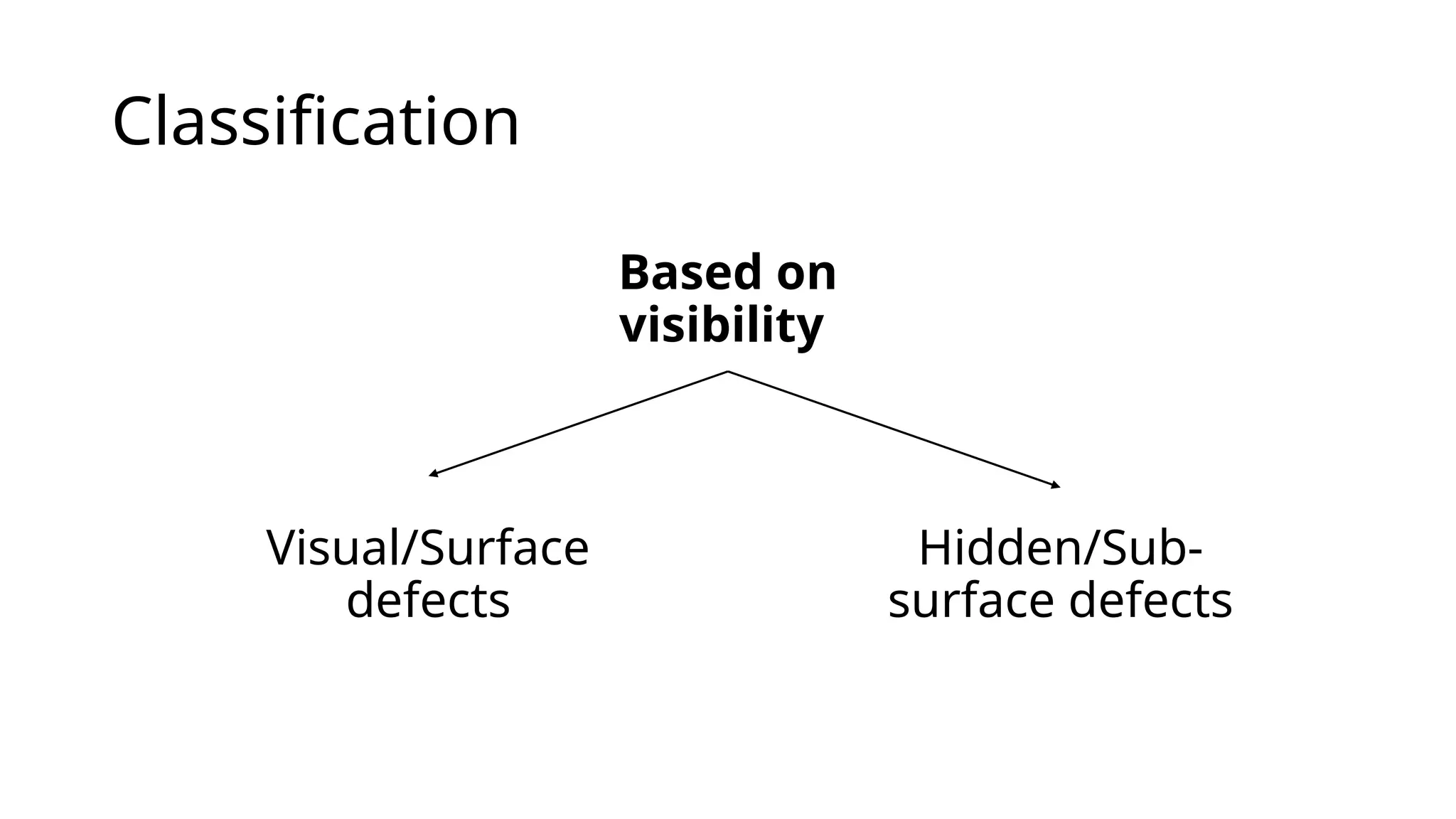
Classification
Visual/Surface
defects
Hidden/Sub-
surface defects
Based on
visibility
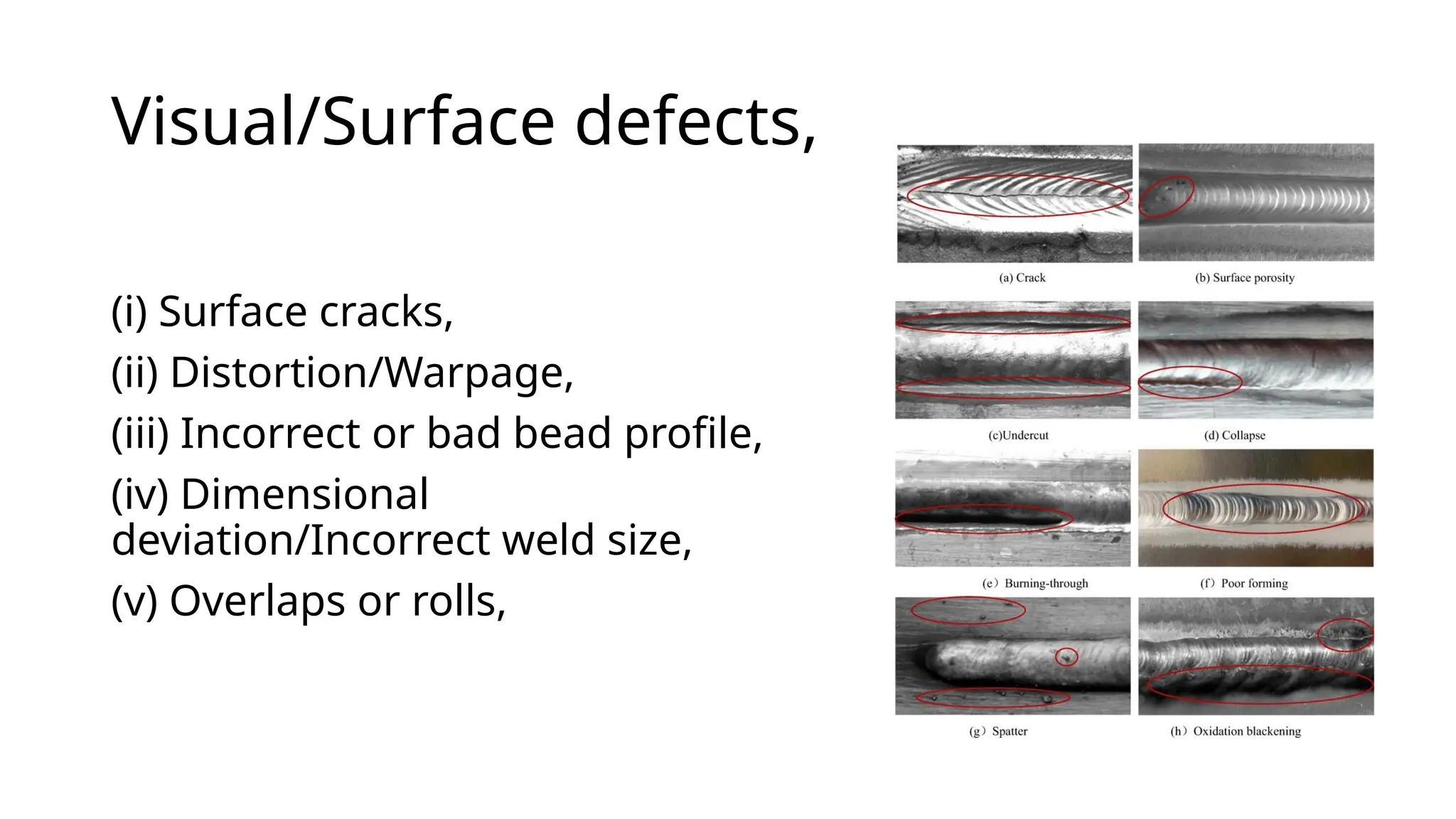
Visual/Surface defects,
(i) Surface cracks,
(ii) Distortion/Warpage,
(iii) Incorrect or bad bead profile,
(iv) Dimensional
deviation/Incorrect weld size,
(v) Overlaps or rolls,
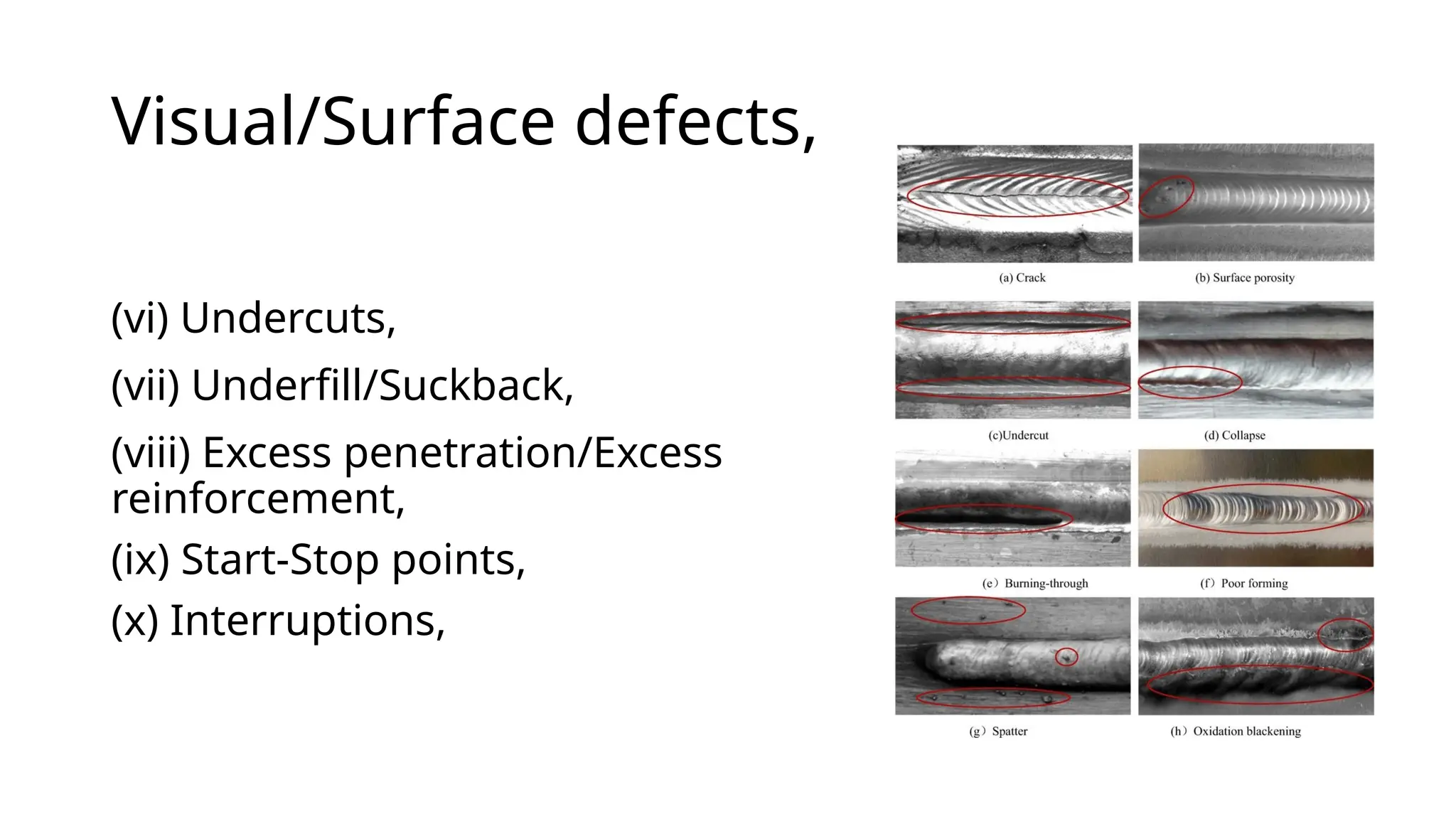
(vi) Undercuts,
(vii) Underfill/Suckback,
(viii) Excess penetration/Excess
reinforcement,
(ix) Start-Stop points,
(x) Interruptions,
Visual/Surface defects,
(xi) Unfilled craters,
(xii) Burn-through,
(xiii) Surface porosity,
(xiv) Surface oxidation,
(xv) Uneven and Coarse ripples,
Visual/Surface defects
(xvi) Pock marks/Flat spots,
(xvii) Excessive spatter,
(xviii) Arc strike,
(xix) Bad surface appearance,
(xx) High/Iow off-set.
Visual/Surface defects,
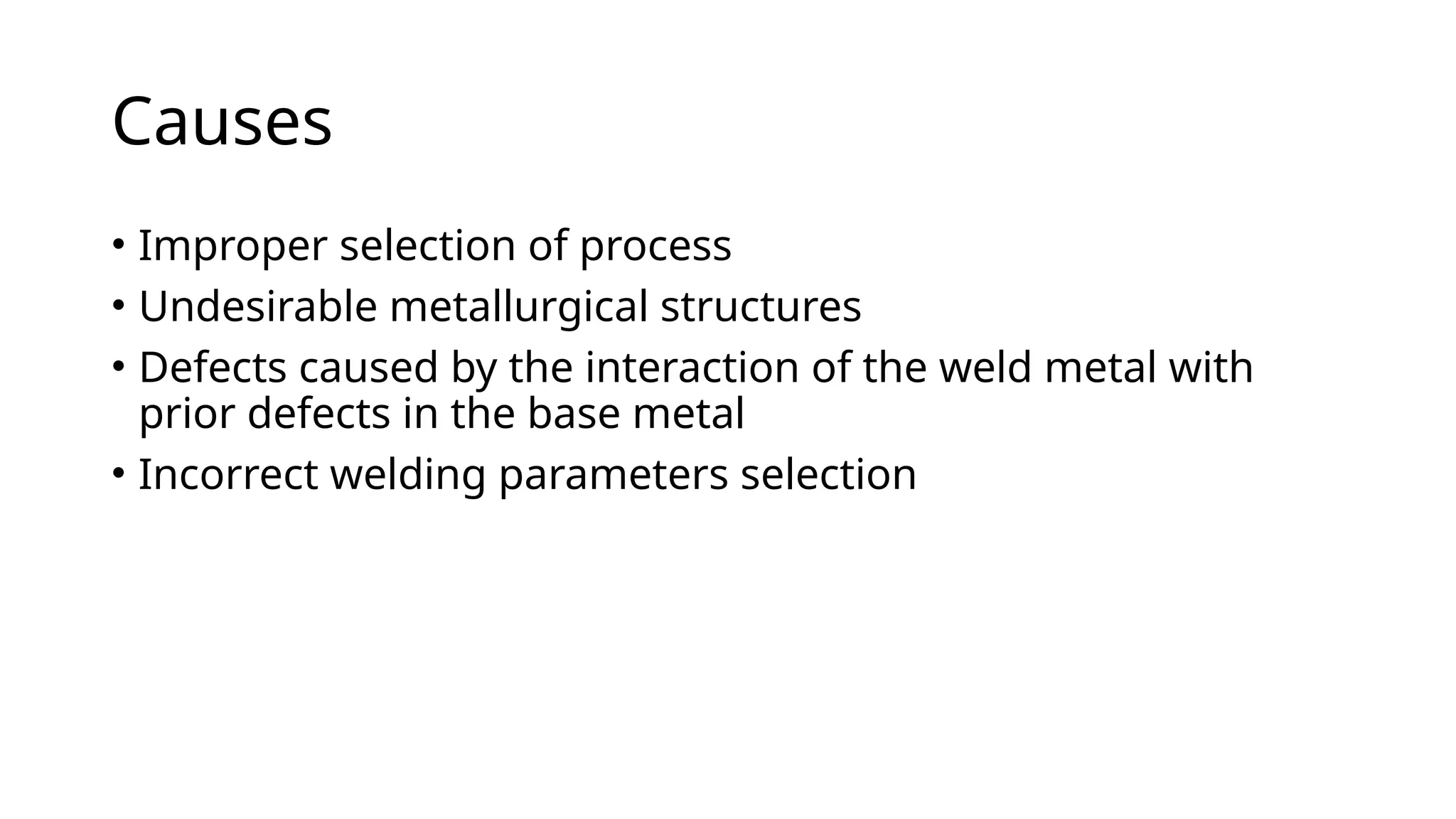
Hidden or Subsurface Weld Defects
(i) Lack of fusion,
(ii) Lack of penetration,
(iii) Hidden or Subsurface cracks,
(iv) Blowholes/Subsurface porosity,
(v) Shrinkage cavities,
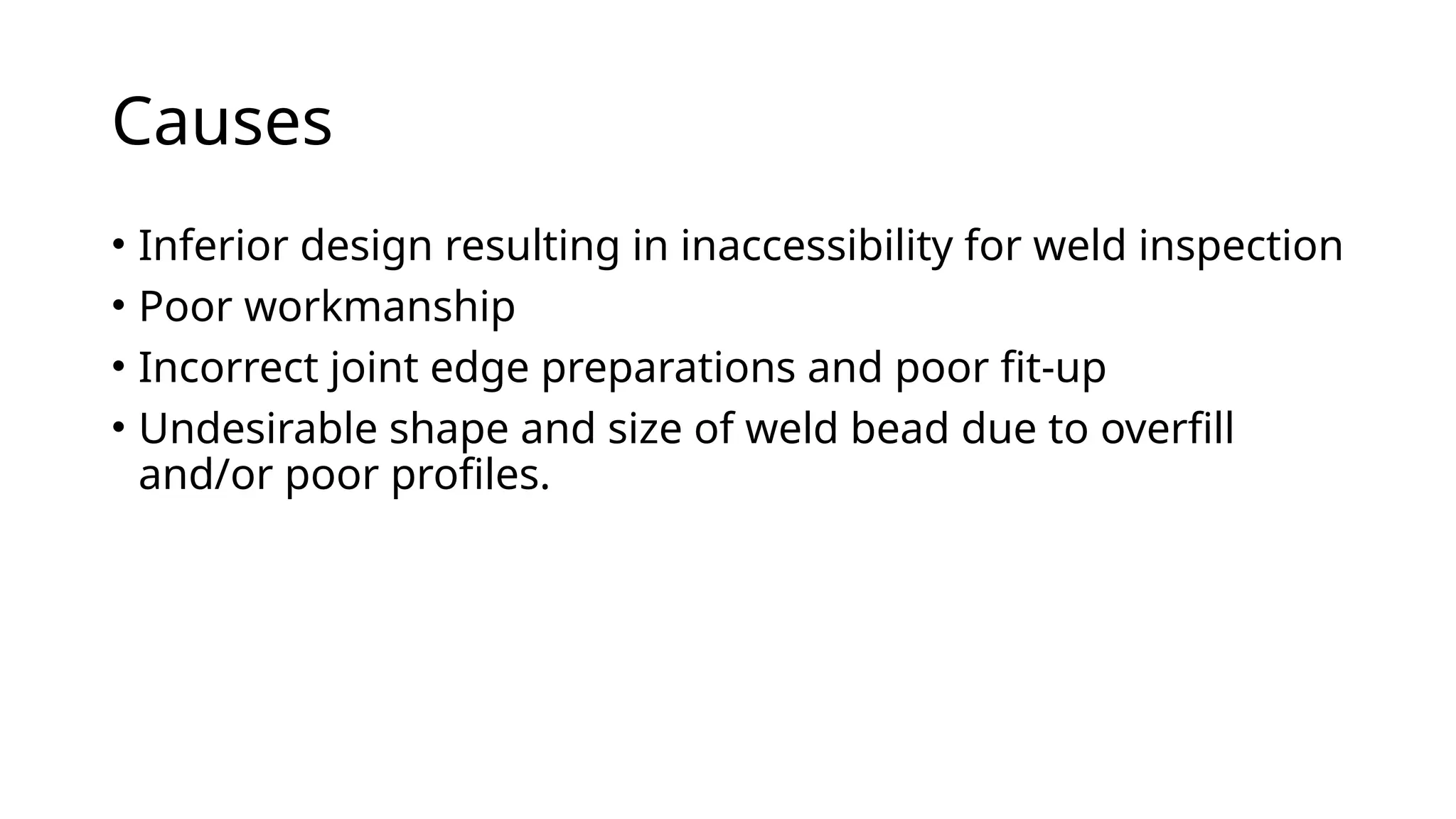
Hidden or Subsurface Weld Defects
(vi) Slag inclusion,
(vii) Tungsten/copper ( Metallic)
inclusions,
(viii) Finger penetration,
(ix) Coarse microstructure.
Causes
• Improper selection of process
• Undesirable metallurgical structures
• Defects caused by the interaction of the weld metal with
prior defects in the base metal
• Incorrect welding parameters selection
• Inferior design resulting in inaccessibility for weld inspection
• Poor workmanship
• Incorrect joint edge preparations and poor fit-up
• Undesirable shape and size of weld bead due to overfill
and/or poor profiles.
Causes
• Most dangerous
• Invariably unacceptable
Types:
1. Surface Cracks/Hidden cracks
2. Micro/Macro cracks
Cracks
Cracks
Causes:
(i) High contraction stresses (being greater than the hot
strength of the weld or parent material)
(ii) poor fit-up and incorrect welding procedures
(iii) poor edge quality.
Solidification cracking
• Microsegregation and resultant
formation of low solidification
temperature liquid films along
the grain boundaries
• Microfissures formed in the
welding due to shrinkage
propagate as microcracks
• Hot cracking
Cold cracking
• Occurs below 300 °C
• Localized stresses exceed
the ultimate strength of the
BM
• Hydrogen accumulation in
highly stress-concentrated
zones
• Formation of brittle
martensite and/or cementite
during welding
Reheat cracking
• Occurs in welded
materials during or
after heat treatment.
Subsurface Cracks/Internal Cracks
• a.k.a Underbead cracks
• Most serious when impact loading and low
temperature service conditions are involved.
• Must be fully chipped back and welded up.
Internal stresses
• Large thermal gradient (local
heating)
• Uneven expansion/contraction
• Residual stresses
Result: Warping, distortion, cracking
Warping / distortion
Corrected by
• Proper jigging of joint
• Controlled cooling after
welding
• Stress-relieving heat
treatment
• Peening the weld metal and
HAZ
Dimensional Defects
• Bad bead profiles
• Non-uniform width or height of a weld, irregular crests and
valleys, and variations in leg length
Causes:
• Variation in the supply voltage, wire slippage in feed rolls,
variations in the welding speed because of backlash and lost
motion in traction gear, a wrong work angle, etc.
• Poor skill of welder
Dimensional Defects
Overlaps and Rolls
Protrusions of weld metal beyond the bond at the toe, face or
root of the weld.
Causes:
• Excessive welding current
• Wrong electrode offset
• Wrong tilt of electrode
• Accompanied by lack of fusion, cracks and other defects.
Excessive Reinforcement
• Stiffens the section
• Makes notches that create
stress concentration.
• Objectionable from an
appearance point of view
• Economic waste - adds to
the cost of welding without
gaining any worthwhile
strength.
Undercuts
• Grooves melted into the parent metal and left unfilled by
weld metal
• Notch effect
Undercuts
Cause(s): Excessive welding current
and arc voltage.
• High heat input
• Width of penetration increases
• Excessive melting of fusion faces
Undercuts
• Limited melt flow
• Depends on material interactions, temperature-dependent
viscosity, and surface tension
• Stress riser
Underfill/Suckback
• ‘a depression on the face of a weld’
• ‘Root surface extending below the surface of the adjacent
base metal’
• Reduces the cross-sectional area of the weld
Voids, holes or cavities formed by gas trapped by the
solidified weld metal.
• Large holes (blow-holes)
• Small holes (porosity)
• Wormholes (long and continuous).
Porosity
Porosity
Causes:
• Evaporation of low boiling point
elements
• Hydrogen rejection from solid
phase during solidification
• Shielding gas entrapment in high
density welding
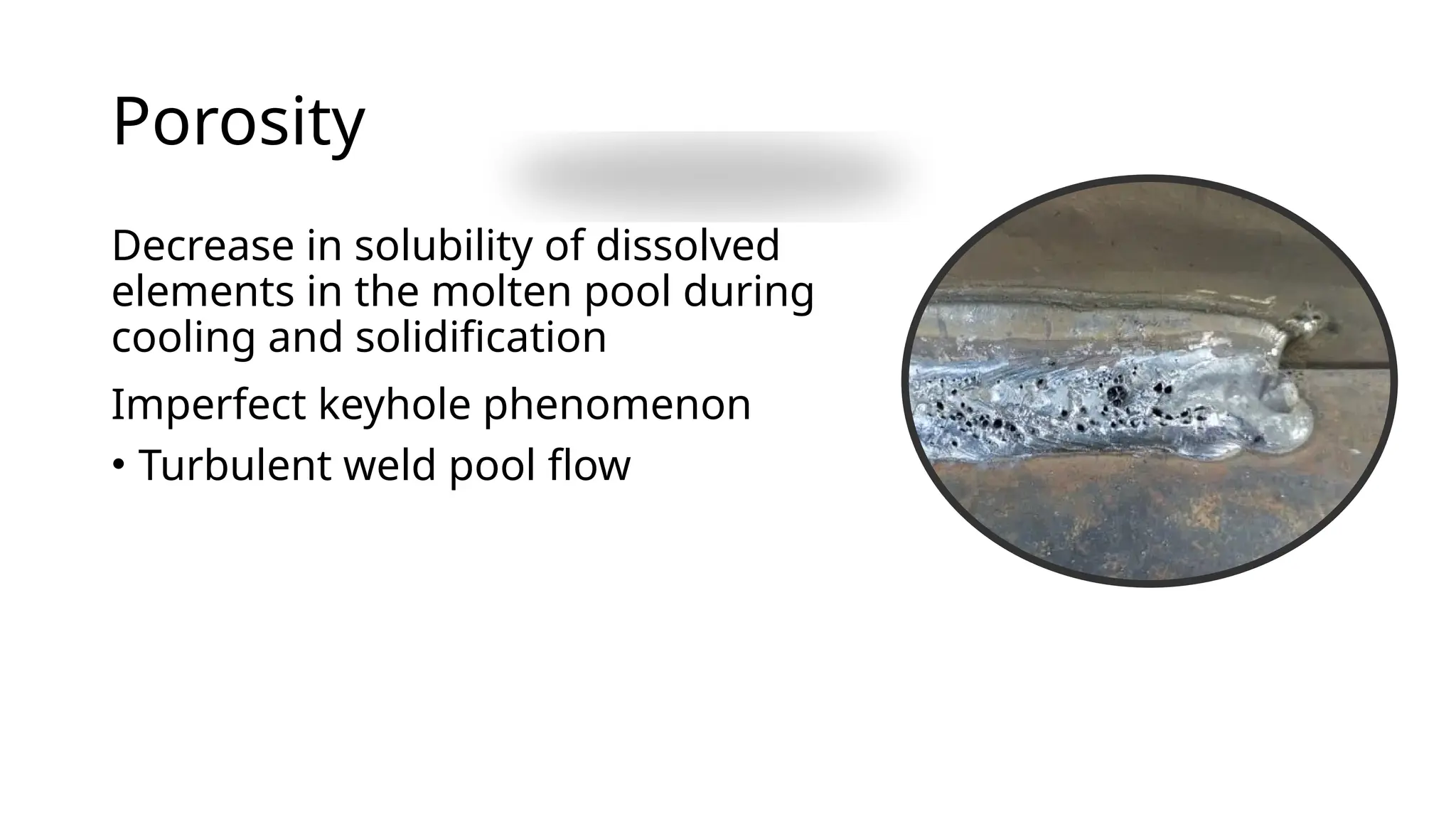
Decrease in solubility of dissolved
elements in the molten pool during
cooling and solidification
Imperfect keyhole phenomenon
• Turbulent weld pool flow
Porosity
Porosity (Laser welding)
• Metallurgical porosity (presence of hydrogen in weld pool)
• Keyhole instability
Surface Oxidation
Common with readily oxidising
metals such as Al, Ti, Mg, and
their alloys, processes with less
or no shielding.
• Reaction with atmospheric
gases
• Oxidation is accelerated at
higher temperatures
Inclusion
• Entrapment of solid
particles
• Sources: Surface oxides,
sulfide, tungsten
electrodes, and slag
Slag Inclusion
Slag is forced below the surface of the molten metal
by the stirring action of the arc (SMAW).
Causes: Insufficient welding current, an off-set of the
electrode from the axis of the weld, too high a welding speed,
and improper wearing procedure.
• Reduces the strength of welds and makes welded structures
unreliable.
Lack of fusion
Lack of fusion
• Built-in crack ready to start running through the base metal,
weld metal, or HAZ when the weldment is put under stress.
• Notch effect
Lack of penetration
Lack of penetration
• Caused by low welding
current, excessive travel
speed, improper electrode
application, or the presence
of surface contaminants
Spatter
Too long arc
Unsuitable filler materials
• Improper shielding gas
combination with regard to BMs
and filler metals
• Contaminations of filler metals.
Lamellar Tears
• Commonly found in rolled structural shapes and plates
• Caused by thermally induced shrinkage stresses resulting
from welding
Surface Burning (spot welding)
• Melting of the metal surface in
contact with the electrode
• Heavy expulsion of molten metal
• Accompanied by deep electrode
indentation
Cracks, deep cavities, or pinholes (spot
welding)
• Removing the electrode force before
welds are cooled from liquids
• Excessive heat generation, resulting in
heavy expulsion of molten metal
• Poorly fitting parts requiring most of
the electrode force to bring the faying
surfaces into contact
Deep electrode indentation (spot
welding)
• Improperly dressed electrode
face
• Lack of control of electrode force
• Excessively high rate of heat
generation due to high contact
resistance (low electrode force)
Spot welding defects
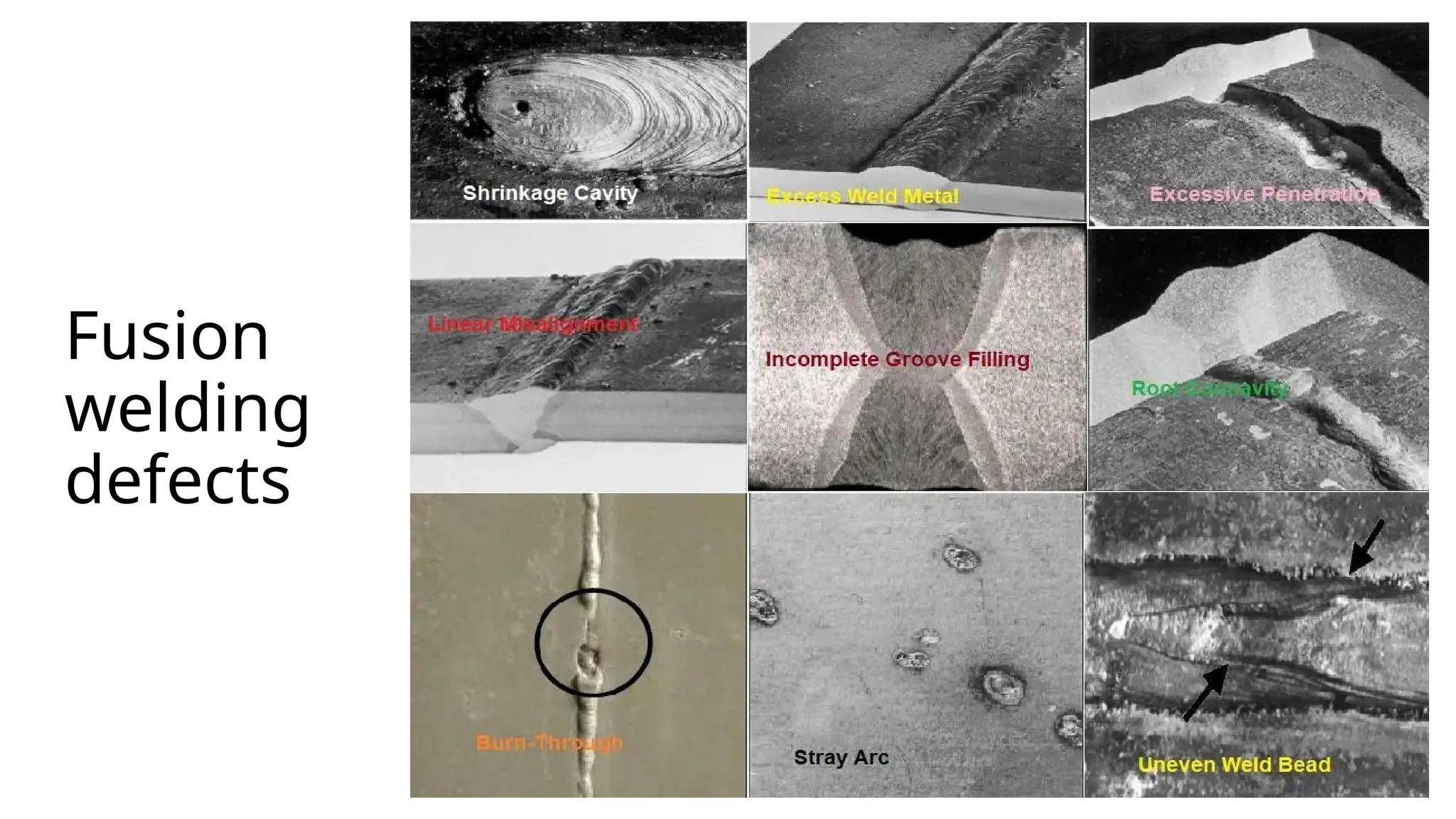
Fusion welding defects
Fusion
welding
defects
Laser
welding
defects
Friction stir welding defects
THANK YOU

Defects in welding / Weld defects- A comprehensive presentation.pptx

  • 1.
  • 2.
  • 3.
    Visual/Surface defects, (i) Surfacecracks, (ii) Distortion/Warpage, (iii) Incorrect or bad bead profile, (iv) Dimensional deviation/Incorrect weld size, (v) Overlaps or rolls,
  • 4.
    (vi) Undercuts, (vii) Underfill/Suckback, (viii)Excess penetration/Excess reinforcement, (ix) Start-Stop points, (x) Interruptions, Visual/Surface defects,
  • 5.
    (xi) Unfilled craters, (xii)Burn-through, (xiii) Surface porosity, (xiv) Surface oxidation, (xv) Uneven and Coarse ripples, Visual/Surface defects
  • 6.
    (xvi) Pock marks/Flatspots, (xvii) Excessive spatter, (xviii) Arc strike, (xix) Bad surface appearance, (xx) High/Iow off-set. Visual/Surface defects,
  • 7.
    Hidden or SubsurfaceWeld Defects (i) Lack of fusion, (ii) Lack of penetration, (iii) Hidden or Subsurface cracks, (iv) Blowholes/Subsurface porosity, (v) Shrinkage cavities,
  • 8.
    Hidden or SubsurfaceWeld Defects (vi) Slag inclusion, (vii) Tungsten/copper ( Metallic) inclusions, (viii) Finger penetration, (ix) Coarse microstructure.
  • 9.
    Causes • Improper selectionof process • Undesirable metallurgical structures • Defects caused by the interaction of the weld metal with prior defects in the base metal • Incorrect welding parameters selection
  • 10.
    • Inferior designresulting in inaccessibility for weld inspection • Poor workmanship • Incorrect joint edge preparations and poor fit-up • Undesirable shape and size of weld bead due to overfill and/or poor profiles. Causes
  • 11.
    • Most dangerous •Invariably unacceptable Types: 1. Surface Cracks/Hidden cracks 2. Micro/Macro cracks Cracks
  • 12.
    Cracks Causes: (i) High contractionstresses (being greater than the hot strength of the weld or parent material) (ii) poor fit-up and incorrect welding procedures (iii) poor edge quality.
  • 14.
    Solidification cracking • Microsegregationand resultant formation of low solidification temperature liquid films along the grain boundaries • Microfissures formed in the welding due to shrinkage propagate as microcracks • Hot cracking
  • 15.
    Cold cracking • Occursbelow 300 °C • Localized stresses exceed the ultimate strength of the BM • Hydrogen accumulation in highly stress-concentrated zones • Formation of brittle martensite and/or cementite during welding
  • 16.
    Reheat cracking • Occursin welded materials during or after heat treatment.
  • 17.
    Subsurface Cracks/Internal Cracks •a.k.a Underbead cracks • Most serious when impact loading and low temperature service conditions are involved. • Must be fully chipped back and welded up.
  • 18.
    Internal stresses • Largethermal gradient (local heating) • Uneven expansion/contraction • Residual stresses Result: Warping, distortion, cracking
  • 19.
    Warping / distortion Correctedby • Proper jigging of joint • Controlled cooling after welding • Stress-relieving heat treatment • Peening the weld metal and HAZ
  • 20.
    Dimensional Defects • Badbead profiles • Non-uniform width or height of a weld, irregular crests and valleys, and variations in leg length Causes: • Variation in the supply voltage, wire slippage in feed rolls, variations in the welding speed because of backlash and lost motion in traction gear, a wrong work angle, etc. • Poor skill of welder
  • 21.
  • 23.
    Overlaps and Rolls Protrusionsof weld metal beyond the bond at the toe, face or root of the weld. Causes: • Excessive welding current • Wrong electrode offset • Wrong tilt of electrode • Accompanied by lack of fusion, cracks and other defects.
  • 25.
    Excessive Reinforcement • Stiffensthe section • Makes notches that create stress concentration. • Objectionable from an appearance point of view • Economic waste - adds to the cost of welding without gaining any worthwhile strength.
  • 26.
    Undercuts • Grooves meltedinto the parent metal and left unfilled by weld metal • Notch effect
  • 27.
    Undercuts Cause(s): Excessive weldingcurrent and arc voltage. • High heat input • Width of penetration increases • Excessive melting of fusion faces
  • 28.
    Undercuts • Limited meltflow • Depends on material interactions, temperature-dependent viscosity, and surface tension • Stress riser
  • 29.
    Underfill/Suckback • ‘a depressionon the face of a weld’ • ‘Root surface extending below the surface of the adjacent base metal’ • Reduces the cross-sectional area of the weld
  • 30.
    Voids, holes orcavities formed by gas trapped by the solidified weld metal. • Large holes (blow-holes) • Small holes (porosity) • Wormholes (long and continuous). Porosity
  • 32.
    Porosity Causes: • Evaporation oflow boiling point elements • Hydrogen rejection from solid phase during solidification • Shielding gas entrapment in high density welding
  • 33.
    Decrease in solubilityof dissolved elements in the molten pool during cooling and solidification Imperfect keyhole phenomenon • Turbulent weld pool flow Porosity
  • 34.
    Porosity (Laser welding) •Metallurgical porosity (presence of hydrogen in weld pool) • Keyhole instability
  • 35.
    Surface Oxidation Common withreadily oxidising metals such as Al, Ti, Mg, and their alloys, processes with less or no shielding. • Reaction with atmospheric gases • Oxidation is accelerated at higher temperatures
  • 36.
    Inclusion • Entrapment ofsolid particles • Sources: Surface oxides, sulfide, tungsten electrodes, and slag
  • 37.
    Slag Inclusion Slag isforced below the surface of the molten metal by the stirring action of the arc (SMAW).
  • 38.
    Causes: Insufficient weldingcurrent, an off-set of the electrode from the axis of the weld, too high a welding speed, and improper wearing procedure. • Reduces the strength of welds and makes welded structures unreliable. Lack of fusion
  • 39.
  • 40.
    • Built-in crackready to start running through the base metal, weld metal, or HAZ when the weldment is put under stress. • Notch effect Lack of penetration
  • 41.
    Lack of penetration •Caused by low welding current, excessive travel speed, improper electrode application, or the presence of surface contaminants
  • 42.
    Spatter Too long arc Unsuitablefiller materials • Improper shielding gas combination with regard to BMs and filler metals • Contaminations of filler metals.
  • 43.
    Lamellar Tears • Commonlyfound in rolled structural shapes and plates • Caused by thermally induced shrinkage stresses resulting from welding
  • 44.
    Surface Burning (spotwelding) • Melting of the metal surface in contact with the electrode • Heavy expulsion of molten metal • Accompanied by deep electrode indentation
  • 45.
    Cracks, deep cavities,or pinholes (spot welding) • Removing the electrode force before welds are cooled from liquids • Excessive heat generation, resulting in heavy expulsion of molten metal • Poorly fitting parts requiring most of the electrode force to bring the faying surfaces into contact
  • 46.
    Deep electrode indentation(spot welding) • Improperly dressed electrode face • Lack of control of electrode force • Excessively high rate of heat generation due to high contact resistance (low electrode force)
  • 47.
  • 48.
  • 49.
  • 50.
  • 51.
  • 52.