Chapter 27 
Advanced Machining Processes 
Manufacturing, Engineering & Technology, Fifth Edition, by Serope Kalpakjian and Steven R. Schmid. 
ISBN 0-13-148965-8. © 2006 Pearson Education, Inc., Upper Saddle River, NJ. All rights reserved.
Parts Made by Advanced Machining Processes 
(a) 
(b) 
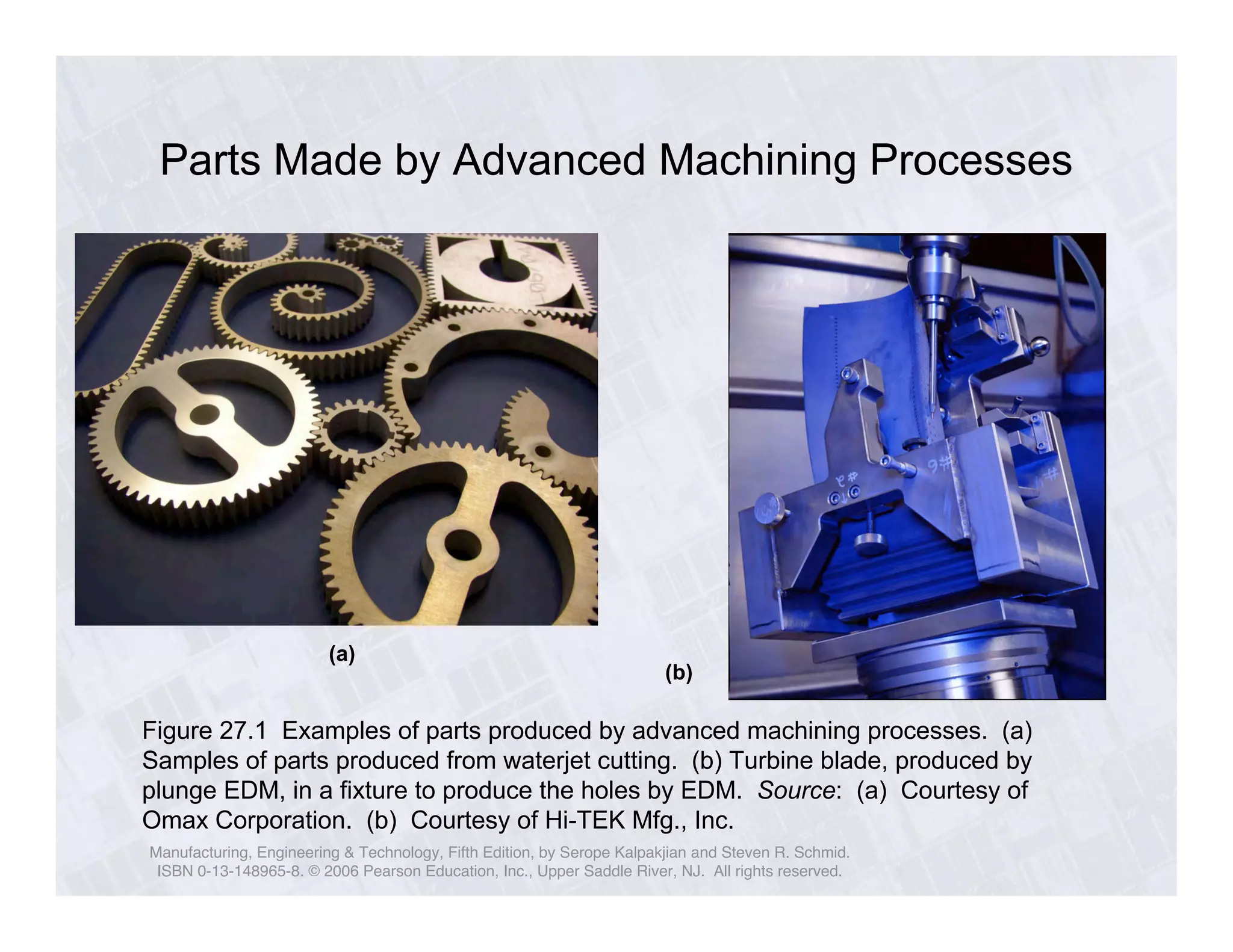
Figure 27.1 Examples of parts produced by advanced machining processes. (a) 
Samples of parts produced from waterjet cutting. (b) Turbine blade, produced by 
plunge EDM, in a fixture to produce the holes by EDM. Source: (a) Courtesy of 
Omax Corporation. (b) Courtesy of Hi-TEK Mfg., Inc. 
Manufacturing, Engineering & Technology, Fifth Edition, by Serope Kalpakjian and Steven R. Schmid. 
ISBN 0-13-148965-8. © 2006 Pearson Education, Inc., Upper Saddle River, NJ. All rights reserved.
Manufacturing, Engineering & Technology, Fifth Edition, by Serope Kalpakjian and Steven R. Schmid. 
ISBN 0-13-148965-8. © 2006 Pearson Education, Inc., Upper Saddle River, NJ. All rights reserved. 
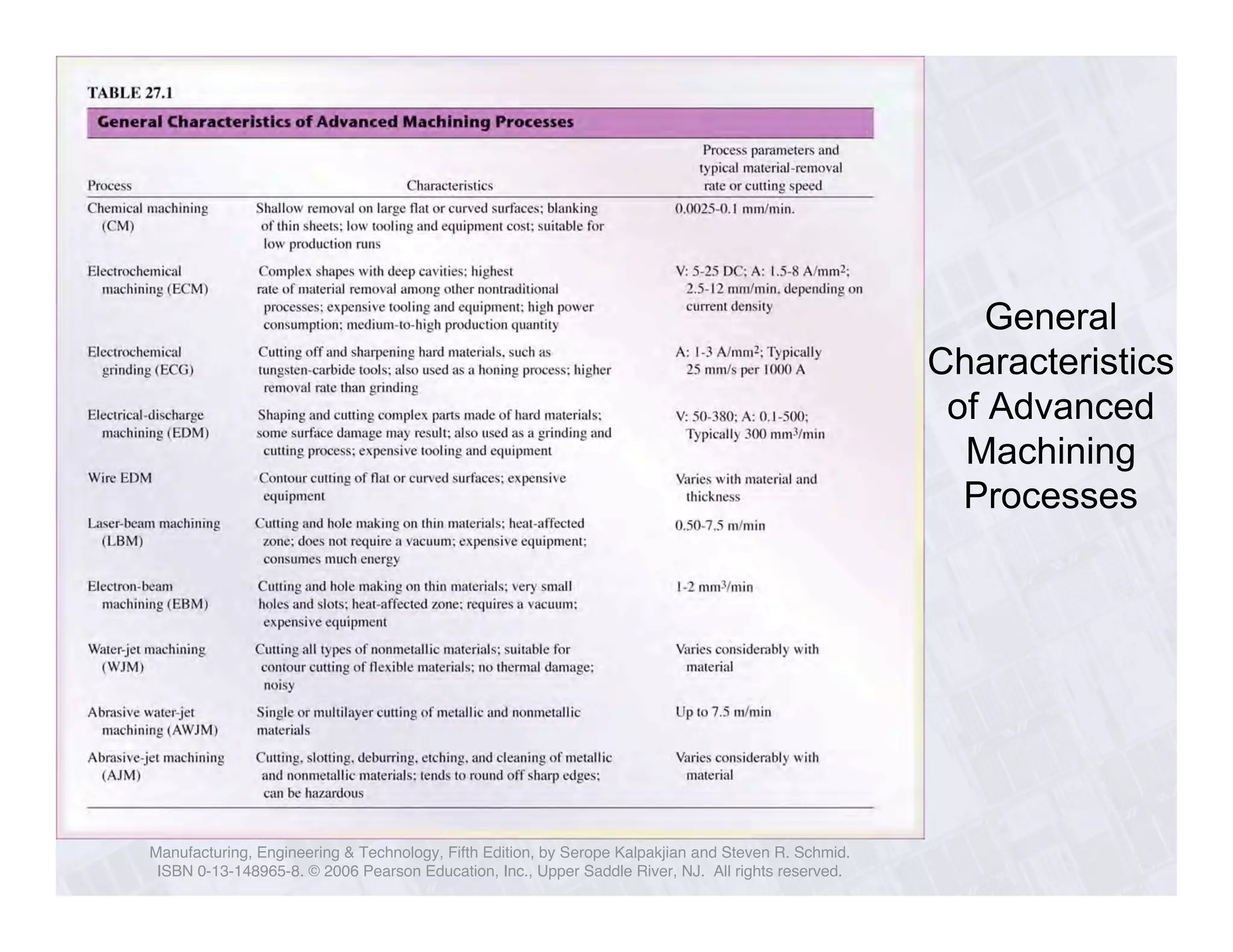
General 
Characteristics 
of Advanced 
Machining 
Processes
Chemical Milling 
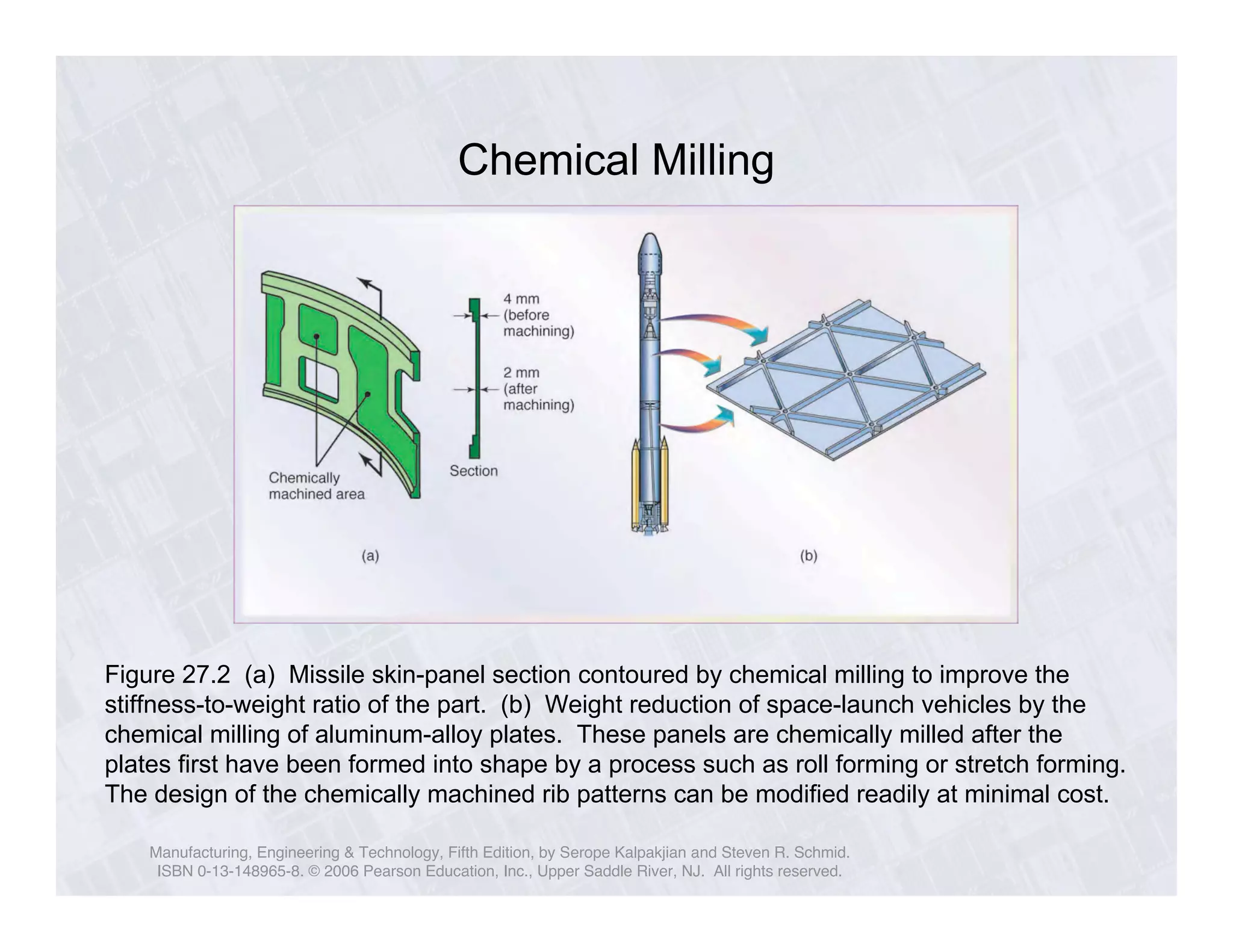
Figure 27.2 (a) Missile skin-panel section contoured by chemical milling to improve the 
stiffness-to-weight ratio of the part. (b) Weight reduction of space-launch vehicles by the 
chemical milling of aluminum-alloy plates. These panels are chemically milled after the 
plates first have been formed into shape by a process such as roll forming or stretch forming. 
The design of the chemically machined rib patterns can be modified readily at minimal cost. 
Manufacturing, Engineering & Technology, Fifth Edition, by Serope Kalpakjian and Steven R. Schmid. 
ISBN 0-13-148965-8. © 2006 Pearson Education, Inc., Upper Saddle River, NJ. All rights reserved.
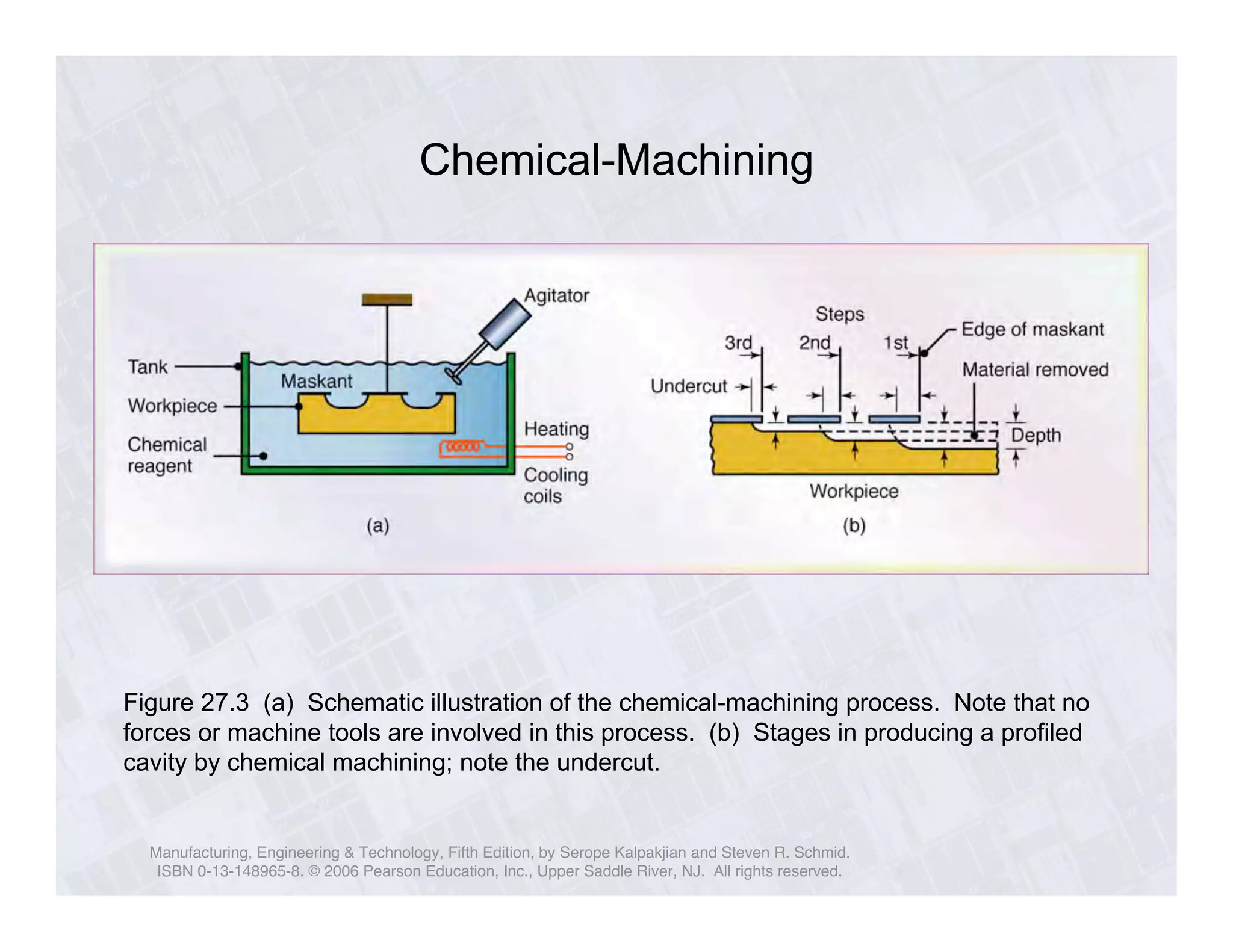
Chemical-Machining 
Figure 27.3 (a) Schematic illustration of the chemical-machining process. Note that no 
forces or machine tools are involved in this process. (b) Stages in producing a profiled 
cavity by chemical machining; note the undercut. 
Manufacturing, Engineering & Technology, Fifth Edition, by Serope Kalpakjian and Steven R. Schmid. 
ISBN 0-13-148965-8. © 2006 Pearson Education, Inc., Upper Saddle River, NJ. All rights reserved.
Manufacturing, Engineering & Technology, Fifth Edition, by Serope Kalpakjian and Steven R. Schmid. 
ISBN 0-13-148965-8. © 2006 Pearson Education, Inc., Upper Saddle River, NJ. All rights reserved. 
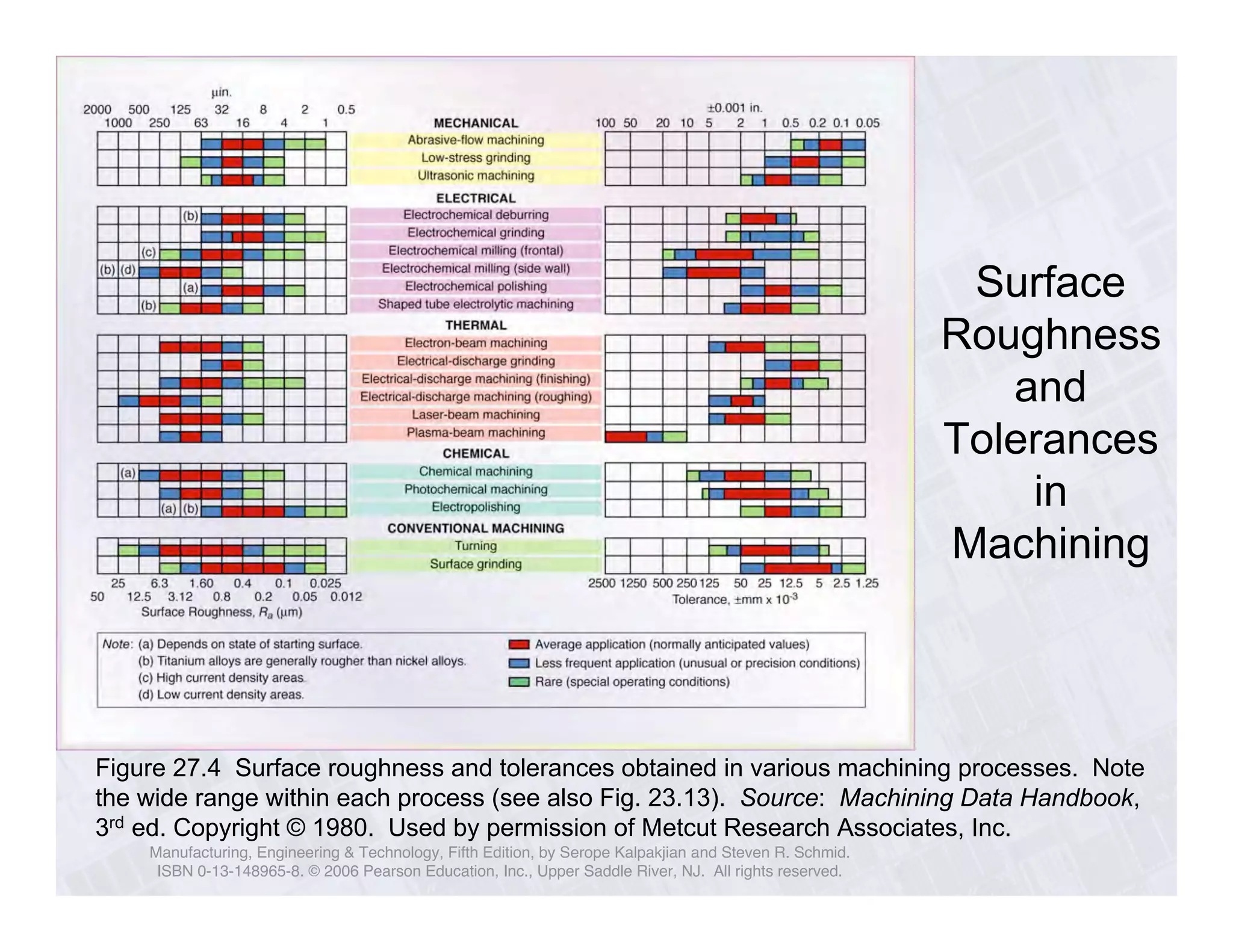
Surface 
Roughness 
and 
Tolerances 
in 
Machining 
Figure 27.4 Surface roughness and tolerances obtained in various machining processes. Note 
the wide range within each process (see also Fig. 23.13). Source: Machining Data Handbook, 
3rd ed. Copyright © 1980. Used by permission of Metcut Research Associates, Inc.
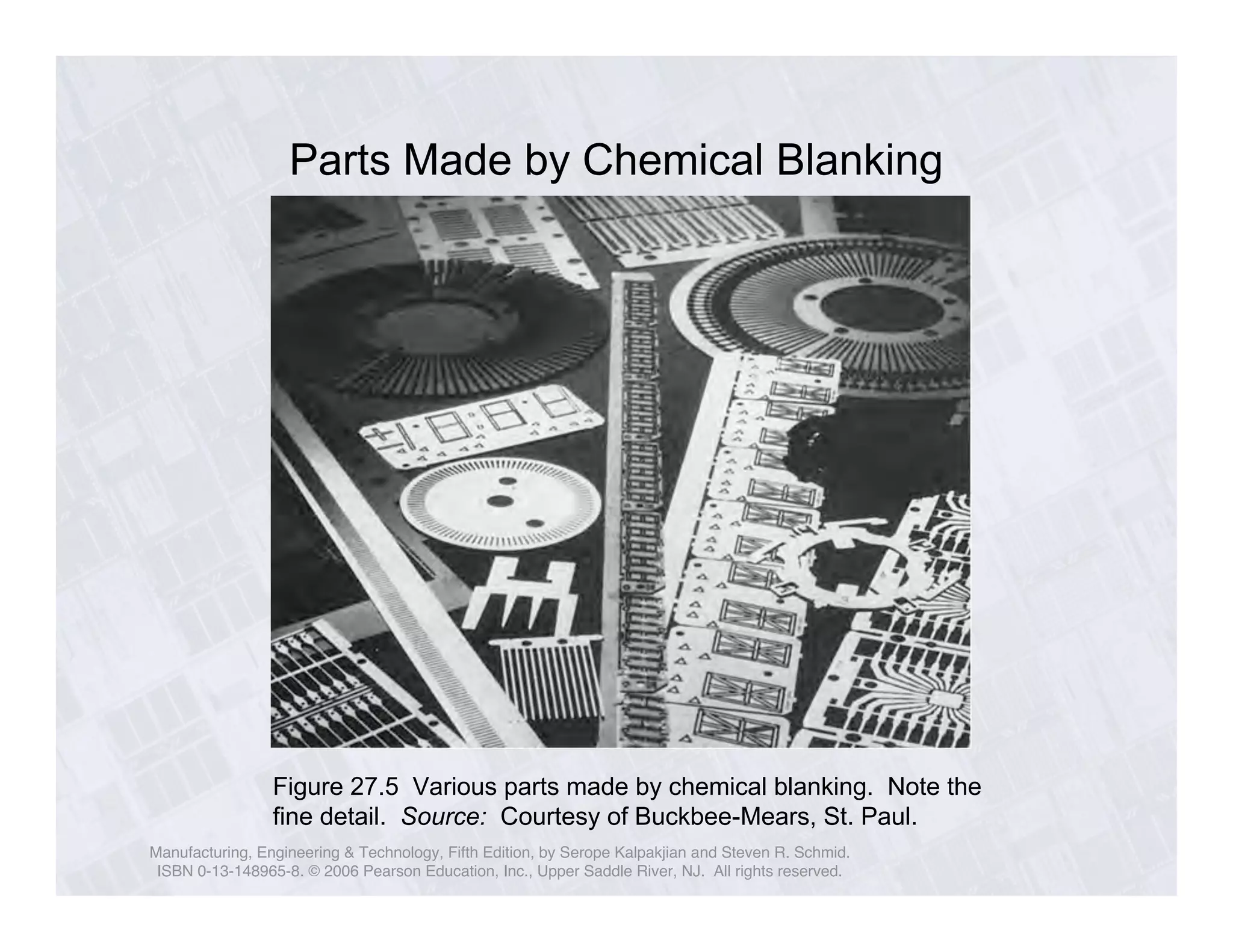
Parts Made by Chemical Blanking 
Figure 27.5 Various parts made by chemical blanking. Note the 
fine detail. Source: Courtesy of Buckbee-Mears, St. Paul. 
Manufacturing, Engineering & Technology, Fifth Edition, by Serope Kalpakjian and Steven R. Schmid. 
ISBN 0-13-148965-8. © 2006 Pearson Education, Inc., Upper Saddle River, NJ. All rights reserved.
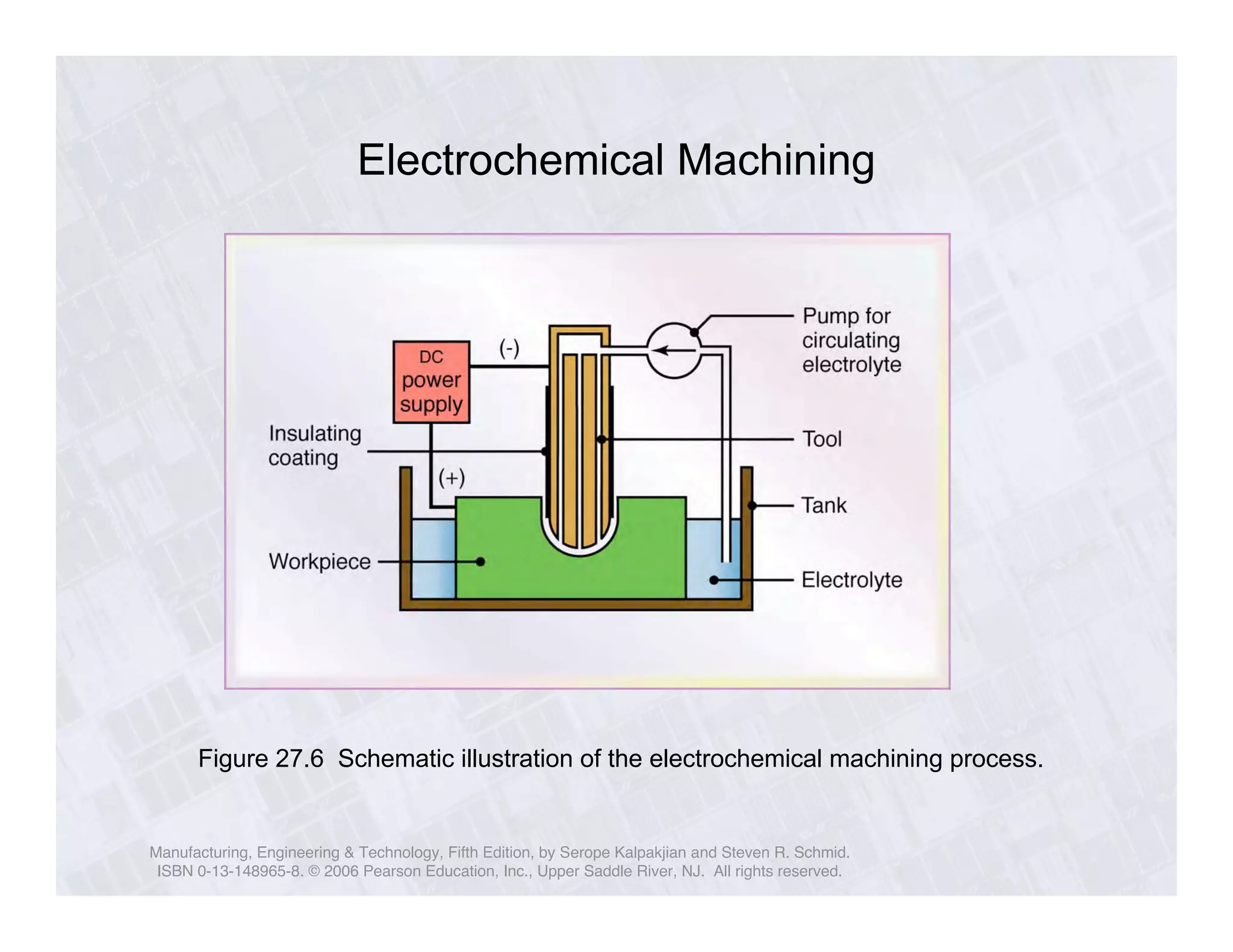
Electrochemical Machining 
Figure 27.6 Schematic illustration of the electrochemical machining process. 
Manufacturing, Engineering & Technology, Fifth Edition, by Serope Kalpakjian and Steven R. Schmid. 
ISBN 0-13-148965-8. © 2006 Pearson Education, Inc., Upper Saddle River, NJ. All rights reserved.
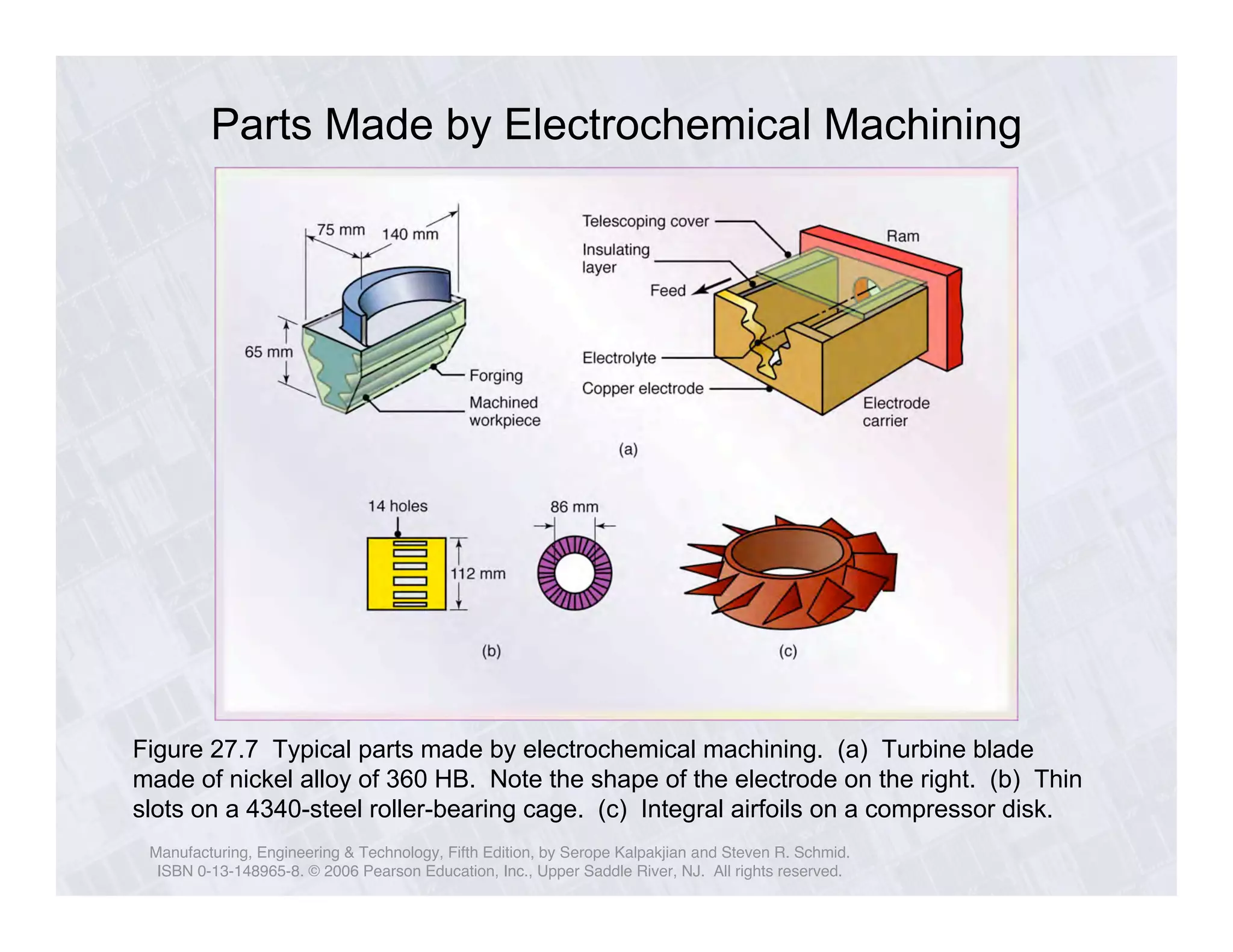
Parts Made by Electrochemical Machining 
Figure 27.7 Typical parts made by electrochemical machining. (a) Turbine blade 
made of nickel alloy of 360 HB. Note the shape of the electrode on the right. (b) Thin 
slots on a 4340-steel roller-bearing cage. (c) Integral airfoils on a compressor disk. 
Manufacturing, Engineering & Technology, Fifth Edition, by Serope Kalpakjian and Steven R. Schmid. 
ISBN 0-13-148965-8. © 2006 Pearson Education, Inc., Upper Saddle River, NJ. All rights reserved.
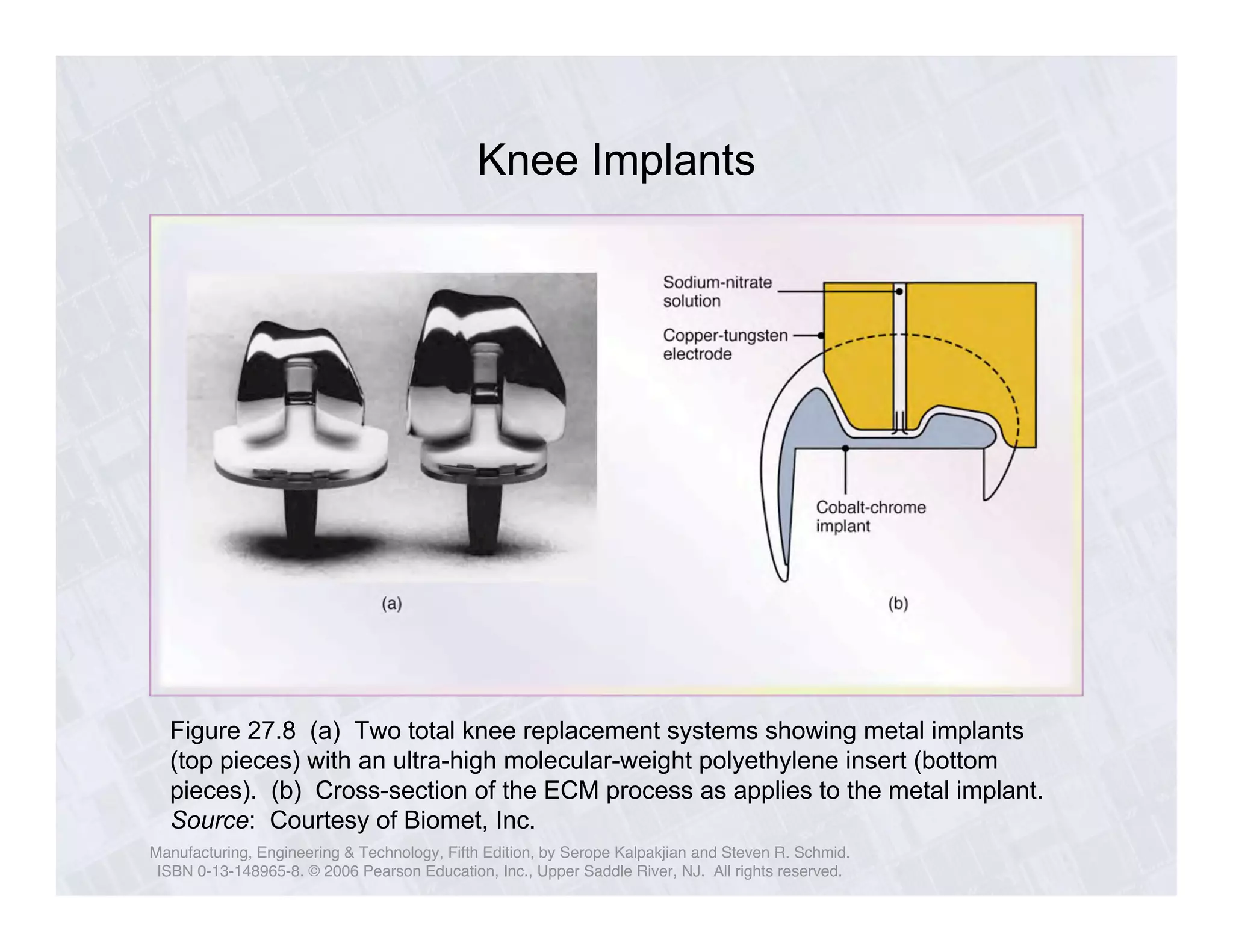
Knee Implants 
Figure 27.8 (a) Two total knee replacement systems showing metal implants 
(top pieces) with an ultra-high molecular-weight polyethylene insert (bottom 
pieces). (b) Cross-section of the ECM process as applies to the metal implant. 
Source: Courtesy of Biomet, Inc. 
Manufacturing, Engineering & Technology, Fifth Edition, by Serope Kalpakjian and Steven R. Schmid. 
ISBN 0-13-148965-8. © 2006 Pearson Education, Inc., Upper Saddle River, NJ. All rights reserved.
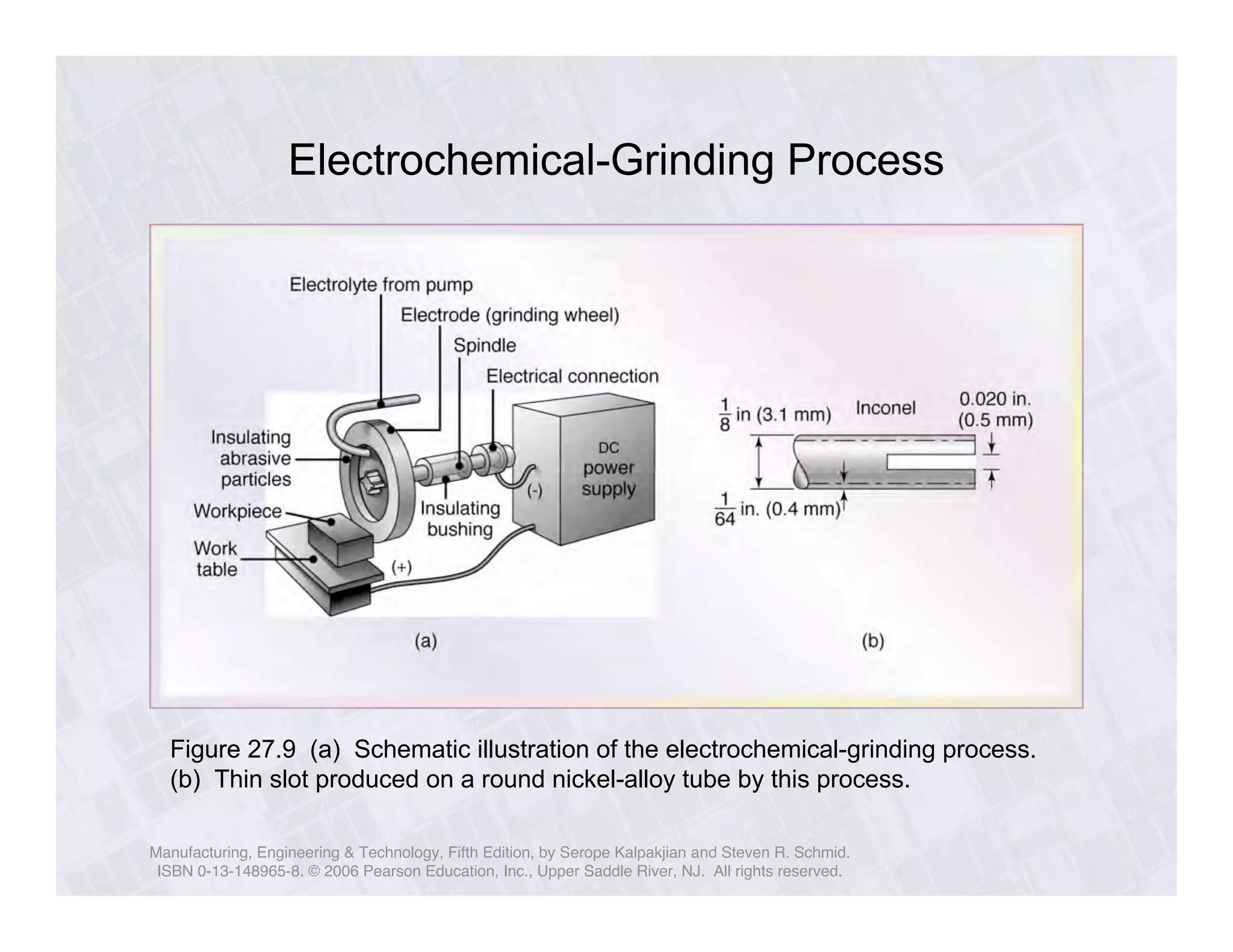
Electrochemical-Grinding Process 
Figure 27.9 (a) Schematic illustration of the electrochemical-grinding process. 
(b) Thin slot produced on a round nickel-alloy tube by this process. 
Manufacturing, Engineering & Technology, Fifth Edition, by Serope Kalpakjian and Steven R. Schmid. 
ISBN 0-13-148965-8. © 2006 Pearson Education, Inc., Upper Saddle River, NJ. All rights reserved.
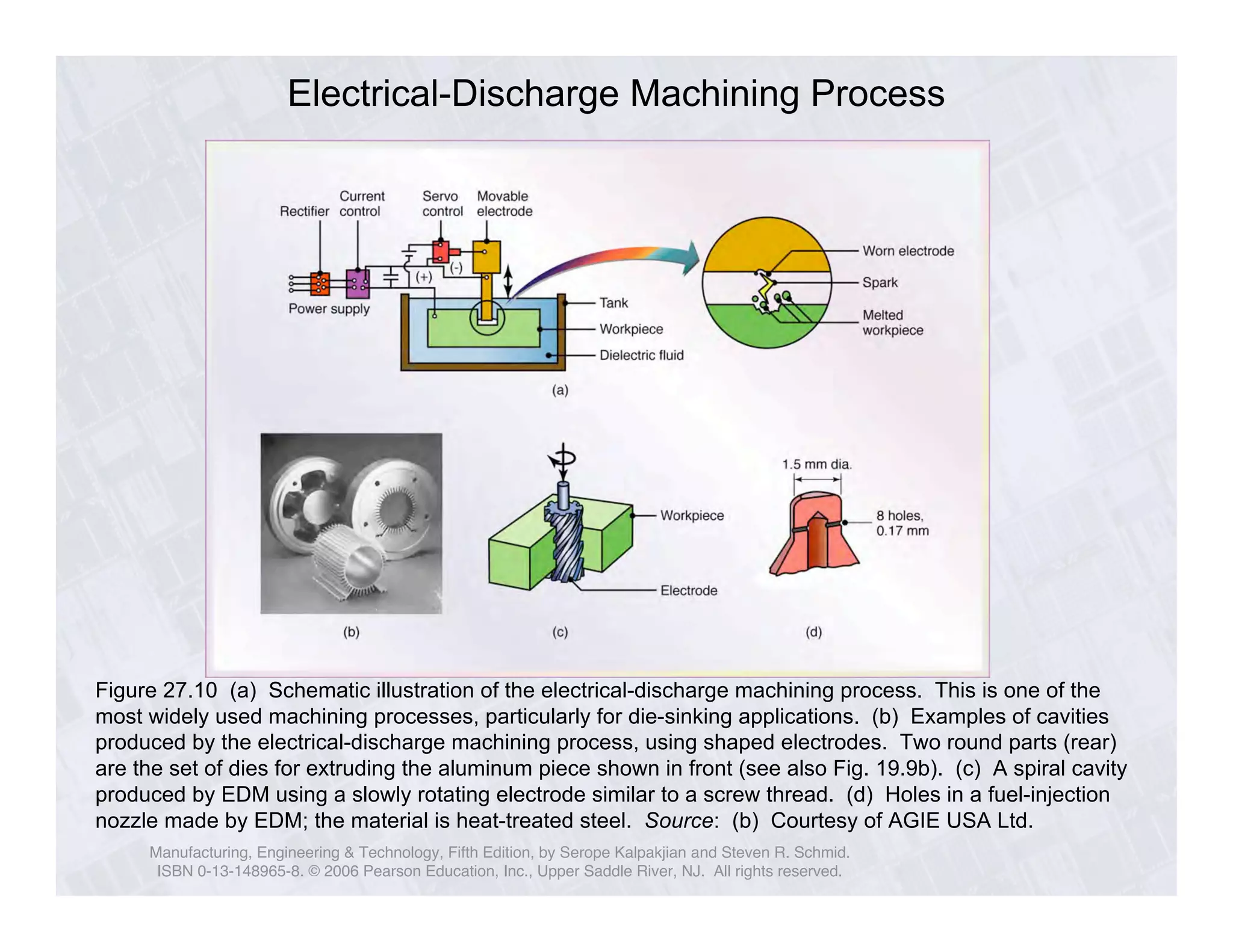
Electrical-Discharge Machining Process 
Figure 27.10 (a) Schematic illustration of the electrical-discharge machining process. This is one of the 
most widely used machining processes, particularly for die-sinking applications. (b) Examples of cavities 
produced by the electrical-discharge machining process, using shaped electrodes. Two round parts (rear) 
are the set of dies for extruding the aluminum piece shown in front (see also Fig. 19.9b). (c) A spiral cavity 
produced by EDM using a slowly rotating electrode similar to a screw thread. (d) Holes in a fuel-injection 
nozzle made by EDM; the material is heat-treated steel. Source: (b) Courtesy of AGIE USA Ltd. 
Manufacturing, Engineering & Technology, Fifth Edition, by Serope Kalpakjian and Steven R. Schmid. 
ISBN 0-13-148965-8. © 2006 Pearson Education, Inc., Upper Saddle River, NJ. All rights reserved.
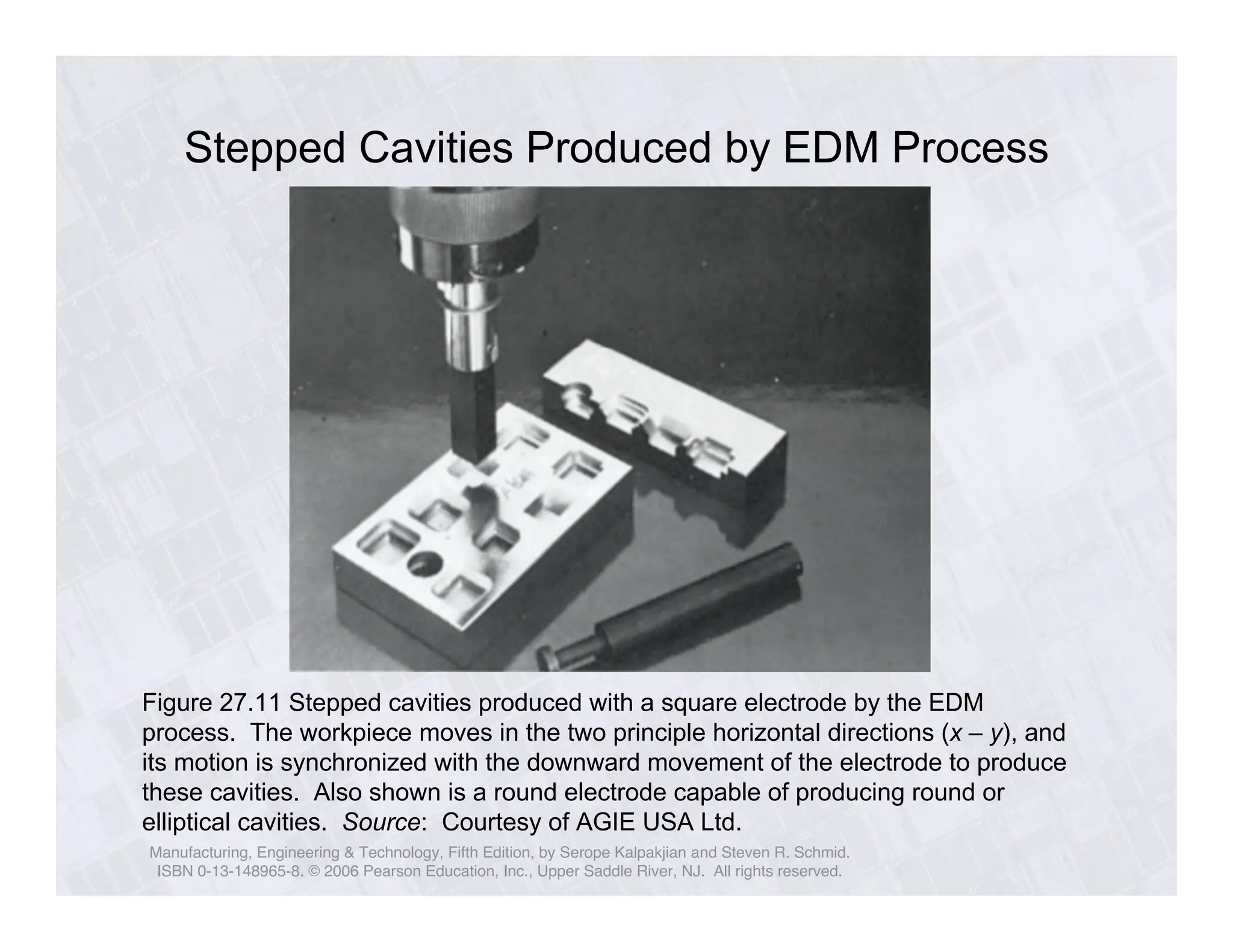
Stepped Cavities Produced by EDM Process 
Figure 27.11 Stepped cavities produced with a square electrode by the EDM 
process. The workpiece moves in the two principle horizontal directions (x – y), and 
its motion is synchronized with the downward movement of the electrode to produce 
these cavities. Also shown is a round electrode capable of producing round or 
elliptical cavities. Source: Courtesy of AGIE USA Ltd. 
Manufacturing, Engineering & Technology, Fifth Edition, by Serope Kalpakjian and Steven R. Schmid. 
ISBN 0-13-148965-8. © 2006 Pearson Education, Inc., Upper Saddle River, NJ. All rights reserved.
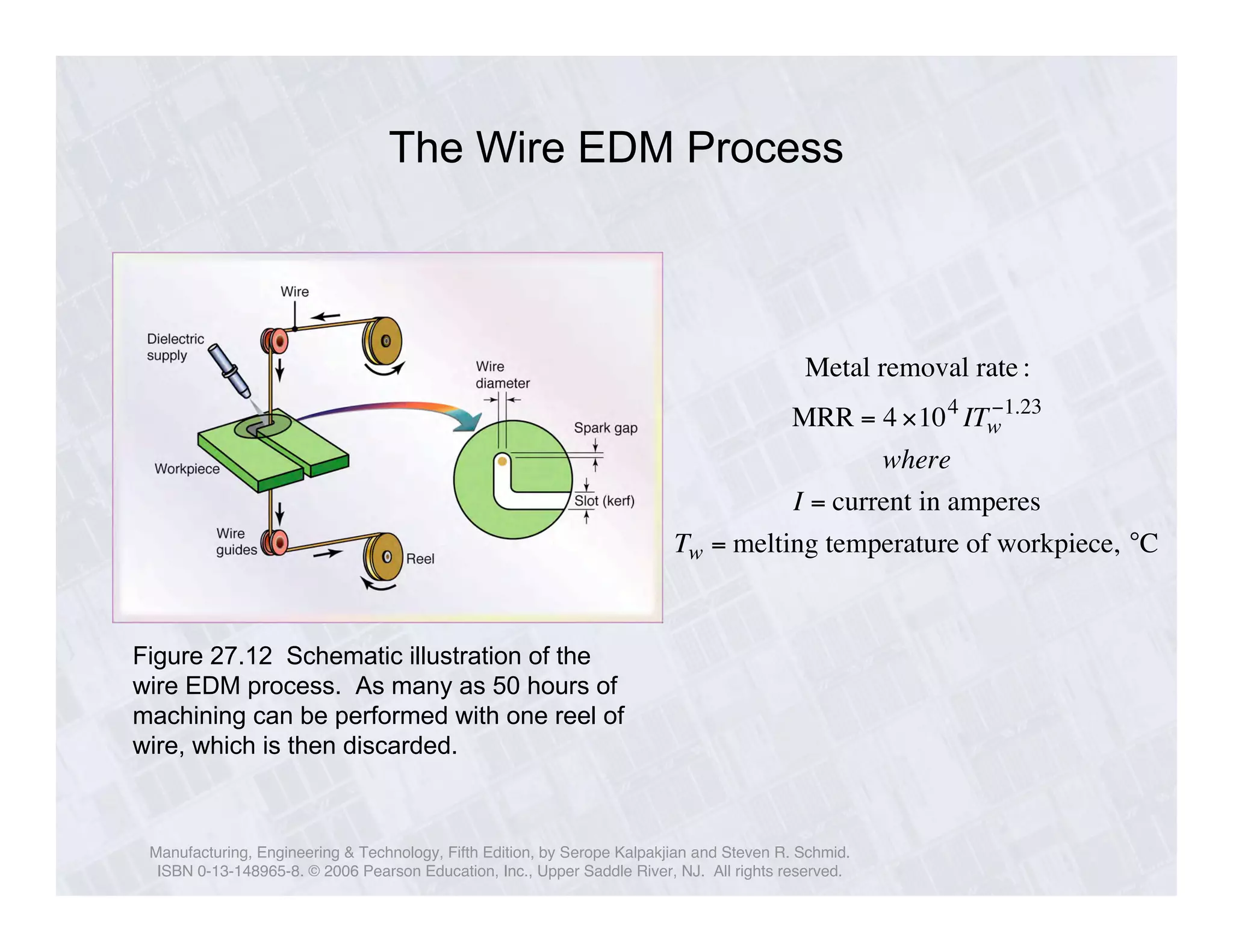
The Wire EDM Process 
Figure 27.12 Schematic illustration of the 
! 
wire EDM process. As many as 50 hours of 
machining can be performed with one reel of 
wire, which is then discarded. 
Metal removal rate : 
MRR = 4 "104 ITw 
Manufacturing, Engineering & Technology, Fifth Edition, by Serope Kalpakjian and Steven R. Schmid. 
ISBN 0-13-148965-8. © 2006 Pearson Education, Inc., Upper Saddle River, NJ. All rights reserved. 
#1.23 
where 
I = current in amperes 
Tw = melting temperature of workpiece, °C
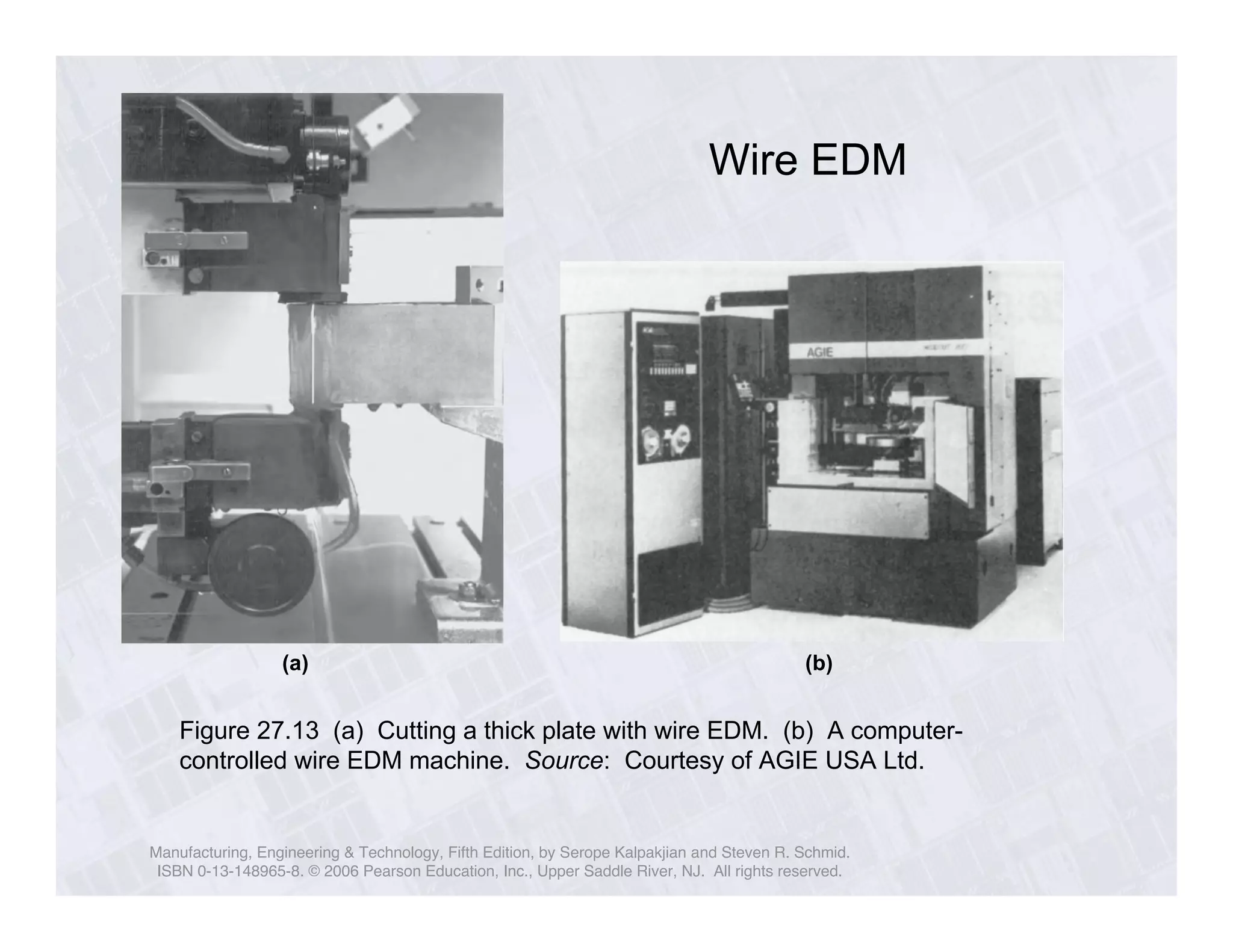
Wire EDM 
(a) (b) 
Figure 27.13 (a) Cutting a thick plate with wire EDM. (b) A computer-controlled 
wire EDM machine. Source: Courtesy of AGIE USA Ltd. 
Manufacturing, Engineering & Technology, Fifth Edition, by Serope Kalpakjian and Steven R. Schmid. 
ISBN 0-13-148965-8. © 2006 Pearson Education, Inc., Upper Saddle River, NJ. All rights reserved.
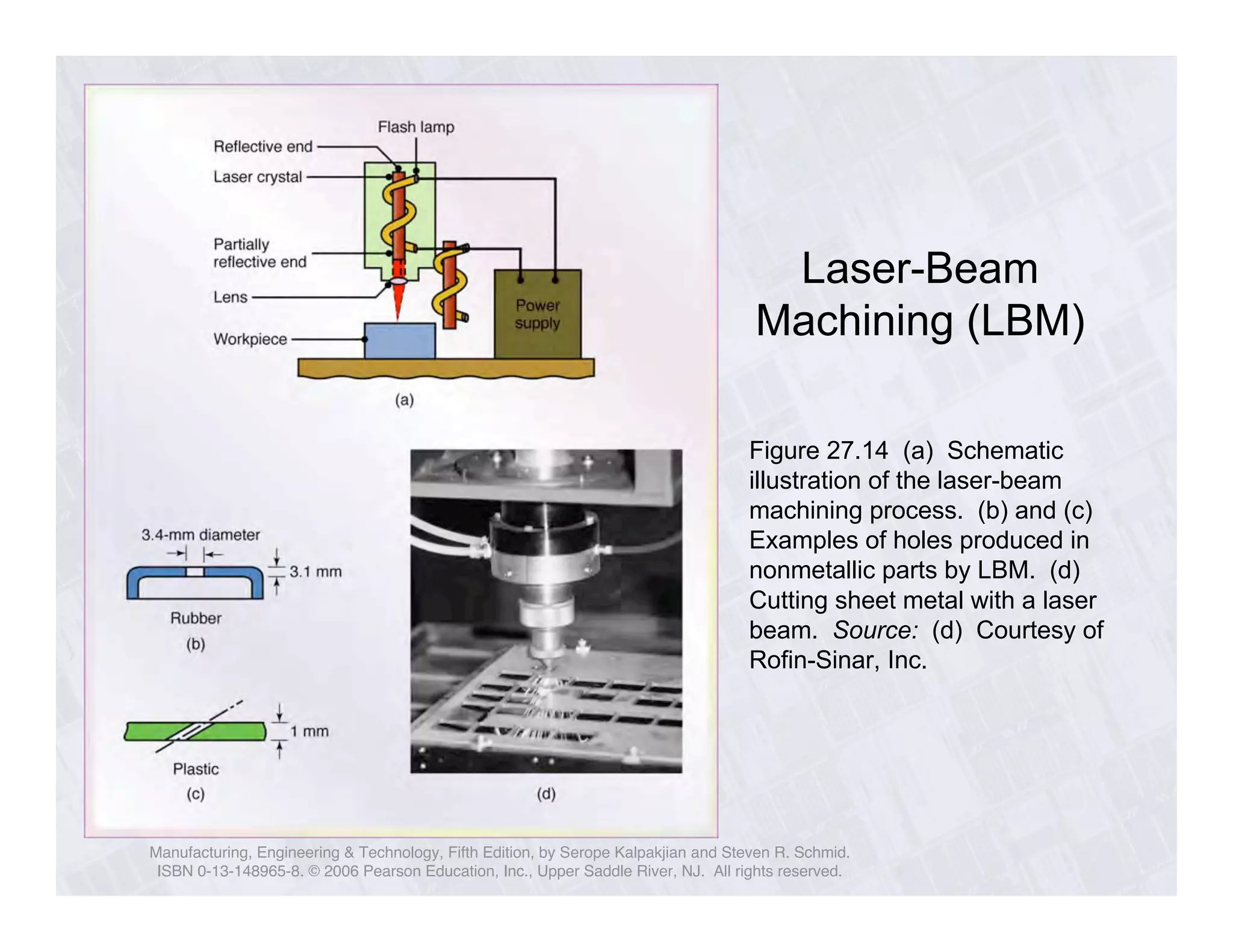
Laser-Beam 
Machining (LBM) 
Figure 27.14 (a) Schematic 
illustration of the laser-beam 
machining process. (b) and (c) 
Examples of holes produced in 
nonmetallic parts by LBM. (d) 
Cutting sheet metal with a laser 
beam. Source: (d) Courtesy of 
Rofin-Sinar, Inc. 
Manufacturing, Engineering & Technology, Fifth Edition, by Serope Kalpakjian and Steven R. Schmid. 
ISBN 0-13-148965-8. © 2006 Pearson Education, Inc., Upper Saddle River, NJ. All rights reserved.
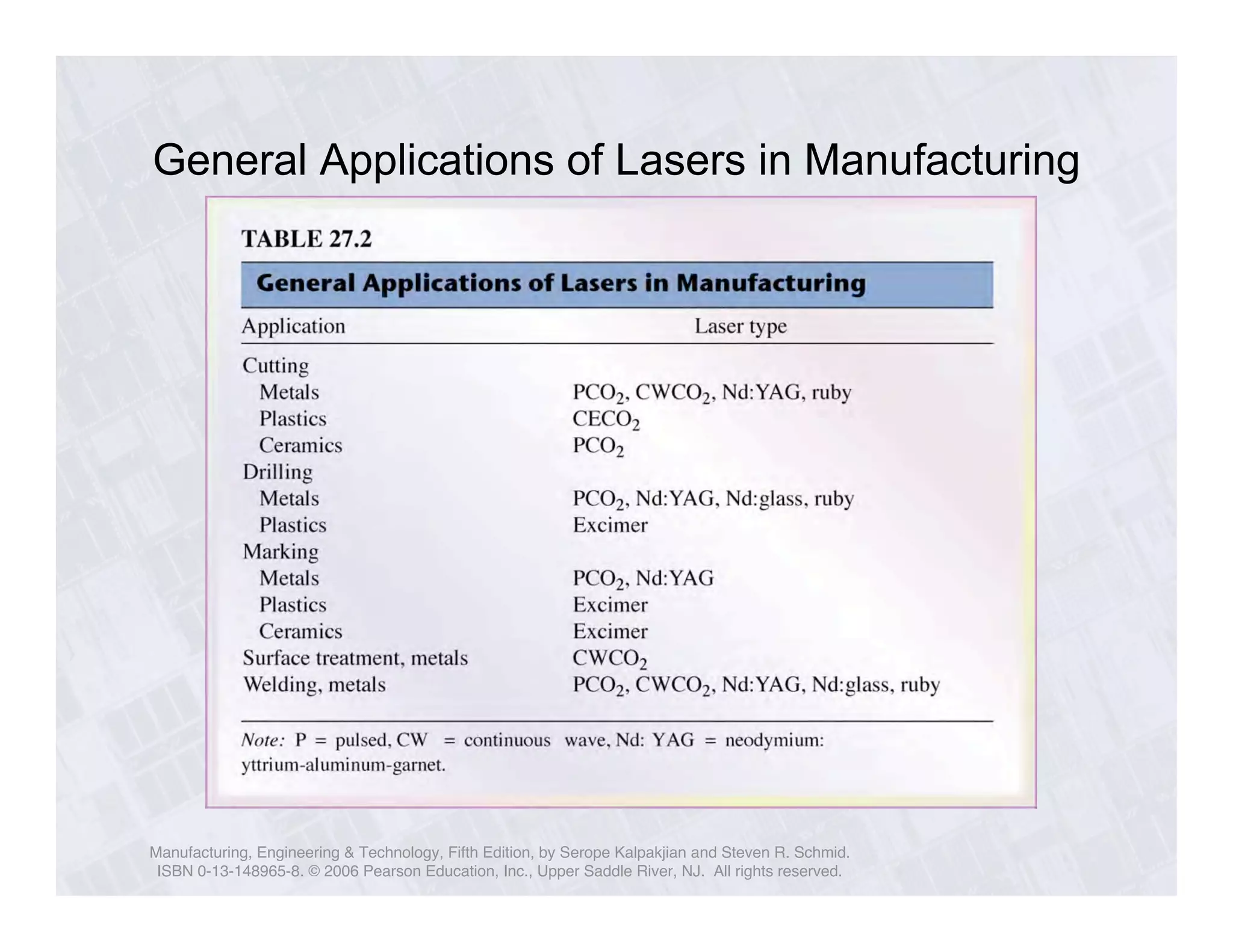
General Applications of Lasers in Manufacturing 
Manufacturing, Engineering & Technology, Fifth Edition, by Serope Kalpakjian and Steven R. Schmid. 
ISBN 0-13-148965-8. © 2006 Pearson Education, Inc., Upper Saddle River, NJ. All rights reserved.
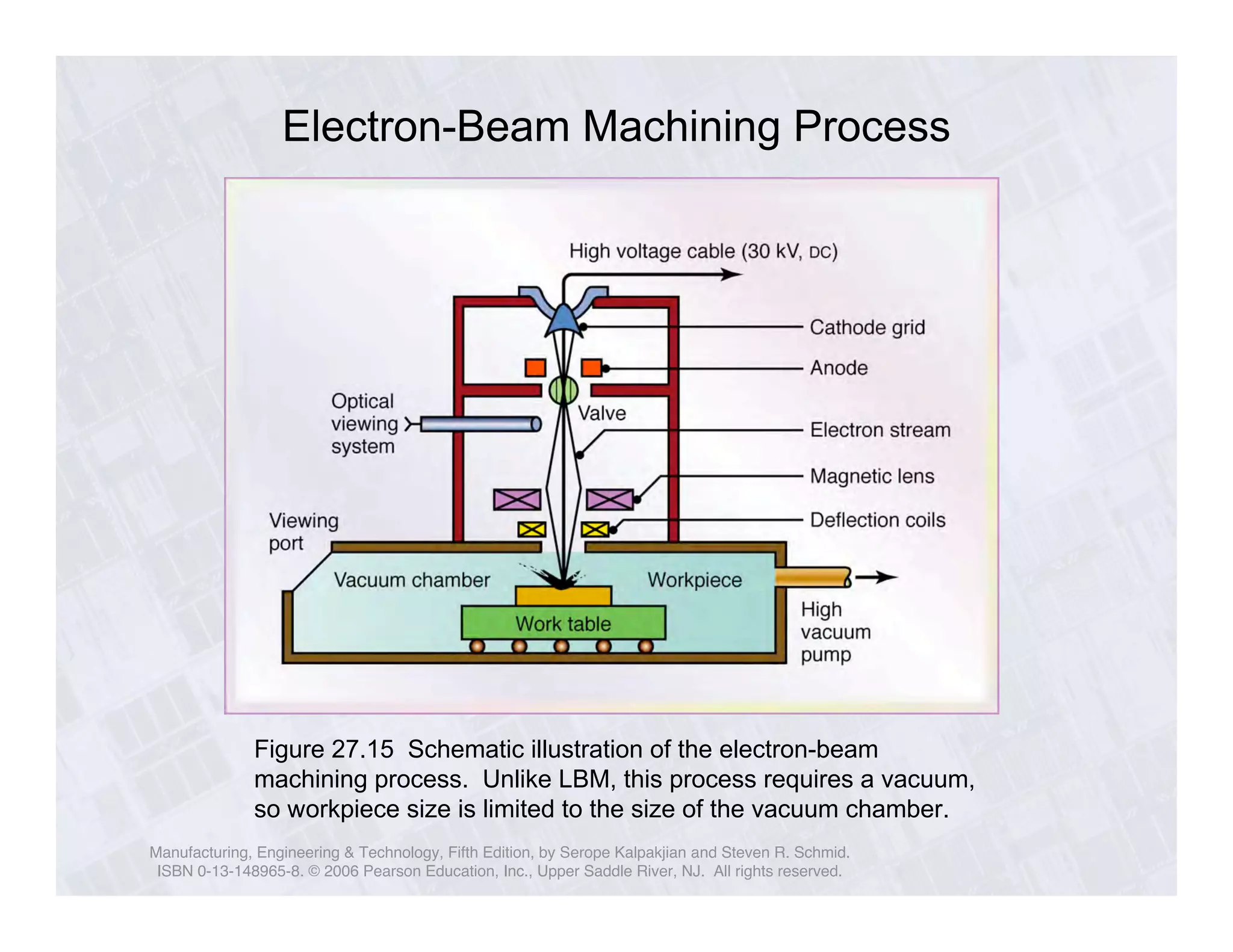
Electron-Beam Machining Process 
Figure 27.15 Schematic illustration of the electron-beam 
machining process. Unlike LBM, this process requires a vacuum, 
so workpiece size is limited to the size of the vacuum chamber. 
Manufacturing, Engineering & Technology, Fifth Edition, by Serope Kalpakjian and Steven R. Schmid. 
ISBN 0-13-148965-8. © 2006 Pearson Education, Inc., Upper Saddle River, NJ. All rights reserved.
Manufacturing, Engineering & Technology, Fifth Edition, by Serope Kalpakjian and Steven R. Schmid. 
ISBN 0-13-148965-8. © 2006 Pearson Education, Inc., Upper Saddle River, NJ. All rights reserved. 
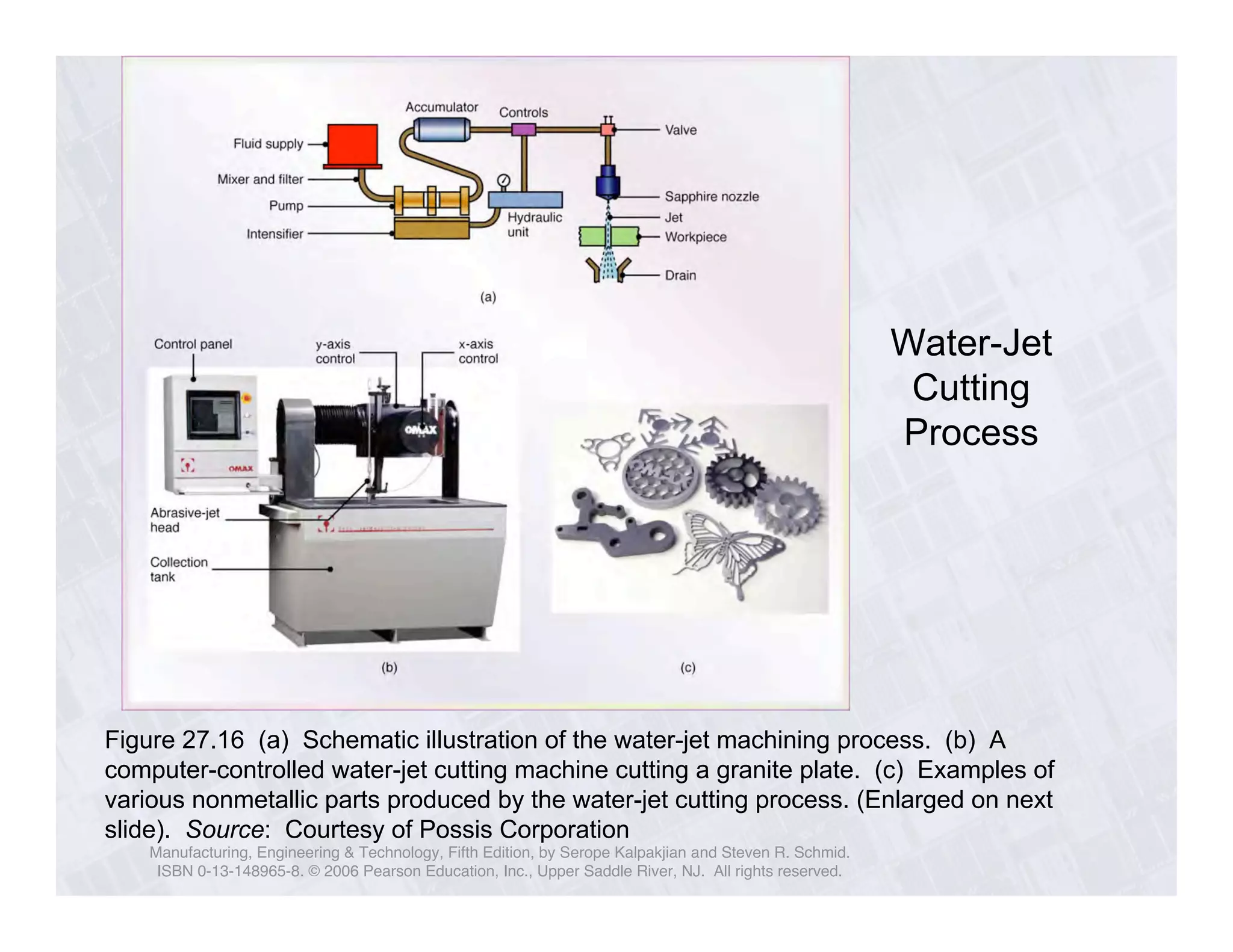
Water-Jet 
Cutting 
Process 
Figure 27.16 (a) Schematic illustration of the water-jet machining process. (b) A 
computer-controlled water-jet cutting machine cutting a granite plate. (c) Examples of 
various nonmetallic parts produced by the water-jet cutting process. (Enlarged on next 
slide). Source: Courtesy of Possis Corporation
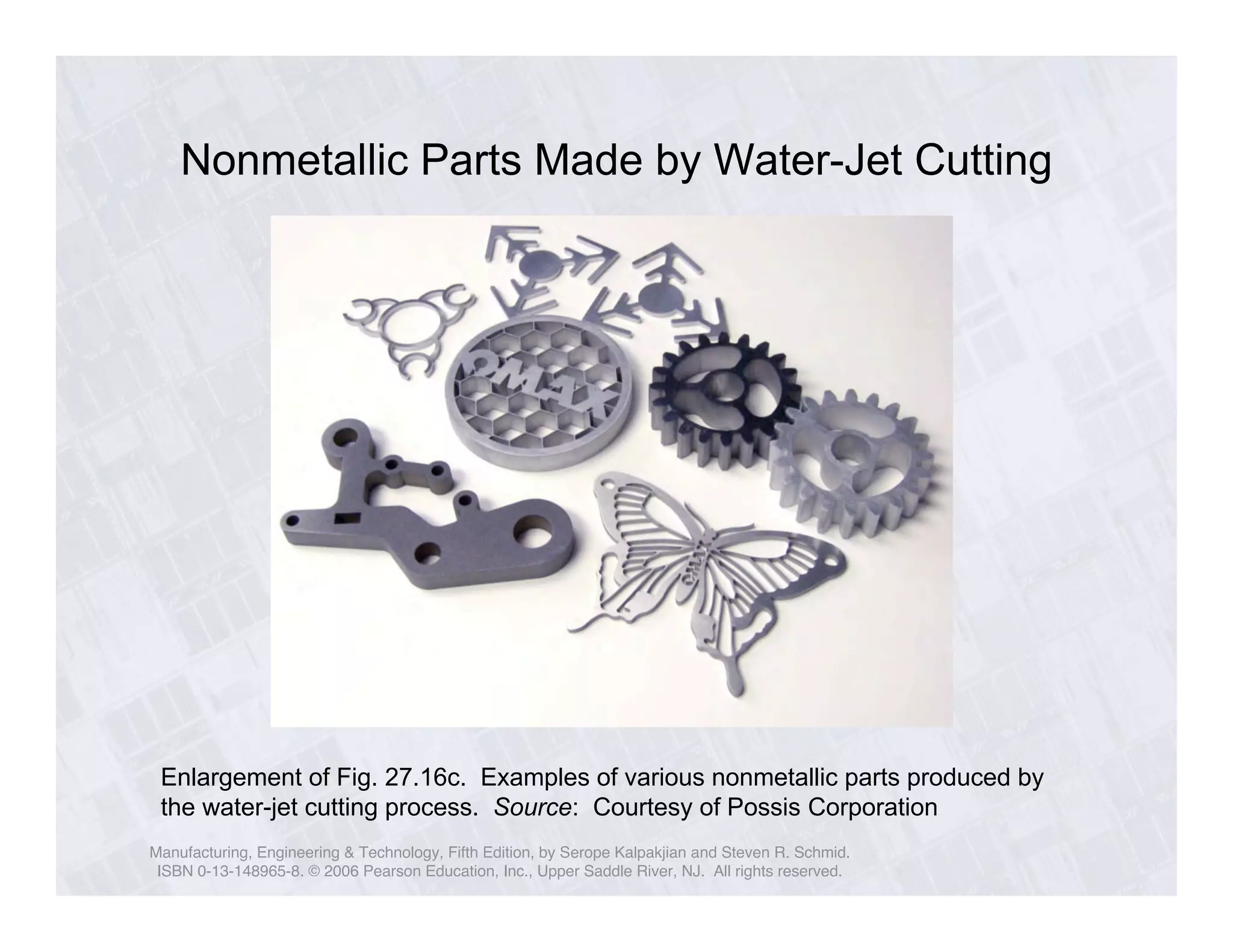
Nonmetallic Parts Made by Water-Jet Cutting 
Enlargement of Fig. 27.16c. Examples of various nonmetallic parts produced by 
the water-jet cutting process. Source: Courtesy of Possis Corporation 
Manufacturing, Engineering & Technology, Fifth Edition, by Serope Kalpakjian and Steven R. Schmid. 
ISBN 0-13-148965-8. © 2006 Pearson Education, Inc., Upper Saddle River, NJ. All rights reserved.
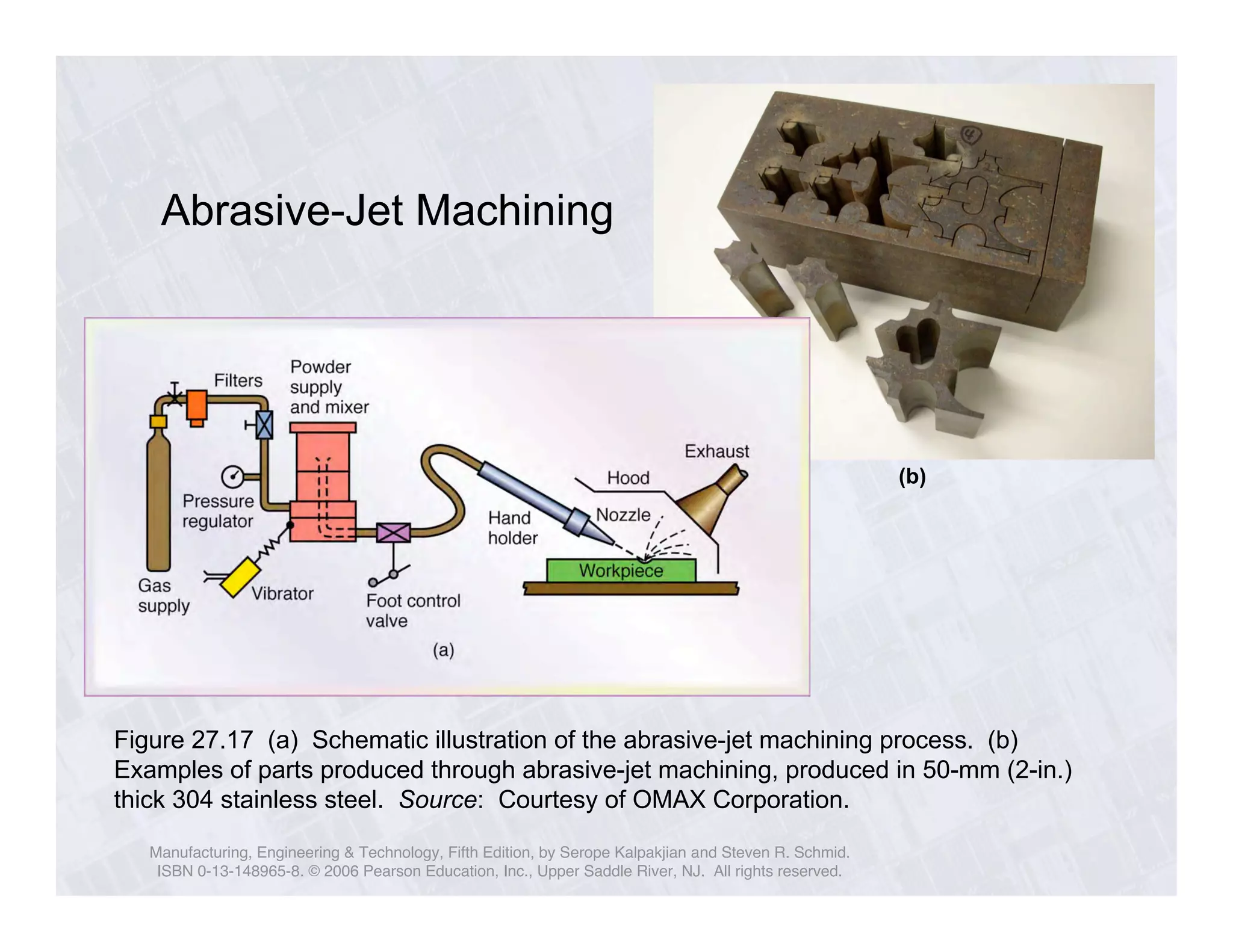
Abrasive-Jet Machining 
Figure 27.17 (a) Schematic illustration of the abrasive-jet machining process. (b) 
Examples of parts produced through abrasive-jet machining, produced in 50-mm (2-in.) 
thick 304 stainless steel. Source: Courtesy of OMAX Corporation. 
Manufacturing, Engineering & Technology, Fifth Edition, by Serope Kalpakjian and Steven R. Schmid. 
ISBN 0-13-148965-8. © 2006 Pearson Education, Inc., Upper Saddle River, NJ. All rights reserved. 
(b)
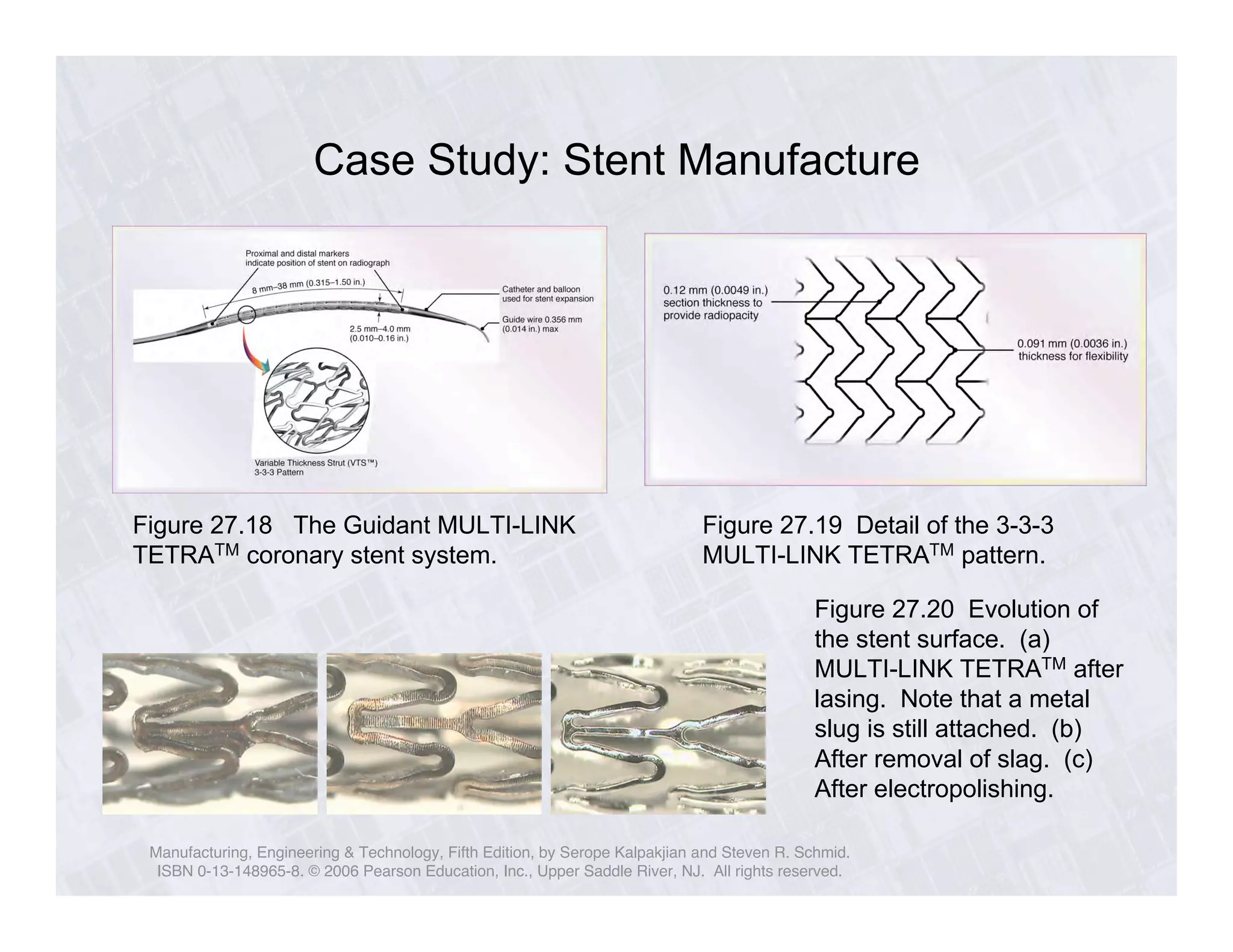
Case Study: Stent Manufacture 
Figure 27.18 The Guidant MULTI-LINK 
TETRATM coronary stent system. 
Figure 27.19 Detail of the 3-3-3 
MULTI-LINK TETRATM pattern. 
Figure 27.20 Evolution of 
the stent surface. (a) 
MULTI-LINK TETRATM after 
lasing. Note that a metal 
slug is still attached. (b) 
After removal of slag. (c) 
After electropolishing. 
Manufacturing, Engineering & Technology, Fifth Edition, by Serope Kalpakjian and Steven R. Schmid. 
ISBN 0-13-148965-8. © 2006 Pearson Education, Inc., Upper Saddle River, NJ. All rights reserved.

Ch27 advanced machining Erdi Karaçal Mechanical Engineer University of Gaziantep

  • 1.
    Chapter 27 AdvancedMachining Processes Manufacturing, Engineering & Technology, Fifth Edition, by Serope Kalpakjian and Steven R. Schmid. ISBN 0-13-148965-8. © 2006 Pearson Education, Inc., Upper Saddle River, NJ. All rights reserved.
  • 2.
    Parts Made byAdvanced Machining Processes (a) (b) Figure 27.1 Examples of parts produced by advanced machining processes. (a) Samples of parts produced from waterjet cutting. (b) Turbine blade, produced by plunge EDM, in a fixture to produce the holes by EDM. Source: (a) Courtesy of Omax Corporation. (b) Courtesy of Hi-TEK Mfg., Inc. Manufacturing, Engineering & Technology, Fifth Edition, by Serope Kalpakjian and Steven R. Schmid. ISBN 0-13-148965-8. © 2006 Pearson Education, Inc., Upper Saddle River, NJ. All rights reserved.
  • 3.
    Manufacturing, Engineering &Technology, Fifth Edition, by Serope Kalpakjian and Steven R. Schmid. ISBN 0-13-148965-8. © 2006 Pearson Education, Inc., Upper Saddle River, NJ. All rights reserved. General Characteristics of Advanced Machining Processes
  • 4.
    Chemical Milling Figure27.2 (a) Missile skin-panel section contoured by chemical milling to improve the stiffness-to-weight ratio of the part. (b) Weight reduction of space-launch vehicles by the chemical milling of aluminum-alloy plates. These panels are chemically milled after the plates first have been formed into shape by a process such as roll forming or stretch forming. The design of the chemically machined rib patterns can be modified readily at minimal cost. Manufacturing, Engineering & Technology, Fifth Edition, by Serope Kalpakjian and Steven R. Schmid. ISBN 0-13-148965-8. © 2006 Pearson Education, Inc., Upper Saddle River, NJ. All rights reserved.
  • 5.
    Chemical-Machining Figure 27.3(a) Schematic illustration of the chemical-machining process. Note that no forces or machine tools are involved in this process. (b) Stages in producing a profiled cavity by chemical machining; note the undercut. Manufacturing, Engineering & Technology, Fifth Edition, by Serope Kalpakjian and Steven R. Schmid. ISBN 0-13-148965-8. © 2006 Pearson Education, Inc., Upper Saddle River, NJ. All rights reserved.
  • 6.
    Manufacturing, Engineering &Technology, Fifth Edition, by Serope Kalpakjian and Steven R. Schmid. ISBN 0-13-148965-8. © 2006 Pearson Education, Inc., Upper Saddle River, NJ. All rights reserved. Surface Roughness and Tolerances in Machining Figure 27.4 Surface roughness and tolerances obtained in various machining processes. Note the wide range within each process (see also Fig. 23.13). Source: Machining Data Handbook, 3rd ed. Copyright © 1980. Used by permission of Metcut Research Associates, Inc.
  • 7.
    Parts Made byChemical Blanking Figure 27.5 Various parts made by chemical blanking. Note the fine detail. Source: Courtesy of Buckbee-Mears, St. Paul. Manufacturing, Engineering & Technology, Fifth Edition, by Serope Kalpakjian and Steven R. Schmid. ISBN 0-13-148965-8. © 2006 Pearson Education, Inc., Upper Saddle River, NJ. All rights reserved.
  • 8.
    Electrochemical Machining Figure27.6 Schematic illustration of the electrochemical machining process. Manufacturing, Engineering & Technology, Fifth Edition, by Serope Kalpakjian and Steven R. Schmid. ISBN 0-13-148965-8. © 2006 Pearson Education, Inc., Upper Saddle River, NJ. All rights reserved.
  • 9.
    Parts Made byElectrochemical Machining Figure 27.7 Typical parts made by electrochemical machining. (a) Turbine blade made of nickel alloy of 360 HB. Note the shape of the electrode on the right. (b) Thin slots on a 4340-steel roller-bearing cage. (c) Integral airfoils on a compressor disk. Manufacturing, Engineering & Technology, Fifth Edition, by Serope Kalpakjian and Steven R. Schmid. ISBN 0-13-148965-8. © 2006 Pearson Education, Inc., Upper Saddle River, NJ. All rights reserved.
  • 10.
    Knee Implants Figure27.8 (a) Two total knee replacement systems showing metal implants (top pieces) with an ultra-high molecular-weight polyethylene insert (bottom pieces). (b) Cross-section of the ECM process as applies to the metal implant. Source: Courtesy of Biomet, Inc. Manufacturing, Engineering & Technology, Fifth Edition, by Serope Kalpakjian and Steven R. Schmid. ISBN 0-13-148965-8. © 2006 Pearson Education, Inc., Upper Saddle River, NJ. All rights reserved.
  • 11.
    Electrochemical-Grinding Process Figure27.9 (a) Schematic illustration of the electrochemical-grinding process. (b) Thin slot produced on a round nickel-alloy tube by this process. Manufacturing, Engineering & Technology, Fifth Edition, by Serope Kalpakjian and Steven R. Schmid. ISBN 0-13-148965-8. © 2006 Pearson Education, Inc., Upper Saddle River, NJ. All rights reserved.
  • 12.
    Electrical-Discharge Machining Process Figure 27.10 (a) Schematic illustration of the electrical-discharge machining process. This is one of the most widely used machining processes, particularly for die-sinking applications. (b) Examples of cavities produced by the electrical-discharge machining process, using shaped electrodes. Two round parts (rear) are the set of dies for extruding the aluminum piece shown in front (see also Fig. 19.9b). (c) A spiral cavity produced by EDM using a slowly rotating electrode similar to a screw thread. (d) Holes in a fuel-injection nozzle made by EDM; the material is heat-treated steel. Source: (b) Courtesy of AGIE USA Ltd. Manufacturing, Engineering & Technology, Fifth Edition, by Serope Kalpakjian and Steven R. Schmid. ISBN 0-13-148965-8. © 2006 Pearson Education, Inc., Upper Saddle River, NJ. All rights reserved.
  • 13.
    Stepped Cavities Producedby EDM Process Figure 27.11 Stepped cavities produced with a square electrode by the EDM process. The workpiece moves in the two principle horizontal directions (x – y), and its motion is synchronized with the downward movement of the electrode to produce these cavities. Also shown is a round electrode capable of producing round or elliptical cavities. Source: Courtesy of AGIE USA Ltd. Manufacturing, Engineering & Technology, Fifth Edition, by Serope Kalpakjian and Steven R. Schmid. ISBN 0-13-148965-8. © 2006 Pearson Education, Inc., Upper Saddle River, NJ. All rights reserved.
  • 14.
    The Wire EDMProcess Figure 27.12 Schematic illustration of the ! wire EDM process. As many as 50 hours of machining can be performed with one reel of wire, which is then discarded. Metal removal rate : MRR = 4 "104 ITw Manufacturing, Engineering & Technology, Fifth Edition, by Serope Kalpakjian and Steven R. Schmid. ISBN 0-13-148965-8. © 2006 Pearson Education, Inc., Upper Saddle River, NJ. All rights reserved. #1.23 where I = current in amperes Tw = melting temperature of workpiece, °C
  • 15.
    Wire EDM (a)(b) Figure 27.13 (a) Cutting a thick plate with wire EDM. (b) A computer-controlled wire EDM machine. Source: Courtesy of AGIE USA Ltd. Manufacturing, Engineering & Technology, Fifth Edition, by Serope Kalpakjian and Steven R. Schmid. ISBN 0-13-148965-8. © 2006 Pearson Education, Inc., Upper Saddle River, NJ. All rights reserved.
  • 16.
    Laser-Beam Machining (LBM) Figure 27.14 (a) Schematic illustration of the laser-beam machining process. (b) and (c) Examples of holes produced in nonmetallic parts by LBM. (d) Cutting sheet metal with a laser beam. Source: (d) Courtesy of Rofin-Sinar, Inc. Manufacturing, Engineering & Technology, Fifth Edition, by Serope Kalpakjian and Steven R. Schmid. ISBN 0-13-148965-8. © 2006 Pearson Education, Inc., Upper Saddle River, NJ. All rights reserved.
  • 17.
    General Applications ofLasers in Manufacturing Manufacturing, Engineering & Technology, Fifth Edition, by Serope Kalpakjian and Steven R. Schmid. ISBN 0-13-148965-8. © 2006 Pearson Education, Inc., Upper Saddle River, NJ. All rights reserved.
  • 18.
    Electron-Beam Machining Process Figure 27.15 Schematic illustration of the electron-beam machining process. Unlike LBM, this process requires a vacuum, so workpiece size is limited to the size of the vacuum chamber. Manufacturing, Engineering & Technology, Fifth Edition, by Serope Kalpakjian and Steven R. Schmid. ISBN 0-13-148965-8. © 2006 Pearson Education, Inc., Upper Saddle River, NJ. All rights reserved.
  • 19.
    Manufacturing, Engineering &Technology, Fifth Edition, by Serope Kalpakjian and Steven R. Schmid. ISBN 0-13-148965-8. © 2006 Pearson Education, Inc., Upper Saddle River, NJ. All rights reserved. Water-Jet Cutting Process Figure 27.16 (a) Schematic illustration of the water-jet machining process. (b) A computer-controlled water-jet cutting machine cutting a granite plate. (c) Examples of various nonmetallic parts produced by the water-jet cutting process. (Enlarged on next slide). Source: Courtesy of Possis Corporation
  • 20.
    Nonmetallic Parts Madeby Water-Jet Cutting Enlargement of Fig. 27.16c. Examples of various nonmetallic parts produced by the water-jet cutting process. Source: Courtesy of Possis Corporation Manufacturing, Engineering & Technology, Fifth Edition, by Serope Kalpakjian and Steven R. Schmid. ISBN 0-13-148965-8. © 2006 Pearson Education, Inc., Upper Saddle River, NJ. All rights reserved.
  • 21.
    Abrasive-Jet Machining Figure27.17 (a) Schematic illustration of the abrasive-jet machining process. (b) Examples of parts produced through abrasive-jet machining, produced in 50-mm (2-in.) thick 304 stainless steel. Source: Courtesy of OMAX Corporation. Manufacturing, Engineering & Technology, Fifth Edition, by Serope Kalpakjian and Steven R. Schmid. ISBN 0-13-148965-8. © 2006 Pearson Education, Inc., Upper Saddle River, NJ. All rights reserved. (b)
  • 22.
    Case Study: StentManufacture Figure 27.18 The Guidant MULTI-LINK TETRATM coronary stent system. Figure 27.19 Detail of the 3-3-3 MULTI-LINK TETRATM pattern. Figure 27.20 Evolution of the stent surface. (a) MULTI-LINK TETRATM after lasing. Note that a metal slug is still attached. (b) After removal of slag. (c) After electropolishing. Manufacturing, Engineering & Technology, Fifth Edition, by Serope Kalpakjian and Steven R. Schmid. ISBN 0-13-148965-8. © 2006 Pearson Education, Inc., Upper Saddle River, NJ. All rights reserved.