METALS FABRICATIONS
Fabrication is the act of taking raw stock material and turning it into a part for use in an assembly
process.
There are many different types of fabrication processes. The most common are
• Cutting
• Folding
• Punching
• Shearing
• Welding
METAL FABRICATION MATERIALS
Standard raw materials used by metal fabricators are;
• plate metal
• formed and expanded metal (tube stock, CDSM, square stock)
• welding wire
• hardware
• castings
• fittings
• Cutting
There are many ways to cut nowadays. The old standby is the saw. Others now include plasma torches, water jets,
and lasers.
• Folding
Some parts need to be bent. The most common method is a press brake (or brake press). It has a set of dies that
pinches the metal to form a crease.
• Punching
Punching is the act of a punch and a die forming a ‘scissor’ effect on a piece of metal to make a hole in it. Obviously,
the punch and die must be the same shape and size of the desired hole.
• Shearing
Shearing is the process of making a long cut on a piece of metal. It is, in effect, just like the action of one of those
paper cutters with the long chop-handle. This is done on sheet metal.
• Stamping
Stamping is very similar to punching, except the material is not cut. The die is shaped to make a raised portion of
material rather than penetrating.
• Welding
Welding is the act of joining two pieces of metal together.
FORMNG OPERATIONS
• FORGING
• ROLLING
• EXTRUSION
• DRAWING
Annealing Processes
Annealing is a heat treatment where the material is taken to a high temperature,
kept there for some time and then cooled. High temperatures allow diffusion
processes to occur fast. The time at the high temperature (soaking time) is long
enough to allow the desired transformation to occur. Cooling is done slowly to
avoid the misrepresentation (warping) of the metal piece, or even cracking, caused
by stresses induced by differential contraction due to thermal in-homogeneities.
Benefits or purpose of annealing are:
• relieve stresses
• increase softness, ductility and toughness
• produce a specific microstructure
Stages of Annealing:
• Heating to required temperature
• Holding (“soaking”) at constant temperature
• Cooling
• The time at the high temperature (soaking time) is long enough to allow the desired
transformation (diffusion, kinetics) to occur.
• Cooling is done slowly to avoid warping OR cracking formed due to the thermal gradients and
thermo-elastic stresses.
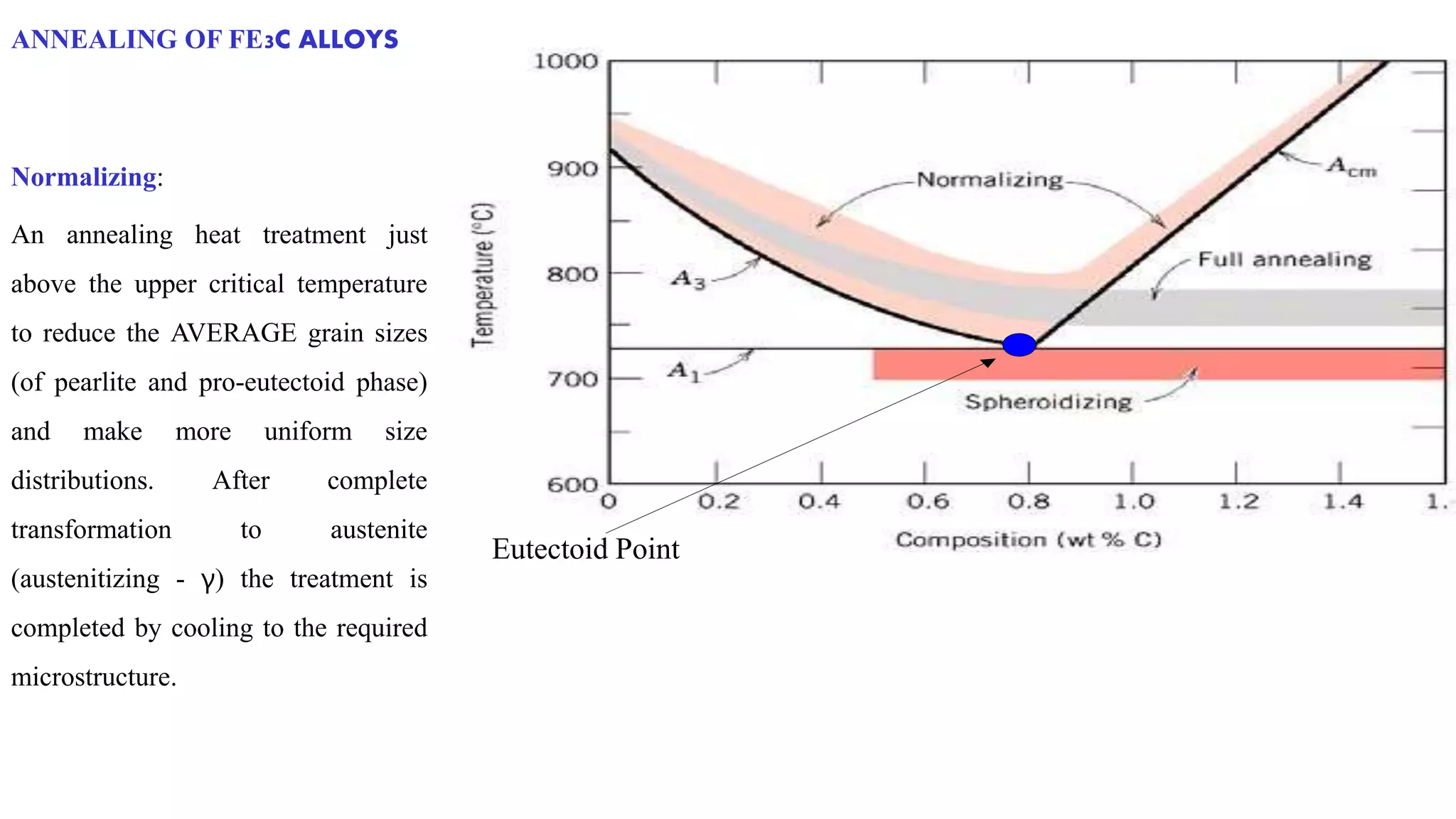
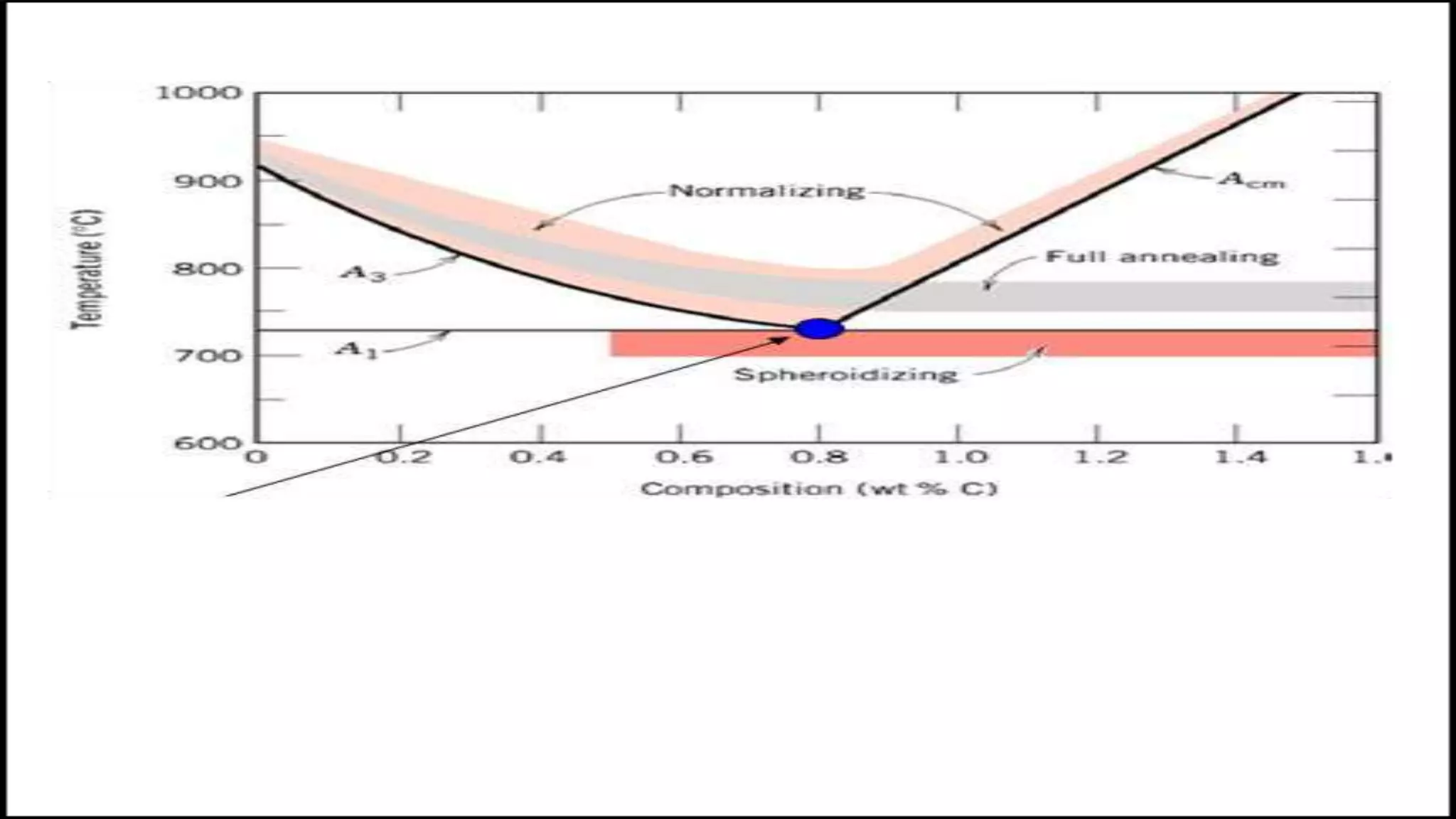
Eutectoid Point
ANNEALING OF FE3C ALLOYS
Normalizing:
An annealing heat treatment just
above the upper critical temperature
to reduce the AVERAGE grain sizes
(of pearlite and pro-eutectoid phase)
and make more uniform size
distributions. After complete
transformation to austenite
(austenitizing - γ) the treatment is
completed by cooling to the required
microstructure.
Full annealing:
Austen-zing (γ) and slow cooling (several hours). Produces coarse pearlite (large
grains and possible pro-eutectoid phase) that is relatively soft and ductile. Full
annealing is used to soften pieces which have been hardened by plastic
deformation, and which need to undergo subsequent machining OR forming.
Spheroid-zing:
Prolonged heating just below the eutectoid temperature, which results in the soft
spheroidite structure. This achieves maximum softness needed in subsequent
forming operations.

Fabrication of metals

  • 1.
    METALS FABRICATIONS Fabrication isthe act of taking raw stock material and turning it into a part for use in an assembly process. There are many different types of fabrication processes. The most common are • Cutting • Folding • Punching • Shearing • Welding
  • 2.
    METAL FABRICATION MATERIALS Standardraw materials used by metal fabricators are; • plate metal • formed and expanded metal (tube stock, CDSM, square stock) • welding wire • hardware • castings • fittings
  • 3.
    • Cutting There aremany ways to cut nowadays. The old standby is the saw. Others now include plasma torches, water jets, and lasers. • Folding Some parts need to be bent. The most common method is a press brake (or brake press). It has a set of dies that pinches the metal to form a crease. • Punching Punching is the act of a punch and a die forming a ‘scissor’ effect on a piece of metal to make a hole in it. Obviously, the punch and die must be the same shape and size of the desired hole.
  • 4.
    • Shearing Shearing isthe process of making a long cut on a piece of metal. It is, in effect, just like the action of one of those paper cutters with the long chop-handle. This is done on sheet metal. • Stamping Stamping is very similar to punching, except the material is not cut. The die is shaped to make a raised portion of material rather than penetrating. • Welding Welding is the act of joining two pieces of metal together.
  • 5.
    FORMNG OPERATIONS • FORGING •ROLLING • EXTRUSION • DRAWING
  • 7.
    Annealing Processes Annealing isa heat treatment where the material is taken to a high temperature, kept there for some time and then cooled. High temperatures allow diffusion processes to occur fast. The time at the high temperature (soaking time) is long enough to allow the desired transformation to occur. Cooling is done slowly to avoid the misrepresentation (warping) of the metal piece, or even cracking, caused by stresses induced by differential contraction due to thermal in-homogeneities. Benefits or purpose of annealing are: • relieve stresses • increase softness, ductility and toughness • produce a specific microstructure
  • 9.
    Stages of Annealing: •Heating to required temperature • Holding (“soaking”) at constant temperature • Cooling • The time at the high temperature (soaking time) is long enough to allow the desired transformation (diffusion, kinetics) to occur. • Cooling is done slowly to avoid warping OR cracking formed due to the thermal gradients and thermo-elastic stresses.
  • 10.
    Eutectoid Point ANNEALING OFFE3C ALLOYS Normalizing: An annealing heat treatment just above the upper critical temperature to reduce the AVERAGE grain sizes (of pearlite and pro-eutectoid phase) and make more uniform size distributions. After complete transformation to austenite (austenitizing - γ) the treatment is completed by cooling to the required microstructure.
  • 12.
    Full annealing: Austen-zing (γ)and slow cooling (several hours). Produces coarse pearlite (large grains and possible pro-eutectoid phase) that is relatively soft and ductile. Full annealing is used to soften pieces which have been hardened by plastic deformation, and which need to undergo subsequent machining OR forming. Spheroid-zing: Prolonged heating just below the eutectoid temperature, which results in the soft spheroidite structure. This achieves maximum softness needed in subsequent forming operations.