Thin-Film Photovoltaics R&D: Innovation, Opportunities
Ahmed Ennaoui
Helmholtz-Zentrum Berlin für Materialien und Energie
ennaoui@helmholtz-berlin.de
IRESEN ´s Event for the launch of calls for proposals 2013 Casablanca, January 30th, 2013
This material is intended for use in lectures, presentations and as handouts to students, it can be provided in Powerpoint format to allow
customization for the individual needs of course instructors. Permission of the author and publisher is required for any other usage.
Flexible PV OPV Nanoparticles
Tandem Solar cellSilicon Solar cell
http://www.iresen.org/index.php
Thin Film Solar Cell
DSSC
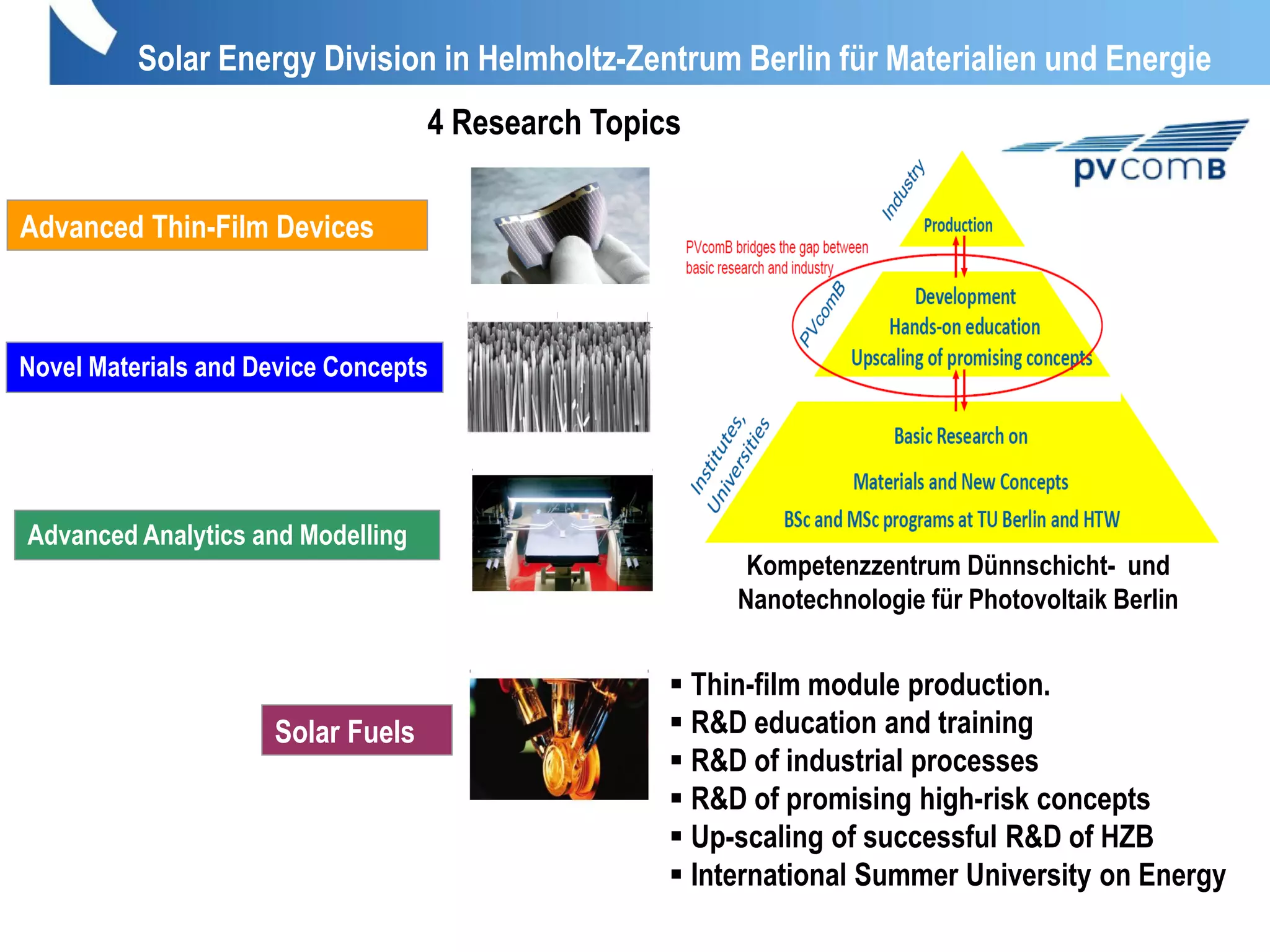
Advanced Thin-Film Devices
Novel Materials and Device Concepts
Advanced Analytics and Modelling
Solar Fuels
• Chalcopyrite-Type Semiconductors
• Silicon Photovoltaics
• Directed toward long-term goal of
producing cost-effective and more
efficient devices
• Advanced interface analysis
• Charge carrier dynamics
• Microstructure an defect analysis
• Device and material characterisation
• Development cost-effective PV
hybrid systems directly convert
sunlight into stored chemical
energy producing hydrogen via
water splitting
Solar Energy Division in Helmholtz-Zentrum Berlin für Materialien und Energie
Kompetenzzentrum Dünnschicht- und
Nanotechnologie für Photovoltaik Berlin
 Thin-film module production.
 R&D education and training
 R&D of industrial processes
 R&D of promising high-risk concepts
 Up-scaling of successful R&D of HZB
 International Summer University on Energy
4 Research Topics
Thin-Film Photovoltaics: Innovation and Opportunities
Third Generation: Molecular devices:
 Dye sensitised DSSC
 Organics OPV
 Quantum structured solar cells
Innovation
Thinner
Efficient
FasterSecond Generation
 Cu-chlacopyrite compounds (CIGSSe)
 Emerging structure compounds (CZTSSe)
 Cadmium telluride (CdTe)
 Amorphous and µ-crystalline silicon
Scarcity of materials
Monolithic integration
Lower production costs
Large area deposition
Energy pay back time
Implementation in building
Highlight
Introduction: VLSI Technology vs. Solar Cell and Moore´s law
The first practical photovoltaic cell was invented
at Bell Laboratories in 1954 (few %)
1941, first silicon solar cell was reported
(US Patent 240252, filed 27 March 1941)
http://www.intel.com/technology/silicon/mooreslaw/
Solar Cells: Efficient, Thinner , Cheaper, Faster
Pentium 4 has around 55 million components per chip (2003)
Number of transistors doubles every two years
Computer: Faster, cheaper, storing more data
Quelle: G. Willeke, ISE
First transistor
Introduction: PV Module production cost evolution
CdTe
Record Cell
EFFiciency (%)
17.3
Record Module
EFFiciency (%)
15.5
Aver. Module
EFFiciency (%)
12.5
Prod. Capacity
2011 (MWp/yr)
2200
Prod. Capacity
2012 (MWp/yr)
2700
CIGSS
Minimodule
Cell (0.5cm2)
17.8
19.7%
Record Module 14.5
Aver Module 12.6
Prod. Capacity
2011 (MWp/yr)
500
Prod. Capacity
2012 (MWp/yr)
1000
 Crystalline -Si PV prices dropped by over 40% EFFICIENCY ≈15 % 0.8 - 0.6 €/W
 CdTe (First Solar) / EFFICIENCY ≈12.2 % 0.67 €/W
 CIGSS Solar Frontier EFFICIENCY ≈ 12.6% 0.55 - 0.42 €/W
 a-Si:H/mcSi / (Oerlikon,ThinFab140) / EFFICIENCY 2012 ≈ 10.8% (154 W) 0.35 $/W
New Record (January 2013)
Quelle: Alberto Mittiga/ENEA / and H.W. Schock Annu. Rev. Mater. Res. 2011. 41:297–321
Introduction: Storage: High capacity, Higher Operating voltage, and Long Cycle
Quelle
http://www.treehugger.com/files/2008/02/lithium-ion_battery_factory.php
LITHIUM BATTERIES:
• high energy density (3 times lead-acid).
• Application spans beyond the electronics market
• Li-ion nanophosphate is inherently safer.
• Safe non-flammable electrolytes.
Structurally stable compounds, such as: LiFePO4
High capacity, Higher Operating voltage, and Long Cycle
Ahmed Ennaoui / Helmholtz-Zentrum Berlin für Materialien und Energie
Introduction: Key Task of Photovoltaic
Power [Watt/cm2] = Voltage [Volt ] x Current density [A/cm2]
PV products can be optimized for
location, with lower associated financial
risk based on predictable performance
 Key aim is to generate electricity from solar spectrum
EFFECIENCY INCREASING
LESS AREA
LESS MATERIAL
COST FOR PV REDUCED
LOW €/Wp
Materials with small Band gap
But low voltage
Excess energy lost to heat
 Generating a large current (JSC)
Materials with large band gap
But low current
Sub-band gap light is lost
 Generating a large voltage (VOC)
 Two challenges
Solar cell design
versus
solar spectrum
Voltage [Volt ]
JSC[A/cm2]
Power[Watt/cm2]
VOC
0
JSC
maximum
power
point
Jm
Vm
Vm x Jm
AM1,5
Efficiencies beyond the Shockley-Queisser limit
500 1000 1500 2000 2500
0
200
400
600
800
1000
1200
1400
1600
Leistungsdichte[W/m
2
µm]
AM15
GaInP
GaInAs
Ge
Wellenlänge [nm]
(1) Lattice thermalization loss (> 50%)
(2) Transparency to h < Band gap
(3) Recombination Loss
(4) Current flow
(5) Contact voltage loss
Not all the energy of absorbed photon
can be captured for productive use.
(Th. Maxi efficiency ~32% ).
source
1.7 eV
1.1 eV
0.7 eV
R.R. King; Spectrolab Inc., AVS 54th International Symposium, Seattle 2007
Optimistic calculation
Best commercially available cells  37% efficient at 25°C.
75% efficient  0.30 × 0.75 × 850 ≈ 200 W/m2 of electrical power.
At $200/m2 the capital cost would be $1.50/W.
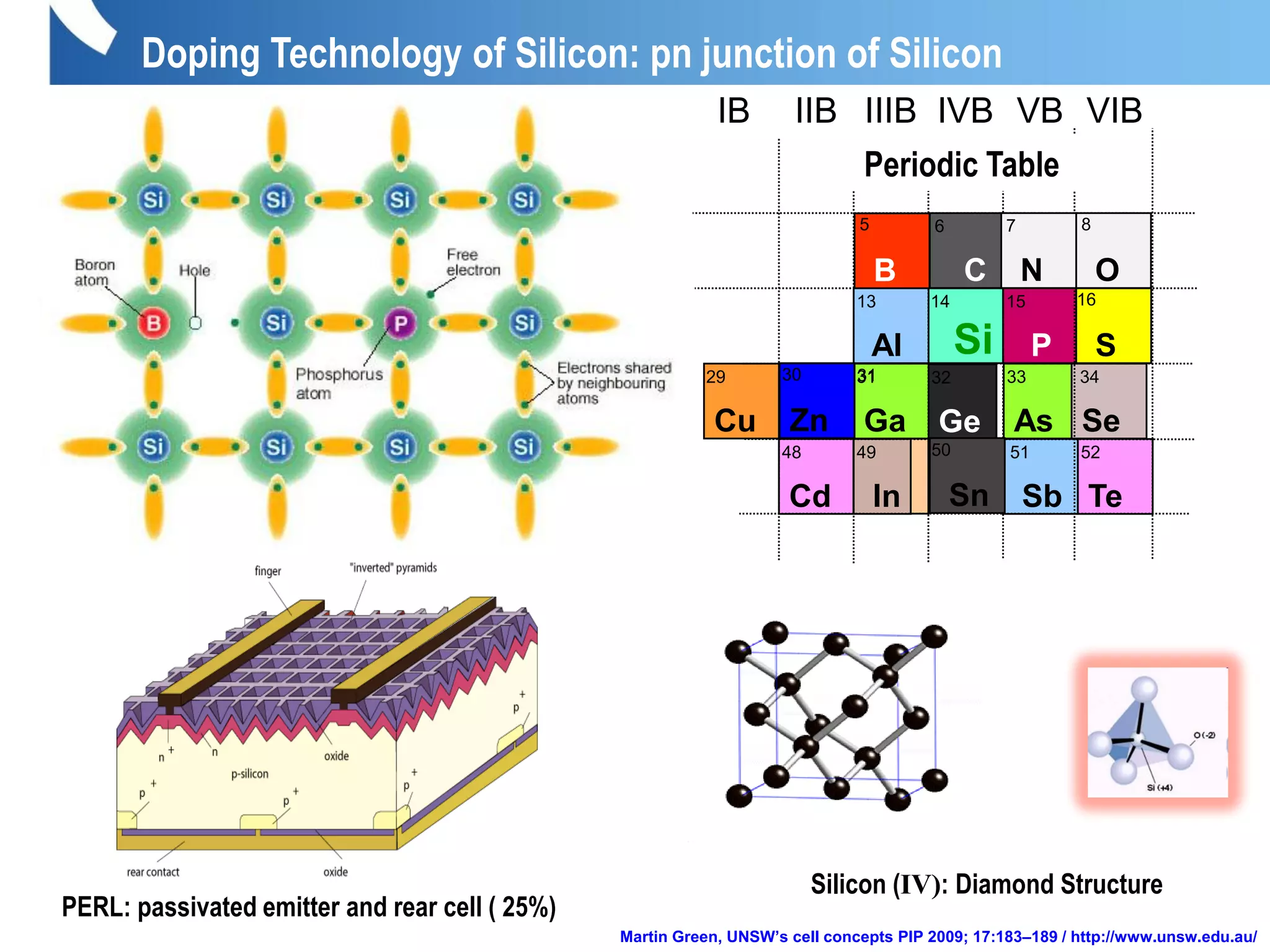
Si
14
Si
Ge
32
Ga
31
As
33
Cd
48
Te
52
P
15
In
49
Al
13
Sb
51
Cu
29
Se
34
In
49
31
IIB IIIB IVB VB VIBIB
C
6
B
5
Zn
30
Sn
50
S
16
O
8
N
7
Periodic Table
ZnS
Ge
GaAs
CdTe
InP
AlSb
CdS
Scientific Background
Silicon
IV
Tetrahedrally coordinated
4
...



mn
mqnq MN
n,m atoms/unit cell
Grimm-Sommerfeld rule
Source: Ennaoui Osaka seminar
CuInxGa1-xSe2
Cu2SnZnSe4
Diamond Structure
I-III-VI2
II-IV-V2
AlxGa1-xSe2
Cu(In,Ga)Se2
Cu2(ZnSn)Se4
Zincblende
Structure II-VIIII-V
Common Symbol+ -
Si
14
Ge
32
Ga
31
As
33
Cd
48
Te
52
P
15
In
49
Al
13
Sb
51
Cu
29
Se
34
In
49
31
IIB IIIB IVB VB VIBIB
C
6
B
5
Zn
30
Sn
50
S
16
O
8
N
7
Periodic Table
Silicon (IV): Diamond Structure
Doping Technology of Silicon: pn junction of Silicon
PERL: passivated emitter and rear cell ( 25%)
Martin Green, UNSW’s cell concepts PIP 2009; 17:183–189 / http://www.unsw.edu.au/
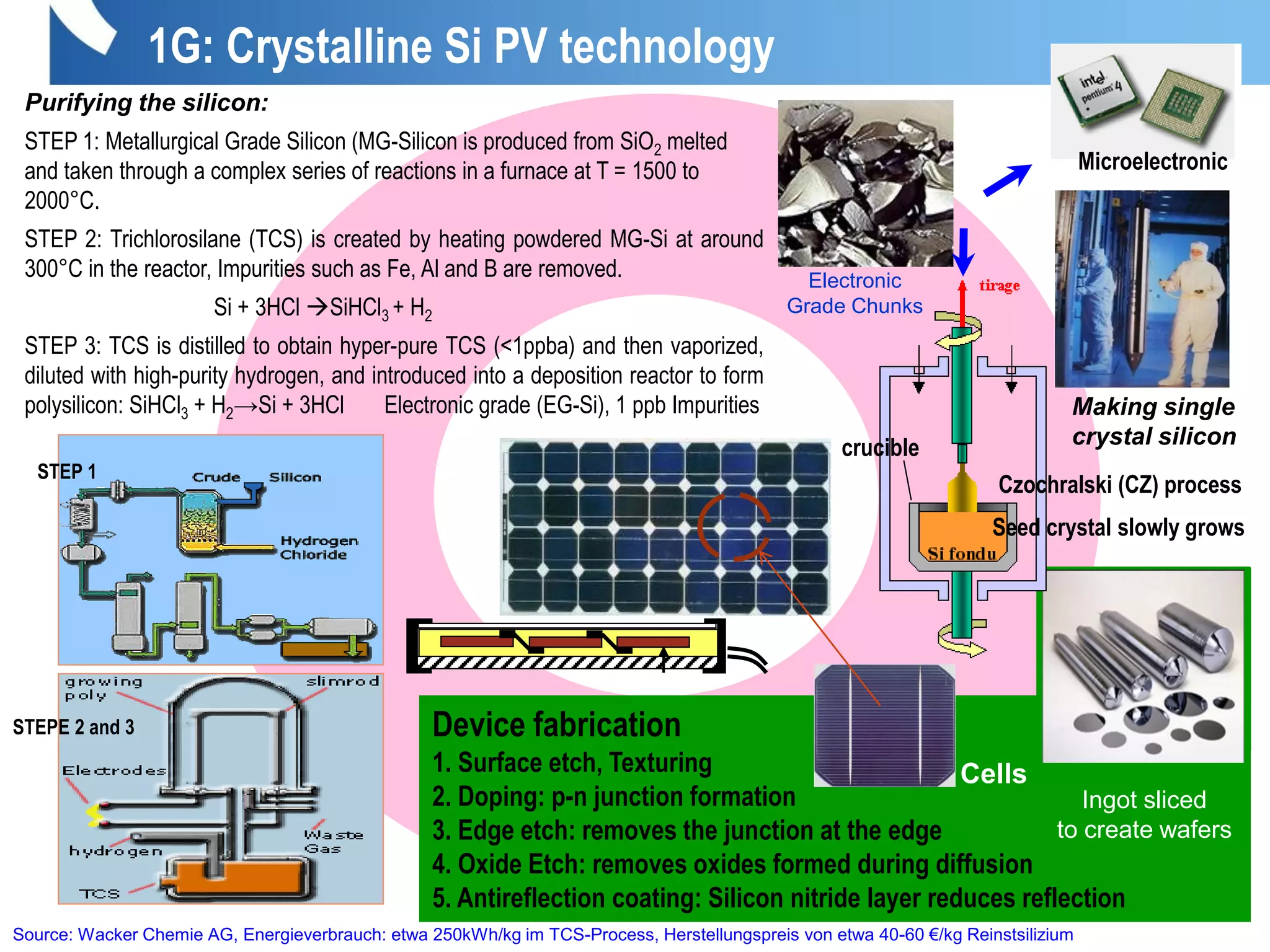
Device fabrication
1. Surface etch, Texturing
2. Doping: p-n junction formation
3. Edge etch: removes the junction at the edge
4. Oxide Etch: removes oxides formed during diffusion
5. Antireflection coating: Silicon nitride layer reduces reflection
Cells
Purifying the silicon:
STEP 1: Metallurgical Grade Silicon (MG-Silicon is produced from SiO2 melted
and taken through a complex series of reactions in a furnace at T = 1500 to
2000°C.
STEP 2: Trichlorosilane (TCS) is created by heating powdered MG-Si at around
300°C in the reactor, Impurities such as Fe, Al and B are removed.
Si + 3HCl SiHCl3 + H2
STEP 3: TCS is distilled to obtain hyper-pure TCS (<1ppba) and then vaporized,
diluted with high-purity hydrogen, and introduced into a deposition reactor to form
polysilicon: SiHCl3 + H2→Si + 3HCl Electronic grade (EG-Si), 1 ppb Impurities
STEP 1
STEPE 2 and 3
Electronic
Grade Chunks
Source: Wacker Chemie AG, Energieverbrauch: etwa 250kWh/kg im TCS-Process, Herstellungspreis von etwa 40-60 €/kg Reinstsilizium
Ingot sliced
to create wafers
Making single
crystal silicon
Czochralski (CZ) process
crucible
Seed crystal slowly grows
Microelectronic
1G: Crystalline Si PV technology
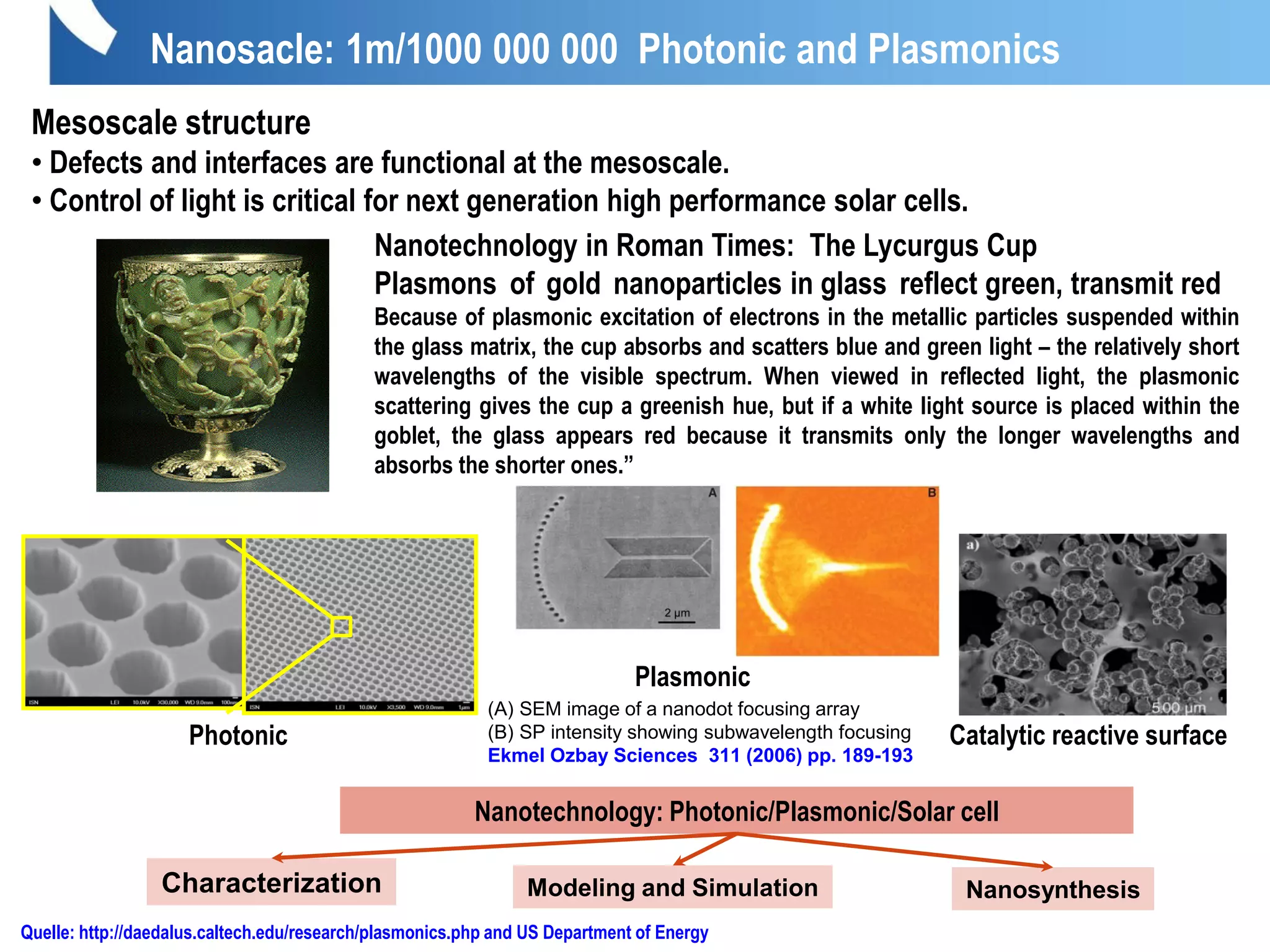
Nanotechnology in Roman Times: The Lycurgus Cup
Plasmons of gold nanoparticles in glass reflect green, transmit red
Because of plasmonic excitation of electrons in the metallic particles suspended within
the glass matrix, the cup absorbs and scatters blue and green light – the relatively short
wavelengths of the visible spectrum. When viewed in reflected light, the plasmonic
scattering gives the cup a greenish hue, but if a white light source is placed within the
goblet, the glass appears red because it transmits only the longer wavelengths and
absorbs the shorter ones.”
Nanosacle: 1m/1000 000 000 Photonic and Plasmonics
Quelle: http://daedalus.caltech.edu/research/plasmonics.php and US Department of Energy
Mesoscale structure
• Defects and interfaces are functional at the mesoscale.
• Control of light is critical for next generation high performance solar cells.
Photonic
(A) SEM image of a nanodot focusing array
(B) SP intensity showing subwavelength focusing
Ekmel Ozbay Sciences 311 (2006) pp. 189-193
1µ
Catalytic reactive surface
Nanotechnology: Photonic/Plasmonic/Solar cell
NanosynthesisModeling and SimulationCharacterization
Plasmonic
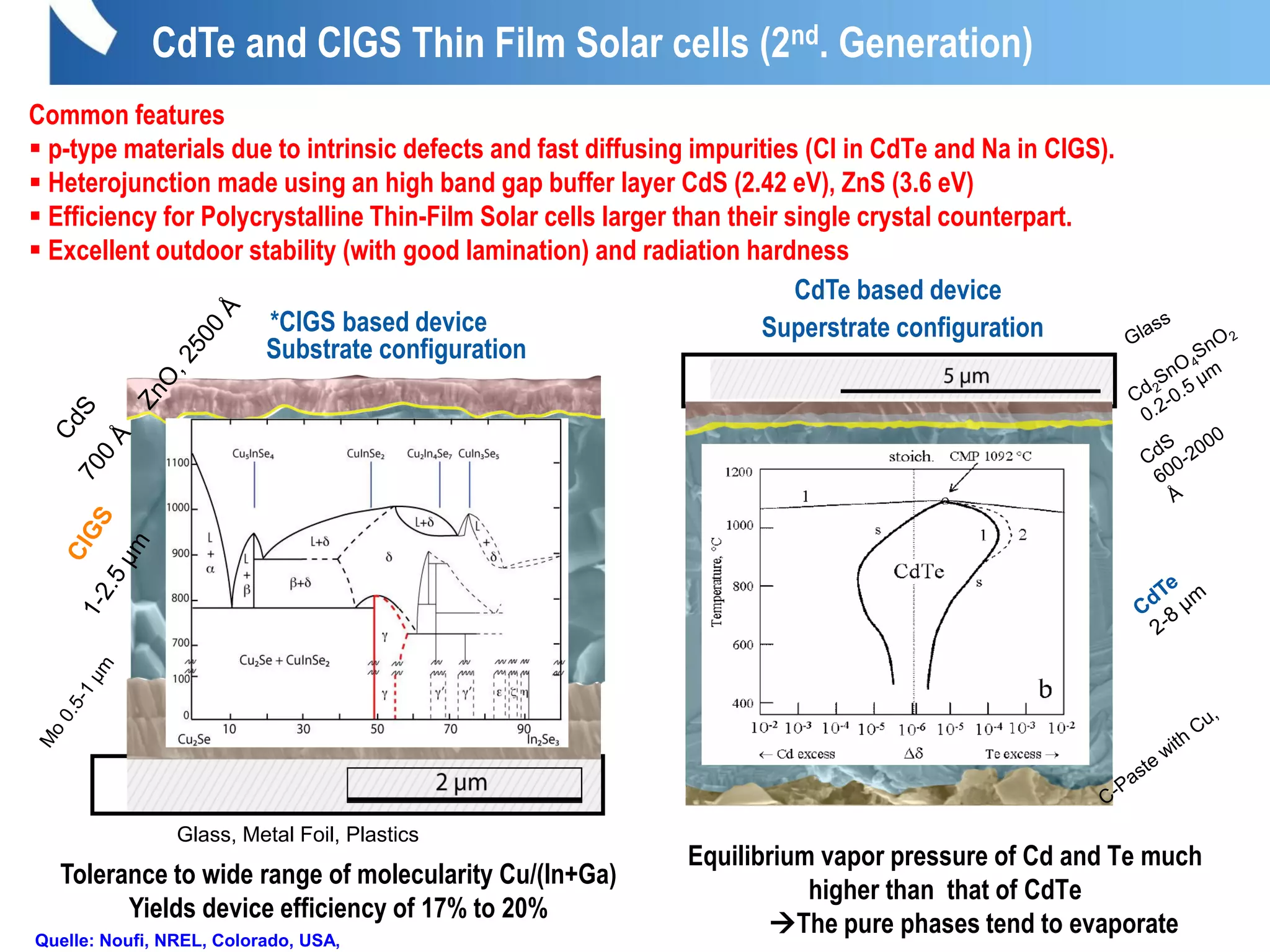
Glass, Metal Foil, Plastics
CdTe based device
Quelle: Noufi, NREL, Colorado, USA,
Substrate configuration
*CIGS based device
CdTe and CIGS Thin Film Solar cells (2nd. Generation)
Superstrate configuration
Common features
 p-type materials due to intrinsic defects and fast diffusing impurities (Cl in CdTe and Na in CIGS).
 Heterojunction made using an high band gap buffer layer CdS (2.42 eV), ZnS (3.6 eV)
 Efficiency for Polycrystalline Thin-Film Solar cells larger than their single crystal counterpart.
 Excellent outdoor stability (with good lamination) and radiation hardness
Tolerance to wide range of molecularity Cu/(In+Ga)
Yields device efficiency of 17% to 20%
Equilibrium vapor pressure of Cd and Te much
higher than that of CdTe
The pure phases tend to evaporate
R&D Directions
In situ optical processing
Optimal range for efficient thin film
solar cells: 22-24 at % of Cu
a-phase highly narrowed at room temperature
Possible at growth T from RT to 550°C
b-phase (CuIn3Se5) defect phase defect pairs (VCu, InCu)
d-phase (high-temperature)  Cu & In sub-lattice
Cu2Se
• built from chalcopyrite structure by
• Cu interstitials Cu-Inanti sites
• Melting point at ca. 530°C surfactant
for recristallization (large grains)
 Reduce the manufacturing cost.
 Through efficiency improvements.
 Reduce the thickness of CIGS.
(0.7 µm thickness and 17% efficiency)
 Interface engineering.
 Band gap adjustment: 1.03eV-1.7 eV.
 Cadmium free buffer layer R&D.
 Low cost processing.
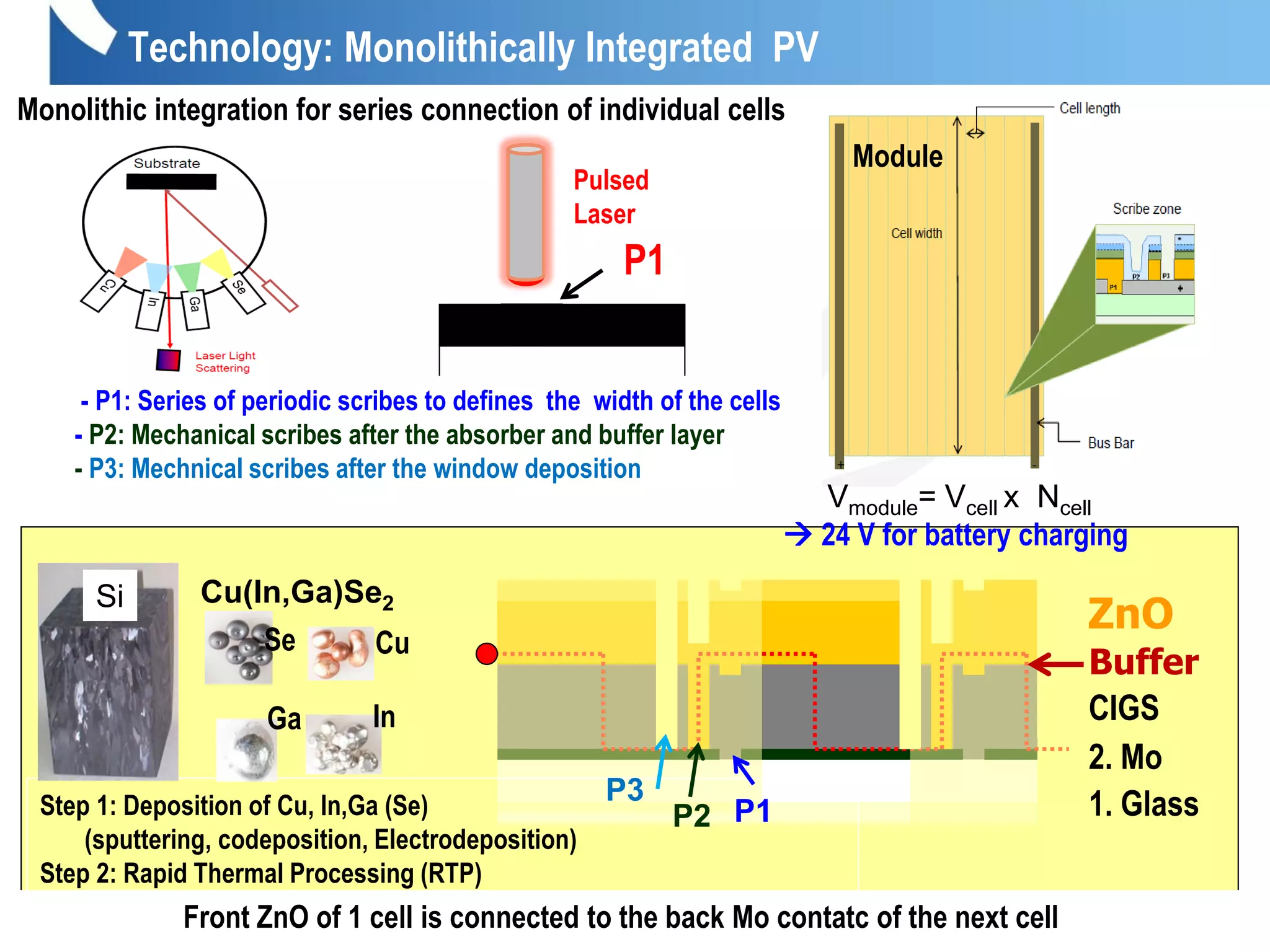
1. Glass
2. Mo
CIGS
Buffer
ZnO
Technology: Monolithically Integrated PV
P1
Step 1: Deposition of Cu, In,Ga (Se)
(sputtering, codeposition, Electrodeposition)
Step 2: Rapid Thermal Processing (RTP)
Pulsed
Laser
Front ZnO of 1 cell is connected to the back Mo contatc of the next cell
Se Cu
Ga In
Cu(In,Ga)Se2
Monolithic integration for series connection of individual cells
P3
P2 P1
- P1: Series of periodic scribes to defines the width of the cells
- P2: Mechanical scribes after the absorber and buffer layer
- P3: Mechnical scribes after the window deposition
Si
Module
Vmodule= Vcell x Ncell
 24 V for battery charging
 CIGS manufactured on low cost glass substrates.
 CIGS manufactured on flexible substrates.
 Enables access to the largest PV markets.
 Short energy pay back time and less energy consuming process.
 Compatible with existing photovoltaic system infrastructure.
 Easy to integrate into Building (BIPV) market.
Strong point of CIGS
PowerFLEX™ Modules
http://www.globalsolar.com
BIPV thin-film CIGS façade
Honda building in Japan
Light weight
3.5 kg/m2
EFFICIENCY
10.5% to 12.6%
50% more efficient than flexible a-Si
Evolution and Record efficiency
20.4%
~11.1%
~12%
19.7%
Cadmium free
CIGSS Jan. 2013
Flexible substrate
CIGSe Jan. 2013
CZTSSe
IBM New York 2013
OPV
2013
 EFFICIENCY 20.4% for Cu(In,Ga)Se2 or (CIGS) on polymer foils
(Swiss Federal Laboratories EMPA achieved January 2013)
 EFFICIENCY 12% for PV (OPV)
(Heliatek: German organic January 2013 )
 EFFICIENCY 11.1% for ink-based Cu2ZnSn(S,Se)4 (CZTS)
(IBM’s Materials Science team + Solar Frontier, Tokyo + DelSolar )
Big issue: CIGS and CZTS
on flexible substrate
Problem: Materials availability
Modules
(EFF ≈11%)
Metal
Required
(Tonn/m2)
Reserves
1998
Tonn
Productio
n
1997
Tonn/yr
CdTe
(3 µm)
Te
180 t/GWp
20000 290
CIGS
(2 µm)
In 98 t/GWp 2600 290
 2011 Total PV Annual production≈37 GWp/yr (2 GWp/yr due to CdTe and 1GWp/yr due to CIGS)
 Worldwide continuous electricity consumption : 15 Terawatts
Fthenakis, Renewable and Sust. Energy Rev., 13, 2746-2750, 2009 / http://www.compoundsemiconductor.net/csc/news-details.php?id=19735415
 CZTS Thickness 1 μm and an efficiency of 10% needs 10 g/m2 of material
CZTS PV cells could potentially yield up to 500 GW/year.
 CIGS and CdTe contain rare elements that limit their manufacturing < 100 GW /year.
 Recycling issue for In and Te
B. A. Andersson Prog. Photovolt. Res. Appl. 8, 61 (2000) / Wadia et al. Environmental Science and Technology 2009, 43, 2072
U.S. Geological Survey Fact Sheet 087-02
Design to high efficiency solar cells
Light trapping
Reflection Loss: ARC
Material
Parameter
absorption
Important cost factor
thikness
€









 αW
p
e
αL1
1
1R)(1η
λ
hc
e
)J(
Φ(λ)
1
N
N
η photons
in
electron
out



Decisive Material
Parameter
The band gap
0.3 0.5 0.7 0.9 1.1
20
0
40
60
80
100
0
1
2
3
4
5
NumberofSunlightPhotons(m-2s-1micron-1)E+19
RExternalQuantumEfficiency,%
c-Si:H junctiona-Si:H junction
AM 1.5 global spectrum
Wavelength, microns
a-Si:H/c-Si:H Cell Spectral Response
Textured TCO
a-Si
Top cell
Back
Reflector
Glass
substrate
Thin film mc-
Si
Bottom cell
  
GE
λ0λsc dλ.dα-exp.)().ΦR(1.η(λ).qJ
Light from the sun
C10x1.6e
][A.mCurrent
N 19
-2
electron
out 


energy[J]photon
][J.mEnergyInput
N
-2
Photon
in 
a-Si/μc-Si Tandems: Tandem Cell Design
Source PVComB/Rutger Schlatmann
a-Si/μc-Si Tandems: Lab Record Cells (1 cm², stable)
Source PVComB/Rutger Schlatmann
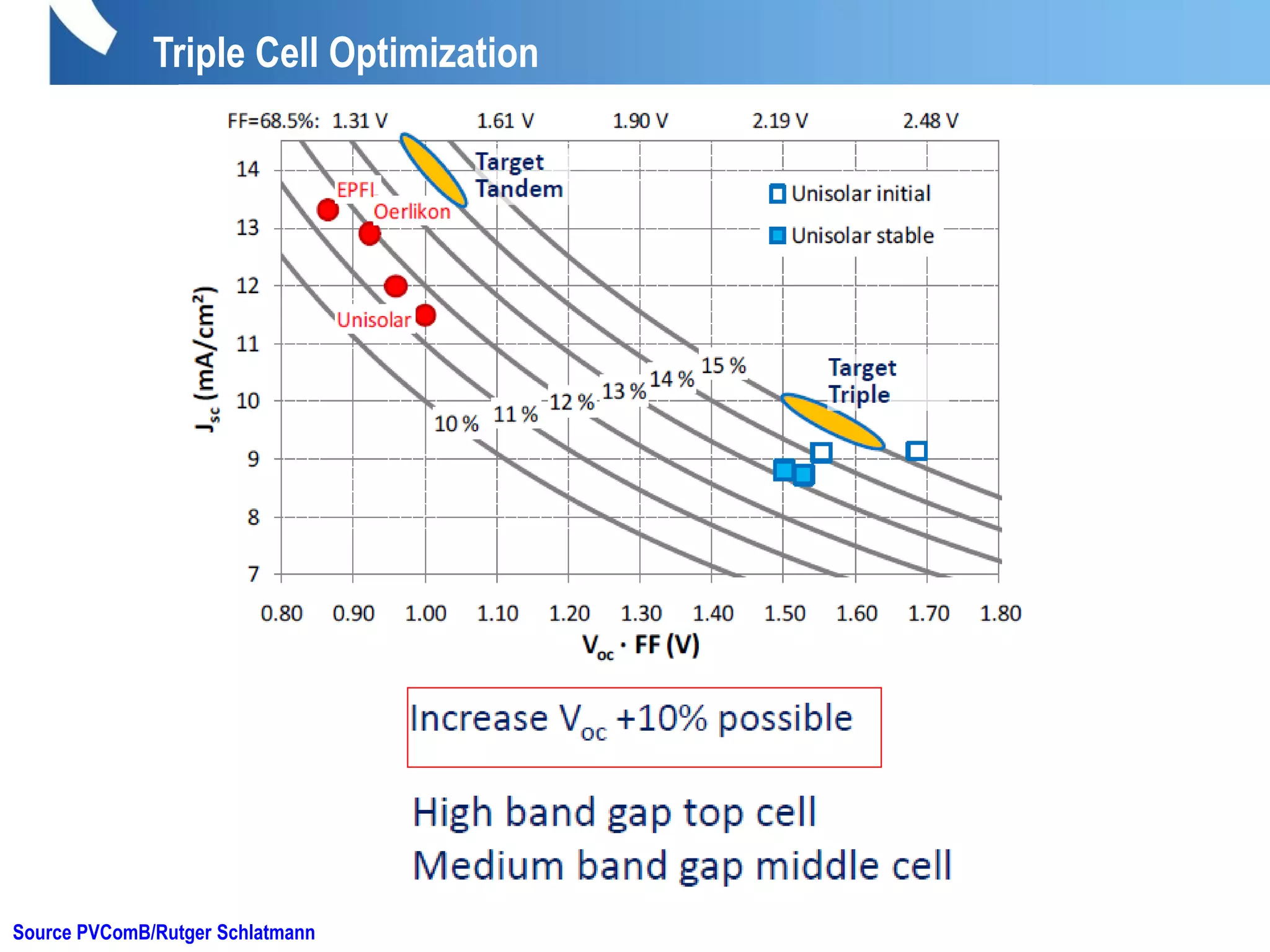
Triple Cell Optimization
Source PVComB/Rutger Schlatmann
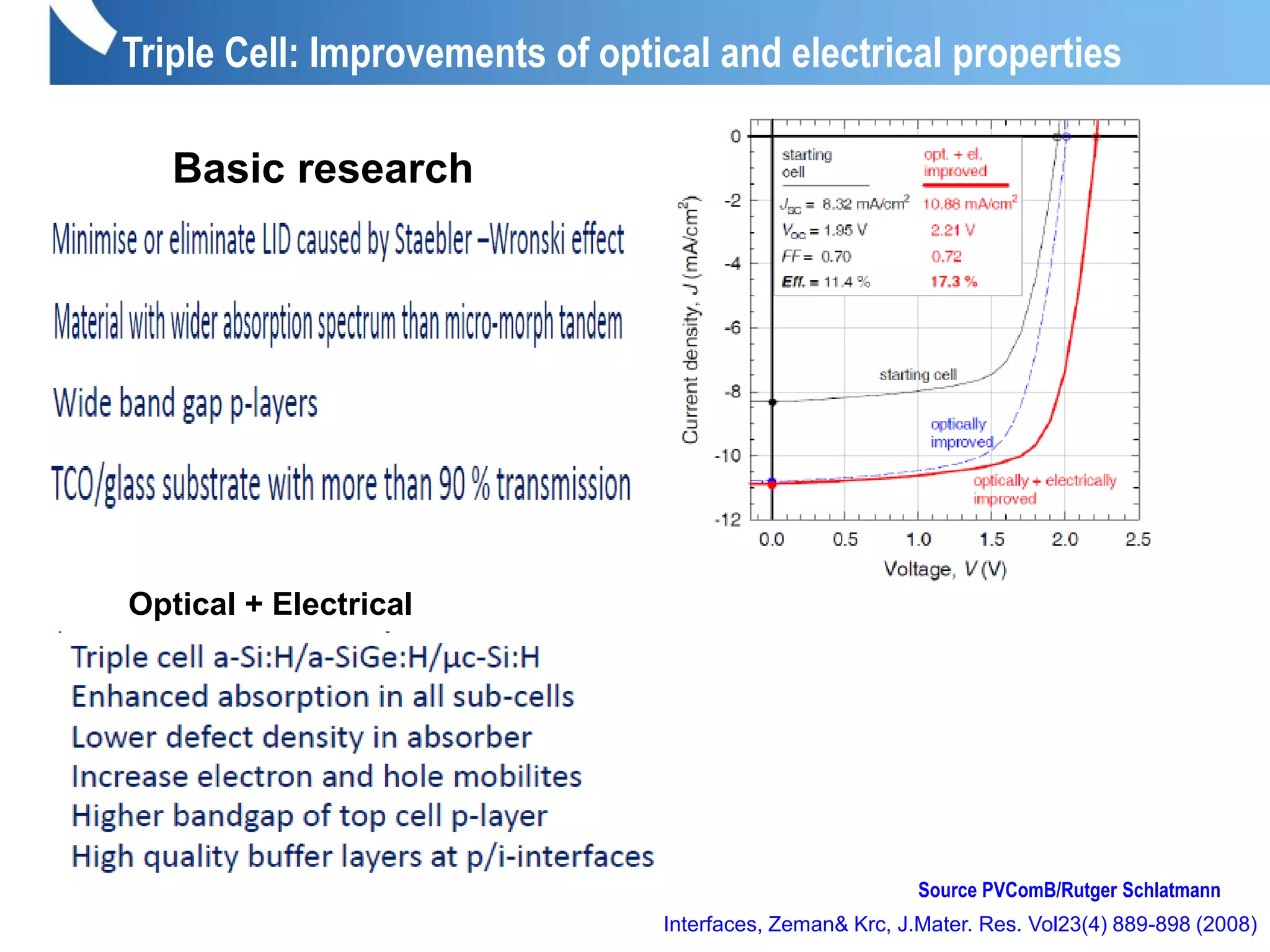
Triple Cell: Improvements of optical and electrical properties
Interfaces, Zeman& Krc, J.Mater. Res. Vol23(4) 889-898 (2008)
Source PVComB/Rutger Schlatmann
Basic research
Optical + Electrical
• 3th. Generation: OPV solar cells
Provide Earth abundant and low-energy-production PV solution.
Organic semiconductors: Abundant: ~100,000 tons/year
• Key component
The electron acceptor
Light harvesting material (conjugated polymer)
Organic Photovoltaics (OPV): Molecular Perspective
Aluminum
Absorber
Polymer Anode
ITO
Substrate
Donor polymer (i.e. P3HT)
absorbs light generating an exciton
Exciton must diffuse to the
Donor/Acceptor interface
Status (Dresden/Germany, 16. Januar 2013 / http://www.heliatek.com/)
New word record 12% efficiency by Heliatek GmbH
Polymer-Fullerene Heterojunction Cells
Electrons travel to the back
electrode and Holes travel to the
front electrode
~200nmthick
OPV: R&D
Large Scale Printing
Konarka
Important issue:
optimizing the band gap and LUMO-LUMO offset
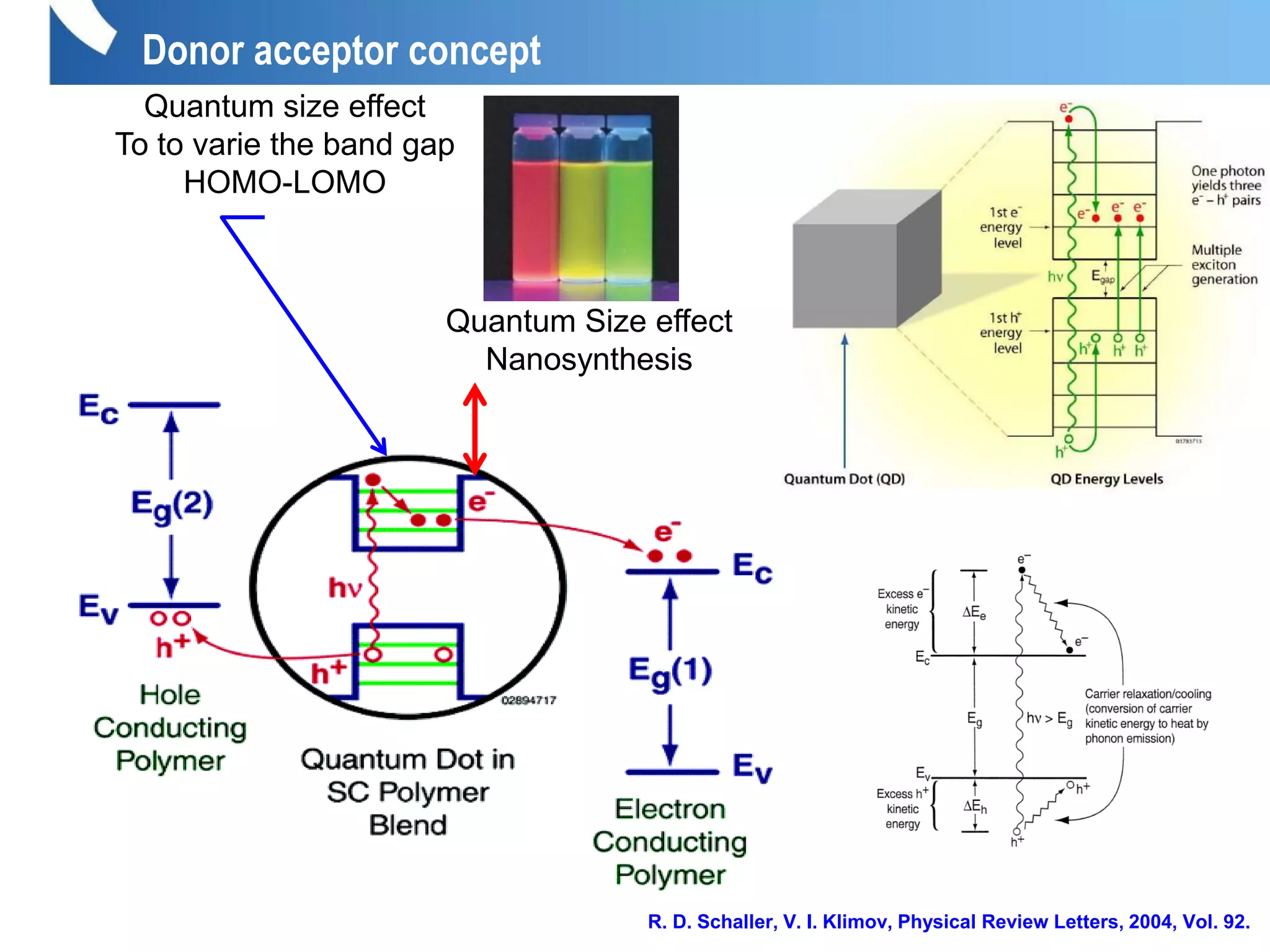
Donor acceptor concept
Quantum size effect
To to varie the band gap
HOMO-LOMO
Quantum Size effect
Nanosynthesis
R. D. Schaller, V. I. Klimov, Physical Review Letters, 2004, Vol. 92.
Excellent review on Concept of Inorganic solid-state nanostructured solar cells
T. Dittrich, A. Belaidi, A. Ennaoui Extremely Thin Absorber (ETA)
Solar Energy Materials and Solar Cells, Volume 95, Issue 6, June 2011, Pages 1527-1536
ZnO
nanorodes
Nanocrystalline based Solar cells
 Electron holes photogenerated
 Immediately injected in mesoporous TiO2 (or ZnO NRs)
Photosynthesis
CO2
Sugar
H2O
O2
OPV: Research direction
glass or plastic
transparent conductor
organic-inorganic
metal
Organic multijunction architecture ((Including Encapsulation and reduce cell degradation)
NC Nanoparticles
Nanosynthesis,
Nanotechnology
Organic / Polymer
Chemistry Coating
Technoques
Contact
materials
Contact
materials
Glass
Ag
ZnO-NRs
ZnPc:C60 C60
MoO3
ZnO-NR / C60 / ZnPc:C60 / MoO3 / Ag
200 nm
First solar cells with ZnO-NRs and small molecules / Eff. 2.8%
HZB-Patent WO 2008 / 104173 (Rusu et al.)
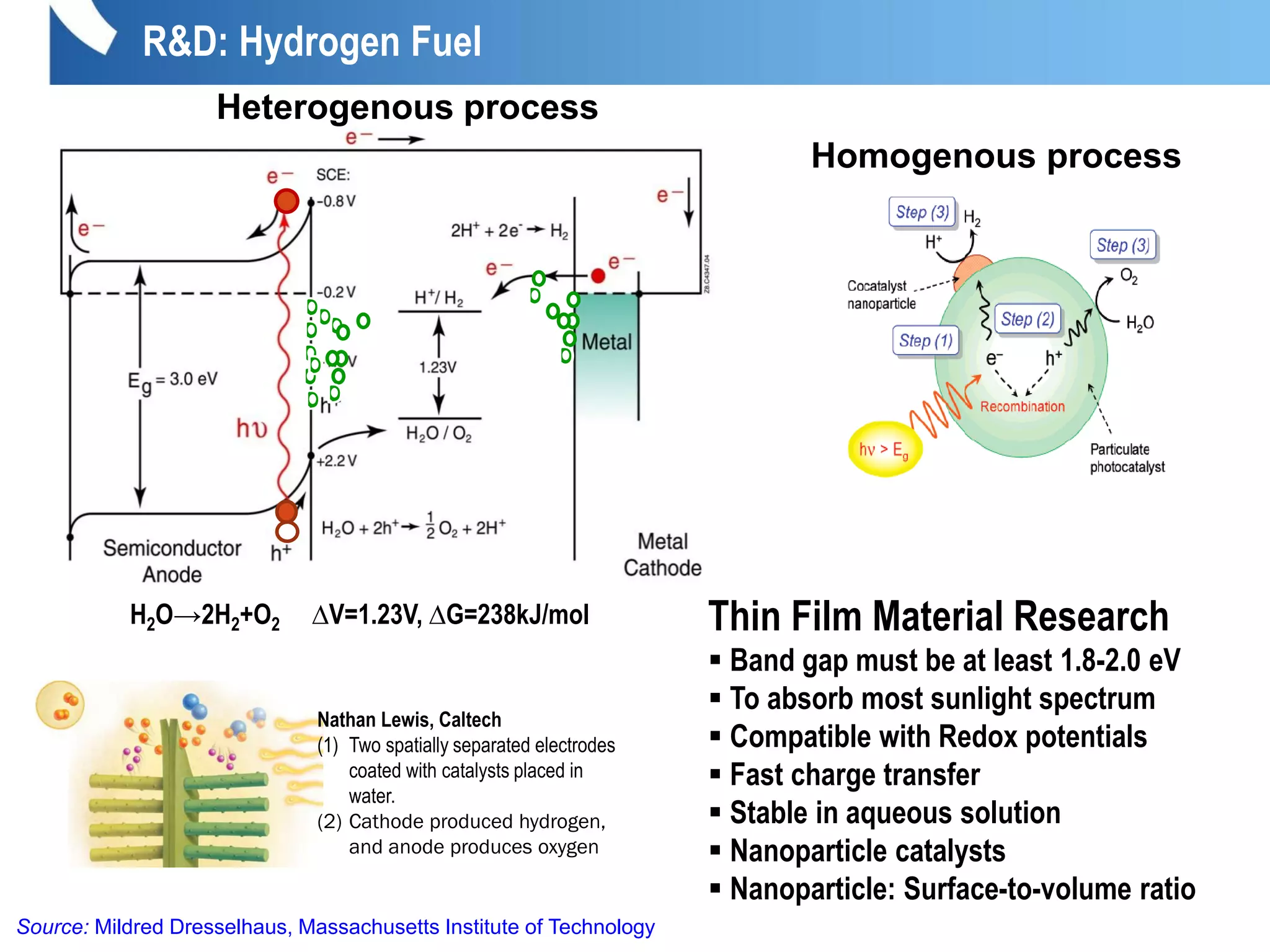
H2O→2H2+O2 ∆V=1.23V, ∆G=238kJ/mol
R&D: Hydrogen Fuel
Source: Mildred Dresselhaus, Massachusetts Institute of Technology
D
D
D
D
D
D
Heterogenous process
Homogenous process
Thin Film Material Research
 Band gap must be at least 1.8-2.0 eV
 To absorb most sunlight spectrum
 Compatible with Redox potentials
 Fast charge transfer
 Stable in aqueous solution
 Nanoparticle catalysts
 Nanoparticle: Surface-to-volume ratio
Nathan Lewis, Caltech
(1) Two spatially separated electrodes
coated with catalysts placed in
water.
(2) Cathode produced hydrogen,
and anode produces oxygen
D
D
D
D
D
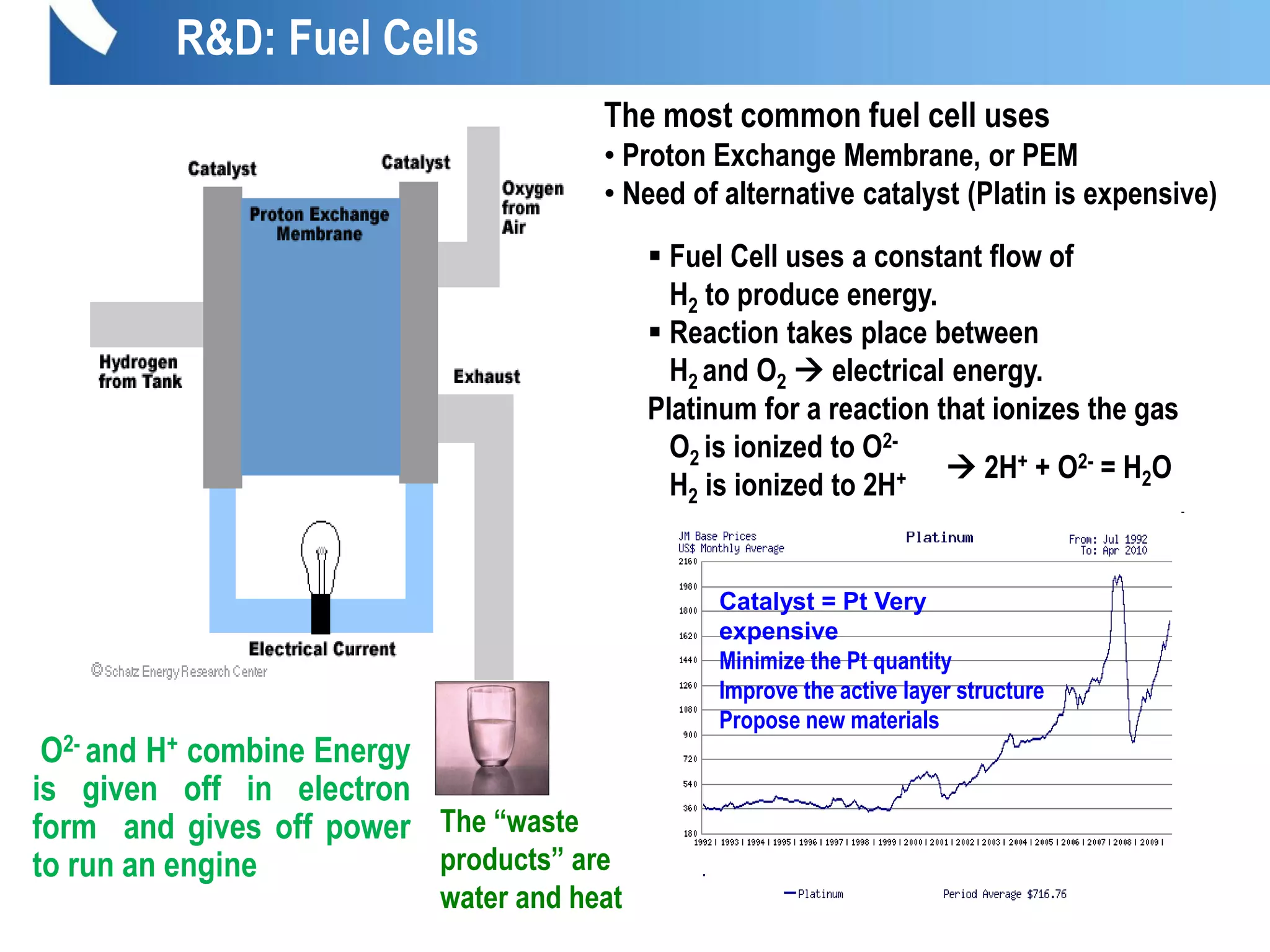
R&D: Fuel Cells
O2- and H+ combine Energy
is given off in electron
form and gives off power
to run an engine
The “waste
products” are
water and heat
Catalyst = Pt Very
expensive
Minimize the Pt quantity
Improve the active layer structure
Propose new materials
 Fuel Cell uses a constant flow of
H2 to produce energy.
 Reaction takes place between
H2 and O2  electrical energy.
Platinum for a reaction that ionizes the gas
O2 is ionized to O2-
H2 is ionized to 2H+  2H+ + O2- = H2O
The most common fuel cell uses
• Proton Exchange Membrane, or PEM
• Need of alternative catalyst (Platin is expensive)
Advantages
Zero emission
No dependence on foreign oil
Ability to harvest solar and renewable energy
Not many moving part in a car
Hydrogen weighs less than gasoline :
car would not need as much energy to move
R&D
Fuel Cells: Platinum plate is very expensive.
Batteries: Lithium batteries: high energy density (3 times lead-acid).
Safety issue:
Instead of oxygen releasing (LiCoO2)
Structurally stable alternative compounds, e.g. LiFePO4
Chemistry and anode/cathode design
Li-ion nanophosphate
Storage (Fuel Cell, Batteries)
Final Remarks
others
0.3 GW
CIS
0.9 GW
CdTe
2.05 GW
Amorphous/microcrystalline silicon
1.26 GW
Monocrystalline silicon
11.5 GW
Multicrystalline silicon
21.2 GW
2011 Total Production : 37 GW
Quelle: http://www.photon-international.com
Weak point of c-Si:
•Indirect bandgap 1 eV
•Low light absorption
•Huge loss
•Production Cost
Strong point of c-Si:
• High module efficiency: up to 20%
• High stability and reliability
• Mature and “modular” technology
Thin Film Solar PV
Inexpensive ways to produce energy, (few cts/kWh)
Thinner, Efficient, Faster, Cheap
Large area deposition
Energy pay back time
Implementation in building
Scarcity of materials
Monolithic integration
Lower production costs
 Cu(In,Ga)(SSe)2 20.4% flexible ; 19,7% Cd free
 Cu2ZnSn(S,Se)4  Printing technology?
 OPV new record 12%  Printing technology?
 DSSC (11%)  Reliability/Degradation, solid electrolyte
 Quantum devices (long term Research topic)
15 %
0.8 - 0.6 €/W
12.6%, 0.8 - 0.6 €/W
12.2 % , 0.67 €/W
10.8% (154 W) 0.35 $/W
IRESEN Event for the launch of calls for proposals 2013 Casablanca, January. 30th, 2013
This material is intended for use in lectures, presentations and as handouts to students, it can be provided in Powerpoint format to allow
customization for the individual needs of course instructors. Permission of the author and publisher is required for any other usage.
Flexible PV OPV DSSC Nanoparticles
Thin Film Solar Cell Tandem Solar cellSilicon Solar cell
http://www.iresen.org/index.php
Vielen Dank für Ihre Aufmerksamkeit
‫اهتمامكم‬ ‫على‬ ‫لكم‬ ‫شكرا‬Thank you for your attention
Morocco is going to translate from being a net importer of energy and a country facing
water shortage issues, into a producer of clean renewable energy and water in the region.
‫المياه‬ ‫نقص‬ ‫قضايا‬ ‫يواجه‬ ‫وبلد‬ ‫للطاقة‬ ‫مستوردا‬ ‫كونه‬ ‫من‬ ‫يترجم‬ ‫أن‬ ‫المغرب‬ ‫على‬ ‫ينبغي‬
‫النظيفة‬ ‫المتجددة‬ ‫للطاقة‬ ‫منتج‬ ‫إلى‬‫المنطقة‬ ‫في‬ ‫والمياه‬
‫الكبير‬ ‫التحدي‬Big Challenge

Thin-Film Photovoltaics R&D: Innovation, Opportunities_Ennaoui

  • 1.
    Thin-Film Photovoltaics R&D:Innovation, Opportunities Ahmed Ennaoui Helmholtz-Zentrum Berlin für Materialien und Energie ennaoui@helmholtz-berlin.de IRESEN ´s Event for the launch of calls for proposals 2013 Casablanca, January 30th, 2013 This material is intended for use in lectures, presentations and as handouts to students, it can be provided in Powerpoint format to allow customization for the individual needs of course instructors. Permission of the author and publisher is required for any other usage. Flexible PV OPV Nanoparticles Tandem Solar cellSilicon Solar cell http://www.iresen.org/index.php Thin Film Solar Cell DSSC
  • 2.
    Advanced Thin-Film Devices NovelMaterials and Device Concepts Advanced Analytics and Modelling Solar Fuels • Chalcopyrite-Type Semiconductors • Silicon Photovoltaics • Directed toward long-term goal of producing cost-effective and more efficient devices • Advanced interface analysis • Charge carrier dynamics • Microstructure an defect analysis • Device and material characterisation • Development cost-effective PV hybrid systems directly convert sunlight into stored chemical energy producing hydrogen via water splitting Solar Energy Division in Helmholtz-Zentrum Berlin für Materialien und Energie Kompetenzzentrum Dünnschicht- und Nanotechnologie für Photovoltaik Berlin  Thin-film module production.  R&D education and training  R&D of industrial processes  R&D of promising high-risk concepts  Up-scaling of successful R&D of HZB  International Summer University on Energy 4 Research Topics
  • 3.
    Thin-Film Photovoltaics: Innovationand Opportunities Third Generation: Molecular devices:  Dye sensitised DSSC  Organics OPV  Quantum structured solar cells Innovation Thinner Efficient FasterSecond Generation  Cu-chlacopyrite compounds (CIGSSe)  Emerging structure compounds (CZTSSe)  Cadmium telluride (CdTe)  Amorphous and µ-crystalline silicon Scarcity of materials Monolithic integration Lower production costs Large area deposition Energy pay back time Implementation in building Highlight
  • 4.
    Introduction: VLSI Technologyvs. Solar Cell and Moore´s law The first practical photovoltaic cell was invented at Bell Laboratories in 1954 (few %) 1941, first silicon solar cell was reported (US Patent 240252, filed 27 March 1941) http://www.intel.com/technology/silicon/mooreslaw/ Solar Cells: Efficient, Thinner , Cheaper, Faster Pentium 4 has around 55 million components per chip (2003) Number of transistors doubles every two years Computer: Faster, cheaper, storing more data Quelle: G. Willeke, ISE First transistor
  • 5.
    Introduction: PV Moduleproduction cost evolution CdTe Record Cell EFFiciency (%) 17.3 Record Module EFFiciency (%) 15.5 Aver. Module EFFiciency (%) 12.5 Prod. Capacity 2011 (MWp/yr) 2200 Prod. Capacity 2012 (MWp/yr) 2700 CIGSS Minimodule Cell (0.5cm2) 17.8 19.7% Record Module 14.5 Aver Module 12.6 Prod. Capacity 2011 (MWp/yr) 500 Prod. Capacity 2012 (MWp/yr) 1000  Crystalline -Si PV prices dropped by over 40% EFFICIENCY ≈15 % 0.8 - 0.6 €/W  CdTe (First Solar) / EFFICIENCY ≈12.2 % 0.67 €/W  CIGSS Solar Frontier EFFICIENCY ≈ 12.6% 0.55 - 0.42 €/W  a-Si:H/mcSi / (Oerlikon,ThinFab140) / EFFICIENCY 2012 ≈ 10.8% (154 W) 0.35 $/W New Record (January 2013) Quelle: Alberto Mittiga/ENEA / and H.W. Schock Annu. Rev. Mater. Res. 2011. 41:297–321
  • 6.
    Introduction: Storage: Highcapacity, Higher Operating voltage, and Long Cycle Quelle http://www.treehugger.com/files/2008/02/lithium-ion_battery_factory.php LITHIUM BATTERIES: • high energy density (3 times lead-acid). • Application spans beyond the electronics market • Li-ion nanophosphate is inherently safer. • Safe non-flammable electrolytes. Structurally stable compounds, such as: LiFePO4 High capacity, Higher Operating voltage, and Long Cycle
  • 7.
    Ahmed Ennaoui /Helmholtz-Zentrum Berlin für Materialien und Energie Introduction: Key Task of Photovoltaic Power [Watt/cm2] = Voltage [Volt ] x Current density [A/cm2] PV products can be optimized for location, with lower associated financial risk based on predictable performance  Key aim is to generate electricity from solar spectrum EFFECIENCY INCREASING LESS AREA LESS MATERIAL COST FOR PV REDUCED LOW €/Wp Materials with small Band gap But low voltage Excess energy lost to heat  Generating a large current (JSC) Materials with large band gap But low current Sub-band gap light is lost  Generating a large voltage (VOC)  Two challenges Solar cell design versus solar spectrum Voltage [Volt ] JSC[A/cm2] Power[Watt/cm2] VOC 0 JSC maximum power point Jm Vm Vm x Jm AM1,5
  • 8.
    Efficiencies beyond theShockley-Queisser limit 500 1000 1500 2000 2500 0 200 400 600 800 1000 1200 1400 1600 Leistungsdichte[W/m 2 µm] AM15 GaInP GaInAs Ge Wellenlänge [nm] (1) Lattice thermalization loss (> 50%) (2) Transparency to h < Band gap (3) Recombination Loss (4) Current flow (5) Contact voltage loss Not all the energy of absorbed photon can be captured for productive use. (Th. Maxi efficiency ~32% ). source 1.7 eV 1.1 eV 0.7 eV R.R. King; Spectrolab Inc., AVS 54th International Symposium, Seattle 2007 Optimistic calculation Best commercially available cells  37% efficient at 25°C. 75% efficient  0.30 × 0.75 × 850 ≈ 200 W/m2 of electrical power. At $200/m2 the capital cost would be $1.50/W.
  • 9.
    Si 14 Si Ge 32 Ga 31 As 33 Cd 48 Te 52 P 15 In 49 Al 13 Sb 51 Cu 29 Se 34 In 49 31 IIB IIIB IVBVB VIBIB C 6 B 5 Zn 30 Sn 50 S 16 O 8 N 7 Periodic Table ZnS Ge GaAs CdTe InP AlSb CdS Scientific Background Silicon IV Tetrahedrally coordinated 4 ...    mn mqnq MN n,m atoms/unit cell Grimm-Sommerfeld rule Source: Ennaoui Osaka seminar CuInxGa1-xSe2 Cu2SnZnSe4 Diamond Structure I-III-VI2 II-IV-V2 AlxGa1-xSe2 Cu(In,Ga)Se2 Cu2(ZnSn)Se4 Zincblende Structure II-VIIII-V
  • 10.
    Common Symbol+ - Si 14 Ge 32 Ga 31 As 33 Cd 48 Te 52 P 15 In 49 Al 13 Sb 51 Cu 29 Se 34 In 49 31 IIBIIIB IVB VB VIBIB C 6 B 5 Zn 30 Sn 50 S 16 O 8 N 7 Periodic Table Silicon (IV): Diamond Structure Doping Technology of Silicon: pn junction of Silicon PERL: passivated emitter and rear cell ( 25%) Martin Green, UNSW’s cell concepts PIP 2009; 17:183–189 / http://www.unsw.edu.au/
  • 11.
    Device fabrication 1. Surfaceetch, Texturing 2. Doping: p-n junction formation 3. Edge etch: removes the junction at the edge 4. Oxide Etch: removes oxides formed during diffusion 5. Antireflection coating: Silicon nitride layer reduces reflection Cells Purifying the silicon: STEP 1: Metallurgical Grade Silicon (MG-Silicon is produced from SiO2 melted and taken through a complex series of reactions in a furnace at T = 1500 to 2000°C. STEP 2: Trichlorosilane (TCS) is created by heating powdered MG-Si at around 300°C in the reactor, Impurities such as Fe, Al and B are removed. Si + 3HCl SiHCl3 + H2 STEP 3: TCS is distilled to obtain hyper-pure TCS (<1ppba) and then vaporized, diluted with high-purity hydrogen, and introduced into a deposition reactor to form polysilicon: SiHCl3 + H2→Si + 3HCl Electronic grade (EG-Si), 1 ppb Impurities STEP 1 STEPE 2 and 3 Electronic Grade Chunks Source: Wacker Chemie AG, Energieverbrauch: etwa 250kWh/kg im TCS-Process, Herstellungspreis von etwa 40-60 €/kg Reinstsilizium Ingot sliced to create wafers Making single crystal silicon Czochralski (CZ) process crucible Seed crystal slowly grows Microelectronic 1G: Crystalline Si PV technology
  • 12.
    Nanotechnology in RomanTimes: The Lycurgus Cup Plasmons of gold nanoparticles in glass reflect green, transmit red Because of plasmonic excitation of electrons in the metallic particles suspended within the glass matrix, the cup absorbs and scatters blue and green light – the relatively short wavelengths of the visible spectrum. When viewed in reflected light, the plasmonic scattering gives the cup a greenish hue, but if a white light source is placed within the goblet, the glass appears red because it transmits only the longer wavelengths and absorbs the shorter ones.” Nanosacle: 1m/1000 000 000 Photonic and Plasmonics Quelle: http://daedalus.caltech.edu/research/plasmonics.php and US Department of Energy Mesoscale structure • Defects and interfaces are functional at the mesoscale. • Control of light is critical for next generation high performance solar cells. Photonic (A) SEM image of a nanodot focusing array (B) SP intensity showing subwavelength focusing Ekmel Ozbay Sciences 311 (2006) pp. 189-193 1µ Catalytic reactive surface Nanotechnology: Photonic/Plasmonic/Solar cell NanosynthesisModeling and SimulationCharacterization Plasmonic
  • 13.
    Glass, Metal Foil,Plastics CdTe based device Quelle: Noufi, NREL, Colorado, USA, Substrate configuration *CIGS based device CdTe and CIGS Thin Film Solar cells (2nd. Generation) Superstrate configuration Common features  p-type materials due to intrinsic defects and fast diffusing impurities (Cl in CdTe and Na in CIGS).  Heterojunction made using an high band gap buffer layer CdS (2.42 eV), ZnS (3.6 eV)  Efficiency for Polycrystalline Thin-Film Solar cells larger than their single crystal counterpart.  Excellent outdoor stability (with good lamination) and radiation hardness Tolerance to wide range of molecularity Cu/(In+Ga) Yields device efficiency of 17% to 20% Equilibrium vapor pressure of Cd and Te much higher than that of CdTe The pure phases tend to evaporate
  • 14.
    R&D Directions In situoptical processing Optimal range for efficient thin film solar cells: 22-24 at % of Cu a-phase highly narrowed at room temperature Possible at growth T from RT to 550°C b-phase (CuIn3Se5) defect phase defect pairs (VCu, InCu) d-phase (high-temperature)  Cu & In sub-lattice Cu2Se • built from chalcopyrite structure by • Cu interstitials Cu-Inanti sites • Melting point at ca. 530°C surfactant for recristallization (large grains)  Reduce the manufacturing cost.  Through efficiency improvements.  Reduce the thickness of CIGS. (0.7 µm thickness and 17% efficiency)  Interface engineering.  Band gap adjustment: 1.03eV-1.7 eV.  Cadmium free buffer layer R&D.  Low cost processing.
  • 15.
    1. Glass 2. Mo CIGS Buffer ZnO Technology:Monolithically Integrated PV P1 Step 1: Deposition of Cu, In,Ga (Se) (sputtering, codeposition, Electrodeposition) Step 2: Rapid Thermal Processing (RTP) Pulsed Laser Front ZnO of 1 cell is connected to the back Mo contatc of the next cell Se Cu Ga In Cu(In,Ga)Se2 Monolithic integration for series connection of individual cells P3 P2 P1 - P1: Series of periodic scribes to defines the width of the cells - P2: Mechanical scribes after the absorber and buffer layer - P3: Mechnical scribes after the window deposition Si Module Vmodule= Vcell x Ncell  24 V for battery charging
  • 16.
     CIGS manufacturedon low cost glass substrates.  CIGS manufactured on flexible substrates.  Enables access to the largest PV markets.  Short energy pay back time and less energy consuming process.  Compatible with existing photovoltaic system infrastructure.  Easy to integrate into Building (BIPV) market. Strong point of CIGS PowerFLEX™ Modules http://www.globalsolar.com BIPV thin-film CIGS façade Honda building in Japan Light weight 3.5 kg/m2 EFFICIENCY 10.5% to 12.6% 50% more efficient than flexible a-Si
  • 17.
    Evolution and Recordefficiency 20.4% ~11.1% ~12% 19.7% Cadmium free CIGSS Jan. 2013 Flexible substrate CIGSe Jan. 2013 CZTSSe IBM New York 2013 OPV 2013  EFFICIENCY 20.4% for Cu(In,Ga)Se2 or (CIGS) on polymer foils (Swiss Federal Laboratories EMPA achieved January 2013)  EFFICIENCY 12% for PV (OPV) (Heliatek: German organic January 2013 )  EFFICIENCY 11.1% for ink-based Cu2ZnSn(S,Se)4 (CZTS) (IBM’s Materials Science team + Solar Frontier, Tokyo + DelSolar ) Big issue: CIGS and CZTS on flexible substrate
  • 18.
    Problem: Materials availability Modules (EFF≈11%) Metal Required (Tonn/m2) Reserves 1998 Tonn Productio n 1997 Tonn/yr CdTe (3 µm) Te 180 t/GWp 20000 290 CIGS (2 µm) In 98 t/GWp 2600 290  2011 Total PV Annual production≈37 GWp/yr (2 GWp/yr due to CdTe and 1GWp/yr due to CIGS)  Worldwide continuous electricity consumption : 15 Terawatts Fthenakis, Renewable and Sust. Energy Rev., 13, 2746-2750, 2009 / http://www.compoundsemiconductor.net/csc/news-details.php?id=19735415  CZTS Thickness 1 μm and an efficiency of 10% needs 10 g/m2 of material CZTS PV cells could potentially yield up to 500 GW/year.  CIGS and CdTe contain rare elements that limit their manufacturing < 100 GW /year.  Recycling issue for In and Te B. A. Andersson Prog. Photovolt. Res. Appl. 8, 61 (2000) / Wadia et al. Environmental Science and Technology 2009, 43, 2072 U.S. Geological Survey Fact Sheet 087-02
  • 19.
    Design to highefficiency solar cells Light trapping Reflection Loss: ARC Material Parameter absorption Important cost factor thikness €           αW p e αL1 1 1R)(1η λ hc e )J( Φ(λ) 1 N N η photons in electron out    Decisive Material Parameter The band gap 0.3 0.5 0.7 0.9 1.1 20 0 40 60 80 100 0 1 2 3 4 5 NumberofSunlightPhotons(m-2s-1micron-1)E+19 RExternalQuantumEfficiency,% c-Si:H junctiona-Si:H junction AM 1.5 global spectrum Wavelength, microns a-Si:H/c-Si:H Cell Spectral Response Textured TCO a-Si Top cell Back Reflector Glass substrate Thin film mc- Si Bottom cell    GE λ0λsc dλ.dα-exp.)().ΦR(1.η(λ).qJ Light from the sun C10x1.6e ][A.mCurrent N 19 -2 electron out    energy[J]photon ][J.mEnergyInput N -2 Photon in 
  • 20.
    a-Si/μc-Si Tandems: TandemCell Design Source PVComB/Rutger Schlatmann
  • 21.
    a-Si/μc-Si Tandems: LabRecord Cells (1 cm², stable) Source PVComB/Rutger Schlatmann
  • 22.
    Triple Cell Optimization SourcePVComB/Rutger Schlatmann
  • 23.
    Triple Cell: Improvementsof optical and electrical properties Interfaces, Zeman& Krc, J.Mater. Res. Vol23(4) 889-898 (2008) Source PVComB/Rutger Schlatmann Basic research Optical + Electrical
  • 24.
    • 3th. Generation:OPV solar cells Provide Earth abundant and low-energy-production PV solution. Organic semiconductors: Abundant: ~100,000 tons/year • Key component The electron acceptor Light harvesting material (conjugated polymer) Organic Photovoltaics (OPV): Molecular Perspective Aluminum Absorber Polymer Anode ITO Substrate Donor polymer (i.e. P3HT) absorbs light generating an exciton Exciton must diffuse to the Donor/Acceptor interface Status (Dresden/Germany, 16. Januar 2013 / http://www.heliatek.com/) New word record 12% efficiency by Heliatek GmbH Polymer-Fullerene Heterojunction Cells Electrons travel to the back electrode and Holes travel to the front electrode ~200nmthick
  • 25.
    OPV: R&D Large ScalePrinting Konarka Important issue: optimizing the band gap and LUMO-LUMO offset
  • 26.
    Donor acceptor concept Quantumsize effect To to varie the band gap HOMO-LOMO Quantum Size effect Nanosynthesis R. D. Schaller, V. I. Klimov, Physical Review Letters, 2004, Vol. 92.
  • 27.
    Excellent review onConcept of Inorganic solid-state nanostructured solar cells T. Dittrich, A. Belaidi, A. Ennaoui Extremely Thin Absorber (ETA) Solar Energy Materials and Solar Cells, Volume 95, Issue 6, June 2011, Pages 1527-1536 ZnO nanorodes Nanocrystalline based Solar cells  Electron holes photogenerated  Immediately injected in mesoporous TiO2 (or ZnO NRs) Photosynthesis CO2 Sugar H2O O2
  • 28.
    OPV: Research direction glassor plastic transparent conductor organic-inorganic metal Organic multijunction architecture ((Including Encapsulation and reduce cell degradation) NC Nanoparticles Nanosynthesis, Nanotechnology Organic / Polymer Chemistry Coating Technoques Contact materials Contact materials Glass Ag ZnO-NRs ZnPc:C60 C60 MoO3 ZnO-NR / C60 / ZnPc:C60 / MoO3 / Ag 200 nm First solar cells with ZnO-NRs and small molecules / Eff. 2.8% HZB-Patent WO 2008 / 104173 (Rusu et al.)
  • 29.
    H2O→2H2+O2 ∆V=1.23V, ∆G=238kJ/mol R&D:Hydrogen Fuel Source: Mildred Dresselhaus, Massachusetts Institute of Technology D D D D D D Heterogenous process Homogenous process Thin Film Material Research  Band gap must be at least 1.8-2.0 eV  To absorb most sunlight spectrum  Compatible with Redox potentials  Fast charge transfer  Stable in aqueous solution  Nanoparticle catalysts  Nanoparticle: Surface-to-volume ratio Nathan Lewis, Caltech (1) Two spatially separated electrodes coated with catalysts placed in water. (2) Cathode produced hydrogen, and anode produces oxygen D D D D D
  • 30.
    R&D: Fuel Cells O2-and H+ combine Energy is given off in electron form and gives off power to run an engine The “waste products” are water and heat Catalyst = Pt Very expensive Minimize the Pt quantity Improve the active layer structure Propose new materials  Fuel Cell uses a constant flow of H2 to produce energy.  Reaction takes place between H2 and O2  electrical energy. Platinum for a reaction that ionizes the gas O2 is ionized to O2- H2 is ionized to 2H+  2H+ + O2- = H2O The most common fuel cell uses • Proton Exchange Membrane, or PEM • Need of alternative catalyst (Platin is expensive)
  • 31.
    Advantages Zero emission No dependenceon foreign oil Ability to harvest solar and renewable energy Not many moving part in a car Hydrogen weighs less than gasoline : car would not need as much energy to move R&D Fuel Cells: Platinum plate is very expensive. Batteries: Lithium batteries: high energy density (3 times lead-acid). Safety issue: Instead of oxygen releasing (LiCoO2) Structurally stable alternative compounds, e.g. LiFePO4 Chemistry and anode/cathode design Li-ion nanophosphate Storage (Fuel Cell, Batteries)
  • 32.
    Final Remarks others 0.3 GW CIS 0.9GW CdTe 2.05 GW Amorphous/microcrystalline silicon 1.26 GW Monocrystalline silicon 11.5 GW Multicrystalline silicon 21.2 GW 2011 Total Production : 37 GW Quelle: http://www.photon-international.com Weak point of c-Si: •Indirect bandgap 1 eV •Low light absorption •Huge loss •Production Cost Strong point of c-Si: • High module efficiency: up to 20% • High stability and reliability • Mature and “modular” technology Thin Film Solar PV Inexpensive ways to produce energy, (few cts/kWh) Thinner, Efficient, Faster, Cheap Large area deposition Energy pay back time Implementation in building Scarcity of materials Monolithic integration Lower production costs  Cu(In,Ga)(SSe)2 20.4% flexible ; 19,7% Cd free  Cu2ZnSn(S,Se)4  Printing technology?  OPV new record 12%  Printing technology?  DSSC (11%)  Reliability/Degradation, solid electrolyte  Quantum devices (long term Research topic) 15 % 0.8 - 0.6 €/W 12.6%, 0.8 - 0.6 €/W 12.2 % , 0.67 €/W 10.8% (154 W) 0.35 $/W
  • 33.
    IRESEN Event forthe launch of calls for proposals 2013 Casablanca, January. 30th, 2013 This material is intended for use in lectures, presentations and as handouts to students, it can be provided in Powerpoint format to allow customization for the individual needs of course instructors. Permission of the author and publisher is required for any other usage. Flexible PV OPV DSSC Nanoparticles Thin Film Solar Cell Tandem Solar cellSilicon Solar cell http://www.iresen.org/index.php Vielen Dank für Ihre Aufmerksamkeit ‫اهتمامكم‬ ‫على‬ ‫لكم‬ ‫شكرا‬Thank you for your attention Morocco is going to translate from being a net importer of energy and a country facing water shortage issues, into a producer of clean renewable energy and water in the region. ‫المياه‬ ‫نقص‬ ‫قضايا‬ ‫يواجه‬ ‫وبلد‬ ‫للطاقة‬ ‫مستوردا‬ ‫كونه‬ ‫من‬ ‫يترجم‬ ‫أن‬ ‫المغرب‬ ‫على‬ ‫ينبغي‬ ‫النظيفة‬ ‫المتجددة‬ ‫للطاقة‬ ‫منتج‬ ‫إلى‬‫المنطقة‬ ‫في‬ ‫والمياه‬ ‫الكبير‬ ‫التحدي‬Big Challenge