1 MAHARASHTRA INSTITUTE OF TECHNOLOGY
, PUNE
Seminar on
SQUEEZE CASTING PROCESS
Seminar by
DIPANSHU KAWLE(308030)
Guided by
Prof. G.P.BORIKAR
Contents
1. Introduction
2. Squeeze casting
3. Working
4. Process parameters
5. Case study
6. Advantages & Disadvantages
7. Applications
8. Conclusion
9. References
MIT Pune
2
SQUEEZE CASTING
MIT Pune
3
Introduction
 Also known as liquid-metal forging.
 Near net shape process - the initial production of the item is very close to the final (net)
shape, reducing the need for surface finishing.
 Combination of casting and forging.
 Squeeze casting is simple and economical, efficient in its use of raw material.
 The process generates the highest mechanical properties attainable in a cast product .
MIT Pune
4
Squeeze casting process working
Squeeze casting consists of
entering liquid metal into a
preheated, lubricated die and
forging the metal while it
solidifies
The load is applied shortly after the
metal begins to freeze and is maintained
until the entire casting has solidified
MIT Pune
5
Casting parameters
 Casting temperatures depend on the alloy and the part geometry. The starting point is
normally 6 to 55°C above the liquidus temperature.
 Tooling temperatures ranging from 190 to 315°C are normally used
 Pressure levels of 50 to 140 MPa are normally used
 Lubrication For aluminum, magnesium, and copper alloys, a good grade of colloidal graphite
spray lubricant has proved satisfactory when sprayed on the warm dies prior to casting
MIT Pune
6
Case Study
 Effects Of Squeeze Casting Process Parameters On Density Of Lm20 Alloy
The experiment are carried out at different
squeeze casting condition to know the effect
of process parameters such as
squeeze pressure,Pressure duration,,Time
delay & Die temperature.
Experiments were conducted by varying one
parameter at a time and keeping the rest of
other process parameters constant.
MIT Pune
7
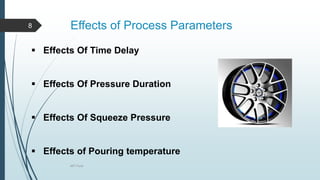
Effects of Process Parameters
 Effects Of Time Delay
 Effects Of Pressure Duration
 Effects Of Squeeze Pressure
 Effects of Pouring temperature
MIT Pune
8
MIT Pune
9
Advantages
 Little or no machining required post casting process
 Low levels of porosity
 Good surface texture
 Fine micro-structures with higher strength components
 No waste material, 100% utilization
MIT Pune
10
Disadvantages
 Costs are very high due to complex tooling
 No flexibility as tooling is dedicated to specific components
 Process needs to be accurately controlled which slows the cycle
time down and increases process costs.
 High costs mean high production volumes are necessary to
justify equipment investment
MIT Pune
11
Applications of Squeeze Casting
 The squeeze casting has been commercially succeeded in manufacturing parts
include an Aluminium dome , ductile Iron mortar shell, and a Steel bevel gear.
 Aluminium automotive wheels and pistons, and gear blanks made of brass and
bronze.
 Compared with the HPDC, the squeeze casting process with high applied pressure
is a promising solution for thick magnesium castings
 Other parts that have been Squeeze cast include stainless steel blades, super
alloy discs,
MIT Pune
12
Conclusion
 In conclusion, squeeze casting technology can greatly improve the
performance of aluminum alloys and other light alloys;
 promote the utilization of aluminum alloys instead of steel;
 reduce the weight of automobile, machinery equipment and military
equipment;
 promote energy conservation and environmental protection.
 Finally, squeeze casting technology can greatly lessen the impurity
restriction in raw material.MIT Pune
13
REFERENCES
 Najib Souissi ,Slim Souissi , Christophe Le Niniven , Mohamed Ben Amar , Chedly
Bradai and Foued Elhalouani “ Optimization of Squeeze Casting Parameters for
2017 A Wrought Al Alloy Using Taguchi Method “
 Maleki, A.; Shafyei, A.; Niroumand, B. Effects of squeeze casting parameters on the
microstructure of LM13 alloy. J. Mater. Process. Technol. 2009, 209, 3790–3797.
 Manjunath Patel G. C1, Robins Mathew, and Prasad Krishna, “Effects of Squeeze
Casting Process Parameters on Density” Department of Mechanical Engineering,
National Institute of Technology Karnataka , Elsevier, 2013
MIT Pune
14
THANK
YOU
MIT Pune
15

Squeeze casting process

  • 1.
    1 MAHARASHTRA INSTITUTEOF TECHNOLOGY , PUNE Seminar on SQUEEZE CASTING PROCESS Seminar by DIPANSHU KAWLE(308030) Guided by Prof. G.P.BORIKAR
  • 2.
    Contents 1. Introduction 2. Squeezecasting 3. Working 4. Process parameters 5. Case study 6. Advantages & Disadvantages 7. Applications 8. Conclusion 9. References MIT Pune 2
  • 3.
  • 4.
    Introduction  Also knownas liquid-metal forging.  Near net shape process - the initial production of the item is very close to the final (net) shape, reducing the need for surface finishing.  Combination of casting and forging.  Squeeze casting is simple and economical, efficient in its use of raw material.  The process generates the highest mechanical properties attainable in a cast product . MIT Pune 4
  • 5.
    Squeeze casting processworking Squeeze casting consists of entering liquid metal into a preheated, lubricated die and forging the metal while it solidifies The load is applied shortly after the metal begins to freeze and is maintained until the entire casting has solidified MIT Pune 5
  • 6.
    Casting parameters  Castingtemperatures depend on the alloy and the part geometry. The starting point is normally 6 to 55°C above the liquidus temperature.  Tooling temperatures ranging from 190 to 315°C are normally used  Pressure levels of 50 to 140 MPa are normally used  Lubrication For aluminum, magnesium, and copper alloys, a good grade of colloidal graphite spray lubricant has proved satisfactory when sprayed on the warm dies prior to casting MIT Pune 6
  • 7.
    Case Study  EffectsOf Squeeze Casting Process Parameters On Density Of Lm20 Alloy The experiment are carried out at different squeeze casting condition to know the effect of process parameters such as squeeze pressure,Pressure duration,,Time delay & Die temperature. Experiments were conducted by varying one parameter at a time and keeping the rest of other process parameters constant. MIT Pune 7
  • 8.
    Effects of ProcessParameters  Effects Of Time Delay  Effects Of Pressure Duration  Effects Of Squeeze Pressure  Effects of Pouring temperature MIT Pune 8
  • 9.
  • 10.
    Advantages  Little orno machining required post casting process  Low levels of porosity  Good surface texture  Fine micro-structures with higher strength components  No waste material, 100% utilization MIT Pune 10
  • 11.
    Disadvantages  Costs arevery high due to complex tooling  No flexibility as tooling is dedicated to specific components  Process needs to be accurately controlled which slows the cycle time down and increases process costs.  High costs mean high production volumes are necessary to justify equipment investment MIT Pune 11
  • 12.
    Applications of SqueezeCasting  The squeeze casting has been commercially succeeded in manufacturing parts include an Aluminium dome , ductile Iron mortar shell, and a Steel bevel gear.  Aluminium automotive wheels and pistons, and gear blanks made of brass and bronze.  Compared with the HPDC, the squeeze casting process with high applied pressure is a promising solution for thick magnesium castings  Other parts that have been Squeeze cast include stainless steel blades, super alloy discs, MIT Pune 12
  • 13.
    Conclusion  In conclusion,squeeze casting technology can greatly improve the performance of aluminum alloys and other light alloys;  promote the utilization of aluminum alloys instead of steel;  reduce the weight of automobile, machinery equipment and military equipment;  promote energy conservation and environmental protection.  Finally, squeeze casting technology can greatly lessen the impurity restriction in raw material.MIT Pune 13
  • 14.
    REFERENCES  Najib Souissi,Slim Souissi , Christophe Le Niniven , Mohamed Ben Amar , Chedly Bradai and Foued Elhalouani “ Optimization of Squeeze Casting Parameters for 2017 A Wrought Al Alloy Using Taguchi Method “  Maleki, A.; Shafyei, A.; Niroumand, B. Effects of squeeze casting parameters on the microstructure of LM13 alloy. J. Mater. Process. Technol. 2009, 209, 3790–3797.  Manjunath Patel G. C1, Robins Mathew, and Prasad Krishna, “Effects of Squeeze Casting Process Parameters on Density” Department of Mechanical Engineering, National Institute of Technology Karnataka , Elsevier, 2013 MIT Pune 14
  • 15.