Aromatic Amines
1
Mr. Mote G.D.
ADCBP, ASHTA
INTRODUCTION
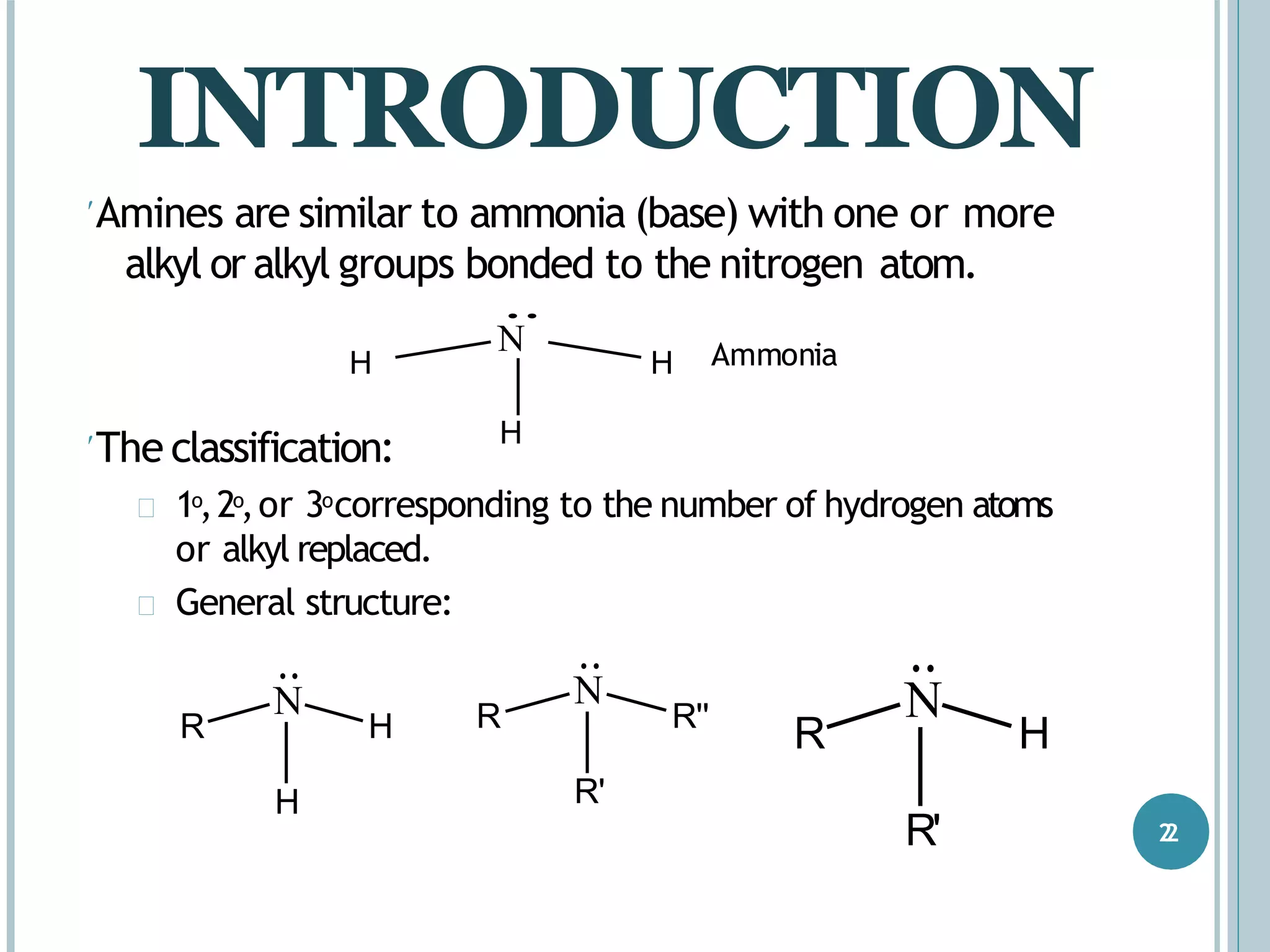
Amines are similar to ammonia (base) with one or more
alkyl or alkyl groups bonded to the nitrogen atom.
The classification:
 1o,2o,or 3ocorresponding to the number of hydrogen atoms
or alkyl replaced.
 General structure:
N
H
H H Ammonia
N
R
H
H
N
R
R'
H
N
R
R'
R''
22
Aromatic amines
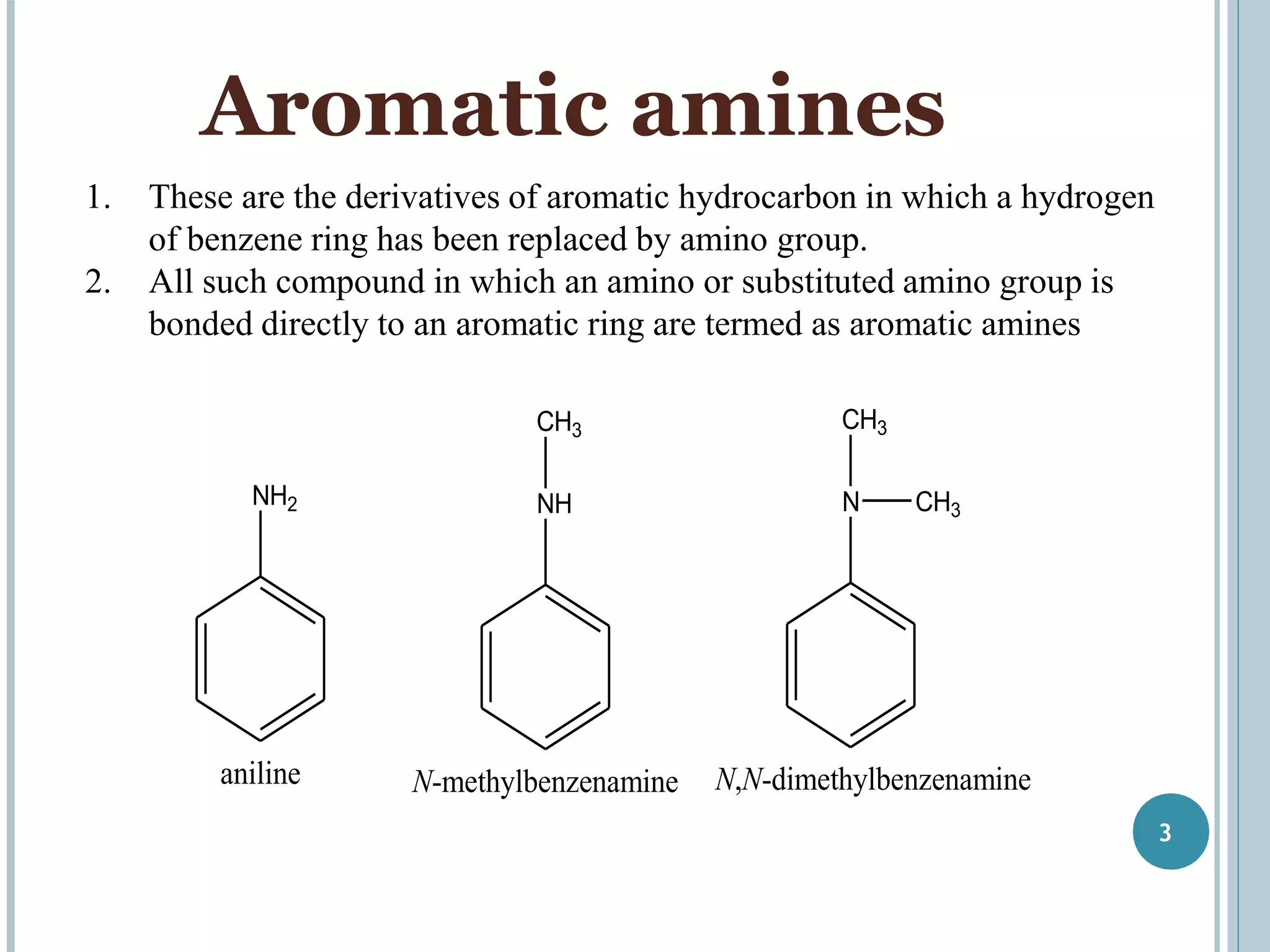
1. These are the derivatives of aromatic hydrocarbon in which a hydrogen
of benzene ring has been replaced by amino group.
2. All such compound in which an amino or substituted amino group is
bonded directly to an aromatic ring are termed as aromatic amines
NH2
aniline
NH N
CH3 CH3
CH3
N,N-dimethylbenzenamineN-methylbenzenamine
3
N
NH
CH3
N
OH
H3C
Cl
Hydroxychloroquine
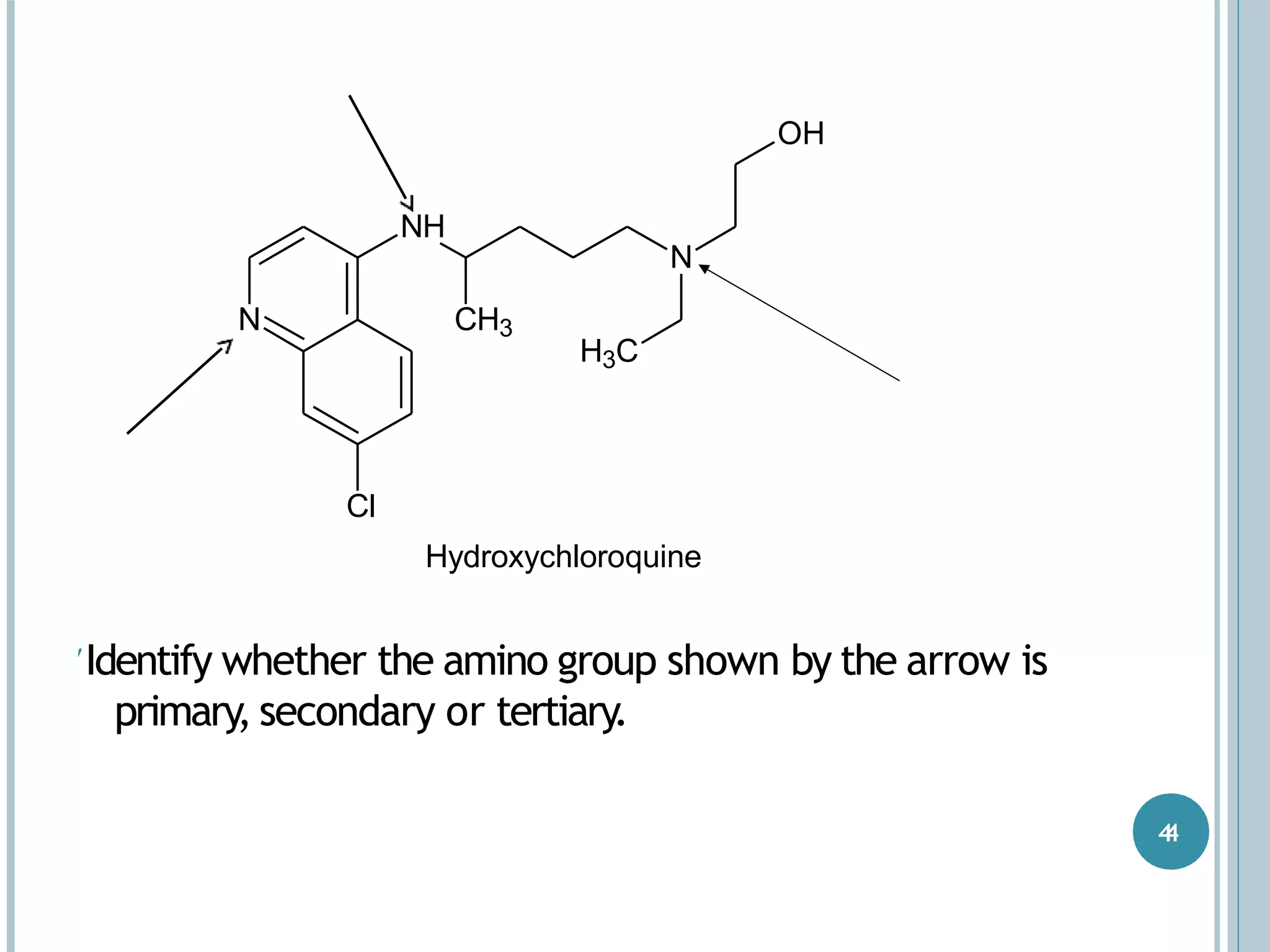
Identify whether the amino group shown by the arrow is
primary, secondary or tertiary.
44
55
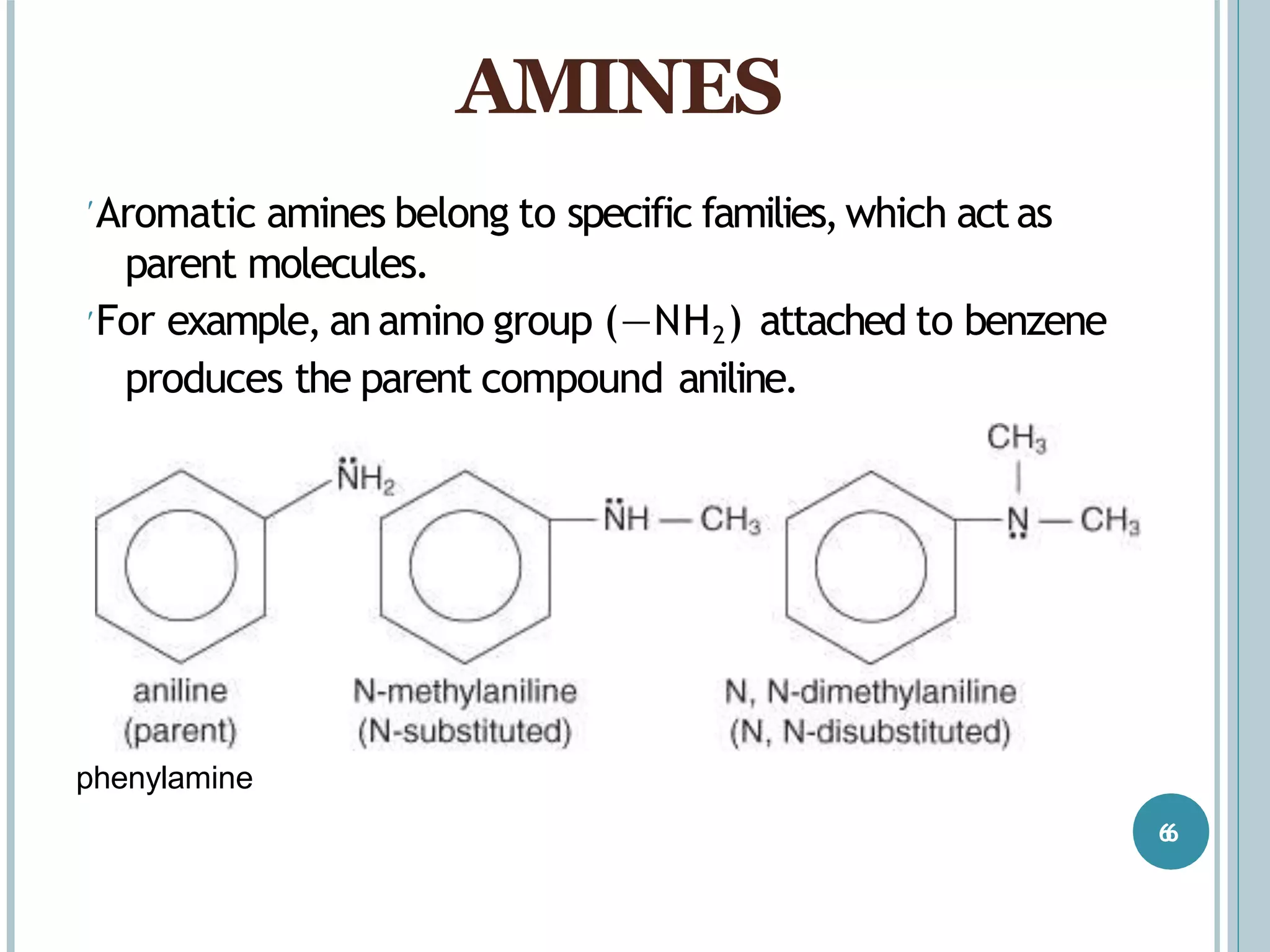
Aromatic amines belong to specific families,which actas
parent molecules.
For example, an amino group (—NH2) attached to benzene
produces the parent compound aniline.
AMINES
6
phenylamine
6
H2N (CH2)6 NH2
hexane-1,6-diamine
(1,6-hexanediamine)
7
H2N NH2
benzene-1,4-diamine
(1,4-benzenediamine)
NOMENCLATURE OF
AMINES
Compounds with two –NH2 groups are named by adding the
suffix ‘diamine’to the name of the corresponding alkane or
aromatic compounds.
7
PREPARATION OF
8
AMINES
1. Reduction of nitro compounds
2. Reduction of halides with ammonia
3. Reduction of amides
4. Reduction of nitriles
5. Hoffmann degradation of amides
8


Aromatic amines are normally prepared by reduction of the
corresponding aromatic nitro compound.
Aniline is prepared from nitrobenzene.
 Reducing agents: Fe/H+,Sn/H+or catalytic hydrogenation (example,
H2/Pdor Pt or Ni). 10
PREPARATION OF
AMINES
1. Reduction of nitro compounds – gives 1oamines
9
Another example:
PREPARATION OF
AMINES
10
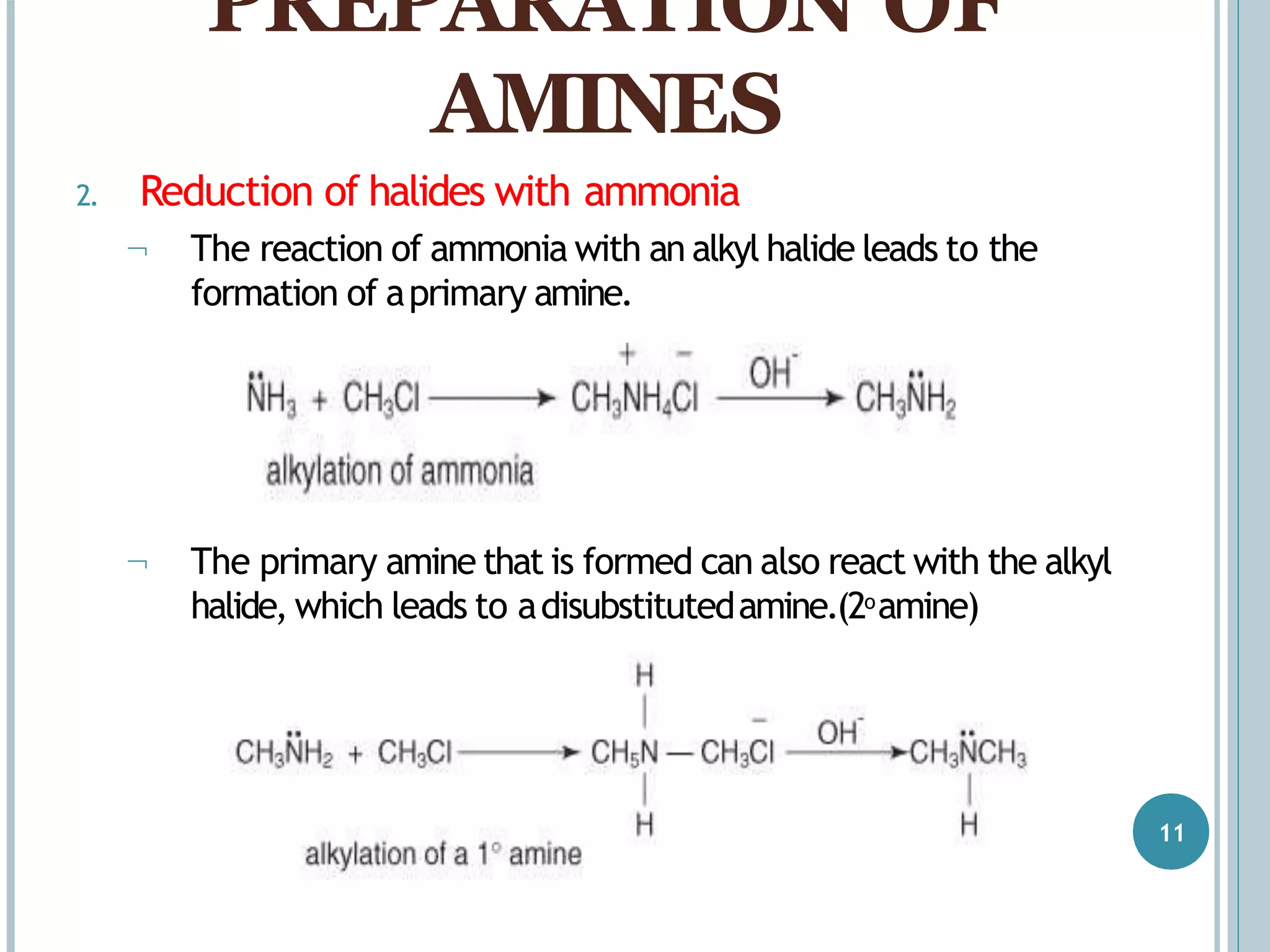
 The reaction of ammonia with an alkyl halide leads to the
formation of aprimary amine.
 The primary amine that is formed can also react with the alkyl
halide, which leads to adisubstitutedamine.(2oamine)
PREPARATION OF
AMINES
2. Reduction of halides with ammonia
11
In general:
PREPARATION OF
AMINES
Further reaction can form atrisubstituted amine.(3oamine).
12



3. Reduction of amides
 Amides yield primary amines on reduction by lithium aluminum hydride,
LiAlH4.
The oxygen atom is replacedby two hydrogen atoms.
2oand 3oamides produce 2oand 3oamines, respectively.
Reaction occurs via nucleophilic acylsubstitution then nucleophilic addition.
AMINES
13
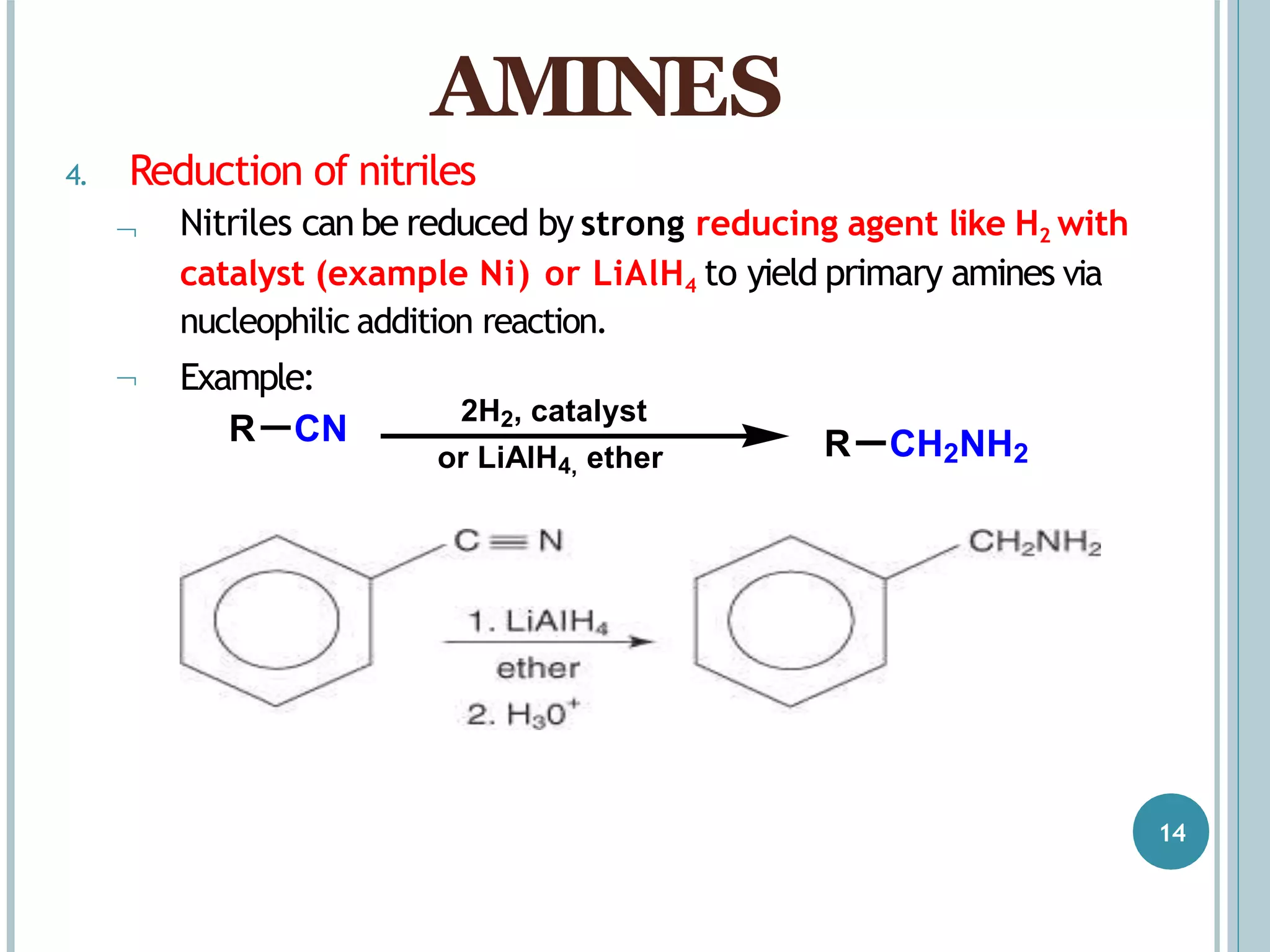
4. Reduction of nitriles


Nitriles can be reduced by strong reducing agent like H2 with
catalyst (example Ni) or LiAlH4 to yield primary amines via
nucleophilic addition reaction.
Example:
AMINES
R CN
2H2, catalyst
or LiAlH4, ether R CH2NH2
14
5. Hoffmann degradation of amides



Heating the amides with a mixture of bromine and KO H
or NaOH.
amides will change to amines.
is used to shorten the chain by onecarbon.
AMINES
∆
C
O
NH2
NH2
anilinebenzamide
NaOH/Br2
15
Basicity of aromatic amines
1. Aryl amines are basic compounds due to pressence of
lone of electron present on nitrogen.
2. Incase of ethyl amine, the lone pair of electron
localized on the nitrogen atom.
3. Incase of aromatic amines, lone pair of electron
deloacalized on the benzene ring.
4. As the electron density decreases and basicity also
decreases. Hence ethyl amine is more basic than
aromatic amines.
5. Aromatic amines react with HCl or acid to form salt.
6. Aromatic amines are levis base because they give
electron to form pair.
7. Aromatic amines are lowry bronsted base because
they accept hydrogen to form salt.
16
Factor affecting on basicity of aromatic amines
1. Electron donating groups adds electron density to the benzene ring
making aryl amines more basic than aniline
2. Electron withdrawing groups removes electron density from benzene ring .
Hence 4-nitro aniline is less basic than aniline.
NH2
NH2
NH2
NH2
NO2
4-nitrobenzenaminebenzene-1,4-diamine
aniline
17
R
REACTIONSAMINES
18
1. Formation of amides
2. Amine alkylation: formation of quarternary salts
3. With nitrous acid
4. Isocyanides (nitrile compound)
5. Benzenediazonium salts
1. Preparation of Benzenediazonium chloride
2. Reaction of Benzenediazonium chloride
6. Oxidation
7. Hofmann-Martius reaction
8. Electrophilic substitution
9. Salt formation
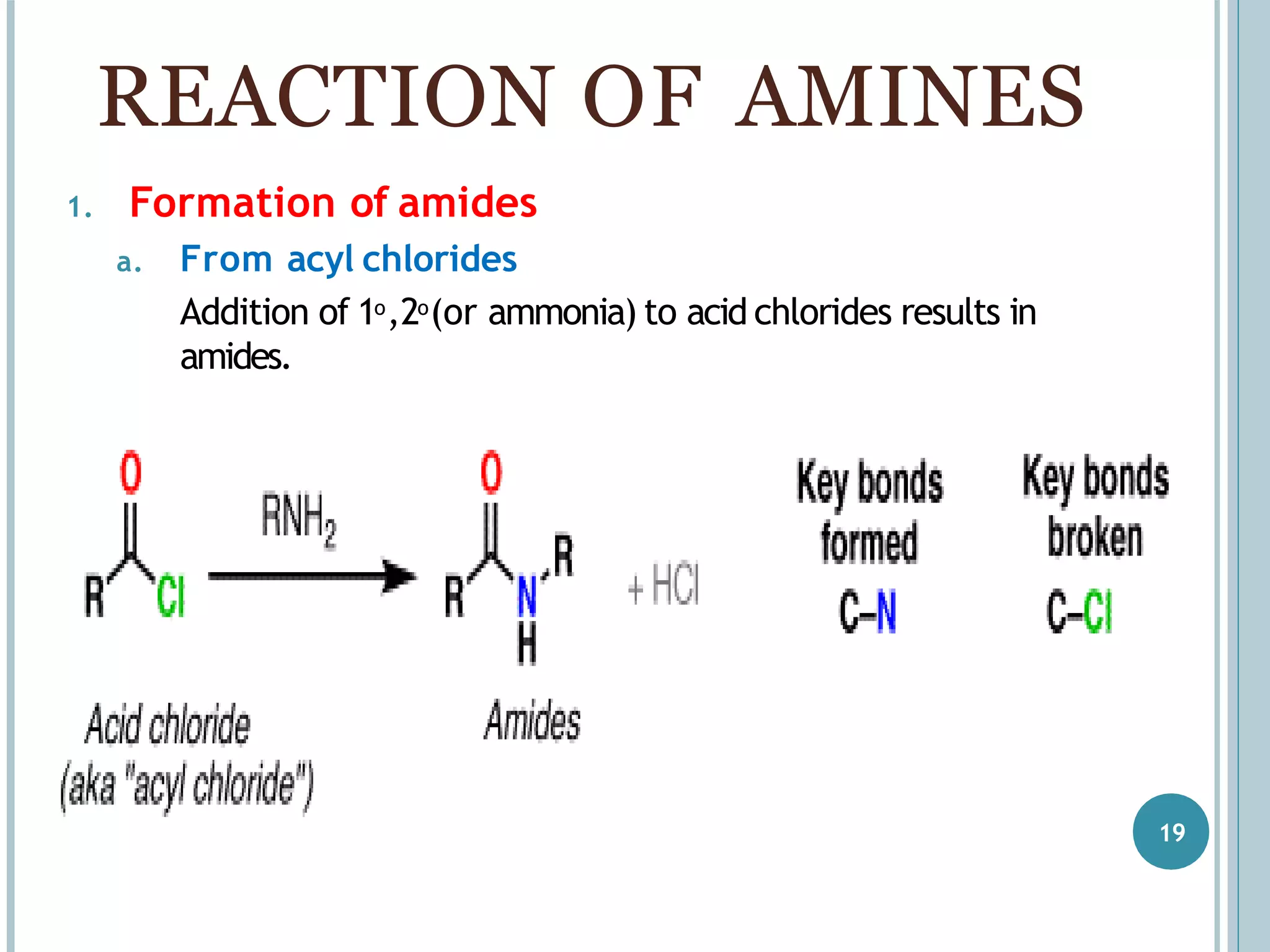
1. Formation of amides
a. From acyl chlorides
Addition of 1o,2o(or ammonia) to acid chlorides results in
amides.
REACTION OF AMINES
19
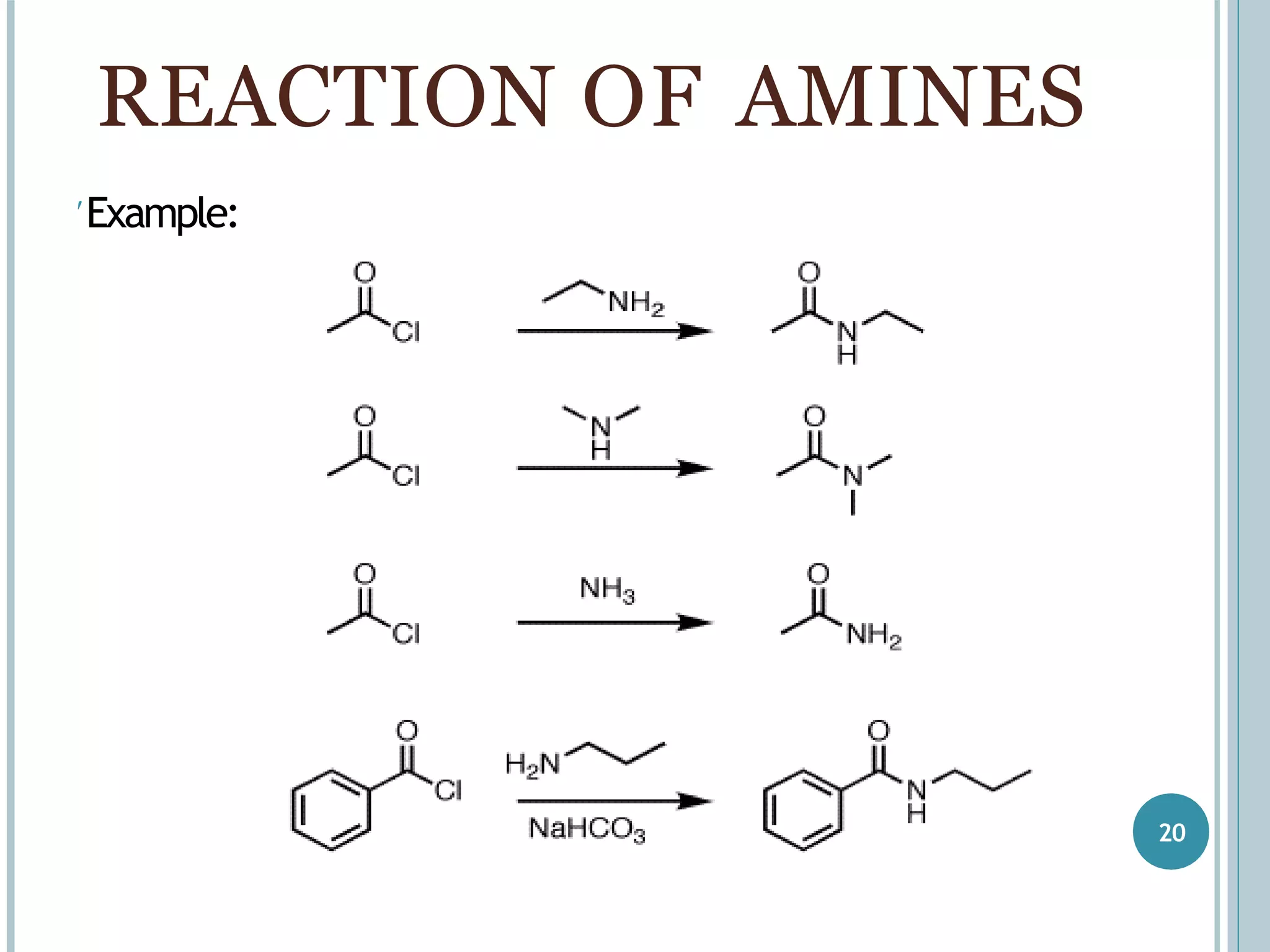
Example:
REACTION OF AMINES
20
1. Formation of amides
a. From acid anhydride
REACTION OF AMINES
O
2R2NH
O
R C NR2
O O
R C O C R
O O
R C O C R
R C
O
O RNH3
+
O
R C
+
O R2NH2
acid anhydride
2RNH2
amine
R C NHR
amide
21
1. Formation of amides
a. From ester
Esters reacts with ammonia, primary and secondary
amines to produce amides andalcohols.
REACTION OF AMINES
R OH
H
H N R
O RO
R C O R
ester
O
R C O R
ester
R OH
O R
R C N R
R C NH
secondary amide
tertiary amide
EXAMPLE
O
H3C C O CH2CH3
O
H3C C NH2 CH3CH2 OH21
H
H N H
0-5OC
primary amine
R
H N R
secondary amine
22
REACTION OF AMINES
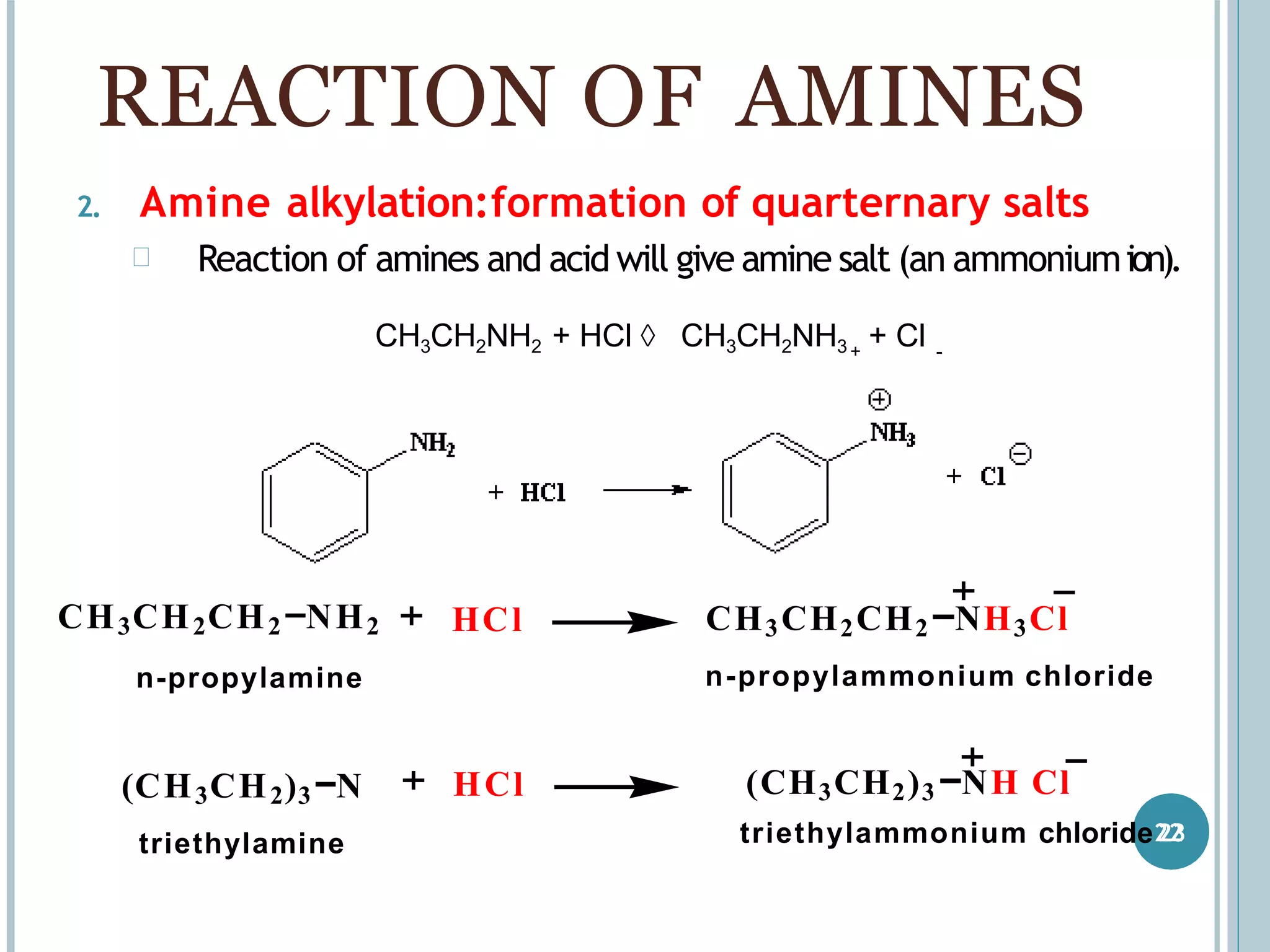
2. Amine alkylation:formation of quarternary salts
 Reaction of amines and acid will give amine salt (an ammoniumion).
CH3CH2NH2 + HCl  CH3CH2NH3 + Cl+ -
CH3CH2CH2 NH2
n-propylamine
HCl CH3CH2CH2 NH3Cl
n-propylammonium chloride
HCl(CH3CH2)3 N
triethylamine
(CH3CH2)3 NH Cl
triethylammonium chloride2223
Amine alkylation: formation of quarternarysalts
 Examples:
REACTION OF AMINES
CH3CH2CH2 NH2
n-propylamine
HCl CH3CH2CH2 NH3Cl
n-propylammonium chloride
HCl(CH3CH2)3 N
triethylamine
(CH3CH2)3 NH Cl
triethylammonium chloride
24
3. With nitrous acid
 Nitrous acid is unstable and must be prepared in the reaction solutionby
mixing sodium nitrite with acid.
 Primary amines react with nitrous acid to yield adiazonium salt,which
ishighly unstable and degradates into acarbocation that is capableof
reaction with any nucleophile in solution.Therefore, reacting primary
amines with nitrous acid leads to amixture of alcohol, alkenes, and alkyl
halides.
REACTION OF AMINES
25
With nitrousacid
 Primary aromatic amines form stable diazonium salts atzero
degrees.
REACTION OF AMINES
26
With nitrousacid
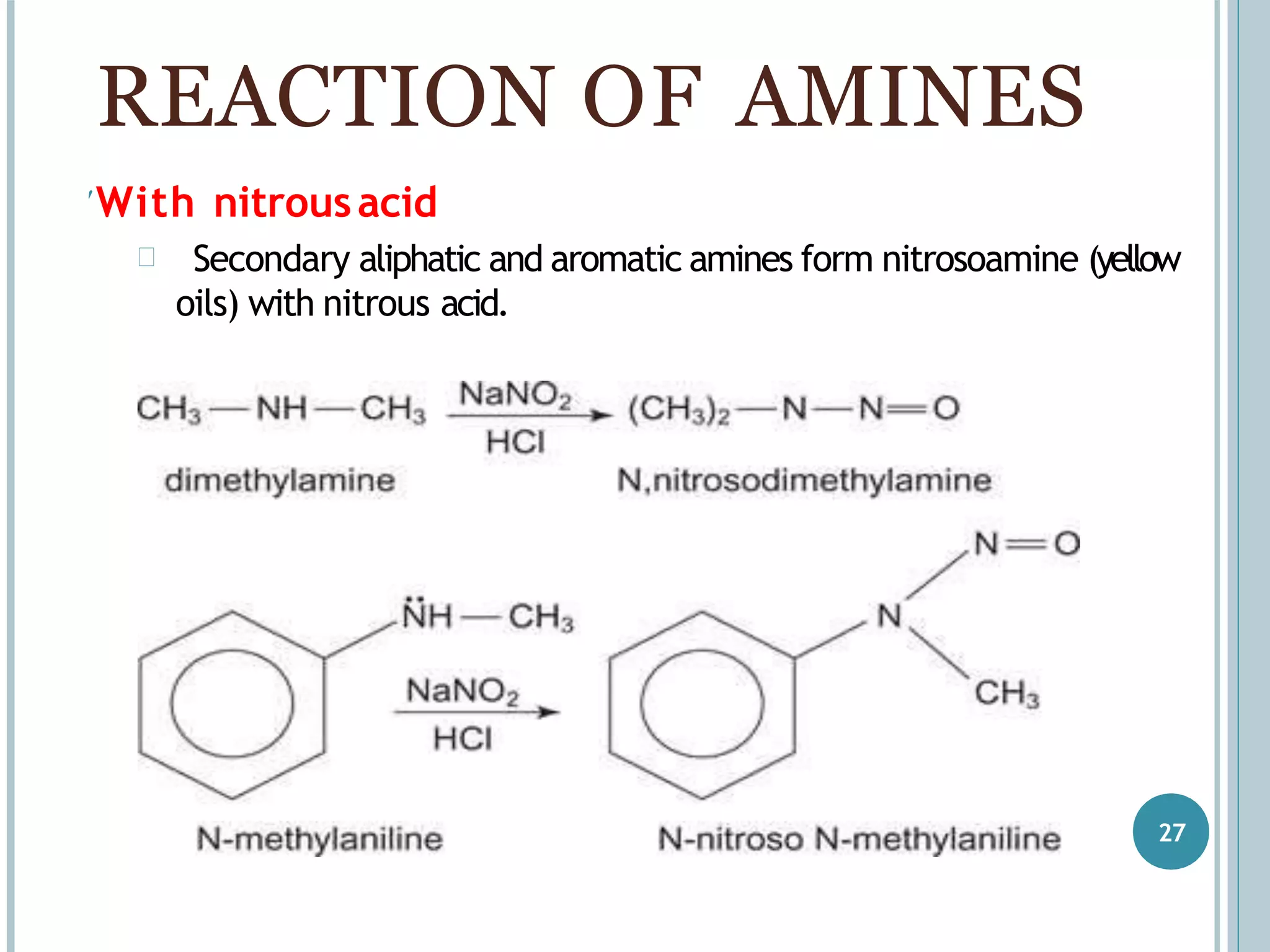
 Secondary aliphatic and aromatic amines form nitrosoamine (yellow
oils) with nitrous acid.
REACTION OF AMINES
27
With nitrousacid
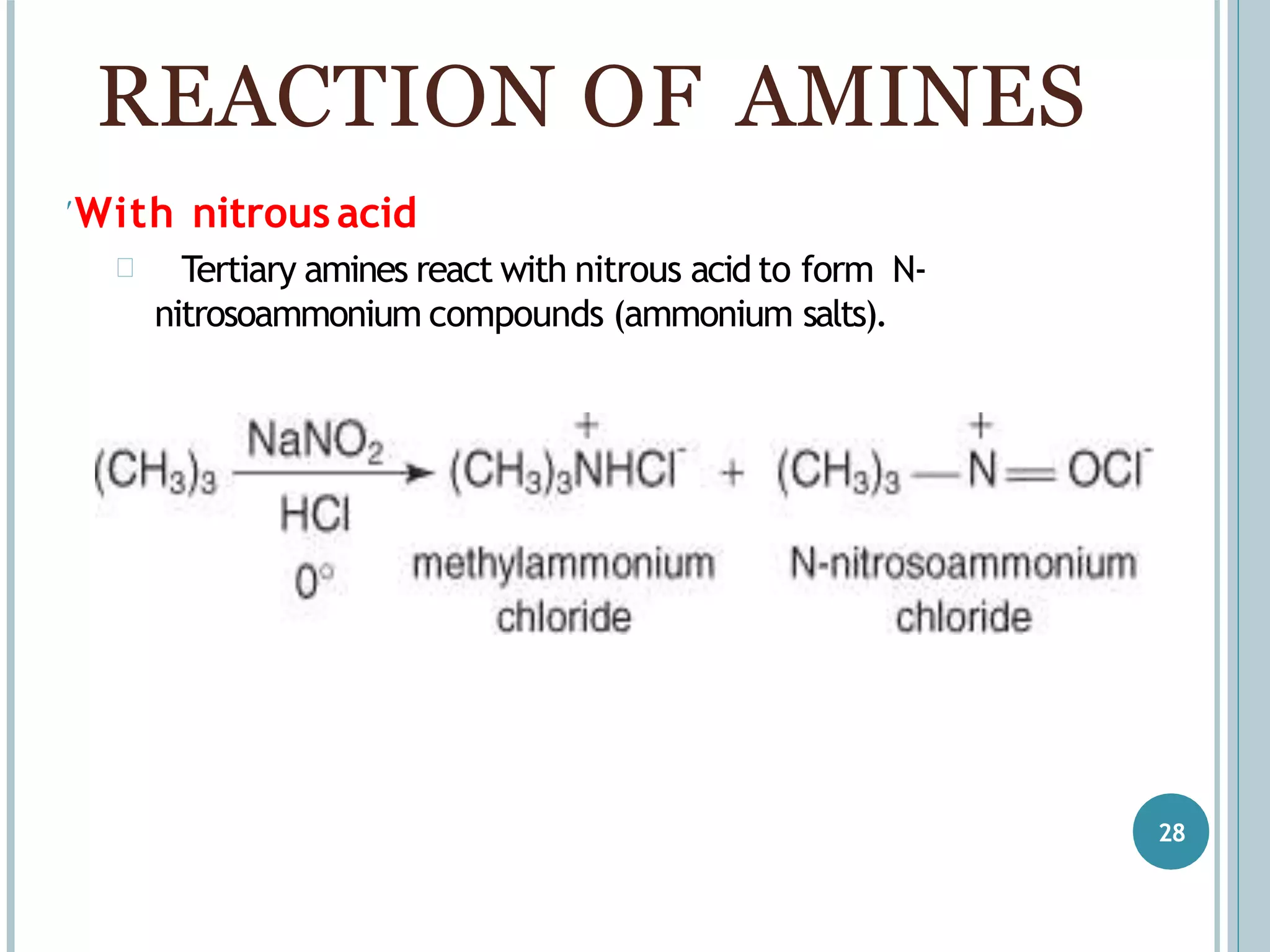
 Tertiary amines react with nitrous acid to form N-
nitrosoammonium compounds (ammonium salts).
REACTION OF AMINES
28
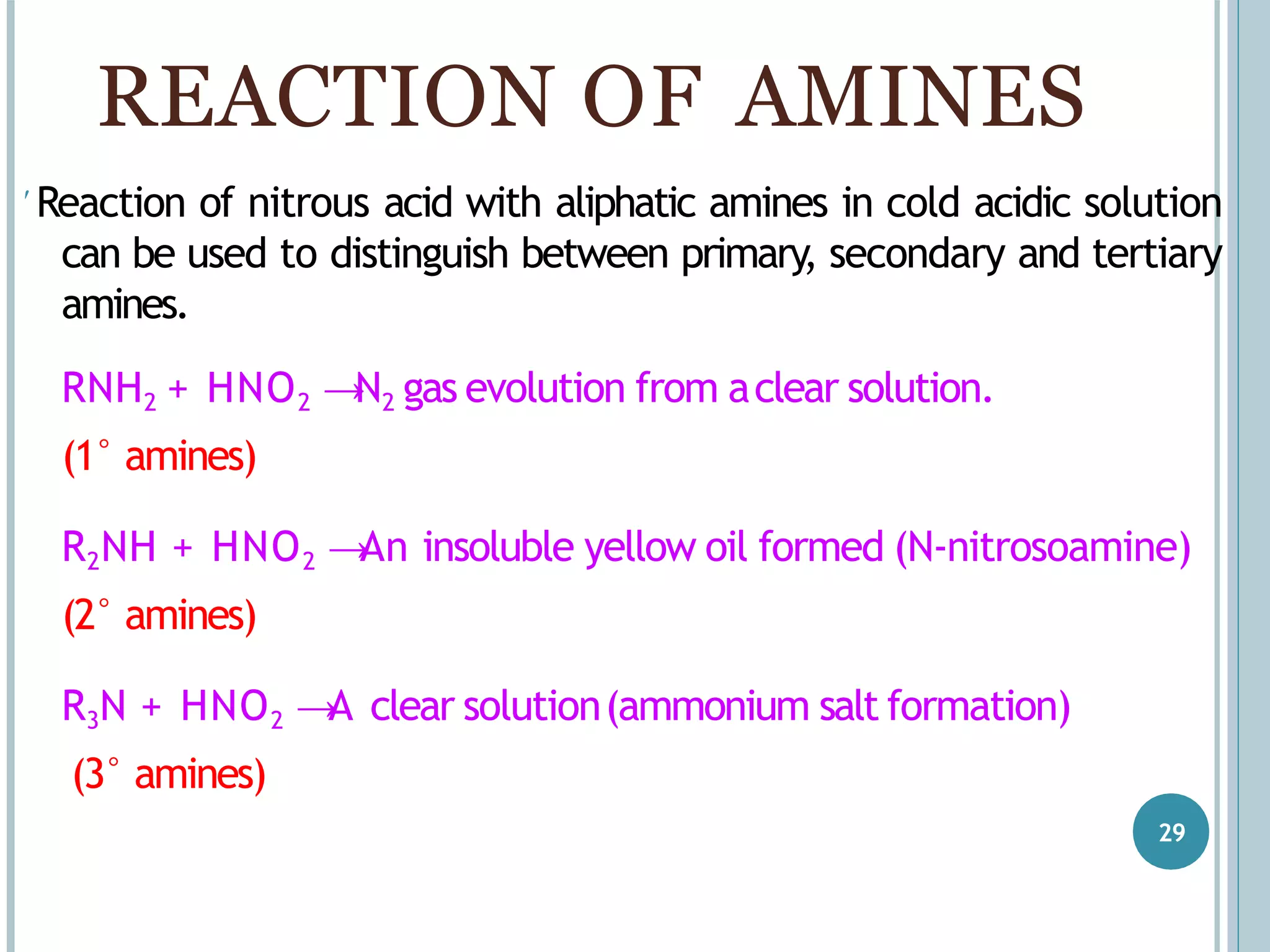
 Reaction of nitrous acid with aliphatic amines in cold acidic solution
can be used to distinguish between primary, secondary and tertiary
amines.
RNH2 + HNO2 →N2 gas evolution from aclear solution.
(1° amines)
R2NH + HNO2 →An insoluble yellow oil formed (N-nitrosoamine)
(2° amines)
R3N + HNO2 →A clear solution(ammonium salt formation)
(3° amines)
REACTION OF AMINES
29
4. Isocyanides (nitrile compound)
• Primary amines heated with trichloromethane (CHCl3) and
alcoholic KOH solution will produce a foul odor of isocyanide,
RNC.
•
- The C N functionality is connected to the organic
fragment via the nitrogen atom, not via carbon atom.
- a zwitterion (nitrogen atom carries positivecharge,
carbon atom carries negativecharge).
REACTION OF AMINES
Isocyanide:
- an organic compound with functional group R N C
30
REACTION OF AMINES
4. Isocyanides (nitrile compound)
examples:
31
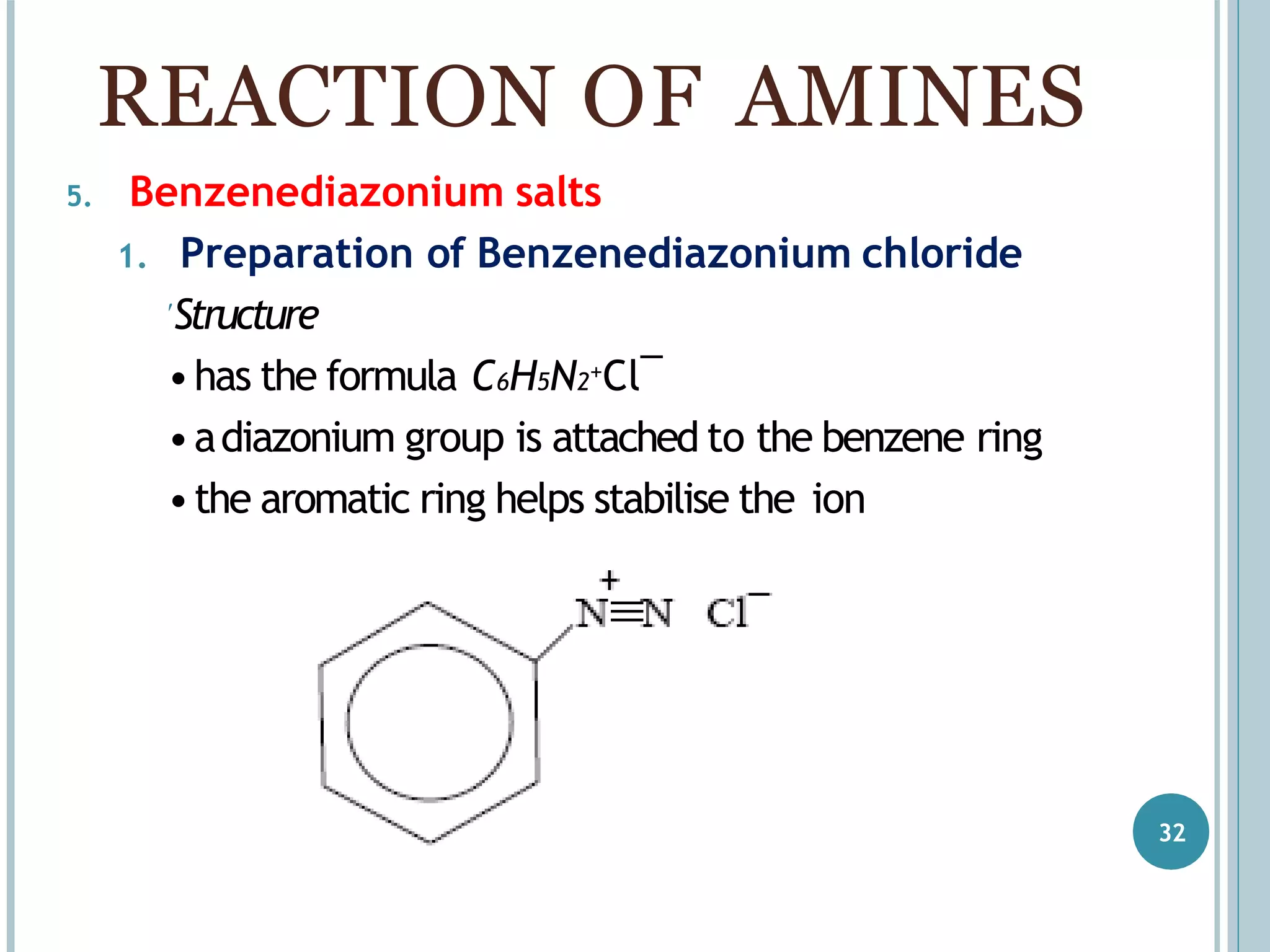
5. Benzenediazonium salts
1. Preparation of Benzenediazonium chloride
Structure
•has the formula C6H5N2+Cl¯
•adiazonium group is attached to the benzene ring
•the aromatic ring helps stabilise the ion
REACTION OF AMINES
32
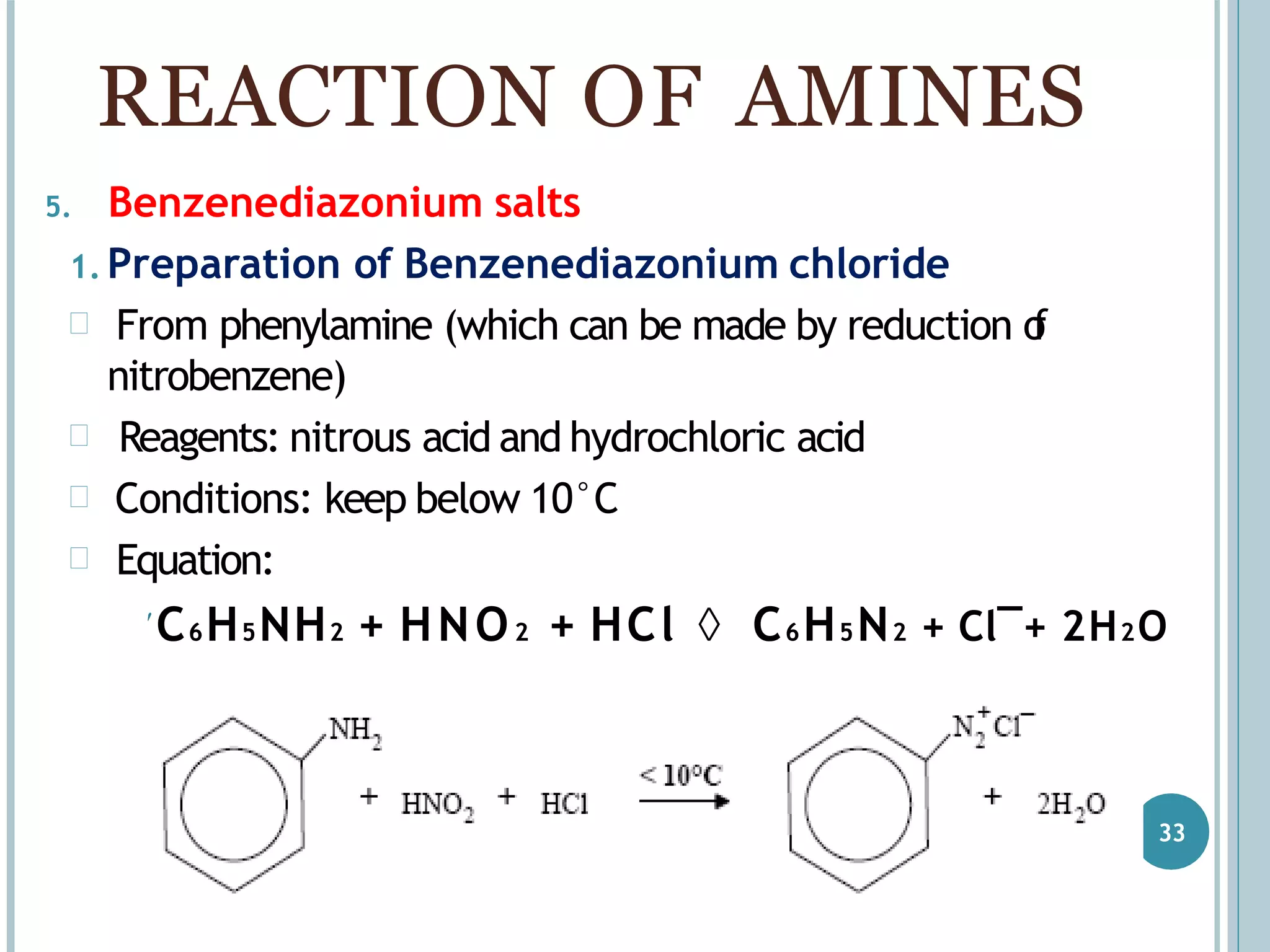
5. Benzenediazonium salts
1. Preparation of Benzenediazonium chloride
 From phenylamine (which can be made by reduction of
nitrobenzene)
 Reagents: nitrous acid and hydrochloric acid
 Conditions: keep below 10°C
 Equation:
C6H5NH2 + HNO2 + HCl  C6H5N2 + Cl¯+ 2H2O
REACTION OF AMINES
33
REACTION OF AMINES
5. Benzenediazonium salts
2. Reaction of Benzenediazonium chloride



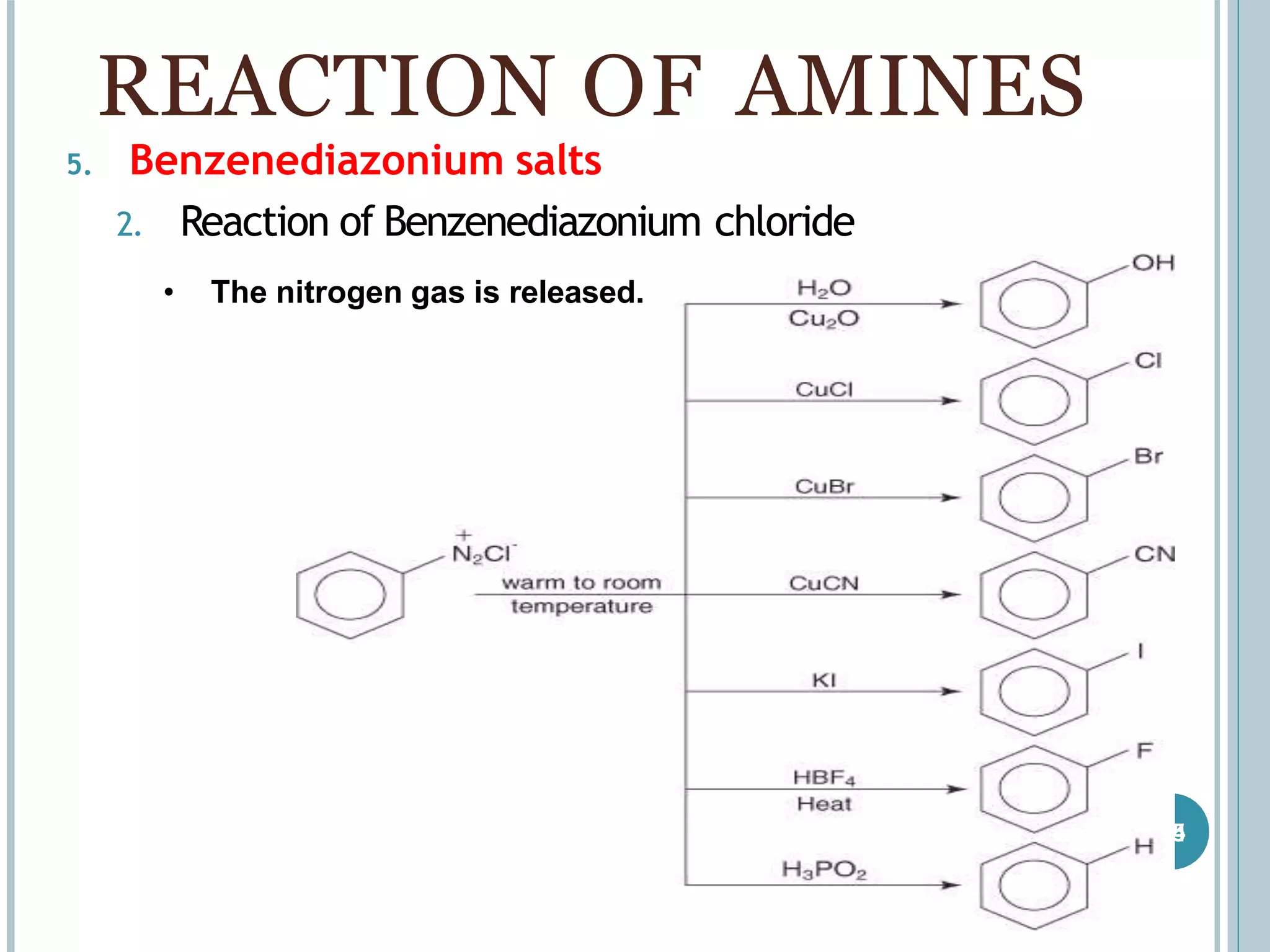
Diazonium salts of aromatic amines are very useful as
intermediates to other compounds.
Aromatic diazonium salts are only stable atvery low
temperatures (zero degrees and below), warming these
salts initiates decomposition into highly reactive cations.
These cations can react with any anion present in
solution to form avariety of compounds. Figure
illustrates the diversity of the reactions.
34
3
REACTION OF AMINES
5. Benzenediazonium salts
2. Reaction of Benzenediazonium chloride
• The nitrogen gas is released.
435
N2Cl
H2O
OH
H3PO2
Cl
Br
CN
I
FNO2
NHNH2
N=N
OH
N=N
NH2
N=N
N(CH3)2
CuCl
CuBr
CuCN
KI
HBF4
NaNO2
NaoH
4(H)
OH
NH2
N(CH3)2
Synthetic uses of Aryl diazonium salt
36
REACTION OF AMINES
6.Oxidation: Aromatic amines are readily oxidezed to
give p-benzoquinone
NH2
aniline
K2Cr2O7
O
O
cyclohexa-2,5-diene-1,4-dione
37
REACTION OF AMINES
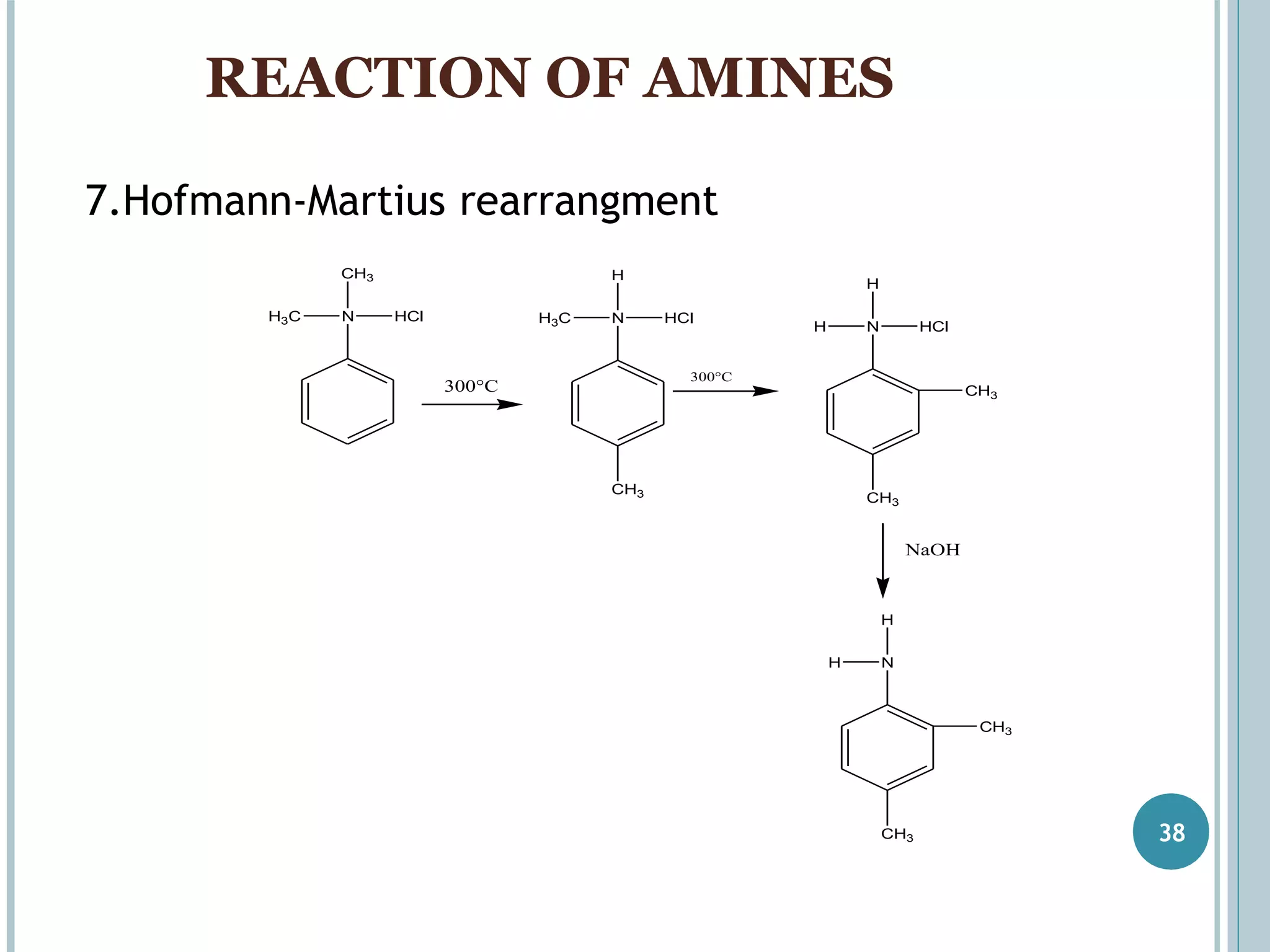
7.Hofmann-Martius rearrangment
N
CH3
HClH3C
300°C
N
H
HClH3C
CH3
300°C
N
H
HCl
CH3
H
CH3
N
H
CH3
H
CH3
NaOH
38
REACTION OF AMINES
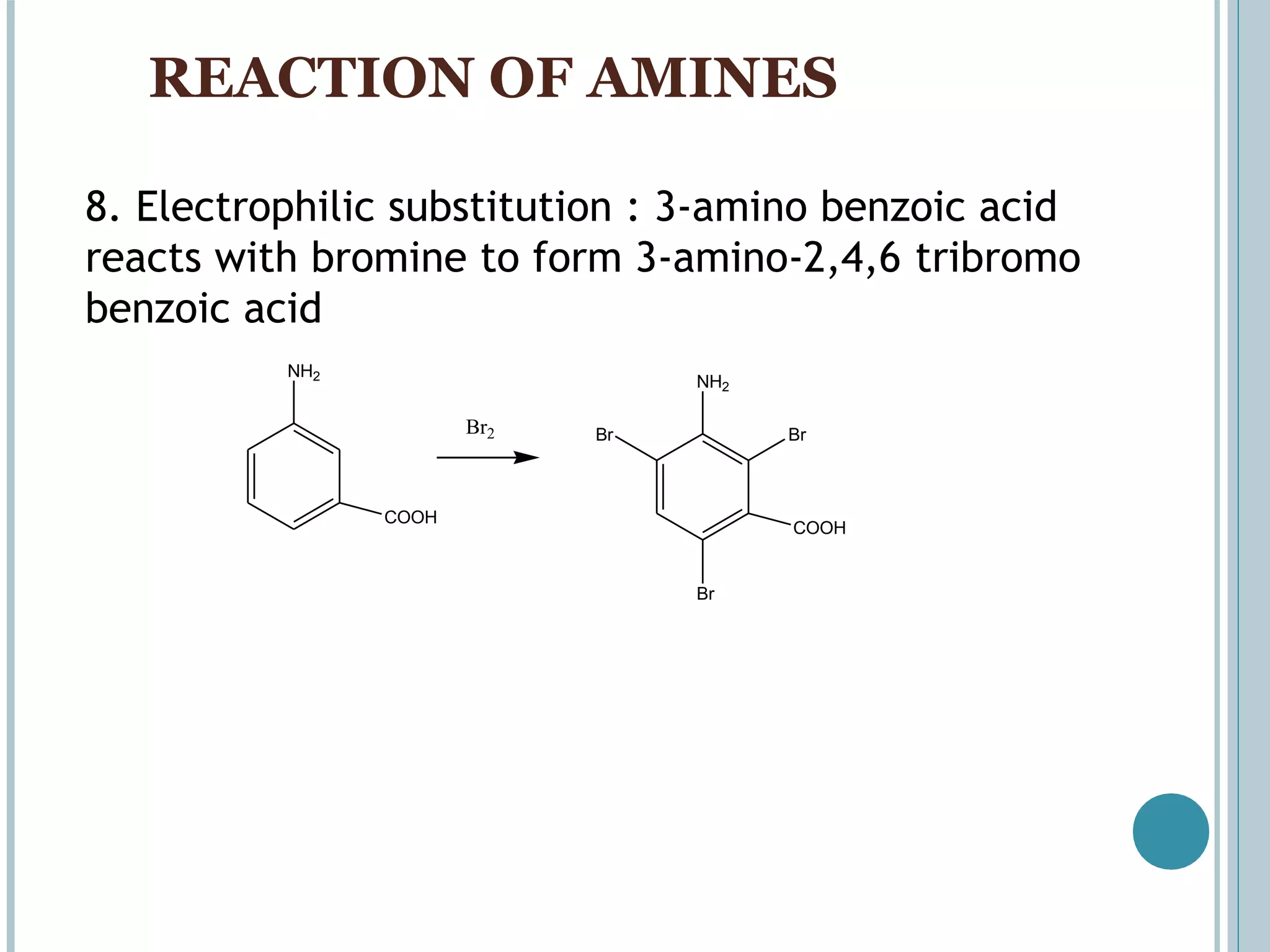
8. Electrophilic substitution : 3-amino benzoic acid
reacts with bromine to form 3-amino-2,4,6 tribromo
benzoic acid
NH2
COOH
NH2
BrBr
Br
COOH
Br2
Formation of salt
Aromatic amine react with hydrochloric acid to form salt
of aromatic amine.
Ar-NH2 HCl ArNH3Cl
NH2
HCl
NH3Cl
benzenaminium chloride

Aromatic amines

  • 1.
    Aromatic Amines 1 Mr. MoteG.D. ADCBP, ASHTA
  • 2.
    INTRODUCTION Amines are similarto ammonia (base) with one or more alkyl or alkyl groups bonded to the nitrogen atom. The classification:  1o,2o,or 3ocorresponding to the number of hydrogen atoms or alkyl replaced.  General structure: N H H H Ammonia N R H H N R R' H N R R' R'' 22
  • 3.
    Aromatic amines 1. Theseare the derivatives of aromatic hydrocarbon in which a hydrogen of benzene ring has been replaced by amino group. 2. All such compound in which an amino or substituted amino group is bonded directly to an aromatic ring are termed as aromatic amines NH2 aniline NH N CH3 CH3 CH3 N,N-dimethylbenzenamineN-methylbenzenamine 3
  • 4.
    N NH CH3 N OH H3C Cl Hydroxychloroquine Identify whether theamino group shown by the arrow is primary, secondary or tertiary. 44
  • 5.
  • 6.
    Aromatic amines belongto specific families,which actas parent molecules. For example, an amino group (—NH2) attached to benzene produces the parent compound aniline. AMINES 6 phenylamine 6
  • 7.
    H2N (CH2)6 NH2 hexane-1,6-diamine (1,6-hexanediamine) 7 H2NNH2 benzene-1,4-diamine (1,4-benzenediamine) NOMENCLATURE OF AMINES Compounds with two –NH2 groups are named by adding the suffix ‘diamine’to the name of the corresponding alkane or aromatic compounds. 7
  • 8.
    PREPARATION OF 8 AMINES 1. Reductionof nitro compounds 2. Reduction of halides with ammonia 3. Reduction of amides 4. Reduction of nitriles 5. Hoffmann degradation of amides 8
  • 9.
      Aromatic amines arenormally prepared by reduction of the corresponding aromatic nitro compound. Aniline is prepared from nitrobenzene.  Reducing agents: Fe/H+,Sn/H+or catalytic hydrogenation (example, H2/Pdor Pt or Ni). 10 PREPARATION OF AMINES 1. Reduction of nitro compounds – gives 1oamines 9
  • 10.
  • 11.
     The reactionof ammonia with an alkyl halide leads to the formation of aprimary amine.  The primary amine that is formed can also react with the alkyl halide, which leads to adisubstitutedamine.(2oamine) PREPARATION OF AMINES 2. Reduction of halides with ammonia 11
  • 12.
    In general: PREPARATION OF AMINES Furtherreaction can form atrisubstituted amine.(3oamine). 12
  • 13.
       3. Reduction ofamides  Amides yield primary amines on reduction by lithium aluminum hydride, LiAlH4. The oxygen atom is replacedby two hydrogen atoms. 2oand 3oamides produce 2oand 3oamines, respectively. Reaction occurs via nucleophilic acylsubstitution then nucleophilic addition. AMINES 13
  • 14.
    4. Reduction ofnitriles   Nitriles can be reduced by strong reducing agent like H2 with catalyst (example Ni) or LiAlH4 to yield primary amines via nucleophilic addition reaction. Example: AMINES R CN 2H2, catalyst or LiAlH4, ether R CH2NH2 14
  • 15.
    5. Hoffmann degradationof amides    Heating the amides with a mixture of bromine and KO H or NaOH. amides will change to amines. is used to shorten the chain by onecarbon. AMINES ∆ C O NH2 NH2 anilinebenzamide NaOH/Br2 15
  • 16.
    Basicity of aromaticamines 1. Aryl amines are basic compounds due to pressence of lone of electron present on nitrogen. 2. Incase of ethyl amine, the lone pair of electron localized on the nitrogen atom. 3. Incase of aromatic amines, lone pair of electron deloacalized on the benzene ring. 4. As the electron density decreases and basicity also decreases. Hence ethyl amine is more basic than aromatic amines. 5. Aromatic amines react with HCl or acid to form salt. 6. Aromatic amines are levis base because they give electron to form pair. 7. Aromatic amines are lowry bronsted base because they accept hydrogen to form salt. 16
  • 17.
    Factor affecting onbasicity of aromatic amines 1. Electron donating groups adds electron density to the benzene ring making aryl amines more basic than aniline 2. Electron withdrawing groups removes electron density from benzene ring . Hence 4-nitro aniline is less basic than aniline. NH2 NH2 NH2 NH2 NO2 4-nitrobenzenaminebenzene-1,4-diamine aniline 17 R
  • 18.
    REACTIONSAMINES 18 1. Formation ofamides 2. Amine alkylation: formation of quarternary salts 3. With nitrous acid 4. Isocyanides (nitrile compound) 5. Benzenediazonium salts 1. Preparation of Benzenediazonium chloride 2. Reaction of Benzenediazonium chloride 6. Oxidation 7. Hofmann-Martius reaction 8. Electrophilic substitution 9. Salt formation
  • 19.
    1. Formation ofamides a. From acyl chlorides Addition of 1o,2o(or ammonia) to acid chlorides results in amides. REACTION OF AMINES 19
  • 20.
  • 21.
    1. Formation ofamides a. From acid anhydride REACTION OF AMINES O 2R2NH O R C NR2 O O R C O C R O O R C O C R R C O O RNH3 + O R C + O R2NH2 acid anhydride 2RNH2 amine R C NHR amide 21
  • 22.
    1. Formation ofamides a. From ester Esters reacts with ammonia, primary and secondary amines to produce amides andalcohols. REACTION OF AMINES R OH H H N R O RO R C O R ester O R C O R ester R OH O R R C N R R C NH secondary amide tertiary amide EXAMPLE O H3C C O CH2CH3 O H3C C NH2 CH3CH2 OH21 H H N H 0-5OC primary amine R H N R secondary amine 22
  • 23.
    REACTION OF AMINES 2.Amine alkylation:formation of quarternary salts  Reaction of amines and acid will give amine salt (an ammoniumion). CH3CH2NH2 + HCl  CH3CH2NH3 + Cl+ - CH3CH2CH2 NH2 n-propylamine HCl CH3CH2CH2 NH3Cl n-propylammonium chloride HCl(CH3CH2)3 N triethylamine (CH3CH2)3 NH Cl triethylammonium chloride2223
  • 24.
    Amine alkylation: formationof quarternarysalts  Examples: REACTION OF AMINES CH3CH2CH2 NH2 n-propylamine HCl CH3CH2CH2 NH3Cl n-propylammonium chloride HCl(CH3CH2)3 N triethylamine (CH3CH2)3 NH Cl triethylammonium chloride 24
  • 25.
    3. With nitrousacid  Nitrous acid is unstable and must be prepared in the reaction solutionby mixing sodium nitrite with acid.  Primary amines react with nitrous acid to yield adiazonium salt,which ishighly unstable and degradates into acarbocation that is capableof reaction with any nucleophile in solution.Therefore, reacting primary amines with nitrous acid leads to amixture of alcohol, alkenes, and alkyl halides. REACTION OF AMINES 25
  • 26.
    With nitrousacid  Primaryaromatic amines form stable diazonium salts atzero degrees. REACTION OF AMINES 26
  • 27.
    With nitrousacid  Secondaryaliphatic and aromatic amines form nitrosoamine (yellow oils) with nitrous acid. REACTION OF AMINES 27
  • 28.
    With nitrousacid  Tertiaryamines react with nitrous acid to form N- nitrosoammonium compounds (ammonium salts). REACTION OF AMINES 28
  • 29.
     Reaction ofnitrous acid with aliphatic amines in cold acidic solution can be used to distinguish between primary, secondary and tertiary amines. RNH2 + HNO2 →N2 gas evolution from aclear solution. (1° amines) R2NH + HNO2 →An insoluble yellow oil formed (N-nitrosoamine) (2° amines) R3N + HNO2 →A clear solution(ammonium salt formation) (3° amines) REACTION OF AMINES 29
  • 30.
    4. Isocyanides (nitrilecompound) • Primary amines heated with trichloromethane (CHCl3) and alcoholic KOH solution will produce a foul odor of isocyanide, RNC. • - The C N functionality is connected to the organic fragment via the nitrogen atom, not via carbon atom. - a zwitterion (nitrogen atom carries positivecharge, carbon atom carries negativecharge). REACTION OF AMINES Isocyanide: - an organic compound with functional group R N C 30
  • 31.
    REACTION OF AMINES 4.Isocyanides (nitrile compound) examples: 31
  • 32.
    5. Benzenediazonium salts 1.Preparation of Benzenediazonium chloride Structure •has the formula C6H5N2+Cl¯ •adiazonium group is attached to the benzene ring •the aromatic ring helps stabilise the ion REACTION OF AMINES 32
  • 33.
    5. Benzenediazonium salts 1.Preparation of Benzenediazonium chloride  From phenylamine (which can be made by reduction of nitrobenzene)  Reagents: nitrous acid and hydrochloric acid  Conditions: keep below 10°C  Equation: C6H5NH2 + HNO2 + HCl  C6H5N2 + Cl¯+ 2H2O REACTION OF AMINES 33
  • 34.
    REACTION OF AMINES 5.Benzenediazonium salts 2. Reaction of Benzenediazonium chloride    Diazonium salts of aromatic amines are very useful as intermediates to other compounds. Aromatic diazonium salts are only stable atvery low temperatures (zero degrees and below), warming these salts initiates decomposition into highly reactive cations. These cations can react with any anion present in solution to form avariety of compounds. Figure illustrates the diversity of the reactions. 34
  • 35.
    3 REACTION OF AMINES 5.Benzenediazonium salts 2. Reaction of Benzenediazonium chloride • The nitrogen gas is released. 435
  • 36.
  • 37.
    REACTION OF AMINES 6.Oxidation:Aromatic amines are readily oxidezed to give p-benzoquinone NH2 aniline K2Cr2O7 O O cyclohexa-2,5-diene-1,4-dione 37
  • 38.
    REACTION OF AMINES 7.Hofmann-Martiusrearrangment N CH3 HClH3C 300°C N H HClH3C CH3 300°C N H HCl CH3 H CH3 N H CH3 H CH3 NaOH 38
  • 39.
    REACTION OF AMINES 8.Electrophilic substitution : 3-amino benzoic acid reacts with bromine to form 3-amino-2,4,6 tribromo benzoic acid NH2 COOH NH2 BrBr Br COOH Br2
  • 40.
    Formation of salt Aromaticamine react with hydrochloric acid to form salt of aromatic amine. Ar-NH2 HCl ArNH3Cl NH2 HCl NH3Cl benzenaminium chloride