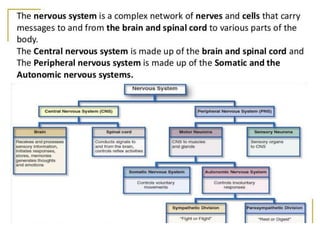
Drug Acting on Autonomic Nervous system
A. Sympathomimetic (Adrenergic agonist)
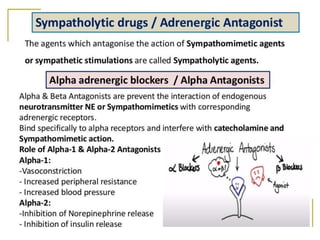
B. Sympatholytic( Adrenergic antagonist)
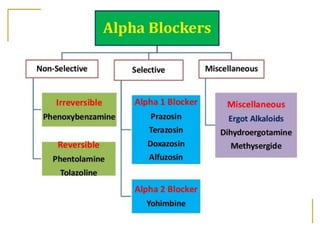
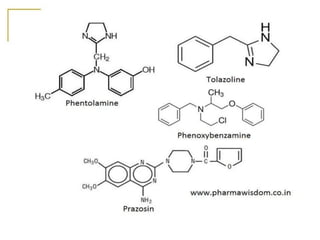
Alpha Blockers
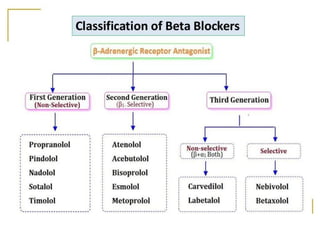
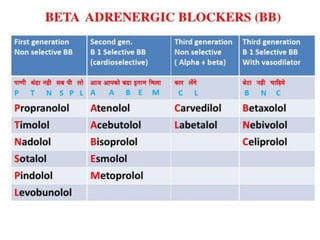
Beta Blockers
Mr. Mote G.D.
Asst. Prof, ADCBP, Ashta
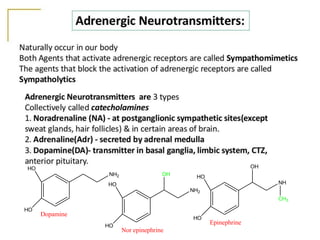
NH2
HO
HO
Dopamine
NH2
HO
HO
Nor epinephrine
OH
NH
HO
HO
Epinephrine
OH
CH3
NH
HO
HO
Epinephrine
OH
CH3
NH2
Phenyl alanine
NH2
HO
Tyrosine
NH2
HO
HO
L-DOPA
COOH
COOH
1 2
NH2
HO
HO
Dopamine
H
NH2
HO
HO
Nor Epinephrine
OH
3
4
5
PAH TH
LDOPA-DC
DH
NE-MT
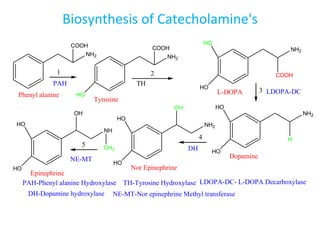
PAH-Phenyl alanine Hydroxylase TH-Tyrosine Hydroxylase LDOPA-DC- L-DOPA Decarboxylase
DH-Dopamine hydroxylase NE-MT-Nor epinephrine Methyl transferase
COOH
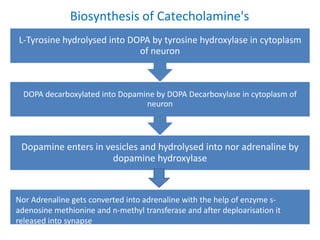
Biosynthesis of Catecholamine's
L-
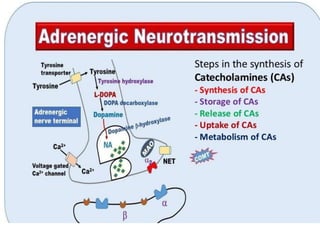
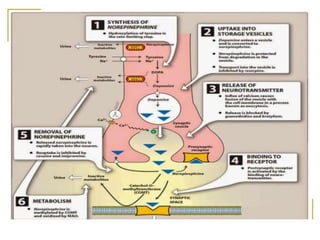
Dopamine enters in vesicles and hydrolysed into nor adrenaline by
dopamine hydroxylase
DOPA decarboxylated into Dopamine by DOPA Decarboxylase in cytoplasm of
neuron
L-Tyrosine hydrolysed into DOPA by tyrosine hydroxylase in cytoplasm
of neuron
Nor Adrenaline gets converted into adrenaline with the help of enzyme s-
adenosine methionine and n-methyl transferase and after deploarisation it
released into synapse
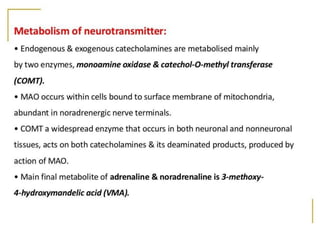
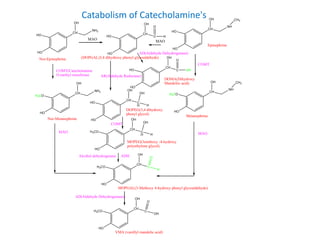
Catabolism of Catecholamine's
CH
OH
NH2
HO
HO
MAO
CH
OH
C
HO
HO
O
H
CH
OH
NH
HO
HO
CH3
Epinephrine
Nor-Epinephrine (DOPGAL)3,4 dihydroxy phenyl glycoaldehyde)
MAO
COMT(Catecholamine
O-methyl transferase
CH
OH
NH2
H3CO
HO
CH
OH
NH
H3CO
HO
CH3
Metanephrine
Nor-Metanephrine
MAO
MAO
CH
OH
C
H3CO
HO
O
H
MOPGAL(3-Methoxy 4-hydroxy phenyl glycoaldehyde)
CH
OH
C
H3CO
HO
O
OH
AD(Aldehyde Dehydrogenase)
VMA (vanillyl mandelic acid)
CH
OH
C
HO
HO
O
OH
DOMA(Dihydroxy
Mandeliic acid)
AD(Aldehyde Dehydrogenase)
AR(Aldehyde Reductase)
CH
OH
C
H
HO
HO
OH
H
DOPEG(3,4 dihydroxy
phenyl glycol)
CH
OH
C
H
H3CO
HO
OH
H
MOPEG(3methoxy -4-hydroxy
polyethylene glycol)
COMT
ADH
Alcohol dehydrogenase
COMT
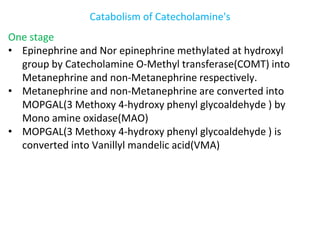
Catabolism of Catecholamine's
One stage
• Epinephrine and Nor epinephrine methylated at hydroxyl
group by Catecholamine O-Methyl transferase(COMT) into
Metanephrine and non-Metanephrine respectively.
• Metanephrine and non-Metanephrine are converted into
MOPGAL(3 Methoxy 4-hydroxy phenyl glycoaldehyde ) by
Mono amine oxidase(MAO)
• MOPGAL(3 Methoxy 4-hydroxy phenyl glycoaldehyde ) is
converted into Vanillyl mandelic acid(VMA)
Catabolism of Catecholamine's
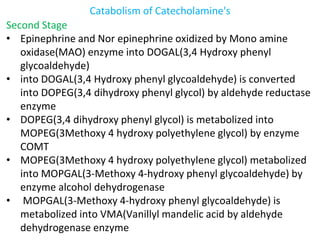
Second Stage
• Epinephrine and Nor epinephrine oxidized by Mono amine
oxidase(MAO) enzyme into DOGAL(3,4 Hydroxy phenyl
glycoaldehyde)
• into DOGAL(3,4 Hydroxy phenyl glycoaldehyde) is converted
into DOPEG(3,4 dihydroxy phenyl glycol) by aldehyde reductase
enzyme
• DOPEG(3,4 dihydroxy phenyl glycol) is metabolized into
MOPEG(3Methoxy 4 hydroxy polyethylene glycol) by enzyme
COMT
• MOPEG(3Methoxy 4 hydroxy polyethylene glycol) metabolized
into MOPGAL(3-Methoxy 4-hydroxy phenyl glycoaldehyde) by
enzyme alcohol dehydrogenase
• MOPGAL(3-Methoxy 4-hydroxy phenyl glycoaldehyde) is
metabolized into VMA(Vanillyl mandelic acid by aldehyde
dehydrogenase enzyme
Catabolism of Catecholamine's
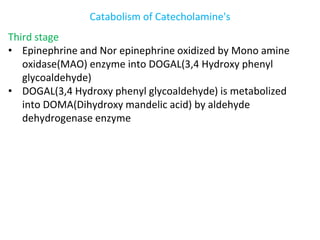
Third stage
• Epinephrine and Nor epinephrine oxidized by Mono amine
oxidase(MAO) enzyme into DOGAL(3,4 Hydroxy phenyl
glycoaldehyde)
• DOGAL(3,4 Hydroxy phenyl glycoaldehyde) is metabolized
into DOMA(Dihydroxy mandelic acid) by aldehyde
dehydrogenase enzyme
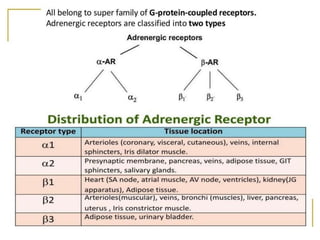
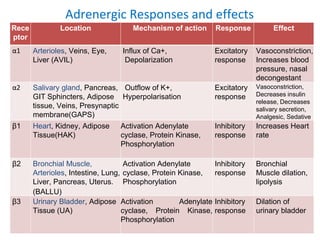
Adrenergic Responses and effects
Rece
ptor
Location Mechanism of action Response Effect
α1 Arterioles, Veins, Eye,
Liver (AVIL)
Influx of Ca+,
Depolarization
Excitatory
response
Vasoconstriction,
Increases blood
pressure, nasal
decongestant
α2 Salivary gland, Pancreas,
GIT Sphincters, Adipose
tissue, Veins, Presynaptic
membrane(GAPS)
Outflow of K+,
Hyperpolarisation
Excitatory
response
Vasoconstriction,
Decreases insulin
release, Decreases
salivary secretion,
Analgesic, Sedative
β1 Heart, Kidney, Adipose
Tissue(HAK)
Activation Adenylate
cyclase, Protein Kinase,
Phosphorylation
Inhibitory
response
Increases Heart
rate
β2 Bronchial Muscle,
Arterioles, Intestine, Lung,
Liver, Pancreas, Uterus.
(BALLU)
Activation Adenylate
cyclase, Protein Kinase,
Phosphorylation
Inhibitory
response
Bronchial
Muscle dilation,
lipolysis
β3 Urinary Bladder, Adipose
Tissue (UA)
Activation Adenylate
cyclase, Protein Kinase,
Phosphorylation
Inhibitory
response
Dilation of
urinary bladder
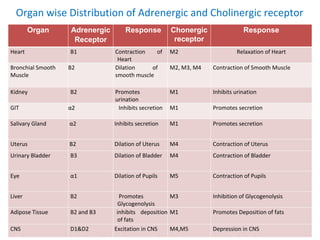
Organ wise Distribution of Adrenergic and Cholinergic receptor
Organ Adrenergic
Receptor
Response Chonergic
receptor
Response
Heart B1 Contraction of
Heart
M2 Relaxation of Heart
Bronchial Smooth
Muscle
B2 Dilation of
smooth muscle
M2, M3, M4 Contraction of Smooth Muscle
Kidney B2 Promotes
urination
M1 Inhibits urination
GIT α2 Inhibits secretion M1 Promotes secretion
Salivary Gland α2 Inhibits secretion M1 Promotes secretion
Uterus B2 Dilation of Uterus M4 Contraction of Uterus
Urinary Bladder B3 Dilation of Bladder M4 Contraction of Bladder
Eye α1 Dilation of Pupils M5 Contraction of Pupils
Liver B2 Promotes
Glycogenolysis
M3 Inhibition of Glycogenolysis
Adipose Tissue B2 and B3 inhibits deposition
of fats
M1 Promotes Deposition of fats
CNS D1&D2 Excitation in CNS M4,M5 Depression in CNS
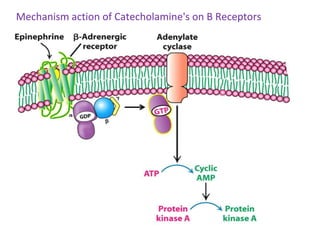
Mechanism action of Catecholamine's on B Receptors
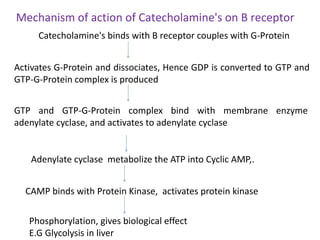
Mechanism of action of Catecholamine's on B receptor
Catecholamine's binds with B receptor couples with G-Protein
Activates G-Protein and dissociates, Hence GDP is converted to GTP and
GTP-G-Protein complex is produced
GTP and GTP-G-Protein complex bind with membrane enzyme
adenylate cyclase, and activates to adenylate cyclase
Adenylate cyclase metabolize the ATP into Cyclic AMP,.
CAMP binds with Protein Kinase, activates protein kinase
Phosphorylation, gives biological effect
E.G Glycolysis in liver
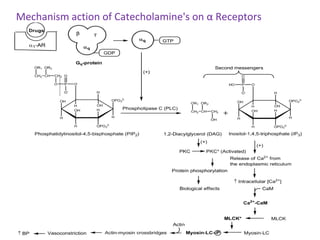
Mechanism action of Catecholamine's on α Receptors
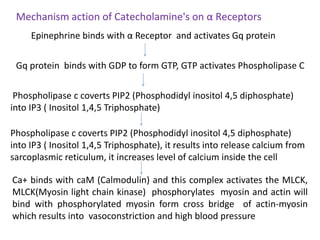
Epinephrine binds with α Receptor and activates Gq protein
Gq protein binds with GDP to form GTP, GTP activates Phospholipase C
Phospholipase c coverts PIP2 (Phosphodidyl inositol 4,5 diphosphate)
into IP3 ( Inositol 1,4,5 Triphosphate)
Phospholipase c coverts PIP2 (Phosphodidyl inositol 4,5 diphosphate)
into IP3 ( Inositol 1,4,5 Triphosphate), it results into release calcium from
sarcoplasmic reticulum, it increases level of calcium inside the cell
Ca+ binds with caM (Calmodulin) and this complex activates the MLCK,
MLCK(Myosin light chain kinase) phosphorylates myosin and actin will
bind with phosphorylated myosin form cross bridge of actin-myosin
which results into vasoconstriction and high blood pressure
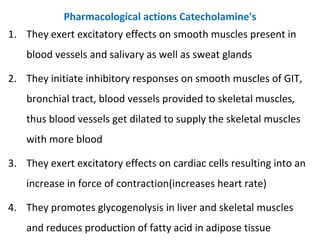
Pharmacological actions Catecholamine's
1. They exert excitatory effects on smooth muscles present in
blood vessels and salivary as well as sweat glands
2. They initiate inhibitory responses on smooth muscles of GIT,
bronchial tract, blood vessels provided to skeletal muscles,
thus blood vessels get dilated to supply the skeletal muscles
with more blood
3. They exert excitatory effects on cardiac cells resulting into an
increase in force of contraction(increases heart rate)
4. They promotes glycogenolysis in liver and skeletal muscles
and reduces production of fatty acid in adipose tissue
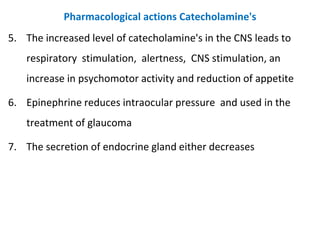
Pharmacological actions Catecholamine's
5. The increased level of catecholamine's in the CNS leads to
respiratory stimulation, alertness, CNS stimulation, an
increase in psychomotor activity and reduction of appetite
6. Epinephrine reduces intraocular pressure and used in the
treatment of glaucoma
7. The secretion of endocrine gland either decreases
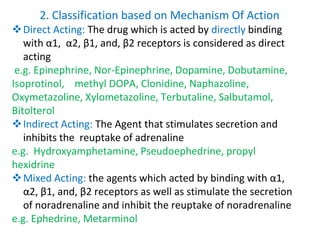
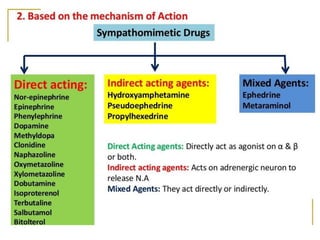
2. Classification based on Mechanism Of Action
Direct Acting: The drug which is acted by directly binding
with α1, α2, β1, and, β2 receptors is considered as direct
acting
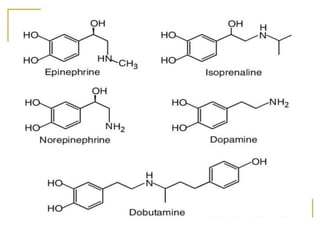
e.g. Epinephrine, Nor-Epinephrine, Dopamine, Dobutamine,
Isoprotinol, methyl DOPA, Clonidine, Naphazoline,
Oxymetazoline, Xylometazoline, Terbutaline, Salbutamol,
Bitolterol
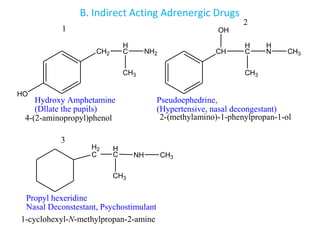
Indirect Acting: The Agent that stimulates secretion and
inhibits the reuptake of adrenaline
e.g. Hydroxyamphetamine, Pseudoephedrine, propyl
hexidrine
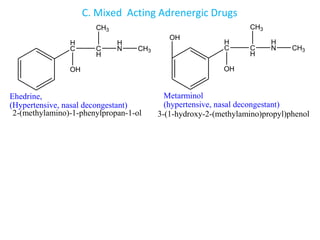
Mixed Acting: the agents which acted by binding with α1,
α2, β1, and, β2 receptors as well as stimulate the secretion
of noradrenaline and inhibit the reuptake of noradrenaline
e.g. Ephedrine, Metarminol
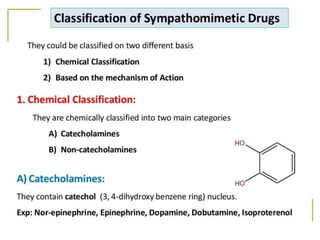
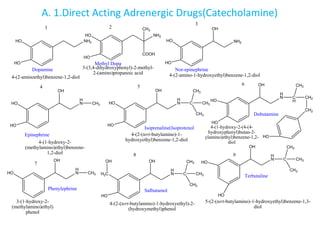
A. 1.Direct Acting Adrenergic Drugs(Catecholamine)
H2C
HO
H
N
OH
C
CH3
CH3
CH3
OH
HO
HO
NH2
Dopamine
HO
HO
NH2
Methyl Dopa
HO
HO
H
N
Epinephrine
OH
CH3
1 2
4
HO
HO
H
N
Isoprenaline(Isoprotenol
OH
C
5
CH3
CH3
CH3
4-(2-aminoethyl)benzene-1,2-diol
4-(2-(tert-butylamino)-1-
hydroxyethyl)benzene-1,2-diol
4-(1-hydroxy-2-
(methylamino)ethyl)benzene-
1,2-diol
Salbutamol
HO
H
N
OH
CH3
Phenylephrine
7
8
3-(1-hydroxy-2-
(methylamino)ethyl)
phenol
4-(2-(tert-butylamino)-1-hydroxyethyl)-2-
(hydroxymethyl)phenol
HO
HO
NH2
Nor-epinephrine
OH
3
4-(2-amino-1-hydroxyethyl)benzene-1,2-diol
H
N
OH
C
CH3
CH3
CH3
Terbutaline
9
HO
HO
5-(2-(tert-butylamino)-1-hydroxyethyl)benzene-1,3-
diol
H
N
OH
C
H
CH3
CH2
Dobutamine
6
HO
HO
CH2
4-(1-hydroxy-2-(4-(4-
hydroxyphenyl)butan-2-
ylamino)ethyl)benzene-1,2-
diol
HO
COOH
CH3
3-(3,4-dihydroxyphenyl)-2-methyl-
2-(amino)propanoic acid
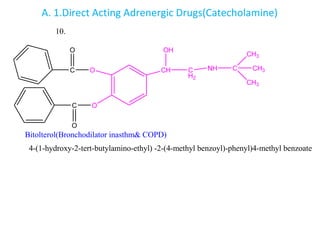
A. 1.Direct Acting Adrenergic Drugs(Catecholamine)
O
O
CH C
H2
NH C
CH3
CH3
CH3
OH
C
C
O
O
Bitolterol(Bronchodilator inasthm& COPD)
4-(1-hydroxy-2-tert-butylamino-ethyl) -2-(4-methyl benzoyl)-phenyl)4-methyl benzoate
10.
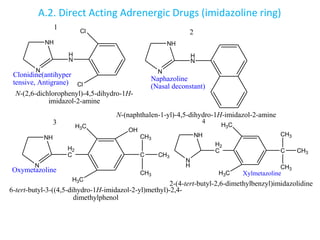
A.2. Direct Acting Adrenergic Drugs (imidazoline ring)
NH
N
H
N
Cl
Cl
Clonidine(antihyper
tensive, Antigrane)
N-(2,6-dichlorophenyl)-4,5-dihydro-1H-
imidazol-2-amine
NH
N
H
N
Naphazoline
(Nasal deconstant)
N-(naphthalen-1-yl)-4,5-dihydro-1H-imidazol-2-amine
1
2
NH
N
H2
C
H3C
H3C
Oxymetazoline
3
OH
C
CH3
CH3
CH3
6-tert-butyl-3-((4,5-dihydro-1H-imidazol-2-yl)methyl)-2,4-
dimethylphenol
NH
N
H
H2
C
H3C
H3C Xylmetazoline
4
C
CH3
CH3
CH3
2-(4-tert-butyl-2,6-dimethylbenzyl)imidazolidine
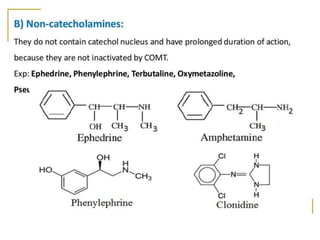
B. Indirect Acting Adrenergic Drugs
HO
CH2
H
C
CH3
NH2
Hydroxy Amphetamine
(Dllate the pupils)
4-(2-aminopropyl)phenol
CH
H
C
CH3
H
N
Pseudoephedrine,
(Hypertensive, nasal decongestant)
OH
CH3
2-(methylamino)-1-phenylpropan-1-ol
H2
C
H
C NH
CH3
CH3
Propyl hexeridine
Nasal Deconstestant, Psychostimulant
1-cyclohexyl-N-methylpropan-2-amine
1
2
3
C. Mixed Acting Adrenergic Drugs
H
C C
H
H
N
Ehedrine,
(Hypertensive, nasal decongestant)
CH3
2-(methylamino)-1-phenylpropan-1-ol
OH
CH3
H
C C
H
H
N
Metarminol
(hypertensive, nasal decongestant)
CH3
OH
CH3
OH
3-(1-hydroxy-2-(methylamino)propyl)phenol
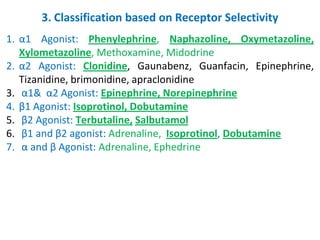
3. Classification based on Receptor Selectivity
1. α1 Agonist: Phenylephrine, Naphazoline, Oxymetazoline,
Xylometazoline, Methoxamine, Midodrine
2. α2 Agonist: Clonidine, Gaunabenz, Guanfacin, Epinephrine,
Tizanidine, brimonidine, apraclonidine
3. α1& α2 Agonist: Epinephrine, Norepinephrine
4. β1 Agonist: Isoprotinol, Dobutamine
5. β2 Agonist: Terbutaline, Salbutamol
6. β1 and β2 agonist: Adrenaline, Isoprotinol, Dobutamine
7. α and β Agonist: Adrenaline, Ephedrine
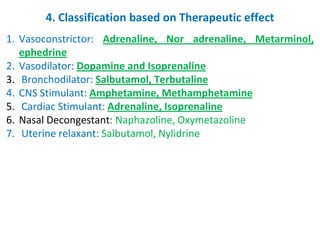
4. Classification based on Therapeutic effect
1. Vasoconstrictor: Adrenaline, Nor adrenaline, Metarminol,
ephedrine
2. Vasodilator: Dopamine and Isoprenaline
3. Bronchodilator: Salbutamol, Terbutaline
4. CNS Stimulant: Amphetamine, Methamphetamine
5. Cardiac Stimulant: Adrenaline, Isoprenaline
6. Nasal Decongestant: Naphazoline, Oxymetazoline
7. Uterine relaxant: Salbutamol, Nylidrine
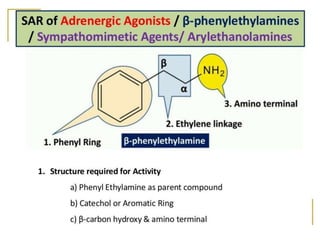
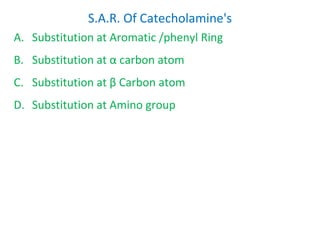
S.A.R. Of Catecholamine's
A. Substitution at Aromatic /phenyl Ring
B. Substitution at α carbon atom
C. Substitution at β Carbon atom
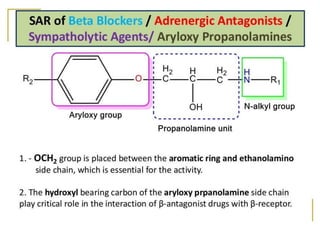
D. Substitution at Amino group
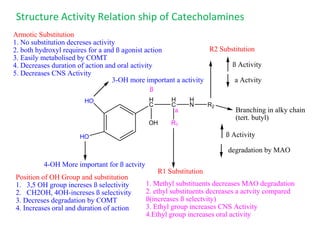
H
C
H
C
H
N R2
OH
HO
HO
a
ß
R1
3-OH more important a activity
4-OH More important for ß actvity
R2 Substitution
ß Activity
a Actvity
Branching in alky chain
(tert. butyl)
ß Activity
degradation by MAO
R1 Substitution
1. Methyl substituents decreases MAO degradation
2. ethyl substituents decreases a actvity compared
ß(increases ß selectvity)
3. Ethyl group increases CNS Activity
4.Ethyl group increases oral activity
Armotic Substitution
1. No substitution decreses activity
2. both hydroxyl requires for a and ß agonist action
3. Easily metabolised by COMT
4. Decreases duration of action and oral activity
5. Decreases CNS Activity
Position of OH Group and substitution
1. 3,5 OH group increses ß selectivity
2. CH2OH, 4OH-increses ß selectivity
3. Decreses degradation by COMT
4. Increases oral and duration of action
Structure Activity Relation ship of Catecholamines
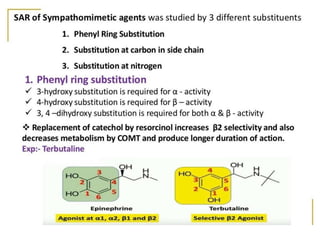
A. Substitution at Aromatic ring
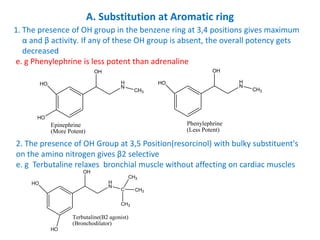
1. The presence of OH group in the benzene ring at 3,4 positions gives maximum
α and β activity. If any of these OH group is absent, the overall potency gets
decreased
e. g Phenylephrine is less potent than adrenaline
HO
HO
H
N
CH3
OH
HO H
N
CH3
OH
Phenylephrine
(Less Potent)
Epinephrine
(More Potent)
2. The presence of OH Group at 3,5 Position(resorcinol) with bulky substituent's
on the amino nitrogen gives β2 selective
e. g Terbutaline relaxes bronchial muscle without affecting on cardiac muscles
HO H
N
C
OH
HO
CH3
CH3
CH3
Terbutaline(B2 agonist)
(Bronchodilator)
A. Substitution at Aromatic ring
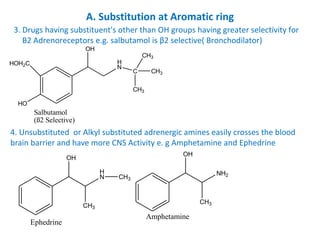
3. Drugs having substituent's other than OH groups having greater selectivity for
B2 Adrenoreceptors e.g. salbutamol is β2 selective( Bronchodilator)
4. Unsubstituted or Alkyl substituted adrenergic amines easily crosses the blood
brain barrier and have more CNS Activity e. g Amphetamine and Ephedrine
HOH2C
HO
H
N
C
OH
Salbutamol
(ß2 Selective)
CH3
CH3
CH3
H
N
OH
CH3
Ephedrine
NH2
OH
CH3
Amphetamine
CH3
A. Substitution at Aromatic ring
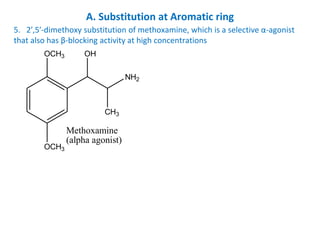
5. 2′,5′-dimethoxy substitution of methoxamine, which is a selective α-agonist
that also has β-blocking activity at high concentrations
NH2
OH
CH3
OCH3
OCH3
Methoxamine
(alpha agonist)
B. Substitution α Carbon atom
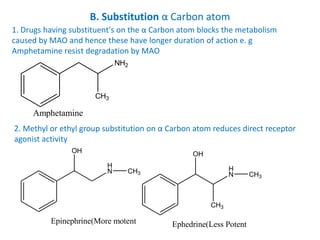
1. Drugs having substituent's on the α Carbon atom blocks the metabolism
caused by MAO and hence these have longer duration of action e. g
Amphetamine resist degradation by MAO
2. Methyl or ethyl group substitution on α Carbon atom reduces direct receptor
agonist activity
NH2
Amphetamine
CH3
H
N
CH3
CH3
OH
Ephedrine(Less Potent
H
N CH3
OH
Epinephrine(More motent
C. Substitution β Carbon atom
NH2
Amphetamine(More CNS Acivity)
CH3
H
N
Ephedrine(Less CNS Activity)
CH3
CH3
OH
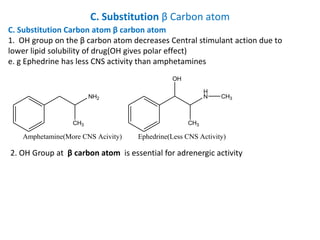
C. Substitution Carbon atom β carbon atom
1. OH group on the β carbon atom decreases Central stimulant action due to
lower lipid solubility of drug(OH gives polar effect)
e. g Ephedrine has less CNS activity than amphetamines
2. OH Group at β carbon atom is essential for adrenergic activity
D. Substitution at Amino Group
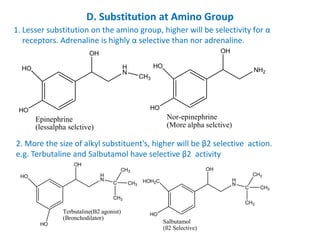
1. Lesser substitution on the amino group, higher will be selectivity for α
receptors. Adrenaline is highly α selective than nor adrenaline.
2. More the size of alkyl substituent's, higher will be β2 selective action.
e.g. Terbutaline and Salbutamol have selective β2 activity
HO
HO
H
N
CH3
OH
Epinephrine
(lessalpha selctive)
HO
HO
NH2
OH
Nor-epinephrine
(More alpha selctive)
HOH2C
HO
H
N
C
OH
Salbutamol
(ß2 Selective)
CH3
CH3
CH3
HO H
N
C
OH
HO
CH3
CH3
CH3
Terbutaline(B2 agonist)
(Bronchodilator)
D. Substitution at Amino Group
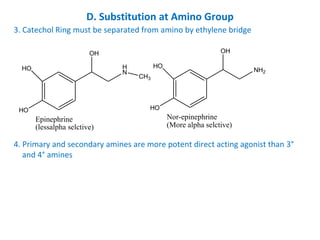
3. Catechol Ring must be separated from amino by ethylene bridge
HO
HO
H
N
CH3
OH
Epinephrine
(lessalpha selctive)
HO
HO
NH2
OH
Nor-epinephrine
(More alpha selctive)
4. Primary and secondary amines are more potent direct acting agonist than 3°
and 4° amines
S.A.R of Non Catecholamine's
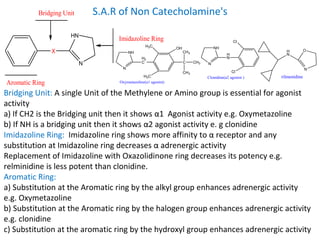
Bridging Unit: A single Unit of the Methylene or Amino group is essential for agonist
activity
a) If CH2 is the Bridging unit then it shows α1 Agonist activity e.g. Oxymetazoline
b) If NH is a bridging unit then it shows α2 agonist activity e. g clonidine
Imidazoline Ring: Imidazoline ring shows more affinity to α receptor and any
substitution at Imidazoline ring decreases α adrenergic activity
Replacement of Imidazoline with Oxazolidinone ring decreases its potency e.g.
relminidine is less potent than clonidine.
Aromatic Ring:
a) Substitution at the Aromatic ring by the alkyl group enhances adrenergic activity
e.g. Oxymetazoline
b) Substitution at the Aromatic ring by the halogen group enhances adrenergic activity
e.g. clonidine
c) Substitution at the aromatic ring by the hydroxyl group enhances adrenergic activity
X
N
HN
Bridging Unit
Imidazoline Ring
Aromatic Ring
O
N
H
N
rilmenidine
NH
N
H
N
Cl
Cl
Clonidine(a2 agonist )
NH
N
H2
C
H3C
H3C
Oxymetazoline(a1 agonist)
OH
C
CH3
CH3
CH3
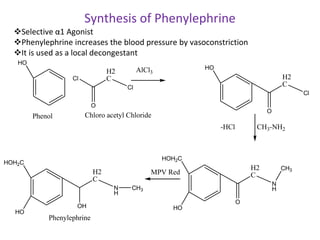
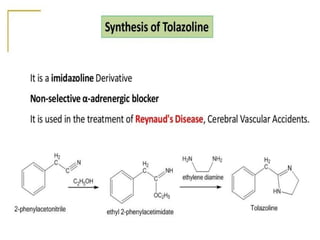
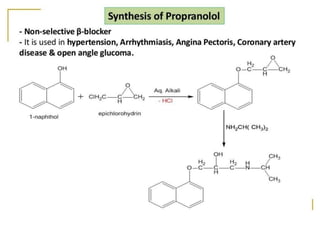
Synthesis of Phenylephrine
Selective α1 Agonist
Phenylephrine increases the blood pressure by vasoconstriction
It is used as a local decongestant
HO
H2
C
Cl
Cl
O
Chloro acetyl Chloride
AlCl3
HO
H2
C
Cl
O
-HCl CH3-NH2
HOH2C
HO
H2
C
N
H
O
HOH2C
HO
H2
C
N
H
OH
CH3
MPV Red
CH3
Phenol
Phenylephrine
HOH2C
HO
H2
C
Cl
Cl
O
Chloro acetyl Chloride
2-Hydroxy Benzyl
alcohol
AlCl3
HOH2C
HO
H2
C
Cl
O
-HCl (CH3)3C-NH2
HOH2C
HO
H2
C
N
H
O
C
CH3
CH3
CH3
HOH2C
HO
H2
C
N
H
OH
C
CH3
CH3
CH3
MPV Red
Salbutamol
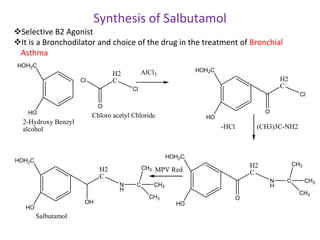
Synthesis of Salbutamol
Selective B2 Agonist
It is a Bronchodilator and choice of the drug in the treatment of Bronchial
Asthma
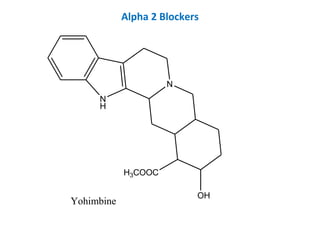
N
H
N
H3COOC
OH
Yohimbine
Alpha 2 Blockers
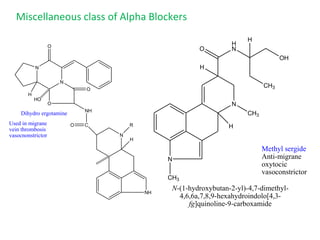
Miscellaneous class of Alpha Blockers
N
N
O
NH
C
O
N
NH
H
R
O
H
HO
O
Dihydro ergotamine
Used in migrane
vein thrombosis
vasocnonstrictor
N
N
H
N
OH
CH3
CH3
H
H
CH3
H
O
Methyl sergide
Anti-migrane
oxytocic
vasoconstrictor
N-(1-hydroxybutan-2-yl)-4,7-dimethyl-
4,6,6a,7,8,9-hexahydroindolo[4,3-
fg]quinoline-9-carboxamide
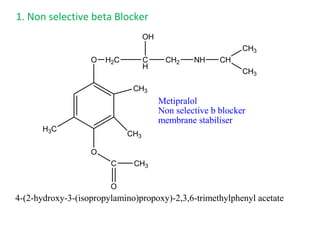
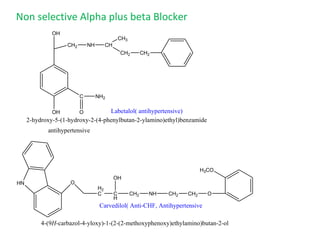
1. Non selective beta Blocker
O H2C C
H
OH
CH2 NH CH
CH3
CH3
H3C
CH3
O
CH3
C
O
CH3
Metipralol
Non selective b blocker
membrane stabiliser
4-(2-hydroxy-3-(isopropylamino)propoxy)-2,3,6-trimethylphenyl acetate
OH
C
CH2
OH
O
NH2
NH CH
CH3
CH2 CH2
2-hydroxy-5-(1-hydroxy-2-(4-phenylbutan-2-ylamino)ethyl)benzamide
Labetalol( antihypertensive)
antihypertensive
HN O
H2
C C
H
OH
CH2 NH CH2 CH2 O
H3CO
Carvedilol( Anti-CHF, Antihypertensive
4-(9H-carbazol-4-yloxy)-1-(2-(2-methoxyphenoxy)ethylamino)butan-2-ol
Non selective Alpha plus beta Blocker
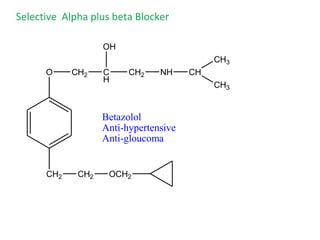
Selective Alpha plus beta Blocker
O
CH2 CH2 OCH2
CH2 C
H
OH
CH2 NH CH
CH3
CH3
Betazolol
Anti-hypertensive
Anti-gloucoma
Medicinal chemistry-I, Unit 2. Drug Acting On Sympathetic nervous system.pdf