URUNANAK COLLEGE OF PHARMACY
NAGPUR
"THE ATOM FAMILY "
GROUP -
3RD SEM
PRESENTED BY :-
Kunika Chopkar
Nikita Lodhi
Sanjana Pahade
Roshan Watari
Samiksha KalePRESENTED TO :- Res.. Pradnya Gondane Mam
TOPIC:- QUALITATIVE TESTS FOR PHENOLS
Solubility of phenols :-
. The solubility of phenol in water is governed by the hydroxyl group present.
. The hydroxyl group in phenol is involved in the formation of intermolecular hydrogen
bonding.
. Thus, hydrogen bonds are formed between water and phenol molecules which make
phenol soluble in water.
. However, the aryl group attached to the hydroxyl group is hydrophobic in nature.
. Thus, the solubility of phenol decreases with the increase in the size of the aryl group.
PHENOLS
. Aromatic compounds containing one or more OH groups directly attached to
carbon of benzene ring are called phenols.
. Simplest phenol is carbolic acid.
. Term phenol is derived from an old name of benzene
- PHENE
. Phenyl = C6H5
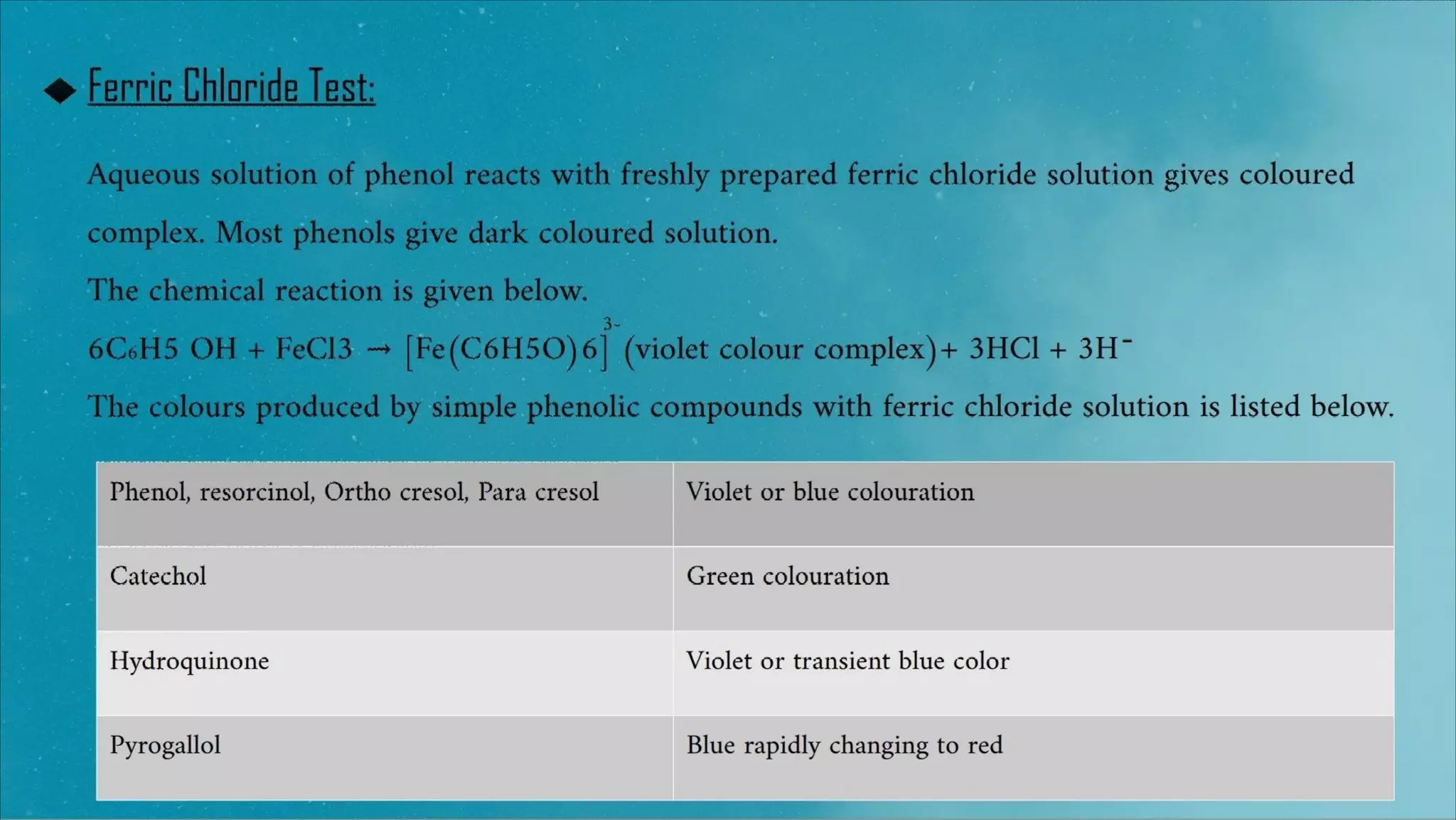
Ferric Chloride Test:
complex. Most phenols give dark coloured solution.
The chemical reaction is given below.
6C H OH + F
eC→l [Fe(C H O) ] (violet colour complex)+ 3HCl + 3H
esol
Phenol, resorcinol, Ortho cresol, Para cr Violet or blue colouration
Catechol Green colouration
Hydroquinone Violet or transient blue color
Pyrogallol Blue rapidly changing to red
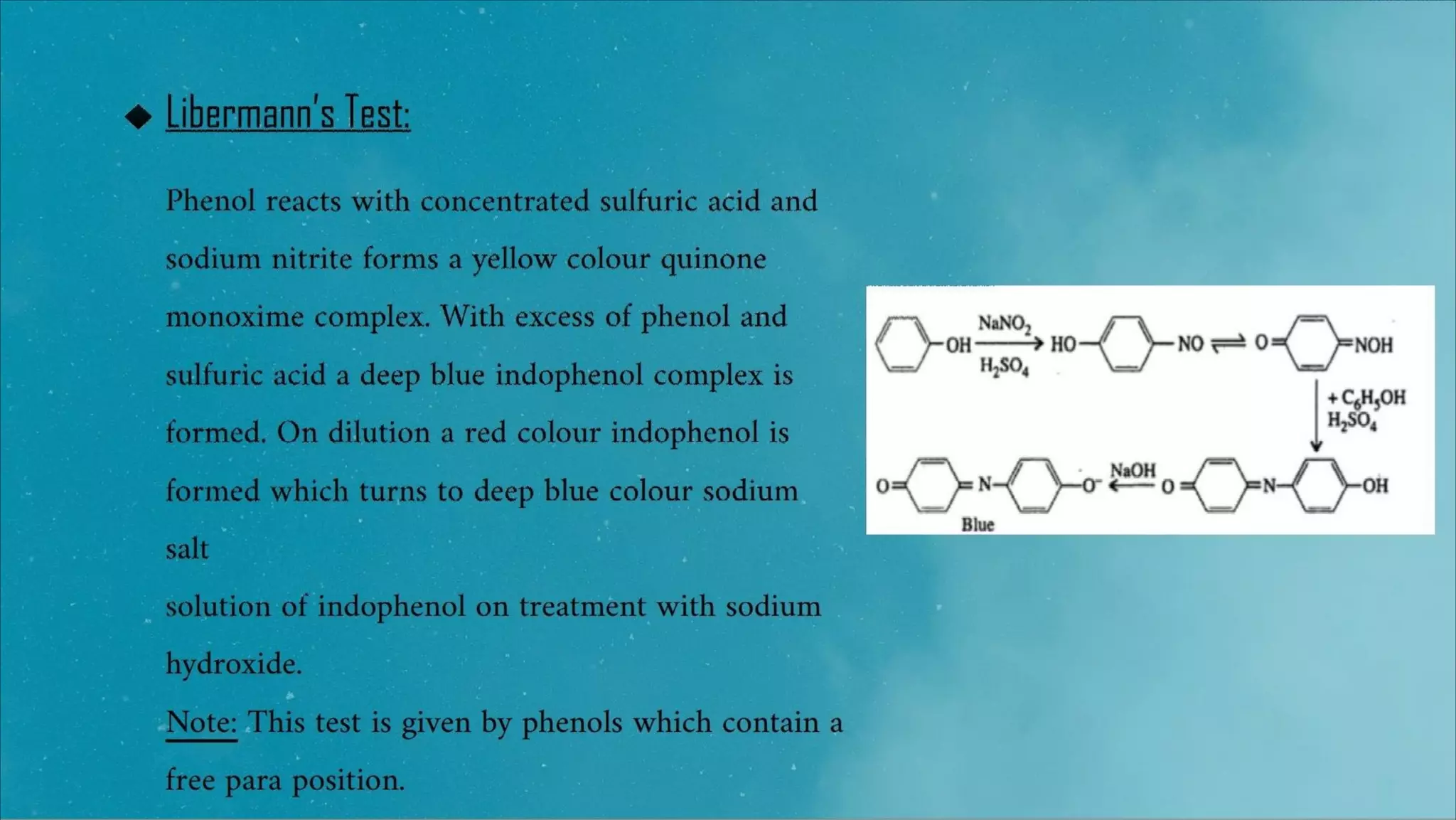
Libermann’s Test:
l and
lex is
ol is
dium
Phenol reacts with concentrated sulfuric acid and
sodium nitrite forms a yellow colour quinone
monoxime complex. With excess of pheno
sulfuric acid a deep blue indophenol comp
formed. On dilution a red colour indophen
formed which turns to deep blue colour so
salt
solution of indophenol on treatment with sodium
hydroxide.
Note: This test is given by phenols which contain a
free para position.
THANK YOU!!!
THANK YOU!!!
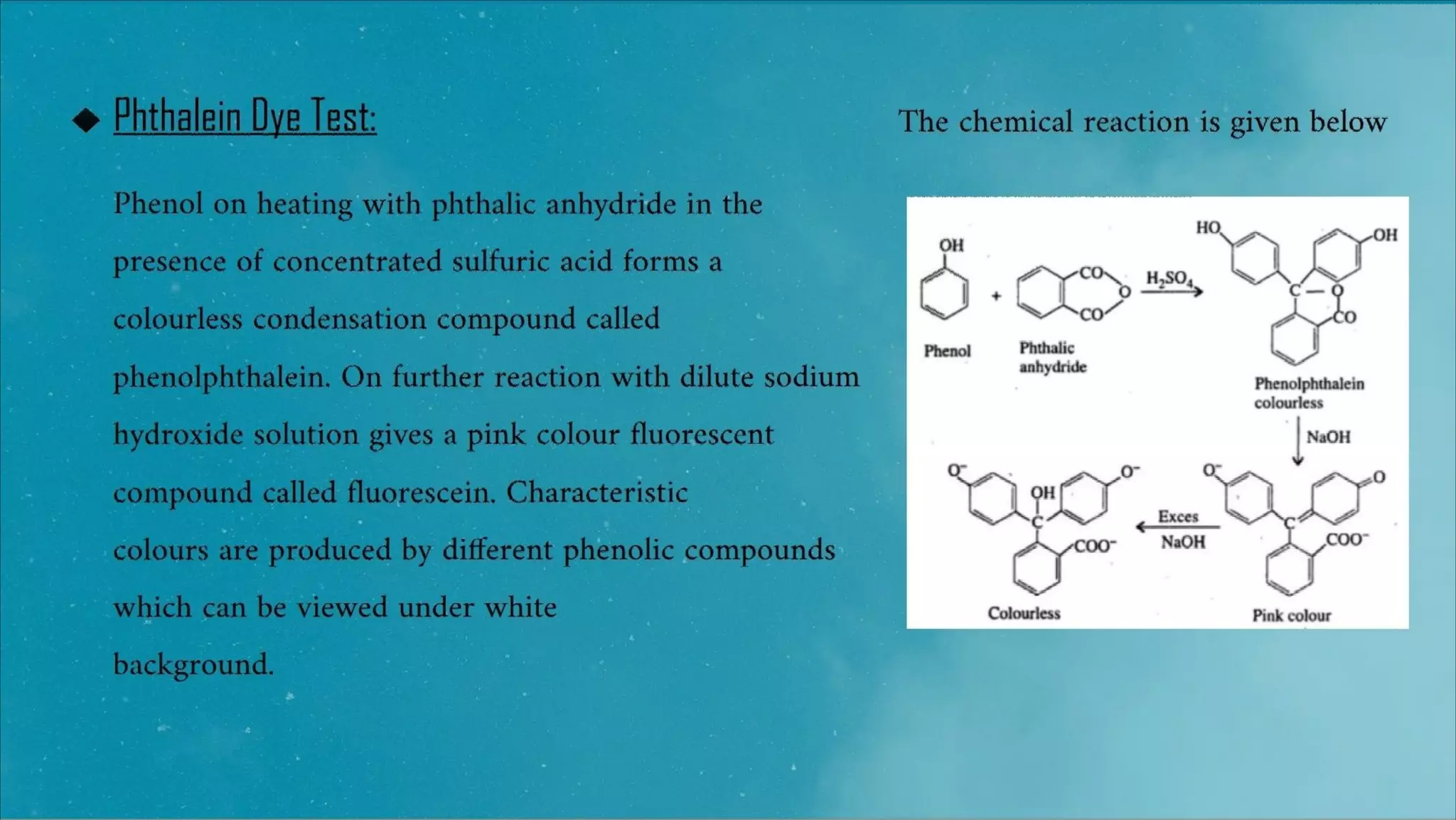
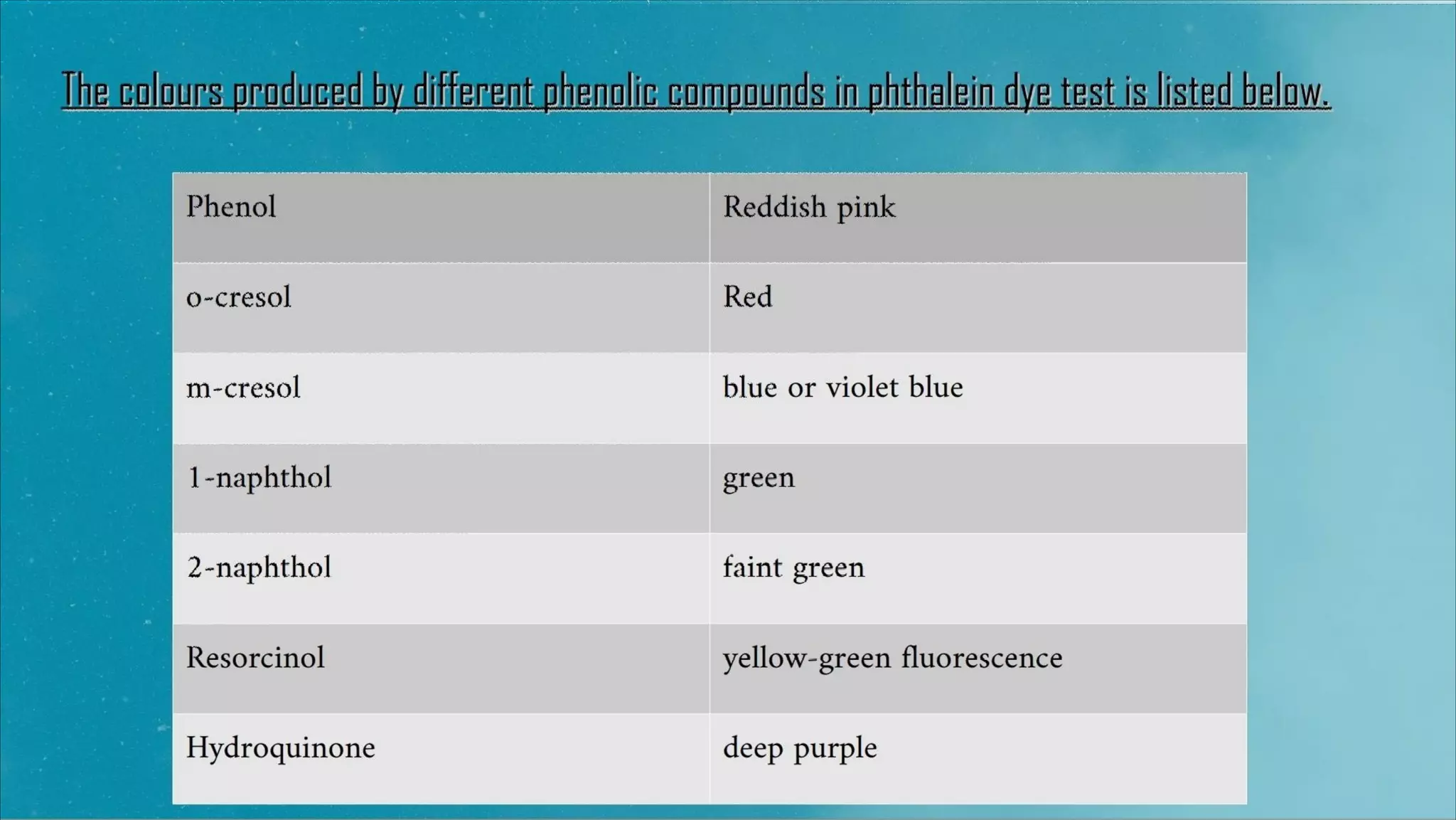
Phthalein Dye Test:
Phenol on heating with phthalic anhydride in the
presence of concentrated sulfuric acid forms a
colourless condensation compound called
phenolphthalein. On further reaction with dilute sodium
hydroxide solution gives a pink colour fluorescent
compound called fluorescein. Characteristic
colours are produced by different phenolic compounds
which can be viewed under white
background.
THANK YOU!!!
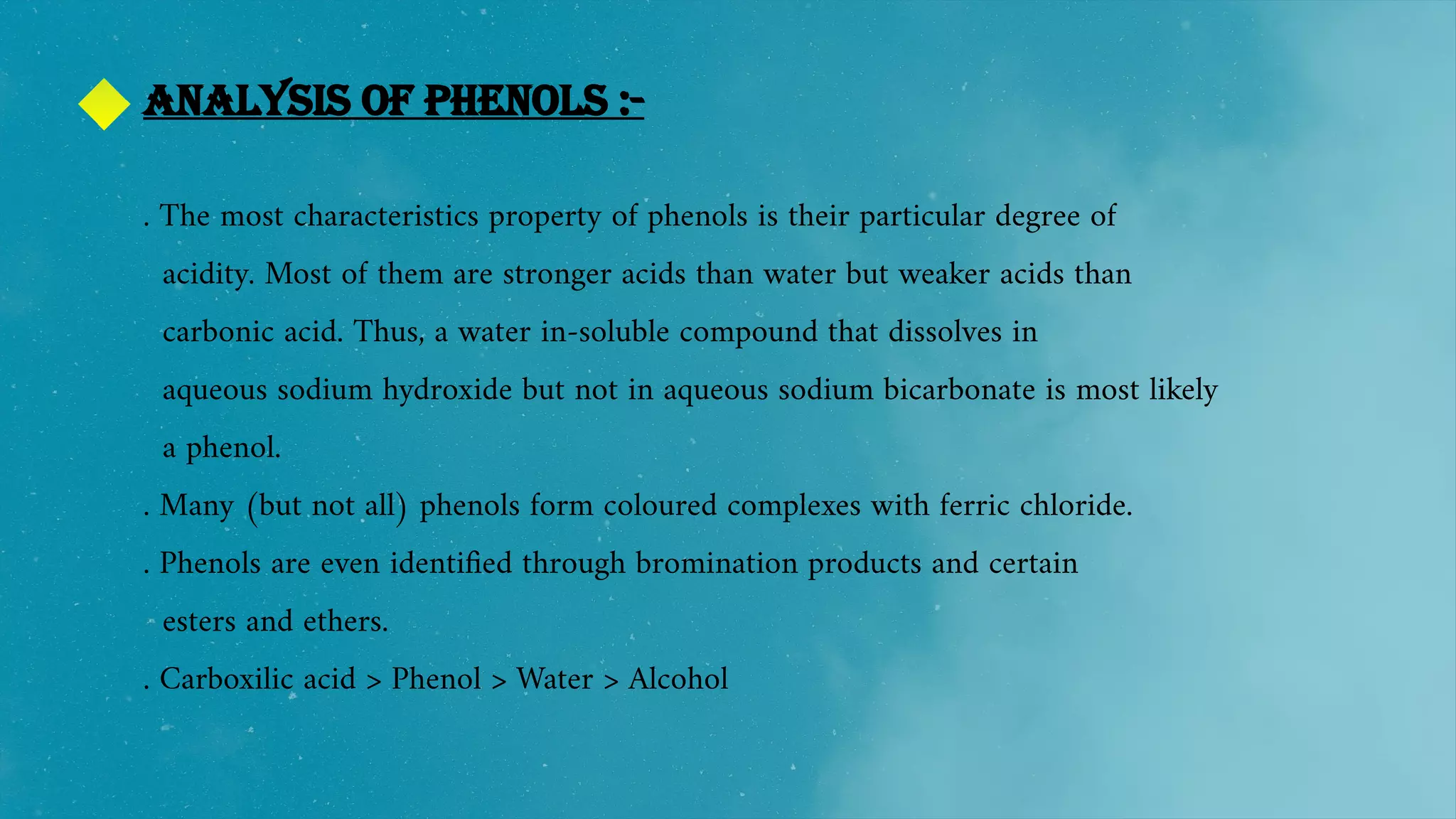
Analysis of phenols :-
. The most characteristics property of phenols is their particular degree of
acidity. Most of them are stronger acids than water but weaker acids than
carbonic acid. Thus, a water in-soluble compound that dissolves in
aqueous sodium hydroxide but not in aqueous sodium bicarbonate is most likely
a phenol.
. Many (but not all) phenols form coloured complexes with ferric chloride.
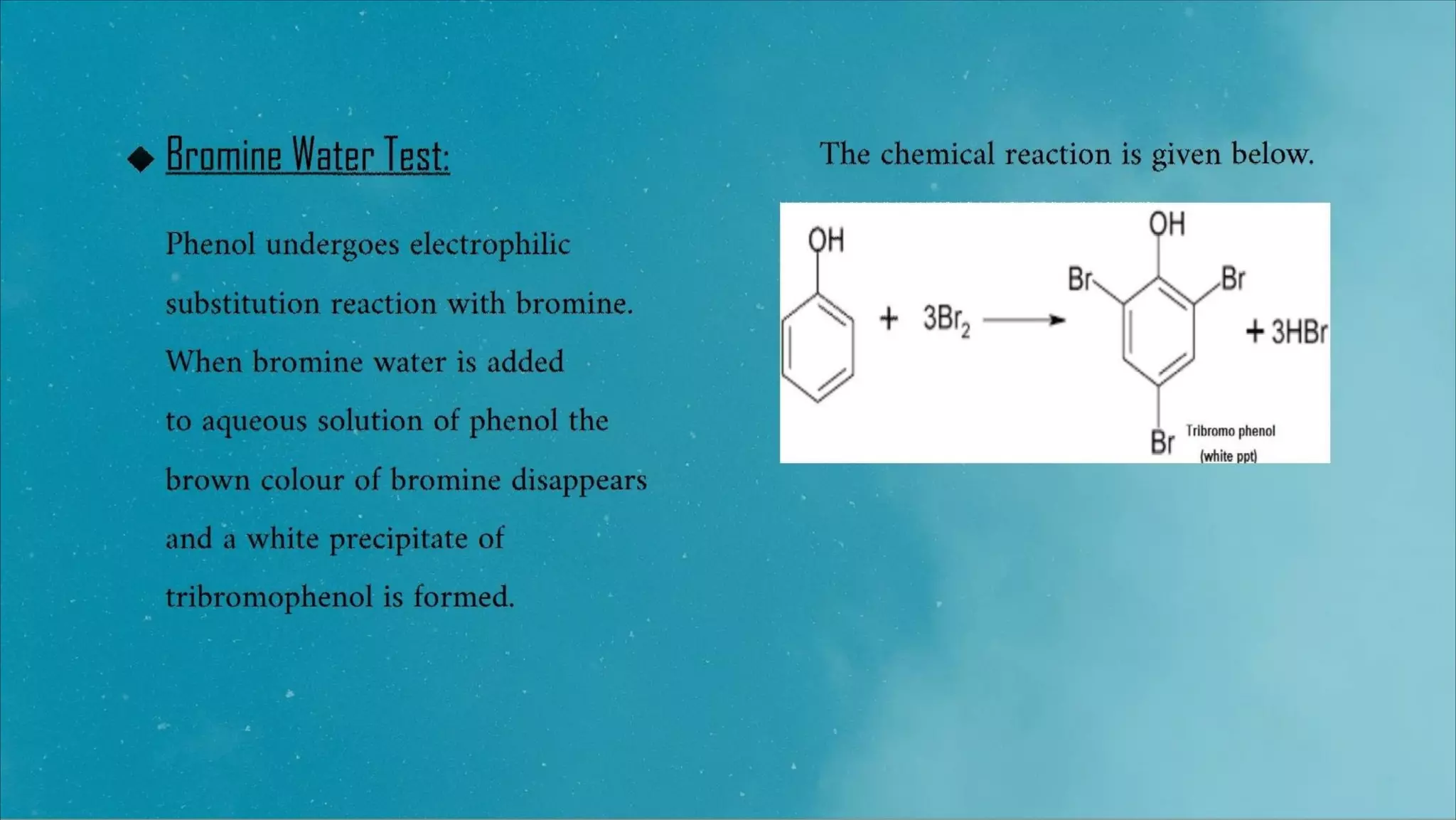
. Phenols are even identified through bromination products and certain
esters and ethers.
. Carboxilic acid > Phenol > Water > Alcohol
Spectroscopic analysis of phenols (structure
elucidation):-
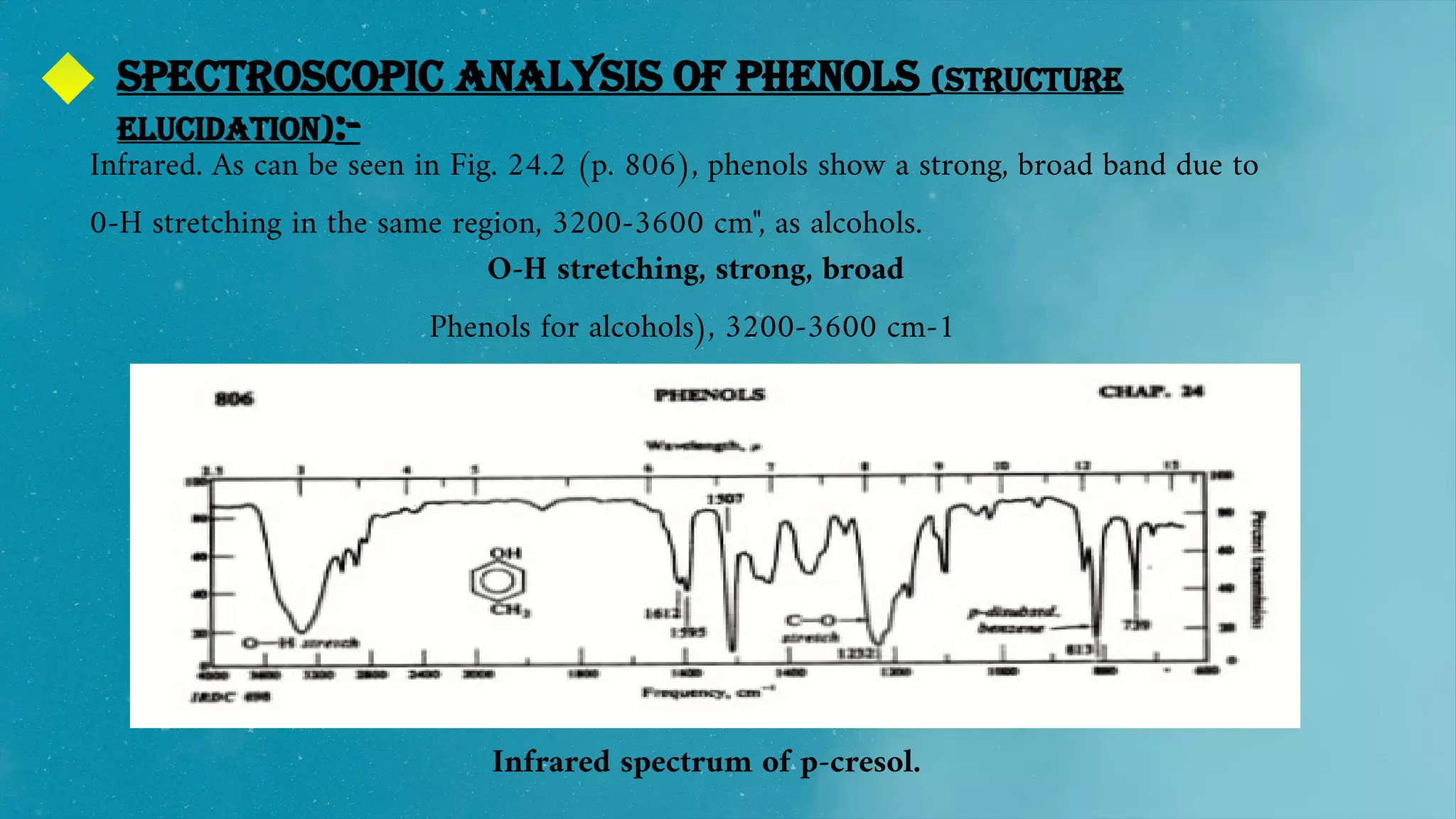
Infrared. As can be seen in Fig. 24.2 (p. 806), phenols show a strong, broad band due to
0-H stretching in the same region, 3200-3600 cm", as alcohols.
O-H stretching, strong, broad
Phenols for alcohols), 3200-3600 cm-1
Infrared spectrum of p-cresol.
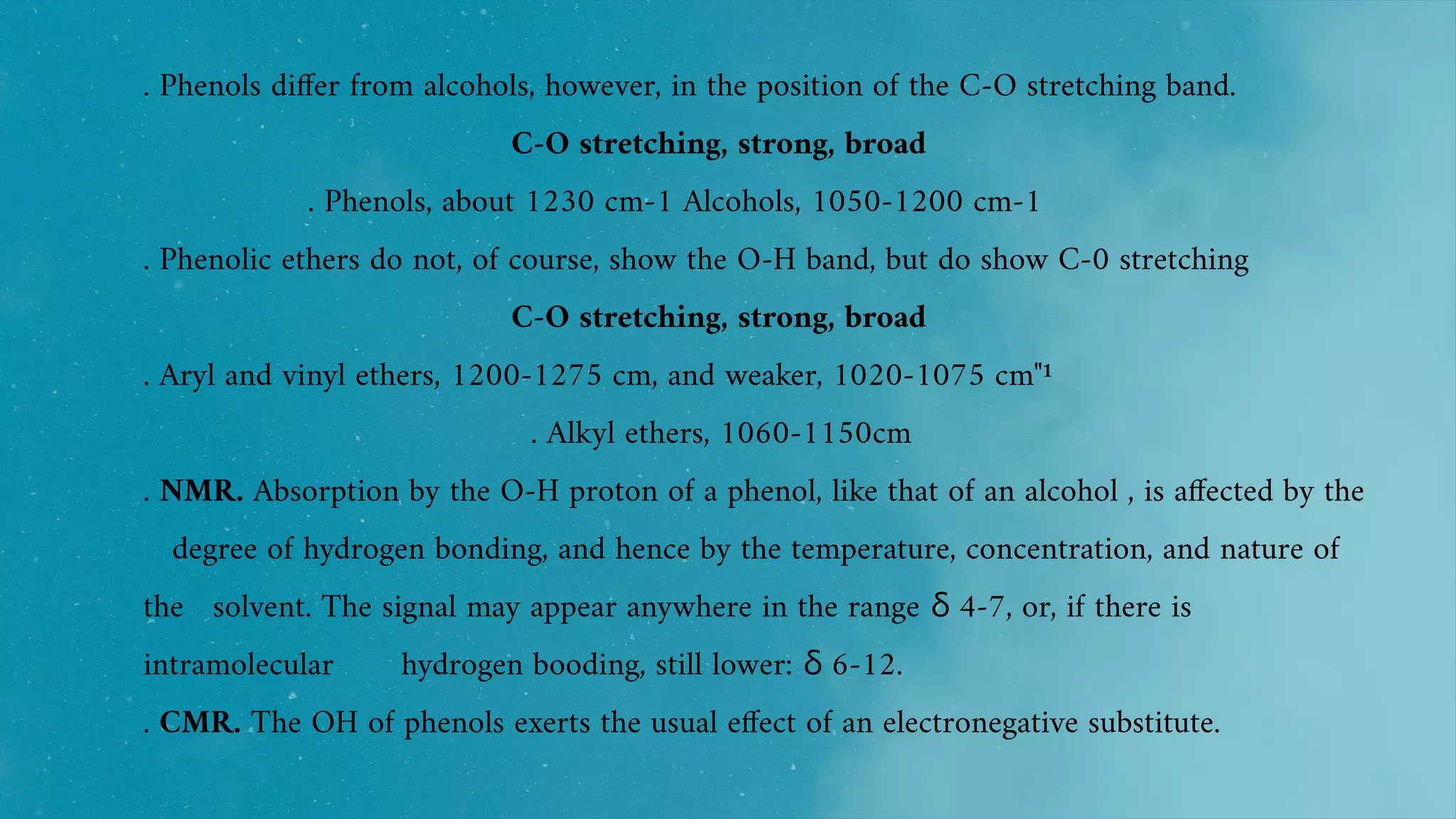
. Phenols differ from alcohols, however, in the position of the C-O stretching band.
C-O stretching, strong, broad
. Phenols, about 1230 cm-1 Alcohols, 1050-1200 cm-1
. Phenolic ethers do not, of course, show the O-H band, but do show C-0 stretching
C-O stretching, strong, broad
. Aryl and vinyl ethers, 1200-1275 cm, and weaker, 1020-1075 cm"¹
. Alkyl ethers, 1060-1150cm
. NMR. Absorption by the O-H proton of a phenol, like that of an alcohol , is affected by the
degree of hydrogen bonding, and hence by the temperature, concentration, and nature of
the solvent. The signal may appear anywhere in the range 4-7, or, if there is
δ
intramolecular hydrogen booding, still lower: 6-12.
δ
. CMR. The OH of phenols exerts the usual effect of an electronegative substitute.
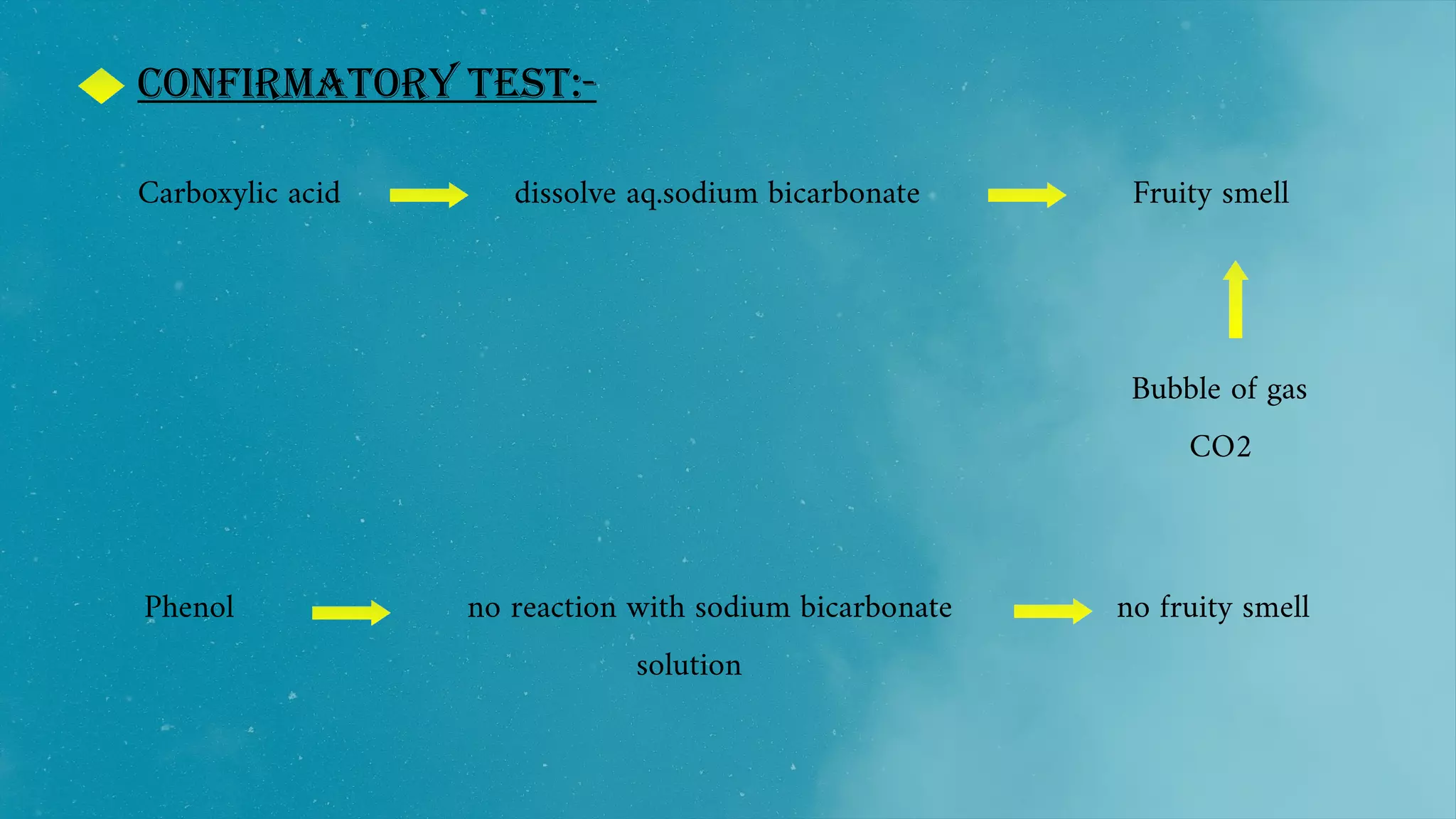
Confirmatory test:-
Carboxylic acid dissolve aq.sodium bicarbonate Fruity smell
Bubble of gas
CO2
Phenol no reaction with sodium bicarbonate no fruity smell
solution
THANK YOU!!!

Analysis of phenols and qualitative tests for phenols

  • 1.
    URUNANAK COLLEGE OFPHARMACY NAGPUR "THE ATOM FAMILY " GROUP - 3RD SEM PRESENTED BY :- Kunika Chopkar Nikita Lodhi Sanjana Pahade Roshan Watari Samiksha KalePRESENTED TO :- Res.. Pradnya Gondane Mam TOPIC:- QUALITATIVE TESTS FOR PHENOLS
  • 3.
    Solubility of phenols:- . The solubility of phenol in water is governed by the hydroxyl group present. . The hydroxyl group in phenol is involved in the formation of intermolecular hydrogen bonding. . Thus, hydrogen bonds are formed between water and phenol molecules which make phenol soluble in water. . However, the aryl group attached to the hydroxyl group is hydrophobic in nature. . Thus, the solubility of phenol decreases with the increase in the size of the aryl group.
  • 4.
    PHENOLS . Aromatic compoundscontaining one or more OH groups directly attached to carbon of benzene ring are called phenols. . Simplest phenol is carbolic acid. . Term phenol is derived from an old name of benzene - PHENE . Phenyl = C6H5
  • 5.
    Ferric Chloride Test: complex.Most phenols give dark coloured solution. The chemical reaction is given below. 6C H OH + F eC→l [Fe(C H O) ] (violet colour complex)+ 3HCl + 3H esol Phenol, resorcinol, Ortho cresol, Para cr Violet or blue colouration Catechol Green colouration Hydroquinone Violet or transient blue color Pyrogallol Blue rapidly changing to red
  • 6.
    Libermann’s Test: l and lexis ol is dium Phenol reacts with concentrated sulfuric acid and sodium nitrite forms a yellow colour quinone monoxime complex. With excess of pheno sulfuric acid a deep blue indophenol comp formed. On dilution a red colour indophen formed which turns to deep blue colour so salt solution of indophenol on treatment with sodium hydroxide. Note: This test is given by phenols which contain a free para position.
  • 7.
  • 8.
  • 9.
    Phthalein Dye Test: Phenolon heating with phthalic anhydride in the presence of concentrated sulfuric acid forms a colourless condensation compound called phenolphthalein. On further reaction with dilute sodium hydroxide solution gives a pink colour fluorescent compound called fluorescein. Characteristic colours are produced by different phenolic compounds which can be viewed under white background.
  • 10.
  • 11.
    Analysis of phenols:- . The most characteristics property of phenols is their particular degree of acidity. Most of them are stronger acids than water but weaker acids than carbonic acid. Thus, a water in-soluble compound that dissolves in aqueous sodium hydroxide but not in aqueous sodium bicarbonate is most likely a phenol. . Many (but not all) phenols form coloured complexes with ferric chloride. . Phenols are even identified through bromination products and certain esters and ethers. . Carboxilic acid > Phenol > Water > Alcohol
  • 12.
    Spectroscopic analysis ofphenols (structure elucidation):- Infrared. As can be seen in Fig. 24.2 (p. 806), phenols show a strong, broad band due to 0-H stretching in the same region, 3200-3600 cm", as alcohols. O-H stretching, strong, broad Phenols for alcohols), 3200-3600 cm-1 Infrared spectrum of p-cresol.
  • 13.
    . Phenols differfrom alcohols, however, in the position of the C-O stretching band. C-O stretching, strong, broad . Phenols, about 1230 cm-1 Alcohols, 1050-1200 cm-1 . Phenolic ethers do not, of course, show the O-H band, but do show C-0 stretching C-O stretching, strong, broad . Aryl and vinyl ethers, 1200-1275 cm, and weaker, 1020-1075 cm"¹ . Alkyl ethers, 1060-1150cm . NMR. Absorption by the O-H proton of a phenol, like that of an alcohol , is affected by the degree of hydrogen bonding, and hence by the temperature, concentration, and nature of the solvent. The signal may appear anywhere in the range 4-7, or, if there is δ intramolecular hydrogen booding, still lower: 6-12. δ . CMR. The OH of phenols exerts the usual effect of an electronegative substitute.
  • 14.
    Confirmatory test:- Carboxylic aciddissolve aq.sodium bicarbonate Fruity smell Bubble of gas CO2 Phenol no reaction with sodium bicarbonate no fruity smell solution
  • 15.