KOTA COLLEGE
OF PHARMACY
Phenanthrene
Mr. Pradeep Swarnkar
Associate Professor
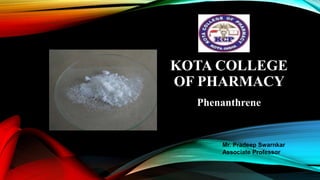
Phenanthrene is a polycyclic aromatic hydrocarbon composed of
three fused benzene rings. In its pure form, it is found incigarette
smoke and is a known irritant , photosensitizing skin to light.
Phenanthrene appears as a white powder having blue
fluorescence. Phenanthrene is the backbone of morphine.
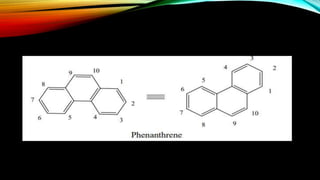
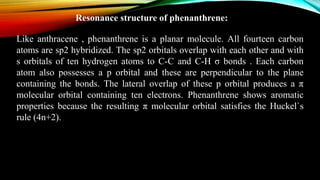
Resonance structure of phenanthrene:
Like anthracene , phenanthrene is a planar molecule. All fourteen carbon
atoms are sp2 hybridized. The sp2 orbitals overlap with each other and with
s orbitals of ten hydrogen atoms to C-C and C-H σ bonds . Each carbon
atom also possesses a p orbital and these are perpendicular to the plane
containing the bonds. The lateral overlap of these p orbital produces a π
molecular orbital containing ten electrons. Phenanthrene shows aromatic
properties because the resulting π molecular orbital satisfies the Huckel`s
rule (4n+2).
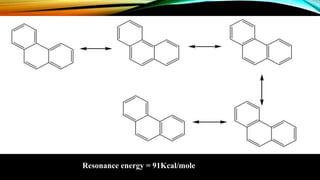
Resonance energy = 91Kcal/mole
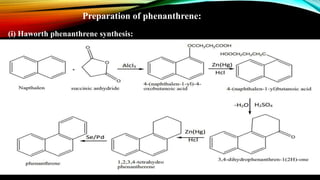
Preparation of phenanthrene:
(i) Haworth phenanthrene synthesis:
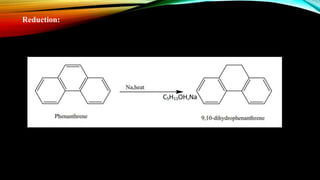
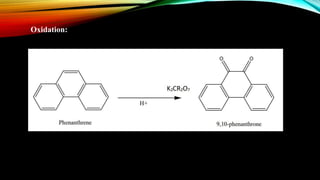
Reaction of Phenanthrene:
Reduction:
Oxidation:
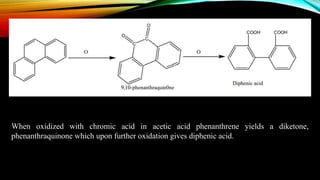
When oxidized with chromic acid in acetic acid phenanthrene yields a diketone,
phenanthraquinone which upon further oxidation gives diphenic acid.
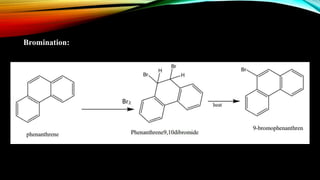
Bromination:
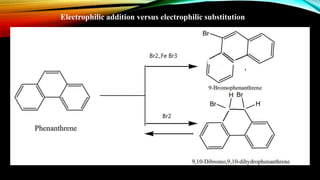
Electrophilic addition versus electrophilic substitution
Br2,,Fe Br3
Br2
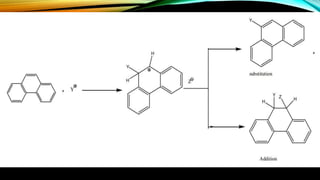
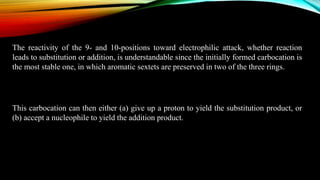
The reactivity of the 9- and 10-positions toward electrophilic attack, whether reaction
leads to substitution or addition, is understandable since the initially formed carbocation is
the most stable one, in which aromatic sextets are preserved in two of the three rings.
This carbocation can then either (a) give up a proton to yield the substitution product, or
(b) accept a nucleophile to yield the addition product.
Derivatives of phenanthrene:
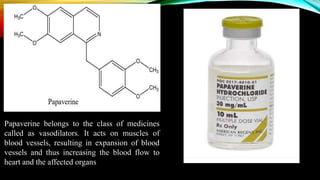
Papaverine belongs to the class of medicines
called as vasodilators. It acts on muscles of
blood vessels, resulting in expansion of blood
vessels and thus increasing the blood flow to
heart and the affected organs
Medicinal uses of Phenanthrene:
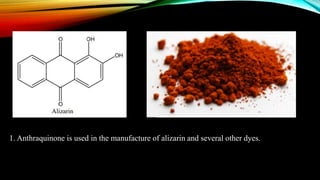
1. Anthraquinone is used in the manufacture of alizarin and several other dyes.
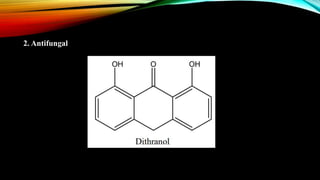
2. Antifungal
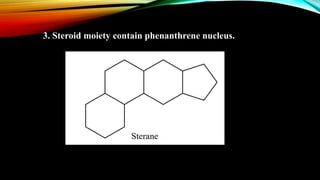
3. Steroid moiety contain phenanthrene nucleus.
4. Sex hormones and bile acids.
5. Steroid used as oral contraceptive and antiinflamatory agent.
6. Cardiac glycosides, morphine, codeine.
Phenanthrene by Mr. pradeep swarnkar

Phenanthrene by Mr. pradeep swarnkar

  • 1.
    KOTA COLLEGE OF PHARMACY Phenanthrene Mr.Pradeep Swarnkar Associate Professor
  • 2.
    Phenanthrene is apolycyclic aromatic hydrocarbon composed of three fused benzene rings. In its pure form, it is found incigarette smoke and is a known irritant , photosensitizing skin to light. Phenanthrene appears as a white powder having blue fluorescence. Phenanthrene is the backbone of morphine.
  • 4.
    Resonance structure ofphenanthrene: Like anthracene , phenanthrene is a planar molecule. All fourteen carbon atoms are sp2 hybridized. The sp2 orbitals overlap with each other and with s orbitals of ten hydrogen atoms to C-C and C-H σ bonds . Each carbon atom also possesses a p orbital and these are perpendicular to the plane containing the bonds. The lateral overlap of these p orbital produces a π molecular orbital containing ten electrons. Phenanthrene shows aromatic properties because the resulting π molecular orbital satisfies the Huckel`s rule (4n+2).
  • 5.
    Resonance energy =91Kcal/mole
  • 6.
    Preparation of phenanthrene: (i)Haworth phenanthrene synthesis:
  • 7.
  • 8.
  • 9.
  • 10.
    When oxidized withchromic acid in acetic acid phenanthrene yields a diketone, phenanthraquinone which upon further oxidation gives diphenic acid.
  • 11.
  • 12.
    Electrophilic addition versuselectrophilic substitution Br2,,Fe Br3 Br2
  • 14.
    The reactivity ofthe 9- and 10-positions toward electrophilic attack, whether reaction leads to substitution or addition, is understandable since the initially formed carbocation is the most stable one, in which aromatic sextets are preserved in two of the three rings. This carbocation can then either (a) give up a proton to yield the substitution product, or (b) accept a nucleophile to yield the addition product.
  • 15.
  • 16.
    Papaverine belongs tothe class of medicines called as vasodilators. It acts on muscles of blood vessels, resulting in expansion of blood vessels and thus increasing the blood flow to heart and the affected organs
  • 18.
    Medicinal uses ofPhenanthrene:
  • 19.
    1. Anthraquinone isused in the manufacture of alizarin and several other dyes.
  • 20.
  • 21.
    3. Steroid moietycontain phenanthrene nucleus.
  • 22.
    4. Sex hormonesand bile acids. 5. Steroid used as oral contraceptive and antiinflamatory agent. 6. Cardiac glycosides, morphine, codeine.