Ocean Floor
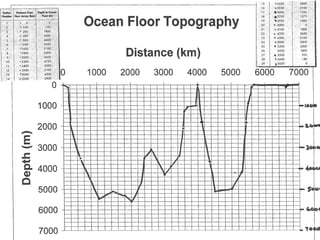
Topography
Sonar Activity
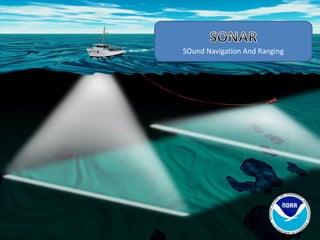
SOund Navigation And Ranging
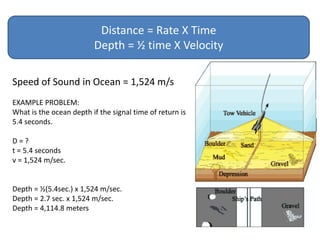
Distance = Rate X Time
Depth = ½ time X Velocity
Speed of Sound in Ocean = 1,524 m/s
EXAMPLE PROBLEM:
What is the ocean depth if the signal time of return is
5.4 seconds.
D = ?
t = 5.4 seconds
v = 1,524 m/sec.
Depth = ½(5.4sec.) x 1,524 m/sec.
Depth = 2.7 sec. x 1,524 m/sec.
Depth = 4,114.8 meters
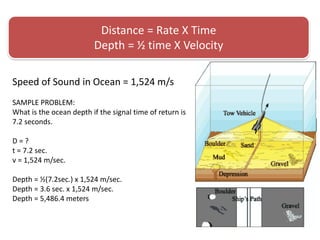
Distance = Rate X Time
Depth = ½ time X Velocity
Speed of Sound in Ocean = 1,524 m/s
SAMPLE PROBLEM:
What is the ocean depth if the signal time of return is
7.2 seconds.
D = ?
t = 7.2 sec.
v = 1,524 m/sec.
Depth = ½(7.2sec.) x 1,524 m/sec.
Depth = 3.6 sec. x 1,524 m/sec.
Depth = 5,486.4 meters
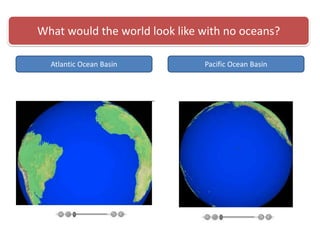
What would the world look like with no oceans?
Atlantic Ocean Basin Pacific Ocean Basin
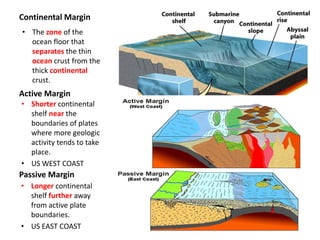
Continental Margin
• The zone of the
ocean floor that
separates the thin
ocean crust from the
thick continental
crust.
Active Margin
• Shorter continental
shelf near the
boundaries of plates
where more geologic
activity tends to take
place.
• US WEST COAST
Passive Margin
• Longer continental
shelf further away
from active plate
boundaries.
• US EAST COAST
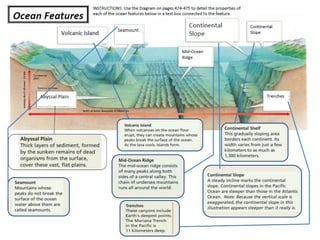
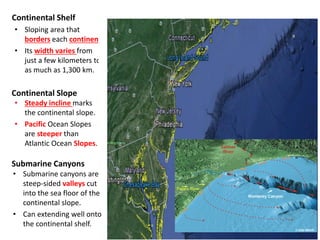
Continental Shelf
• Sloping area that
borders each continent.
• Its width varies from
just a few kilometers to
as much as 1,300 km.
Continental Slope
• Steady incline marks
the continental slope.
• Pacific Ocean Slopes
are steeper than
Atlantic Ocean Slopes.
Submarine Canyons
• Submarine canyons are
steep-sided valleys cut
into the sea floor of the
continental slope.
• Can extending well onto
the continental shelf.
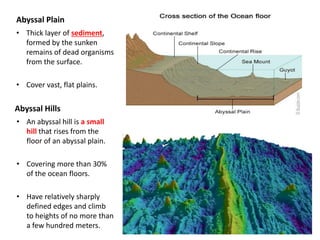
Abyssal Plain
• Thick layer of sediment,
formed by the sunken
remains of dead organisms
from the surface.
• Cover vast, flat plains.
Abyssal Hills
• An abyssal hill is a small
hill that rises from the
floor of an abyssal plain.
• Covering more than 30%
of the ocean floors.
• Have relatively sharply
defined edges and climb
to heights of no more than
a few hundred meters.
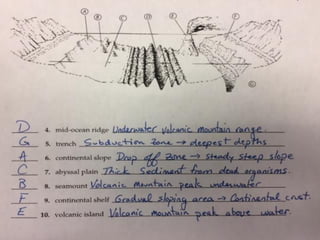
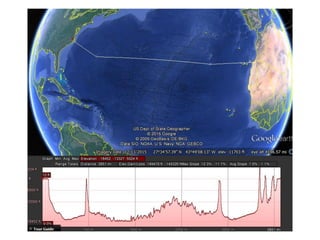
Mid Ocean Ridge
• Consists of many
peaks along both
sides of a central
valley.
• Chain of undersea
volcanic mountains
that run around the
world.
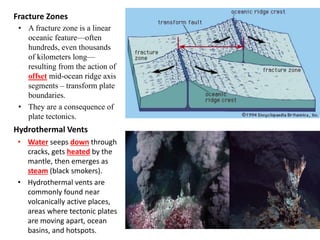
Fracture Zones
• A fracture zone is a linear
oceanic feature—often
hundreds, even thousands
of kilometers long—
resulting from the action of
offset mid-ocean ridge axis
segments – transform plate
boundaries.
• They are a consequence of
plate tectonics.
Hydrothermal Vents
• Water seeps down through
cracks, gets heated by the
mantle, then emerges as
steam (black smokers).
• Hydrothermal vents are
commonly found near
volcanically active places,
areas where tectonic plates
are moving apart, ocean
basins, and hotspots.
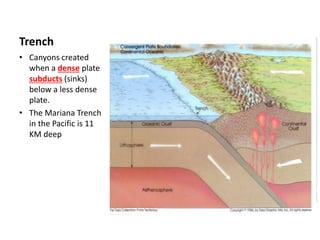
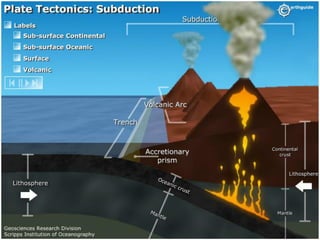
Trench
• Canyons created
when a dense plate
subducts (sinks)
below a less dense
plate.
• The Mariana Trench
in the Pacific is 11
KM deep
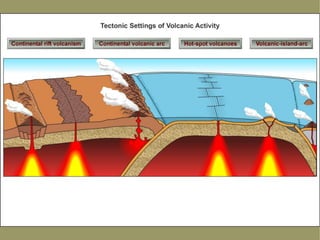
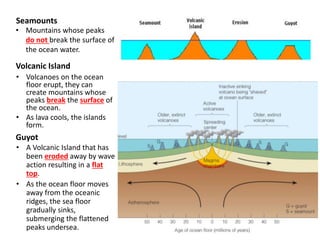
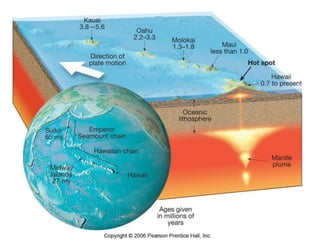
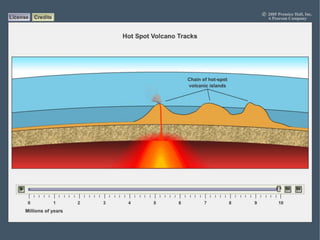
Volcanic Island
• Volcanoes on the ocean
floor erupt, they can
create mountains whose
peaks break the surface of
the ocean.
• As lava cools, the islands
form.
Seamounts
• Mountains whose peaks
do not break the surface of
the ocean water.
Guyot
• A Volcanic Island that has
been eroded away by wave
action resulting in a flat
top.
• As the ocean floor moves
away from the oceanic
ridges, the sea floor
gradually sinks,
submerging the flattened
peaks undersea.
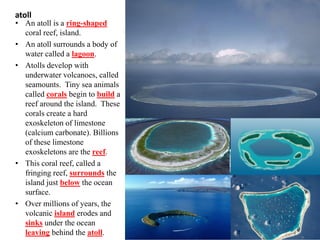
atoll
• An atoll is a ring-shaped
coral reef, island.
• An atoll surrounds a body of
water called a lagoon.
• Atolls develop with
underwater volcanoes, called
seamounts. Tiny sea animals
called corals begin to build a
reef around the island. These
corals create a hard
exoskeleton of limestone
(calcium carbonate). Billions
of these limestone
exoskeletons are the reef.
• This coral reef, called a
fringing reef, surrounds the
island just below the ocean
surface.
• Over millions of years, the
volcanic island erodes and
sinks under the ocean
leaving behind the atoll.

Ocean Floor Topography and Features

  • 1.
  • 2.
  • 3.
    Distance = RateX Time Depth = ½ time X Velocity Speed of Sound in Ocean = 1,524 m/s EXAMPLE PROBLEM: What is the ocean depth if the signal time of return is 5.4 seconds. D = ? t = 5.4 seconds v = 1,524 m/sec. Depth = ½(5.4sec.) x 1,524 m/sec. Depth = 2.7 sec. x 1,524 m/sec. Depth = 4,114.8 meters
  • 4.
    Distance = RateX Time Depth = ½ time X Velocity Speed of Sound in Ocean = 1,524 m/s SAMPLE PROBLEM: What is the ocean depth if the signal time of return is 7.2 seconds. D = ? t = 7.2 sec. v = 1,524 m/sec. Depth = ½(7.2sec.) x 1,524 m/sec. Depth = 3.6 sec. x 1,524 m/sec. Depth = 5,486.4 meters
  • 10.
    What would theworld look like with no oceans? Atlantic Ocean Basin Pacific Ocean Basin
  • 12.
    Continental Margin • Thezone of the ocean floor that separates the thin ocean crust from the thick continental crust. Active Margin • Shorter continental shelf near the boundaries of plates where more geologic activity tends to take place. • US WEST COAST Passive Margin • Longer continental shelf further away from active plate boundaries. • US EAST COAST
  • 13.
    Continental Shelf • Slopingarea that borders each continent. • Its width varies from just a few kilometers to as much as 1,300 km. Continental Slope • Steady incline marks the continental slope. • Pacific Ocean Slopes are steeper than Atlantic Ocean Slopes. Submarine Canyons • Submarine canyons are steep-sided valleys cut into the sea floor of the continental slope. • Can extending well onto the continental shelf.
  • 14.
    Abyssal Plain • Thicklayer of sediment, formed by the sunken remains of dead organisms from the surface. • Cover vast, flat plains. Abyssal Hills • An abyssal hill is a small hill that rises from the floor of an abyssal plain. • Covering more than 30% of the ocean floors. • Have relatively sharply defined edges and climb to heights of no more than a few hundred meters.
  • 15.
    Mid Ocean Ridge •Consists of many peaks along both sides of a central valley. • Chain of undersea volcanic mountains that run around the world.
  • 17.
    Fracture Zones • Afracture zone is a linear oceanic feature—often hundreds, even thousands of kilometers long— resulting from the action of offset mid-ocean ridge axis segments – transform plate boundaries. • They are a consequence of plate tectonics. Hydrothermal Vents • Water seeps down through cracks, gets heated by the mantle, then emerges as steam (black smokers). • Hydrothermal vents are commonly found near volcanically active places, areas where tectonic plates are moving apart, ocean basins, and hotspots.
  • 18.
    Trench • Canyons created whena dense plate subducts (sinks) below a less dense plate. • The Mariana Trench in the Pacific is 11 KM deep
  • 21.
    Volcanic Island • Volcanoeson the ocean floor erupt, they can create mountains whose peaks break the surface of the ocean. • As lava cools, the islands form. Seamounts • Mountains whose peaks do not break the surface of the ocean water. Guyot • A Volcanic Island that has been eroded away by wave action resulting in a flat top. • As the ocean floor moves away from the oceanic ridges, the sea floor gradually sinks, submerging the flattened peaks undersea.
  • 24.
    atoll • An atollis a ring-shaped coral reef, island. • An atoll surrounds a body of water called a lagoon. • Atolls develop with underwater volcanoes, called seamounts. Tiny sea animals called corals begin to build a reef around the island. These corals create a hard exoskeleton of limestone (calcium carbonate). Billions of these limestone exoskeletons are the reef. • This coral reef, called a fringing reef, surrounds the island just below the ocean surface. • Over millions of years, the volcanic island erodes and sinks under the ocean leaving behind the atoll.