Take A Walk With Me . . . .
The Ocean Floor
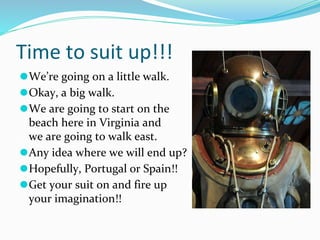
Time to suit up!!!
⚫We’re going on a little walk.
⚫Okay, a big walk.
⚫We are going to start on the
beach here in Virginia and
we are going to walk east.
⚫Any idea where we will end up?
⚫Hopefully, Portugal or Spain!!
⚫Get your suit on and fire up
your imagination!!
This is your guide speaking . . .
⚫First off, what do you think we will see on our trip?
⚫What will the ocean floor look like?
⚫What geographic features will we see?
⚫Hills
⚫Mountains
⚫Canyons
⚫Wide plains
⚫Basically, if you can see it on dry ground, you can find it
on the ocean floor!
Starting out!!!
⚫The Continental Shelf
⚫Surround each of the large land masses on Earth is a
wide, shallow ridge. This is the first – and shallowest
– part of the ocean floor.
⚫On average, it extends out about 45 miles from the
edge of a continent. It can, however, be as small as a
couple miles or as long as 200 miles.
⚫If you wade out into the water at the beach, you are
standing on the shallowest part of the continental
shelf!! The water will be just inches deep!
More on the continental shelf!
⚫The continental shelf is long and flat!
⚫When walking across it, you will probably notice
small hills, ridges, and small canyons, but the water
doesn’t get very deep – usually around 450 feet - on
the continental shelf.
⚫The continental shelf gradually extends away from the
continent until it reaches a point where it drops
steeply to the deep ocean floor.
⚫Look out! That next step could be a doozy!
Continental Shelf Pix 1
Continental Shelf Pix 2
Watch that next step!!
⚫If you aren’t paying attention on our little walk, the
first step at the edge of the continental shelf could
send you tuckus over tea kettle!
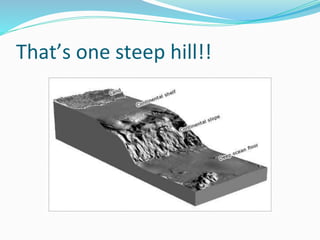
⚫At the edge of the continental shelf, the continental
slope plunges steeply downward towards the deep
ocean bottom, or oceanic crust.
⚫Better be careful or you will go rolling, rolling, rolling
to the deep!!
That’s one steep hill!!
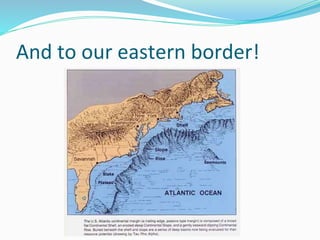
And to our eastern border!
Watch out for the speed bump!
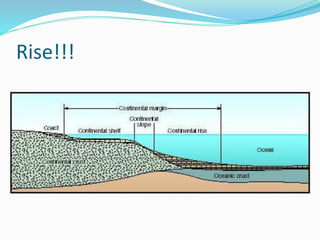
⚫Before reaching the deep ocean floor, you have to get
over the continental rise.
⚫The continental rise is a deposit of sediment and
other material washed off the continental shelf and
down the continental slope by ocean currents.
⚫All this stuff collects at the bottom of the slope. It can
be a big bump or just a long slope – it just depends on
the strength of the current and how much stuff gets
swept down there.
Rise!!!
Rise . . . . AGAIN!!!
Finally . . . . The Abyss!!
⚫After climbing over the continental rise, you will now
be on the deep ocean floor, which is also known as
the deep ocean basin or the abyss.
⚫On average, the deep ocean floor is between 2.5 to 3.5
miles deep, and it covers 30% of the Earth’s surface
area.
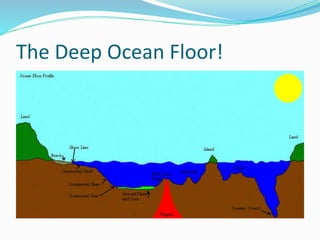
⚫Every feature you could find on dry ground can be
found on the deep ocean floor – canyons, mountain
ranges, individual mountains, hills, valleys . . . . You
name it, it’s there. (Maybe – if you don’t name
anything whacky!!)
The Deep Ocean Floor!
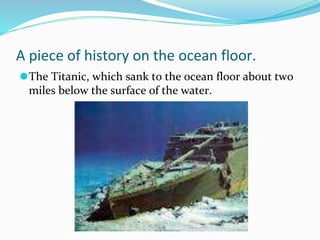
A piece of history on the ocean floor.
⚫The Titanic, which sank to the ocean floor about two
miles below the surface of the water.
Deep Ocean Floor Features
⚫The abyssal plain – A wide, open, and flat part of the
ocean floor. Think of the plains in North America –
just the same, only these are under water!
⚫Deep sea trenches are the deepest part of the ocean.
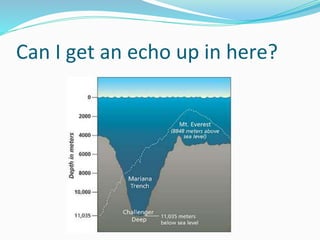
Marianas Trench, in the Pacific Ocean, is more than
35,000 feet deep!! That’s around 7 miles!!
⚫You will also find mountain ranges, called mid-ocean
ridges, on the ocean floor. In fact, the Mid-Atlantic
Ridge, which we have to cross on our underwater
hike, is the world’s longest mountain chain!
More Deep Ocean Floor Features
⚫Seamounts are underwater mountains that have not
broken the surface of the water. Seamounts are
usually formed from extinct volcanoes.
⚫If the volcano that makes a seamount remains active
and continues growing, it could break the surface of
the ocean and become an island!! The islands of
Hawaii were formed when seamounts kept growing
right out of the water!!
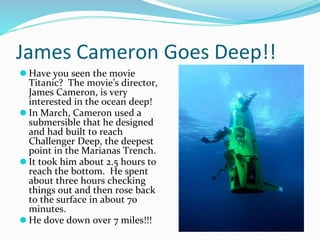
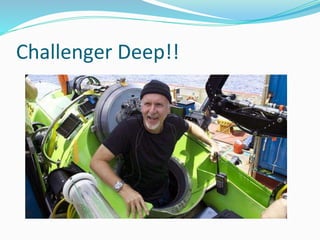
James Cameron Goes Deep!!
⚫ Have you seen the movie
Titanic? The movie’s director,
James Cameron, is very
interested in the ocean deep!
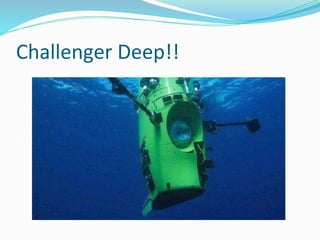
⚫ In March, Cameron used a
submersible that he designed
and had built to reach
Challenger Deep, the deepest
point in the Marianas Trench.
⚫ It took him about 2.5 hours to
reach the bottom. He spent
about three hours checking
things out and then rose back
to the surface in about 70
minutes.
⚫ He dove down over 7 miles!!!
Challenger Deep!!
Challenger Deep!!
Challenger Deep
Can I get an echo up in here?
Time to climb a mountain!
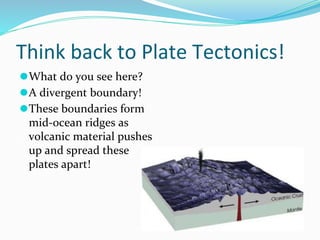
Think back to Plate Tectonics!
⚫What do you see here?
⚫A divergent boundary!
⚫These boundaries form
mid-ocean ridges as
volcanic material pushes
up and spread these
plates apart!
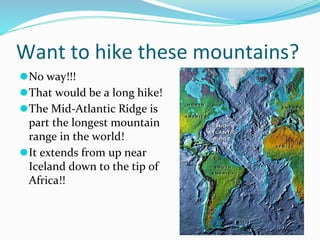
Want to hike these mountains?
⚫No way!!!
⚫That would be a long hike!
⚫The Mid-Atlantic Ridge is
part the longest mountain
range in the world!
⚫It extends from up near
Iceland down to the tip of
Africa!!
Who was paying attention?
⚫What is the shallowest part of the ocean floor?
⚫What is at the edge of the continental shelf that
plunges steeply downward towards the deep ocean
bottom?
⚫What is a deposit of sediment and other materials
that are washed off the continental shelf and down
the continental slope by ocean currents?
⚫How many miles deep is the deep ocean floor?
⚫How much of the Earth’s surface area does the deep
ocean floor cover?

ocean floor

  • 1.
    Take A WalkWith Me . . . . The Ocean Floor
  • 2.
    Time to suitup!!! ⚫We’re going on a little walk. ⚫Okay, a big walk. ⚫We are going to start on the beach here in Virginia and we are going to walk east. ⚫Any idea where we will end up? ⚫Hopefully, Portugal or Spain!! ⚫Get your suit on and fire up your imagination!!
  • 3.
    This is yourguide speaking . . . ⚫First off, what do you think we will see on our trip? ⚫What will the ocean floor look like? ⚫What geographic features will we see? ⚫Hills ⚫Mountains ⚫Canyons ⚫Wide plains ⚫Basically, if you can see it on dry ground, you can find it on the ocean floor!
  • 4.
    Starting out!!! ⚫The ContinentalShelf ⚫Surround each of the large land masses on Earth is a wide, shallow ridge. This is the first – and shallowest – part of the ocean floor. ⚫On average, it extends out about 45 miles from the edge of a continent. It can, however, be as small as a couple miles or as long as 200 miles. ⚫If you wade out into the water at the beach, you are standing on the shallowest part of the continental shelf!! The water will be just inches deep!
  • 5.
    More on thecontinental shelf! ⚫The continental shelf is long and flat! ⚫When walking across it, you will probably notice small hills, ridges, and small canyons, but the water doesn’t get very deep – usually around 450 feet - on the continental shelf. ⚫The continental shelf gradually extends away from the continent until it reaches a point where it drops steeply to the deep ocean floor. ⚫Look out! That next step could be a doozy!
  • 6.
  • 7.
  • 8.
    Watch that nextstep!! ⚫If you aren’t paying attention on our little walk, the first step at the edge of the continental shelf could send you tuckus over tea kettle! ⚫At the edge of the continental shelf, the continental slope plunges steeply downward towards the deep ocean bottom, or oceanic crust. ⚫Better be careful or you will go rolling, rolling, rolling to the deep!!
  • 9.
  • 10.
    And to oureastern border!
  • 11.
    Watch out forthe speed bump! ⚫Before reaching the deep ocean floor, you have to get over the continental rise. ⚫The continental rise is a deposit of sediment and other material washed off the continental shelf and down the continental slope by ocean currents. ⚫All this stuff collects at the bottom of the slope. It can be a big bump or just a long slope – it just depends on the strength of the current and how much stuff gets swept down there.
  • 12.
  • 13.
    Rise . .. . AGAIN!!!
  • 14.
    Finally . .. . The Abyss!! ⚫After climbing over the continental rise, you will now be on the deep ocean floor, which is also known as the deep ocean basin or the abyss. ⚫On average, the deep ocean floor is between 2.5 to 3.5 miles deep, and it covers 30% of the Earth’s surface area. ⚫Every feature you could find on dry ground can be found on the deep ocean floor – canyons, mountain ranges, individual mountains, hills, valleys . . . . You name it, it’s there. (Maybe – if you don’t name anything whacky!!)
  • 15.
  • 16.
    A piece ofhistory on the ocean floor. ⚫The Titanic, which sank to the ocean floor about two miles below the surface of the water.
  • 17.
    Deep Ocean FloorFeatures ⚫The abyssal plain – A wide, open, and flat part of the ocean floor. Think of the plains in North America – just the same, only these are under water! ⚫Deep sea trenches are the deepest part of the ocean. Marianas Trench, in the Pacific Ocean, is more than 35,000 feet deep!! That’s around 7 miles!! ⚫You will also find mountain ranges, called mid-ocean ridges, on the ocean floor. In fact, the Mid-Atlantic Ridge, which we have to cross on our underwater hike, is the world’s longest mountain chain!
  • 18.
    More Deep OceanFloor Features ⚫Seamounts are underwater mountains that have not broken the surface of the water. Seamounts are usually formed from extinct volcanoes. ⚫If the volcano that makes a seamount remains active and continues growing, it could break the surface of the ocean and become an island!! The islands of Hawaii were formed when seamounts kept growing right out of the water!!
  • 19.
    James Cameron GoesDeep!! ⚫ Have you seen the movie Titanic? The movie’s director, James Cameron, is very interested in the ocean deep! ⚫ In March, Cameron used a submersible that he designed and had built to reach Challenger Deep, the deepest point in the Marianas Trench. ⚫ It took him about 2.5 hours to reach the bottom. He spent about three hours checking things out and then rose back to the surface in about 70 minutes. ⚫ He dove down over 7 miles!!!
  • 20.
  • 21.
  • 22.
  • 23.
    Can I getan echo up in here?
  • 24.
    Time to climba mountain!
  • 25.
    Think back toPlate Tectonics! ⚫What do you see here? ⚫A divergent boundary! ⚫These boundaries form mid-ocean ridges as volcanic material pushes up and spread these plates apart!
  • 26.
    Want to hikethese mountains? ⚫No way!!! ⚫That would be a long hike! ⚫The Mid-Atlantic Ridge is part the longest mountain range in the world! ⚫It extends from up near Iceland down to the tip of Africa!!
  • 27.
    Who was payingattention? ⚫What is the shallowest part of the ocean floor? ⚫What is at the edge of the continental shelf that plunges steeply downward towards the deep ocean bottom? ⚫What is a deposit of sediment and other materials that are washed off the continental shelf and down the continental slope by ocean currents? ⚫How many miles deep is the deep ocean floor? ⚫How much of the Earth’s surface area does the deep ocean floor cover?