EARTH SCIENCE
Directions: Read each slide
use the RED underlined words to
complete the organizer.
Tarbuck Lutgens
Directions: READ each slide then
decide what is important to record (Use
the RED & or
underlined words).
Some slides are just FACTS
(Read them) others you will
need to use for the organizer.
Chapter
13
Ocean Water
S6E3. Obtain, evaluate, and communicate information to recognize
the significant role of water in Earth processes.
c. Ask questions to identify and communicate, using graphs and maps,
the composition, location, and subsurface topography of the world’s
oceans.
Learning Target: I can tell about underneath the
ocean, the Earth has plains, mountains, and valleys,
what the ocean is made up of, and where the oceans
are located.
Guiding Question
• Is the ocean the same everywhere?
• How many oceans are there?
• What is the composition of ocean water?
Salinity
13.1 The Ocean’s Composition
 Salinity is the total amount of solid
material dissolved in water.
 Because the proportion of dissolved
substances in seawater is such a small
number, oceanographers typically express
salinity in parts per thousands.
 Most of the salt in seawater is sodium chloride,
common table salt.
Salinity
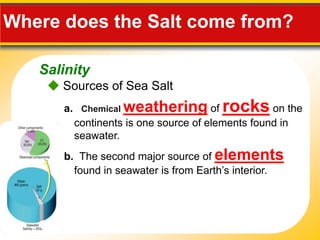
Where does the Salt come from?
 Sources of Sea Salt
a. Chemical weathering of rocks on the
continents is one source of elements found in
seawater.
b. The second major source of elements
found in seawater is from Earth’s interior.
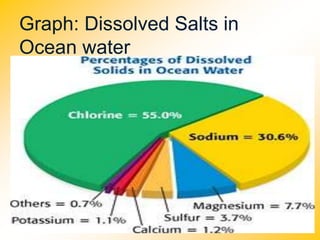
Graph: Dissolved Salts in
Ocean water
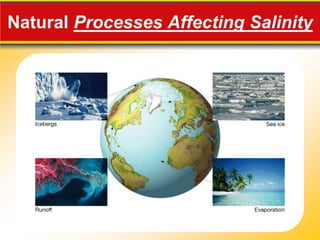
Natural Processes Affecting Salinity
Salinity
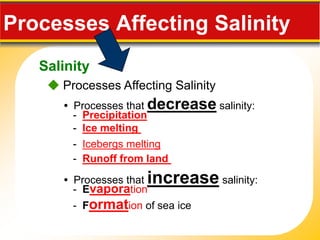
 Processes Affecting Salinity
Processes Affecting Salinity
• Processes that decrease salinity:
• Processes that increase salinity:
- Precipitation
- Runoff from land
- Icebergs melting
- Ice melting
- Evaporation
- Formation of sea ice
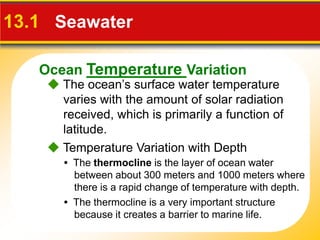
Ocean Temperature Variation
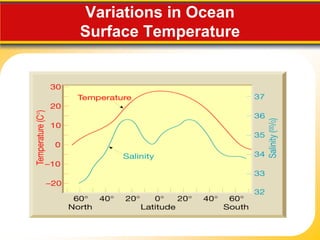
 The ocean’s surface water temperature
varies with the amount of solar radiation
received, which is primarily a function of
latitude.
13.1 Seawater
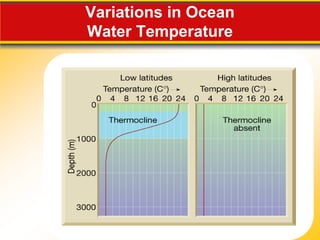
• The thermocline is the layer of ocean water
between about 300 meters and 1000 meters where
there is a rapid change of temperature with depth.
 Temperature Variation with Depth
• The thermocline is a very important structure
because it creates a barrier to marine life.
Variations in Ocean
Surface Temperature
Variations in Ocean
Water Temperature
Ocean Density Variation
 Density is defined as mass per unit volume.
It can be thought of as a measure of how
heavy something is for its size.
13.1 Factors Affecting Seawater Density
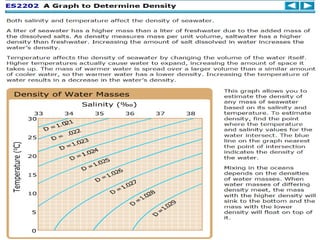
• Seawater density is influenced by two main factors:
salinity and temperature.
 Factors Affecting Seawater Density
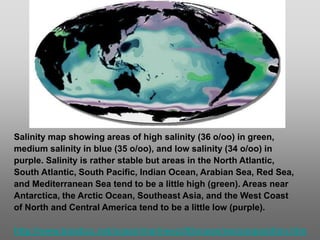
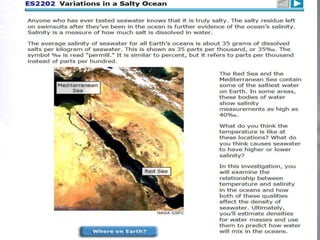
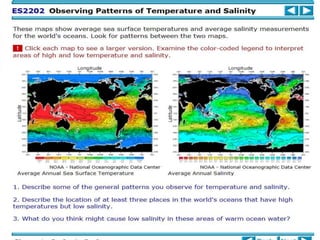
Salinity map showing areas of high salinity (36 o/oo) in green,
medium salinity in blue (35 o/oo), and low salinity (34 o/oo) in
purple. Salinity is rather stable but areas in the North Atlantic,
South Atlantic, South Pacific, Indian Ocean, Arabian Sea, Red Sea,
and Mediterranean Sea tend to be a little high (green). Areas near
Antarctica, the Arctic Ocean, Southeast Asia, and the West Coast
of North and Central America tend to be a little low (purple).
http://www.biosbcc.net/ocean/marinesci/02ocean/swcomposition.htm
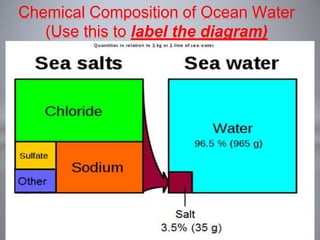
Chemical Composition of Ocean Water
(Use this to label the diagram)
Making connections
Read the next sides when you are finished go
to Classzone and explore salinity and the
ocean
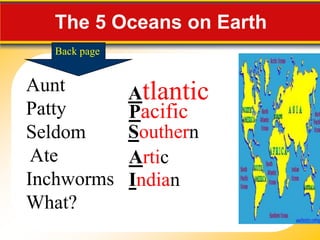
Aunt
Patty
Seldom
Ate
Inchworms
What?
The 5 Oceans on Earth
Atlantic
Southern
Artic
Indian
Pacific
Back page
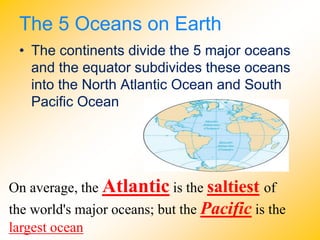
The 5 Oceans on Earth
• The continents divide the 5 major oceans
and the equator subdivides these oceans
into the North Atlantic Ocean and South
Pacific Ocean
On average, the Atlantic is the saltiest of
the world's major oceans; but the Pacific is the
largest ocean
Ocean Topography:
*Oceanographers studying the oceans and ocean floor have delineated three (3)
major units:
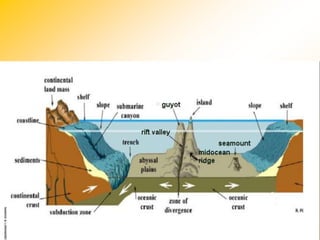
1. Continental margin
2. Ocean basin floor
3. Mid-oceanic ridges
Surprisingly, we know very little about the mapping of our ocean floor. We probably have
accurately mapped only 5% of the ocean floor. It is time-consuming, expensive, and
our current technology only allows us to map a few miles at a stretch.
As technology develops, mapping will improve. Currently, we use echo-sounding
devices, which are slow and tedious.
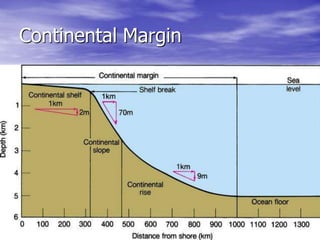
1. The continental margin includes:
a. Continental shelf -- very gentle slope (submerged land)
b. Continental slope -- steep slope on edge of continental shelf.
c. Continental rise -- gentle slope where trenches do not exist
Deep sea fans exist where sediment is accumulated and falls off of the continental
slope. Mixture of sediment-laden heavy water forms submarine turbidity currents.
Continental Margin
2. The Deep Sea includes:
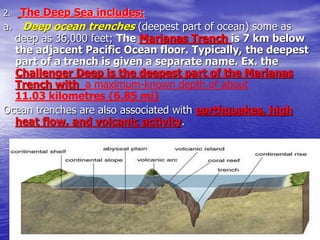
a. Deep ocean trenches (deepest part of ocean) some as
deep as 36,000 feet; The Marianas Trench is 7 km below
the adjacent Pacific Ocean floor. Typically, the deepest
part of a trench is given a separate name. Ex. the
Challenger Deep is the deepest part of the Marianas
Trench with a maximum-known depth of about
11.03 kilometres (6.85 mi)
Ocean trenches are also associated with earthquakes, high
heat flow, and volcanic activity.
The Deep Sea includes:
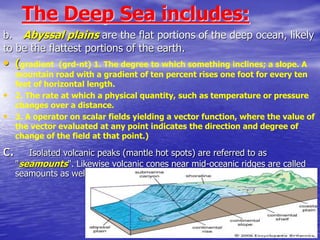
b. Abyssal plains are the flat portions of the deep ocean, likely
to be the flattest portions of the earth.
• (gradient (grd-nt) 1. The degree to which something inclines; a slope. A
mountain road with a gradient of ten percent rises one foot for every ten
feet of horizontal length.
• 2. The rate at which a physical quantity, such as temperature or pressure
changes over a distance.
• 3. A operator on scalar fields yielding a vector function, where the value of
the vector evaluated at any point indicates the direction and degree of
change of the field at that point.)
c. Isolated volcanic peaks (mantle hot spots) are referred to as
"seamounts". Likewise volcanic cones near mid-oceanic ridges are called
seamounts as well. Harry Hess called these “guyots”.
Examples of mid-ocean
ridges
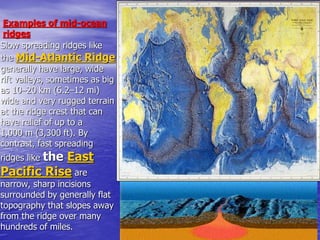
Slow spreading ridges like
the Mid-Atlantic Ridge
generally have large, wide
rift valleys, sometimes as big
as 10–20 km (6.2–12 mi)
wide and very rugged terrain
at the ridge crest that can
have relief of up to a
1,000 m (3,300 ft). By
contrast, fast spreading
ridges like the East
Pacific Rise are
narrow, sharp incisions
surrounded by generally flat
topography that slopes away
from the ridge over many
hundreds of miles.
Technology: Exploring the
Ocean Floor
1. How can scientists study the ocean floor?
2. What did they find?
3. With state of the art technology, scientists
have discovered a wide variety of landforms
and sea life on the ocean floor.
Underwater Explorer
• Some parts of the ocean are too deep for
humans and so they must use special
underwater equipment.
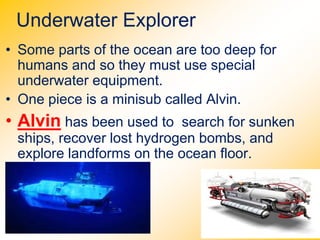
• One piece is a minisub called Alvin.
• Alvin has been used to search for sunken
ships, recover lost hydrogen bombs, and
explore landforms on the ocean floor.
Viewing the ocean floor with sonar
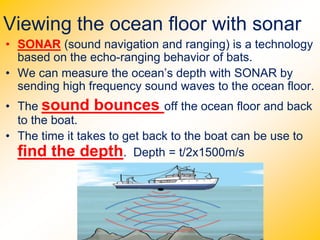
• SONAR (sound navigation and ranging) is a technology
based on the echo-ranging behavior of bats.
• We can measure the ocean’s depth with SONAR by
sending high frequency sound waves to the ocean floor.
• The sound bounces off the ocean floor and back
to the boat.
• The time it takes to get back to the boat can be use to
find the depth. Depth = t/2x1500m/s
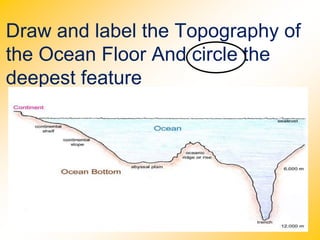
Draw and label the Topography of
the Ocean Floor And circle the
deepest feature
Go back to ikeepbookmarks
Classzone. How Do
Temperature and Salinity
Affect Mixing in the Oceans?
or the BLOG
or USATESTPREP
Review any concept
• Congratulation Oceanographer
– Job well done!

The ocean's composition & location

  • 1.
    EARTH SCIENCE Directions: Readeach slide use the RED underlined words to complete the organizer. Tarbuck Lutgens
  • 2.
    Directions: READ eachslide then decide what is important to record (Use the RED & or underlined words). Some slides are just FACTS (Read them) others you will need to use for the organizer.
  • 3.
    Chapter 13 Ocean Water S6E3. Obtain,evaluate, and communicate information to recognize the significant role of water in Earth processes. c. Ask questions to identify and communicate, using graphs and maps, the composition, location, and subsurface topography of the world’s oceans. Learning Target: I can tell about underneath the ocean, the Earth has plains, mountains, and valleys, what the ocean is made up of, and where the oceans are located.
  • 4.
    Guiding Question • Isthe ocean the same everywhere? • How many oceans are there? • What is the composition of ocean water?
  • 5.
    Salinity 13.1 The Ocean’sComposition  Salinity is the total amount of solid material dissolved in water.  Because the proportion of dissolved substances in seawater is such a small number, oceanographers typically express salinity in parts per thousands.  Most of the salt in seawater is sodium chloride, common table salt.
  • 6.
    Salinity Where does theSalt come from?  Sources of Sea Salt a. Chemical weathering of rocks on the continents is one source of elements found in seawater. b. The second major source of elements found in seawater is from Earth’s interior.
  • 7.
    Graph: Dissolved Saltsin Ocean water
  • 8.
  • 9.
    Salinity  Processes AffectingSalinity Processes Affecting Salinity • Processes that decrease salinity: • Processes that increase salinity: - Precipitation - Runoff from land - Icebergs melting - Ice melting - Evaporation - Formation of sea ice
  • 10.
    Ocean Temperature Variation The ocean’s surface water temperature varies with the amount of solar radiation received, which is primarily a function of latitude. 13.1 Seawater • The thermocline is the layer of ocean water between about 300 meters and 1000 meters where there is a rapid change of temperature with depth.  Temperature Variation with Depth • The thermocline is a very important structure because it creates a barrier to marine life.
  • 11.
  • 12.
  • 13.
    Ocean Density Variation Density is defined as mass per unit volume. It can be thought of as a measure of how heavy something is for its size. 13.1 Factors Affecting Seawater Density • Seawater density is influenced by two main factors: salinity and temperature.  Factors Affecting Seawater Density
  • 14.
    Salinity map showingareas of high salinity (36 o/oo) in green, medium salinity in blue (35 o/oo), and low salinity (34 o/oo) in purple. Salinity is rather stable but areas in the North Atlantic, South Atlantic, South Pacific, Indian Ocean, Arabian Sea, Red Sea, and Mediterranean Sea tend to be a little high (green). Areas near Antarctica, the Arctic Ocean, Southeast Asia, and the West Coast of North and Central America tend to be a little low (purple). http://www.biosbcc.net/ocean/marinesci/02ocean/swcomposition.htm
  • 15.
    Chemical Composition ofOcean Water (Use this to label the diagram)
  • 16.
    Making connections Read thenext sides when you are finished go to Classzone and explore salinity and the ocean
  • 20.
    Aunt Patty Seldom Ate Inchworms What? The 5 Oceanson Earth Atlantic Southern Artic Indian Pacific Back page
  • 22.
    The 5 Oceanson Earth • The continents divide the 5 major oceans and the equator subdivides these oceans into the North Atlantic Ocean and South Pacific Ocean On average, the Atlantic is the saltiest of the world's major oceans; but the Pacific is the largest ocean
  • 23.
    Ocean Topography: *Oceanographers studyingthe oceans and ocean floor have delineated three (3) major units: 1. Continental margin 2. Ocean basin floor 3. Mid-oceanic ridges Surprisingly, we know very little about the mapping of our ocean floor. We probably have accurately mapped only 5% of the ocean floor. It is time-consuming, expensive, and our current technology only allows us to map a few miles at a stretch. As technology develops, mapping will improve. Currently, we use echo-sounding devices, which are slow and tedious. 1. The continental margin includes: a. Continental shelf -- very gentle slope (submerged land) b. Continental slope -- steep slope on edge of continental shelf. c. Continental rise -- gentle slope where trenches do not exist Deep sea fans exist where sediment is accumulated and falls off of the continental slope. Mixture of sediment-laden heavy water forms submarine turbidity currents.
  • 24.
  • 25.
    2. The DeepSea includes: a. Deep ocean trenches (deepest part of ocean) some as deep as 36,000 feet; The Marianas Trench is 7 km below the adjacent Pacific Ocean floor. Typically, the deepest part of a trench is given a separate name. Ex. the Challenger Deep is the deepest part of the Marianas Trench with a maximum-known depth of about 11.03 kilometres (6.85 mi) Ocean trenches are also associated with earthquakes, high heat flow, and volcanic activity.
  • 26.
    The Deep Seaincludes: b. Abyssal plains are the flat portions of the deep ocean, likely to be the flattest portions of the earth. • (gradient (grd-nt) 1. The degree to which something inclines; a slope. A mountain road with a gradient of ten percent rises one foot for every ten feet of horizontal length. • 2. The rate at which a physical quantity, such as temperature or pressure changes over a distance. • 3. A operator on scalar fields yielding a vector function, where the value of the vector evaluated at any point indicates the direction and degree of change of the field at that point.) c. Isolated volcanic peaks (mantle hot spots) are referred to as "seamounts". Likewise volcanic cones near mid-oceanic ridges are called seamounts as well. Harry Hess called these “guyots”.
  • 27.
    Examples of mid-ocean ridges Slowspreading ridges like the Mid-Atlantic Ridge generally have large, wide rift valleys, sometimes as big as 10–20 km (6.2–12 mi) wide and very rugged terrain at the ridge crest that can have relief of up to a 1,000 m (3,300 ft). By contrast, fast spreading ridges like the East Pacific Rise are narrow, sharp incisions surrounded by generally flat topography that slopes away from the ridge over many hundreds of miles.
  • 28.
    Technology: Exploring the OceanFloor 1. How can scientists study the ocean floor? 2. What did they find? 3. With state of the art technology, scientists have discovered a wide variety of landforms and sea life on the ocean floor.
  • 29.
    Underwater Explorer • Someparts of the ocean are too deep for humans and so they must use special underwater equipment. • One piece is a minisub called Alvin. • Alvin has been used to search for sunken ships, recover lost hydrogen bombs, and explore landforms on the ocean floor.
  • 30.
    Viewing the oceanfloor with sonar • SONAR (sound navigation and ranging) is a technology based on the echo-ranging behavior of bats. • We can measure the ocean’s depth with SONAR by sending high frequency sound waves to the ocean floor. • The sound bounces off the ocean floor and back to the boat. • The time it takes to get back to the boat can be use to find the depth. Depth = t/2x1500m/s
  • 31.
    Draw and labelthe Topography of the Ocean Floor And circle the deepest feature
  • 33.
    Go back toikeepbookmarks Classzone. How Do Temperature and Salinity Affect Mixing in the Oceans? or the BLOG or USATESTPREP Review any concept • Congratulation Oceanographer – Job well done!