Mid-Ocean Ridges
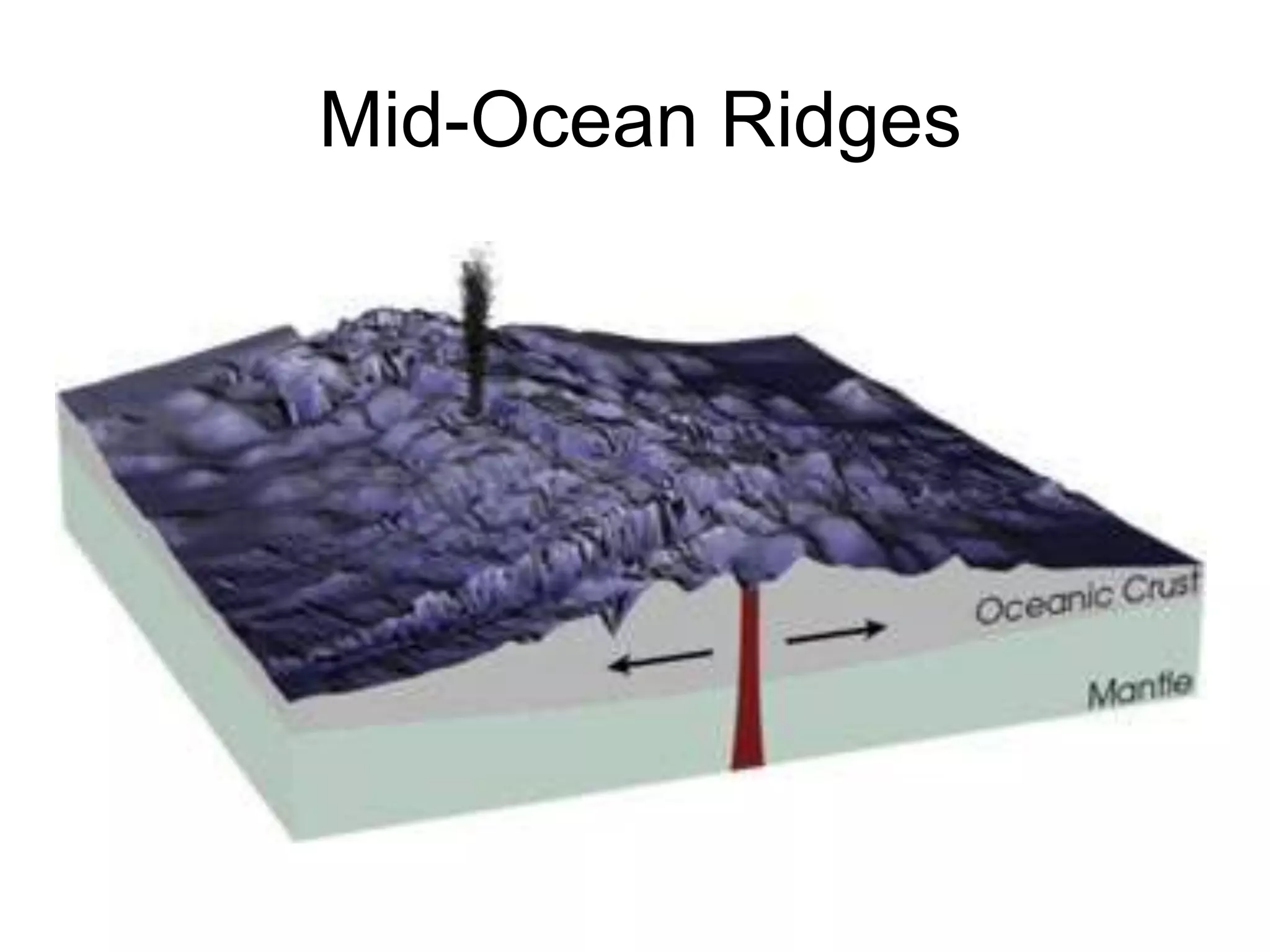
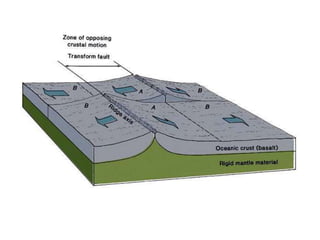
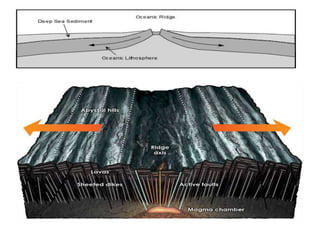
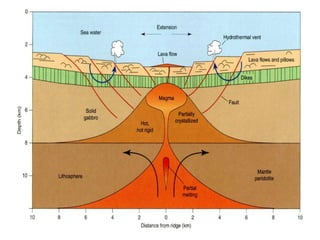
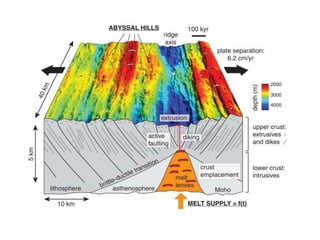
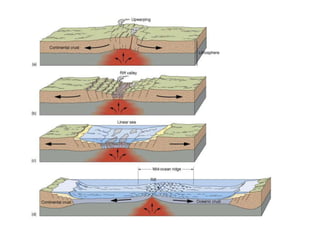
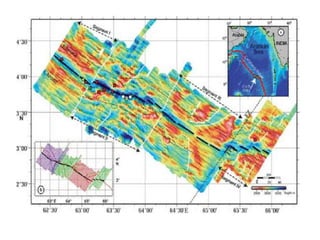
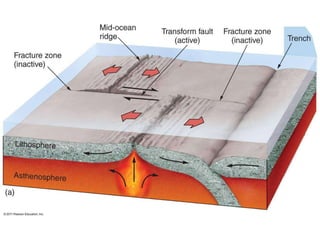
A mid-ocean ridge is an underwater mountain system formed
by plate tectonics. It consists of various mountains linked in
chains, typically having a valley known as a rift running along
its spine.
This type of oceanic mountain ridge is characteristic of what is
known as an oceanic spreading center, which is responsible
for seafloor spreading.
The production of new seafloor results
from mantle upwelling in response to plate spreading;
this isentropic upwelling solid mantle material eventually
exceeds the solidus and melts.
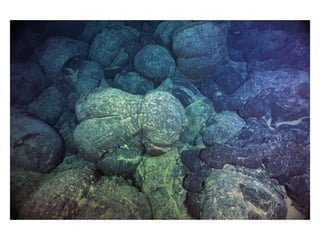
The buoyant melt rises as magma at a linear weakness in
the oceanic crust, and emerges as lava, creating new crust
upon cooling.
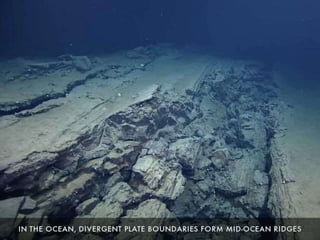
A mid-ocean ridge demarcates the boundary between
two tectonic plates, and consequently is termed a divergent
plate boundary.
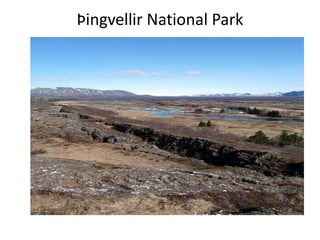
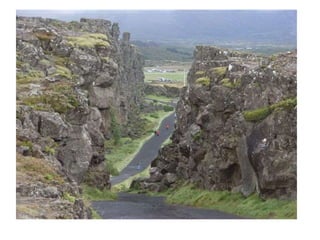
Þingvellir National Park
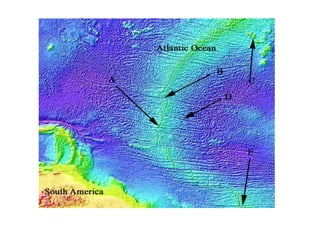
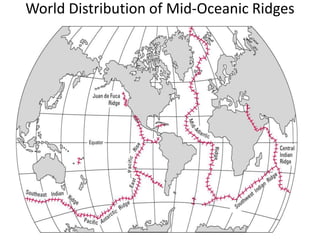
World Distribution of Mid-Oceanic Ridges
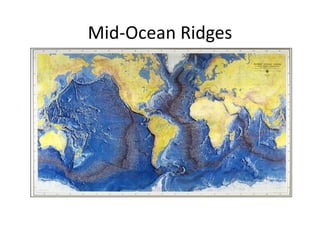
Mid-Ocean Ridges
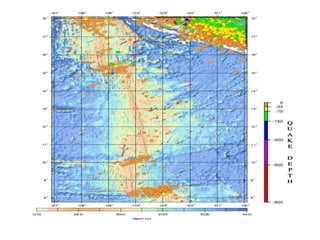
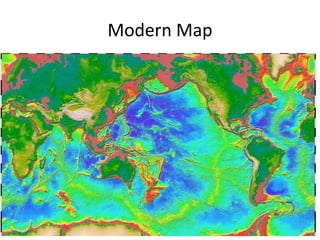
Modern Map
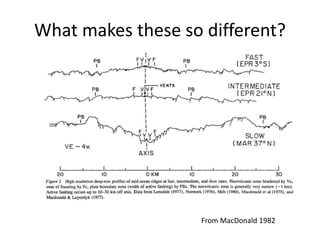
What makes these so different?
From MacDonald 1982
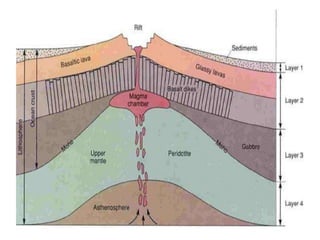
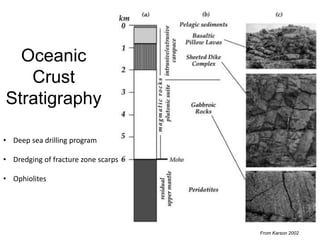
Oceanic
Crust
Stratigraphy
From Karson 2002
• Deep sea drilling program
• Dredging of fracture zone scarps
• Ophiolites
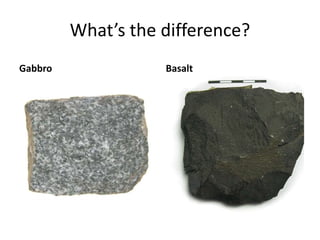
What’s the difference?
Gabbro Basalt
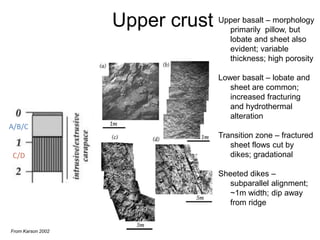
Upper crust
From Karson 2002
Upper basalt – morphology
primarily pillow, but
lobate and sheet also
evident; variable
thickness; high porosity
Lower basalt – lobate and
sheet are common;
increased fracturing
and hydrothermal
alteration
Transition zone – fractured
sheet flows cut by
dikes; gradational
Sheeted dikes –
subparallel alignment;
~1m width; dip away
from ridge
A/B/C
C/D
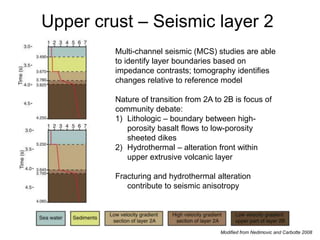
Modified from Nedimovic and Carbotte 2008
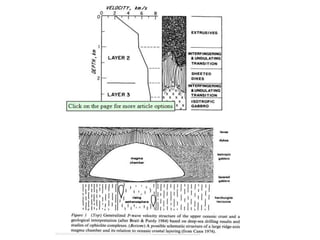
Upper crust – Seismic layer 2
Multi-channel seismic (MCS) studies are able
to identify layer boundaries based on
impedance contrasts; tomography identifies
changes relative to reference model
Nature of transition from 2A to 2B is focus of
community debate:
1) Lithologic – boundary between high-
porosity basalt flows to low-porosity
sheeted dikes
2) Hydrothermal – alteration front within
upper extrusive volcanic layer
Fracturing and hydrothermal alteration
contribute to seismic anisotropy
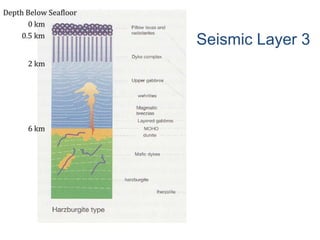
Seismic Layer 3
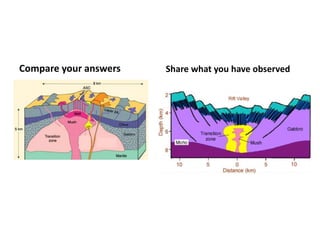
Compare your answers Share what you have observed
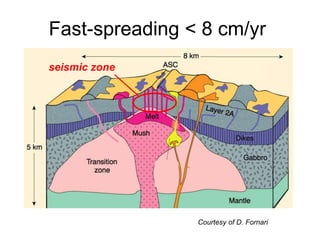
Fast-spreading < 8 cm/yr
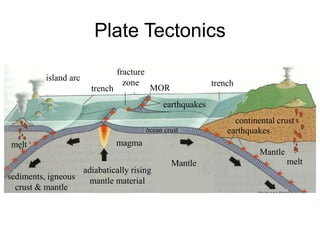
seismic zone
Courtesy of D. Fornari
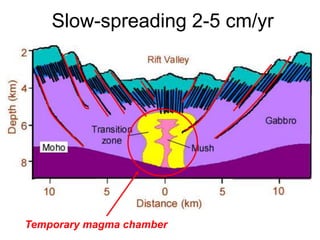
Slow-spreading 2-5 cm/yr
Temporary magma chamber
Mantle melt
adiabatically rising
mantle material
magma
MOR
Mantle
sediments, igneous
crust & mantle
island arc
trench
earthquakes
ocean crust earthquakes
continental crust
melt
fracture
zone
trench
Plate Tectonics
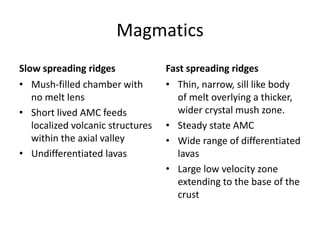
Magmatics
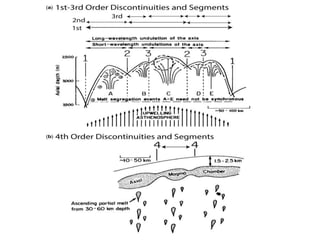
Slow spreading ridges
• Mush-filled chamber with
no melt lens
• Short lived AMC feeds
localized volcanic structures
within the axial valley
• Undifferentiated lavas
Fast spreading ridges
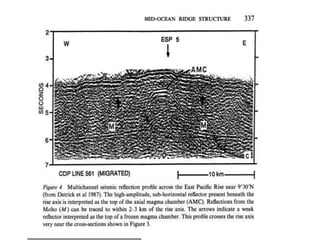
• Thin, narrow, sill like body
of melt overlying a thicker,
wider crystal mush zone.
• Steady state AMC
• Wide range of differentiated
lavas
• Large low velocity zone
extending to the base of the
crust
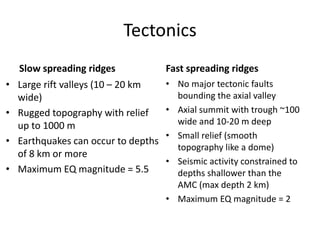
Tectonics
Slow spreading ridges
• Large rift valleys (10 – 20 km
wide)
• Rugged topography with relief
up to 1000 m
• Earthquakes can occur to depths
of 8 km or more
• Maximum EQ magnitude = 5.5
Fast spreading ridges
• No major tectonic faults
bounding the axial valley
• Axial summit with trough ~100
wide and 10-20 m deep
• Small relief (smooth
topography like a dome)
• Seismic activity constrained to
depths shallower than the
AMC (max depth 2 km)
• Maximum EQ magnitude = 2
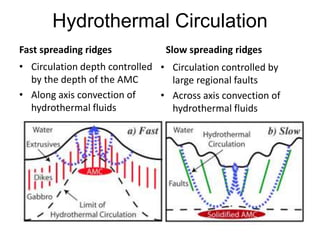
Hydrothermal Circulation
Fast spreading ridges
• Circulation depth controlled
by the depth of the AMC
• Along axis convection of
hydrothermal fluids
Slow spreading ridges
• Circulation controlled by
large regional faults
• Across axis convection of
hydrothermal fluids
What about intermediate
spreading-rate ridges
4-8 cm/yr
Are they more like slow or fast
spreading ridges
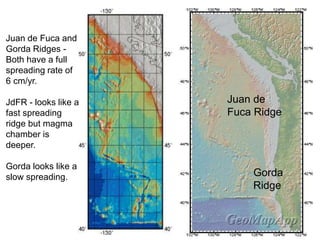
Juan de Fuca and
Gorda Ridges -
Both have a full
spreading rate of
6 cm/yr.
JdFR - looks like a
fast spreading
ridge but magma
chamber is
deeper.
Gorda looks like a
slow spreading. Gorda
Ridge
Juan de
Fuca Ridge
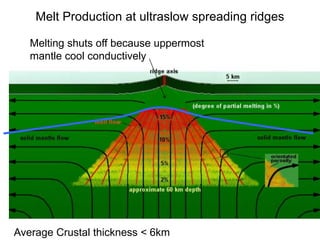
Melt Production at ultraslow spreading ridges
Melting shuts off because uppermost
mantle cool conductively
Average Crustal thickness < 6km
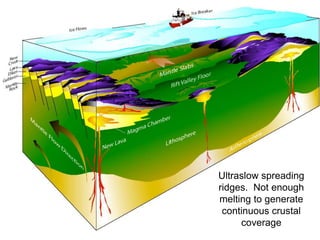
Ultraslow spreading
ridges. Not enough
melting to generate
continuous crustal
coverage
Midoceanic ridges
Midoceanic ridges
Midoceanic ridges
Midoceanic ridges
Midoceanic ridges
Midoceanic ridges

Midoceanic ridges

  • 1.
  • 2.
    A mid-ocean ridgeis an underwater mountain system formed by plate tectonics. It consists of various mountains linked in chains, typically having a valley known as a rift running along its spine. This type of oceanic mountain ridge is characteristic of what is known as an oceanic spreading center, which is responsible for seafloor spreading. The production of new seafloor results from mantle upwelling in response to plate spreading; this isentropic upwelling solid mantle material eventually exceeds the solidus and melts. The buoyant melt rises as magma at a linear weakness in the oceanic crust, and emerges as lava, creating new crust upon cooling. A mid-ocean ridge demarcates the boundary between two tectonic plates, and consequently is termed a divergent plate boundary.
  • 4.
  • 14.
    World Distribution ofMid-Oceanic Ridges
  • 15.
  • 16.
  • 17.
    What makes theseso different? From MacDonald 1982
  • 23.
    Oceanic Crust Stratigraphy From Karson 2002 •Deep sea drilling program • Dredging of fracture zone scarps • Ophiolites
  • 24.
  • 25.
    Upper crust From Karson2002 Upper basalt – morphology primarily pillow, but lobate and sheet also evident; variable thickness; high porosity Lower basalt – lobate and sheet are common; increased fracturing and hydrothermal alteration Transition zone – fractured sheet flows cut by dikes; gradational Sheeted dikes – subparallel alignment; ~1m width; dip away from ridge A/B/C C/D
  • 26.
    Modified from Nedimovicand Carbotte 2008 Upper crust – Seismic layer 2 Multi-channel seismic (MCS) studies are able to identify layer boundaries based on impedance contrasts; tomography identifies changes relative to reference model Nature of transition from 2A to 2B is focus of community debate: 1) Lithologic – boundary between high- porosity basalt flows to low-porosity sheeted dikes 2) Hydrothermal – alteration front within upper extrusive volcanic layer Fracturing and hydrothermal alteration contribute to seismic anisotropy
  • 27.
  • 28.
    Compare your answersShare what you have observed
  • 29.
    Fast-spreading < 8cm/yr seismic zone Courtesy of D. Fornari
  • 30.
  • 32.
    Mantle melt adiabatically rising mantlematerial magma MOR Mantle sediments, igneous crust & mantle island arc trench earthquakes ocean crust earthquakes continental crust melt fracture zone trench Plate Tectonics
  • 33.
    Magmatics Slow spreading ridges •Mush-filled chamber with no melt lens • Short lived AMC feeds localized volcanic structures within the axial valley • Undifferentiated lavas Fast spreading ridges • Thin, narrow, sill like body of melt overlying a thicker, wider crystal mush zone. • Steady state AMC • Wide range of differentiated lavas • Large low velocity zone extending to the base of the crust
  • 34.
    Tectonics Slow spreading ridges •Large rift valleys (10 – 20 km wide) • Rugged topography with relief up to 1000 m • Earthquakes can occur to depths of 8 km or more • Maximum EQ magnitude = 5.5 Fast spreading ridges • No major tectonic faults bounding the axial valley • Axial summit with trough ~100 wide and 10-20 m deep • Small relief (smooth topography like a dome) • Seismic activity constrained to depths shallower than the AMC (max depth 2 km) • Maximum EQ magnitude = 2
  • 35.
    Hydrothermal Circulation Fast spreadingridges • Circulation depth controlled by the depth of the AMC • Along axis convection of hydrothermal fluids Slow spreading ridges • Circulation controlled by large regional faults • Across axis convection of hydrothermal fluids
  • 36.
    What about intermediate spreading-rateridges 4-8 cm/yr Are they more like slow or fast spreading ridges
  • 37.
    Juan de Fucaand Gorda Ridges - Both have a full spreading rate of 6 cm/yr. JdFR - looks like a fast spreading ridge but magma chamber is deeper. Gorda looks like a slow spreading. Gorda Ridge Juan de Fuca Ridge
  • 38.
    Melt Production atultraslow spreading ridges Melting shuts off because uppermost mantle cool conductively Average Crustal thickness < 6km
  • 39.
    Ultraslow spreading ridges. Notenough melting to generate continuous crustal coverage