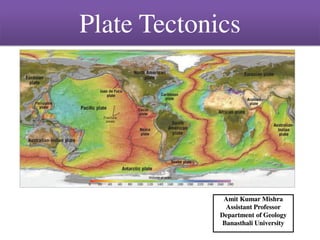
Plate Tectonics
Amit Kumar Mishra
Assistant Professor
Department of Geology
Banasthali University
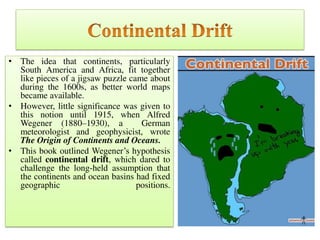
• The idea that continents, particularly
South America and Africa, fit together
like pieces of a jigsaw puzzle came about
during the 1600s, as better world maps
became available.
• However, little significance was given to
this notion until 1915, when Alfred
Wegener (1880–1930), a German
meteorologist and geophysicist, wrote
The Origin of Continents and Oceans.
• This book outlined Wegener’s hypothesis
called continental drift, which dared to
challenge the long-held assumption that
the continents and ocean basins had fixed
geographic positions.
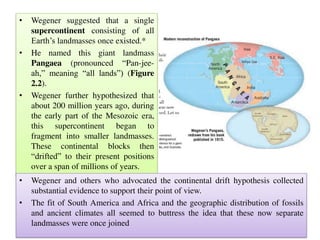
• Wegener suggested that a single
supercontinent consisting of all
Earth’s landmasses once existed.*
• He named this giant landmass
Pangaea (pronounced “Pan-jee-
ah,” meaning “all lands”) (Figure
2.2).
• Wegener further hypothesized that
about 200 million years ago, during
the early part of the Mesozoic era,
this supercontinent began to
fragment into smaller landmasses.
These continental blocks then
“drifted” to their present positions
over a span of millions of years.
• Wegener and others who advocated the continental drift hypothesis collected
substantial evidence to support their point of view.
• The fit of South America and Africa and the geographic distribution of fossils
and ancient climates all seemed to buttress the idea that these now separate
landmasses were once joined
Evidence: The Continental
Jigsaw Puzzle
• Like a few others before him, Wegener suspected that the
continents might once have been joined when he noticed the
remarkable similarity between the coastlines on opposite sides of
the Atlantic Ocean.
• However, other Earth scientists challenged Wegener’s use of
present-day shorelines to “fit” these continents together.
• These opponents correctly argued that wave erosion and
depositional processes continually modify shorelines.
• Even if continental displacement had taken place, a good fit today
would be unlikely. Because Wegener’s original jigsaw fit of the
continents was crude, it is assumed that he was aware of this
problem .
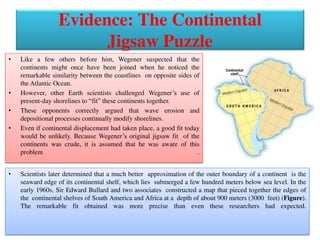
• Scientists later determined that a much better approximation of the outer boundary of a continent is the
seaward edge of its continental shelf, which lies submerged a few hundred meters below sea level. In the
early 1960s, Sir Edward Bullard and two associates constructed a map that pieced together the edges of
the continental shelves of South America and Africa at a depth of about 900 meters (3000 feet) (Figure).
The remarkable fit obtained was more precise than even these researchers had expected.
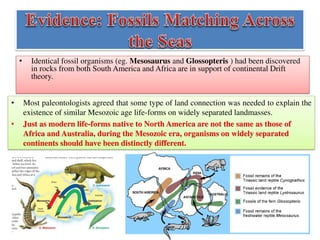
• Identical fossil organisms (eg. Mesosaurus and Glossopteris ) had been discovered
in rocks from both South America and Africa are in support of continental Drift
theory.
• Most paleontologists agreed that some type of land connection was needed to explain the
existence of similar Mesozoic age life-forms on widely separated landmasses.
• Just as modern life-forms native to North America are not the same as those of
Africa and Australia, during the Mesozoic era, organisms on widely separated
continents should have been distinctly different.
• Mesosaurus, a small aquatic freshwater reptile whose fossil remains are limited to black
shales of the Permian period (about 260 million years ago) in eastern South America and
southwestern Africa. If Mesosaurus had been able to make the long journey across the
South Atlantic, its remains should be more widely distributed.
• As this is not the case, Wegener asserted that South America and Africa must have been
joined during that period of Earth history.
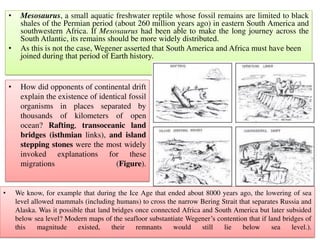
• How did opponents of continental drift
explain the existence of identical fossil
organisms in places separated by
thousands of kilometers of open
ocean? Rafting, transoceanic land
bridges (isthmian links), and island
stepping stones were the most widely
invoked explanations for these
migrations (Figure).
• We know, for example that during the Ice Age that ended about 8000 years ago, the lowering of sea
level allowed mammals (including humans) to cross the narrow Bering Strait that separates Russia and
Alaska. Was it possible that land bridges once connected Africa and South America but later subsided
below sea level? Modern maps of the seafloor substantiate Wegener’s contention that if land bridges of
this magnitude existed, their remnants would still lie below sea level.).
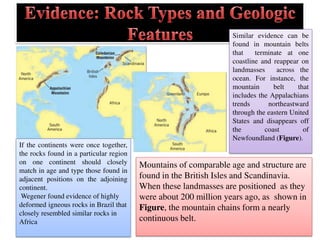
If the continents were once together,
the rocks found in a particular region
on one continent should closely
match in age and type those found in
adjacent positions on the adjoining
continent.
Wegener found evidence of highly
deformed igneous rocks in Brazil that
closely resembled similar rocks in
Africa
Mountains of comparable age and structure are
found in the British Isles and Scandinavia.
When these landmasses are positioned as they
were about 200 million years ago, as shown in
Figure, the mountain chains form a nearly
continuous belt.
Similar evidence can be
found in mountain belts
that terminate at one
coastline and reappear on
landmasses across the
ocean. For instance, the
mountain belt that
includes the Appalachians
trends northeastward
through the eastern United
States and disappears off
the coast of
Newfoundland (Figure).
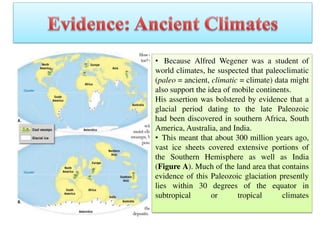
• Because Alfred Wegener was a student of
world climates, he suspected that paleoclimatic
(paleo = ancient, climatic = climate) data might
also support the idea of mobile continents.
His assertion was bolstered by evidence that a
glacial period dating to the late Paleozoic
had been discovered in southern Africa, South
America, Australia, and India.
• This meant that about 300 million years ago,
vast ice sheets covered extensive portions of
the Southern Hemisphere as well as India
(Figure A). Much of the land area that contains
evidence of this Paleozoic glaciation presently
lies within 30 degrees of the equator in
subtropical or tropical climates
• How could extensive ice sheets form near the equator? One proposal suggested that our
planet experienced a period of extreme global cooling. Wegener rejected this
explanation because during the same span of geologic time, large tropical swamps
existed in several locations in the Northern Hemisphere. The lush vegetation in these
swamps was eventually buried and converted to coal (Figure B).
• Today these deposits comprise major coal fields in the eastern United States and Northern
Europe. Many of the fossils found in these coal bearing rocks were produced by tree
ferns with large fronds—a fact consistent with warm, moist climates.**
• The existence of these large tropical swamps, Wegener argued, was inconsistent with the
proposal that extreme global cooling caused glaciers to form in areas that are currently
tropical.
• Wegener suggested a more plausible explanation for the late Paleozoic glaciation: the
supercontinent of Pangaea. The southern continents being joined together and located near
the South Pole would account for the polar conditions necessary to generate extensive
expanses of glacial ice over much of these landmasses (Figure B).
• At the same time, this geography places today’s northern continents nearer the equator and
accounts for the tropical swamps that generated the vast coal deposits.
How does a glacier develop in hot, arid central Australia? How do land animals migrate
across wide expanses of the ocean? As compelling as this evidence may have been, 50
years passed before most of the scientific community accepted the concept of continental
drift and the logical conclusions to which it led.
• Following World War II, oceanographers equipped
with new marine tools and ample funding from the
U.S. Office of Naval Research embarked on an
unprecedented period of oceanographic exploration.
• Over the next two decades, a much better picture of
large expanses of the seafloor slowly and
painstakingly began to emerge.
• From this work came the discovery of a global oceanic
ridge system that winds through all the major oceans.
• In other parts of the ocean, more new discoveries were
being made.
• Studies conducted in the western Pacific demonstrated
that earthquakes were occurring at great depths beneath
deep-ocean trenches.
• Of equal importance was the fact that dredging of the
seafloor did not bring up any oceanic crust that was
older than 180 million years. Further, sediment
accumulations in the deep ocean basins were found to
be thin, not the thousands of meters that were predicted.
• By 1968 these developments, among others, had led to
the unfolding of a far more encompassing theory than
continental drift, known as the theory of plate
tectonics (tekto = to build)
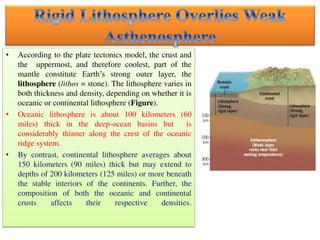
• According to the plate tectonics model, the crust and
the uppermost, and therefore coolest, part of the
mantle constitute Earth’s strong outer layer, the
lithosphere (lithos = stone). The lithosphere varies in
both thickness and density, depending on whether it is
oceanic or continental lithosphere (Figure).
• Oceanic lithosphere is about 100 kilometers (60
miles) thick in the deep-ocean basins but is
considerably thinner along the crest of the oceanic
ridge system.
• By contrast, continental lithosphere averages about
150 kilometers (90 miles) thick but may extend to
depths of 200 kilometers (125 miles) or more beneath
the stable interiors of the continents. Further, the
composition of both the oceanic and continental
crusts affects their respective densities.
• The asthenosphere (asthenos = weak) is a hotter, weaker region in the
mantle that lies below the lithosphere). The temperatures and pressures in
the upper asthenosphere (100 to 200 kilometers [60 to 125 miles] in
depth) are such that rocks at this depth are very near their melting
temperatures and, hence, respond to forces by flowing, similar to the way
a thick liquid would flow.
• By contrast, the relatively cool and rigid lithosphere tends to respond to
forces acting on it by bending or breaking but not flowing.
• Because of these differences, Earth’s rigid outer shell is effectively
detached from the asthenosphere, which allows these layers to move
independently .
• Oceanic crust is composed of basalt, rich in dense iron and magnesium,
whereas continental crust is composed largely of less dense granitic
rocks. Because of these differences, the overall density of oceanic lithosphere
(crust and upper mantle) is greater than the overall density of continental
lithosphere.
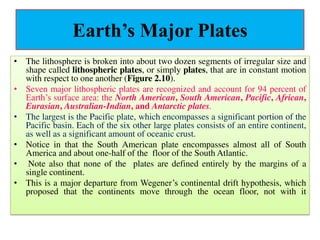
Earth’s Major Plates
• The lithosphere is broken into about two dozen segments of irregular size and
shape called lithospheric plates, or simply plates, that are in constant motion
with respect to one another (Figure 2.10).
• Seven major lithospheric plates are recognized and account for 94 percent of
Earth’s surface area: the North American, South American, Pacific, African,
Eurasian, Australian-Indian, and Antarctic plates.
• The largest is the Pacific plate, which encompasses a significant portion of the
Pacific basin. Each of the six other large plates consists of an entire continent,
as well as a significant amount of oceanic crust.
• Notice in that the South American plate encompasses almost all of South
America and about one-half of the floor of the South Atlantic.
• Note also that none of the plates are defined entirely by the margins of a
single continent.
• This is a major departure from Wegener’s continental drift hypothesis, which
proposed that the continents move through the ocean floor, not with it
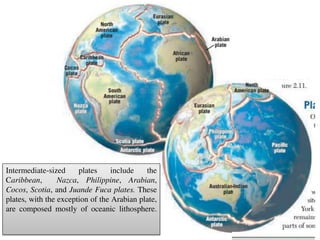
Intermediate-sized plates include the
Caribbean, Nazca, Philippine, Arabian,
Cocos, Scotia, and Juande Fuca plates. These
plates, with the exception of the Arabian plate,
are composed mostly of oceanic lithosphere.
• One of the main tenets of the plate tectonics theory is that plates
move as somewhat rigid units relative to all other plates.
• As plates move, the distance between two locations on different
plates, such as New York and London, gradually changes,
whereas the distance between sites on the same plate—New York
and Denver, for example—remains relatively constant.
• However, parts of some plates are comparatively “weak and can
become fragmented” such as southern China, which is literally
being squeezed as the Indian subcontinent rams into Asia
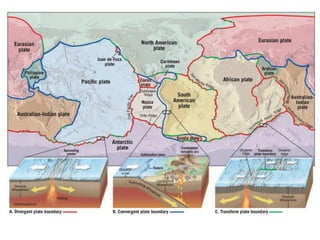
• Divergent plate boundaries —where two plates move
apart, resulting in upwelling and partial melting of hot
material from the mantle to create new seafloor.
• Convergent plate boundaries —where two plates move
together, resulting either in oceanic lithosphere descending
beneath an overriding plate, eventually to be reabsorbed
into the mantle, or possibly in the collision of two
continental blocks to create a mountain belt.
• Transform plate boundaries —where two plates grind past
each other without the production or destruction of
lithosphere . Divergent and convergent plate boundaries
each account for about 40 percent of all plate boundaries.
• Transform boundaries, or faults account for the remaining
20 percent. In the following sections we will summarize the
nature of the three types of plate boundaries.
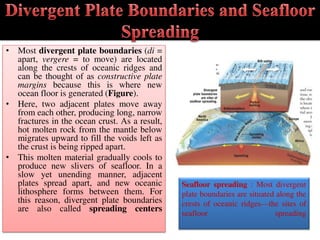
• Most divergent plate boundaries (di =
apart, vergere = to move) are located
along the crests of oceanic ridges and
can be thought of as constructive plate
margins because this is where new
ocean floor is generated (Figure).
• Here, two adjacent plates move away
from each other, producing long, narrow
fractures in the ocean crust. As a result,
hot molten rock from the mantle below
migrates upward to fill the voids left as
the crust is being ripped apart.
• This molten material gradually cools to
produce new slivers of seafloor. In a
slow yet unending manner, adjacent
plates spread apart, and new oceanic
lithosphere forms between them. For
this reason, divergent plate boundaries
are also called spreading centers
Seafloor spreading : Most divergent
plate boundaries are situated along the
crests of oceanic ridges—the sites of
seafloor spreading
• The majority of, but not all, divergent plate boundaries are associated with oceanic ridges:
elevated areas of the seafloor characterized by high heat flow and volcanism.
• The global oceanic ridge system is the longest topographic feature on Earth’s surface,
exceeding 70,000 kilometers (43,000 miles) in length.
• Various segments of the global ridge system have been named, including the Mid-Atlantic
Ridge, East Pacific Rise, and Mid-Indian Ridge.
• Representing 20 percent of Earth’s surface, the oceanic ridge system winds through all
major ocean basins, like the seams on a baseball. Although the crest of the oceanic ridge is
commonly 2 to 3 kilometers (1 to 2 miles) higher than the adjacent ocean basins, the term
ridge may be misleading because it implies “narrow” when, in fact, ridges vary in width
from 1000 kilometers (600 miles) to more than 4000 (2500 miles) kilometers.
• Further, along the crest of some ridge segments is a deep canyonlike structure called a rift
valley. This structure is evidence that tensional (opposing) forces are actively pulling the
ocean crust apart at the ridge crest.
• The mechanism that operates along the oceanic ridge system to create new seafloor is
appropriately called seafloor spreading. Spreading typically averages around 5
centimeters (2 inches) per year, roughly the same rate at which human fingernails grow.
• Comparatively slow spreading rates of 2 centimeters per year are found along the Mid-
Atlantic Ridge, whereas spreading rates exceeding 15 centimeters (6 inches) per year
have been measured along sections of the East Pacific Rise.
• Although these rates of seafloor production are slow on a human time scale, they are
nevertheless rapid enough to have generated all of Earth’s ocean basins within the
past 200 million years.
• The primary reason for the elevated position of the oceanic ridge is that newly created
oceanic lithosphere is hot and, therefore, less dense than cooler rocks found away from the
ridge axis. (Geologists use the term axis to refer to a line that follows the general trend of
the ridge crest.)
• As soon as new lithosphere forms, it is slowly yet continually displaced away from the
zone of upwelling. Thus, it begins to cool and contract, thereby increasing in density.
• This thermal contraction accounts for the increase in ocean depths away from the
ridge crest. It takes about 80 million years for the temperature of oceanic lithosphere to
stabilize and contraction to cease. By this time, rock that was once part of the elevated
oceanic ridge system is located in the deep-ocean basin, where it may be buried by
substantial accumulations of sediment.
• In addition, as the plate moves away from the ridge, cooling of the underlying
asthenosphere causes it to become increasingly more rigid.
• Thus, oceanic lithosphere is generated by cooling of the asthenosphere from the top down.
Stated another way, the thickness of oceanic lithosphere is age dependent. The older
(cooler) it is, the greater its thickness. Oceanic lithosphere that exceeds 80 million years in
age is about 100 kilometers (60 miles) thick—approximately its maximum thickness.
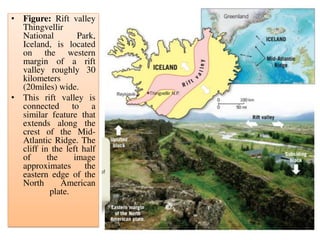
• Figure: Rift valley
Thingvellir
National Park,
Iceland, is located
on the western
margin of a rift
valley roughly 30
kilometers
(20miles) wide.
• This rift valley is
connected to a
similar feature that
extends along the
crest of the Mid-
Atlantic Ridge. The
cliff in the left half
of the image
approximates the
eastern edge of the
North American
plate.
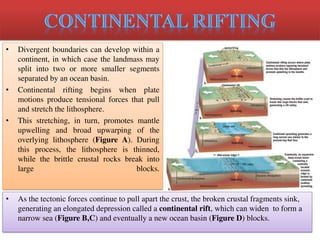
• Divergent boundaries can develop within a
continent, in which case the landmass may
split into two or more smaller segments
separated by an ocean basin.
• Continental rifting begins when plate
motions produce tensional forces that pull
and stretch the lithosphere.
• This stretching, in turn, promotes mantle
upwelling and broad upwarping of the
overlying lithosphere (Figure A). During
this process, the lithosphere is thinned,
while the brittle crustal rocks break into
large blocks.
• As the tectonic forces continue to pull apart the crust, the broken crustal fragments sink,
generating an elongated depression called a continental rift, which can widen to form a
narrow sea (Figure B,C) and eventually a new ocean basin (Figure D) blocks.
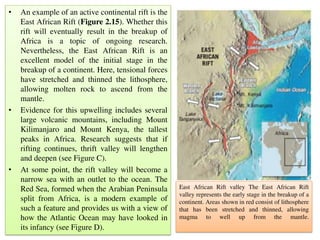
• An example of an active continental rift is the
East African Rift (Figure 2.15). Whether this
rift will eventually result in the breakup of
Africa is a topic of ongoing research.
Nevertheless, the East African Rift is an
excellent model of the initial stage in the
breakup of a continent. Here, tensional forces
have stretched and thinned the lithosphere,
allowing molten rock to ascend from the
mantle.
• Evidence for this upwelling includes several
large volcanic mountains, including Mount
Kilimanjaro and Mount Kenya, the tallest
peaks in Africa. Research suggests that if
rifting continues, thrift valley will lengthen
and deepen (see Figure C).
• At some point, the rift valley will become a
narrow sea with an outlet to the ocean. The
Red Sea, formed when the Arabian Peninsula
split from Africa, is a modern example of
such a feature and provides us with a view of
how the Atlantic Ocean may have looked in
its infancy (see Figure D).
East African Rift valley The East African Rift
valley represents the early stage in the breakup of a
continent. Areas shown in red consist of lithosphere
that has been stretched and thinned, allowing
magma to well up from the mantle.
• New lithosphere is constantly being produced at the oceanic ridges. However, our planet is
not growing larger; its total surface area remains constant. A balance is maintained
because older, denser portions of oceanic lithosphere descend into the mantle at a rate
equal to seafloor production.
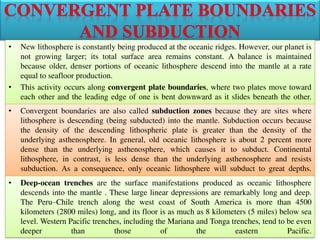
• This activity occurs along convergent plate boundaries, where two plates move toward
each other and the leading edge of one is bent downward as it slides beneath the other.
• Convergent boundaries are also called subduction zones because they are sites where
lithosphere is descending (being subducted) into the mantle. Subduction occurs because
the density of the descending lithospheric plate is greater than the density of the
underlying asthenosphere. In general, old oceanic lithosphere is about 2 percent more
dense than the underlying asthenosphere, which causes it to subduct. Continental
lithosphere, in contrast, is less dense than the underlying asthenosphere and resists
subduction. As a consequence, only oceanic lithosphere will subduct to great depths.
• Deep-ocean trenches are the surface manifestations produced as oceanic lithosphere
descends into the mantle . These large linear depressions are remarkably long and deep.
The Peru–Chile trench along the west coast of South America is more than 4500
kilometers (2800 miles) long, and its floor is as much as 8 kilometers (5 miles) below sea
level. Western Pacific trenches, including the Mariana and Tonga trenches, tend to be even
deeper than those of the eastern Pacific.
• Slabs of oceanic lithosphere descend into the mantle at angles that vary from a few degrees
to nearly vertical (90 degrees). The angle at which oceanic lithosphere subducts depends
largely on its age and, therefore, its density. For example, when seafloor spreading occurs
near a subduction zone, as is the case along the coast of Chile, the subducting lithosphere is
young and buoyant, which results in a low angle of descent. As the two plates converge, the
overriding plate scrapes over the top of the subducting plate below—a type of forced
subduction. Consequently, the region around the Peru – Chile trench experiences great
earthquakes, including the 2010 Chilean earthquake—one of the 10 largest on record.
• As oceanic lithosphere ages (gets farther from the spreading center), it gradually cools,
which causes it to thicken and increase in density. In parts of the western Pacific, some
oceanic lithosphere is 180 million years old—the thickest and densest in today’s oceans.
The very dense slabs in this region typically plunge into the mantle at angles approaching
90 degrees. This largely explains why most trenches in the western Pacific are deeper than
trenches in the eastern Pacific.
• Although all convergent zones have the same basic characteristics, they vary considerably
depending on the type of crustal material involved and the tectonic setting. Convergent
boundaries can form betweenone oceanic plate and one continental plate, between
two oceanic plates, or between two continental plates.
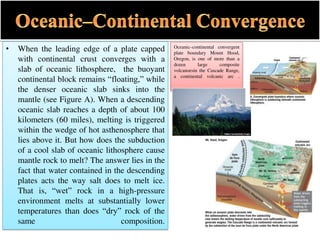
• When the leading edge of a plate capped
with continental crust converges with a
slab of oceanic lithosphere, the buoyant
continental block remains “floating,” while
the denser oceanic slab sinks into the
mantle (see Figure A). When a descending
oceanic slab reaches a depth of about 100
kilometers (60 miles), melting is triggered
within the wedge of hot asthenosphere that
lies above it. But how does the subduction
of a cool slab of oceanic lithosphere cause
mantle rock to melt? The answer lies in the
fact that water contained in the descending
plates acts the way salt does to melt ice.
That is, “wet” rock in a high-pressure
environment melts at substantially lower
temperatures than does “dry” rock of the
same composition.
Oceanic–continental convergent
plate boundary Mount Hood,
Oregon, is one of more than a
dozen large composite
volcanoesin the Cascade Range,
a continental volcanic arc .
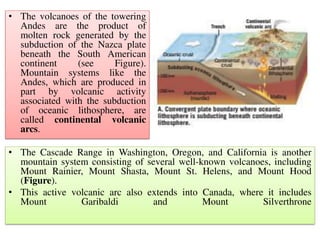
• The volcanoes of the towering
Andes are the product of
molten rock generated by the
subduction of the Nazca plate
beneath the South American
continent (see Figure).
Mountain systems like the
Andes, which are produced in
part by volcanic activity
associated with the subduction
of oceanic lithosphere, are
called continental volcanic
arcs.
• The Cascade Range in Washington, Oregon, and California is another
mountain system consisting of several well-known volcanoes, including
Mount Rainier, Mount Shasta, Mount St. Helens, and Mount Hood
(Figure).
• This active volcanic arc also extends into Canada, where it includes
Mount Garibaldi and Mount Silverthrone
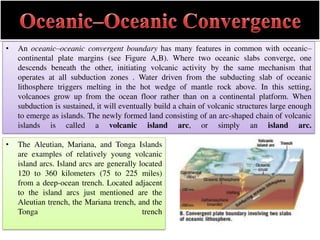
• An oceanic–oceanic convergent boundary has many features in common with oceanic–
continental plate margins (see Figure A,B). Where two oceanic slabs converge, one
descends beneath the other, initiating volcanic activity by the same mechanism that
operates at all subduction zones . Water driven from the subducting slab of oceanic
lithosphere triggers melting in the hot wedge of mantle rock above. In this setting,
volcanoes grow up from the ocean floor rather than on a continental platform. When
subduction is sustained, it will eventually build a chain of volcanic structures large enough
to emerge as islands. The newly formed land consisting of an arc-shaped chain of volcanic
islands is called a volcanic island arc, or simply an island arc.
• The Aleutian, Mariana, and Tonga Islands
are examples of relatively young volcanic
island arcs. Island arcs are generally located
120 to 360 kilometers (75 to 225 miles)
from a deep-ocean trench. Located adjacent
to the island arcs just mentioned are the
Aleutian trench, the Mariana trench, and the
Tonga trench
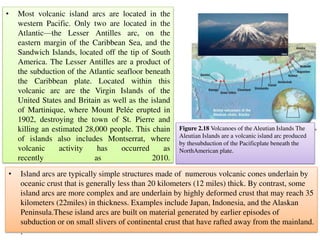
• Most volcanic island arcs are located in the
western Pacific. Only two are located in the
Atlantic—the Lesser Antilles arc, on the
eastern margin of the Caribbean Sea, and the
Sandwich Islands, located off the tip of South
America. The Lesser Antilles are a product of
the subduction of the Atlantic seafloor beneath
the Caribbean plate. Located within this
volcanic arc are the Virgin Islands of the
United States and Britain as well as the island
of Martinique, where Mount Pelée erupted in
1902, destroying the town of St. Pierre and
killing an estimated 28,000 people. This chain
of islands also includes Montserrat, where
volcanic activity has occurred as
recently as 2010.
• Island arcs are typically simple structures made of numerous volcanic cones underlain by
oceanic crust that is generally less than 20 kilometers (12 miles) thick. By contrast, some
island arcs are more complex and are underlain by highly deformed crust that may reach 35
kilometers (22miles) in thickness. Examples include Japan, Indonesia, and the Alaskan
Peninsula.These island arcs are built on material generated by earlier episodes of
subduction or on small slivers of continental crust that have rafted away from the mainland.
.
Figure 2.18 Volcanoes of the Aleutian Islands The
Aleutian Islands are a volcanic island arc produced
by thesubduction of the Pacificplate beneath the
NorthAmerican plate.
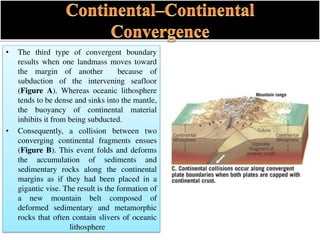
• The third type of convergent boundary
results when one landmass moves toward
the margin of another because of
subduction of the intervening seafloor
(Figure A). Whereas oceanic lithosphere
tends to be dense and sinks into the mantle,
the buoyancy of continental material
inhibits it from being subducted.
• Consequently, a collision between two
converging continental fragments ensues
(Figure B). This event folds and deforms
the accumulation of sediments and
sedimentary rocks along the continental
margins as if they had been placed in a
gigantic vise. The result is the formation of
a new mountain belt composed of
deformed sedimentary and metamorphic
rocks that often contain slivers of oceanic
lithosphere
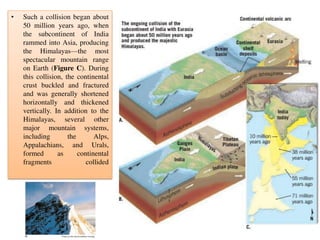
• Such a collision began about
50 million years ago, when
the subcontinent of India
rammed into Asia, producing
the Himalayas—the most
spectacular mountain range
on Earth (Figure C). During
this collision, the continental
crust buckled and fractured
and was generally shortened
horizontally and thickened
vertically. In addition to the
Himalayas, several other
major mountain systems,
including the Alps,
Appalachians, and Urals,
formed as continental
fragments collided
Transform Plate Boundaries
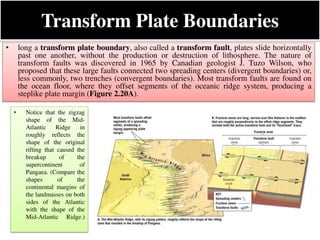
• long a transform plate boundary, also called a transform fault, plates slide horizontally
past one another, without the production or destruction of lithosphere. The nature of
transform faults was discovered in 1965 by Canadian geologist J. Tuzo Wilson, who
proposed that these large faults connected two spreading centers (divergent boundaries) or,
less commonly, two trenches (convergent boundaries). Most transform faults are found on
the ocean floor, where they offset segments of the oceanic ridge system, producing a
steplike plate margin (Figure 2.20A).
• Notice that the zigzag
shape of the Mid-
Atlantic Ridge in
roughly reflects the
shape of the original
rifting that caused the
breakup of the
supercontinent of
Pangaea. (Compare the
shapes of the
continental margins of
the landmasses on both
sides of the Atlantic
with the shape of the
Mid-Atlantic Ridge.)
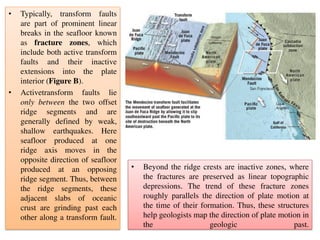
• Typically, transform faults
are part of prominent linear
breaks in the seafloor known
as fracture zones, which
include both active transform
faults and their inactive
extensions into the plate
interior (Figure B).
• Activetransform faults lie
only between the two offset
ridge segments and are
generally defined by weak,
shallow earthquakes. Here
seafloor produced at one
ridge axis moves in the
opposite direction of seafloor
produced at an opposing
ridge segment. Thus, between
the ridge segments, these
adjacent slabs of oceanic
crust are grinding past each
other along a transform fault.
• Beyond the ridge crests are inactive zones, where
the fractures are preserved as linear topographic
depressions. The trend of these fracture zones
roughly parallels the direction of plate motion at
the time of their formation. Thus, these structures
help geologists map the direction of plate motion in
the geologic past.
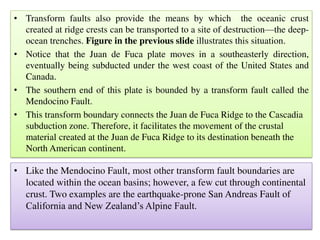
• Transform faults also provide the means by which the oceanic crust
created at ridge crests can be transported to a site of destruction—the deep-
ocean trenches. Figure in the previous slide illustrates this situation.
• Notice that the Juan de Fuca plate moves in a southeasterly direction,
eventually being subducted under the west coast of the United States and
Canada.
• The southern end of this plate is bounded by a transform fault called the
Mendocino Fault.
• This transform boundary connects the Juan de Fuca Ridge to the Cascadia
subduction zone. Therefore, it facilitates the movement of the crustal
material created at the Juan de Fuca Ridge to its destination beneath the
North American continent.
• Like the Mendocino Fault, most other transform fault boundaries are
located within the ocean basins; however, a few cut through continental
crust. Two examples are the earthquake-prone San Andreas Fault of
California and New Zealand’s Alpine Fault.
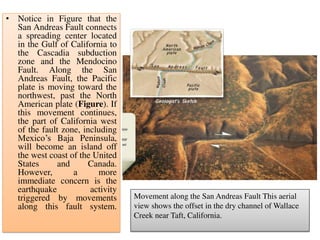
• Notice in Figure that the
San Andreas Fault connects
a spreading center located
in the Gulf of California to
the Cascadia subduction
zone and the Mendocino
Fault. Along the San
Andreas Fault, the Pacific
plate is moving toward the
northwest, past the North
American plate (Figure). If
this movement continues,
the part of California west
of the fault zone, including
Mexico’s Baja Peninsula,
will become an island off
the west coast of the United
States and Canada.
However, a more
immediate concern is the
earthquake activity
triggered by movements
along this fault system.
Movement along the San Andreas Fault This aerial
view shows the offset in the dry channel of Wallace
Creek near Taft, California.
• Researchers are in general agreement that some type of convection—where hot mantle
rocks rise and cold, dense oceanic lithosphere sinks—is the ultimate driver of plate
tectonics. Many of the details of this convective flow, however, remain topics of debate
in the scientific community.
slab pull
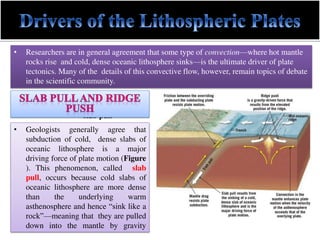
• Geologists generally agree that
subduction of cold, dense slabs of
oceanic lithosphere is a major
driving force of plate motion (Figure
). This phenomenon, called slab
pull, occurs because cold slabs of
oceanic lithosphere are more dense
than the underlying warm
asthenosphere and hence “sink like a
rock”—meaning that they are pulled
down into the mantle by gravity
• Another important driving force is ridge push (see Figure at slide 37). This
gravity-driven mechanism results from the elevated position of the oceanic ridge,
which causes slabs of lithosphere to “slide” down the flanks of the ridge.
• Ridge push appears to contribute far less to plate motions than slab pull. The
primary evidence for this is that the fastest-moving plates—Pacific, Nazca, and
Cocos plates—have extensive subduction zones along their margins.
• By contrast, the spreading rate in the North Atlantic basin, which is nearly devoid
of subduction zones, is one of the lowest, at about 2.5 centimeters (1 inch) per
year
• Although the subduction of cold, dense lithospheric plates appears to be the
dominant force acting on plates, other factors are also at work. Flow in the mantle,
perhaps best described as “mantle drag,” is also thought to affect plate motion
(see Figure at slide 37). When flow in the asthenosphere is moving at a velocity
that exceeds that of the plate, mantle drag enhances plate motion. However, if the
asthenosphere is moving more slowly than the plate, or if it is moving in the
opposite direction, this force tends to resist plate motion. Another type of
resistance to plate motion occurs along some subduction zones, where friction
between the overriding plate and the descending slab generates significant
earthquake activity
• Although convection in the mantle has yet to be fully understood, researchers
generally agree on the following:
a) Convective flow in the rocky 2900-kilometer- (1800 mile-) thick mantle—in
which warm, buoyant rock rises and cooler, denser material sinks—is the
underlying driving force for plate movement.
b) Mantle convection and plate tectonics are part of the same system. Subducting
oceanic plates drive the cold downward-moving portion of convective flow,
while shallow upwelling of hot rock along the oceanic ridge and buoyant
mantle plumes are the upward-flowing arms of the convective mechanism.
c) Convective flow in the mantle is a major mechanism for transporting heat
away from Earth’s interior to the surface, where it is eventually radiated into
space.
• What is not known with certainty is the exact structure of this convective flow.
Several models have been proposed for plate–mantle convection, and we will
look at two of them viz. 1. Whole-Mantle Convection and 2. Layer Cake
Model
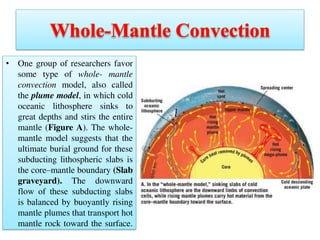
• One group of researchers favor
some type of whole- mantle
convection model, also called
the plume model, in which cold
oceanic lithosphere sinks to
great depths and stirs the entire
mantle (Figure A). The whole-
mantle model suggests that the
ultimate burial ground for these
subducting lithospheric slabs is
the core–mantle boundary (Slab
graveyard). The downward
flow of these subducting slabs
is balanced by buoyantly rising
mantle plumes that transport hot
mantle rock toward the surface.
• Two kinds of plumes have been proposed—narrow tube-like
plumes and giant upwellings, often referred to as mega-plumes.
The long, narrow plumes are thought to originate from the core–
mantle boundary and produce hot-spot volcanism of the type
associated with the Hawaiian Islands, Iceland, and Yellowstone.
Scientists believe that areas of large mega-plumes, as shown in
Figure A in previous slide, occur beneath the Pacific basin and
southern Africa.
• The latter structure is thought to explain why southern Africa has
an elevation much higher than would be predicted for a stable
continental landmass. In the whole-mantle convection model, heat
for both types of plumes is thought to arise mainly from Earth’s
core, while the deep mantle provides a source for chemically
distinct magmas. However, some researchers have questioned that
idea and instead propose that the source of magma for most hot
spot volcanism is found in the upper
mantle (asthenosphere)
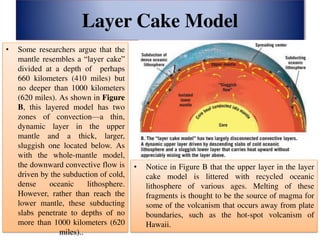
Layer Cake Model
• Some researchers argue that the
mantle resembles a “layer cake”
divided at a depth of perhaps
660 kilometers (410 miles) but
no deeper than 1000 kilometers
(620 miles). As shown in Figure
B, this layered model has two
zones of convection—a thin,
dynamic layer in the upper
mantle and a thick, larger,
sluggish one located below. As
with the whole-mantle model,
the downward convective flow is
driven by the subduction of cold,
dense oceanic lithosphere.
However, rather than reach the
lower mantle, these subducting
slabs penetrate to depths of no
more than 1000 kilometers (620
miles)..
• Notice in Figure B that the upper layer in the layer
cake model is littered with recycled oceanic
lithosphere of various ages. Melting of these
fragments is thought to be the source of magma for
some of the volcanism that occurs away from plate
boundaries, such as the hot-spot volcanism of
Hawaii.
• In contrast to the active upper mantle, the lower
mantle is sluggish and does not provide material to
support volcanism at the surface. Very slow
convection within this layer likely carries heat
upward, but very little mixing between these two
layers is thought to occur.
• Geologists continue to debate the nature of the
convective flow in the mantle. As they investigate
the possibilities, perhaps a hypothesis that combines
features from the layer cake model and the whole-
mantle convection model will emerge.

Plate tectonics

  • 1.
    Plate Tectonics Amit KumarMishra Assistant Professor Department of Geology Banasthali University
  • 2.
    • The ideathat continents, particularly South America and Africa, fit together like pieces of a jigsaw puzzle came about during the 1600s, as better world maps became available. • However, little significance was given to this notion until 1915, when Alfred Wegener (1880–1930), a German meteorologist and geophysicist, wrote The Origin of Continents and Oceans. • This book outlined Wegener’s hypothesis called continental drift, which dared to challenge the long-held assumption that the continents and ocean basins had fixed geographic positions.
  • 3.
    • Wegener suggestedthat a single supercontinent consisting of all Earth’s landmasses once existed.* • He named this giant landmass Pangaea (pronounced “Pan-jee- ah,” meaning “all lands”) (Figure 2.2). • Wegener further hypothesized that about 200 million years ago, during the early part of the Mesozoic era, this supercontinent began to fragment into smaller landmasses. These continental blocks then “drifted” to their present positions over a span of millions of years. • Wegener and others who advocated the continental drift hypothesis collected substantial evidence to support their point of view. • The fit of South America and Africa and the geographic distribution of fossils and ancient climates all seemed to buttress the idea that these now separate landmasses were once joined
  • 4.
    Evidence: The Continental JigsawPuzzle • Like a few others before him, Wegener suspected that the continents might once have been joined when he noticed the remarkable similarity between the coastlines on opposite sides of the Atlantic Ocean. • However, other Earth scientists challenged Wegener’s use of present-day shorelines to “fit” these continents together. • These opponents correctly argued that wave erosion and depositional processes continually modify shorelines. • Even if continental displacement had taken place, a good fit today would be unlikely. Because Wegener’s original jigsaw fit of the continents was crude, it is assumed that he was aware of this problem . • Scientists later determined that a much better approximation of the outer boundary of a continent is the seaward edge of its continental shelf, which lies submerged a few hundred meters below sea level. In the early 1960s, Sir Edward Bullard and two associates constructed a map that pieced together the edges of the continental shelves of South America and Africa at a depth of about 900 meters (3000 feet) (Figure). The remarkable fit obtained was more precise than even these researchers had expected.
  • 5.
    • Identical fossilorganisms (eg. Mesosaurus and Glossopteris ) had been discovered in rocks from both South America and Africa are in support of continental Drift theory. • Most paleontologists agreed that some type of land connection was needed to explain the existence of similar Mesozoic age life-forms on widely separated landmasses. • Just as modern life-forms native to North America are not the same as those of Africa and Australia, during the Mesozoic era, organisms on widely separated continents should have been distinctly different.
  • 6.
    • Mesosaurus, asmall aquatic freshwater reptile whose fossil remains are limited to black shales of the Permian period (about 260 million years ago) in eastern South America and southwestern Africa. If Mesosaurus had been able to make the long journey across the South Atlantic, its remains should be more widely distributed. • As this is not the case, Wegener asserted that South America and Africa must have been joined during that period of Earth history. • How did opponents of continental drift explain the existence of identical fossil organisms in places separated by thousands of kilometers of open ocean? Rafting, transoceanic land bridges (isthmian links), and island stepping stones were the most widely invoked explanations for these migrations (Figure). • We know, for example that during the Ice Age that ended about 8000 years ago, the lowering of sea level allowed mammals (including humans) to cross the narrow Bering Strait that separates Russia and Alaska. Was it possible that land bridges once connected Africa and South America but later subsided below sea level? Modern maps of the seafloor substantiate Wegener’s contention that if land bridges of this magnitude existed, their remnants would still lie below sea level.).
  • 7.
    If the continentswere once together, the rocks found in a particular region on one continent should closely match in age and type those found in adjacent positions on the adjoining continent. Wegener found evidence of highly deformed igneous rocks in Brazil that closely resembled similar rocks in Africa Mountains of comparable age and structure are found in the British Isles and Scandinavia. When these landmasses are positioned as they were about 200 million years ago, as shown in Figure, the mountain chains form a nearly continuous belt. Similar evidence can be found in mountain belts that terminate at one coastline and reappear on landmasses across the ocean. For instance, the mountain belt that includes the Appalachians trends northeastward through the eastern United States and disappears off the coast of Newfoundland (Figure).
  • 8.
    • Because AlfredWegener was a student of world climates, he suspected that paleoclimatic (paleo = ancient, climatic = climate) data might also support the idea of mobile continents. His assertion was bolstered by evidence that a glacial period dating to the late Paleozoic had been discovered in southern Africa, South America, Australia, and India. • This meant that about 300 million years ago, vast ice sheets covered extensive portions of the Southern Hemisphere as well as India (Figure A). Much of the land area that contains evidence of this Paleozoic glaciation presently lies within 30 degrees of the equator in subtropical or tropical climates
  • 9.
    • How couldextensive ice sheets form near the equator? One proposal suggested that our planet experienced a period of extreme global cooling. Wegener rejected this explanation because during the same span of geologic time, large tropical swamps existed in several locations in the Northern Hemisphere. The lush vegetation in these swamps was eventually buried and converted to coal (Figure B). • Today these deposits comprise major coal fields in the eastern United States and Northern Europe. Many of the fossils found in these coal bearing rocks were produced by tree ferns with large fronds—a fact consistent with warm, moist climates.** • The existence of these large tropical swamps, Wegener argued, was inconsistent with the proposal that extreme global cooling caused glaciers to form in areas that are currently tropical. • Wegener suggested a more plausible explanation for the late Paleozoic glaciation: the supercontinent of Pangaea. The southern continents being joined together and located near the South Pole would account for the polar conditions necessary to generate extensive expanses of glacial ice over much of these landmasses (Figure B). • At the same time, this geography places today’s northern continents nearer the equator and accounts for the tropical swamps that generated the vast coal deposits. How does a glacier develop in hot, arid central Australia? How do land animals migrate across wide expanses of the ocean? As compelling as this evidence may have been, 50 years passed before most of the scientific community accepted the concept of continental drift and the logical conclusions to which it led.
  • 10.
    • Following WorldWar II, oceanographers equipped with new marine tools and ample funding from the U.S. Office of Naval Research embarked on an unprecedented period of oceanographic exploration. • Over the next two decades, a much better picture of large expanses of the seafloor slowly and painstakingly began to emerge. • From this work came the discovery of a global oceanic ridge system that winds through all the major oceans.
  • 11.
    • In otherparts of the ocean, more new discoveries were being made. • Studies conducted in the western Pacific demonstrated that earthquakes were occurring at great depths beneath deep-ocean trenches. • Of equal importance was the fact that dredging of the seafloor did not bring up any oceanic crust that was older than 180 million years. Further, sediment accumulations in the deep ocean basins were found to be thin, not the thousands of meters that were predicted. • By 1968 these developments, among others, had led to the unfolding of a far more encompassing theory than continental drift, known as the theory of plate tectonics (tekto = to build)
  • 12.
    • According tothe plate tectonics model, the crust and the uppermost, and therefore coolest, part of the mantle constitute Earth’s strong outer layer, the lithosphere (lithos = stone). The lithosphere varies in both thickness and density, depending on whether it is oceanic or continental lithosphere (Figure). • Oceanic lithosphere is about 100 kilometers (60 miles) thick in the deep-ocean basins but is considerably thinner along the crest of the oceanic ridge system. • By contrast, continental lithosphere averages about 150 kilometers (90 miles) thick but may extend to depths of 200 kilometers (125 miles) or more beneath the stable interiors of the continents. Further, the composition of both the oceanic and continental crusts affects their respective densities.
  • 13.
    • The asthenosphere(asthenos = weak) is a hotter, weaker region in the mantle that lies below the lithosphere). The temperatures and pressures in the upper asthenosphere (100 to 200 kilometers [60 to 125 miles] in depth) are such that rocks at this depth are very near their melting temperatures and, hence, respond to forces by flowing, similar to the way a thick liquid would flow. • By contrast, the relatively cool and rigid lithosphere tends to respond to forces acting on it by bending or breaking but not flowing. • Because of these differences, Earth’s rigid outer shell is effectively detached from the asthenosphere, which allows these layers to move independently . • Oceanic crust is composed of basalt, rich in dense iron and magnesium, whereas continental crust is composed largely of less dense granitic rocks. Because of these differences, the overall density of oceanic lithosphere (crust and upper mantle) is greater than the overall density of continental lithosphere.
  • 14.
    Earth’s Major Plates •The lithosphere is broken into about two dozen segments of irregular size and shape called lithospheric plates, or simply plates, that are in constant motion with respect to one another (Figure 2.10). • Seven major lithospheric plates are recognized and account for 94 percent of Earth’s surface area: the North American, South American, Pacific, African, Eurasian, Australian-Indian, and Antarctic plates. • The largest is the Pacific plate, which encompasses a significant portion of the Pacific basin. Each of the six other large plates consists of an entire continent, as well as a significant amount of oceanic crust. • Notice in that the South American plate encompasses almost all of South America and about one-half of the floor of the South Atlantic. • Note also that none of the plates are defined entirely by the margins of a single continent. • This is a major departure from Wegener’s continental drift hypothesis, which proposed that the continents move through the ocean floor, not with it
  • 15.
    Intermediate-sized plates includethe Caribbean, Nazca, Philippine, Arabian, Cocos, Scotia, and Juande Fuca plates. These plates, with the exception of the Arabian plate, are composed mostly of oceanic lithosphere.
  • 16.
    • One ofthe main tenets of the plate tectonics theory is that plates move as somewhat rigid units relative to all other plates. • As plates move, the distance between two locations on different plates, such as New York and London, gradually changes, whereas the distance between sites on the same plate—New York and Denver, for example—remains relatively constant. • However, parts of some plates are comparatively “weak and can become fragmented” such as southern China, which is literally being squeezed as the Indian subcontinent rams into Asia
  • 18.
    • Divergent plateboundaries —where two plates move apart, resulting in upwelling and partial melting of hot material from the mantle to create new seafloor. • Convergent plate boundaries —where two plates move together, resulting either in oceanic lithosphere descending beneath an overriding plate, eventually to be reabsorbed into the mantle, or possibly in the collision of two continental blocks to create a mountain belt. • Transform plate boundaries —where two plates grind past each other without the production or destruction of lithosphere . Divergent and convergent plate boundaries each account for about 40 percent of all plate boundaries. • Transform boundaries, or faults account for the remaining 20 percent. In the following sections we will summarize the nature of the three types of plate boundaries.
  • 19.
    • Most divergentplate boundaries (di = apart, vergere = to move) are located along the crests of oceanic ridges and can be thought of as constructive plate margins because this is where new ocean floor is generated (Figure). • Here, two adjacent plates move away from each other, producing long, narrow fractures in the ocean crust. As a result, hot molten rock from the mantle below migrates upward to fill the voids left as the crust is being ripped apart. • This molten material gradually cools to produce new slivers of seafloor. In a slow yet unending manner, adjacent plates spread apart, and new oceanic lithosphere forms between them. For this reason, divergent plate boundaries are also called spreading centers Seafloor spreading : Most divergent plate boundaries are situated along the crests of oceanic ridges—the sites of seafloor spreading
  • 20.
    • The majorityof, but not all, divergent plate boundaries are associated with oceanic ridges: elevated areas of the seafloor characterized by high heat flow and volcanism. • The global oceanic ridge system is the longest topographic feature on Earth’s surface, exceeding 70,000 kilometers (43,000 miles) in length. • Various segments of the global ridge system have been named, including the Mid-Atlantic Ridge, East Pacific Rise, and Mid-Indian Ridge. • Representing 20 percent of Earth’s surface, the oceanic ridge system winds through all major ocean basins, like the seams on a baseball. Although the crest of the oceanic ridge is commonly 2 to 3 kilometers (1 to 2 miles) higher than the adjacent ocean basins, the term ridge may be misleading because it implies “narrow” when, in fact, ridges vary in width from 1000 kilometers (600 miles) to more than 4000 (2500 miles) kilometers. • Further, along the crest of some ridge segments is a deep canyonlike structure called a rift valley. This structure is evidence that tensional (opposing) forces are actively pulling the ocean crust apart at the ridge crest. • The mechanism that operates along the oceanic ridge system to create new seafloor is appropriately called seafloor spreading. Spreading typically averages around 5 centimeters (2 inches) per year, roughly the same rate at which human fingernails grow.
  • 21.
    • Comparatively slowspreading rates of 2 centimeters per year are found along the Mid- Atlantic Ridge, whereas spreading rates exceeding 15 centimeters (6 inches) per year have been measured along sections of the East Pacific Rise. • Although these rates of seafloor production are slow on a human time scale, they are nevertheless rapid enough to have generated all of Earth’s ocean basins within the past 200 million years. • The primary reason for the elevated position of the oceanic ridge is that newly created oceanic lithosphere is hot and, therefore, less dense than cooler rocks found away from the ridge axis. (Geologists use the term axis to refer to a line that follows the general trend of the ridge crest.) • As soon as new lithosphere forms, it is slowly yet continually displaced away from the zone of upwelling. Thus, it begins to cool and contract, thereby increasing in density. • This thermal contraction accounts for the increase in ocean depths away from the ridge crest. It takes about 80 million years for the temperature of oceanic lithosphere to stabilize and contraction to cease. By this time, rock that was once part of the elevated oceanic ridge system is located in the deep-ocean basin, where it may be buried by substantial accumulations of sediment. • In addition, as the plate moves away from the ridge, cooling of the underlying asthenosphere causes it to become increasingly more rigid. • Thus, oceanic lithosphere is generated by cooling of the asthenosphere from the top down. Stated another way, the thickness of oceanic lithosphere is age dependent. The older (cooler) it is, the greater its thickness. Oceanic lithosphere that exceeds 80 million years in age is about 100 kilometers (60 miles) thick—approximately its maximum thickness.
  • 22.
    • Figure: Riftvalley Thingvellir National Park, Iceland, is located on the western margin of a rift valley roughly 30 kilometers (20miles) wide. • This rift valley is connected to a similar feature that extends along the crest of the Mid- Atlantic Ridge. The cliff in the left half of the image approximates the eastern edge of the North American plate.
  • 23.
    • Divergent boundariescan develop within a continent, in which case the landmass may split into two or more smaller segments separated by an ocean basin. • Continental rifting begins when plate motions produce tensional forces that pull and stretch the lithosphere. • This stretching, in turn, promotes mantle upwelling and broad upwarping of the overlying lithosphere (Figure A). During this process, the lithosphere is thinned, while the brittle crustal rocks break into large blocks. • As the tectonic forces continue to pull apart the crust, the broken crustal fragments sink, generating an elongated depression called a continental rift, which can widen to form a narrow sea (Figure B,C) and eventually a new ocean basin (Figure D) blocks.
  • 24.
    • An exampleof an active continental rift is the East African Rift (Figure 2.15). Whether this rift will eventually result in the breakup of Africa is a topic of ongoing research. Nevertheless, the East African Rift is an excellent model of the initial stage in the breakup of a continent. Here, tensional forces have stretched and thinned the lithosphere, allowing molten rock to ascend from the mantle. • Evidence for this upwelling includes several large volcanic mountains, including Mount Kilimanjaro and Mount Kenya, the tallest peaks in Africa. Research suggests that if rifting continues, thrift valley will lengthen and deepen (see Figure C). • At some point, the rift valley will become a narrow sea with an outlet to the ocean. The Red Sea, formed when the Arabian Peninsula split from Africa, is a modern example of such a feature and provides us with a view of how the Atlantic Ocean may have looked in its infancy (see Figure D). East African Rift valley The East African Rift valley represents the early stage in the breakup of a continent. Areas shown in red consist of lithosphere that has been stretched and thinned, allowing magma to well up from the mantle.
  • 25.
    • New lithosphereis constantly being produced at the oceanic ridges. However, our planet is not growing larger; its total surface area remains constant. A balance is maintained because older, denser portions of oceanic lithosphere descend into the mantle at a rate equal to seafloor production. • This activity occurs along convergent plate boundaries, where two plates move toward each other and the leading edge of one is bent downward as it slides beneath the other. • Convergent boundaries are also called subduction zones because they are sites where lithosphere is descending (being subducted) into the mantle. Subduction occurs because the density of the descending lithospheric plate is greater than the density of the underlying asthenosphere. In general, old oceanic lithosphere is about 2 percent more dense than the underlying asthenosphere, which causes it to subduct. Continental lithosphere, in contrast, is less dense than the underlying asthenosphere and resists subduction. As a consequence, only oceanic lithosphere will subduct to great depths. • Deep-ocean trenches are the surface manifestations produced as oceanic lithosphere descends into the mantle . These large linear depressions are remarkably long and deep. The Peru–Chile trench along the west coast of South America is more than 4500 kilometers (2800 miles) long, and its floor is as much as 8 kilometers (5 miles) below sea level. Western Pacific trenches, including the Mariana and Tonga trenches, tend to be even deeper than those of the eastern Pacific.
  • 26.
    • Slabs ofoceanic lithosphere descend into the mantle at angles that vary from a few degrees to nearly vertical (90 degrees). The angle at which oceanic lithosphere subducts depends largely on its age and, therefore, its density. For example, when seafloor spreading occurs near a subduction zone, as is the case along the coast of Chile, the subducting lithosphere is young and buoyant, which results in a low angle of descent. As the two plates converge, the overriding plate scrapes over the top of the subducting plate below—a type of forced subduction. Consequently, the region around the Peru – Chile trench experiences great earthquakes, including the 2010 Chilean earthquake—one of the 10 largest on record. • As oceanic lithosphere ages (gets farther from the spreading center), it gradually cools, which causes it to thicken and increase in density. In parts of the western Pacific, some oceanic lithosphere is 180 million years old—the thickest and densest in today’s oceans. The very dense slabs in this region typically plunge into the mantle at angles approaching 90 degrees. This largely explains why most trenches in the western Pacific are deeper than trenches in the eastern Pacific. • Although all convergent zones have the same basic characteristics, they vary considerably depending on the type of crustal material involved and the tectonic setting. Convergent boundaries can form betweenone oceanic plate and one continental plate, between two oceanic plates, or between two continental plates.
  • 27.
    • When theleading edge of a plate capped with continental crust converges with a slab of oceanic lithosphere, the buoyant continental block remains “floating,” while the denser oceanic slab sinks into the mantle (see Figure A). When a descending oceanic slab reaches a depth of about 100 kilometers (60 miles), melting is triggered within the wedge of hot asthenosphere that lies above it. But how does the subduction of a cool slab of oceanic lithosphere cause mantle rock to melt? The answer lies in the fact that water contained in the descending plates acts the way salt does to melt ice. That is, “wet” rock in a high-pressure environment melts at substantially lower temperatures than does “dry” rock of the same composition. Oceanic–continental convergent plate boundary Mount Hood, Oregon, is one of more than a dozen large composite volcanoesin the Cascade Range, a continental volcanic arc .
  • 28.
    • The volcanoesof the towering Andes are the product of molten rock generated by the subduction of the Nazca plate beneath the South American continent (see Figure). Mountain systems like the Andes, which are produced in part by volcanic activity associated with the subduction of oceanic lithosphere, are called continental volcanic arcs. • The Cascade Range in Washington, Oregon, and California is another mountain system consisting of several well-known volcanoes, including Mount Rainier, Mount Shasta, Mount St. Helens, and Mount Hood (Figure). • This active volcanic arc also extends into Canada, where it includes Mount Garibaldi and Mount Silverthrone
  • 29.
    • An oceanic–oceanicconvergent boundary has many features in common with oceanic– continental plate margins (see Figure A,B). Where two oceanic slabs converge, one descends beneath the other, initiating volcanic activity by the same mechanism that operates at all subduction zones . Water driven from the subducting slab of oceanic lithosphere triggers melting in the hot wedge of mantle rock above. In this setting, volcanoes grow up from the ocean floor rather than on a continental platform. When subduction is sustained, it will eventually build a chain of volcanic structures large enough to emerge as islands. The newly formed land consisting of an arc-shaped chain of volcanic islands is called a volcanic island arc, or simply an island arc. • The Aleutian, Mariana, and Tonga Islands are examples of relatively young volcanic island arcs. Island arcs are generally located 120 to 360 kilometers (75 to 225 miles) from a deep-ocean trench. Located adjacent to the island arcs just mentioned are the Aleutian trench, the Mariana trench, and the Tonga trench
  • 30.
    • Most volcanicisland arcs are located in the western Pacific. Only two are located in the Atlantic—the Lesser Antilles arc, on the eastern margin of the Caribbean Sea, and the Sandwich Islands, located off the tip of South America. The Lesser Antilles are a product of the subduction of the Atlantic seafloor beneath the Caribbean plate. Located within this volcanic arc are the Virgin Islands of the United States and Britain as well as the island of Martinique, where Mount Pelée erupted in 1902, destroying the town of St. Pierre and killing an estimated 28,000 people. This chain of islands also includes Montserrat, where volcanic activity has occurred as recently as 2010. • Island arcs are typically simple structures made of numerous volcanic cones underlain by oceanic crust that is generally less than 20 kilometers (12 miles) thick. By contrast, some island arcs are more complex and are underlain by highly deformed crust that may reach 35 kilometers (22miles) in thickness. Examples include Japan, Indonesia, and the Alaskan Peninsula.These island arcs are built on material generated by earlier episodes of subduction or on small slivers of continental crust that have rafted away from the mainland. . Figure 2.18 Volcanoes of the Aleutian Islands The Aleutian Islands are a volcanic island arc produced by thesubduction of the Pacificplate beneath the NorthAmerican plate.
  • 31.
    • The thirdtype of convergent boundary results when one landmass moves toward the margin of another because of subduction of the intervening seafloor (Figure A). Whereas oceanic lithosphere tends to be dense and sinks into the mantle, the buoyancy of continental material inhibits it from being subducted. • Consequently, a collision between two converging continental fragments ensues (Figure B). This event folds and deforms the accumulation of sediments and sedimentary rocks along the continental margins as if they had been placed in a gigantic vise. The result is the formation of a new mountain belt composed of deformed sedimentary and metamorphic rocks that often contain slivers of oceanic lithosphere
  • 32.
    • Such acollision began about 50 million years ago, when the subcontinent of India rammed into Asia, producing the Himalayas—the most spectacular mountain range on Earth (Figure C). During this collision, the continental crust buckled and fractured and was generally shortened horizontally and thickened vertically. In addition to the Himalayas, several other major mountain systems, including the Alps, Appalachians, and Urals, formed as continental fragments collided
  • 33.
    Transform Plate Boundaries •long a transform plate boundary, also called a transform fault, plates slide horizontally past one another, without the production or destruction of lithosphere. The nature of transform faults was discovered in 1965 by Canadian geologist J. Tuzo Wilson, who proposed that these large faults connected two spreading centers (divergent boundaries) or, less commonly, two trenches (convergent boundaries). Most transform faults are found on the ocean floor, where they offset segments of the oceanic ridge system, producing a steplike plate margin (Figure 2.20A). • Notice that the zigzag shape of the Mid- Atlantic Ridge in roughly reflects the shape of the original rifting that caused the breakup of the supercontinent of Pangaea. (Compare the shapes of the continental margins of the landmasses on both sides of the Atlantic with the shape of the Mid-Atlantic Ridge.)
  • 34.
    • Typically, transformfaults are part of prominent linear breaks in the seafloor known as fracture zones, which include both active transform faults and their inactive extensions into the plate interior (Figure B). • Activetransform faults lie only between the two offset ridge segments and are generally defined by weak, shallow earthquakes. Here seafloor produced at one ridge axis moves in the opposite direction of seafloor produced at an opposing ridge segment. Thus, between the ridge segments, these adjacent slabs of oceanic crust are grinding past each other along a transform fault. • Beyond the ridge crests are inactive zones, where the fractures are preserved as linear topographic depressions. The trend of these fracture zones roughly parallels the direction of plate motion at the time of their formation. Thus, these structures help geologists map the direction of plate motion in the geologic past.
  • 35.
    • Transform faultsalso provide the means by which the oceanic crust created at ridge crests can be transported to a site of destruction—the deep- ocean trenches. Figure in the previous slide illustrates this situation. • Notice that the Juan de Fuca plate moves in a southeasterly direction, eventually being subducted under the west coast of the United States and Canada. • The southern end of this plate is bounded by a transform fault called the Mendocino Fault. • This transform boundary connects the Juan de Fuca Ridge to the Cascadia subduction zone. Therefore, it facilitates the movement of the crustal material created at the Juan de Fuca Ridge to its destination beneath the North American continent. • Like the Mendocino Fault, most other transform fault boundaries are located within the ocean basins; however, a few cut through continental crust. Two examples are the earthquake-prone San Andreas Fault of California and New Zealand’s Alpine Fault.
  • 36.
    • Notice inFigure that the San Andreas Fault connects a spreading center located in the Gulf of California to the Cascadia subduction zone and the Mendocino Fault. Along the San Andreas Fault, the Pacific plate is moving toward the northwest, past the North American plate (Figure). If this movement continues, the part of California west of the fault zone, including Mexico’s Baja Peninsula, will become an island off the west coast of the United States and Canada. However, a more immediate concern is the earthquake activity triggered by movements along this fault system. Movement along the San Andreas Fault This aerial view shows the offset in the dry channel of Wallace Creek near Taft, California.
  • 37.
    • Researchers arein general agreement that some type of convection—where hot mantle rocks rise and cold, dense oceanic lithosphere sinks—is the ultimate driver of plate tectonics. Many of the details of this convective flow, however, remain topics of debate in the scientific community. slab pull • Geologists generally agree that subduction of cold, dense slabs of oceanic lithosphere is a major driving force of plate motion (Figure ). This phenomenon, called slab pull, occurs because cold slabs of oceanic lithosphere are more dense than the underlying warm asthenosphere and hence “sink like a rock”—meaning that they are pulled down into the mantle by gravity
  • 38.
    • Another importantdriving force is ridge push (see Figure at slide 37). This gravity-driven mechanism results from the elevated position of the oceanic ridge, which causes slabs of lithosphere to “slide” down the flanks of the ridge. • Ridge push appears to contribute far less to plate motions than slab pull. The primary evidence for this is that the fastest-moving plates—Pacific, Nazca, and Cocos plates—have extensive subduction zones along their margins. • By contrast, the spreading rate in the North Atlantic basin, which is nearly devoid of subduction zones, is one of the lowest, at about 2.5 centimeters (1 inch) per year • Although the subduction of cold, dense lithospheric plates appears to be the dominant force acting on plates, other factors are also at work. Flow in the mantle, perhaps best described as “mantle drag,” is also thought to affect plate motion (see Figure at slide 37). When flow in the asthenosphere is moving at a velocity that exceeds that of the plate, mantle drag enhances plate motion. However, if the asthenosphere is moving more slowly than the plate, or if it is moving in the opposite direction, this force tends to resist plate motion. Another type of resistance to plate motion occurs along some subduction zones, where friction between the overriding plate and the descending slab generates significant earthquake activity
  • 39.
    • Although convectionin the mantle has yet to be fully understood, researchers generally agree on the following: a) Convective flow in the rocky 2900-kilometer- (1800 mile-) thick mantle—in which warm, buoyant rock rises and cooler, denser material sinks—is the underlying driving force for plate movement. b) Mantle convection and plate tectonics are part of the same system. Subducting oceanic plates drive the cold downward-moving portion of convective flow, while shallow upwelling of hot rock along the oceanic ridge and buoyant mantle plumes are the upward-flowing arms of the convective mechanism. c) Convective flow in the mantle is a major mechanism for transporting heat away from Earth’s interior to the surface, where it is eventually radiated into space. • What is not known with certainty is the exact structure of this convective flow. Several models have been proposed for plate–mantle convection, and we will look at two of them viz. 1. Whole-Mantle Convection and 2. Layer Cake Model
  • 40.
    • One groupof researchers favor some type of whole- mantle convection model, also called the plume model, in which cold oceanic lithosphere sinks to great depths and stirs the entire mantle (Figure A). The whole- mantle model suggests that the ultimate burial ground for these subducting lithospheric slabs is the core–mantle boundary (Slab graveyard). The downward flow of these subducting slabs is balanced by buoyantly rising mantle plumes that transport hot mantle rock toward the surface.
  • 41.
    • Two kindsof plumes have been proposed—narrow tube-like plumes and giant upwellings, often referred to as mega-plumes. The long, narrow plumes are thought to originate from the core– mantle boundary and produce hot-spot volcanism of the type associated with the Hawaiian Islands, Iceland, and Yellowstone. Scientists believe that areas of large mega-plumes, as shown in Figure A in previous slide, occur beneath the Pacific basin and southern Africa. • The latter structure is thought to explain why southern Africa has an elevation much higher than would be predicted for a stable continental landmass. In the whole-mantle convection model, heat for both types of plumes is thought to arise mainly from Earth’s core, while the deep mantle provides a source for chemically distinct magmas. However, some researchers have questioned that idea and instead propose that the source of magma for most hot spot volcanism is found in the upper mantle (asthenosphere)
  • 42.
    Layer Cake Model •Some researchers argue that the mantle resembles a “layer cake” divided at a depth of perhaps 660 kilometers (410 miles) but no deeper than 1000 kilometers (620 miles). As shown in Figure B, this layered model has two zones of convection—a thin, dynamic layer in the upper mantle and a thick, larger, sluggish one located below. As with the whole-mantle model, the downward convective flow is driven by the subduction of cold, dense oceanic lithosphere. However, rather than reach the lower mantle, these subducting slabs penetrate to depths of no more than 1000 kilometers (620 miles).. • Notice in Figure B that the upper layer in the layer cake model is littered with recycled oceanic lithosphere of various ages. Melting of these fragments is thought to be the source of magma for some of the volcanism that occurs away from plate boundaries, such as the hot-spot volcanism of Hawaii.
  • 43.
    • In contrastto the active upper mantle, the lower mantle is sluggish and does not provide material to support volcanism at the surface. Very slow convection within this layer likely carries heat upward, but very little mixing between these two layers is thought to occur. • Geologists continue to debate the nature of the convective flow in the mantle. As they investigate the possibilities, perhaps a hypothesis that combines features from the layer cake model and the whole- mantle convection model will emerge.