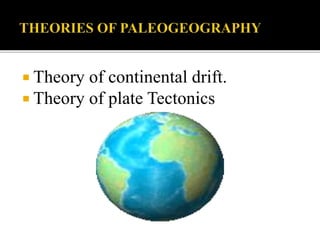
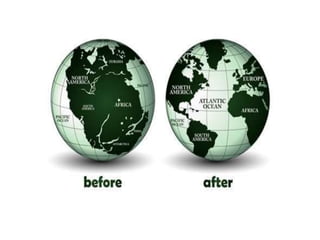
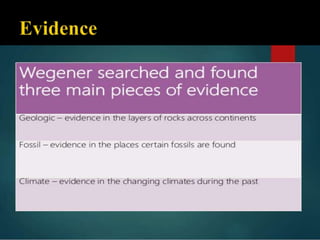
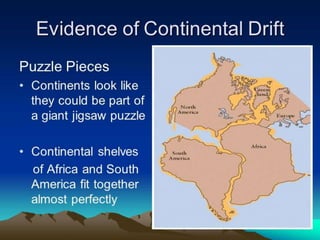
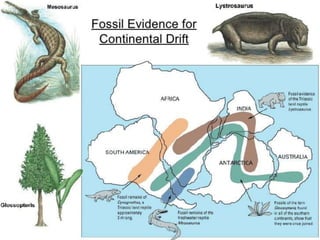
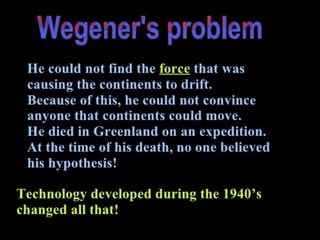
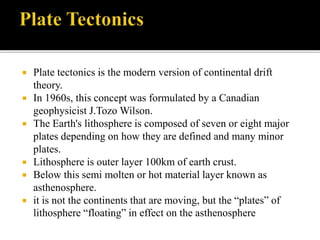
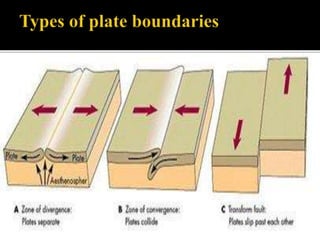
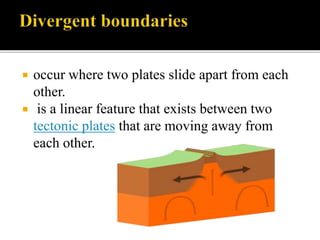
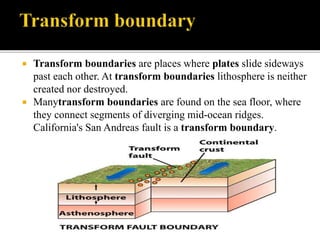
Paleogeography studies the geography of the past by mapping the positions of continents and distribution of land and seas over geological time. The positions of past continents can be determined using data like paleomagnetism, magnetic anomalies, paleobiogeography, paleoclimatology, and geological history. Alfred Wegener first proposed the theory of continental drift in 1915 to explain geological evidence that continents have moved over time, such as matching fossil and rock formations found across separated continents. Plate tectonics later expanded on this theory by proposing that Earth's lithosphere is composed of plates that move over Earth's asthenosphere, causing geological activity along plate boundaries.