Diel Vertical
Migration
What is diel vertical migration?
• Diel vertical migration (DVM) is the synchronized movement of
zooplankton and fish up and down in the water column over a
daily cycle.
• The word diel comes from the Latin “dies” day, and means a
24-hour period. It is the greatest migration in the world in
terms of biomass.
• Animals migrate most commonly upwards towards the surface
at dusk and descend back to deeper water before dawn, but
reverse patterns also occur.
• Food and predation are among the most important ultimate
factors governing DVM of zooplankton.
Many small marine animals reside in the surface, euphotic ocean at night, where they feed on plant and other smaller plankton (left panel), but
migrate to deeper, mesopelagic waters during the day (middle panel). In the process, these animals transfer organic carbon consumed at the
surface ocean to depth. The metabolic breakdown (respiration) of this organic carbon by both the migrators and the mesopelagic community
lowers oxygen levels at depth, where O2 concentrations are already low (shown schematically by the O2 profile with lower values to the left). This
downward transport of organic carbon by diel migrators serves as an alternate pathway to the gravitational sinking of detrital particles (right panel).
Bianchi et al.3 use acoustic profile data to show that the depth of diel vertical migration varies with region across the global ocean, and mirrors
spatial patterns in the depth of subsurface low-oxygen waters, such that migrators descend to the upper range of low oxygen waters.
Vertical migration
• Vertical migration is a daily pattern
of phytoplankton and zooplankton
changing positions like a day and
night shift.
During the day :
• phytoplankton produce lipids by
photosynthesis.
• Because oils are less dense than
water, the products of
photosynthesis increase their
buoyancy.
As the sun goes down :
• The phytoplankton use lipids
for energy which causes them
to sink in the water column.
• In response to the “rain” of
phytoplankton descending, the
zooplankton move up in the
water column to graze on them.
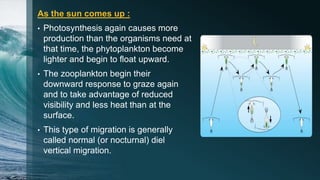
As the sun comes up :
• Photosynthesis again causes more
production than the organisms need at
that time, the phytoplankton become
lighter and begin to float upward.
• The zooplankton begin their
downward response to graze again
and to take advantage of reduced
visibility and less heat than at the
surface.
• This type of migration is generally
called normal (or nocturnal) diel
vertical migration.
How is diel vertical migration detected?
A synthetic echogram generated from data collected using a 38 kHz echosounder in the
southwest Indian Ocean in December 2011. The colour scale is echo intensity (mean volume
backscattering strength, MVBS): stronger echoes arise from denser aggregations of
organisms. Some layers remain at consistent depth over time as their constituents ‘sit and
wait’, while one layer shows classic DVM with pronounced downward migration at dawn and
a return towards the surface around dusk.
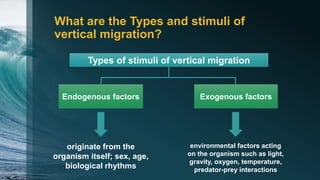
What are the Types and stimuli of
vertical migration?
originate from the
organism itself; sex, age,
biological rhythms
environmental factors acting
on the organism such as light,
gravity, oxygen, temperature,
predator-prey interactions
Endogenous factors Exogenous factors
Types of stimuli of vertical migration
Exogenous factors
• Organisms want to find an optimum light intensity, Whether it is no light or a large
amount of light, an organism will travel to where it is most comfortableLight
• Sometimes thermoclines can act as a barrier that an organism will
not crossTemperature
• In areas as the Arctic, melting ice causes a layer of fresh water
which organisms cannot cross.Salinity
• A predator might release a chemical cue which could cause its prey
to vertically migrate away.
Predator
Kairomone
Kairomone
Is a semiochemical, emitted by an organism, which mediates
interspecific interactions in a way that benefits an individual of
another species which receives it, and harms the emitter.
A semiochemical, is a chemical substance or mixture that
carries a message for purpose of communication
Kairomone benefits the receiver only by :
• Indicate a food source for the receiver.
• Warn a receiver of predator presence.
Endogenous factors
• An experiment was done at the Scripps
Institution of Oceanography which kept
organisms in column tanks with light/dark
cycles.
• few days later the light was changed to a
constant low light and the organisms still
displayed diel vertical migration.
• Thus suggestions that some type of
internal response was causing the
migration.
Types of vertical migration
• Diel Migration.
• Seasonal Migration.
• Ontogenetic Migration.
Diel Migration (DVM):
• This type of migration is the most important and common type
as it is present throughout the year and in all types of water
bodies.
Ontogenetic Migration:
• This type of migration is dependent on the organism’s life
stage, sex and biological rhythm. Ontogenetic migration
has only been observed in copepods.
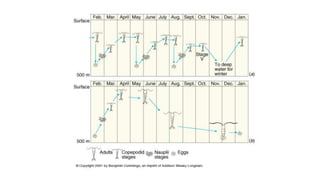
Seasonal Migration:
• The general pattern of seasonal migration is
such that zooplankton are higher up the water
column from late winter/early spring to late
summer/early fall, and lower in the water column
from late summer/early fall to late winter/early
spring.
Seasonal Migration:
• Zooplankton reproduction is timed with the spring
bloom. The spring bloom is stimulated by increasing
light intensity, warming and stratification of the upper
layers and leftover nutrient supplies from the winter.
Sometimes eggs or larvae remain dormant throughout
the winter and hatch in harmony with the spring bloom
in order to gain the maximum benefits of the rich food
supply.
Seasonal Migration:
• Zooplankton tend to remain in deeper layers during the
winter to avoid energy expenditure by travelling
upwards. Food supply is limited during the fall-winter
season because of a decline in primary production, so
zooplankton tend to rely mainly on their energy
reserves.
What are the causes of diel vertical
migration?
• Predator avoidance :
• Light-dependent predation by fish is a common pressure that causes
DVM behavior in zooplankton. in many instances it is advantageous
for zooplankton to migrate to deep waters during the day to avoid
predation and come up to the surface at night to feed.
• Metabolic advantages :
• By feeding in the warm surface waters at night and residing in the
cooler deep waters during the day they can conserve energy.
Alternatively, organisms feeding on the bottom in cold water during the
day may migrate to surface waters at night in order to digest their
meal at warmer temperatures.
What are the causes of diel vertical
migration?
• Dispersal and transport :
• Organisms can use deep and shallow currents to find food patches or
to maintain a geographical location.
• Avoid UV damage:
• The sunlight can penetrate into the water column. If an organism,
especially something small like a microbe, is too close to the surface
the UV can damage them. So they would want to avoid getting too
close to the surface, especially during daylight.
What are the benefits of DVM for the
zooplanktons?
• Access to food in surface waters at night with reduced vulnerability to
visual predators.
• Descending into cooler waters during day reduces metabolic rates and
makes more efficient use of food (Energetic benefits).
• Replenishment of food supply because Low food may enhance or
suppress DVM.
How About its Consequences?
• Mixing of populations enhances gene flow.
• Active transport of organic material to sea floor through trophic
ladder.
DVM in recent studies :
2011
• Day and nighttime depth selection are in response to, and reflect a trade-off between
environmental cues that can be distinguished as structural or dynamic drivers of DVM
(Williamson et al)
2013
• Midwater oxygen levels were singled out as a controlling factor (Bianchi
et al)
2014
• The rapid changes in day-night cycle and other environmental factors
affect timing, synchrony, and vertical range of migration (Berge et al)
2014
• herbivorous zooplankton feed in the epipelagic layer at night and migrate
to depth before dawn to avoid predation by visual predators (Brierley)
Summery:
• Zooplankton rise to shallow water at night, sink to deeper water
during the day
• Found in many different groups of zooplankton
• Zooplankters usually start to sink before dawn, and start to rise
before dusk
• Cycle is probably an internal biological clock that must be reinforced
by day-night light changes
• Types of vertical migration could be Diel, seasonal and ontogenetic.
• Zooplanktons migrate to avoid predation and the harmful UV light,
also to transport and find more food.
Stay ignorant HUMAN!
Someday I will rule the
WORLD!!!!!!
References
Williamson, C. E., Olson, O. G., Lott, S. E., Walker, N. D., Engstrom, D. R., & Hargreaves, B.
R. (2001). Ultraviolet radiation and zooplankton community structure following deglaciation in
Glacier Bay, Alaska. Ecology, 82(6), 1748-1760.
Bianchi, D., Galbraith, E. D., Carozza, D. A., Mislan, K. A. S., & Stock, C. A. (2013).
Intensification of open-ocean oxygen depletion by vertically migrating animals. Nature
Geoscience, 6(7), 545.
Berge, J., Cottier, F., Varpe., Renaud, P. E., Falk-Petersen, S., Kwasniewski, S., &
Bjærke, O. (2014). Arctic complexity: a case study on diel vertical migration of
zooplankton. Journal of plankton research, 36(5), 1279-1297.
Brierley, A. S. (2014). Diel vertical migration. Current biology, 24(22), R1074-R1076.
References
https://aquaticfieldcourse2013.wordpress.com/spatial-temporal-diversity/what-is-vertical-
migration/
https://www.nature.com/scitable/blog/saltwater-science/what_makes_plankton_migrate
http://www.cell.com/current-biology/fulltext/S0960-9822(14)01067-7

Diel vertical migration

  • 1.
  • 2.
    What is dielvertical migration? • Diel vertical migration (DVM) is the synchronized movement of zooplankton and fish up and down in the water column over a daily cycle. • The word diel comes from the Latin “dies” day, and means a 24-hour period. It is the greatest migration in the world in terms of biomass. • Animals migrate most commonly upwards towards the surface at dusk and descend back to deeper water before dawn, but reverse patterns also occur. • Food and predation are among the most important ultimate factors governing DVM of zooplankton.
  • 3.
    Many small marineanimals reside in the surface, euphotic ocean at night, where they feed on plant and other smaller plankton (left panel), but migrate to deeper, mesopelagic waters during the day (middle panel). In the process, these animals transfer organic carbon consumed at the surface ocean to depth. The metabolic breakdown (respiration) of this organic carbon by both the migrators and the mesopelagic community lowers oxygen levels at depth, where O2 concentrations are already low (shown schematically by the O2 profile with lower values to the left). This downward transport of organic carbon by diel migrators serves as an alternate pathway to the gravitational sinking of detrital particles (right panel). Bianchi et al.3 use acoustic profile data to show that the depth of diel vertical migration varies with region across the global ocean, and mirrors spatial patterns in the depth of subsurface low-oxygen waters, such that migrators descend to the upper range of low oxygen waters.
  • 4.
    Vertical migration • Verticalmigration is a daily pattern of phytoplankton and zooplankton changing positions like a day and night shift. During the day : • phytoplankton produce lipids by photosynthesis. • Because oils are less dense than water, the products of photosynthesis increase their buoyancy.
  • 5.
    As the sungoes down : • The phytoplankton use lipids for energy which causes them to sink in the water column. • In response to the “rain” of phytoplankton descending, the zooplankton move up in the water column to graze on them.
  • 6.
    As the suncomes up : • Photosynthesis again causes more production than the organisms need at that time, the phytoplankton become lighter and begin to float upward. • The zooplankton begin their downward response to graze again and to take advantage of reduced visibility and less heat than at the surface. • This type of migration is generally called normal (or nocturnal) diel vertical migration.
  • 7.
    How is dielvertical migration detected? A synthetic echogram generated from data collected using a 38 kHz echosounder in the southwest Indian Ocean in December 2011. The colour scale is echo intensity (mean volume backscattering strength, MVBS): stronger echoes arise from denser aggregations of organisms. Some layers remain at consistent depth over time as their constituents ‘sit and wait’, while one layer shows classic DVM with pronounced downward migration at dawn and a return towards the surface around dusk.
  • 8.
    What are theTypes and stimuli of vertical migration? originate from the organism itself; sex, age, biological rhythms environmental factors acting on the organism such as light, gravity, oxygen, temperature, predator-prey interactions Endogenous factors Exogenous factors Types of stimuli of vertical migration
  • 9.
    Exogenous factors • Organismswant to find an optimum light intensity, Whether it is no light or a large amount of light, an organism will travel to where it is most comfortableLight • Sometimes thermoclines can act as a barrier that an organism will not crossTemperature • In areas as the Arctic, melting ice causes a layer of fresh water which organisms cannot cross.Salinity • A predator might release a chemical cue which could cause its prey to vertically migrate away. Predator Kairomone
  • 10.
    Kairomone Is a semiochemical,emitted by an organism, which mediates interspecific interactions in a way that benefits an individual of another species which receives it, and harms the emitter. A semiochemical, is a chemical substance or mixture that carries a message for purpose of communication Kairomone benefits the receiver only by : • Indicate a food source for the receiver. • Warn a receiver of predator presence.
  • 11.
    Endogenous factors • Anexperiment was done at the Scripps Institution of Oceanography which kept organisms in column tanks with light/dark cycles. • few days later the light was changed to a constant low light and the organisms still displayed diel vertical migration. • Thus suggestions that some type of internal response was causing the migration.
  • 12.
    Types of verticalmigration • Diel Migration. • Seasonal Migration. • Ontogenetic Migration.
  • 13.
    Diel Migration (DVM): •This type of migration is the most important and common type as it is present throughout the year and in all types of water bodies. Ontogenetic Migration: • This type of migration is dependent on the organism’s life stage, sex and biological rhythm. Ontogenetic migration has only been observed in copepods.
  • 14.
    Seasonal Migration: • Thegeneral pattern of seasonal migration is such that zooplankton are higher up the water column from late winter/early spring to late summer/early fall, and lower in the water column from late summer/early fall to late winter/early spring.
  • 15.
    Seasonal Migration: • Zooplanktonreproduction is timed with the spring bloom. The spring bloom is stimulated by increasing light intensity, warming and stratification of the upper layers and leftover nutrient supplies from the winter. Sometimes eggs or larvae remain dormant throughout the winter and hatch in harmony with the spring bloom in order to gain the maximum benefits of the rich food supply.
  • 16.
    Seasonal Migration: • Zooplanktontend to remain in deeper layers during the winter to avoid energy expenditure by travelling upwards. Food supply is limited during the fall-winter season because of a decline in primary production, so zooplankton tend to rely mainly on their energy reserves.
  • 18.
    What are thecauses of diel vertical migration? • Predator avoidance : • Light-dependent predation by fish is a common pressure that causes DVM behavior in zooplankton. in many instances it is advantageous for zooplankton to migrate to deep waters during the day to avoid predation and come up to the surface at night to feed. • Metabolic advantages : • By feeding in the warm surface waters at night and residing in the cooler deep waters during the day they can conserve energy. Alternatively, organisms feeding on the bottom in cold water during the day may migrate to surface waters at night in order to digest their meal at warmer temperatures.
  • 19.
    What are thecauses of diel vertical migration? • Dispersal and transport : • Organisms can use deep and shallow currents to find food patches or to maintain a geographical location. • Avoid UV damage: • The sunlight can penetrate into the water column. If an organism, especially something small like a microbe, is too close to the surface the UV can damage them. So they would want to avoid getting too close to the surface, especially during daylight.
  • 20.
    What are thebenefits of DVM for the zooplanktons? • Access to food in surface waters at night with reduced vulnerability to visual predators. • Descending into cooler waters during day reduces metabolic rates and makes more efficient use of food (Energetic benefits). • Replenishment of food supply because Low food may enhance or suppress DVM. How About its Consequences? • Mixing of populations enhances gene flow. • Active transport of organic material to sea floor through trophic ladder.
  • 21.
    DVM in recentstudies : 2011 • Day and nighttime depth selection are in response to, and reflect a trade-off between environmental cues that can be distinguished as structural or dynamic drivers of DVM (Williamson et al) 2013 • Midwater oxygen levels were singled out as a controlling factor (Bianchi et al) 2014 • The rapid changes in day-night cycle and other environmental factors affect timing, synchrony, and vertical range of migration (Berge et al) 2014 • herbivorous zooplankton feed in the epipelagic layer at night and migrate to depth before dawn to avoid predation by visual predators (Brierley)
  • 22.
    Summery: • Zooplankton riseto shallow water at night, sink to deeper water during the day • Found in many different groups of zooplankton • Zooplankters usually start to sink before dawn, and start to rise before dusk • Cycle is probably an internal biological clock that must be reinforced by day-night light changes • Types of vertical migration could be Diel, seasonal and ontogenetic. • Zooplanktons migrate to avoid predation and the harmful UV light, also to transport and find more food.
  • 23.
    Stay ignorant HUMAN! SomedayI will rule the WORLD!!!!!!
  • 24.
    References Williamson, C. E.,Olson, O. G., Lott, S. E., Walker, N. D., Engstrom, D. R., & Hargreaves, B. R. (2001). Ultraviolet radiation and zooplankton community structure following deglaciation in Glacier Bay, Alaska. Ecology, 82(6), 1748-1760. Bianchi, D., Galbraith, E. D., Carozza, D. A., Mislan, K. A. S., & Stock, C. A. (2013). Intensification of open-ocean oxygen depletion by vertically migrating animals. Nature Geoscience, 6(7), 545. Berge, J., Cottier, F., Varpe., Renaud, P. E., Falk-Petersen, S., Kwasniewski, S., & Bjærke, O. (2014). Arctic complexity: a case study on diel vertical migration of zooplankton. Journal of plankton research, 36(5), 1279-1297. Brierley, A. S. (2014). Diel vertical migration. Current biology, 24(22), R1074-R1076.
  • 25.

Editor's Notes

  • #4 The euphotic zone is the layer closer to the surface that receives enough light for photosynthesis to occur. Most of the zooplanktons stay on the surface or the euphotic zone at night where they feed on the phytoplankton, but they migrate to the deeper mesopelagic zone during the day. During migration, the transfer the organic carbon they consumed (the consumed phytoplankton) from the surface together with them to the mesopelagic zone, so when they either die or breath they will release Co2 and that will lower the O2 concentration in the mesoplagic zone which are already low. So the organic carbon from the remaining phytoplankton cells and the zooplankton feces will form the detrital particles, the migration of the zooplankton is an alternate pathway for the gravitational sinking of detrital particles.
  • #8 Diel vertical migration in the open ocean. A synthetic echogram generated from data collected using a 38 kHz echosounder in the southwest Indian Ocean in December 2011. The colour scale is echo intensity (mean volume backscattering strength, MVBS): stronger echoes arise from denser aggregations of organisms. Some layers remain at consistent depth over time as their constituents ‘sit and wait’, while one layer shows classic DVM with pronounced downward migration at dawn and a return towards the surface around dusk. Data were collected from the Fishing Vessel Will Watch travelling at 11 knots along the BASOOP Acoustic Transit. Data courtesy of CSIRO Oceans and Atmosphere Flagship/IMOS. Image supplied by Roland Proud.