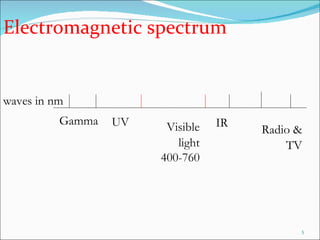
The Light Is that part of the  electro-magnetic spectrum  to which the human  eye is sensitive i.e. the  visible part of the electro-magnetic spectrum.  It ’ s wavelength range is 400-760 nm.
Electromagnetic spectrum Visible   light 400-760 UV IR Radio &   TV waves in nm   Gamma
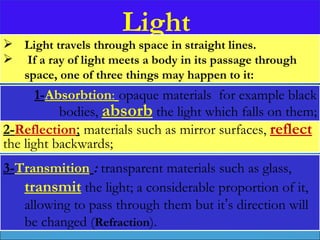
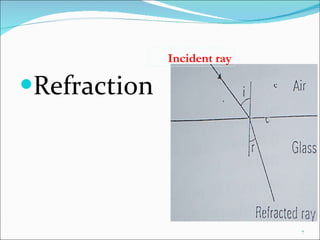
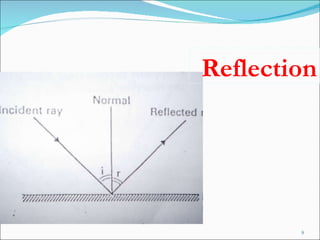
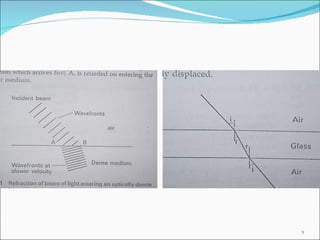
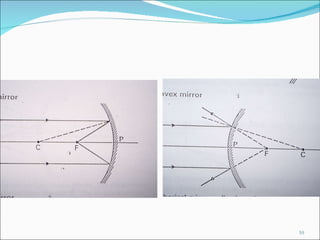
Light  3- Transmition   :  transparent   materials such as glass,   transmit   the light; a considerable proportion of it, allowing to pass through them but it ’ s direction will be changed ( Refraction ).  2- Reflection ;   materials such as mirror surfaces,  reflect   the light backwards; 1- Absorbtion :   opaque materials  for example black bodies,  absorb   the light which falls on them; Light travels through space in straight lines. If a ray of light meets a body in its passage through space, one of three things may happen to it:
Refraction Incident ray
Reflection
REFRACTION BY PRISMS When light passes through a medium with parallel sides the incident rays and the emergent rays are parallel; but if the  sides of the medium are not parallel  the direction of the rays must also change.  Such  a  medium  is  typified  in  the  prism
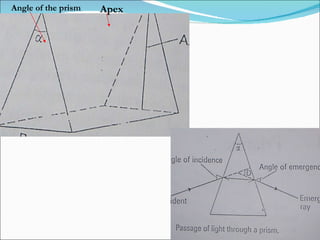
Apex Angle of the prism
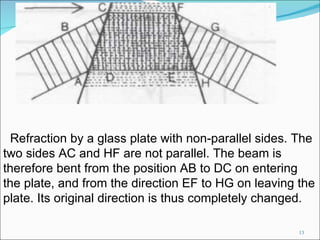
Refraction by a glass plate with non-parallel sides. The two sides AC and HF are not parallel. The beam is therefore bent from the position AB to DC on entering the plate, and from the direction EF to HG on leaving the plate. Its original direction is thus completely changed.
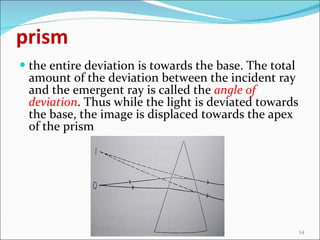
prism the entire deviation is towards the base. The total amount of the deviation between the incident ray and the emergent ray is called the  angle of deviation . Thus while the light is deviated towards the base, the image is displaced towards the apex of the prism
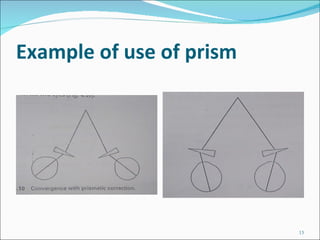
Example of use of prism
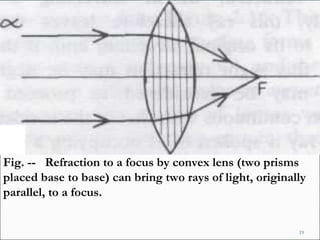
Fig. --  Refraction to a focus by convex lens (two prisms placed base to base) can bring two rays of light, originally parallel, to a focus.
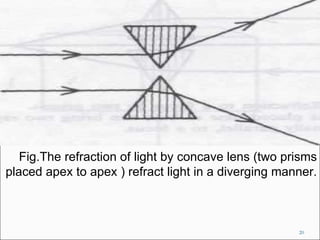
Fig.The refraction of light by concave lens (two prisms placed apex to apex ) refract light in a diverging manner.
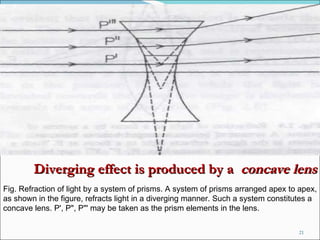
Fig. Refraction of light by a system of prisms. A system of prisms arranged apex to apex, as shown in the figure, refracts light in a diverging manner. Such a system constitutes a concave lens. P', P", P"' may be taken as the prism elements in the lens. Diverging effect is produced by a  concave lens
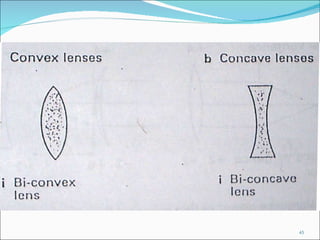
Types of spherical lenses: Biconvex Plano-convex Convex meniscus Biconcave Plano-concave Concave meniscus
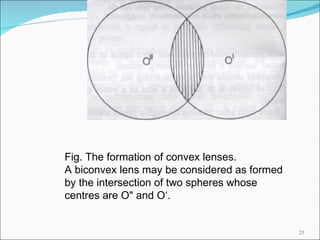
Fig. The formation of convex lenses. A biconvex lens may be considered as formed by the intersection of two spheres whose centres are O" and O‘.
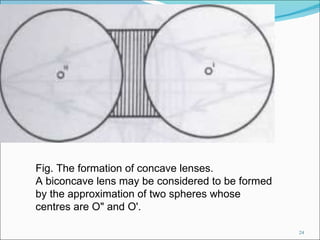
Fig. The formation of concave lenses. A biconcave lens may be considered to be formed by the approximation of two spheres whose centres are O" and O'.
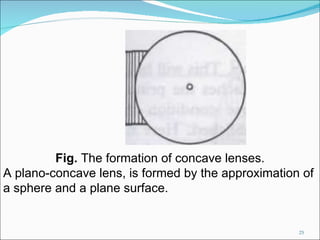
Fig.  The formation of concave lenses. A plano-concave lens, is formed by the approximation of a sphere and a plane surface.
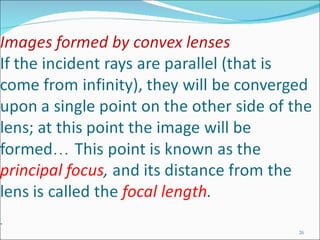
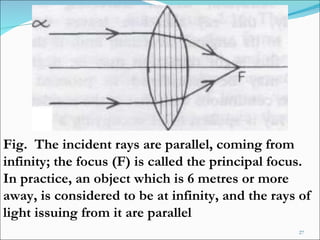
Fig.  The incident rays are parallel, coming from infinity; the focus (F) is called the principal focus. In practice, an object which is 6 metres or more away, is considered to be at infinity, and the rays of light issuing from it are parallel
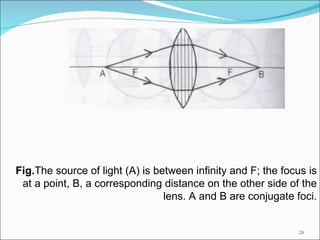
Fig. The source of light (A) is between infinity and F; the focus is at a point, B, a corresponding distance on the other side of the lens. A and B are conjugate foci.
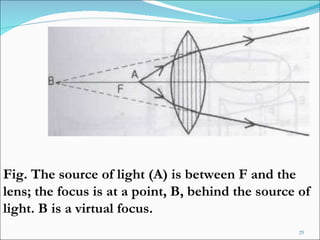
Fig. The source of light (A) is between F and the lens; the focus is at a point, B, behind the source of light. B is a virtual focus.
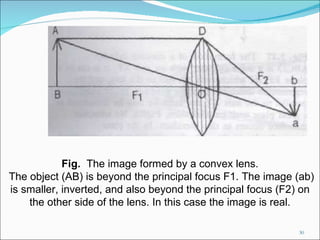
Fig.   The image formed by a convex lens. The object (AB) is beyond the principal focus F1. The image (ab) is smaller, inverted, and also beyond the principal focus (F2) on the other side of the lens. In this case the image is real.
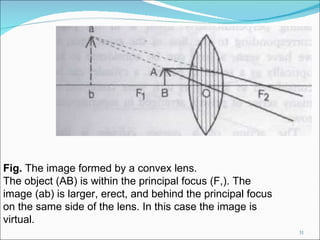
Fig.  The image formed by a convex lens. The object (AB) is within the principal focus (F,). The image (ab) is larger, erect, and behind the principal focus on the same side of the lens. In this case the image is virtual.
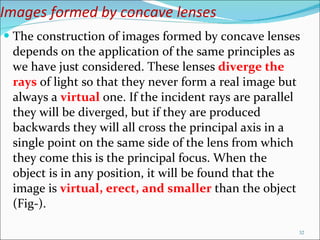
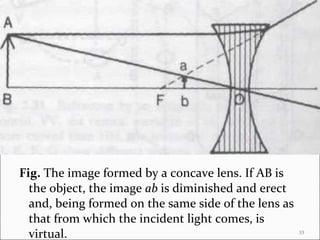
Images formed by concave lenses The construction of images formed by concave lenses depends on the application of the same principles as we have just considered. These lenses  diverge the rays  of light so that they never form a real image but always a  virtual   one. If the incident rays are parallel they will be diverged, but if they are produced backwards they will all cross the principal axis in a single point on the same side of the lens from which they come this is the principal focus. When the object is in any position, it will be found that the image is  virtual, erect, and smaller  than the object (Fig-).
Fig.  The image formed by a concave lens. If AB is the object, the image  ab  is diminished and erect and, being formed on the same side of the lens as that from which the incident light comes, is virtual.
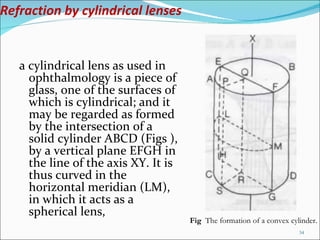
Refraction by cylindrical lenses a cylindrical lens as used in ophthalmology is a piece of glass, one of the surfaces of which is cylindrical; and it may be regarded as formed by the intersection of a solid cylinder ABCD (Figs ), by a vertical plane EFGH in the line of the axis XY. It is thus curved in the horizontal meridian (LM), in which it acts as a spherical lens, Fig  The formation of a convex cylinder.
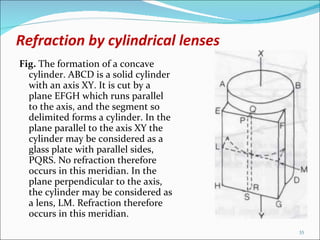
Refraction by cylindrical lenses Fig.  The formation of a concave cylinder. ABCD is a solid cylinder with an axis XY. It is cut by a plane EFGH which runs parallel to the axis, and the segment so delimited forms a cylinder. In the plane parallel to the axis XY the cylinder may be considered as a glass plate with parallel sides, PQRS. No refraction therefore occurs in this meridian. In the plane perpendicular to the axis, the cylinder may be considered as a lens, LM. Refraction therefore occurs in this meridian.
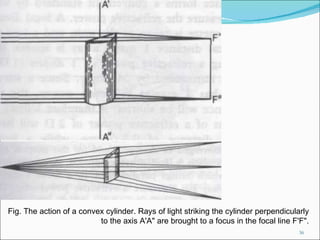
Fig. The action of a convex cylinder. Rays of light striking the cylinder perpendicularly to the axis A'A" are brought to a focus in the focal line F'F".
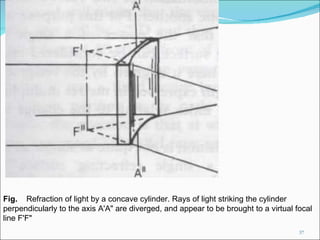
Fig.  Refraction of light by a concave cylinder. Rays of light striking the cylinder perpendicularly to the axis A'A" are diverged, and appear to be brought to a virtual focal line F'F"
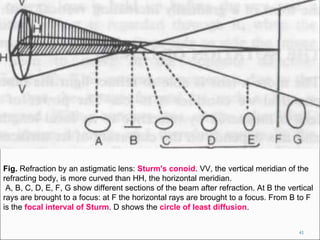
Fig.  Refraction by an astigmatic lens:  Sturm's conoid . VV, the vertical meridian of the refracting body, is more curved than HH, the horizontal meridian. A, B, C, D, E, F, G show different sections of the beam after refraction. At B the vertical rays are brought to a focus: at F the horizontal rays are brought to a focus. From B to F is the  focal interval of Sturm . D shows the  circle of least diffusion .
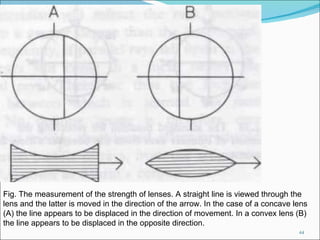
Fig. The measurement of the strength of lenses. A straight line is viewed through the lens and the latter is moved in the direction of the arrow. In the case of a concave lens (A) the line appears to be displaced in the direction of movement. In a convex lens (B) the line appears to be displaced in the opposite direction.
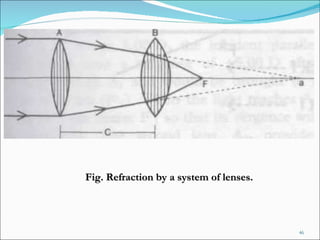
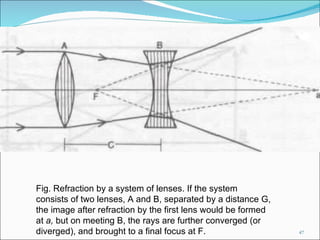
Fig. Refraction by a system of lenses.
Fig. Refraction by a system of lenses. If the system consists of two lenses, A and B, separated by a distance G, the image after refraction by the first lens would be formed at  a,  but on meeting B, the rays are further converged (or diverged), and brought to a final focus at F.
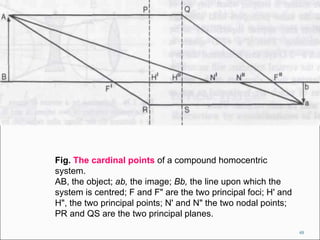
Fig.  The cardinal points  of a compound homocentric system. AB, the object;  ab,  the image;  Bb,  the line upon which the system is centred; F and F" are the two principal foci; H' and H", the two principal points; N' and N" the two nodal points; PR and QS are the two principal planes.
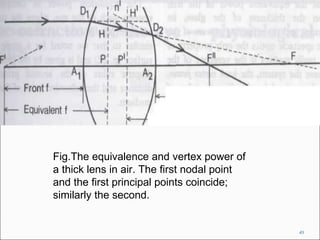
Fig.The equivalence and vertex power of a thick lens in air. The first nodal point and the first principal points coincide; similarly the second.
References 1. Duke Elder ’ s Optics & refraction 2. Lecture notes ophthalmology
Thank you

Ophthalmology 5th year, 3rd lecture (Dr. Tara)

  • 4.
    The Light Isthat part of the electro-magnetic spectrum to which the human eye is sensitive i.e. the visible part of the electro-magnetic spectrum. It ’ s wavelength range is 400-760 nm.
  • 5.
    Electromagnetic spectrum Visible light 400-760 UV IR Radio & TV waves in nm Gamma
  • 6.
    Light 3-Transmition : transparent materials such as glass, transmit the light; a considerable proportion of it, allowing to pass through them but it ’ s direction will be changed ( Refraction ). 2- Reflection ; materials such as mirror surfaces, reflect the light backwards; 1- Absorbtion : opaque materials for example black bodies, absorb the light which falls on them; Light travels through space in straight lines. If a ray of light meets a body in its passage through space, one of three things may happen to it:
  • 7.
  • 8.
  • 11.
    REFRACTION BY PRISMSWhen light passes through a medium with parallel sides the incident rays and the emergent rays are parallel; but if the sides of the medium are not parallel the direction of the rays must also change. Such a medium is typified in the prism
  • 12.
    Apex Angle ofthe prism
  • 13.
    Refraction by aglass plate with non-parallel sides. The two sides AC and HF are not parallel. The beam is therefore bent from the position AB to DC on entering the plate, and from the direction EF to HG on leaving the plate. Its original direction is thus completely changed.
  • 14.
    prism the entiredeviation is towards the base. The total amount of the deviation between the incident ray and the emergent ray is called the angle of deviation . Thus while the light is deviated towards the base, the image is displaced towards the apex of the prism
  • 15.
  • 19.
    Fig. -- Refraction to a focus by convex lens (two prisms placed base to base) can bring two rays of light, originally parallel, to a focus.
  • 20.
    Fig.The refraction oflight by concave lens (two prisms placed apex to apex ) refract light in a diverging manner.
  • 21.
    Fig. Refraction oflight by a system of prisms. A system of prisms arranged apex to apex, as shown in the figure, refracts light in a diverging manner. Such a system constitutes a concave lens. P', P", P"' may be taken as the prism elements in the lens. Diverging effect is produced by a concave lens
  • 22.
    Types of sphericallenses: Biconvex Plano-convex Convex meniscus Biconcave Plano-concave Concave meniscus
  • 23.
    Fig. The formationof convex lenses. A biconvex lens may be considered as formed by the intersection of two spheres whose centres are O" and O‘.
  • 24.
    Fig. The formationof concave lenses. A biconcave lens may be considered to be formed by the approximation of two spheres whose centres are O" and O'.
  • 25.
    Fig. Theformation of concave lenses. A plano-concave lens, is formed by the approximation of a sphere and a plane surface.
  • 27.
    Fig. Theincident rays are parallel, coming from infinity; the focus (F) is called the principal focus. In practice, an object which is 6 metres or more away, is considered to be at infinity, and the rays of light issuing from it are parallel
  • 28.
    Fig. The sourceof light (A) is between infinity and F; the focus is at a point, B, a corresponding distance on the other side of the lens. A and B are conjugate foci.
  • 29.
    Fig. The sourceof light (A) is between F and the lens; the focus is at a point, B, behind the source of light. B is a virtual focus.
  • 30.
    Fig. The image formed by a convex lens. The object (AB) is beyond the principal focus F1. The image (ab) is smaller, inverted, and also beyond the principal focus (F2) on the other side of the lens. In this case the image is real.
  • 31.
    Fig. Theimage formed by a convex lens. The object (AB) is within the principal focus (F,). The image (ab) is larger, erect, and behind the principal focus on the same side of the lens. In this case the image is virtual.
  • 32.
    Images formed byconcave lenses The construction of images formed by concave lenses depends on the application of the same principles as we have just considered. These lenses diverge the rays of light so that they never form a real image but always a virtual one. If the incident rays are parallel they will be diverged, but if they are produced backwards they will all cross the principal axis in a single point on the same side of the lens from which they come this is the principal focus. When the object is in any position, it will be found that the image is virtual, erect, and smaller than the object (Fig-).
  • 33.
    Fig. Theimage formed by a concave lens. If AB is the object, the image ab is diminished and erect and, being formed on the same side of the lens as that from which the incident light comes, is virtual.
  • 34.
    Refraction by cylindricallenses a cylindrical lens as used in ophthalmology is a piece of glass, one of the surfaces of which is cylindrical; and it may be regarded as formed by the intersection of a solid cylinder ABCD (Figs ), by a vertical plane EFGH in the line of the axis XY. It is thus curved in the horizontal meridian (LM), in which it acts as a spherical lens, Fig The formation of a convex cylinder.
  • 35.
    Refraction by cylindricallenses Fig. The formation of a concave cylinder. ABCD is a solid cylinder with an axis XY. It is cut by a plane EFGH which runs parallel to the axis, and the segment so delimited forms a cylinder. In the plane parallel to the axis XY the cylinder may be considered as a glass plate with parallel sides, PQRS. No refraction therefore occurs in this meridian. In the plane perpendicular to the axis, the cylinder may be considered as a lens, LM. Refraction therefore occurs in this meridian.
  • 36.
    Fig. The actionof a convex cylinder. Rays of light striking the cylinder perpendicularly to the axis A'A" are brought to a focus in the focal line F'F".
  • 37.
    Fig. Refractionof light by a concave cylinder. Rays of light striking the cylinder perpendicularly to the axis A'A" are diverged, and appear to be brought to a virtual focal line F'F"
  • 41.
    Fig. Refractionby an astigmatic lens: Sturm's conoid . VV, the vertical meridian of the refracting body, is more curved than HH, the horizontal meridian. A, B, C, D, E, F, G show different sections of the beam after refraction. At B the vertical rays are brought to a focus: at F the horizontal rays are brought to a focus. From B to F is the focal interval of Sturm . D shows the circle of least diffusion .
  • 44.
    Fig. The measurementof the strength of lenses. A straight line is viewed through the lens and the latter is moved in the direction of the arrow. In the case of a concave lens (A) the line appears to be displaced in the direction of movement. In a convex lens (B) the line appears to be displaced in the opposite direction.
  • 46.
    Fig. Refraction bya system of lenses.
  • 47.
    Fig. Refraction bya system of lenses. If the system consists of two lenses, A and B, separated by a distance G, the image after refraction by the first lens would be formed at a, but on meeting B, the rays are further converged (or diverged), and brought to a final focus at F.
  • 48.
    Fig. Thecardinal points of a compound homocentric system. AB, the object; ab, the image; Bb, the line upon which the system is centred; F and F" are the two principal foci; H' and H", the two principal points; N' and N" the two nodal points; PR and QS are the two principal planes.
  • 49.
    Fig.The equivalence andvertex power of a thick lens in air. The first nodal point and the first principal points coincide; similarly the second.
  • 50.
    References 1. DukeElder ’ s Optics & refraction 2. Lecture notes ophthalmology
  • 51.