• “When light from a point source goes through
a correctly powered spectacle lens yet fails to
create a perfect image, the cause is lens
aberration.”
• All form of deviations are basically
aberrations.
1. Chromatic
2. Monochromatic
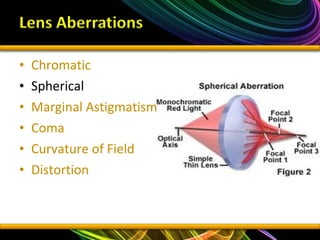
 Spherical
 Marginal Astigmatism
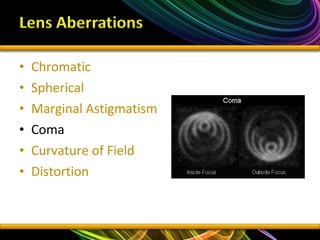
 Coma
 Curvature of Field
 Distortion
• In Focus vs. Out of Focus
– Out of focus aberrations cause fuzzy images
where clear sharp images should be
– In focus aberrations cause images to be the wrong
shape (distorted).
• Wide Beam vs. Narrow Beam
– Wide beam aberrations are not as important when
the light goes through a narrow opening or
aperture, such as the pupil of the eye.
– Narrow beam aberrations are the important
aberrations when making glasses.
– Wide beam aberrations are important for optical
instruments such as telescopes.
• On Axis vs. Off Axis
– On axis aberrations effect vision when looking
straight ahead through the lens.
– Off axis aberrations effect peripheral vision.
1) Low Degree Aberrations : It include
Myopia, Hypermetropia & Regular
Astigmatism. It can be surgically treated by
conventional LASIK.
2) Higher Degree Aberrations : It include
Spherical Aberration, Chromatic
Aberration, Coma, Oblique Aberration,
Centring, Diffraction of light & Distortion.
• Chromatic
• Spherical
• Marginal Astigmatism
• Coma
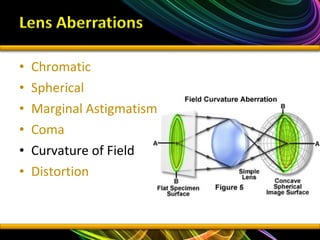
• Curvature of Field
• Distortion
• Rays corresponding to different wavelengths
travel different paths
• The lens material breaks white light into its
component colors
1. Longitudinal Chromatic Aberration
2. Lateral Chromatic Aberration
Blue
image
Red
image(Red ray)
(Blue Ray)
(Red ray)
(Blue Ray)
Longitudinal
chromatic
aberration
Object
Lateral
chromatic
aberration
Prismatic effect
for blue light
Prismatic effect
for red light
Lateral chromatic
aberration
• It occurs when a prism bends light of two different wavelengths by
different amounts.
• Different image sizes
• Result in colored ‘ghost’ images
White light
Lateral Chromatic Aberration
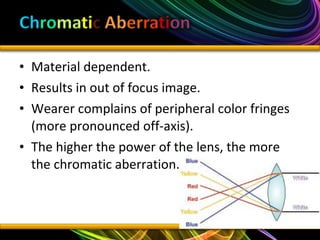
• Material dependent.
• Results in out of focus image.
• Wearer complains of peripheral color fringes
(more pronounced off-axis).
• The higher the power of the lens, the more
the chromatic aberration.
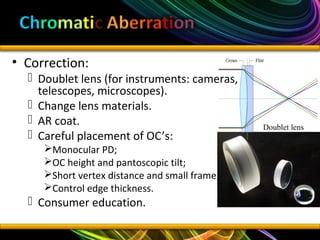
• Correction:
 Doublet lens (for instruments: cameras,
telescopes, microscopes).
 Change lens materials.
 AR coat.
 Careful placement of OC’s:
Monocular PD;
OC height and pantoscopic tilt;
Short vertex distance and small frame;
Control edge thickness.
 Consumer education.
Doublet lens
• Reducing chromatic aberration by Achromatic
Aberration.
- Used two diff. Lens material one regular length an
other occur correct the dispersion of 1st
lens.
- One lens produced of crow glass i.e. low dispersion
an other is flint glass i.e. high dispersion.
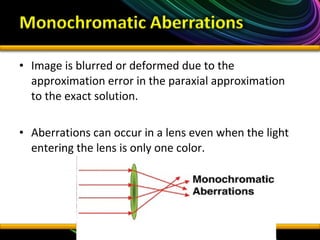
• Image is blurred or deformed due to the
approximation error in the paraxial approximation
to the exact solution.
• Aberrations can occur in a lens even when the light
entering the lens is only one color.
• Chromatic
• Spherical
• Marginal Astigmatism
• Coma
• Curvature of Field
• Distortion
Spherical lens:
Peripheral rays have shorter
focal length than paraxial rays.
Spherically aberrated
focal points
for peripheral rays
Focal Point for central
(paraxial) rays
Spherical Aberration
Image is blurred or deformed due to the approximation
error in the paraxial approximation to the exact solution
• Peripheral rays refract more strongly than paraxial
rays.
• Correct with parabolic curves, aplanatic lens design.
• Results in out-of-focus image.
• Axial n Wide beam aberration – not important in
glasses design.
• On-axis aberration.
• Seidal aberration
i. Ant. Surface of cornea is flatter at paraxial
than centre therefore act as aplanatic
surface.
ii. The iris act as a stop to spherical aberration,
impairment of visual acuity when pupil is
dilated is due to spherical aberrations.
iii. Sph. Aberrations may reduced by occluding
periphery of the lens that only the paraxial
zone is used.
 1st
– Image quality es bcoz the focus us not
stigmatic.
 2nd
– Image location change from the position.
• Chromatic
• Spherical
• Marginal Astigmatism
• Coma
• Curvature of Field
• Distortion
Spherical lens, narrow beam
entering off-axis.
• Narrow beam aberration, therefore important in
glasses lens design.
• Beam enters obliquely to lens axis, therefore effects
peripheral vision.
• Creates excess power and cylinder
• Also called Oblique astigmatism or Radial
astigmatism.
• Correct Curve lens design for glasses corrects for this
aberration.
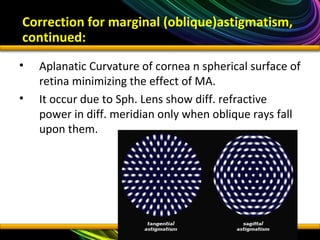
• The distance between the two line foci that
occurs in oblique astigmatism is called the
Astigmatic Difference.
• When expressed in diopters, this difference is
called the Oblique Astigmatic Error.
 Correction for Marginal(oblique)astigmatism,
continued:
• Pantoscopic tilt / OC height combination.
 Lower OC 1 mm for every 2 degrees pantoscopic
tilt.
 Use face form in glasses where the OC’s are
decentered in.
• Aspheric design for high powers and large
lenses.
• Aplanatic Curvature of cornea n spherical surface of
retina minimizing the effect of MA.
• It occur due to Sph. Lens show diff. refractive
power in diff. meridian only when oblique rays fall
upon them.
Correction for marginal (oblique)astigmatism,
continued:
• Chromatic
• Spherical
• Marginal Astigmatism
• Coma
• Curvature of Field
• Distortion
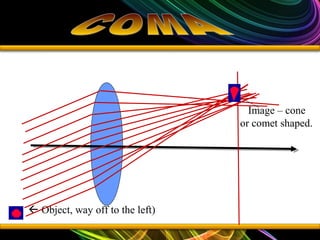
 Object, way off to the left)
Image – cone
or comet shaped.
• Type of Monochromatic aberration.
• 2nd
Seidal aberration similar to Sph.aberration.
• Object point is off the axis of the lens, there is
a diff. in magnification for the rays passing
through different zones of the lens.
• The composition image is not a circle bt
elongated like Comet or Coma.
• Associated with off-axis object points.
• Not important in glasses design (except
very high plus Rx).
• Results in out-of-focus image.
• Off-axis aberration, so a peripheral vision
problem when present.
• Worst type of aberration
• Degenerate and deforms the image of
point objects.
• Corrected with parabolic curves, aplanatic
lens design.
• Reduce coma in high plus lens - Aspheric lens.
• If head of coma points towards the optical axis
it is +ve coma.
• If head of coma points away from the optical
axis it is –ve coma.
• Chromatic
• Spherical
• Marginal Astigmatism
• Coma
• Curvature of Field
• Distortion
Plane of focus when
Marginal astigmatism is corrected
Plane of focus when
Curvature of field is corrected
• Also called power error.
• Light does not focus on a flat focal plane. The focal
plane is curved.
• Remember the screens at drive-in movies? They are
curved, not flat, to focus the sides of the movie as
well as the center.
• The retina at the back of your eye globe is not a flat
plane.
• It is curved.
• Curvature of field is minimized with corrected
curve design base curves.
• This aberration effects peripheral vision.
• Petzval’s surface is the name for the curved
surface when marginal (oblique) astigmatism is
correct.
• Another name for the Petzval's surface is the
image sphere.
• Far point sphere is where the image would focus
correctly.
• Chromatic
• Spherical
• Marginal Astigmatism
• Coma
• Curvature of Field
• Distortion
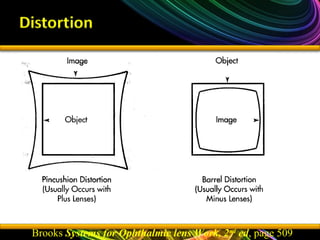
Distortion – pincushion – high plus lens
Object:
Distortion – barrel – high minus lens
Object:
• Another aberration of thick lenses.
• In distortion, the object is sharply imaged bt
does not retain its shape.
• Two types of distortion;
1.Barrel Distortion.
2.Pincushion Distortion.
Brooks Systems for Ophthalmic lens Work, 2nd
ed, page 509
1. Barrel Distortion –
• Produced in minus lenses.
• Rays in centre more magnified than the
further off-axis.
• Due to minification of corners of a square
grid more from minus lenses.
2. Pincushion Distortion -
• Produced in plus lens.
• Rays in centre are less magnified .
• Due to the magnification of corners of square
object more from plus lens
• Image is in focus, but not shaped the same as
the object.
• Results from increased prism away from the
OC of the lens.
• Solution is aspheric design lenses.
• Minor importance for glasses lenses.
• Chromatic --------------- material dependent
• Spherical (the rest are not)
• Marginal Astigmatism
• Coma
• Curvature of Field
• Distortion ----------------- in-focus image
(the rest give blurred images)
• Chromatic
• Spherical Wide Beam
• Marginal Astigmatism Narrow Beam
• Coma Wide Beam
• Curvature of Field Narrow Beam
• Distortion
• Chromatic
• Spherical On-axis
• Marginal Astigmatism Off-axis
• Coma Off-axis
• Curvature of Field On-axis
• Distortion
• Chromatic peripheral
• Spherical central
• Marginal Astigmatism peripheral
(Central when pantoscopic tilt incorrect)
• Coma peripheral
• Curvature of Field peripheral
• Distortion peripheral
• Marginal Astigmatism
• Curvature of Field
. . . . .
• Distortion
• Chromatic aberration
Brooks & Borish, System for Ophthalmic
Dispensing, 2nd
ed, Butterworth-Heinemann,
1996.
A.K.Khurana, Theory and Practice of Optics and
Refraction, 4th
ed
A.K.Khurana, Comprehensive ophthalmology, 5th
ed
Aberrations

Aberrations

  • 2.
    • “When lightfrom a point source goes through a correctly powered spectacle lens yet fails to create a perfect image, the cause is lens aberration.” • All form of deviations are basically aberrations.
  • 3.
    1. Chromatic 2. Monochromatic Spherical  Marginal Astigmatism  Coma  Curvature of Field  Distortion
  • 4.
    • In Focusvs. Out of Focus – Out of focus aberrations cause fuzzy images where clear sharp images should be – In focus aberrations cause images to be the wrong shape (distorted).
  • 5.
    • Wide Beamvs. Narrow Beam – Wide beam aberrations are not as important when the light goes through a narrow opening or aperture, such as the pupil of the eye. – Narrow beam aberrations are the important aberrations when making glasses. – Wide beam aberrations are important for optical instruments such as telescopes.
  • 6.
    • On Axisvs. Off Axis – On axis aberrations effect vision when looking straight ahead through the lens. – Off axis aberrations effect peripheral vision.
  • 7.
    1) Low DegreeAberrations : It include Myopia, Hypermetropia & Regular Astigmatism. It can be surgically treated by conventional LASIK. 2) Higher Degree Aberrations : It include Spherical Aberration, Chromatic Aberration, Coma, Oblique Aberration, Centring, Diffraction of light & Distortion.
  • 8.
    • Chromatic • Spherical •Marginal Astigmatism • Coma • Curvature of Field • Distortion
  • 9.
    • Rays correspondingto different wavelengths travel different paths
  • 10.
    • The lensmaterial breaks white light into its component colors
  • 11.
    1. Longitudinal ChromaticAberration 2. Lateral Chromatic Aberration
  • 12.
    Blue image Red image(Red ray) (Blue Ray) (Redray) (Blue Ray) Longitudinal chromatic aberration Object Lateral chromatic aberration
  • 13.
    Prismatic effect for bluelight Prismatic effect for red light Lateral chromatic aberration • It occurs when a prism bends light of two different wavelengths by different amounts. • Different image sizes • Result in colored ‘ghost’ images White light Lateral Chromatic Aberration
  • 14.
    • Material dependent. •Results in out of focus image. • Wearer complains of peripheral color fringes (more pronounced off-axis). • The higher the power of the lens, the more the chromatic aberration.
  • 15.
    • Correction:  Doubletlens (for instruments: cameras, telescopes, microscopes).  Change lens materials.  AR coat.  Careful placement of OC’s: Monocular PD; OC height and pantoscopic tilt; Short vertex distance and small frame; Control edge thickness.  Consumer education. Doublet lens
  • 16.
    • Reducing chromaticaberration by Achromatic Aberration. - Used two diff. Lens material one regular length an other occur correct the dispersion of 1st lens. - One lens produced of crow glass i.e. low dispersion an other is flint glass i.e. high dispersion.
  • 17.
    • Image isblurred or deformed due to the approximation error in the paraxial approximation to the exact solution. • Aberrations can occur in a lens even when the light entering the lens is only one color.
  • 18.
    • Chromatic • Spherical •Marginal Astigmatism • Coma • Curvature of Field • Distortion
  • 19.
    Spherical lens: Peripheral rayshave shorter focal length than paraxial rays. Spherically aberrated focal points for peripheral rays Focal Point for central (paraxial) rays
  • 20.
    Spherical Aberration Image isblurred or deformed due to the approximation error in the paraxial approximation to the exact solution
  • 21.
    • Peripheral raysrefract more strongly than paraxial rays. • Correct with parabolic curves, aplanatic lens design. • Results in out-of-focus image. • Axial n Wide beam aberration – not important in glasses design. • On-axis aberration. • Seidal aberration
  • 22.
    i. Ant. Surfaceof cornea is flatter at paraxial than centre therefore act as aplanatic surface. ii. The iris act as a stop to spherical aberration, impairment of visual acuity when pupil is dilated is due to spherical aberrations. iii. Sph. Aberrations may reduced by occluding periphery of the lens that only the paraxial zone is used.
  • 23.
     1st – Imagequality es bcoz the focus us not stigmatic.  2nd – Image location change from the position.
  • 24.
    • Chromatic • Spherical •Marginal Astigmatism • Coma • Curvature of Field • Distortion
  • 25.
    Spherical lens, narrowbeam entering off-axis.
  • 26.
    • Narrow beamaberration, therefore important in glasses lens design. • Beam enters obliquely to lens axis, therefore effects peripheral vision. • Creates excess power and cylinder • Also called Oblique astigmatism or Radial astigmatism. • Correct Curve lens design for glasses corrects for this aberration.
  • 27.
    • The distancebetween the two line foci that occurs in oblique astigmatism is called the Astigmatic Difference. • When expressed in diopters, this difference is called the Oblique Astigmatic Error.
  • 28.
     Correction forMarginal(oblique)astigmatism, continued: • Pantoscopic tilt / OC height combination.  Lower OC 1 mm for every 2 degrees pantoscopic tilt.  Use face form in glasses where the OC’s are decentered in. • Aspheric design for high powers and large lenses.
  • 29.
    • Aplanatic Curvatureof cornea n spherical surface of retina minimizing the effect of MA. • It occur due to Sph. Lens show diff. refractive power in diff. meridian only when oblique rays fall upon them. Correction for marginal (oblique)astigmatism, continued:
  • 30.
    • Chromatic • Spherical •Marginal Astigmatism • Coma • Curvature of Field • Distortion
  • 31.
     Object, wayoff to the left) Image – cone or comet shaped.
  • 32.
    • Type ofMonochromatic aberration. • 2nd Seidal aberration similar to Sph.aberration. • Object point is off the axis of the lens, there is a diff. in magnification for the rays passing through different zones of the lens. • The composition image is not a circle bt elongated like Comet or Coma. • Associated with off-axis object points.
  • 33.
    • Not importantin glasses design (except very high plus Rx). • Results in out-of-focus image. • Off-axis aberration, so a peripheral vision problem when present. • Worst type of aberration • Degenerate and deforms the image of point objects.
  • 34.
    • Corrected withparabolic curves, aplanatic lens design. • Reduce coma in high plus lens - Aspheric lens. • If head of coma points towards the optical axis it is +ve coma. • If head of coma points away from the optical axis it is –ve coma.
  • 35.
    • Chromatic • Spherical •Marginal Astigmatism • Coma • Curvature of Field • Distortion
  • 36.
    Plane of focuswhen Marginal astigmatism is corrected Plane of focus when Curvature of field is corrected
  • 37.
    • Also calledpower error. • Light does not focus on a flat focal plane. The focal plane is curved. • Remember the screens at drive-in movies? They are curved, not flat, to focus the sides of the movie as well as the center. • The retina at the back of your eye globe is not a flat plane. • It is curved.
  • 38.
    • Curvature offield is minimized with corrected curve design base curves. • This aberration effects peripheral vision. • Petzval’s surface is the name for the curved surface when marginal (oblique) astigmatism is correct. • Another name for the Petzval's surface is the image sphere. • Far point sphere is where the image would focus correctly.
  • 39.
    • Chromatic • Spherical •Marginal Astigmatism • Coma • Curvature of Field • Distortion
  • 40.
    Distortion – pincushion– high plus lens Object:
  • 41.
    Distortion – barrel– high minus lens Object:
  • 42.
    • Another aberrationof thick lenses. • In distortion, the object is sharply imaged bt does not retain its shape. • Two types of distortion; 1.Barrel Distortion. 2.Pincushion Distortion.
  • 43.
    Brooks Systems forOphthalmic lens Work, 2nd ed, page 509
  • 44.
    1. Barrel Distortion– • Produced in minus lenses. • Rays in centre more magnified than the further off-axis. • Due to minification of corners of a square grid more from minus lenses.
  • 45.
    2. Pincushion Distortion- • Produced in plus lens. • Rays in centre are less magnified . • Due to the magnification of corners of square object more from plus lens
  • 46.
    • Image isin focus, but not shaped the same as the object. • Results from increased prism away from the OC of the lens. • Solution is aspheric design lenses. • Minor importance for glasses lenses.
  • 47.
    • Chromatic ---------------material dependent • Spherical (the rest are not) • Marginal Astigmatism • Coma • Curvature of Field • Distortion ----------------- in-focus image (the rest give blurred images)
  • 48.
    • Chromatic • SphericalWide Beam • Marginal Astigmatism Narrow Beam • Coma Wide Beam • Curvature of Field Narrow Beam • Distortion
  • 49.
    • Chromatic • SphericalOn-axis • Marginal Astigmatism Off-axis • Coma Off-axis • Curvature of Field On-axis • Distortion
  • 50.
    • Chromatic peripheral •Spherical central • Marginal Astigmatism peripheral (Central when pantoscopic tilt incorrect) • Coma peripheral • Curvature of Field peripheral • Distortion peripheral
  • 51.
    • Marginal Astigmatism •Curvature of Field . . . . . • Distortion • Chromatic aberration
  • 52.
    Brooks & Borish,System for Ophthalmic Dispensing, 2nd ed, Butterworth-Heinemann, 1996. A.K.Khurana, Theory and Practice of Optics and Refraction, 4th ed A.K.Khurana, Comprehensive ophthalmology, 5th ed