Prism 
By - Shwetali Bhagat . 
Bsc. Optometry 3rd yr.
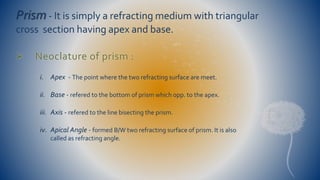
Prism- It is simply a refracting medium with triangular 
cross section having apex and base. 
 Neoclature of prism : 
i. Apex - The point where the two refracting surface are meet. 
ii. Base - refered to the bottom of prism which opp. to the apex. 
iii. Axis - refered to the line bisecting the prism. 
iv. Apical Angle - formed B/W two refracting surface of prism. It is also 
called as refracting angle.
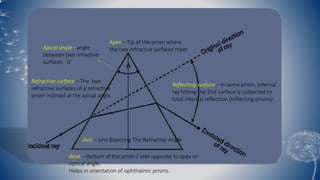
Apex – Tip of the prism where 
the two refractive surfaces meet 
Apical angle - angle 
between two refractive 
surfaces ‘α’ 
Refractive surface – The two 
refractive surfaces of a refractive 
prism inclined at the apical angle 
Reflecting surface – In some prism, internal 
ray hitting the 2nd surface is subjected to 
total internal reflection (reflecting prisms) 
Axis – Line Bisecting The Refractive Angle 
Base – Bottom of the prism / side opposite to apex or 
optical angle. 
Helps in orientation of ophthalmic prisms
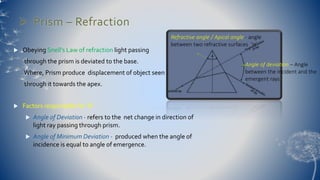
 Prism – Refraction 
Refractive angle / Apical angle - angle 
between two refractive surfaces ‘α’ 
Angle of deviation – Angle 
between the incident and the 
emergent rays. 
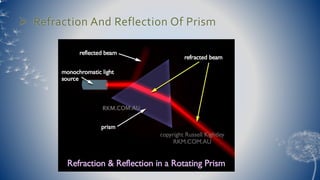
 Obeying Snell's Law of refraction light passing 
through the prism is deviated to the base. 
Where, Prism produce displacement of object seen 
through it towards the apex. 
 Factors responsible for ‘D’ 
 Angle of Deviation - refers to the net change in direction of 
light ray passing through prism. 
 Angle of Minimum Deviation - produced when the angle of 
incidence is equal to angle of emergence.
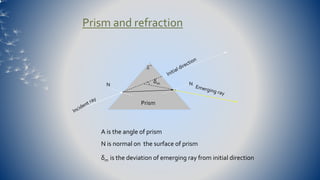
Prism and refraction 
A 
δm 
N N 
Prism 
A is the angle of prism 
N is normal on the surface of prism 
δm is the deviation of emerging ray from initial direction
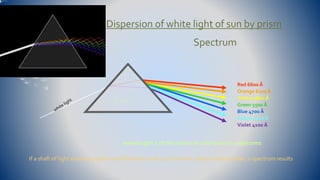
Dispersion of white light of sun by prism 
Red 6600 Å 
Orange 6100 Å 
Yellow 5800 Å 
Green 5500 Å 
Blue 4700 Å 
Indigo 4400 Å 
Violet 4100 Å 
A 
prism 
Spectrum 
wavelength λ of the center of color band in angstroms 
If a shaft of light entering a prism is sufficiently small such that the coloured edges meet, a spectrum results
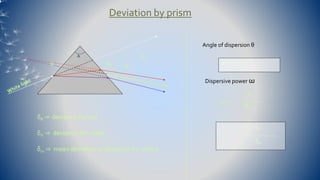
δR δV 
Θ 
A 
δm ⇒ mean deviation or deviation for yellow 
Angle of dispersion θ 
θ = δV - δR 
Dispersive power ω 
θ 
δm 
ω = 
δm 
ω = 
δV - δR 
Deviation by prism 
δR ⇒ deviation for red 
δV ⇒ deviation for violet 
δm
 Refraction And Reflection Of Prism
 Characteristics of Prism - 
 Thickest edge the Base & Thinnest edge the Apex. 
 Displace the incident ray towards the base. 
 Displace the image towards the apex. 
 Does not change vergence of the rays. 
 Does not magnify & minify the image.
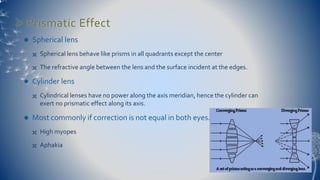
 Prismatic Effect 
 Spherical lens 
 Spherical lens behave like prisms in all quadrants except the center 
 The refractive angle between the lens and the surface incident at the edges. 
 Cylinder lens 
 Cylindrical lenses have no power along the axis meridian, hence the cylinder can 
exert no prismatic effect along its axis. 
 Most commonly if correction is not equal in both eyes. 
 High myopes 
 Aphakia
 Types Of Prisms In Clinical Practice 
1. Loose Prisms 
2. Prisms Bars 
3. Trial Prisms 
4. Fresnel Prisms 
5. Rotating Prisms 
6. Risley Double Prisms – 2 rotating Prisms of same strength on a rotating 
frame 
Prism Bars 
Loose Prisms 
Rotating 
Fresnel Prisms 
Prisms
 Uses of Prism 
 Prisms are used in orthoptic settings, mainly for diagnosis and management 
 Diagnosis 
 Diagnosis microtropia 
 Measurement of angle of deviation 
 To correct angle of deviation 
 Management 
 Eso/ exo deviation of concomitant / incomitant 
 Amblyopia, Nystagmus, Malingering, Visual Field defects
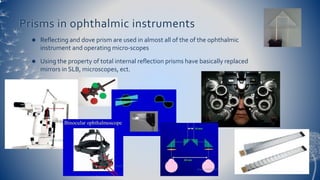
Prisms in ophthalmic instruments 
 Reflecting and dove prism are used in almost all of the of the ophthalmic 
instrument and operating micro-scopes 
 Using the property of total internal reflection prisms have basically replaced 
mirrors in SLB, microscopes, ect.
Thank you

The Prism

  • 1.
    Prism By -Shwetali Bhagat . Bsc. Optometry 3rd yr.
  • 2.
    Prism- It issimply a refracting medium with triangular cross section having apex and base.  Neoclature of prism : i. Apex - The point where the two refracting surface are meet. ii. Base - refered to the bottom of prism which opp. to the apex. iii. Axis - refered to the line bisecting the prism. iv. Apical Angle - formed B/W two refracting surface of prism. It is also called as refracting angle.
  • 3.
    Apex – Tipof the prism where the two refractive surfaces meet Apical angle - angle between two refractive surfaces ‘α’ Refractive surface – The two refractive surfaces of a refractive prism inclined at the apical angle Reflecting surface – In some prism, internal ray hitting the 2nd surface is subjected to total internal reflection (reflecting prisms) Axis – Line Bisecting The Refractive Angle Base – Bottom of the prism / side opposite to apex or optical angle. Helps in orientation of ophthalmic prisms
  • 4.
     Prism –Refraction Refractive angle / Apical angle - angle between two refractive surfaces ‘α’ Angle of deviation – Angle between the incident and the emergent rays.  Obeying Snell's Law of refraction light passing through the prism is deviated to the base. Where, Prism produce displacement of object seen through it towards the apex.  Factors responsible for ‘D’  Angle of Deviation - refers to the net change in direction of light ray passing through prism.  Angle of Minimum Deviation - produced when the angle of incidence is equal to angle of emergence.
  • 5.
    Prism and refraction A δm N N Prism A is the angle of prism N is normal on the surface of prism δm is the deviation of emerging ray from initial direction
  • 6.
    Dispersion of whitelight of sun by prism Red 6600 Å Orange 6100 Å Yellow 5800 Å Green 5500 Å Blue 4700 Å Indigo 4400 Å Violet 4100 Å A prism Spectrum wavelength λ of the center of color band in angstroms If a shaft of light entering a prism is sufficiently small such that the coloured edges meet, a spectrum results
  • 7.
    δR δV Θ A δm ⇒ mean deviation or deviation for yellow Angle of dispersion θ θ = δV - δR Dispersive power ω θ δm ω = δm ω = δV - δR Deviation by prism δR ⇒ deviation for red δV ⇒ deviation for violet δm
  • 8.
     Refraction AndReflection Of Prism
  • 9.
     Characteristics ofPrism -  Thickest edge the Base & Thinnest edge the Apex.  Displace the incident ray towards the base.  Displace the image towards the apex.  Does not change vergence of the rays.  Does not magnify & minify the image.
  • 10.
     Prismatic Effect  Spherical lens  Spherical lens behave like prisms in all quadrants except the center  The refractive angle between the lens and the surface incident at the edges.  Cylinder lens  Cylindrical lenses have no power along the axis meridian, hence the cylinder can exert no prismatic effect along its axis.  Most commonly if correction is not equal in both eyes.  High myopes  Aphakia
  • 11.
     Types OfPrisms In Clinical Practice 1. Loose Prisms 2. Prisms Bars 3. Trial Prisms 4. Fresnel Prisms 5. Rotating Prisms 6. Risley Double Prisms – 2 rotating Prisms of same strength on a rotating frame Prism Bars Loose Prisms Rotating Fresnel Prisms Prisms
  • 12.
     Uses ofPrism  Prisms are used in orthoptic settings, mainly for diagnosis and management  Diagnosis  Diagnosis microtropia  Measurement of angle of deviation  To correct angle of deviation  Management  Eso/ exo deviation of concomitant / incomitant  Amblyopia, Nystagmus, Malingering, Visual Field defects
  • 13.
    Prisms in ophthalmicinstruments  Reflecting and dove prism are used in almost all of the of the ophthalmic instrument and operating micro-scopes  Using the property of total internal reflection prisms have basically replaced mirrors in SLB, microscopes, ect.
  • 14.