Recommended Books for
Ophthalmology
1.

Vaughan & Asbury’s
General Ophthalmology
16th Edition 2004 a LANGE medical book

2.

Parsons’ Diseases of the Eye
19th Edition 2003 Butterworth publication

3.

Clinical Ophthalmology by Jack J. Kanski
5th Edition 2003 Butterworth publication
GLAUCOMA
Patho-physiology & Detection
Dr. Nasir Saeed
Epidemiology of Glaucoma
Glaucoma is not a single disease entity,but the result of a group
of different mechanisms which cause a loss of retinal ganglion
cells. This loss may be acute or episodic, or slowly and
relentlessly progressive. Some authors therefore refer to ‘the
glaucomas’. The common, connecting feature used to be
regarded as the height of the intraocular pressure (IOP), which
dominated the understanding of the clinical manifestations to a
greater or lesser extent. Although intraocular pressure is
frequently raised, it is now regarded as a risk factor, and no
longer considered a defining characteristic.
Glaucoma prevalence surveys, by racial groups
Location

Age

PACG (%)

POAG (%)

Secondary
glaucoma

Congenital/
Developmental

Baltimore, Md.

40+

0.31

1.29

0.68

No available

Beaver Dam, Wisc.

43-84

0.04

2.1

Not stated

Not stated

Blue Mountains,
Australia

49+

0.27

3.0

0.15

Nil

African
Origin

Jamaica

35-74

Nil

1.4

0.35

Nil

Baltimore, Md.

40+

0.67

4.74

1.42

Not available

Asian
Origin

Umanaq area,
Greenland

>40

4.8

1.26

1.00

Nil

NW Alaska

40+

2.65

0.24

Nil

Nil

Beijing, China

40+

1.4

0.03

Not stated

Not stated

Hövsgöl, Mongolia

40+

1.4

0.5

0.3

Nil

European
Origin
World estimates of glaucoma prevalence

Affected
Congenital
300 000
POAG
13.5 million
PACG
6 million
Secondary
2.7 million
Glaucoma suspects 105 million
(IOP>21 mmHg)

Blind
200 000
3 million
2 million
?
RISK FACTORS
Age:
The prevalence and incidence of PACG
increase with age. Although a peak has been
claimed, the best evidence suggests that
incidence rises continually with age. Attacks
of ACG are rare before age 45.
 GENDER
• POAG
• PACG
 Race

• Chinese
• European
• Africans
• Japanese
• Asians

 Refraction
• ACG
• POAG

Genetics

Equal
Females > Males

ACG
POAG
POAG<ACG
NTG
ACG<=POAG

Hypermetopes
Myopes
• Intra-ocular Pressure
• Diabetes
• Family History
• Hypertension
• Vascular Spasm
ANATOMY OF THE ANGLE STRUCTURES
Aqueous Humour
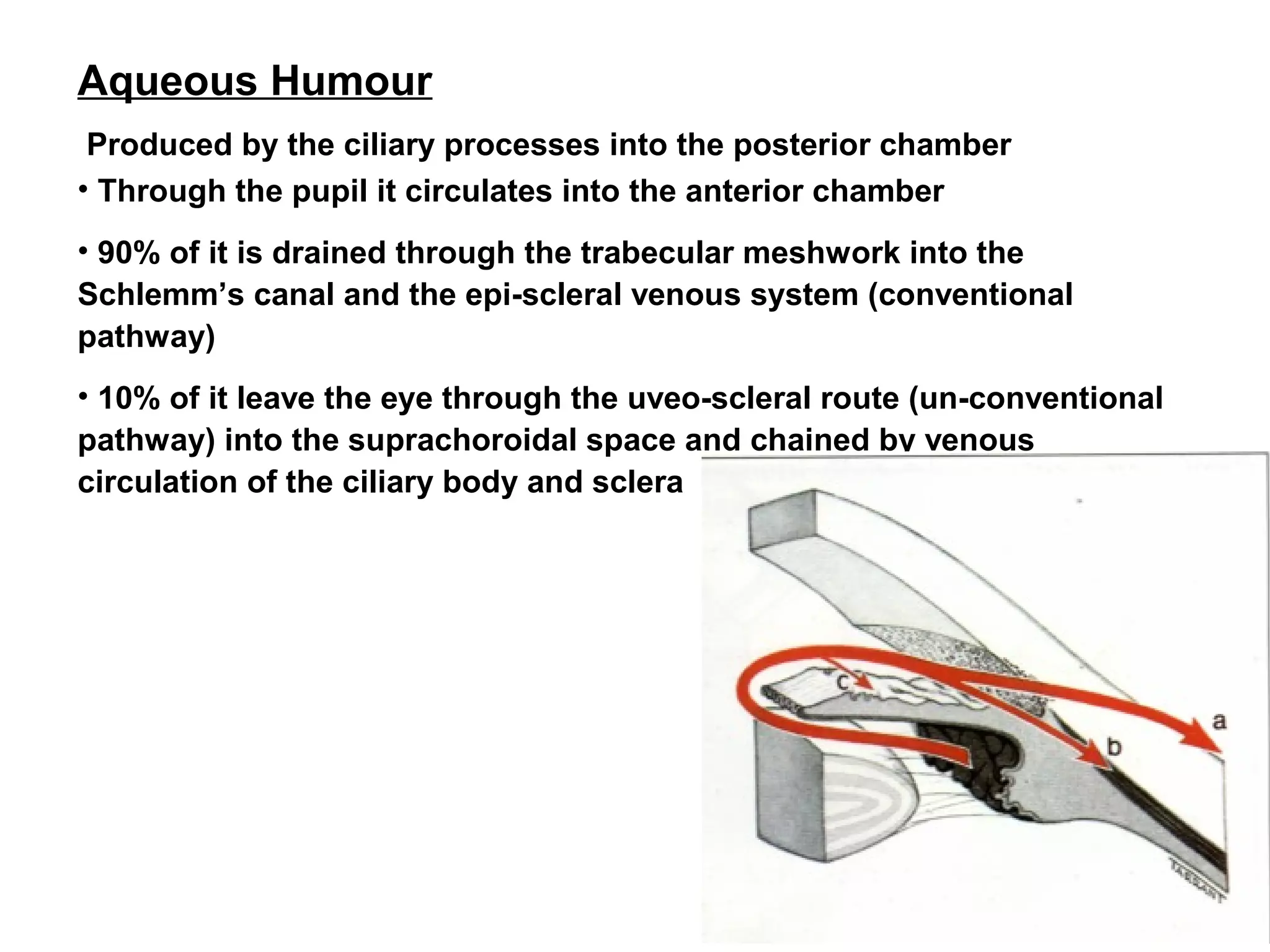
Produced by the ciliary processes into the posterior chamber
• Through the pupil it circulates into the anterior chamber
• 90% of it is drained through the trabecular meshwork into the
Schlemm’s canal and the epi-scleral venous system (conventional
pathway)
• 10% of it leave the eye through the uveo-scleral route (un-conventional
pathway) into the suprachoroidal space and chained by venous
circulation of the ciliary body and sclera
Functions of Aqueous humour

 It maintains the shape and internal structure of the eye by
sustaining an intraocular pressure higher then atmospheric pressure
and helps in maintaining the optical structure.
 It carries oxygen and nutrients to the lens and cornea
It carries waste products away from the lens and cornea
Aqueous humour production
• Produced by the ciliary processes of the ciliary body.
Two Mechanisms
I- Active secretion
• 80% of aqueous is produced by the non pigmented ciliary epithelium
as a result of active metabolic process
• Involves several enzymatic systems i.e. Na+ - K + ATPase / Carbonic
Anhydrase
• Na+, K+, Ascrobate, HCO3
• Transported into the posterior chamber
• Secretion diminishes by factors which will inhibit active metabolism
like drugs, hypoxia, hypothermia
• Independent of IOP
Aqueous humour production
II- Passive Secretions
• 20%
• Diffusion
to maintain equilibrium between the osmotic pressure
and electrical balance on the two sides of the ciliary processes
• Ultra-filtration
• When the diffusion of water and salt is accelerated by blood pressure
(hydrostatic pressure) in the ciliary body
The passive secretion is dependent on level of blood pressure in the
ciliary body, plasma oncotic pressure and intraocular pressure
• Blood Aqueous Barrier
• Large molecules such as plasma proteins and cells do not get
into the aqueous chambers even when the plasma concentration is
very high
•Sites of the barrier is tight junctions between the non-pigment
ciliary epithelium and their basement membrane
Intra-ocular pressure (IOP)
• The circulation of aqueous humour in the eye maintains the IOP
• The equilibrium of aqueous formation and outflow rate is of crucial
importance
• Normally aqueous humour is secreted at a rate of 0.02µl / minute and
same amount is drained
•The distribution of IOP in general population : 11-21 mm of Hg
•Average = 15 mm of Hg
• Diurnal variation – High in morning
Low in evening
• No sex difference

by 5 mm of Hg
Determinants of Intraocular Pressure

•

Rate of aqueous humour formation

•

Resistance encountered in out flow channels

•

Level of epi-scleral venous pressure
Factors influencing Intra-Ocular Pressure
I- Rate of Aqueous Humour formation
Increased by
a. Inflammation
b. Blood Pressure
c. Hypo-osmolarity of plasma

Decreased by
a. Retinal / Choroidal / Ciliary body detachments
b. Drugs

B-Blocker
Carbonic Anhydrase hulibitors

c. Anaesthesia
II- Out flow Resistance
Increased by
Age
Membrane
• Pupillary Block

Synechia
Lens
Vitreous

• Trabecular Meshwork block
Inflammation
Cellular debris
Steroids
Inflammatory exudates
Peripheral Iris bowing
Peripheral Anterior Synechia
Idiopathic
• Outflow Resistance Decreased by
• Accommodation
• Drugs
• Miotics
• Prostaglandins
• Adrenaline
III- Episcleral Venous Pressure

Increased by
• Increased CVP
• Valsalva
• Carotid Cavernous fistula
• Hypercarbia
•Dysthyroid eye disease
•Succinyl – choline
• Co-contraction of extra-ocular muscles
Decreased by
• Hypotension
• Decreased carotid blood flow
• Decrease CVP
Applied Anatomy of the optic n. head
Retinal Nerve fibre layers
Relative positions of nerve fibre layer
Cross Section of the Optic N. Head
Optic Cup & Neuro-retinal rim
Physiological Cup & Neuro-retinal rim
Glaucomatous Damage Retinal Nerve fibre layers Normal
Glaucomatous Damage Abnormal Nerve fibre layers
Abnormal nerve fibre layers
Glaucomatous Damage
Optic disc cupping
Bilateral glaucomatous cupping with inferior notching and
‘bayonetting’
Bilateral advanced glaucomatous cupping with nasal
displacement of the blood vessels
End – Stage glaucomatous cupping
Clinical Methods for detection and evaluation of
glaucoma

• IOP Measurements
• Gonioscopy
• Perimetry Techniques
• Advanced Techniques
Measurement of Intraocular Pressure Tonometry
Principal
• The pressure inside a sphere may be measured directly by canulating
it and connecting it to a measuring device. This is called manometry. It
is the most accurate method but not practical for routine clinical
measurement.
• It can also be measured by the
• Imbert – Fick Law –

Pressure = Force /Area.

• The pressure can be measured by measuring the force necessary to
flatten a fixed area or by measuring the area flattened by a fixed force.
• Also a known force will indent a sphere. In low pressure the
indentation will be more and in high pressure the indentation will be
less.
Goldmann Applanation Tonometer
• Applanation tonometry measures the force applied per unit area. The
Goldmann tonometry is a variable force tonometer consisting of a
double prism with a diameter of 3.06 mm. It is the most popular and
accurate tonometer.
Goldmann applanation
tonometer
Fluorescein-stained semicircles seen during tonometry
A- Schiotz tonometer

B- Principles of
indentation tonometry
•

Checking for diurnal changes= phasing

•

Demonstrating elevation of IOP after pupillary

dilation, water drinking
•

IOP checking in different direction of gaze

•

Checking for steroid responsiveness

•

IOP-measurement digitally
Gonioscopy
•

Visualization of the anterior chamber angle is called
Gonioscopy

Purposes
1. Diagnostic:

to identify abnormal angle structures and to

estimate the width of the anterior chamber angle. This is
particularly important to classify the open angle and angle
closer glaucoma
2. Surgical:

to visualize the angle during the procedures

such as laser trabeculopasty and goniotomy
Optical Principal
• In normal circumstances the angle of anterior chamber can not
be visualized because of the total internal reflection

Lighter Medium

a
b
c
d

d
c
b
a
Critical Angle

Denser Medium
Optical Principal of Gonioscopy
Single Mirror goniolens & Zeiss four mirror goniolens
Swan-Jacob surgical goniolens & Koeppe goniolenses
Normal Anatomy of Angle structure
Schaffer’s Grading System
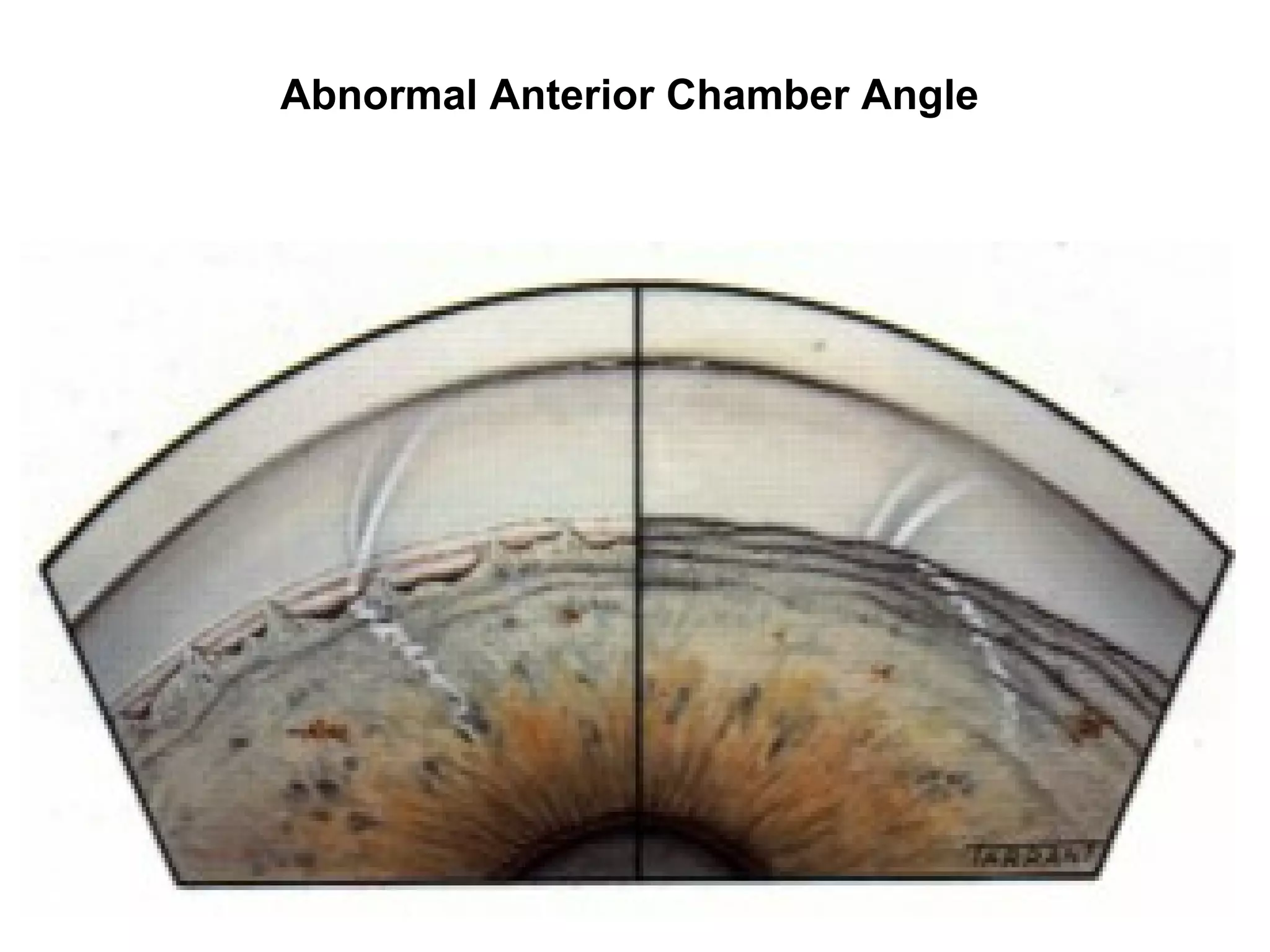
Abnormal Anterior Chamber Angle
Perimetry
• Visual fields ;
• An island of vision surrounded
by a sea of darkness
• Isopter.

An Isopter is a line in the field of vision exhibiting
similar visual acuity

• Scotoma.

Is a defect in the visual field
• Absolute
• Relative
• Positive
• Negative

• Visible threshold. Is the luminance of the stimulus measured in dB at
which it is perceived 50% of times when it is
presented statically
Perimetric Principals

• Perimetry is a method of evaluating the visual fields
• Qualitative Perimetry is a method of detecting a visual field defect
and is the first screening phases of glaucoma suspects
• Quantitative Perimetry
Visual Fields defects in glaucoma
1. Arcuate scotomas : develop between 100 and 200 of
fixation in areas that constitute downward or more
commonly, upward extensions from the blind spot
(Bjeerrum area)
2. Isolated paracentral scotomas: superior or inferior
scotomas may also be found in early glaucoma.
3. A nasal (Roenne) step
4. Ring scotomas
5. Temporal Wedge
6. End Stage fields defects
1. Arcuate scotomas : develop between 100 and 200 of fixation in
areas that constitute downward or more commonly, upward
extensions from the blind spot (Bjeerrum area)
Isolated paracentral scotomas: superior or inferior scotomas may also
be found in early glaucoma
A nasal (Roenne) step
Temporal Wedge
End Stage fields defects
Advanced Techniques

Quantitative Measurements
• Digitalized photogrammetry
• Confocal scanning laser ophthalmoscope (HRT)
• Measurements of ocular blood flow
Digitalized photogrammetry
Confocal scanning laser
ophthalmoscope (HRT)
Glaucoma is the second leading cause of
worldwide blindness.
Early detection and early onset of treatment are
the most important factors for preventing
progressive glaucoma damage.
A comprehensive evaluation of a glaucoma
suspect is the key to diagnosis and management.
The aims of assessment are:
• To assess the risk factors to determine whether
glaucoma is present or likely to develop
• To exclude or confirm the alternative diagnosis
• To identify the underlying mechanism of
damage; so as to select best choice for
management
• To plan a strategy for management
ASSESSMENT
Presenting

Social

HISTORY

Family

Past
VA
Gonio

OM

IOP

Exoph

EXAMINATION
Fundus

Ocu surf

Cornea

Lens
Pupils

AC
Ocular Examination
• Record visual functions
• Ocular motility
• Exclude any proptosis/exophthalmos
• Ocular surface for episcleral blood vessels
• Conjunctiva for papillae and follicles
• Cornea for size, shape and transparency
• Check for corneal thickness
Ocular Examination
• Anterior chamber for inflammation, blood, pigment
• Check for AC depth, central and peripheral

• Convex iris-lens
diaphragm

• Shallow anterior
chamber

• Narrow entrance to
chamber angle
Ocular Examination
Iris for atrophy , rubeosis, trans-illumination defects and pseudoexfoliation

Stromal iris atrophy with
spiral-like configuration

Mid-peripheral iris
atrophy

Central disc with
peripheral band
Ocular Examination
• Pupil for size, shape and reaction
• Lens for presence, transparency,
thickness, position and shape
Ocular Examination
• Record intraocular pressure, look for
diurnal variations
• Evaluate IOP for 24 hours if in doubt
• Use a Goldmann-style applanation
tonometer
Ocular Examination
Gonioscopy: look for width of the angle, configuration of the iris and
chamber, PAS, vessels and iris processes

Open angle of normal
appearance

Schaffer’s grading of angle

Trabecular hyperpigmentation
- may extend anteriorly
(Sampaolesi line)

Synechial angle closure

Irregular widening of ciliary
body band
Ocular Examination
Fundoscopy: evaluate optic nerve head and retinal nerve fibre layer
use slit lamp indirect lenses and a dilated pupil
Look for optic disc size, colour, neuro-retinal rim, disc haemorrhage, vascular pattern, peri-papillary atrophy and
cup disc ratio

Small dimple central cup

Larger and deeper
punched-out central cup

Cup with sloping temporal
wall
Optic disc evaluation
Retinal nerve fibre layer analysis
Investigations
Order for a visual field
examination with a
standard automated
perimeter
Investigations
HRT
OCT
GDx
Systemic investigation include
Imaging of CNS
Evaluation of CVS
Haematological profile
Anatomy of the angle structure (glaucoma)

Anatomy of the angle structure (glaucoma)

  • 1.
    Recommended Books for Ophthalmology 1. Vaughan& Asbury’s General Ophthalmology 16th Edition 2004 a LANGE medical book 2. Parsons’ Diseases of the Eye 19th Edition 2003 Butterworth publication 3. Clinical Ophthalmology by Jack J. Kanski 5th Edition 2003 Butterworth publication
  • 2.
  • 3.
    Epidemiology of Glaucoma Glaucomais not a single disease entity,but the result of a group of different mechanisms which cause a loss of retinal ganglion cells. This loss may be acute or episodic, or slowly and relentlessly progressive. Some authors therefore refer to ‘the glaucomas’. The common, connecting feature used to be regarded as the height of the intraocular pressure (IOP), which dominated the understanding of the clinical manifestations to a greater or lesser extent. Although intraocular pressure is frequently raised, it is now regarded as a risk factor, and no longer considered a defining characteristic.
  • 4.
    Glaucoma prevalence surveys,by racial groups Location Age PACG (%) POAG (%) Secondary glaucoma Congenital/ Developmental Baltimore, Md. 40+ 0.31 1.29 0.68 No available Beaver Dam, Wisc. 43-84 0.04 2.1 Not stated Not stated Blue Mountains, Australia 49+ 0.27 3.0 0.15 Nil African Origin Jamaica 35-74 Nil 1.4 0.35 Nil Baltimore, Md. 40+ 0.67 4.74 1.42 Not available Asian Origin Umanaq area, Greenland >40 4.8 1.26 1.00 Nil NW Alaska 40+ 2.65 0.24 Nil Nil Beijing, China 40+ 1.4 0.03 Not stated Not stated Hövsgöl, Mongolia 40+ 1.4 0.5 0.3 Nil European Origin
  • 5.
    World estimates ofglaucoma prevalence Affected Congenital 300 000 POAG 13.5 million PACG 6 million Secondary 2.7 million Glaucoma suspects 105 million (IOP>21 mmHg) Blind 200 000 3 million 2 million ?
  • 6.
    RISK FACTORS Age: The prevalenceand incidence of PACG increase with age. Although a peak has been claimed, the best evidence suggests that incidence rises continually with age. Attacks of ACG are rare before age 45.
  • 7.
     GENDER • POAG •PACG  Race • Chinese • European • Africans • Japanese • Asians  Refraction • ACG • POAG Genetics Equal Females > Males ACG POAG POAG<ACG NTG ACG<=POAG Hypermetopes Myopes
  • 8.
    • Intra-ocular Pressure •Diabetes • Family History • Hypertension • Vascular Spasm
  • 9.
    ANATOMY OF THEANGLE STRUCTURES
  • 10.
    Aqueous Humour Produced bythe ciliary processes into the posterior chamber • Through the pupil it circulates into the anterior chamber • 90% of it is drained through the trabecular meshwork into the Schlemm’s canal and the epi-scleral venous system (conventional pathway) • 10% of it leave the eye through the uveo-scleral route (un-conventional pathway) into the suprachoroidal space and chained by venous circulation of the ciliary body and sclera
  • 11.
    Functions of Aqueoushumour  It maintains the shape and internal structure of the eye by sustaining an intraocular pressure higher then atmospheric pressure and helps in maintaining the optical structure.  It carries oxygen and nutrients to the lens and cornea It carries waste products away from the lens and cornea
  • 12.
    Aqueous humour production •Produced by the ciliary processes of the ciliary body. Two Mechanisms I- Active secretion • 80% of aqueous is produced by the non pigmented ciliary epithelium as a result of active metabolic process • Involves several enzymatic systems i.e. Na+ - K + ATPase / Carbonic Anhydrase • Na+, K+, Ascrobate, HCO3 • Transported into the posterior chamber • Secretion diminishes by factors which will inhibit active metabolism like drugs, hypoxia, hypothermia • Independent of IOP
  • 13.
    Aqueous humour production II-Passive Secretions • 20% • Diffusion to maintain equilibrium between the osmotic pressure and electrical balance on the two sides of the ciliary processes • Ultra-filtration • When the diffusion of water and salt is accelerated by blood pressure (hydrostatic pressure) in the ciliary body The passive secretion is dependent on level of blood pressure in the ciliary body, plasma oncotic pressure and intraocular pressure • Blood Aqueous Barrier • Large molecules such as plasma proteins and cells do not get into the aqueous chambers even when the plasma concentration is very high •Sites of the barrier is tight junctions between the non-pigment ciliary epithelium and their basement membrane
  • 14.
    Intra-ocular pressure (IOP) •The circulation of aqueous humour in the eye maintains the IOP • The equilibrium of aqueous formation and outflow rate is of crucial importance • Normally aqueous humour is secreted at a rate of 0.02µl / minute and same amount is drained •The distribution of IOP in general population : 11-21 mm of Hg •Average = 15 mm of Hg • Diurnal variation – High in morning Low in evening • No sex difference by 5 mm of Hg
  • 15.
    Determinants of IntraocularPressure • Rate of aqueous humour formation • Resistance encountered in out flow channels • Level of epi-scleral venous pressure
  • 16.
    Factors influencing Intra-OcularPressure I- Rate of Aqueous Humour formation Increased by a. Inflammation b. Blood Pressure c. Hypo-osmolarity of plasma Decreased by a. Retinal / Choroidal / Ciliary body detachments b. Drugs B-Blocker Carbonic Anhydrase hulibitors c. Anaesthesia
  • 17.
    II- Out flowResistance Increased by Age Membrane • Pupillary Block Synechia Lens Vitreous • Trabecular Meshwork block Inflammation Cellular debris Steroids Inflammatory exudates Peripheral Iris bowing Peripheral Anterior Synechia Idiopathic
  • 18.
    • Outflow ResistanceDecreased by • Accommodation • Drugs • Miotics • Prostaglandins • Adrenaline
  • 19.
    III- Episcleral VenousPressure Increased by • Increased CVP • Valsalva • Carotid Cavernous fistula • Hypercarbia •Dysthyroid eye disease •Succinyl – choline • Co-contraction of extra-ocular muscles Decreased by • Hypotension • Decreased carotid blood flow • Decrease CVP
  • 20.
    Applied Anatomy ofthe optic n. head Retinal Nerve fibre layers
  • 21.
    Relative positions ofnerve fibre layer
  • 22.
    Cross Section ofthe Optic N. Head
  • 23.
    Optic Cup &Neuro-retinal rim
  • 24.
    Physiological Cup &Neuro-retinal rim
  • 25.
    Glaucomatous Damage RetinalNerve fibre layers Normal
  • 26.
    Glaucomatous Damage AbnormalNerve fibre layers
  • 27.
  • 28.
  • 29.
    Bilateral glaucomatous cuppingwith inferior notching and ‘bayonetting’
  • 30.
    Bilateral advanced glaucomatouscupping with nasal displacement of the blood vessels
  • 31.
    End – Stageglaucomatous cupping
  • 32.
    Clinical Methods fordetection and evaluation of glaucoma • IOP Measurements • Gonioscopy • Perimetry Techniques • Advanced Techniques
  • 33.
    Measurement of IntraocularPressure Tonometry Principal • The pressure inside a sphere may be measured directly by canulating it and connecting it to a measuring device. This is called manometry. It is the most accurate method but not practical for routine clinical measurement. • It can also be measured by the • Imbert – Fick Law – Pressure = Force /Area. • The pressure can be measured by measuring the force necessary to flatten a fixed area or by measuring the area flattened by a fixed force. • Also a known force will indent a sphere. In low pressure the indentation will be more and in high pressure the indentation will be less.
  • 34.
    Goldmann Applanation Tonometer •Applanation tonometry measures the force applied per unit area. The Goldmann tonometry is a variable force tonometer consisting of a double prism with a diameter of 3.06 mm. It is the most popular and accurate tonometer.
  • 35.
  • 36.
  • 37.
    A- Schiotz tonometer B-Principles of indentation tonometry
  • 38.
    • Checking for diurnalchanges= phasing • Demonstrating elevation of IOP after pupillary dilation, water drinking • IOP checking in different direction of gaze • Checking for steroid responsiveness • IOP-measurement digitally
  • 39.
    Gonioscopy • Visualization of theanterior chamber angle is called Gonioscopy Purposes 1. Diagnostic: to identify abnormal angle structures and to estimate the width of the anterior chamber angle. This is particularly important to classify the open angle and angle closer glaucoma 2. Surgical: to visualize the angle during the procedures such as laser trabeculopasty and goniotomy
  • 40.
    Optical Principal • Innormal circumstances the angle of anterior chamber can not be visualized because of the total internal reflection Lighter Medium a b c d d c b a Critical Angle Denser Medium
  • 41.
  • 42.
    Single Mirror goniolens& Zeiss four mirror goniolens
  • 43.
    Swan-Jacob surgical goniolens& Koeppe goniolenses
  • 45.
    Normal Anatomy ofAngle structure
  • 46.
  • 47.
  • 48.
    Perimetry • Visual fields; • An island of vision surrounded by a sea of darkness
  • 49.
    • Isopter. An Isopteris a line in the field of vision exhibiting similar visual acuity • Scotoma. Is a defect in the visual field • Absolute • Relative • Positive • Negative • Visible threshold. Is the luminance of the stimulus measured in dB at which it is perceived 50% of times when it is presented statically
  • 50.
    Perimetric Principals • Perimetryis a method of evaluating the visual fields • Qualitative Perimetry is a method of detecting a visual field defect and is the first screening phases of glaucoma suspects • Quantitative Perimetry
  • 51.
    Visual Fields defectsin glaucoma 1. Arcuate scotomas : develop between 100 and 200 of fixation in areas that constitute downward or more commonly, upward extensions from the blind spot (Bjeerrum area) 2. Isolated paracentral scotomas: superior or inferior scotomas may also be found in early glaucoma. 3. A nasal (Roenne) step 4. Ring scotomas 5. Temporal Wedge 6. End Stage fields defects
  • 52.
    1. Arcuate scotomas: develop between 100 and 200 of fixation in areas that constitute downward or more commonly, upward extensions from the blind spot (Bjeerrum area)
  • 53.
    Isolated paracentral scotomas:superior or inferior scotomas may also be found in early glaucoma
  • 54.
  • 55.
  • 56.
  • 57.
    Advanced Techniques Quantitative Measurements •Digitalized photogrammetry • Confocal scanning laser ophthalmoscope (HRT) • Measurements of ocular blood flow
  • 58.
  • 59.
  • 60.
    Glaucoma is thesecond leading cause of worldwide blindness. Early detection and early onset of treatment are the most important factors for preventing progressive glaucoma damage. A comprehensive evaluation of a glaucoma suspect is the key to diagnosis and management.
  • 61.
    The aims ofassessment are: • To assess the risk factors to determine whether glaucoma is present or likely to develop • To exclude or confirm the alternative diagnosis • To identify the underlying mechanism of damage; so as to select best choice for management • To plan a strategy for management
  • 62.
  • 63.
  • 64.
  • 65.
    Ocular Examination • Recordvisual functions • Ocular motility • Exclude any proptosis/exophthalmos • Ocular surface for episcleral blood vessels • Conjunctiva for papillae and follicles • Cornea for size, shape and transparency • Check for corneal thickness
  • 66.
    Ocular Examination • Anteriorchamber for inflammation, blood, pigment • Check for AC depth, central and peripheral • Convex iris-lens diaphragm • Shallow anterior chamber • Narrow entrance to chamber angle
  • 67.
    Ocular Examination Iris foratrophy , rubeosis, trans-illumination defects and pseudoexfoliation Stromal iris atrophy with spiral-like configuration Mid-peripheral iris atrophy Central disc with peripheral band
  • 68.
    Ocular Examination • Pupilfor size, shape and reaction • Lens for presence, transparency, thickness, position and shape
  • 69.
    Ocular Examination • Recordintraocular pressure, look for diurnal variations • Evaluate IOP for 24 hours if in doubt • Use a Goldmann-style applanation tonometer
  • 70.
    Ocular Examination Gonioscopy: lookfor width of the angle, configuration of the iris and chamber, PAS, vessels and iris processes Open angle of normal appearance Schaffer’s grading of angle Trabecular hyperpigmentation - may extend anteriorly (Sampaolesi line) Synechial angle closure Irregular widening of ciliary body band
  • 71.
    Ocular Examination Fundoscopy: evaluateoptic nerve head and retinal nerve fibre layer use slit lamp indirect lenses and a dilated pupil Look for optic disc size, colour, neuro-retinal rim, disc haemorrhage, vascular pattern, peri-papillary atrophy and cup disc ratio Small dimple central cup Larger and deeper punched-out central cup Cup with sloping temporal wall
  • 72.
  • 73.
    Retinal nerve fibrelayer analysis
  • 74.
    Investigations Order for avisual field examination with a standard automated perimeter
  • 75.
  • 76.
    Systemic investigation include Imagingof CNS Evaluation of CVS Haematological profile