Glaucoma Screening


       Nicholas J. Silvestros, OD
               Clinical Instructor
Department of Ophthalmology and Vision Sciences
        Washington University St. Louis
               School of Medicine
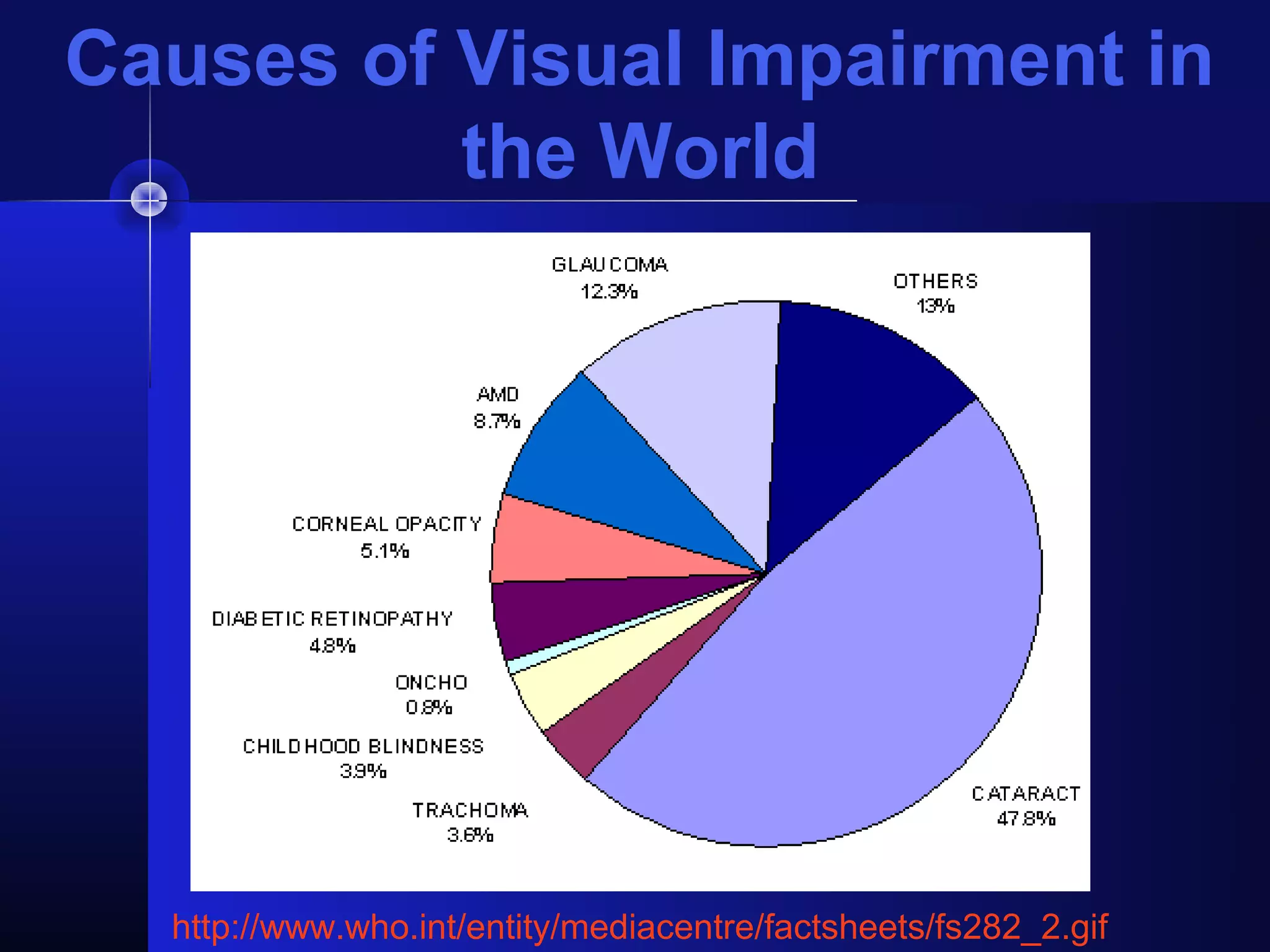
Causes of Visual Impairment in
          the World


  http://www.who.int/entity/mediacentre/factsheets/fs282_2.gif
Glaucoma
• 2nd most common cause of blindness in U.S.
• Single most common cause of blindness in
  African Americans
   • African Americans 4x more likely to have glaucoma
     and 6x more likely to be blind from it
• If detected early and treated, blindness can be
  prevented
• In early stages, most patients asymptomatic
• Peripheral vision can be lost before patient notices
  visual impairment
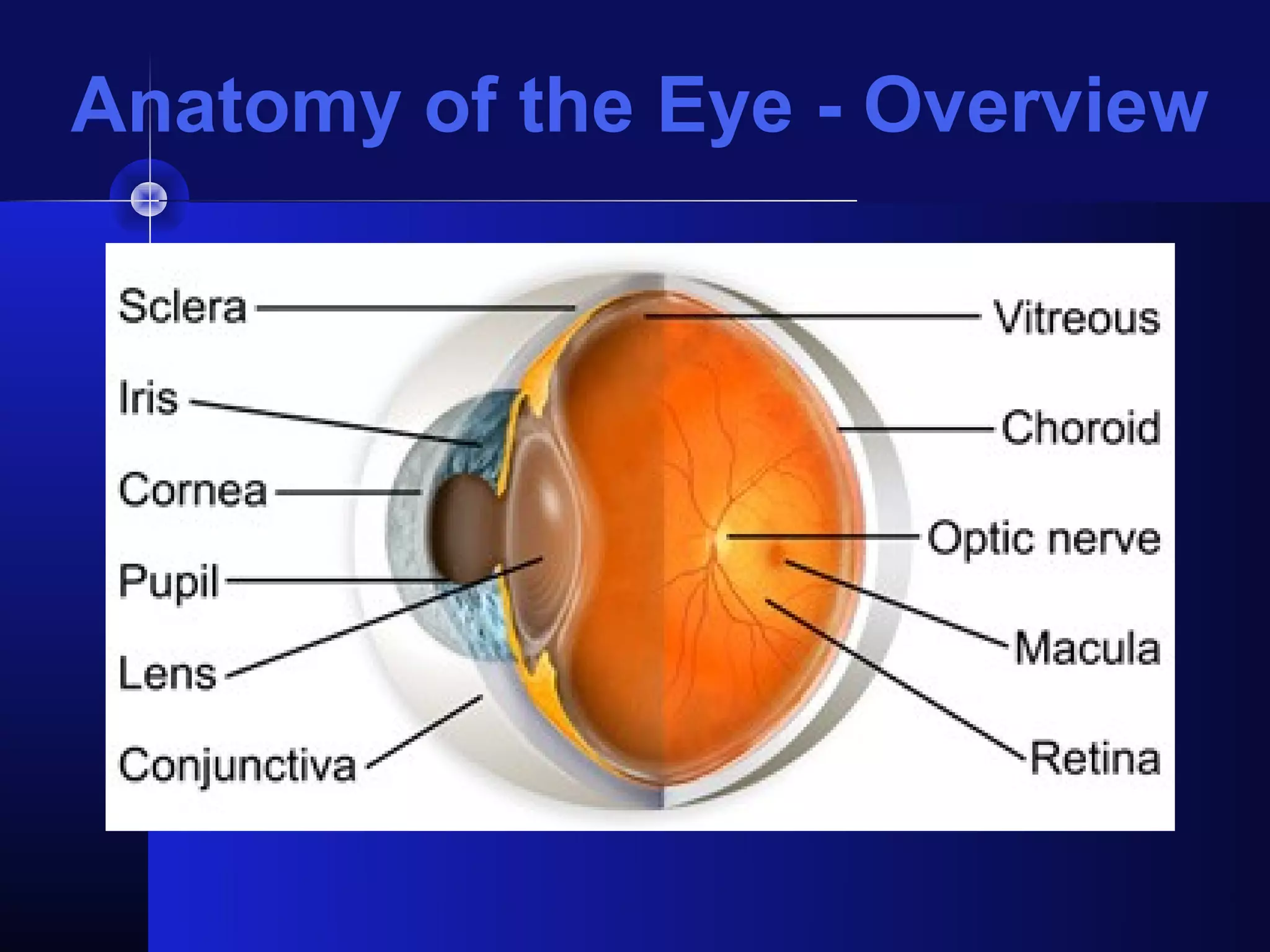
Anatomy of the Eye - Overview
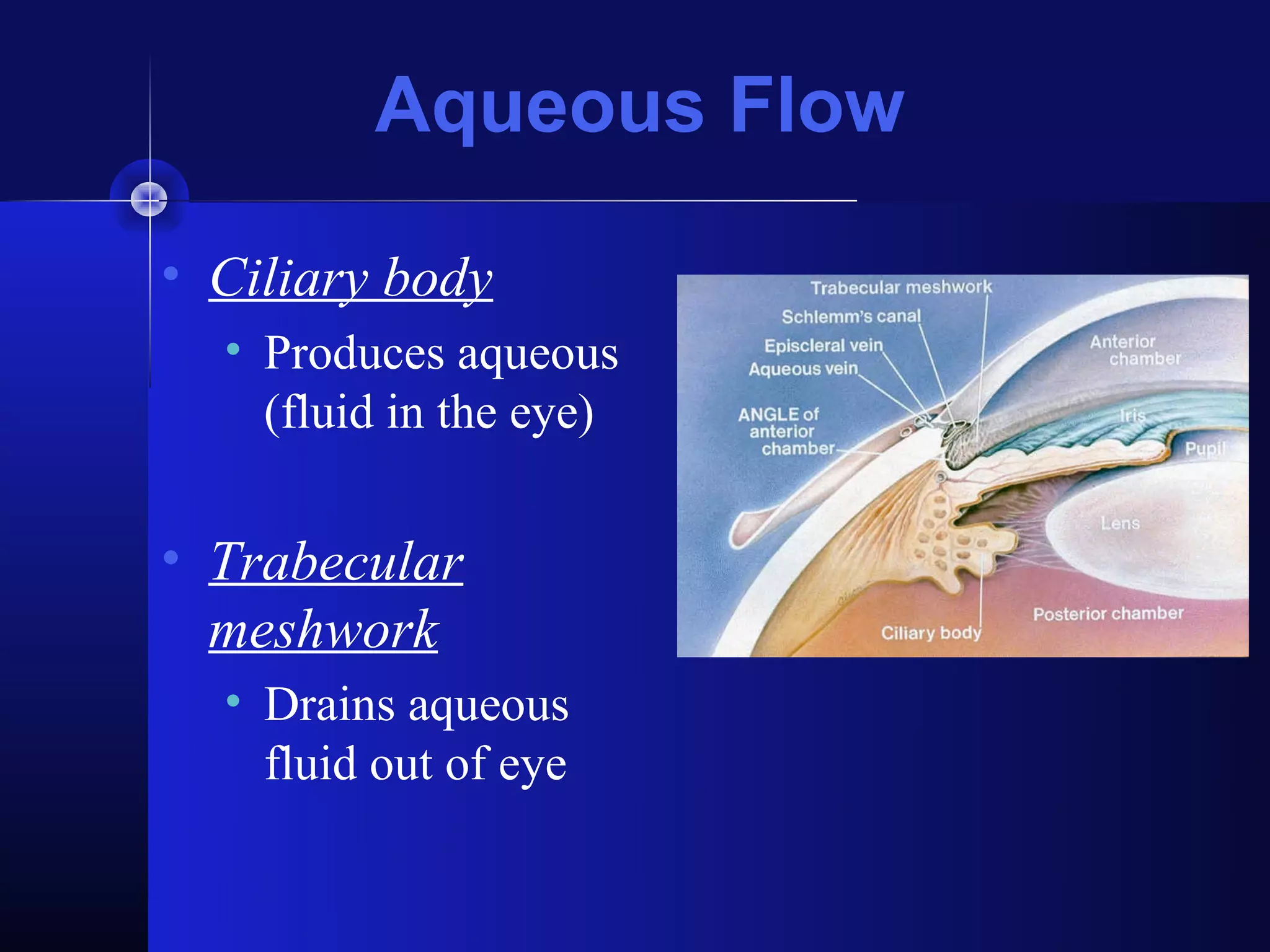
Aqueous Flow

• Ciliary body
  • Produces aqueous
    (fluid in the eye)


• Trabecular
  meshwork
  • Drains aqueous
    fluid out of eye
Aqueous Humor Formation

 • Involves the combination of 2 known
   processes:
   • Active transport (secretion)
      • 80% of Aqueous
   • Passive transport (ultrafiltration and diffusion)
      • 20% of Aqueous
      • Affected by topical glaucoma medications: beta-
        blockers, sympathomimetics and carbonic
        anhydrase inhibitors
Trabecular Outflow

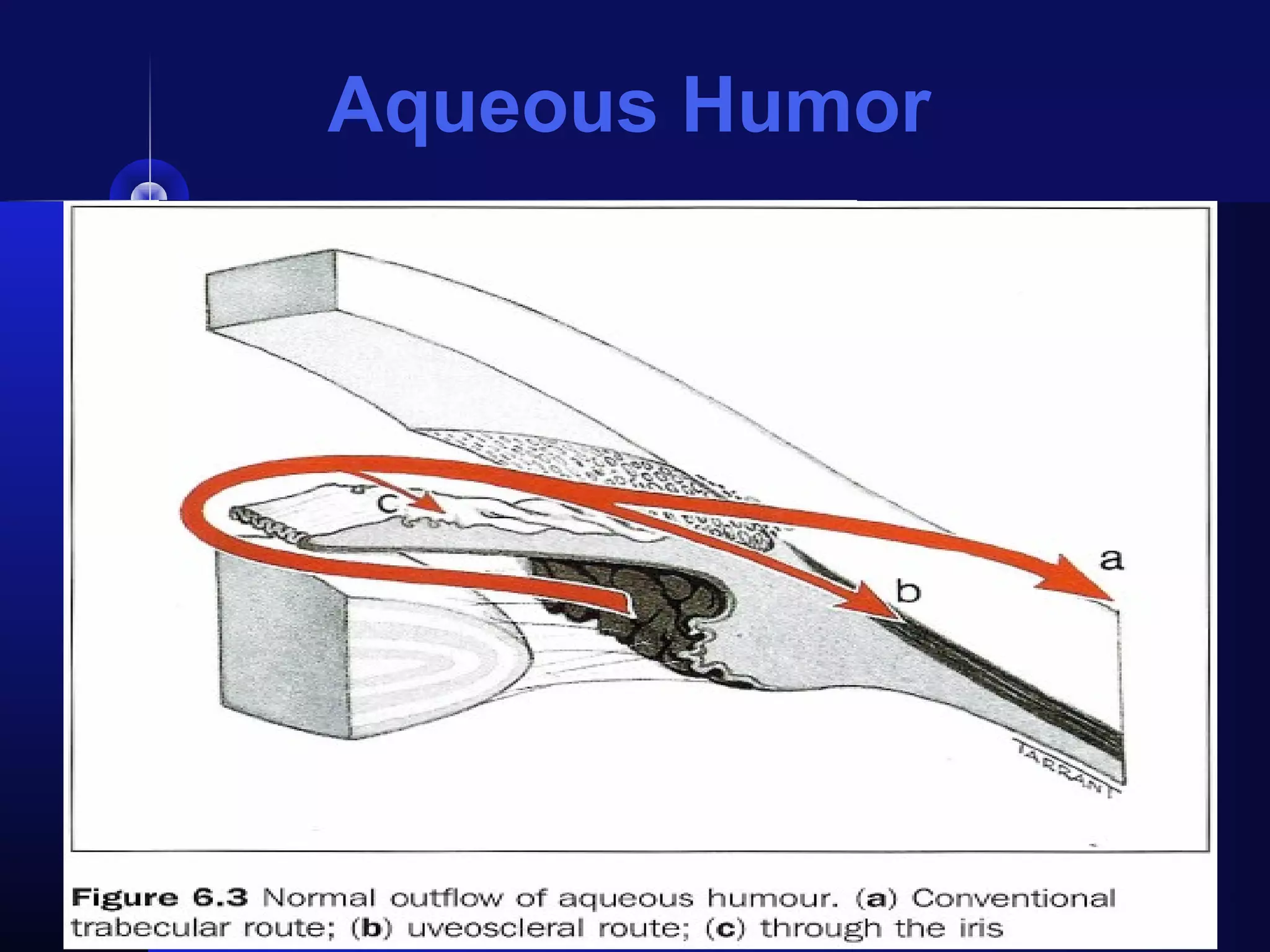
• Conventional outflow
  • 80-90% outflow
  • Increased:
     • Drugs: Cholinergics (pilocarpine), Adrenergic
       agonists
     • Surgical: ALT/SLT, Trabeculotomy/goniotomy
• Unconventional outflow
  • 10-20% outflow
  • Increased:
     • Drugs: sympathomimetics and prostaglandins
Aqueous Humor
Aqueous Humor Trivia

• Nourishes lens, cornea, vitreous
• Decreases production with:
  • Sleep
  • Age
  • Some systemic hypotensive agents
• Decrease outflow with:
  • Age
Intraocular Pressure

• IOP:
  • Range 11 mmHg to 21 mmHG
  • 21 considered upper limit of normal
  • IOP varies time of day, heart beat, BP,
    respiration
     • Tendency for higher AM and lower evening
     • Lower during laying/sleeping
  • Diurnal variation:
     • 2-6 mm Hg normal
     • >10 mm Hg suggestive of glaucoma
Intraocular Pressure

• IOP:
  • IOP varies time of day, heart beat, BP,
    respiration
     •   Tendency for higher AM and lower evening
     •   Lower during laying/sleeping
     •   Age (increases with age)
     •   Caffeine (transiently increases  in IOP)
     •   Alcohol (transiently  in IOP)
     •   Cannibis (mild  in IOP)
Intraocular Pressure Trivia

• IOP:
  • No absolutes
     • A “normal” IOP reading may be misleading and
       additional reading at different times of the day may
       be required
     • IOP is a risk factor and does not eliminate glaucoma
       if a “normal” reading is recorded
     • Must be compared with all other risk factors and
       clinical data
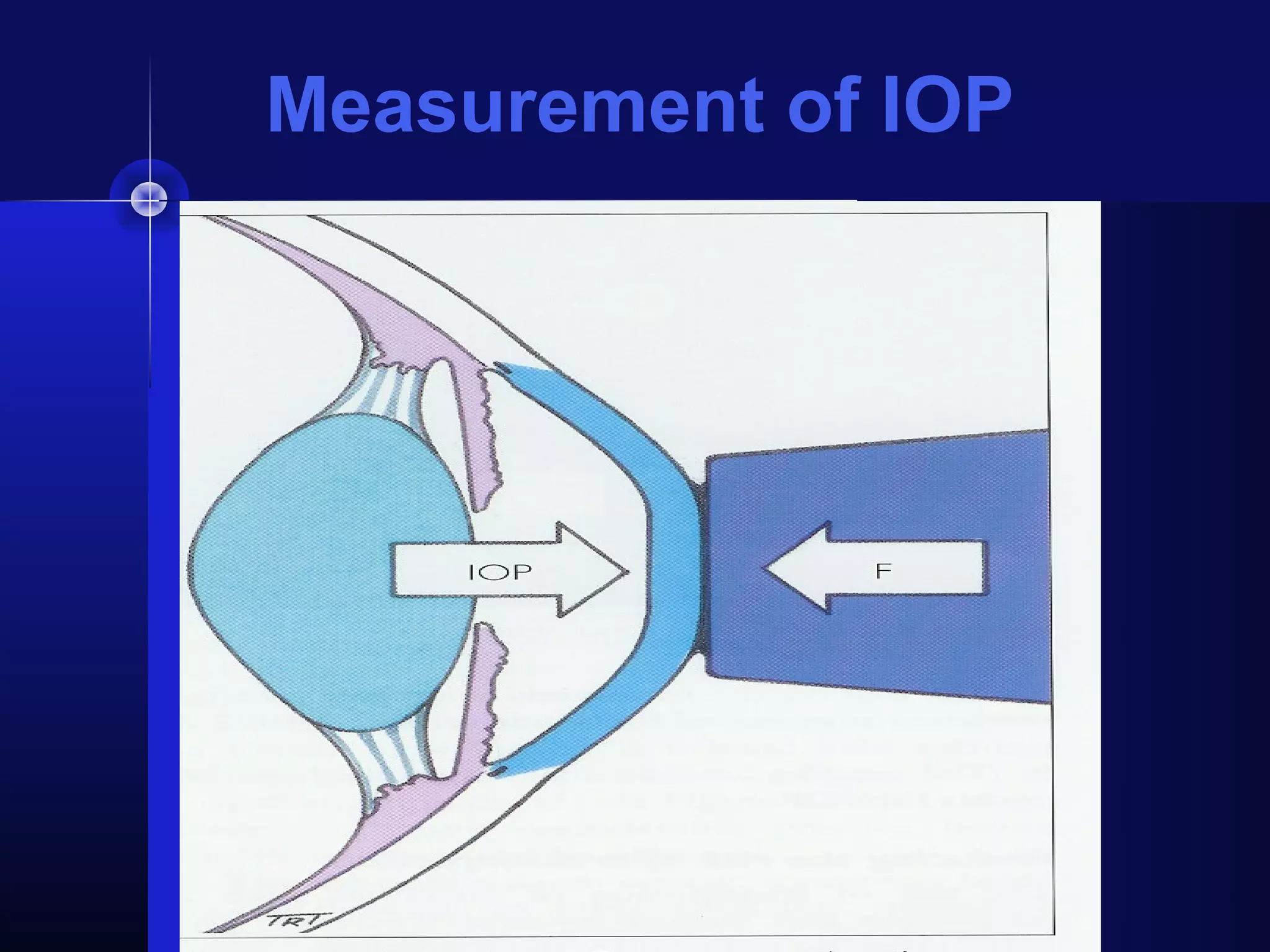
Measurement of IOP
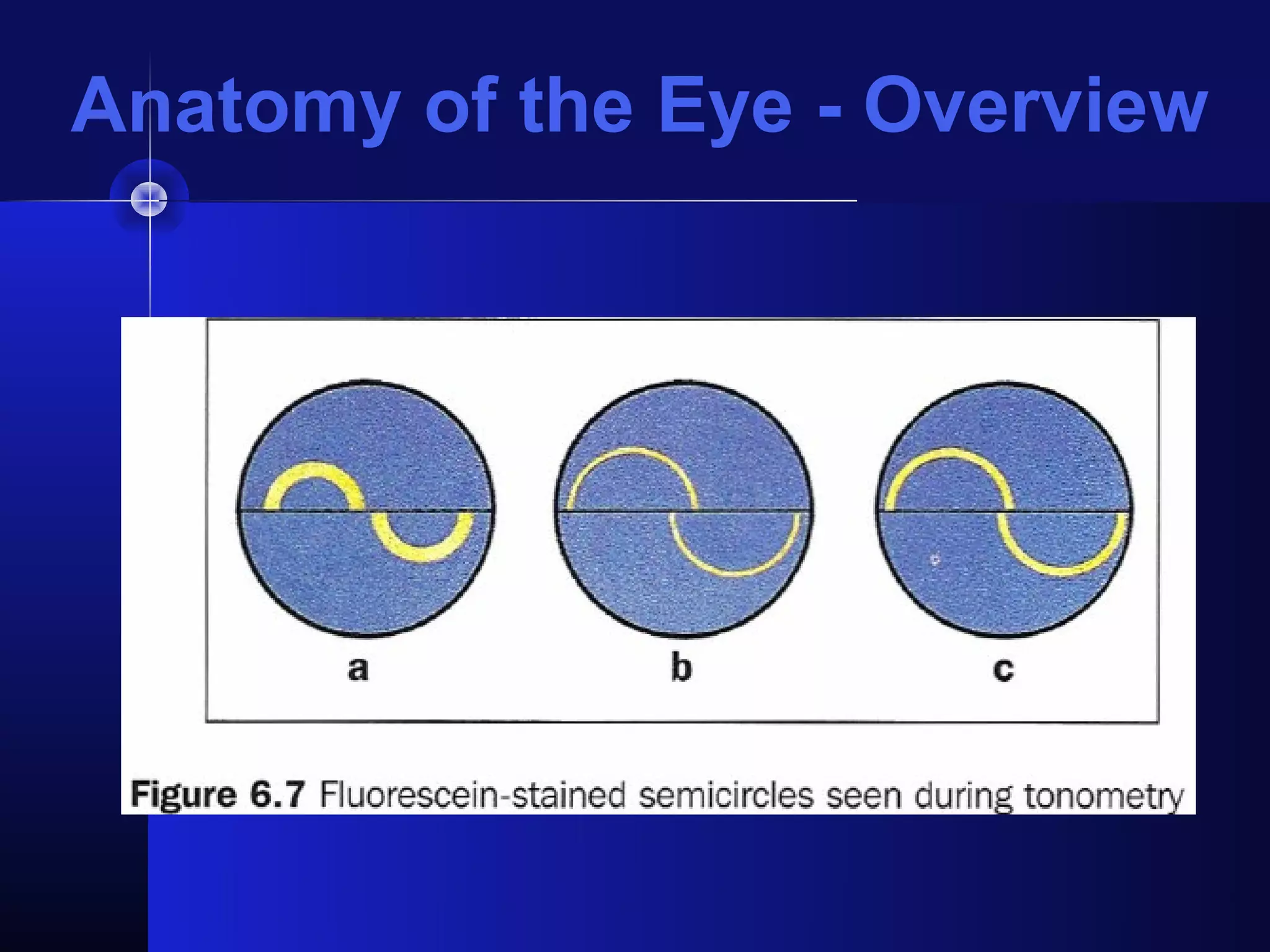
• Applanation Tonometry:
  • Measures the force necessary to flatten an area
    of cornea 3.06 mm diameter
  • Central part of cornea flattened while variable
    force records pressure
  • Central Corneal Thickness:
     • >540 micrometers produce falsely high IOP
       readings by TA
     • <540 micrometers produce falsely low IOP reading
       by TA
Measurement of IOP
Measurement of IOP
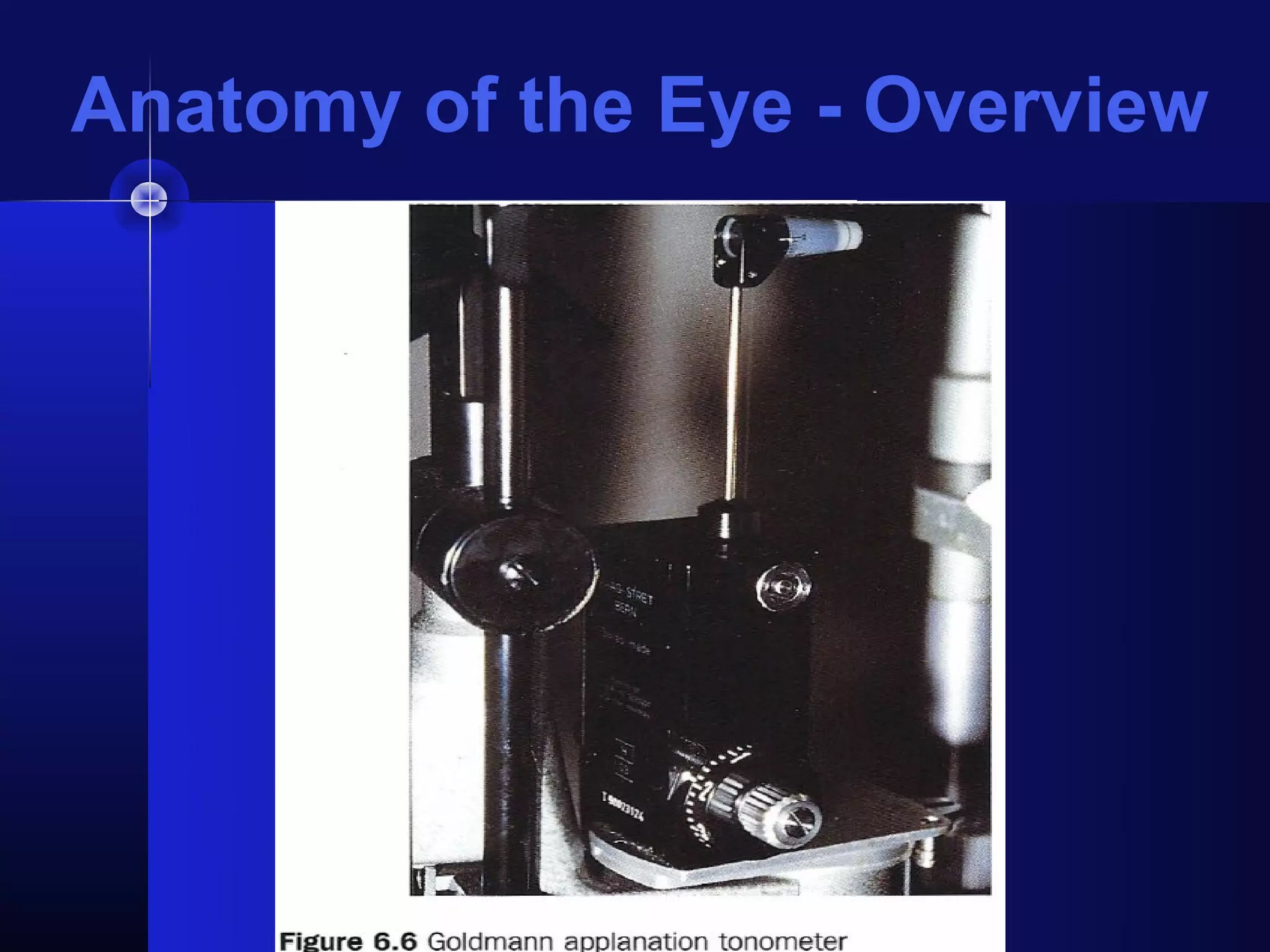
• Applanation Tonometry:
  • Goldmann tonometer
     • Most popular tonometer and accurate tonometer
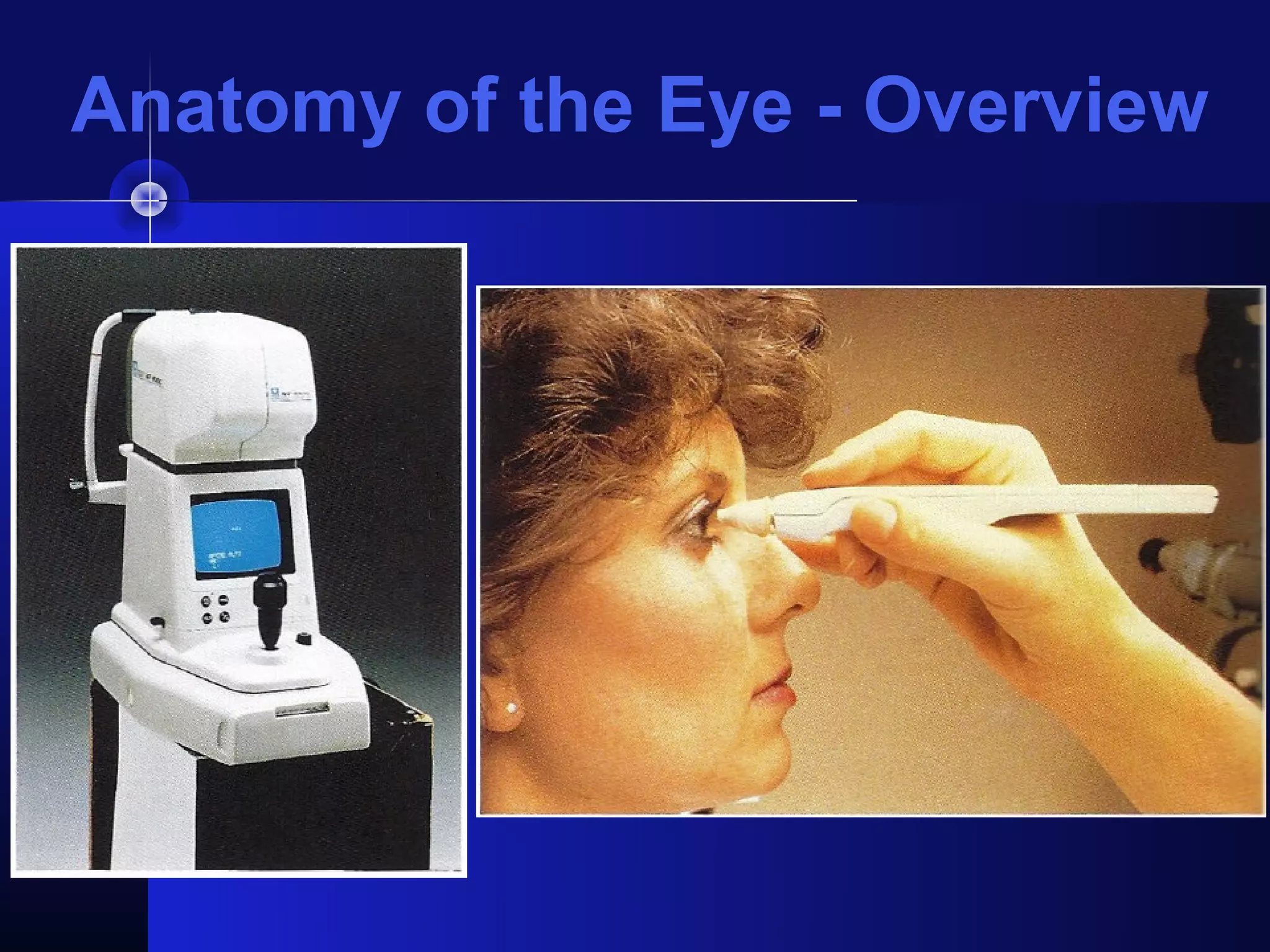
  • Tono-Pen tonometer
     • Hand held portable tonometer
     • Over estimates low IOP and underestimates high
       IOP
Measurement of IOP
• Non-Contact Tonometry:
  • Air-Puff tonometer
     • Goldmann principles with air instead of prism
         time required to flatten cornea relates directly to level of
          IOP
     • Does not require topical anesthetic
     • Useful for screenings
     • Disadvantage – accurate low to mid IOP range
Anatomy of the Eye - Overview
Falsely elevated IOP readings
  • Elevated:
    •   Squeezing of the eyelids
    •   Breath holding or valsalva maneuvers
    •   External pressure on the globe
    •   Thick or scarred corneas
    •   Marked astigmatism
  • Lower:
    • Thin corneas
    • Marked astigmatism
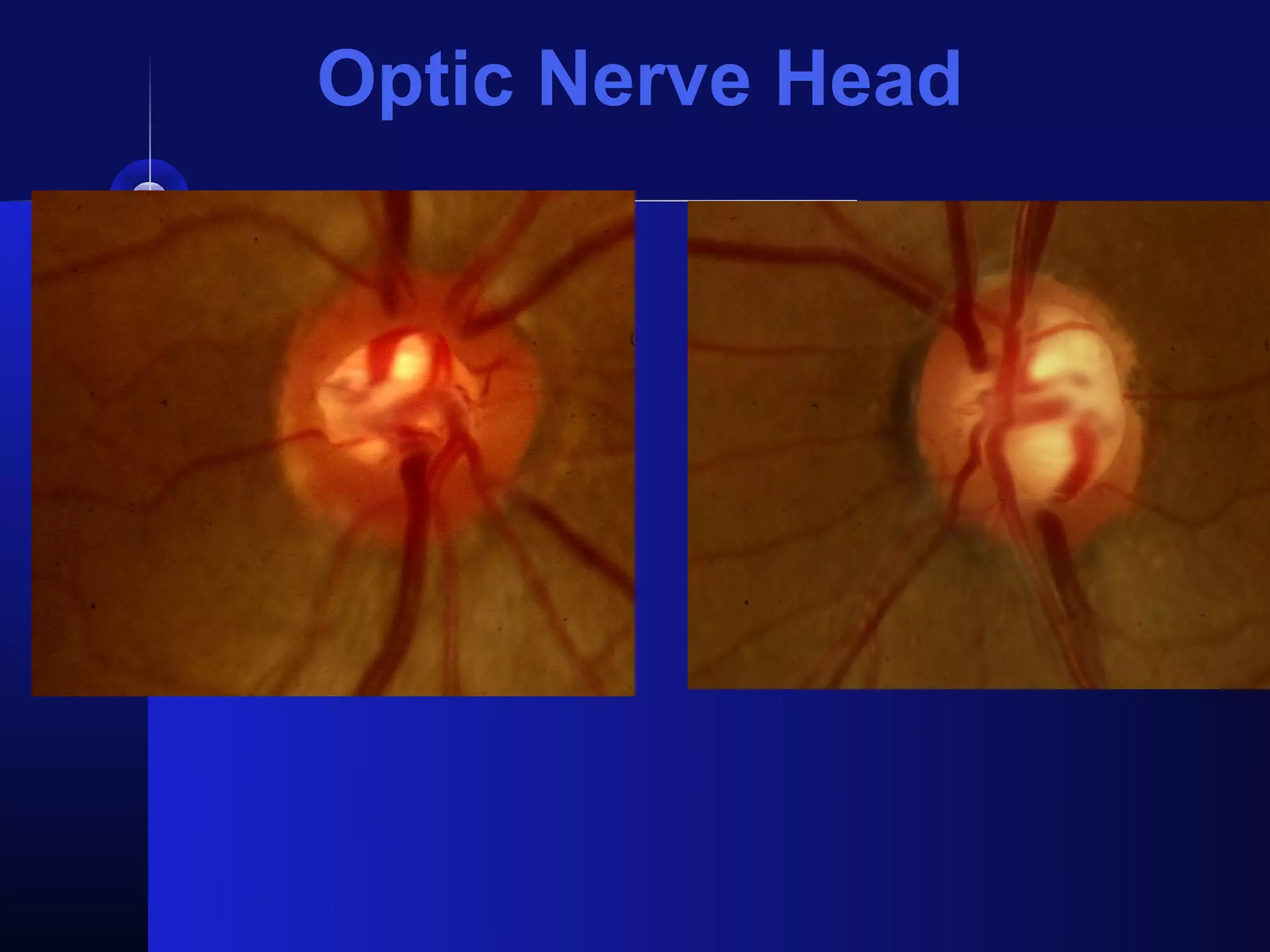
Optic Nerve Head

• 1.2 million axons
  • Declines with age
  • Cell bodies are the ganglion cells
• Magnocellular (M) cells 10%
  • Large diameter (dim illumination)
• Parvocellular (P) cells 90%
  • Small diameter axons (color, fine detail)
Optic Nerve Head

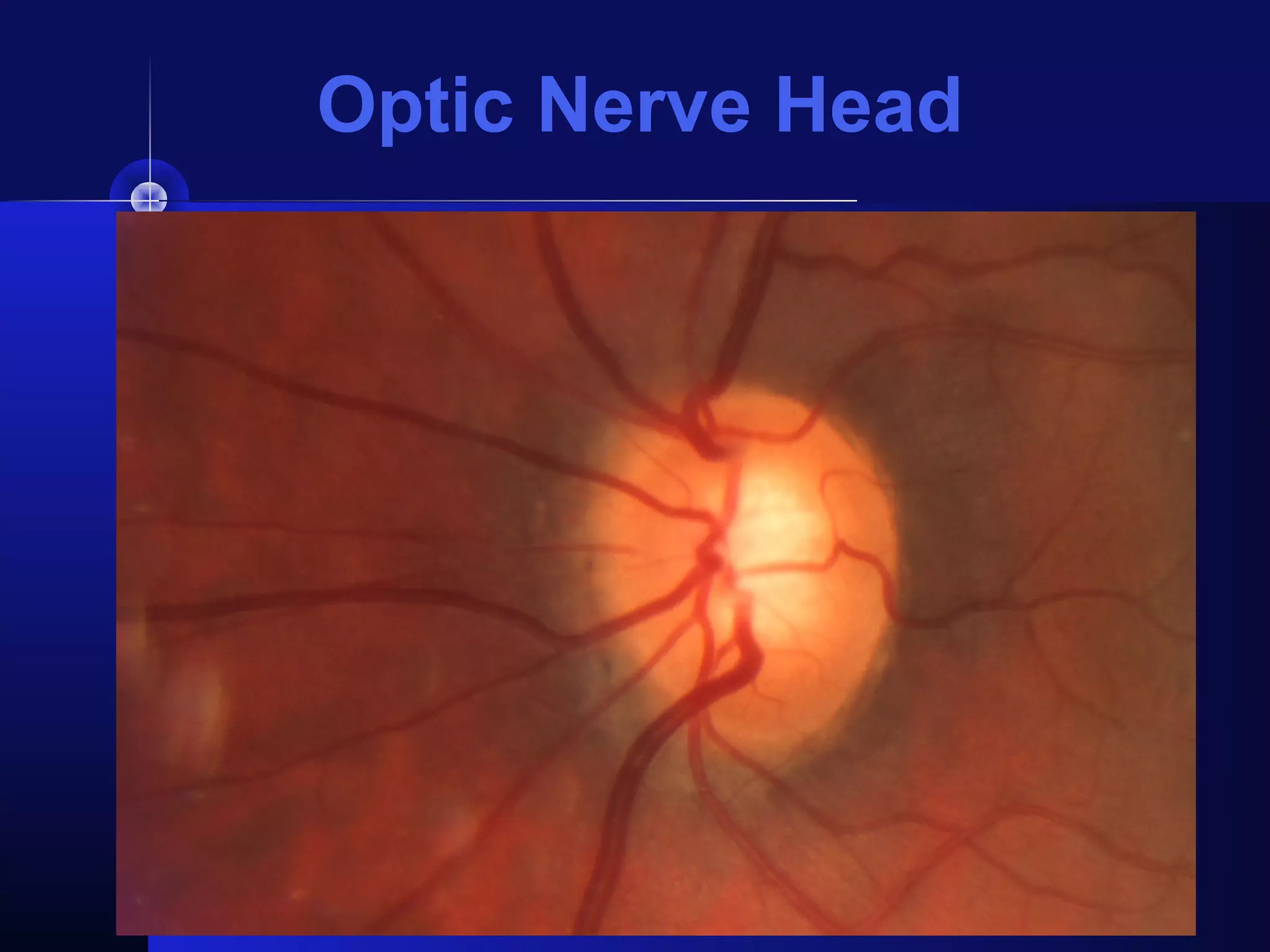
•   Scleral Canal
•   Lamina Cribrosa
•   Optic Cup
•   Neuroretinal Rim
•   Size of ON:
    • AA>Asians>Hispanics>Whites
Optic Nerve Head
Optic Nerve Head

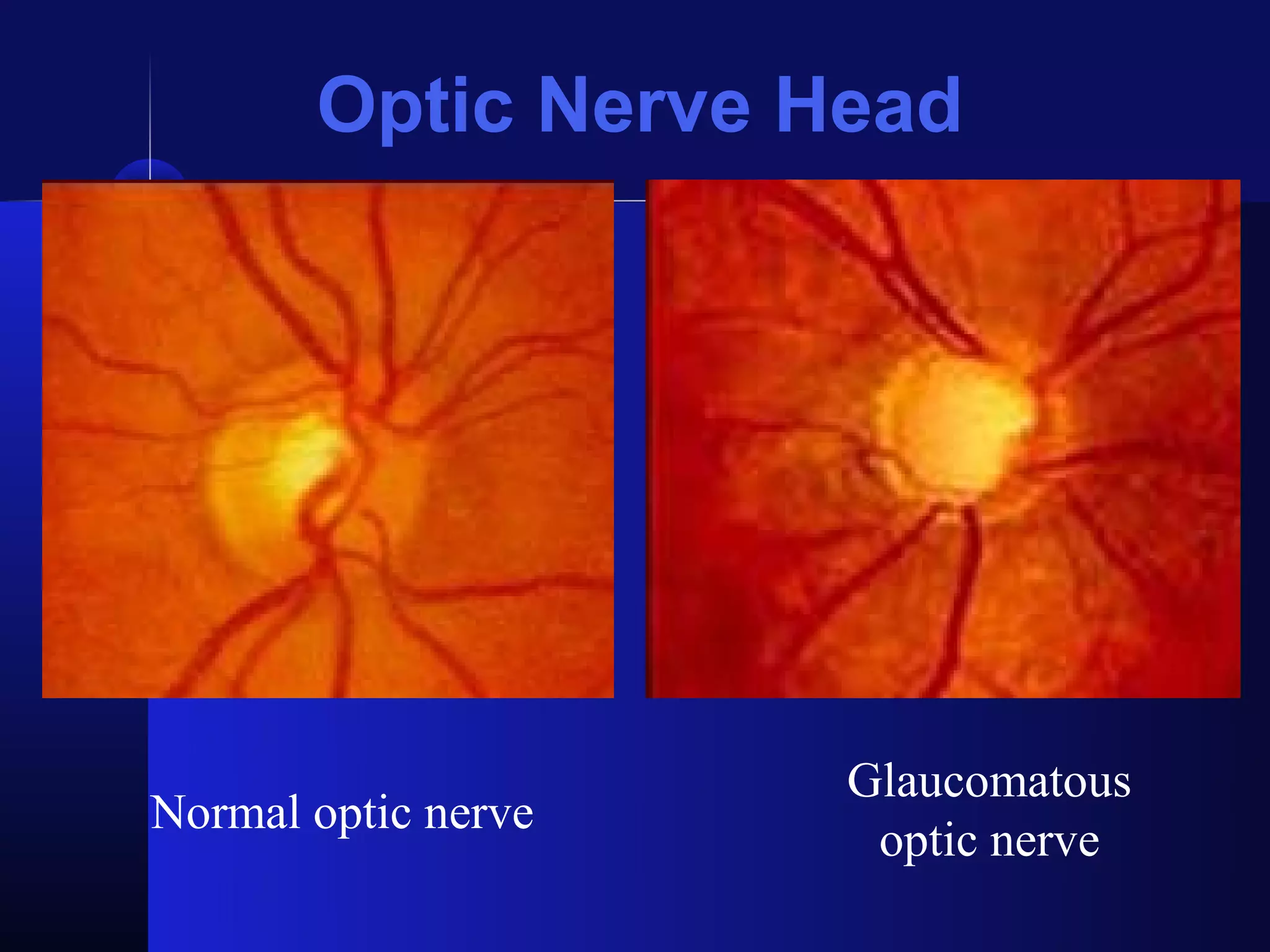
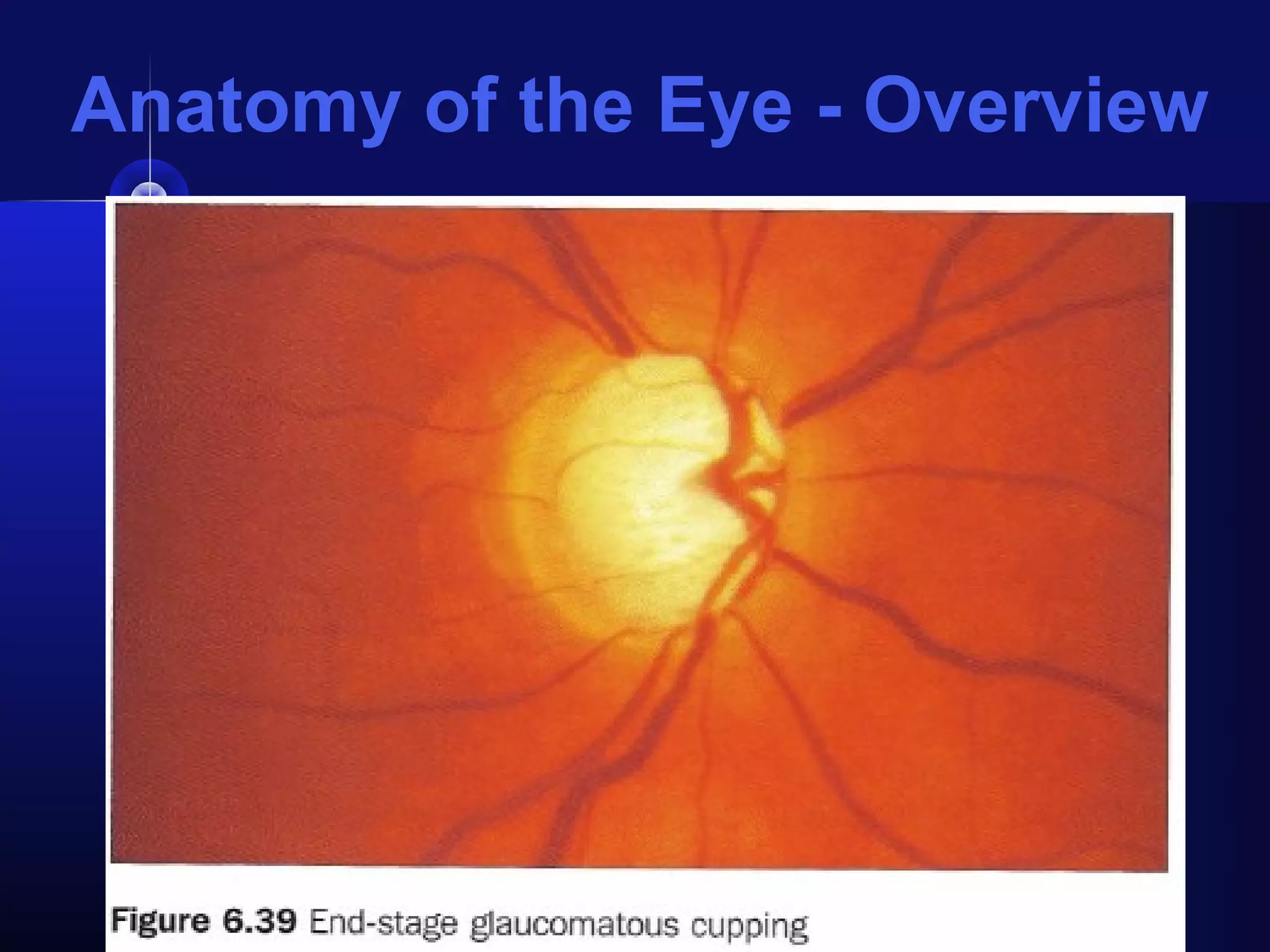
• Cup-Disc Ratio
  • Fraction of vertical and horizontal meridians
     • C/D=0.3/0.3
     • Normal is 0.3 or less
  • Ratio greater than 0.7 regarded suspicious
  • Asymmetry between two eyes of 0.2 or more
    regarded suspicious
  • Cup size is needed to evaluate progression not
    initial diagnosis
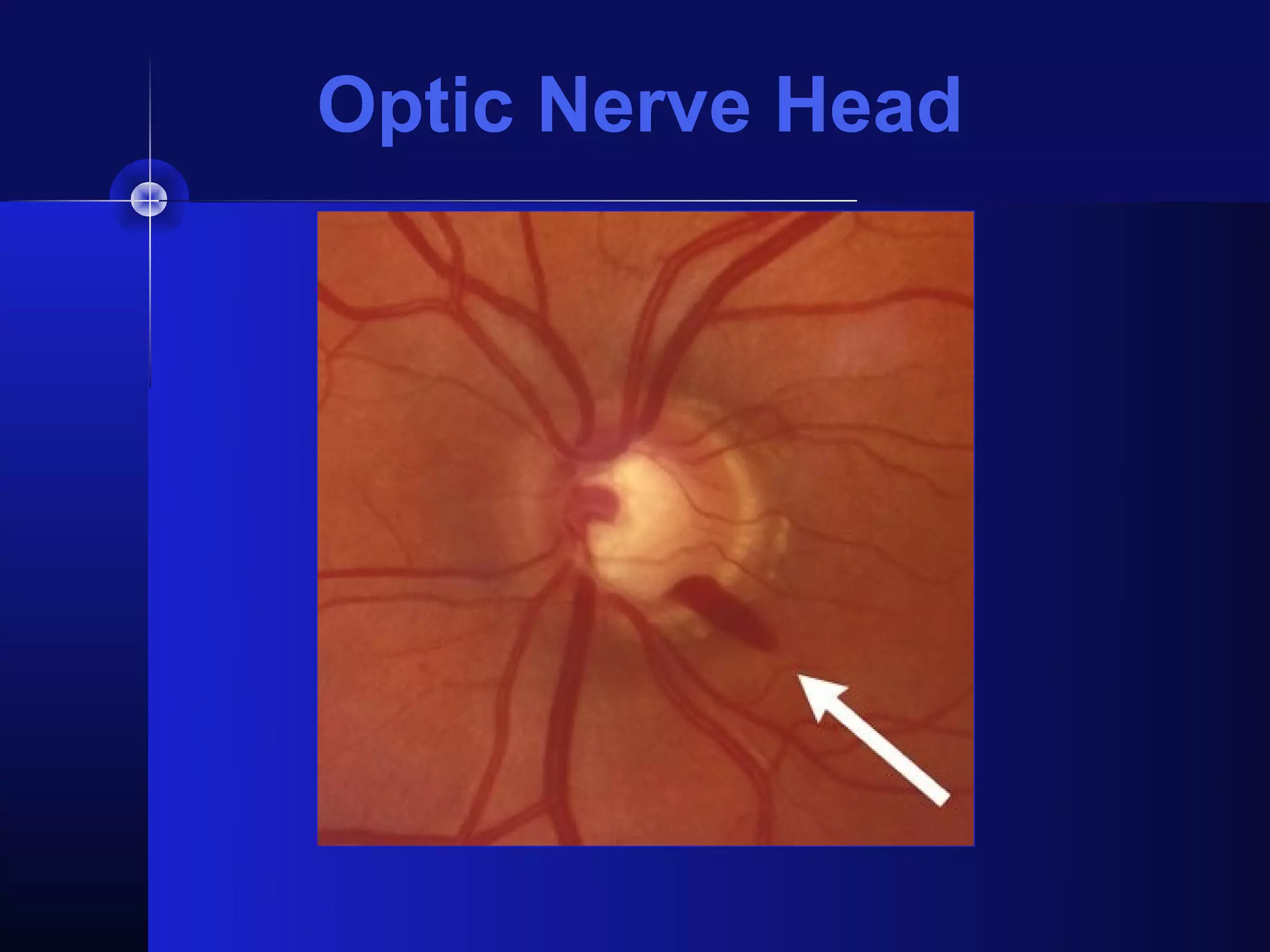
Optic nerve appearance in glaucoma

  • Glaucoma nerve damage ranges from
    localized to diffuse
    • Localized easier to recognize with notching
  • Description of nerve important
    • Neuralretinal rim tissue
       •   Thickness
       •   Symmetry
       •   Color
       •   Notching
       •   Hemorrhage disc margin
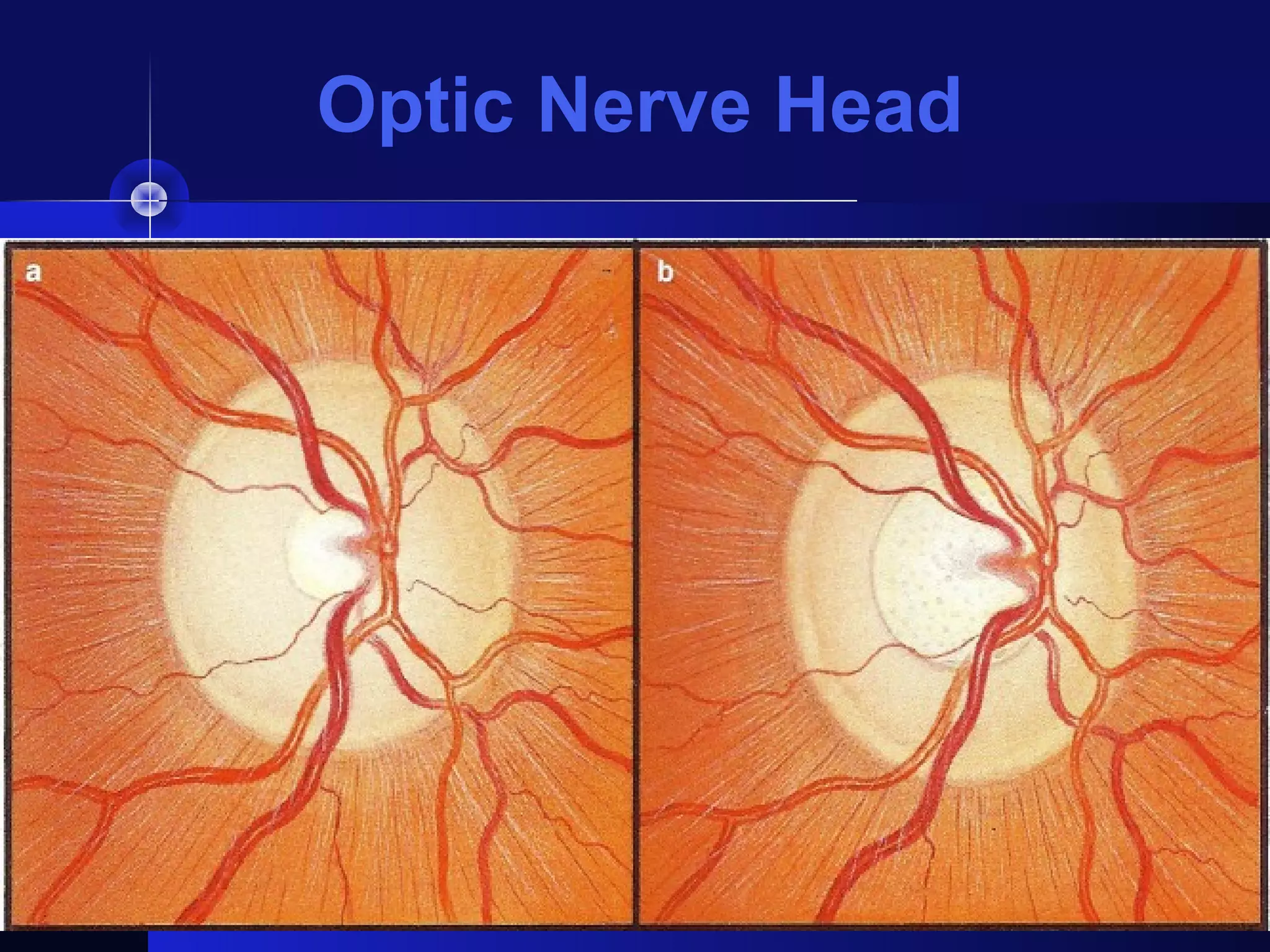
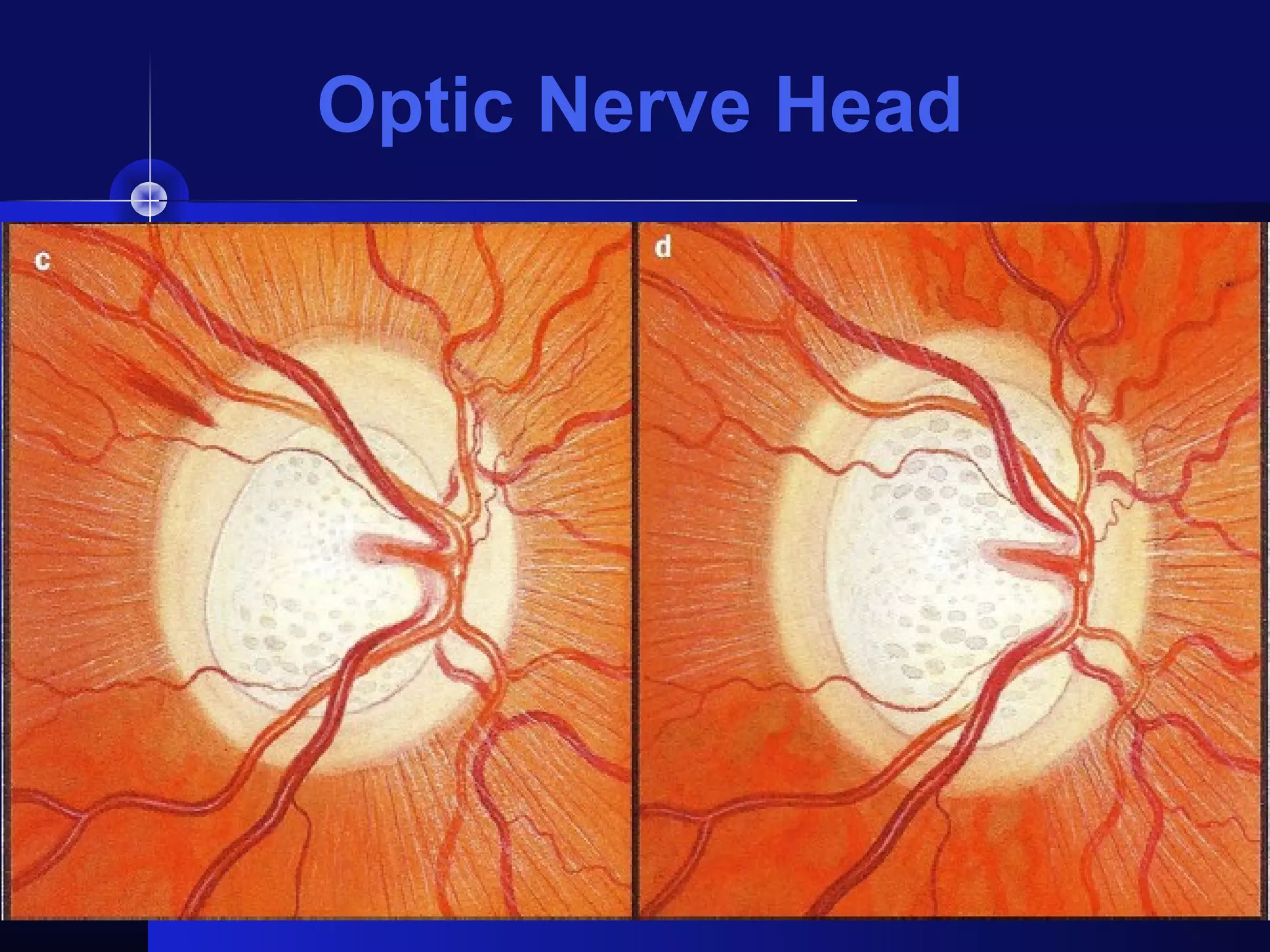
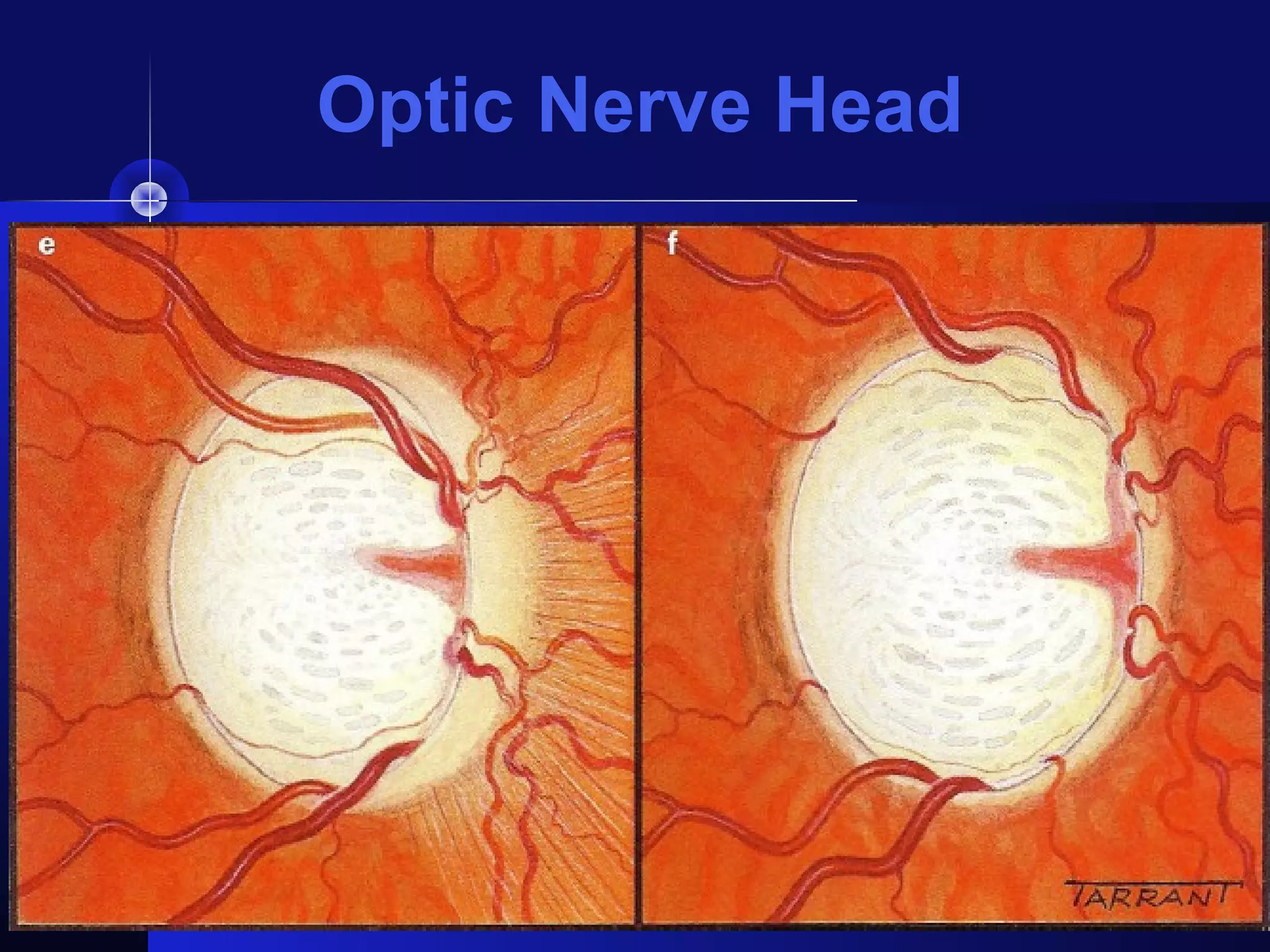
Optic Nerve Head
Optic Nerve Head
Optic Nerve Head
Optic Nerve Head
Optic Nerve Head


                     Glaucomatous
Normal optic nerve
                      optic nerve
Optic Nerve Head
Anatomy of the Eye - Overview
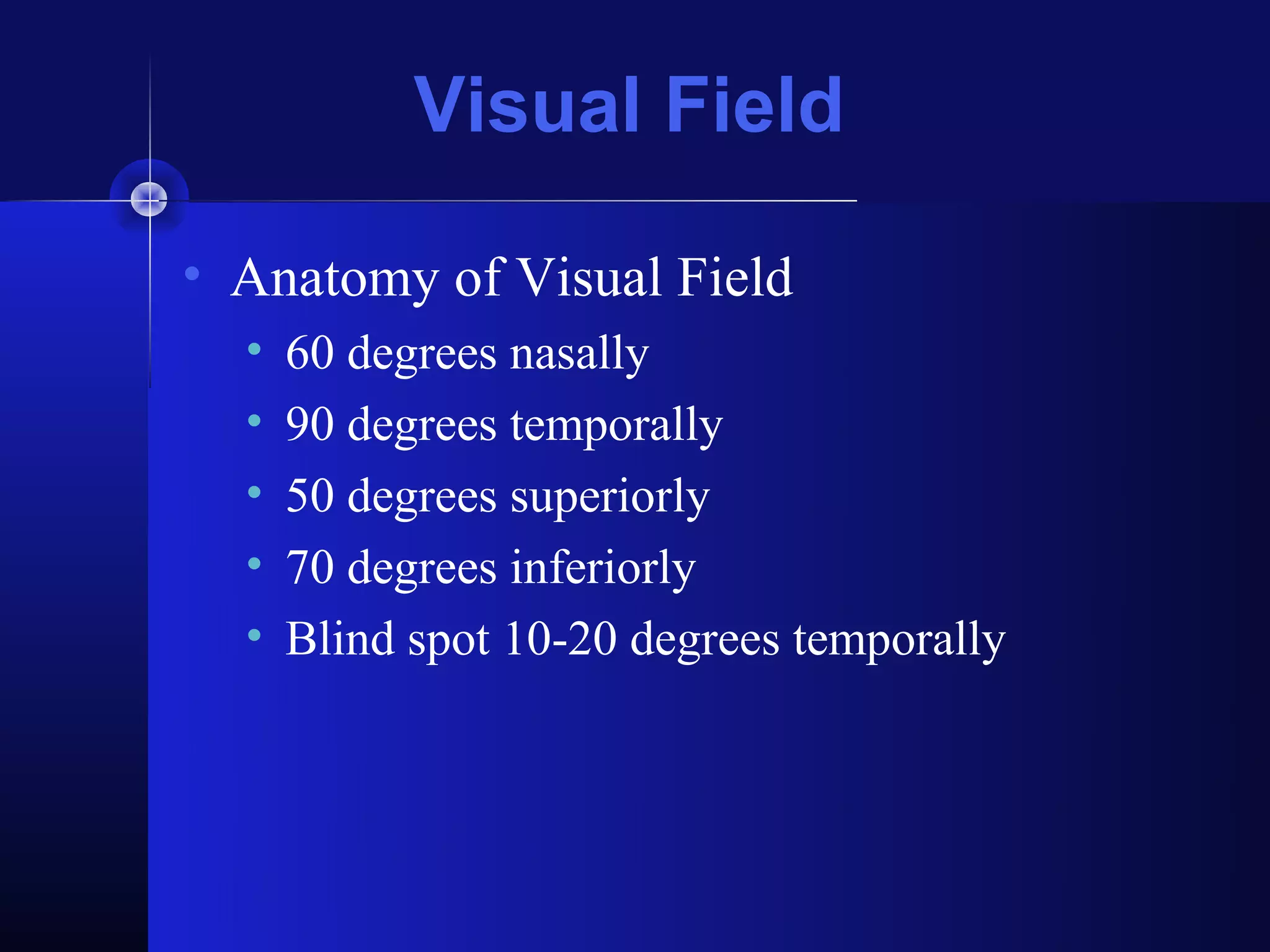
Visual Field

• Anatomy of Visual Field
  •   60 degrees nasally
  •   90 degrees temporally
  •   50 degrees superiorly
  •   70 degrees inferiorly
  •   Blind spot 10-20 degrees temporally
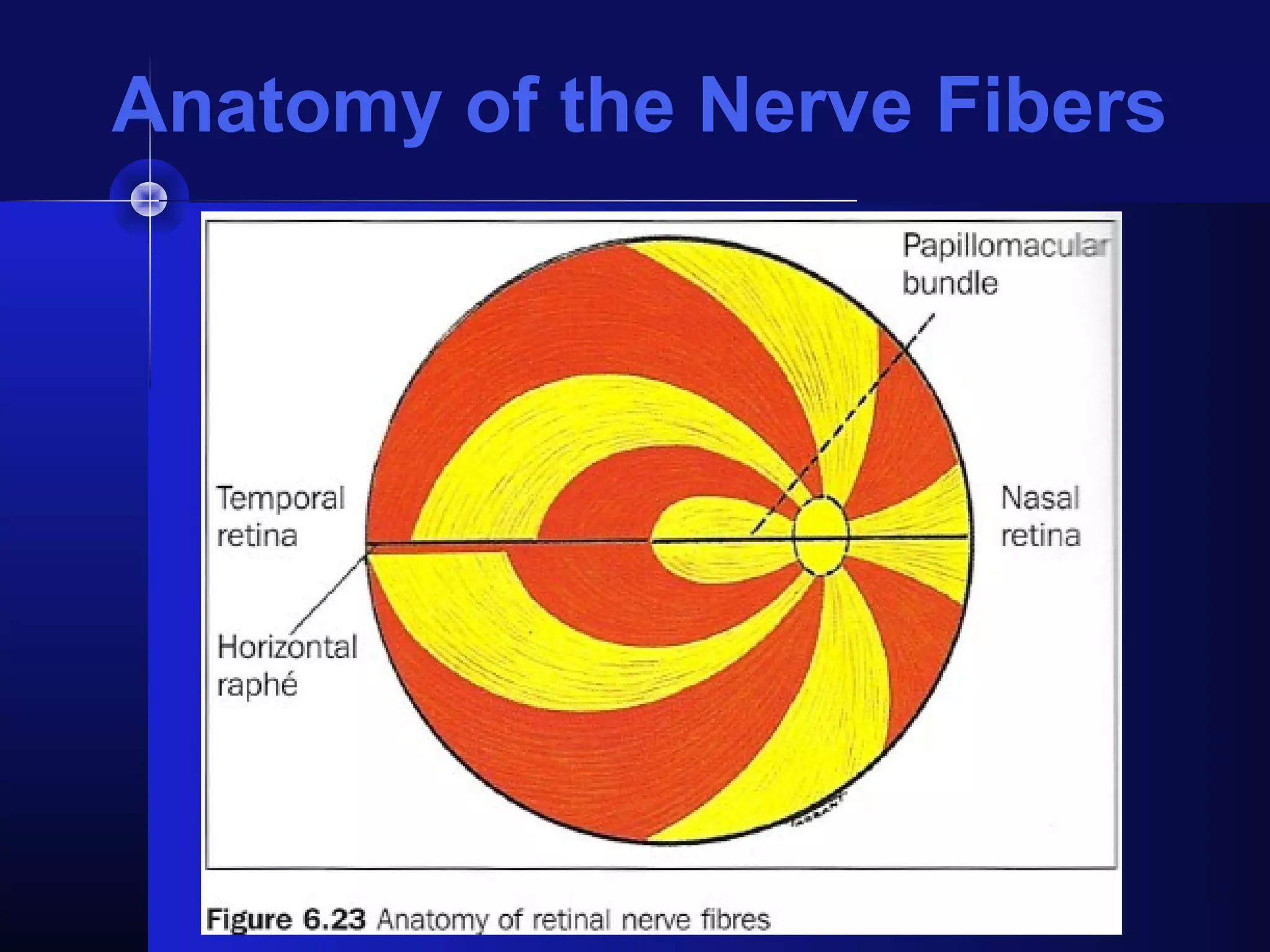
Anatomy of the Nerve Fibers

Glaucoma Screening

  • 1.
    Glaucoma Screening Nicholas J. Silvestros, OD Clinical Instructor Department of Ophthalmology and Vision Sciences Washington University St. Louis School of Medicine
  • 2.
    Causes of VisualImpairment in the World http://www.who.int/entity/mediacentre/factsheets/fs282_2.gif
  • 3.
    Glaucoma • 2nd mostcommon cause of blindness in U.S. • Single most common cause of blindness in African Americans • African Americans 4x more likely to have glaucoma and 6x more likely to be blind from it • If detected early and treated, blindness can be prevented • In early stages, most patients asymptomatic • Peripheral vision can be lost before patient notices visual impairment
  • 4.
    Anatomy of theEye - Overview
  • 5.
    Aqueous Flow • Ciliarybody • Produces aqueous (fluid in the eye) • Trabecular meshwork • Drains aqueous fluid out of eye
  • 6.
    Aqueous Humor Formation • Involves the combination of 2 known processes: • Active transport (secretion) • 80% of Aqueous • Passive transport (ultrafiltration and diffusion) • 20% of Aqueous • Affected by topical glaucoma medications: beta- blockers, sympathomimetics and carbonic anhydrase inhibitors
  • 7.
    Trabecular Outflow • Conventionaloutflow • 80-90% outflow • Increased: • Drugs: Cholinergics (pilocarpine), Adrenergic agonists • Surgical: ALT/SLT, Trabeculotomy/goniotomy • Unconventional outflow • 10-20% outflow • Increased: • Drugs: sympathomimetics and prostaglandins
  • 8.
  • 9.
    Aqueous Humor Trivia •Nourishes lens, cornea, vitreous • Decreases production with: • Sleep • Age • Some systemic hypotensive agents • Decrease outflow with: • Age
  • 10.
    Intraocular Pressure • IOP: • Range 11 mmHg to 21 mmHG • 21 considered upper limit of normal • IOP varies time of day, heart beat, BP, respiration • Tendency for higher AM and lower evening • Lower during laying/sleeping • Diurnal variation: • 2-6 mm Hg normal • >10 mm Hg suggestive of glaucoma
  • 11.
    Intraocular Pressure • IOP: • IOP varies time of day, heart beat, BP, respiration • Tendency for higher AM and lower evening • Lower during laying/sleeping • Age (increases with age) • Caffeine (transiently increases  in IOP) • Alcohol (transiently  in IOP) • Cannibis (mild  in IOP)
  • 12.
    Intraocular Pressure Trivia •IOP: • No absolutes • A “normal” IOP reading may be misleading and additional reading at different times of the day may be required • IOP is a risk factor and does not eliminate glaucoma if a “normal” reading is recorded • Must be compared with all other risk factors and clinical data
  • 13.
    Measurement of IOP •Applanation Tonometry: • Measures the force necessary to flatten an area of cornea 3.06 mm diameter • Central part of cornea flattened while variable force records pressure • Central Corneal Thickness: • >540 micrometers produce falsely high IOP readings by TA • <540 micrometers produce falsely low IOP reading by TA
  • 14.
  • 15.
    Measurement of IOP •Applanation Tonometry: • Goldmann tonometer • Most popular tonometer and accurate tonometer • Tono-Pen tonometer • Hand held portable tonometer • Over estimates low IOP and underestimates high IOP
  • 16.
    Measurement of IOP •Non-Contact Tonometry: • Air-Puff tonometer • Goldmann principles with air instead of prism  time required to flatten cornea relates directly to level of IOP • Does not require topical anesthetic • Useful for screenings • Disadvantage – accurate low to mid IOP range
  • 17.
    Anatomy of theEye - Overview
  • 18.
    Anatomy of theEye - Overview
  • 19.
    Anatomy of theEye - Overview
  • 20.
    Falsely elevated IOPreadings • Elevated: • Squeezing of the eyelids • Breath holding or valsalva maneuvers • External pressure on the globe • Thick or scarred corneas • Marked astigmatism • Lower: • Thin corneas • Marked astigmatism
  • 21.
    Optic Nerve Head •1.2 million axons • Declines with age • Cell bodies are the ganglion cells • Magnocellular (M) cells 10% • Large diameter (dim illumination) • Parvocellular (P) cells 90% • Small diameter axons (color, fine detail)
  • 22.
    Optic Nerve Head • Scleral Canal • Lamina Cribrosa • Optic Cup • Neuroretinal Rim • Size of ON: • AA>Asians>Hispanics>Whites
  • 23.
  • 24.
    Optic Nerve Head •Cup-Disc Ratio • Fraction of vertical and horizontal meridians • C/D=0.3/0.3 • Normal is 0.3 or less • Ratio greater than 0.7 regarded suspicious • Asymmetry between two eyes of 0.2 or more regarded suspicious • Cup size is needed to evaluate progression not initial diagnosis
  • 25.
    Optic nerve appearancein glaucoma • Glaucoma nerve damage ranges from localized to diffuse • Localized easier to recognize with notching • Description of nerve important • Neuralretinal rim tissue • Thickness • Symmetry • Color • Notching • Hemorrhage disc margin
  • 26.
  • 27.
  • 28.
  • 29.
  • 30.
    Optic Nerve Head Glaucomatous Normal optic nerve optic nerve
  • 31.
  • 32.
    Anatomy of theEye - Overview
  • 33.
    Visual Field • Anatomyof Visual Field • 60 degrees nasally • 90 degrees temporally • 50 degrees superiorly • 70 degrees inferiorly • Blind spot 10-20 degrees temporally
  • 34.
    Anatomy of theNerve Fibers

Editor's Notes

  • #3 Cataract leading cause of visual impairment in the world. ARMD leading cause of irreversible blindness in Caucasians and glaucoma is the leading cause of blindness in AA and Hispanics in the U.S.
  • #5 Let’s now look at the anatomy of the eye to better understand the diseases and age-related changes which occur in the eye.
  • #6 Glaucoma is a problem with drainage of aqueous through the TM resulting in increased IOP and….damage to the optic nerve.
  • #7 AH formed by the inner nonpigmented
  • #8 TM (uveoscleral, corneosclera, juxtacanalicular), schlemm’s canal, collector channels,aquous veins, episclearal or conj veins, santerior ciliary and superior ophthalmic veins and cavernous sinus
  • #9 Let’s now look at the anatomy of the eye to better understand the diseases and age-related changes which occur in the eye.
  • #10 Rate of formation and outflow facility decline with age!
  • #11 Rate of formation and outflow facility decline with age!
  • #12 Rate of formation and outflow facility decline with age!
  • #13 Rate of formation and outflow facility decline with age!
  • #14 Perkins- portable Golmann Non-contact – air puff
  • #15 Perkins- portable Golmann Non-contact – air puff
  • #16 Perkins- portable Golmann Non-contact – air puff
  • #17 Perkins- portable Golmann Non-contact – air puff
  • #18 Let’s now look at the anatomy of the eye to better understand the diseases and age-related changes which occur in the eye.
  • #19 Let’s now look at the anatomy of the eye to better understand the diseases and age-related changes which occur in the eye.
  • #20 Let’s now look at the anatomy of the eye to better understand the diseases and age-related changes which occur in the eye.
  • #21 Digital external pressure by examiner Restricted myopathy (thyroid) – &gt;6 mm Hg elevation in IOP in upgaze
  • #23 So normal on is slightly vertically oval
  • #24 Hopewell – c/d OS
  • #25 So normal on is slightly vertically oval
  • #27 Let’s now look at the anatomy of the eye to better understand the diseases and age-related changes which occur in the eye.
  • #28 Let’s now look at the anatomy of the eye to better understand the diseases and age-related changes which occur in the eye.
  • #29 Let’s now look at the anatomy of the eye to better understand the diseases and age-related changes which occur in the eye.
  • #31 Nerve fiber layers affecting peripheral vision damaged early
  • #33 Let’s now look at the anatomy of the eye to better understand the diseases and age-related changes which occur in the eye.
  • #35 Let’s now look at the anatomy of the eye to better understand the diseases and age-related changes which occur in the eye.