
Age Related Cataract (Senile Cataract)
Drug Induced Cataract
Traumatic Cataract

By
Prof. Naimatullah Khan Kundi
Head, Department of Ophthalmology
Khyber Teaching Hospital
Peshawar
AGE RELATED
CATARACT
(SENILE CATARACT)
Lens & Cataract (Pathology)
Aging Chances
Age related cataract (Senile Cataract)








Very common cause of visual impairment in
older adults
50-70% between ages 60-75yrs
Pathogenesis:







Multifactorial and not completely understood.
As lens ages its wt. ↑
Thickness ↑
Accommodative power ↓
Lens Nucleus compressed and hardened (Nuclear
Sclerosis) as new layers of cortical fibers as formed
concentrically

Tuesday, December 24, 2013

3
Lens & Cataract (Pathology)


Lens proteins (Crystallines) – chemically modified and
aggregate into high molecular wt. proteins
The resulting proteins aggregates cause:


Abrupt fluctuations in refractive index



Scatter light rays



Reduce transparency





Chemical modification of nuclear lens proteins also produce
pigmentation (yellow/brownish hue with advancing ages)

↓ concentration of glutathione and K+, ↑conc. of Na+
and Ca++, ↑ Hydration

Tuesday, December 24, 2013

4
Lens & Cataract (Pathology)


Types
1.

Nuclear

2.

Cortical

3.

Subcapsular (Posterior)

Tuesday, December 24, 2013

5
Lens & Cataract (Pathology)
Nuclear

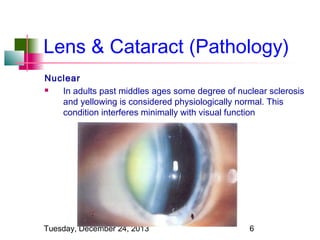
In adults past middles ages some degree of nuclear sclerosis
and yellowing is considered physiologically normal. This
condition interferes minimally with visual function

Tuesday, December 24, 2013

6
Lens & Cataract (Pathology)
Nuclear
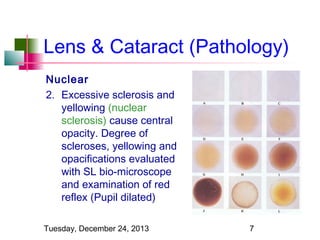
2. Excessive sclerosis and
yellowing (nuclear
sclerosis) cause central
opacity. Degree of
scleroses, yellowing and
opacifications evaluated
with SL bio-microscope
and examination of red
reflex (Pupil dilated)
Tuesday, December 24, 2013

7
Lens & Cataract (Pathology)
Nuclear (cont’d)
3.

Progression slow

4.

BL, (± asymmetric)

5.

Visual impairment greater of distance vision than
of near vision

6.

↑ refractive index and thus myopic shift in
refraction (Lenticular myopia). This myopic shift
transiently enables presbyopic individulas to

read without spectacles
Tuesday, December 24, 2013

(second sight)
8
Lens & Cataract (Pathology)
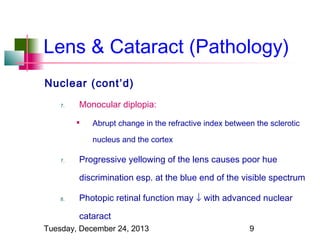
Nuclear (cont’d)
7.

Monocular diplopia:


Abrupt change in the refractive index between the sclerotic
nucleus and the cortex

7.

Progressive yellowing of the lens causes poor hue
discrimination esp. at the blue end of the visible spectrum

8.

Photopic retinal function may ↓ with advanced nuclear
cataract

Tuesday, December 24, 2013

9
Lens & Cataract (Pathology)
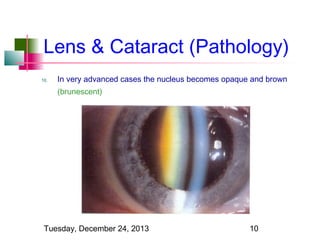
10.

In very advanced cases the nucleus becomes opaque and brown
(brunescent)

Tuesday, December 24, 2013

10
Lens & Cataract (Pathology)
11.

Histopathology:


Nucleus homogenous with loss of celluler
laminations.

Tuesday, December 24, 2013

11
Lens & Cataract (Pathology)
Cortical Cataract


1.

Early changes:


2.
3.

4.

Changes in ionic composition + hydration + cortical
opacification

BL, often Asymmetrical
First visible signs of cortical cataract formation
(SL bio-microscope) are vacuoles & water clefts
in ant. And post. cortex
Cuneiform opacities (cortical spokes): wedge
shaped, form near the periphery the lens, with
pointed ends oriented toward the center

Tuesday, December 24, 2013

12
Lens & Cataract (Pathology)
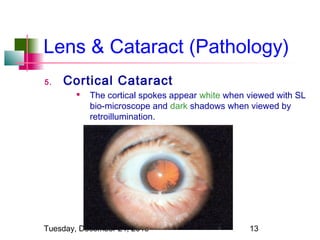
5.

Cortical Cataract


The cortical spokes appear white when viewed with SL
bio-microscope and dark shadows when viewed by
retroillumination.

Tuesday, December 24, 2013

13
Lens & Cataract (Pathology)
Cortical Cataract (cont’d)


6.

Their effect on VA varies greatly, depending
upon the location of the opacity relative to the
visual axis

7.

Common symptom:


Glare from intense focal light sources (e.g. Car head
light)

8.

Monocular diplopia may also result

Tuesday, December 24, 2013

14
Lens & Cataract (Pathology)


Cortical Cataract (cont’d)

9.

Progression:


10.

11.

vary, some times unchanged for prolonged
periods, while others progress rapidly

The wedge shaped opacities may enlarge
and coalesce to form large cortical opacities.
Intumscent Cataract:


As lens continues to take up water it may swell

Tuesday, December 24, 2013

15
Lens & Cataract (Pathology)
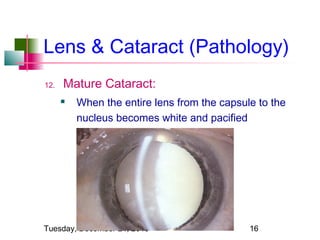
12.

Mature Cataract:


When the entire lens from the capsule to the
nucleus becomes white and pacified

Tuesday, December 24, 2013

16
Lens & Cataract (Pathology)
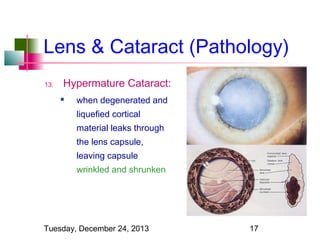
13.

Hypermature Cataract:


when degenerated and
liquefied cortical
material leaks through
the lens capsule,
leaving capsule
wrinkled and shrunken

Tuesday, December 24, 2013

17
Lens & Cataract (Pathology)
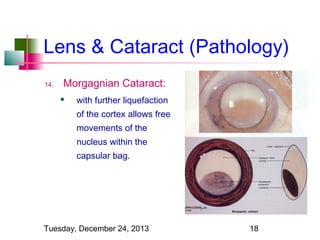
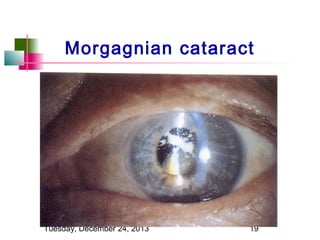
14.

Morgagnian Cataract:


with further liquefaction
of the cortex allows free
movements of the
nucleus within the
capsular bag.

Tuesday, December 24, 2013

18
Morgagnian cataract

Tuesday, December 24, 2013

19
Lens & Cataract (Pathology)
Cortical Cataract (cont’d)
15.

Histopathology:


Hydropic swelling of the lens fibers



Globules (morgagnian) of eosinophilic
material observed in slit-like spaces
between lens fibers

Tuesday, December 24, 2013

20
Lens & Cataract (Pathology)
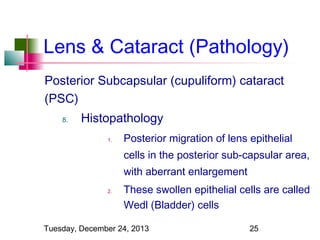
Posterior Subcapsular (cupuliform)
cataract (PSC)
1.

PSCs often seen in patients younger than
those presenting with nuclear/cortical
cataracts

2.

PSC located in the posterior cortical layer
and is axial in location

Tuesday, December 24, 2013

21
Lens & Cataract (Pathology)
Posterior Subcapsular (cupuliform)
cataract (PSC)
3.

First indication: subtle iridescent sheen in the
posterior cortical layers (SLB exam)
Later stages:


Granular opacities and



A plaque like opacities of posterior subcapsular

Tuesday, December cortex appear
24, 2013

22
Lens & Cataract (Pathology)
Posterior Subcapsular (cupuliform)
cataract (PSC)


Patient complains of


glare and



↓ vision



PSC obscures more of the pupillary area when

In bright light

miosis is induced by:


Bright light



Accommodation

Miotics
Tuesday, December 24, 2013


23
Lens & Cataract (Pathology)
Posterior Subcapsular (cupuliform) cataract
(PSC)
5.

6.
7.

Near VA tends to be decreased more than
distance VA
Some patients experience monocular diplopia
Other causes of PSC:
1.
2.
3.
4.
5.

Age related – main type
Trauma
Corticosteroids
Inflammations
Ionizing radiations

Tuesday, December 24, 2013

24
Lens & Cataract (Pathology)
Posterior Subcapsular (cupuliform) cataract
(PSC)
8.

Histopathology
1.

Posterior migration of lens epithelial
cells in the posterior sub-capsular area,
with aberrant enlargement

2.

These swollen epithelial cells are called
Wedl (Bladder) cells

Tuesday, December 24, 2013

25
DRUG INDUCED
CATARACTS
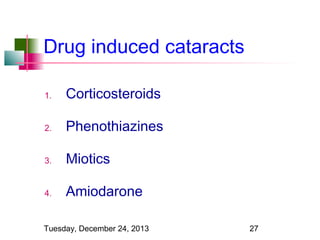
Drug induced cataracts
1.

Corticosteroids

2.

Phenothiazines

3.

Miotics

4.

Amiodarone

Tuesday, December 24, 2013

27
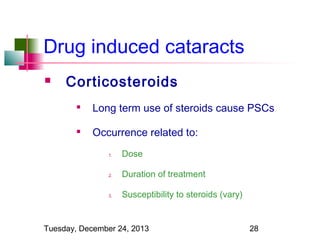
Drug induced cataracts


Corticosteroids


Long term use of steroids cause PSCs



Occurrence related to:
1.

Dose

2.

Duration of treatment

3.

Susceptibility to steroids (vary)

Tuesday, December 24, 2013

28
Drug induced cataracts


Corticosteroids (cont’d)


Cataract Formation:



Nasal spray





Systemic / Topical / Sub-conjunctival
Eye lid dermatitis (steroids treatment)

Histopathology:




Similar to senescent PSC changes

Some steroid-induced PSCs in children may
be reversible with cessation of the drug

Tuesday, December 24, 2013

29
Drug induced cataracts


Phenothiazines



Chloropromazine, Thioridazine
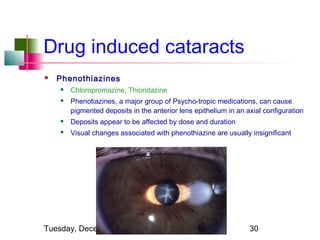
Phenotiazines, a major group of Psycho-tropic medications, can cause
pigmented deposits in the anterior lens epithelium in an axial configuration



Deposits appear to be affected by dose and duration



Visual changes associated with phenothiazine are usually insignificant

Tuesday, December 24, 2013

30
Drug induced cataracts


Miotics


Anticholinesterases (Ecothiophate, demacrium)
pilocarpine, phospholine lodide



These can cause cataracts



Cataract dose and duration related





Cataract may progress to posterior cortical and
nuclear
First appears as small vacuoles within and
posterior to the anterior lens capsule and
epithelium (Best appreciated by retroillumiunation)

Tuesday, December 24, 2013

31
Drug induced cataracts


Miotics


Visually significant cataracts common in
elderly patients (Topical
anticholinesterase)



Progressive cataract not reported in
children (Echothiophate for
accommodative esotropia)

Tuesday, December 24, 2013

32
Drug induced cataracts


Amiodarone


Antiarrythmia medication has been
reported to cause stellate anterior axial
pigment deposition (Visually insignificant)

Tuesday, December 24, 2013

33
TRAUMATIC CATARACT
Traumatic Cataract
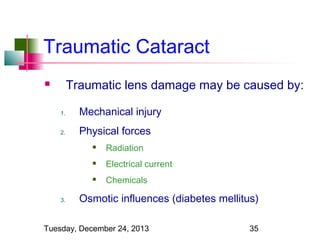
Traumatic lens damage may be caused by:



1.

Mechanical injury

2.

Physical forces



Electrical current



3.

Radiation
Chemicals

Osmotic influences (diabetes mellitus)

Tuesday, December 24, 2013

35
Traumatic Cataract
Contusion (Blunt injury)




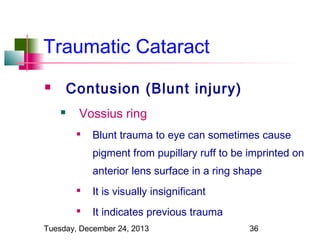
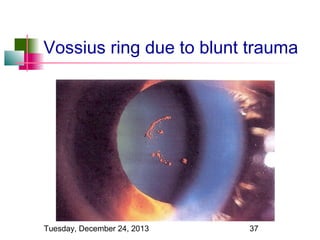
Vossius ring


Blunt trauma to eye can sometimes cause
pigment from pupillary ruff to be imprinted on
anterior lens surface in a ring shape



It is visually insignificant



It indicates previous trauma

Tuesday, December 24, 2013

36
Vossius ring due to blunt trauma

Tuesday, December 24, 2013

37
Traumatic Cataract


Contusion (Blunt injury)






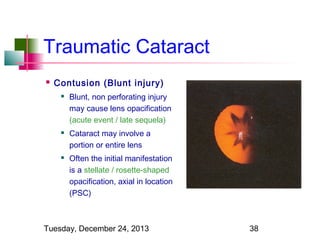
Blunt, non perforating injury
may cause lens opacification
(acute event / late sequela)
Cataract may involve a
portion or entire lens
Often the initial manifestation
is a stellate / rosette-shaped
opacification, axial in location
(PSC)

Tuesday, December 24, 2013

38
Traumatic Cataract


Contusion (Blunt injury)


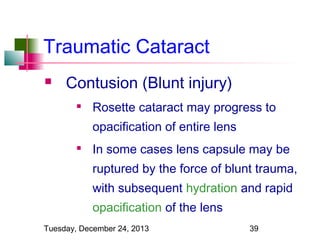
Rosette cataract may progress to
opacification of entire lens



In some cases lens capsule may be
ruptured by the force of blunt trauma,
with subsequent hydration and rapid
opacification of the lens

Tuesday, December 24, 2013

39
Traumatic Cataract
Contusion (Blunt injury)




Perforating and penetrating injuries


Penetrating injury of lens often results in
opacification of cortex at site of rupture,
progressing rapidly to complete opacification



A small perforating injury of the lens capsule
may heal, resulting in a small focal cortical
cataract

Tuesday, December 24, 2013

40
Radiation-induced cataracts


Ionizing radiations






Lens is extremely sensitive to ionizing
radiations
Cataract clinically apparent after period
of up to 20 yrs
Latency related to:




Dose and
Age of patient
A young patient with more actively growing lens
cells is more susceptible

Tuesday, December 24, 2013

41
Radiation-induced cataracts


Ionizing radiations (cont’d)


Clinically:




Punctate opacities within posterior
capsule and feathery anterior subcapsular opacities that radiate towards
the equator of the lens

These may progress to complete
opacification

Tuesday, December 24, 2013

42
Radiation-induced cataracts


Infra-red radiations (Glasses blower’s
cataract)


Intense heat and infra-red radiations
cause outer layer of the anterior capsule
to peel off as a single layer (true




exfoliation)
May be associated with cortical cataract
Rarely seen today

Tuesday, December 24, 2013

43
Radiation-induced cataracts


Ultra-voilet radiations (UV)


Prolong exposure to UV radiations in the
UVB range (Sun exposure) is associated
with ↑ risk of:




Cortical
PSCs

Tuesday, December 24, 2013

(Epidemiologic Evidence)
44
Radiation-induced cataracts
Micro-wave Radiations








Non-ionizing radiations with wavelength
between IR and short waves on the
electromagnetic spectrum
No evidence of cataract by microwaves
Biological effect – thermal
Microwaves could theoretically cause
cataract:



Dose levels would be so high as to induce
hyperthermic brain damage

Tuesday, December 24, 2013

45
Chemical injuries


Alkalis and Acids



Alkalis injuries to ocular surface result in cataract



Alkalis compounds penetrate eye readly causing:
1.

↑ Aqueous pH

2.

↓ Aqueous Glucose

3.

↓ Aqueous Ascorbate



Cortical cataract:

Acutely or delayed effect



Associated injuries:

Damage to cornea,
conjunctiva, iris etc.



Acids: Tends penetrate eye less easily than alkali



Acid injuries are less likely to result in cataract formation

Tuesday, December 24, 2013

46
Tuesday, December 24, 2013

47

Age related cataract

  • 1.
    Age Related Cataract(Senile Cataract) Drug Induced Cataract Traumatic Cataract By Prof. Naimatullah Khan Kundi Head, Department of Ophthalmology Khyber Teaching Hospital Peshawar
  • 2.
  • 3.
    Lens & Cataract(Pathology) Aging Chances Age related cataract (Senile Cataract)      Very common cause of visual impairment in older adults 50-70% between ages 60-75yrs Pathogenesis:      Multifactorial and not completely understood. As lens ages its wt. ↑ Thickness ↑ Accommodative power ↓ Lens Nucleus compressed and hardened (Nuclear Sclerosis) as new layers of cortical fibers as formed concentrically Tuesday, December 24, 2013 3
  • 4.
    Lens & Cataract(Pathology)  Lens proteins (Crystallines) – chemically modified and aggregate into high molecular wt. proteins The resulting proteins aggregates cause:  Abrupt fluctuations in refractive index  Scatter light rays  Reduce transparency   Chemical modification of nuclear lens proteins also produce pigmentation (yellow/brownish hue with advancing ages) ↓ concentration of glutathione and K+, ↑conc. of Na+ and Ca++, ↑ Hydration Tuesday, December 24, 2013 4
  • 5.
    Lens & Cataract(Pathology)  Types 1. Nuclear 2. Cortical 3. Subcapsular (Posterior) Tuesday, December 24, 2013 5
  • 6.
    Lens & Cataract(Pathology) Nuclear  In adults past middles ages some degree of nuclear sclerosis and yellowing is considered physiologically normal. This condition interferes minimally with visual function Tuesday, December 24, 2013 6
  • 7.
    Lens & Cataract(Pathology) Nuclear 2. Excessive sclerosis and yellowing (nuclear sclerosis) cause central opacity. Degree of scleroses, yellowing and opacifications evaluated with SL bio-microscope and examination of red reflex (Pupil dilated) Tuesday, December 24, 2013 7
  • 8.
    Lens & Cataract(Pathology) Nuclear (cont’d) 3. Progression slow 4. BL, (± asymmetric) 5. Visual impairment greater of distance vision than of near vision 6. ↑ refractive index and thus myopic shift in refraction (Lenticular myopia). This myopic shift transiently enables presbyopic individulas to read without spectacles Tuesday, December 24, 2013 (second sight) 8
  • 9.
    Lens & Cataract(Pathology) Nuclear (cont’d) 7. Monocular diplopia:  Abrupt change in the refractive index between the sclerotic nucleus and the cortex 7. Progressive yellowing of the lens causes poor hue discrimination esp. at the blue end of the visible spectrum 8. Photopic retinal function may ↓ with advanced nuclear cataract Tuesday, December 24, 2013 9
  • 10.
    Lens & Cataract(Pathology) 10. In very advanced cases the nucleus becomes opaque and brown (brunescent) Tuesday, December 24, 2013 10
  • 11.
    Lens & Cataract(Pathology) 11. Histopathology:  Nucleus homogenous with loss of celluler laminations. Tuesday, December 24, 2013 11
  • 12.
    Lens & Cataract(Pathology) Cortical Cataract  1. Early changes:  2. 3. 4. Changes in ionic composition + hydration + cortical opacification BL, often Asymmetrical First visible signs of cortical cataract formation (SL bio-microscope) are vacuoles & water clefts in ant. And post. cortex Cuneiform opacities (cortical spokes): wedge shaped, form near the periphery the lens, with pointed ends oriented toward the center Tuesday, December 24, 2013 12
  • 13.
    Lens & Cataract(Pathology) 5. Cortical Cataract  The cortical spokes appear white when viewed with SL bio-microscope and dark shadows when viewed by retroillumination. Tuesday, December 24, 2013 13
  • 14.
    Lens & Cataract(Pathology) Cortical Cataract (cont’d)  6. Their effect on VA varies greatly, depending upon the location of the opacity relative to the visual axis 7. Common symptom:  Glare from intense focal light sources (e.g. Car head light) 8. Monocular diplopia may also result Tuesday, December 24, 2013 14
  • 15.
    Lens & Cataract(Pathology)  Cortical Cataract (cont’d) 9. Progression:  10. 11. vary, some times unchanged for prolonged periods, while others progress rapidly The wedge shaped opacities may enlarge and coalesce to form large cortical opacities. Intumscent Cataract:  As lens continues to take up water it may swell Tuesday, December 24, 2013 15
  • 16.
    Lens & Cataract(Pathology) 12. Mature Cataract:  When the entire lens from the capsule to the nucleus becomes white and pacified Tuesday, December 24, 2013 16
  • 17.
    Lens & Cataract(Pathology) 13. Hypermature Cataract:  when degenerated and liquefied cortical material leaks through the lens capsule, leaving capsule wrinkled and shrunken Tuesday, December 24, 2013 17
  • 18.
    Lens & Cataract(Pathology) 14. Morgagnian Cataract:  with further liquefaction of the cortex allows free movements of the nucleus within the capsular bag. Tuesday, December 24, 2013 18
  • 19.
  • 20.
    Lens & Cataract(Pathology) Cortical Cataract (cont’d) 15. Histopathology:  Hydropic swelling of the lens fibers  Globules (morgagnian) of eosinophilic material observed in slit-like spaces between lens fibers Tuesday, December 24, 2013 20
  • 21.
    Lens & Cataract(Pathology) Posterior Subcapsular (cupuliform) cataract (PSC) 1. PSCs often seen in patients younger than those presenting with nuclear/cortical cataracts 2. PSC located in the posterior cortical layer and is axial in location Tuesday, December 24, 2013 21
  • 22.
    Lens & Cataract(Pathology) Posterior Subcapsular (cupuliform) cataract (PSC) 3. First indication: subtle iridescent sheen in the posterior cortical layers (SLB exam) Later stages:  Granular opacities and  A plaque like opacities of posterior subcapsular Tuesday, December cortex appear 24, 2013 22
  • 23.
    Lens & Cataract(Pathology) Posterior Subcapsular (cupuliform) cataract (PSC)  Patient complains of  glare and  ↓ vision  PSC obscures more of the pupillary area when In bright light miosis is induced by:  Bright light  Accommodation Miotics Tuesday, December 24, 2013  23
  • 24.
    Lens & Cataract(Pathology) Posterior Subcapsular (cupuliform) cataract (PSC) 5. 6. 7. Near VA tends to be decreased more than distance VA Some patients experience monocular diplopia Other causes of PSC: 1. 2. 3. 4. 5. Age related – main type Trauma Corticosteroids Inflammations Ionizing radiations Tuesday, December 24, 2013 24
  • 25.
    Lens & Cataract(Pathology) Posterior Subcapsular (cupuliform) cataract (PSC) 8. Histopathology 1. Posterior migration of lens epithelial cells in the posterior sub-capsular area, with aberrant enlargement 2. These swollen epithelial cells are called Wedl (Bladder) cells Tuesday, December 24, 2013 25
  • 26.
  • 27.
  • 28.
    Drug induced cataracts  Corticosteroids  Longterm use of steroids cause PSCs  Occurrence related to: 1. Dose 2. Duration of treatment 3. Susceptibility to steroids (vary) Tuesday, December 24, 2013 28
  • 29.
    Drug induced cataracts  Corticosteroids(cont’d)  Cataract Formation:   Nasal spray   Systemic / Topical / Sub-conjunctival Eye lid dermatitis (steroids treatment) Histopathology:   Similar to senescent PSC changes Some steroid-induced PSCs in children may be reversible with cessation of the drug Tuesday, December 24, 2013 29
  • 30.
    Drug induced cataracts  Phenothiazines   Chloropromazine,Thioridazine Phenotiazines, a major group of Psycho-tropic medications, can cause pigmented deposits in the anterior lens epithelium in an axial configuration  Deposits appear to be affected by dose and duration  Visual changes associated with phenothiazine are usually insignificant Tuesday, December 24, 2013 30
  • 31.
    Drug induced cataracts  Miotics  Anticholinesterases(Ecothiophate, demacrium) pilocarpine, phospholine lodide  These can cause cataracts  Cataract dose and duration related   Cataract may progress to posterior cortical and nuclear First appears as small vacuoles within and posterior to the anterior lens capsule and epithelium (Best appreciated by retroillumiunation) Tuesday, December 24, 2013 31
  • 32.
    Drug induced cataracts  Miotics  Visuallysignificant cataracts common in elderly patients (Topical anticholinesterase)  Progressive cataract not reported in children (Echothiophate for accommodative esotropia) Tuesday, December 24, 2013 32
  • 33.
    Drug induced cataracts  Amiodarone  Antiarrythmiamedication has been reported to cause stellate anterior axial pigment deposition (Visually insignificant) Tuesday, December 24, 2013 33
  • 34.
  • 35.
    Traumatic Cataract Traumatic lensdamage may be caused by:  1. Mechanical injury 2. Physical forces   Electrical current  3. Radiation Chemicals Osmotic influences (diabetes mellitus) Tuesday, December 24, 2013 35
  • 36.
    Traumatic Cataract Contusion (Bluntinjury)   Vossius ring  Blunt trauma to eye can sometimes cause pigment from pupillary ruff to be imprinted on anterior lens surface in a ring shape  It is visually insignificant  It indicates previous trauma Tuesday, December 24, 2013 36
  • 37.
    Vossius ring dueto blunt trauma Tuesday, December 24, 2013 37
  • 38.
    Traumatic Cataract  Contusion (Bluntinjury)    Blunt, non perforating injury may cause lens opacification (acute event / late sequela) Cataract may involve a portion or entire lens Often the initial manifestation is a stellate / rosette-shaped opacification, axial in location (PSC) Tuesday, December 24, 2013 38
  • 39.
    Traumatic Cataract  Contusion (Bluntinjury)  Rosette cataract may progress to opacification of entire lens  In some cases lens capsule may be ruptured by the force of blunt trauma, with subsequent hydration and rapid opacification of the lens Tuesday, December 24, 2013 39
  • 40.
    Traumatic Cataract Contusion (Bluntinjury)   Perforating and penetrating injuries  Penetrating injury of lens often results in opacification of cortex at site of rupture, progressing rapidly to complete opacification  A small perforating injury of the lens capsule may heal, resulting in a small focal cortical cataract Tuesday, December 24, 2013 40
  • 41.
    Radiation-induced cataracts  Ionizing radiations    Lensis extremely sensitive to ionizing radiations Cataract clinically apparent after period of up to 20 yrs Latency related to:    Dose and Age of patient A young patient with more actively growing lens cells is more susceptible Tuesday, December 24, 2013 41
  • 42.
    Radiation-induced cataracts  Ionizing radiations(cont’d)  Clinically:   Punctate opacities within posterior capsule and feathery anterior subcapsular opacities that radiate towards the equator of the lens These may progress to complete opacification Tuesday, December 24, 2013 42
  • 43.
    Radiation-induced cataracts  Infra-red radiations(Glasses blower’s cataract)  Intense heat and infra-red radiations cause outer layer of the anterior capsule to peel off as a single layer (true   exfoliation) May be associated with cortical cataract Rarely seen today Tuesday, December 24, 2013 43
  • 44.
    Radiation-induced cataracts  Ultra-voilet radiations(UV)  Prolong exposure to UV radiations in the UVB range (Sun exposure) is associated with ↑ risk of:   Cortical PSCs Tuesday, December 24, 2013 (Epidemiologic Evidence) 44
  • 45.
    Radiation-induced cataracts Micro-wave Radiations      Non-ionizingradiations with wavelength between IR and short waves on the electromagnetic spectrum No evidence of cataract by microwaves Biological effect – thermal Microwaves could theoretically cause cataract:  Dose levels would be so high as to induce hyperthermic brain damage Tuesday, December 24, 2013 45
  • 46.
    Chemical injuries  Alkalis andAcids  Alkalis injuries to ocular surface result in cataract  Alkalis compounds penetrate eye readly causing: 1. ↑ Aqueous pH 2. ↓ Aqueous Glucose 3. ↓ Aqueous Ascorbate  Cortical cataract: Acutely or delayed effect  Associated injuries: Damage to cornea, conjunctiva, iris etc.  Acids: Tends penetrate eye less easily than alkali  Acid injuries are less likely to result in cataract formation Tuesday, December 24, 2013 46
  • 47.