Chapter 4.2The Quantum Model of the Atom
Objectives:Discuss Louis de Broglie’s role in the development of the quantum model of the atom.Compare and contrast the Bohr model and the quantum model of the atom.Explain how the Heisenberg uncertainty principle and the Schrodinger wave equation led to the idea of atomic orbitals.List the four quantum numbers, and describe their significance.Relate the number of sublevels corresponding to each of an atom’s main energy levels, the number of orbitals per sublevel, and the number of orbitals per main energy level.
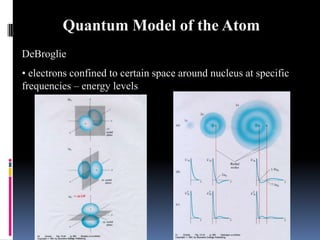
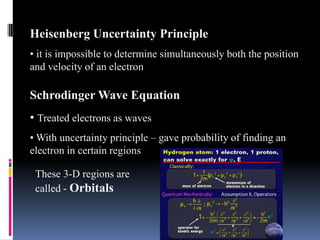
Quantum Model of the AtomDeBroglie electrons confined to certain space around nucleus at specific frequencies – energy levelsHeisenberg Uncertainty Principle it is impossible to determine simultaneously both the position and velocity of an electronSchrodinger Wave EquationTreated electrons as waves
 With uncertainty principle – gave probability of finding an electron in certain regionsThese 3-D regions are called -Orbitals
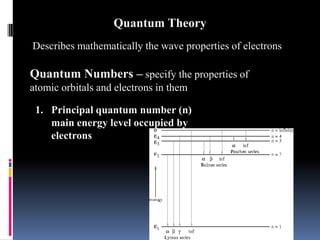
Quantum TheoryDescribes mathematically the wave properties of electronsQuantum Numbers – specify the properties of atomic orbitals and electrons in themPrincipal quantum number (n) main energy level occupied by electrons
2. Angular Momentum (l)     indicates the shape of the orbitall  = 0     1     2     3      s      p     d     f
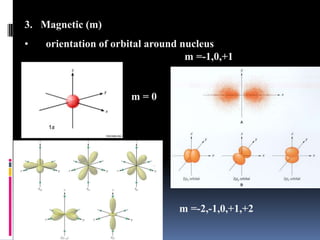
Magnetic (m)   orientation of orbital around nucleusm =-1,0,+1m = 0m =-2,-1,0,+1,+2
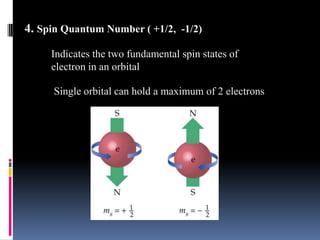
4. Spin Quantum Number ( +1/2,  -1/2)Indicates the two fundamental spin states of electron in an orbitalSingle orbital can hold a maximum of 2 electrons
Chapter 4.2 : The Quantum Model of the Atom

Chapter 4.2 : The Quantum Model of the Atom

  • 1.
    Chapter 4.2The QuantumModel of the Atom
  • 2.
    Objectives:Discuss Louis deBroglie’s role in the development of the quantum model of the atom.Compare and contrast the Bohr model and the quantum model of the atom.Explain how the Heisenberg uncertainty principle and the Schrodinger wave equation led to the idea of atomic orbitals.List the four quantum numbers, and describe their significance.Relate the number of sublevels corresponding to each of an atom’s main energy levels, the number of orbitals per sublevel, and the number of orbitals per main energy level.
  • 3.
    Quantum Model ofthe AtomDeBroglie electrons confined to certain space around nucleus at specific frequencies – energy levelsHeisenberg Uncertainty Principle it is impossible to determine simultaneously both the position and velocity of an electronSchrodinger Wave EquationTreated electrons as waves
  • 4.
    With uncertaintyprinciple – gave probability of finding an electron in certain regionsThese 3-D regions are called -Orbitals
  • 5.
    Quantum TheoryDescribes mathematicallythe wave properties of electronsQuantum Numbers – specify the properties of atomic orbitals and electrons in themPrincipal quantum number (n) main energy level occupied by electrons
  • 6.
    2. Angular Momentum(l) indicates the shape of the orbitall = 0 1 2 3 s p d f
  • 7.
    Magnetic (m) orientation of orbital around nucleusm =-1,0,+1m = 0m =-2,-1,0,+1,+2
  • 8.
    4. Spin QuantumNumber ( +1/2, -1/2)Indicates the two fundamental spin states of electron in an orbitalSingle orbital can hold a maximum of 2 electrons