BENIGN PROSTATIC HYPERPLASIA DR. FRANCISCO N. ESTANISLAO JR.
General Objectives: To present a case of benign prostate hyperplasia To discuss the cause, symptoms and guideline of treatment of the disease Specific objective: To present a combination drug therapy for the disease
Patient’s Profile: P.L , 66 y.o male married, Filipino, Roman Catholic farmer, residing at Consolacion, Cebu Chief complaint : Dysuria
hypertensive for(5) years  as claimed highest BP of 150/100; usual BP 120/70  herbal medications non diabetic, non asthmatic. HFD : (+) HPN Non smoker ; Occasional alcoholic drinker No allergies to food and drugs No previous hospitalization Past Medical History:
I month PTA  – noted to have dribbling and decrease in stream upon urination with occasional urinary frequency. Condition just tolerated. Took herbal medications with some relief. No consults done. History of Present Illness:
5 days PTA  -  complained of lumbar pain radiating to the hypogastric area associated with urinary frequency. No fever. No meds taken. History Of Present Illness
4 days PTA  -  sought consult with AP and prescribed with Paracetamol+Ibuprofen 1 tab 3x a day, Co Amoxiclav 625 mg 1 tab 3x a day with good compliance which afforded some relief. History of present illness
Morning PTA  – persistence of symptoms with dysuria thus sought consult and subsequently admitted History of present illness
Physical examination Examined pt. conscious, coherent, afebrile NIRD: Bp – 110/70  HR – 89  RR – 21  Temp 36.8 Skin: senile turgor , no lesions HEENT: anicteric sclerae, pinkish palpebral conjunctiva C/L: ECE, clear breath sounds CVS: DHS, (-) murmur
Abd: NABS, soft, no mass, no tenderness GUT: (-) KPS bilateral Ext: strong pulses CNS: no neurologic deficit Rectal: tight sphincteric tone, no mass, no rectal wall tenderness Prostate- smooth , firm, elastic, non tender, enlarged
Differential Dx :  Cystolithiasis Acute prostatitis Neurogenic bladder Impression: R/I Benign Prostatic Hyperplasia  ;  Urinary tract infection
Venoclysis started w/ PNSS 1L at 20 gtts / min Started w/ Co Amoxiclav 1.2 g slow IVTT q 12 Referred to a urologist for consult Labs were taken At  the E.R
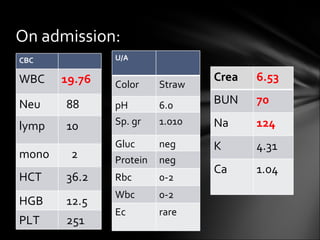
On admission: CBC WBC 19.76 Neu 88 lymp 10 mono 2 HCT 36.2 HGB 12.5 PLT 251 U/A Color Straw pH 6.0 Sp. gr 1.010 Gluc neg Protein neg Rbc 0-2 Wbc 0-2 Ec rare Crea 6.53 BUN 70 Na 124 K 4.31 Ca 1.04
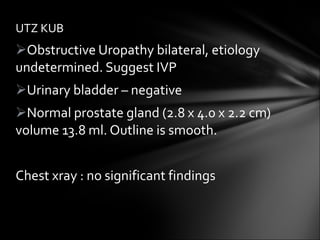
UTZ KUB Obstructive Uropathy bilateral, etiology undetermined. Suggest IVP Urinary bladder – negative Normal prostate gland (2.8 x 4.0 x 2.2 cm) volume 13.8 ml. Outline is smooth. Chest xray : no significant findings
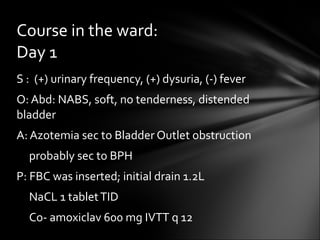
S :  (+) urinary frequency, (+) dysuria, (-) fever O: Abd: NABS, soft, no tenderness, distended bladder A: Azotemia sec to Bladder Outlet obstruction  probably sec to BPH P: FBC was inserted; initial drain 1.2L NaCL 1 tablet TID Co- amoxiclav 600 mg IVTT q 12 Course in the ward: Day 1
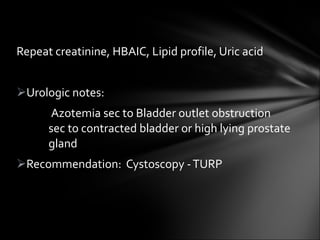
Repeat creatinine, HBAIC, Lipid profile, Uric acid Urologic notes:   Azotemia sec to Bladder outlet obstruction  sec to contracted bladder or high lying prostate  gland Recommendation:  Cystoscopy - TURP
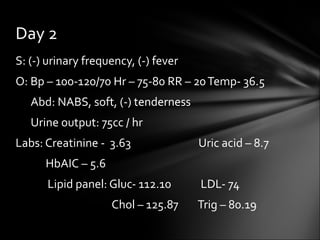
S: (-) urinary frequency, (-) fever O: Bp – 100-120/70 Hr – 75-80 RR – 20 Temp- 36.5 Abd: NABS, soft, (-) tenderness Urine output: 75cc / hr Labs: Creatinine -  3.63   Uric acid – 8.7 HbAIC – 5.6 Lipid panel: Gluc- 112.10   LDL- 74 Chol – 125.87  Trig – 80.19 Day 2
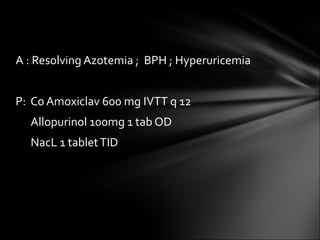
A : Resolving Azotemia ;  BPH ; Hyperuricemia P:  C0 Amoxiclav 600 mg IVTT q 12 Allopurinol 100mg 1 tab OD NacL 1 tablet TID
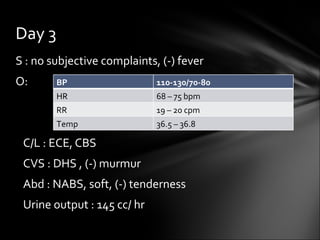
S : no subjective complaints, (-) fever O:  C/L : ECE, CBS CVS : DHS , (-) murmur Abd : NABS, soft, (-) tenderness Urine output : 145 cc/ hr Day 3 BP 110-130/70-80 HR 68 – 75 bpm RR 19 – 20 cpm Temp 36.5 – 36.8
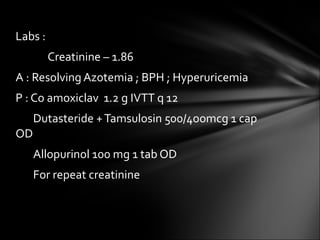
Labs :  Creatinine – 1.86 A : Resolving Azotemia ; BPH ; Hyperuricemia P : Co amoxiclav  1.2 g IVTT q 12 Dutasteride + Tamsulosin 500/4oomcg 1 cap  OD Allopurinol 100 mg 1 tab OD For repeat creatinine
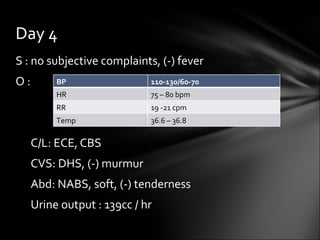
S : no subjective complaints, (-) fever O : C/L: ECE, CBS CVS: DHS, (-) murmur Abd: NABS, soft, (-) tenderness Urine output : 139cc / hr Day 4 BP 110-130/60-70 HR 75 – 80 bpm RR 19 -21 cpm Temp 36.6 – 36.8
Labs :  Creatinine: 1.43 Meds: Co amoxiclav 1.2 g IVTT q 12   Allopurinol 100 mg 1 tab OD Dutasteride + Tamsulosin 1 tab OD  A : Azotemia resolved; BPH ; Hyperuricemia P : Co amoxiclav 625 mg 1 tab BID p.o Referred back to urologist for co management
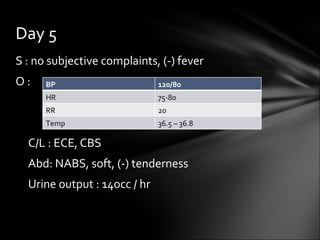
S : no subjective complaints, (-) fever O :  C/L : ECE, CBS Abd: NABS, soft, (-) tenderness Urine output : 14occ / hr Day 5 BP 120/80 HR 75-80 RR 20 Temp 36.5 – 36.8
Meds: Co- amoxiclav 625 mg BID p.o   Dutasteride + Tamsulosin 1 tab OD Allopurinol 1oomg 1 tab OD A : Azotemia resolved ; BPH ; Hyperuricemia P: Scheduled for Cysto – TURP Referred to a cardiologist for CP clearance Referred to anesthesiologist for anesthesia For APTT,  BT, Blood typing, Protime, Na, K ECG 12 leads
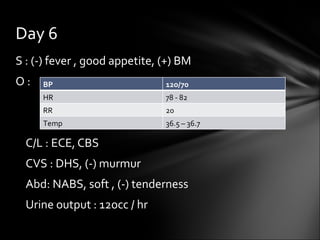
S : (-) fever , good appetite, (+) BM O :  C/L : ECE, CBS CVS : DHS, (-) murmur Abd: NABS, soft , (-) tenderness Urine output : 12occ / hr Day 6 BP 12o/70 HR 78 - 82 RR 20 Temp 36.5 – 36.7
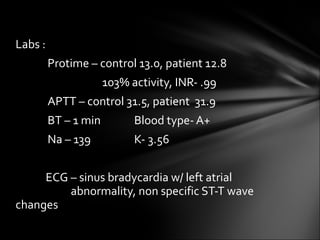
Labs :  Protime – control 13.0, patient 12.8     103% activity, INR- .99 APTT – control 31.5, patient  31.9 BT – 1 min    Blood type- A+ Na – 139   K- 3.56 ECG – sinus bradycardia w/ left atrial  abnormality, non specific ST-T wave changes
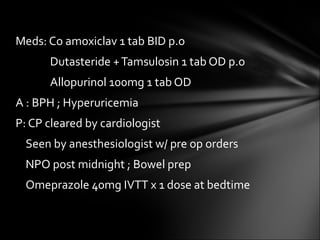
Meds: Co amoxiclav 1 tab BID p.o   Dutasteride + Tamsulosin 1 tab OD p.o   Allopurinol 100mg 1 tab OD A : BPH ; Hyperuricemia P: CP cleared by cardiologist Seen by anesthesiologist w/ pre op orders NPO post midnight ; Bowel prep Omeprazole 40mg IVTT x 1 dose at bedtime
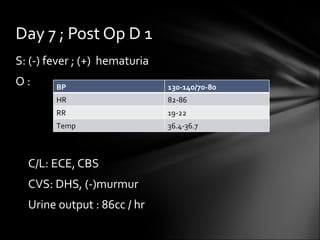
S: (-) fever ; (+)  hematuria O :  C/L: ECE, CBS CVS: DHS, (-)murmur Urine output : 86cc / hr Day 7 ; Post Op D 1 BP 130-140/70-80 HR 82-86 RR 19-22 Temp  36.4-36.7
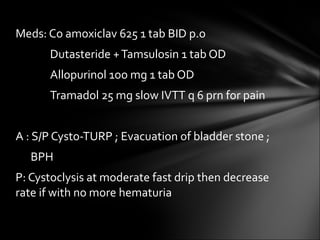
Meds: Co amoxiclav 625 1 tab BID p.o   Dutasteride + Tamsulosin 1 tab OD   Allopurinol 1oo mg 1 tab OD   Tramadol 25 mg slow IVTT q 6 prn for pain A : S/P Cysto-TURP ; Evacuation of bladder stone ; BPH P: Cystoclysis at moderate fast drip then decrease rate if with no more hematuria
> 15 grams of prostatic tissue were evacuated Presence of urinary bladder stone < 2mm was evacuated Intraoperative findings:
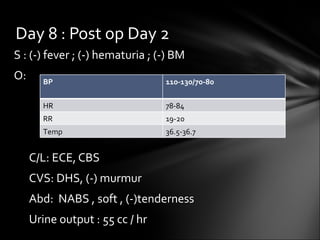
S : (-) fever ; (-) hematuria ; (-) BM O: C/L: ECE, CBS CVS: DHS, (-) murmur Abd:  NABS , soft , (-)tenderness Urine output : 55 cc / hr Day 8 : Post op Day 2 BP 110-130/70-80 HR 78-84 RR 19-20 Temp 36.5-36.7
Meds: Co- amoxiclav 625 mg 1 tab BID Allopurinol 100 mg 1 tab OD Dutasteride + Tamsulosin 1 tab OD Tramadol 50 mg 1 tab TID prn for pain A: BPH ; S/P Cysto TURP ; Evacuation of bladder  stone P: IVF was consumed and terminated
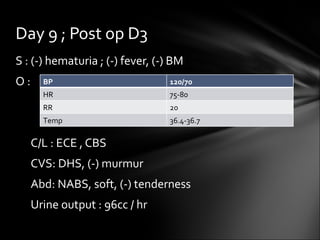
S : (-) hematuria ; (-) fever, (-) BM O : C/L : ECE , CBS CVS: DHS, (-) murmur Abd: NABS, soft, (-) tenderness  Urine output : 96cc / hr  Day 9 ; Post op D3 BP 120/70 HR 75-80 RR 20 Temp 36.4-36.7
Meds : Co Amoxiclav 625 1 tab BID   Allopurinol 100 mg 1 tab OD   Dutasteride + Tamsulosin 1 tab OD A: BPH ; S/P Cysto – TURP ; Evacuation of bladder  stone P: Cystoclysis was discontinued FBC removed
Able to void freely Discharged, improved Final Dx :  Azotemia sec to Bladder Outlet Obstruction  sec to BPH; Cystolithiasis S/P Cysto-TURP ;  Evacuation of bladder stone Biopsy : Nodular Hyperplasia ; Chronic prostatitis Day 9 ; Post op D4
Most common disorder of the prostate gland Proliferation of smooth muscles and epithelial cells Normal aging process May affect the quality of life Cannot be prevented Can be “treated” Benign Prostate Hyperplasia
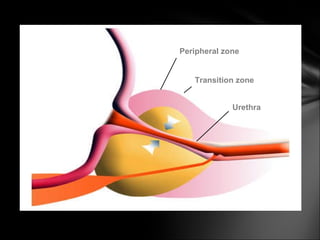
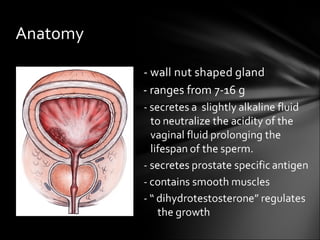
Anatomy
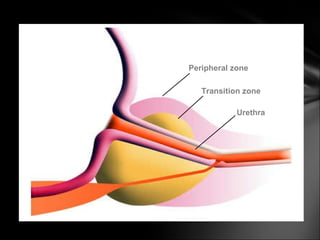
Name Fraction of gland Description Peripheral zone (PZ) Up to 70% in young men It is from this portion of the gland that ~70-80% of  prostatic cancers  originate. [14] [15] Central zone (CZ) Approximately 25% normally This zone surrounds the ejaculatory ducts. Transition zone (TZ) 5% at puberty The transition zone surrounds the proximal urethra and is the region of the prostate gland that grows throughout life and is responsible for the disease of  benign prostatic  enlargement Anterior fibro-muscular zone (or stroma) Approximately 5% This zone is usually devoid of glandular components, and composed only, as its name suggests, of  muscle  and  fibrous tissue .
Peripheral zone Transition zone Urethra
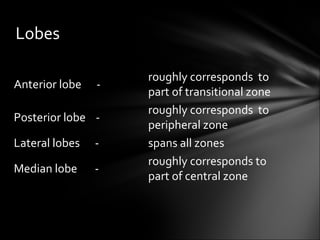
Lobes Anterior lobe  - roughly corresponds  to part of transitional zone Posterior lobe  - roughly corresponds  to peripheral zone Lateral lobes  - spans all zones Median lobe  - roughly corresponds to part of central zone
Aging males Fifth decade of life – 50% evidence of BPH Increase in growth .5 - .8 g /  year 80 years old – 90% evidence of BPH Epidemiology :
Hyperplasia of stromal and epithelial cells causing enlargement of the gland Dihydrotestosterone – mediator of prostate growth A-1 adrenergic receptors on the smooth muscles of the stroma, capsule of the gland and bladder neck Pathophysiology:
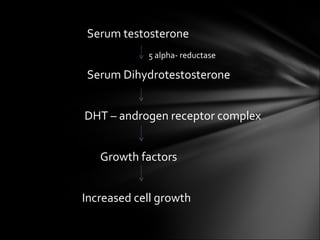
  Serum testosterone   5 alpha- reductase   Serum Dihydrotestosterone     DHT – androgen receptor complex   Growth factors   Increased cell growth
Peripheral zone Transition zone Urethra
 
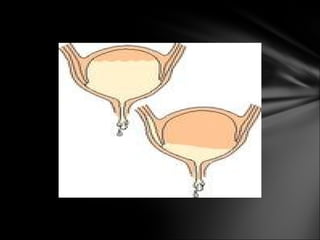
Causes : Static component  – direct bladder outlet obstruction from the enlarged gland Dynamic component  – increased smooth muscle tone and resistance within the enlarged gland Lower Urinary tract Syndrome
Voiding (obstructive) symptoms: Weak urinary stream  – common symptom of BPH Prolonged voiding  – linked to weak urinary stream and frequently accompanied by straining of abdominal muscles upon urination
Hesitancy  – a delay between the voluntary attempt to void and the actual initiation of urination Intermittency  – involuntary disruption of the urinary stream during voiding Incomplete emptying  – may be accompanied by the continued desire to void or by pain or discomfort in the bladder area Terminal dribbling  – inability to effectively terminate voiding
Storage (irritative) symptoms: Urinary frequency  – associated with bladder irritation that presents as a need to void repeatedly during the day. Nocturia  – the need to void during sleeping hours more than once  Urgency  – the need to urinate immediately
Urinary incontinence  – involuntary loss of urine. Complications: Acute urinary retention Renal insufficiency Recurrent urinary tract infections Gross hematuria Bladder stones
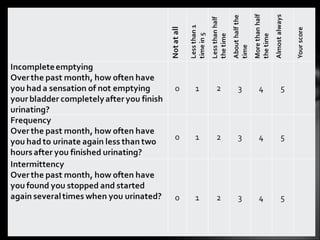
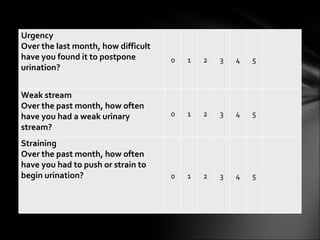
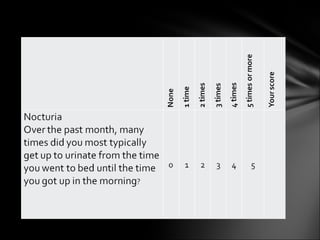
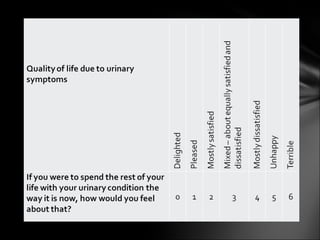
History and Physical examination Symptoms assessment International Prostate Symptom Score Questionnaire Diagnosis of BPH :
 
Urgency Over the last month, how difficult have you found it to postpone urination? 0 1 2 3 4 5   Weak stream Over the past month, how often have you had a weak urinary stream? 0 1 2 3 4 5   Straining Over the past month, how often have you had to push or strain to begin urination? 0 1 2 3 4 5  
 
 
Mildly symptomatic :  0-7 Moderately symptomatic :  8-19 Severely symptomatic :  20-35 IPSS score :
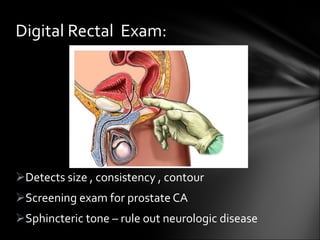
Detects size , consistency , contour Screening exam for prostate CA Sphincteric tone – rule out neurologic disease Digital Rectal  Exam:
Urinary bladder – stones ;  tumors ; post residual volume ;  Kidneys – size ; stones  Prostate – size ; volume ; calcifications Ultrasound :
Urinalysis Prostate Specific Antigen – to rule out prostatic adenocarcinoma Serum creatinine (optional) Laboratory :
Watchful waiting / Active surveillance - mild symptoms of LUTS (IPSS score < 8) - moderate-severe symptoms of LUTS  (IPSS score >8) - not bothered by their symptoms Management (AUA guidelines)
Behavioral Modifications: - reduction of fluid intake (especially at bedtime) - moderation of alcohol and caffeine intake - use of time voiding schedules - discontinuation of drugs that can aggravate  bladder or outlet obstruction  e.g. anhistamines , decongestants
Medical management  -  moderate-severe symptoms of LUTS  (IPSS score >8) - bothered by symptoms
C. Surgical intervention - moderate-severe symptoms of LUTS  (IPSS score >8) - bothered by symptoms - affect the quality of life - complications of BPH  - failed medical therapy - patient’s choice
Acute urinary retention Bladder stones Upper urinary tract dilatation Renal failure Absolute indications for surgery
Hematuria Large post voidal residuals Recurrent urinary tract infections Relative Indications:
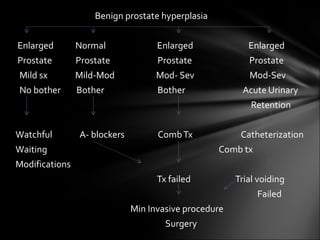
  Benign prostate hyperplasia Enlarged  Normal  Enlarged  Enlarged Prostate  Prostate  Prostate  Prostate Mild sx  Mild-Mod  Mod- Sev  Mod-Sev No bother  Bother  Bother   Acute Urinary   Retention Watchful  A- blockers  Comb Tx   Catheterization Waiting   Comb tx Modifications      Tx failed  Trial voiding     Failed   Min Invasive procedure   Surgery
Alpha blockers  Non selective and selective alpha 1- adrenergic  receptor blockade Relieves lower urinary tract symptoms by: - relaxation of smooth muscle tone in prostatic  stroma and bladder neck - relaxation of bladder smooth muscle - central action Medical therapy
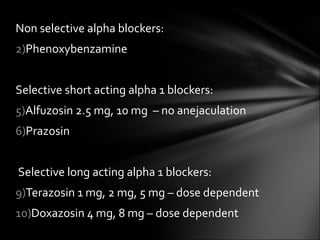
Non selective alpha blockers: Phenoxybenzamine Selective short acting alpha 1 blockers: Alfuzosin 2.5 mg, 10 mg  – no anejaculation Prazosin Selective long acting alpha 1 blockers: Terazosin 1 mg, 2 mg, 5 mg – dose dependent Doxazosin 4 mg, 8 mg – dose dependent
Partially subtype ( alpha-1a) selective agents Tamsulosin 200 mcg, 400 mcg – uroselective Silodozin – new drug
Postural Hypotension – most common - dizziness nasal congestion Headache Ejaculatory dysfunction Side effects:
Intraoperative Floppy Iris Syndrome Triad of progressive intra op miosis, billowing of a flaccid iris and iris prolapse toward the incision site during phacoemulsification  for cataracts Common in tamsulosin : 43%-90% Caution:
Inhibition of DHT receptor  complex formation Profound decrease in the concentration of DHT Decrease in prostate size Dutasteride 500 mcg Finasteride 5mg – refractory hematuria sec to    prostatic bleeding   5 a- reductase enzyme inhibitor
Decrease libido Erectile dysfunction Ejaculation disorder Adverse effects:
Widely used for treatment of various ailments Readily available cheaper Less adverse effects Phytotherapy
Saw palmetto berries – American dwarf palm Antiandrogenic effect Inhibition of 5 a reductase enzyme Anti inflammatory Improve subjective complaints Dosage : 160 mg twice a day Adverse effects : G.I discomfort
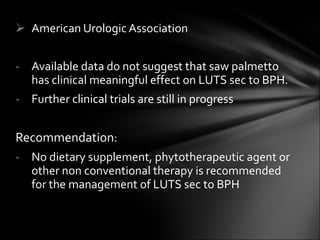
American Urologic Association  Available data do not suggest that saw palmetto has clinical meaningful effect on LUTS sec to BPH. Further clinical trials are still in progress Recommendation :  No dietary supplement, phytotherapeutic agent or other non conventional therapy is recommended for the management of LUTS sec to BPH
Alpha blockers + 5a reductase enzyme inhibitor Finasteride + Doxasozin Dutasteride + Tamsulosin Medical Therapy of Prostate Symptoms (MTOPS) large scale, long term study with a recruitement of 3047 men with BPH and a mean follow-up of 4.5 years. Combination therapy
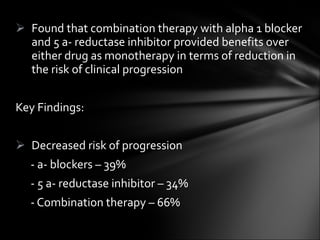
Found that combination therapy with alpha 1 blocker and 5 a- reductase inhibitor provided benefits over either drug as monotherapy in terms of reduction in the risk of clinical progression Key Findings: Decreased risk of progression - a- blockers – 39% - 5 a- reductase inhibitor – 34% - Combination therapy – 66%
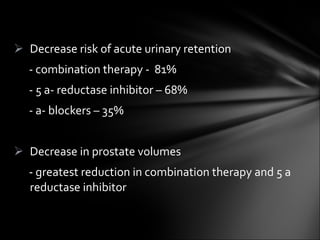
Decrease risk of acute urinary retention - combination therapy -  81% - 5 a- reductase inhibitor – 68% - a- blockers – 35% Decrease in prostate volumes - greatest reduction in combination therapy and 5 a  reductase inhibitor
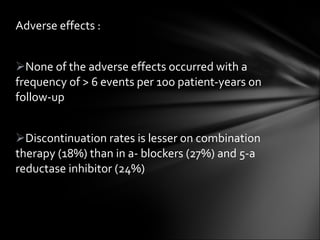
Adverse effects : None of the adverse effects occurred with a frequency of > 6 events per 1oo patient-years on follow-up Discontinuation rates is lesser on combination therapy (18%) than in a- blockers (27%) and 5-a reductase inhibitor (24%)
Conclusion: Combination therapy has been shown to provide fast symptom relief, reduced prostate growth, reduced risk of acute urinary retention and the need for BPH related surgery
Combination of Avodart and Tamsulosin trial (CombAT)  study 66% reduction in the risk of acute urinary retention and BPH related surgery 44% decrease in clinical progression of the disease
Transurethral resection of the Prostate Gold standard for obstructive BPH Standard of care when all other methods fail Surgery
Surgical removal of the prostate’s inner portion through endoscopic approach through the urethra under general / spinal anesthesia Indications: refractory urinary retention Renal insufficiency sec to bladder outlet obstruction Recurrent UTI Recurrent gross hematuria
e) Bladder calculi f) Permanently weakened or damaged bladder Complications: TUR syndrome – dilutional hyponatremia  Hematuria Erectile dysfunction Bladder neck contracuture Irritative voiding symptoms
Open Prostatectomy Surgical removal of the prostate via suprapubic or retropubic incision in the lower abdominal area Indicated in very large prostate Prostate volume of 80-100 ml
Significant risk of blood loss Need for blood transfusion Erectile dysfunction Retrograde ejaculation Longer hospital stay compared to TURP Complications
Transurethral needle ablation of the prostate Transurethral microwave thermotherapy Transurethral Holmium laser ablation  Transurethral Holmium laser enucleation Transurethral vaporization Photoselective vaporization Transurethral incision of the prostate Minimal invasive procedures
Thank you!

Benigh prostatic hyperplasia

  • 1.
    BENIGN PROSTATIC HYPERPLASIADR. FRANCISCO N. ESTANISLAO JR.
  • 2.
    General Objectives: Topresent a case of benign prostate hyperplasia To discuss the cause, symptoms and guideline of treatment of the disease Specific objective: To present a combination drug therapy for the disease
  • 3.
    Patient’s Profile: P.L, 66 y.o male married, Filipino, Roman Catholic farmer, residing at Consolacion, Cebu Chief complaint : Dysuria
  • 4.
    hypertensive for(5) years as claimed highest BP of 150/100; usual BP 120/70 herbal medications non diabetic, non asthmatic. HFD : (+) HPN Non smoker ; Occasional alcoholic drinker No allergies to food and drugs No previous hospitalization Past Medical History:
  • 5.
    I month PTA – noted to have dribbling and decrease in stream upon urination with occasional urinary frequency. Condition just tolerated. Took herbal medications with some relief. No consults done. History of Present Illness:
  • 6.
    5 days PTA - complained of lumbar pain radiating to the hypogastric area associated with urinary frequency. No fever. No meds taken. History Of Present Illness
  • 7.
    4 days PTA - sought consult with AP and prescribed with Paracetamol+Ibuprofen 1 tab 3x a day, Co Amoxiclav 625 mg 1 tab 3x a day with good compliance which afforded some relief. History of present illness
  • 8.
    Morning PTA – persistence of symptoms with dysuria thus sought consult and subsequently admitted History of present illness
  • 9.
    Physical examination Examinedpt. conscious, coherent, afebrile NIRD: Bp – 110/70 HR – 89 RR – 21 Temp 36.8 Skin: senile turgor , no lesions HEENT: anicteric sclerae, pinkish palpebral conjunctiva C/L: ECE, clear breath sounds CVS: DHS, (-) murmur
  • 10.
    Abd: NABS, soft,no mass, no tenderness GUT: (-) KPS bilateral Ext: strong pulses CNS: no neurologic deficit Rectal: tight sphincteric tone, no mass, no rectal wall tenderness Prostate- smooth , firm, elastic, non tender, enlarged
  • 11.
    Differential Dx : Cystolithiasis Acute prostatitis Neurogenic bladder Impression: R/I Benign Prostatic Hyperplasia ; Urinary tract infection
  • 12.
    Venoclysis started w/PNSS 1L at 20 gtts / min Started w/ Co Amoxiclav 1.2 g slow IVTT q 12 Referred to a urologist for consult Labs were taken At the E.R
  • 13.
    On admission: CBCWBC 19.76 Neu 88 lymp 10 mono 2 HCT 36.2 HGB 12.5 PLT 251 U/A Color Straw pH 6.0 Sp. gr 1.010 Gluc neg Protein neg Rbc 0-2 Wbc 0-2 Ec rare Crea 6.53 BUN 70 Na 124 K 4.31 Ca 1.04
  • 14.
    UTZ KUB ObstructiveUropathy bilateral, etiology undetermined. Suggest IVP Urinary bladder – negative Normal prostate gland (2.8 x 4.0 x 2.2 cm) volume 13.8 ml. Outline is smooth. Chest xray : no significant findings
  • 15.
    S : (+) urinary frequency, (+) dysuria, (-) fever O: Abd: NABS, soft, no tenderness, distended bladder A: Azotemia sec to Bladder Outlet obstruction probably sec to BPH P: FBC was inserted; initial drain 1.2L NaCL 1 tablet TID Co- amoxiclav 600 mg IVTT q 12 Course in the ward: Day 1
  • 16.
    Repeat creatinine, HBAIC,Lipid profile, Uric acid Urologic notes: Azotemia sec to Bladder outlet obstruction sec to contracted bladder or high lying prostate gland Recommendation: Cystoscopy - TURP
  • 17.
    S: (-) urinaryfrequency, (-) fever O: Bp – 100-120/70 Hr – 75-80 RR – 20 Temp- 36.5 Abd: NABS, soft, (-) tenderness Urine output: 75cc / hr Labs: Creatinine - 3.63 Uric acid – 8.7 HbAIC – 5.6 Lipid panel: Gluc- 112.10 LDL- 74 Chol – 125.87 Trig – 80.19 Day 2
  • 18.
    A : ResolvingAzotemia ; BPH ; Hyperuricemia P: C0 Amoxiclav 600 mg IVTT q 12 Allopurinol 100mg 1 tab OD NacL 1 tablet TID
  • 19.
    S : nosubjective complaints, (-) fever O: C/L : ECE, CBS CVS : DHS , (-) murmur Abd : NABS, soft, (-) tenderness Urine output : 145 cc/ hr Day 3 BP 110-130/70-80 HR 68 – 75 bpm RR 19 – 20 cpm Temp 36.5 – 36.8
  • 20.
    Labs : Creatinine – 1.86 A : Resolving Azotemia ; BPH ; Hyperuricemia P : Co amoxiclav 1.2 g IVTT q 12 Dutasteride + Tamsulosin 500/4oomcg 1 cap OD Allopurinol 100 mg 1 tab OD For repeat creatinine
  • 21.
    S : nosubjective complaints, (-) fever O : C/L: ECE, CBS CVS: DHS, (-) murmur Abd: NABS, soft, (-) tenderness Urine output : 139cc / hr Day 4 BP 110-130/60-70 HR 75 – 80 bpm RR 19 -21 cpm Temp 36.6 – 36.8
  • 22.
    Labs : Creatinine: 1.43 Meds: Co amoxiclav 1.2 g IVTT q 12 Allopurinol 100 mg 1 tab OD Dutasteride + Tamsulosin 1 tab OD A : Azotemia resolved; BPH ; Hyperuricemia P : Co amoxiclav 625 mg 1 tab BID p.o Referred back to urologist for co management
  • 23.
    S : nosubjective complaints, (-) fever O : C/L : ECE, CBS Abd: NABS, soft, (-) tenderness Urine output : 14occ / hr Day 5 BP 120/80 HR 75-80 RR 20 Temp 36.5 – 36.8
  • 24.
    Meds: Co- amoxiclav625 mg BID p.o Dutasteride + Tamsulosin 1 tab OD Allopurinol 1oomg 1 tab OD A : Azotemia resolved ; BPH ; Hyperuricemia P: Scheduled for Cysto – TURP Referred to a cardiologist for CP clearance Referred to anesthesiologist for anesthesia For APTT, BT, Blood typing, Protime, Na, K ECG 12 leads
  • 25.
    S : (-)fever , good appetite, (+) BM O : C/L : ECE, CBS CVS : DHS, (-) murmur Abd: NABS, soft , (-) tenderness Urine output : 12occ / hr Day 6 BP 12o/70 HR 78 - 82 RR 20 Temp 36.5 – 36.7
  • 26.
    Labs : Protime – control 13.0, patient 12.8 103% activity, INR- .99 APTT – control 31.5, patient 31.9 BT – 1 min Blood type- A+ Na – 139 K- 3.56 ECG – sinus bradycardia w/ left atrial abnormality, non specific ST-T wave changes
  • 27.
    Meds: Co amoxiclav1 tab BID p.o Dutasteride + Tamsulosin 1 tab OD p.o Allopurinol 100mg 1 tab OD A : BPH ; Hyperuricemia P: CP cleared by cardiologist Seen by anesthesiologist w/ pre op orders NPO post midnight ; Bowel prep Omeprazole 40mg IVTT x 1 dose at bedtime
  • 28.
    S: (-) fever; (+) hematuria O : C/L: ECE, CBS CVS: DHS, (-)murmur Urine output : 86cc / hr Day 7 ; Post Op D 1 BP 130-140/70-80 HR 82-86 RR 19-22 Temp 36.4-36.7
  • 29.
    Meds: Co amoxiclav625 1 tab BID p.o Dutasteride + Tamsulosin 1 tab OD Allopurinol 1oo mg 1 tab OD Tramadol 25 mg slow IVTT q 6 prn for pain A : S/P Cysto-TURP ; Evacuation of bladder stone ; BPH P: Cystoclysis at moderate fast drip then decrease rate if with no more hematuria
  • 30.
    > 15 gramsof prostatic tissue were evacuated Presence of urinary bladder stone < 2mm was evacuated Intraoperative findings:
  • 31.
    S : (-)fever ; (-) hematuria ; (-) BM O: C/L: ECE, CBS CVS: DHS, (-) murmur Abd: NABS , soft , (-)tenderness Urine output : 55 cc / hr Day 8 : Post op Day 2 BP 110-130/70-80 HR 78-84 RR 19-20 Temp 36.5-36.7
  • 32.
    Meds: Co- amoxiclav625 mg 1 tab BID Allopurinol 100 mg 1 tab OD Dutasteride + Tamsulosin 1 tab OD Tramadol 50 mg 1 tab TID prn for pain A: BPH ; S/P Cysto TURP ; Evacuation of bladder stone P: IVF was consumed and terminated
  • 33.
    S : (-)hematuria ; (-) fever, (-) BM O : C/L : ECE , CBS CVS: DHS, (-) murmur Abd: NABS, soft, (-) tenderness Urine output : 96cc / hr Day 9 ; Post op D3 BP 120/70 HR 75-80 RR 20 Temp 36.4-36.7
  • 34.
    Meds : CoAmoxiclav 625 1 tab BID Allopurinol 100 mg 1 tab OD Dutasteride + Tamsulosin 1 tab OD A: BPH ; S/P Cysto – TURP ; Evacuation of bladder stone P: Cystoclysis was discontinued FBC removed
  • 35.
    Able to voidfreely Discharged, improved Final Dx : Azotemia sec to Bladder Outlet Obstruction sec to BPH; Cystolithiasis S/P Cysto-TURP ; Evacuation of bladder stone Biopsy : Nodular Hyperplasia ; Chronic prostatitis Day 9 ; Post op D4
  • 36.
    Most common disorderof the prostate gland Proliferation of smooth muscles and epithelial cells Normal aging process May affect the quality of life Cannot be prevented Can be “treated” Benign Prostate Hyperplasia
  • 37.
  • 38.
    Name Fraction ofgland Description Peripheral zone (PZ) Up to 70% in young men It is from this portion of the gland that ~70-80% of prostatic cancers originate. [14] [15] Central zone (CZ) Approximately 25% normally This zone surrounds the ejaculatory ducts. Transition zone (TZ) 5% at puberty The transition zone surrounds the proximal urethra and is the region of the prostate gland that grows throughout life and is responsible for the disease of benign prostatic enlargement Anterior fibro-muscular zone (or stroma) Approximately 5% This zone is usually devoid of glandular components, and composed only, as its name suggests, of muscle and fibrous tissue .
  • 39.
  • 40.
    Lobes Anterior lobe - roughly corresponds to part of transitional zone Posterior lobe - roughly corresponds to peripheral zone Lateral lobes - spans all zones Median lobe - roughly corresponds to part of central zone
  • 41.
    Aging males Fifthdecade of life – 50% evidence of BPH Increase in growth .5 - .8 g / year 80 years old – 90% evidence of BPH Epidemiology :
  • 42.
    Hyperplasia of stromaland epithelial cells causing enlargement of the gland Dihydrotestosterone – mediator of prostate growth A-1 adrenergic receptors on the smooth muscles of the stroma, capsule of the gland and bladder neck Pathophysiology:
  • 43.
    Serumtestosterone 5 alpha- reductase Serum Dihydrotestosterone DHT – androgen receptor complex Growth factors Increased cell growth
  • 44.
  • 45.
  • 46.
    Causes : Staticcomponent – direct bladder outlet obstruction from the enlarged gland Dynamic component – increased smooth muscle tone and resistance within the enlarged gland Lower Urinary tract Syndrome
  • 47.
    Voiding (obstructive) symptoms:Weak urinary stream – common symptom of BPH Prolonged voiding – linked to weak urinary stream and frequently accompanied by straining of abdominal muscles upon urination
  • 48.
    Hesitancy –a delay between the voluntary attempt to void and the actual initiation of urination Intermittency – involuntary disruption of the urinary stream during voiding Incomplete emptying – may be accompanied by the continued desire to void or by pain or discomfort in the bladder area Terminal dribbling – inability to effectively terminate voiding
  • 49.
    Storage (irritative) symptoms:Urinary frequency – associated with bladder irritation that presents as a need to void repeatedly during the day. Nocturia – the need to void during sleeping hours more than once Urgency – the need to urinate immediately
  • 50.
    Urinary incontinence – involuntary loss of urine. Complications: Acute urinary retention Renal insufficiency Recurrent urinary tract infections Gross hematuria Bladder stones
  • 51.
    History and Physicalexamination Symptoms assessment International Prostate Symptom Score Questionnaire Diagnosis of BPH :
  • 52.
  • 53.
    Urgency Over thelast month, how difficult have you found it to postpone urination? 0 1 2 3 4 5   Weak stream Over the past month, how often have you had a weak urinary stream? 0 1 2 3 4 5   Straining Over the past month, how often have you had to push or strain to begin urination? 0 1 2 3 4 5  
  • 54.
  • 55.
  • 56.
    Mildly symptomatic : 0-7 Moderately symptomatic : 8-19 Severely symptomatic : 20-35 IPSS score :
  • 57.
    Detects size ,consistency , contour Screening exam for prostate CA Sphincteric tone – rule out neurologic disease Digital Rectal Exam:
  • 58.
    Urinary bladder –stones ; tumors ; post residual volume ; Kidneys – size ; stones Prostate – size ; volume ; calcifications Ultrasound :
  • 59.
    Urinalysis Prostate SpecificAntigen – to rule out prostatic adenocarcinoma Serum creatinine (optional) Laboratory :
  • 60.
    Watchful waiting /Active surveillance - mild symptoms of LUTS (IPSS score < 8) - moderate-severe symptoms of LUTS (IPSS score >8) - not bothered by their symptoms Management (AUA guidelines)
  • 61.
    Behavioral Modifications: -reduction of fluid intake (especially at bedtime) - moderation of alcohol and caffeine intake - use of time voiding schedules - discontinuation of drugs that can aggravate bladder or outlet obstruction e.g. anhistamines , decongestants
  • 62.
    Medical management - moderate-severe symptoms of LUTS (IPSS score >8) - bothered by symptoms
  • 63.
    C. Surgical intervention- moderate-severe symptoms of LUTS (IPSS score >8) - bothered by symptoms - affect the quality of life - complications of BPH - failed medical therapy - patient’s choice
  • 64.
    Acute urinary retentionBladder stones Upper urinary tract dilatation Renal failure Absolute indications for surgery
  • 65.
    Hematuria Large postvoidal residuals Recurrent urinary tract infections Relative Indications:
  • 66.
    Benignprostate hyperplasia Enlarged Normal Enlarged Enlarged Prostate Prostate Prostate Prostate Mild sx Mild-Mod Mod- Sev Mod-Sev No bother Bother Bother Acute Urinary Retention Watchful A- blockers Comb Tx Catheterization Waiting Comb tx Modifications Tx failed Trial voiding Failed Min Invasive procedure Surgery
  • 67.
    Alpha blockers Non selective and selective alpha 1- adrenergic receptor blockade Relieves lower urinary tract symptoms by: - relaxation of smooth muscle tone in prostatic stroma and bladder neck - relaxation of bladder smooth muscle - central action Medical therapy
  • 68.
    Non selective alphablockers: Phenoxybenzamine Selective short acting alpha 1 blockers: Alfuzosin 2.5 mg, 10 mg – no anejaculation Prazosin Selective long acting alpha 1 blockers: Terazosin 1 mg, 2 mg, 5 mg – dose dependent Doxazosin 4 mg, 8 mg – dose dependent
  • 69.
    Partially subtype (alpha-1a) selective agents Tamsulosin 200 mcg, 400 mcg – uroselective Silodozin – new drug
  • 70.
    Postural Hypotension –most common - dizziness nasal congestion Headache Ejaculatory dysfunction Side effects:
  • 71.
    Intraoperative Floppy IrisSyndrome Triad of progressive intra op miosis, billowing of a flaccid iris and iris prolapse toward the incision site during phacoemulsification for cataracts Common in tamsulosin : 43%-90% Caution:
  • 72.
    Inhibition of DHTreceptor complex formation Profound decrease in the concentration of DHT Decrease in prostate size Dutasteride 500 mcg Finasteride 5mg – refractory hematuria sec to prostatic bleeding 5 a- reductase enzyme inhibitor
  • 73.
    Decrease libido Erectiledysfunction Ejaculation disorder Adverse effects:
  • 74.
    Widely used fortreatment of various ailments Readily available cheaper Less adverse effects Phytotherapy
  • 75.
    Saw palmetto berries– American dwarf palm Antiandrogenic effect Inhibition of 5 a reductase enzyme Anti inflammatory Improve subjective complaints Dosage : 160 mg twice a day Adverse effects : G.I discomfort
  • 76.
    American Urologic Association Available data do not suggest that saw palmetto has clinical meaningful effect on LUTS sec to BPH. Further clinical trials are still in progress Recommendation : No dietary supplement, phytotherapeutic agent or other non conventional therapy is recommended for the management of LUTS sec to BPH
  • 77.
    Alpha blockers +5a reductase enzyme inhibitor Finasteride + Doxasozin Dutasteride + Tamsulosin Medical Therapy of Prostate Symptoms (MTOPS) large scale, long term study with a recruitement of 3047 men with BPH and a mean follow-up of 4.5 years. Combination therapy
  • 78.
    Found that combinationtherapy with alpha 1 blocker and 5 a- reductase inhibitor provided benefits over either drug as monotherapy in terms of reduction in the risk of clinical progression Key Findings: Decreased risk of progression - a- blockers – 39% - 5 a- reductase inhibitor – 34% - Combination therapy – 66%
  • 79.
    Decrease risk ofacute urinary retention - combination therapy - 81% - 5 a- reductase inhibitor – 68% - a- blockers – 35% Decrease in prostate volumes - greatest reduction in combination therapy and 5 a reductase inhibitor
  • 80.
    Adverse effects :None of the adverse effects occurred with a frequency of > 6 events per 1oo patient-years on follow-up Discontinuation rates is lesser on combination therapy (18%) than in a- blockers (27%) and 5-a reductase inhibitor (24%)
  • 81.
    Conclusion: Combination therapyhas been shown to provide fast symptom relief, reduced prostate growth, reduced risk of acute urinary retention and the need for BPH related surgery
  • 82.
    Combination of Avodartand Tamsulosin trial (CombAT) study 66% reduction in the risk of acute urinary retention and BPH related surgery 44% decrease in clinical progression of the disease
  • 83.
    Transurethral resection ofthe Prostate Gold standard for obstructive BPH Standard of care when all other methods fail Surgery
  • 84.
    Surgical removal ofthe prostate’s inner portion through endoscopic approach through the urethra under general / spinal anesthesia Indications: refractory urinary retention Renal insufficiency sec to bladder outlet obstruction Recurrent UTI Recurrent gross hematuria
  • 85.
    e) Bladder calculif) Permanently weakened or damaged bladder Complications: TUR syndrome – dilutional hyponatremia Hematuria Erectile dysfunction Bladder neck contracuture Irritative voiding symptoms
  • 86.
    Open Prostatectomy Surgicalremoval of the prostate via suprapubic or retropubic incision in the lower abdominal area Indicated in very large prostate Prostate volume of 80-100 ml
  • 87.
    Significant risk ofblood loss Need for blood transfusion Erectile dysfunction Retrograde ejaculation Longer hospital stay compared to TURP Complications
  • 88.
    Transurethral needle ablationof the prostate Transurethral microwave thermotherapy Transurethral Holmium laser ablation Transurethral Holmium laser enucleation Transurethral vaporization Photoselective vaporization Transurethral incision of the prostate Minimal invasive procedures
  • 89.