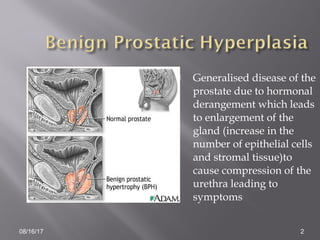
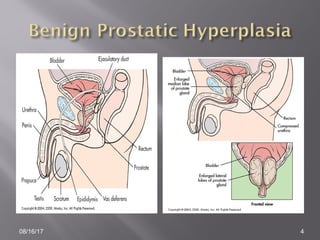
 Generalised disease of the
prostate due to hormonal
derangement which leads
to enlargement of the
gland (increase in the
number of epithelial cells
and stromal tissue)to
cause compression of the
urethra leading to
symptoms
08/16/17 2
 Occurs in 50% of men over 50 and in 80% of
men over 80 have BPH
 BPH progresses differently in every individual
 Many men with BPH may have mild
symptoms and may never need treatment
 BPH does not predispose to the development
of prostate cancer
08/16/17 3
08/16/17 4
 Cause not completely understood
 Change in hormonal milieu with alterations in the
testosterone/estrogen balance
 Induction of prostatic growth factors
 Increased stem cells/decreased stromal cell death
 Accumulation of dihydroxytestosterone, stimulation by
estrogen and prostatic growth hormone actions
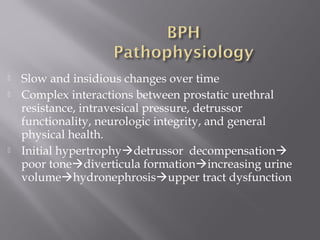
 Slow and insidious changes over time
 Complex interactions between prostatic urethral
resistance, intravesical pressure, detrussor
functionality, neurologic integrity, and general
physical health.
 Initial hypertrophydetrussor decompensation
poor tonediverticula formationincreasing urine
volumehydronephrosisupper tract dysfunction
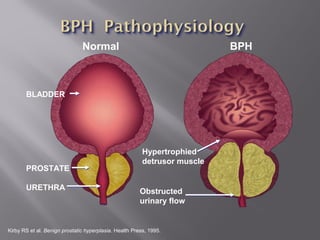
Normal BPH
Hypertrophied
detrusor muscle
Obstructed
urinary flow
PROSTATE
BLADDER
URETHRA
Kirby RS et al. Benign prostatic hyperplasia. Health Press, 1995.
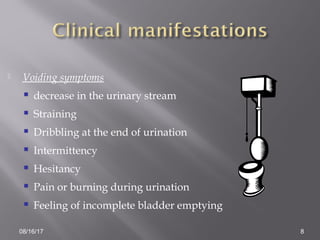
 Voiding symptoms
 decrease in the urinary stream
 Straining
 Dribbling at the end of urination
 Intermittency
 Hesitancy
 Pain or burning during urination
 Feeling of incomplete bladder emptying
08/16/17 8
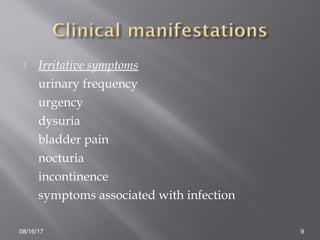
 Irritative symptoms
urinary frequency
urgency
dysuria
bladder pain
nocturia
incontinence
symptoms associated with infection
08/16/17 9
 History (STD, trauma, surgery)
 Other disorders (eg. neurologic, diabetes)
 Medications (anti-cholinergics)
 Functional Status
 Urinary retention
 UTI
 Sepsis secondary to UTI
 Residual urine
 Calculi
 Renal failure
 Hematuria
 Hernias, hemorroids, bowel habit change
08/16/17 11
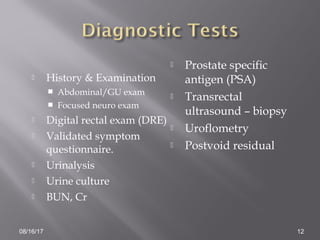
 History & Examination
 Abdominal/GU exam
 Focused neuro exam
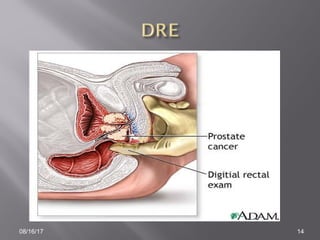
 Digital rectal exam (DRE)
 Validated symptom
questionnaire.
 Urinalysis
 Urine culture
 BUN, Cr
 Prostate specific
antigen (PSA)
 Transrectal
ultrasound – biopsy
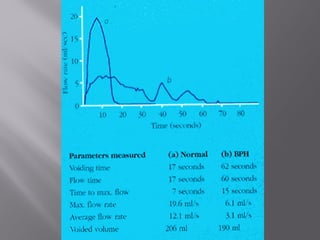
 Uroflometry
 Postvoid residual
08/16/17 12
Not at all
Less
than 1
time
in 5
Less
than
half the
time
About half
the time
More
than
half
the
time
Almost
always
Your
score
Incomplete emptying
Over the past month, how often have you had a sensation of not emptying your
bladder completely after you finish urinating?
0 1 2 3 4 5
Frequency
Over the past month, how often have you had to urinate again less than two hours after
you finished urinating?
0 1 2 3 4 5
Intermittency
Over the past month, how often have you found you stopped and started again several
times when you urinated?
0 1 2 3 4 5
Urgency
Over the last month, how difficult have you found it to postpone urination? 0 1 2 3 4 5
Weak stream
Over the past month, how often have you had a weak urinary stream? 0 1 2 3 4 5
Straining
Over the past month, how often have you had to push or strain to begin urination? 0 1 2 3 4 5
 
 
None 1 time 2 times 3 times 4 times
5 times
or more
Your
score
Nocturia
Over the past month, many times did you most typically get up to urinate from the
time you went to bed until the time you got up in the morning?
0 1 2 3 4 5
Quality of life due to urinary symptoms
Delighted Pleased Mostly satisfied
Mixed – about equally
satisfied and dissatisfied
Mostly
dissatisfied
Unhappy Terrible
If you were to spend the rest of your life with your
urinary condition the way it is now, how would you
feel about that?
0 1 2 3 4 5 6
 
Total score: 0-7 Mildly symptomatic; 8-19 moderately symptomatic; 20-35 severely symptomatic.
08/16/17 14
 Firm to hard nodules
 Irregularities, unequal lobes
 Induration
 Stony hard prostate
 Any palpable nodular abnormality suggests
cancer and warrants investigation
 Urine cytology in patients with:
 Predominance of irritative voiding symptoms.
 Smoking history
 Flow rate and post-void residual
 Not necessary before medical therapy but should be
considered in those undergoing invasive therapy or
those with neurologic conditions
 Upper tract evaluation if hematuria, increased
creatinine
 Cystoscopy
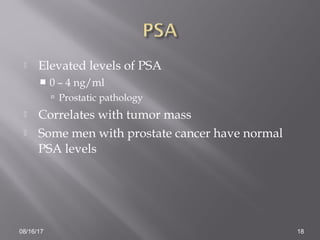
 Elevated levels of PSA
 0 – 4 ng/ml
 Prostatic pathology
 Correlates with tumor mass
 Some men with prostate cancer have normal
PSA levels
08/16/17 18
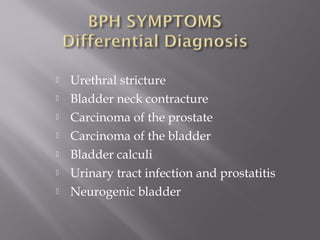
 Urethral stricture
 Bladder neck contracture
 Carcinoma of the prostate
 Carcinoma of the bladder
 Bladder calculi
 Urinary tract infection and prostatitis
 Neurogenic bladder
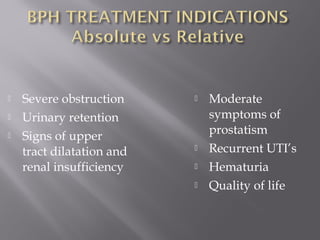
 Severe obstruction
 Urinary retention
 Signs of upper
tract dilatation and
renal insufficiency
 Moderate
symptoms of
prostatism
 Recurrent UTI’s
 Hematuria
 Quality of life
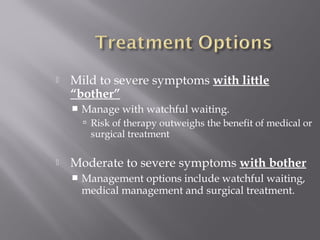
 Mild to severe symptoms with little
“bother”
 Manage with watchful waiting.
 Risk of therapy outweighs the benefit of medical or
surgical treatment
 Moderate to severe symptoms with bother
 Management options include watchful waiting,
medical management and surgical treatment.
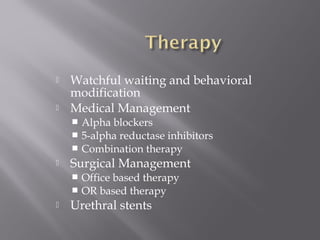
 Watchful waiting and behavioral
modification
 Medical Management
 Alpha blockers
 5-alpha reductase inhibitors
 Combination therapy
 Surgical Management
 Office based therapy
 OR based therapy
 Urethral stents
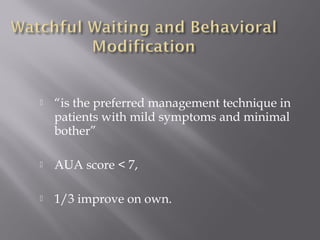
 “is the preferred management technique in
patients with mild symptoms and minimal
bother”
 AUA score < 7,
 1/3 improve on own.
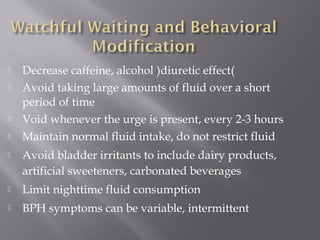
 Decrease caffeine, alcohol )diuretic effect(
 Avoid taking large amounts of fluid over a short
period of time
 Void whenever the urge is present, every 2-3 hours
 Maintain normal fluid intake, do not restrict fluid
 Avoid bladder irritants to include dairy products,
artificial sweeteners, carbonated beverages
 Limit nighttime fluid consumption
 BPH symptoms can be variable, intermittent
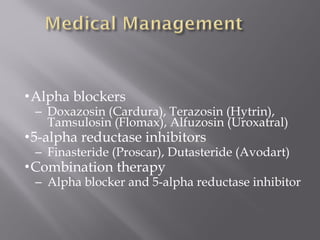
•Alpha blockers
– Doxazosin (Cardura), Terazosin (Hytrin),
Tamsulosin (Flomax), Alfuzosin (Uroxatral)
•5-alpha reductase inhibitors
– Finasteride (Proscar), Dutasteride (Avodart)
•Combination therapy
– Alpha blocker and 5-alpha reductase inhibitor
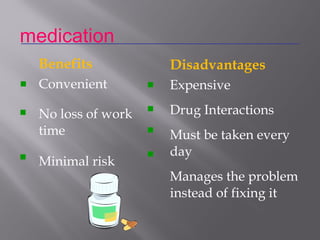
Benefits
Convenient
No loss of work
time
Minimal risk
Disadvantages
Expensive
Drug Interactions
Must be taken every
day
Manages the problem
instead of fixing it
medication


 



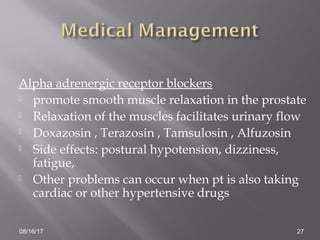
Alpha adrenergic receptor blockers
 promote smooth muscle relaxation in the prostate
 Relaxation of the muscles facilitates urinary flow
 Doxazosin , Terazosin , Tamsulosin , Alfuzosin
 Side effects: postural hypotension, dizziness,
fatigue,
 Other problems can occur when pt is also taking
cardiac or other hypertensive drugs
08/16/17 27
 Equal clinical effectiveness
 Slight differences in adverse event profile
 Orthostasis (lower in tamsulosin)
 Ejaculatory dysfunction (higher in tamsulosin)
 Decreased energy levels
 Nasal congestion
 Increase in CHF risk with doxazosin
 Must titrate doxazosin and terazosin to effective
levels
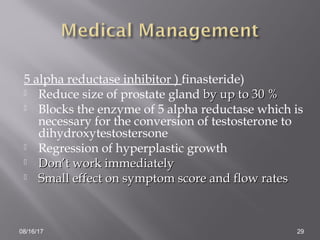
5 alpha reductase inhibitor ) finasteride)
 Reduce size of prostate gland by up to 30 %by up to 30 %
 Blocks the enzyme of 5 alpha reductase which is
necessary for the conversion of testosterone to
dihydroxytestostersone
 Regression of hyperplastic growth
 Don’t work immediatelyDon’t work immediately
 Small effect on symptom score and flow ratesSmall effect on symptom score and flow rates
08/16/17 29
 Agents are effective and appropriate treatment for
patients with lower urinary tract symptoms and
demonstrable enlargement of the prostate.
 Average prostate size is 30 cc’s. Original studies showed
benefit only in men with prostate sizes greater than 50
cc’s.
 Finasteride (Proscar) and Dutasteride (Avodart)
 Less effective for relief of BPH symptoms than alpha
blockers
 Adverse events include
 Decreased libido
 Worsened sexual function (erectile dysfunction)
 decrease volume of ejaculation
 Breast enlargement and tenderness
 Reduces risk of urinary retention by 3%/year.
 PSA must be doubled if screening for prostate cancer
 Concomitant use of alpha blockers and 5-
alpha reductase inhibitors
 Should be reserved for patients who are at
significant risk of progression and adverse
outcome
 Poor surgical candidate
 Patient wants to avoid surgery
 Significant cost associated with dual medications
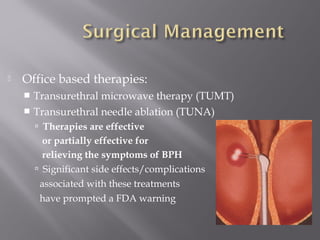
 Office based therapies:
 Transurethral microwave therapy (TUMT)
 Transurethral needle ablation (TUNA)
 Therapies are effective
or partially effective for
relieving the symptoms of BPH
 Significant side effects/complications
associated with these treatments
have prompted a FDA warning
 OR based therapies
 Open simple prostatectomy
 TURP
 Transurethral incision of the prostate
 Laser photoselective vaporization of the prostate
(green light laser PVP)
 Laser Prostatectomy
 Patients may select surgical treatment as initial
therapy if moderate or severe bother is present.
 Patients who have developed complications of
BPH (i.e urinary retention, renal insufficiency,
recurrent UTI) are best treated surgically.
 New surgical treatment have not demonstrated
better outcomes than TURP to date.
 Indicated for AUA score >16
 Transurethral Prostatectomy(TURP): 18%
morbidity with .2% mortality. 80-90%
improvement at 1 year but 60-75% at 5 years
and 5% require repeat TURP.
 Transurethral Incision of Prostate (TUIP): less
morbidity with similar efficacy indicated for
smaller prostates.
 Open Prostatectomy: indicated for glands > 60
grams or when additional procedure needed for
suprapubic/retropubic approaches
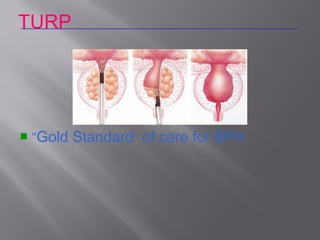
TURP
“Gold Standard” of care for BPH
Benefits
Widely available
Effective
Long lasting
Disadvantages
Greater risk of side effects
and complications
1-4 days hospital stay
1-3 days catheter
4-6 week recovery







Greater than 5% risk of:
 Irritative voiding symptoms
 Bladder neck contracture
 UTI
Risk of incontinence 1%
Decline in erectile function
65% of retrograde ejaculation
TUR syndrome (acute hyponatremia from free water
absorption)
Hemorrhage
Bladder spasms
TURP
 Restoration of urinary drainage
 Treatment of any urinary tract infection
 Understanding of procedure, implications for
sexual functioning and urinary control
08/16/17 41
 Antibiotics
 Allow pt to discuss concerns about surgery on
sexual functioning
 Prostatic surgery may result in retrograde
ejaculation
08/16/17 42
 No complications
 Restoration of urinary control
 Complete bladder emptying
 Satisfying sexual expression
08/16/17 43
 Monitoring
 Continuous irrigation & maintain catheter patency
 Blood clots and hematuria are expected for the
first 24-36 hours
 After catheter is removed – check for urinary
retention and urinary stream
08/16/17 44
 Sphincter tone may be poor after catheter is
removed. Kegal exercise pelvic muscle floor
technique is encouraged. Starting and
stopping the urinary stream is helpful.
 Stool softeners to avoid straining
 Sitting and walking for long periods should be
avoided
08/16/17 45
 Catheter care
 Managing urinary incontinence
 Oral fluid intake – 2,000-3,000 cc per day
 Observe for s/s of urinary tract infection
 Prevent constipation
 Avoid lifting
 No driving or intercourse after surgery
08/16/17 46
08/16/17 47
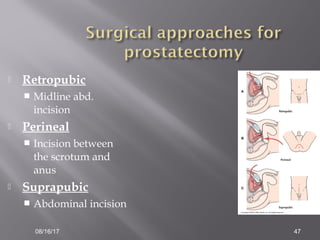
 Retropubic
 Midline abd.
incision
 Perineal
 Incision between
the scrotum and
anus
 Suprapubic
 Abdominal incision
08/16/17 48
 Complications:
 Bleeding
 Postoperative pain
 Risk for infection
 Erectile dysfunction
 Minimally invasive: (Prostatic
Stents,TUNA,TUMT, HIFU,Water-induced
Thermotherapy)
 Laser prostatectomy
(VLAP,ILC,CLAP,TULIP,HoLRP)
 Electrovaporization (TUVP,TVRP)
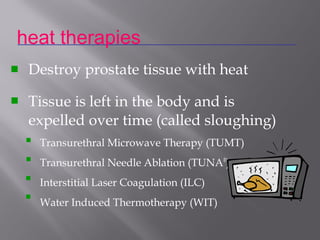
Destroy prostate tissue with heat
Tissue is left in the body and is
expelled over time (called sloughing)
Transurethral Microwave Therapy (TUMT)
Transurethral Needle Ablation (TUNA®
)
Interstitial Laser Coagulation (ILC)
Water Induced Thermotherapy (WIT)
heat therapies






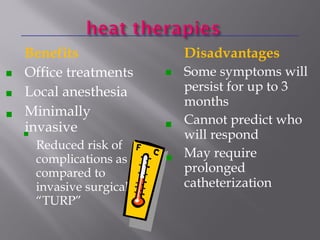
Benefits
Office treatments
Local anesthesia
Minimally
invasive
Reduced risk of
complications as
compared to
invasive surgical
“TURP”
Disadvantages
Some symptoms will
persist for up to 3
months
Cannot predict who
will respond
May require
prolonged
catheterization







Urinary Tract Infection
Impotence
Incontinence
heat therapies



 TURP-equivalent 7 year improvement in symptom
score and urination parameters
 Decreased risk of bleeding and TUR syndrome,
otherwise similar adverse effect profile
 May be done on anti-coagulated patients
08/16/17 54

Benign prostatic hyperplasia

  • 2.
     Generalised diseaseof the prostate due to hormonal derangement which leads to enlargement of the gland (increase in the number of epithelial cells and stromal tissue)to cause compression of the urethra leading to symptoms 08/16/17 2
  • 3.
     Occurs in50% of men over 50 and in 80% of men over 80 have BPH  BPH progresses differently in every individual  Many men with BPH may have mild symptoms and may never need treatment  BPH does not predispose to the development of prostate cancer 08/16/17 3
  • 4.
  • 5.
     Cause notcompletely understood  Change in hormonal milieu with alterations in the testosterone/estrogen balance  Induction of prostatic growth factors  Increased stem cells/decreased stromal cell death  Accumulation of dihydroxytestosterone, stimulation by estrogen and prostatic growth hormone actions
  • 6.
     Slow andinsidious changes over time  Complex interactions between prostatic urethral resistance, intravesical pressure, detrussor functionality, neurologic integrity, and general physical health.  Initial hypertrophydetrussor decompensation poor tonediverticula formationincreasing urine volumehydronephrosisupper tract dysfunction
  • 7.
    Normal BPH Hypertrophied detrusor muscle Obstructed urinaryflow PROSTATE BLADDER URETHRA Kirby RS et al. Benign prostatic hyperplasia. Health Press, 1995.
  • 8.
     Voiding symptoms decrease in the urinary stream  Straining  Dribbling at the end of urination  Intermittency  Hesitancy  Pain or burning during urination  Feeling of incomplete bladder emptying 08/16/17 8
  • 9.
     Irritative symptoms urinaryfrequency urgency dysuria bladder pain nocturia incontinence symptoms associated with infection 08/16/17 9
  • 10.
     History (STD,trauma, surgery)  Other disorders (eg. neurologic, diabetes)  Medications (anti-cholinergics)  Functional Status
  • 11.
     Urinary retention UTI  Sepsis secondary to UTI  Residual urine  Calculi  Renal failure  Hematuria  Hernias, hemorroids, bowel habit change 08/16/17 11
  • 12.
     History &Examination  Abdominal/GU exam  Focused neuro exam  Digital rectal exam (DRE)  Validated symptom questionnaire.  Urinalysis  Urine culture  BUN, Cr  Prostate specific antigen (PSA)  Transrectal ultrasound – biopsy  Uroflometry  Postvoid residual 08/16/17 12
  • 13.
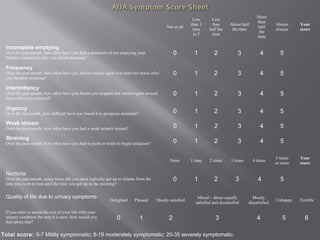
    Not at all Less than1 time in 5 Less than half the time About half the time More than half the time Almost always Your score Incomplete emptying Over the past month, how often have you had a sensation of not emptying your bladder completely after you finish urinating? 0 1 2 3 4 5 Frequency Over the past month, how often have you had to urinate again less than two hours after you finished urinating? 0 1 2 3 4 5 Intermittency Over the past month, how often have you found you stopped and started again several times when you urinated? 0 1 2 3 4 5 Urgency Over the last month, how difficult have you found it to postpone urination? 0 1 2 3 4 5 Weak stream Over the past month, how often have you had a weak urinary stream? 0 1 2 3 4 5 Straining Over the past month, how often have you had to push or strain to begin urination? 0 1 2 3 4 5     None 1 time 2 times 3 times 4 times 5 times or more Your score Nocturia Over the past month, many times did you most typically get up to urinate from the time you went to bed until the time you got up in the morning? 0 1 2 3 4 5 Quality of life due to urinary symptoms Delighted Pleased Mostly satisfied Mixed – about equally satisfied and dissatisfied Mostly dissatisfied Unhappy Terrible If you were to spend the rest of your life with your urinary condition the way it is now, how would you feel about that? 0 1 2 3 4 5 6   Total score: 0-7 Mildly symptomatic; 8-19 moderately symptomatic; 20-35 severely symptomatic.
  • 14.
  • 15.
     Firm tohard nodules  Irregularities, unequal lobes  Induration  Stony hard prostate  Any palpable nodular abnormality suggests cancer and warrants investigation
  • 16.
     Urine cytologyin patients with:  Predominance of irritative voiding symptoms.  Smoking history  Flow rate and post-void residual  Not necessary before medical therapy but should be considered in those undergoing invasive therapy or those with neurologic conditions  Upper tract evaluation if hematuria, increased creatinine  Cystoscopy
  • 18.
     Elevated levelsof PSA  0 – 4 ng/ml  Prostatic pathology  Correlates with tumor mass  Some men with prostate cancer have normal PSA levels 08/16/17 18
  • 19.
     Urethral stricture Bladder neck contracture  Carcinoma of the prostate  Carcinoma of the bladder  Bladder calculi  Urinary tract infection and prostatitis  Neurogenic bladder
  • 20.
     Severe obstruction Urinary retention  Signs of upper tract dilatation and renal insufficiency  Moderate symptoms of prostatism  Recurrent UTI’s  Hematuria  Quality of life
  • 21.
     Mild tosevere symptoms with little “bother”  Manage with watchful waiting.  Risk of therapy outweighs the benefit of medical or surgical treatment  Moderate to severe symptoms with bother  Management options include watchful waiting, medical management and surgical treatment.
  • 22.
     Watchful waitingand behavioral modification  Medical Management  Alpha blockers  5-alpha reductase inhibitors  Combination therapy  Surgical Management  Office based therapy  OR based therapy  Urethral stents
  • 23.
     “is thepreferred management technique in patients with mild symptoms and minimal bother”  AUA score < 7,  1/3 improve on own.
  • 24.
     Decrease caffeine,alcohol )diuretic effect(  Avoid taking large amounts of fluid over a short period of time  Void whenever the urge is present, every 2-3 hours  Maintain normal fluid intake, do not restrict fluid  Avoid bladder irritants to include dairy products, artificial sweeteners, carbonated beverages  Limit nighttime fluid consumption  BPH symptoms can be variable, intermittent
  • 25.
    •Alpha blockers – Doxazosin(Cardura), Terazosin (Hytrin), Tamsulosin (Flomax), Alfuzosin (Uroxatral) •5-alpha reductase inhibitors – Finasteride (Proscar), Dutasteride (Avodart) •Combination therapy – Alpha blocker and 5-alpha reductase inhibitor
  • 26.
    Benefits Convenient No loss ofwork time Minimal risk Disadvantages Expensive Drug Interactions Must be taken every day Manages the problem instead of fixing it medication       
  • 27.
    Alpha adrenergic receptorblockers  promote smooth muscle relaxation in the prostate  Relaxation of the muscles facilitates urinary flow  Doxazosin , Terazosin , Tamsulosin , Alfuzosin  Side effects: postural hypotension, dizziness, fatigue,  Other problems can occur when pt is also taking cardiac or other hypertensive drugs 08/16/17 27
  • 28.
     Equal clinicaleffectiveness  Slight differences in adverse event profile  Orthostasis (lower in tamsulosin)  Ejaculatory dysfunction (higher in tamsulosin)  Decreased energy levels  Nasal congestion  Increase in CHF risk with doxazosin  Must titrate doxazosin and terazosin to effective levels
  • 29.
    5 alpha reductaseinhibitor ) finasteride)  Reduce size of prostate gland by up to 30 %by up to 30 %  Blocks the enzyme of 5 alpha reductase which is necessary for the conversion of testosterone to dihydroxytestostersone  Regression of hyperplastic growth  Don’t work immediatelyDon’t work immediately  Small effect on symptom score and flow ratesSmall effect on symptom score and flow rates 08/16/17 29
  • 30.
     Agents areeffective and appropriate treatment for patients with lower urinary tract symptoms and demonstrable enlargement of the prostate.  Average prostate size is 30 cc’s. Original studies showed benefit only in men with prostate sizes greater than 50 cc’s.
  • 31.
     Finasteride (Proscar)and Dutasteride (Avodart)  Less effective for relief of BPH symptoms than alpha blockers  Adverse events include  Decreased libido  Worsened sexual function (erectile dysfunction)  decrease volume of ejaculation  Breast enlargement and tenderness  Reduces risk of urinary retention by 3%/year.  PSA must be doubled if screening for prostate cancer
  • 32.
     Concomitant useof alpha blockers and 5- alpha reductase inhibitors  Should be reserved for patients who are at significant risk of progression and adverse outcome  Poor surgical candidate  Patient wants to avoid surgery  Significant cost associated with dual medications
  • 34.
     Office basedtherapies:  Transurethral microwave therapy (TUMT)  Transurethral needle ablation (TUNA)  Therapies are effective or partially effective for relieving the symptoms of BPH  Significant side effects/complications associated with these treatments have prompted a FDA warning
  • 35.
     OR basedtherapies  Open simple prostatectomy  TURP  Transurethral incision of the prostate  Laser photoselective vaporization of the prostate (green light laser PVP)  Laser Prostatectomy
  • 36.
     Patients mayselect surgical treatment as initial therapy if moderate or severe bother is present.  Patients who have developed complications of BPH (i.e urinary retention, renal insufficiency, recurrent UTI) are best treated surgically.  New surgical treatment have not demonstrated better outcomes than TURP to date.
  • 37.
     Indicated forAUA score >16  Transurethral Prostatectomy(TURP): 18% morbidity with .2% mortality. 80-90% improvement at 1 year but 60-75% at 5 years and 5% require repeat TURP.  Transurethral Incision of Prostate (TUIP): less morbidity with similar efficacy indicated for smaller prostates.  Open Prostatectomy: indicated for glands > 60 grams or when additional procedure needed for suprapubic/retropubic approaches
  • 38.
  • 39.
    Benefits Widely available Effective Long lasting Disadvantages Greaterrisk of side effects and complications 1-4 days hospital stay 1-3 days catheter 4-6 week recovery       
  • 40.
    Greater than 5%risk of:  Irritative voiding symptoms  Bladder neck contracture  UTI Risk of incontinence 1% Decline in erectile function 65% of retrograde ejaculation TUR syndrome (acute hyponatremia from free water absorption) Hemorrhage Bladder spasms TURP
  • 41.
     Restoration ofurinary drainage  Treatment of any urinary tract infection  Understanding of procedure, implications for sexual functioning and urinary control 08/16/17 41
  • 42.
     Antibiotics  Allowpt to discuss concerns about surgery on sexual functioning  Prostatic surgery may result in retrograde ejaculation 08/16/17 42
  • 43.
     No complications Restoration of urinary control  Complete bladder emptying  Satisfying sexual expression 08/16/17 43
  • 44.
     Monitoring  Continuousirrigation & maintain catheter patency  Blood clots and hematuria are expected for the first 24-36 hours  After catheter is removed – check for urinary retention and urinary stream 08/16/17 44
  • 45.
     Sphincter tonemay be poor after catheter is removed. Kegal exercise pelvic muscle floor technique is encouraged. Starting and stopping the urinary stream is helpful.  Stool softeners to avoid straining  Sitting and walking for long periods should be avoided 08/16/17 45
  • 46.
     Catheter care Managing urinary incontinence  Oral fluid intake – 2,000-3,000 cc per day  Observe for s/s of urinary tract infection  Prevent constipation  Avoid lifting  No driving or intercourse after surgery 08/16/17 46
  • 47.
    08/16/17 47  Retropubic Midline abd. incision  Perineal  Incision between the scrotum and anus  Suprapubic  Abdominal incision
  • 48.
    08/16/17 48  Complications: Bleeding  Postoperative pain  Risk for infection  Erectile dysfunction
  • 49.
     Minimally invasive:(Prostatic Stents,TUNA,TUMT, HIFU,Water-induced Thermotherapy)  Laser prostatectomy (VLAP,ILC,CLAP,TULIP,HoLRP)  Electrovaporization (TUVP,TVRP)
  • 50.
    Destroy prostate tissuewith heat Tissue is left in the body and is expelled over time (called sloughing) Transurethral Microwave Therapy (TUMT) Transurethral Needle Ablation (TUNA® ) Interstitial Laser Coagulation (ILC) Water Induced Thermotherapy (WIT) heat therapies      
  • 51.
    Benefits Office treatments Local anesthesia Minimally invasive Reducedrisk of complications as compared to invasive surgical “TURP” Disadvantages Some symptoms will persist for up to 3 months Cannot predict who will respond May require prolonged catheterization       
  • 52.
  • 53.
     TURP-equivalent 7year improvement in symptom score and urination parameters  Decreased risk of bleeding and TUR syndrome, otherwise similar adverse effect profile  May be done on anti-coagulated patients
  • 54.

Editor's Notes

  • #27 Medications address the desire we all have to find a “cure” to fix the problem. We all like a “quick and easy” solution. They can, however, become less effective over time. Studies have shown that people tend to become less careful about following directions regarding the dose and/or frequency of taking their medication.
  • #34 Until recently, the only option we could offer patients for treatment of their symptoms was either an open abdominal surgical procedure, or a trans-urethral resection of the prostate.
  • #52 Medications address the desire we all have to find a “cure” to fix the problem. We all like a “quick and easy” solution. They can, however, become less effective over time. Studies have shown that people tend to become less careful about following directions regarding the dose and/or frequency of taking their medication.
  • #53 Medications address the desire we all have to find a “cure” to fix the problem. We all like a “quick and easy” solution. They can, however, become less effective over time. Studies have shown that people tend to become less careful about following directions regarding the dose and/or frequency of taking their medication.