




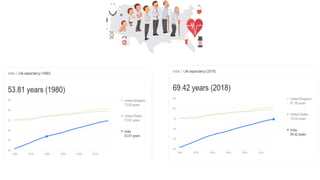




Prostate diseases
Dr.K.Priyatham
MCh Urology, Fellowship in Uro-oncology(RGCI)
Prashanth Hospital
BENIGN PROSTATIC HYPERPLASIA
(BPH)
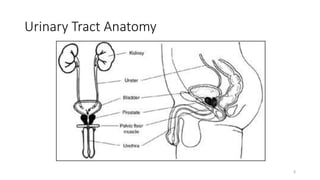
Urinary Tract Anatomy
3
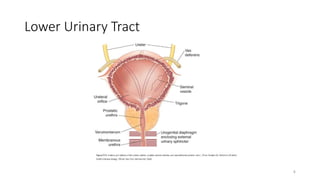
Lower Urinary Tract
4
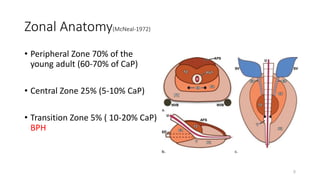
Zonal Anatomy(McNeal-1972)
• Peripheral Zone 70% of the
young adult (60-70% of CaP)
• Central Zone 25% (5-10% CaP)
• Transition Zone 5% ( 10-20% CaP)
BPH
5
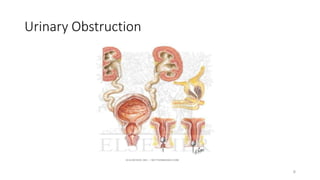
Urinary Obstruction
6
Definition
• BPH is a nonmalignant enlargement of the prostate gland caused by
cellular hyperplasia of both glandular and stromal elements that leads
to troublesome lower urinary tract symptoms (LUTS) in some men
• It is the most common benign tumor in men and is not a
precancerous condition
7
Prevalence of BPH
• In men 20 to 30 years of age, the prostate weighs about 20 g;
• However, the mean prostatic weight increases after the age of 50.
• 20% of men age 41-50
• 50% of men age 51-60
• 65% of men age 61-70
• 80% of men age 71-80
• 90% of men age 81-90
lower urinary tract symptoms associated with BPH increase with age
8
Etiology of BPH
• Androgens
• Estrogens
• Lifestyle
• Hereditary(genetic)/Race
9
Berry SJ, et al. J Urol. 1984;132:474-479.
CDC. 2003 National Diabetes Fact Sheet.
Available at http://www.cdc.gov/diabetes/pubs/estimates.htm. Accessed May 16, 2003.
CDC. 1998 Forecasted State-Specific Estimates of Self-Reported Asthma Prevalence.
Available at http://www.cdc.gov/mmwr/preview/mmwrhtml/00055803.htm. Accessed January 8, 2003.
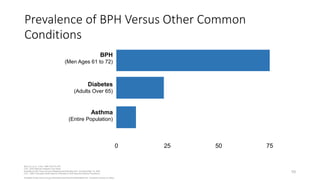
Prevalence of BPH Versus Other Common
Conditions
10
BPH
(Men Ages 61 to 72)
Diabetes
(Adults Over 65)
Asthma
(Entire Population)
0 25 50 75
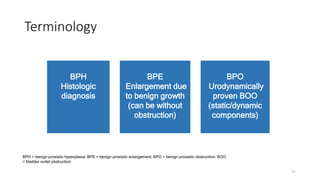
Terminology
11
BPH
Histologic
diagnosis
BPE
Enlargement due
to benign growth
(can be without
obstruction)
BPO
Urodynamically
proven BOO
(static/dynamic
components)
BPH = benign prostatic hyperplasia; BPE = benign prostatic enlargement; BPO = benign prostatic obstruction; BOO
= bladder outlet obstruction
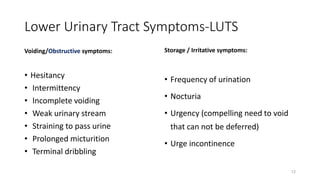
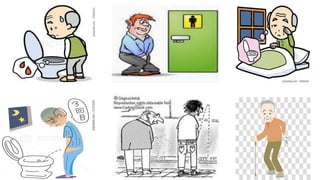
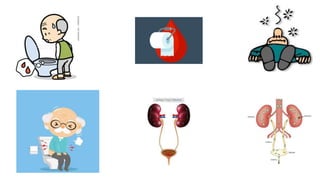
Lower Urinary Tract Symptoms-LUTS
Voiding/Obstructive symptoms:
• Hesitancy
• Intermittency
• Incomplete voiding
• Weak urinary stream
• Straining to pass urine
• Prolonged micturition
• Terminal dribbling
Storage / Irritative symptoms:
• Frequency of urination
• Nocturia
• Urgency (compelling need to void
that can not be deferred)
• Urge incontinence
12
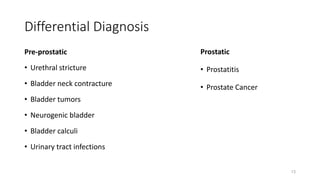
Differential Diagnosis
Pre-prostatic
• Urethral stricture
• Bladder neck contracture
• Bladder tumors
• Neurogenic bladder
• Bladder calculi
• Urinary tract infections
Prostatic
• Prostatitis
• Prostate Cancer
13
Digital rectal exam
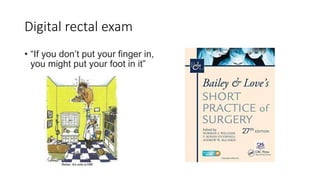
• “If you don’t put your finger in,
you might put your foot in it”
Digital rectal exam
• R/O Ca: nodules, asymmetry, hardened ridges, induration;
• R/O prostatitis: tenderness, bogginess;
• R/O anal malignancy and detect undiagnosed neurologic conditions
by evaluating the sphincter tone and perianal sensation
Approach to a patient with BPH
• Urinalysis- by dipstick and routine microscopy, urine culture and
sensitivity to R/O infections and hematuria
• Serum PSA-optional to R/O Prostate Cancer
16
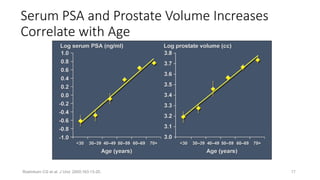
Serum PSA and Prostate Volume Increases
Correlate with Age
17
Roehrborn CG et al. J Urol. 2000;163:13-20.
Approach to a Patient with BPH Contd…
Upper tract imaging (IVP,CT, U/S) only in presence of concomitant urinary tract
disease or complications-hematuria, UTI, renal insufficiency, Hx of stone disease
18
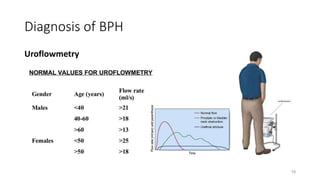
Diagnosis of BPH
Uroflowmetry
19
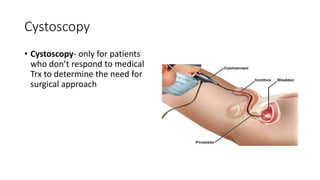
Cystoscopy
• Cystoscopy- only for patients
who don’t respond to medical
Trx to determine the need for
surgical approach
Treatment of BPH
• Lifestyle modification
• Watchful Waiting
• Medical Therapy
• Phytotherapy (alternative)
• Surgical Treatment : Conventional Surgical or Minimally Invasive Treatment
21
Lifestyle Changes
• Enriched diet with ample
amounts of fresh fish, fruits and
vegetables.
• Reduce stress.
• Exercise on a regular basis.
• Weight within normal limits.
• Limit fluid intake, decrease
bladder irritants-caffeine,
alcohol;
• Avoid anticholinergic drugs,
narcotics and skeletal muscle
relaxants.
22
Watchful Waiting
• The risk of progression or complications is uncertain
• In men with symptomatic BPH, progression is not inevitable and some men
undergo spontaneous improvement or resolution of their symptoms
• Men with moderate or severe symptoms can also be managed in this
fashion if they so choose
• Neither the optimal interval for follow-up nor specific endpoints for
intervention have been defined
23
Medical Treatment
• Alpha blockers
• 5α-Reductase inhibitors
• Combination Therapy
24
Medical Treatment : Alpha blockers Contd…
• Side Effects: dizziness, postural hypotension, fatigue, retrograde ejaculation,
rhinitis, and headaches. May potentiate other antihypertensive medications
25
Silodosin
• Preferred for
• Initial management
• Patients with cardiovascular co-morbidities
• Effective in Nocturia
• Patients on Phosphodiesterase type 5 inhibitors
26
Int J Clin Pract. 2013 Jun;67(6):544-51
Medical Treatments : BPH, LUTS, BOO
• -adrenergic blockers
• Dynamic component
• 5 -reductase inhibitors
• Anatomic component
• Anticholinergic Therapy
• Storage Sx’s
27
Guidelines
28
• No bothersome symptoms : Watchful waiting
• Bothersome symptoms and prostate volume <30 cc: 2nd and 3rd
generation alpha 1 receptor antagonist
• Significant bothersome and prostate >30 cc: 5-ARI
• Combination of 5ARI and alpha 1 receptor antagonist : recommended
• PDE-5: not recommended
Guidelines
29
• Men with enlarged prostates >40 ml: 5α-reductase inhibitors (5-ARIs)
• Phosphodiesterase type 5 inhibitor Tadalafil :
• Reduce LUTS to a similar extent as α1-blockers
• Improves erectile dysfunction
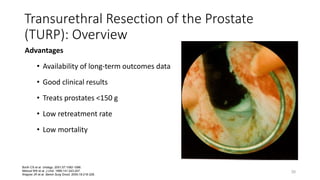
Transurethral Resection of the Prostate
(TURP): Overview
Advantages
• Availability of long-term outcomes data
• Good clinical results
• Treats prostates <150 g
• Low retreatment rate
• Low mortality
30
Borth CS et al. Urology. 2001;57:1082-1086.
Mebust WK et al. J Urol. 1989;141:243-247.
Wagner JR et al. Semin Surg Oncol. 2000;18:216-228.
Transurethral Resection of the Prostate
(TURP): Overview
Disadvantages
• Retrograde ejaculation
• Bleeding
• TUR Syndrome
• Catheter time
• Hospital Stay
31
TURP: Efficacy
• Symptom improvement in 88% of patients
• 82% decrease in AUA Symptom Score
• 125% improvement in peak flow rate (Qmax)
• Re-op rate approx. 1.5%/yr
32
Jepsen JV et al. Urology. 1998;51(suppl 4A):23-31.
TURP: Complications
Conventional TURP
• Clot Retention
16%
• Urethral Stricture
8.4%
• Transfusions
7.0%
• TUR Syndrome
0.9%
• Incontinence
Laser TURP
• Clot Retention
1%
• Urethral Stricture
5%
• Transfusions 0%
• TUR Syndrome
0%
• Incontinence 3-
5% 34
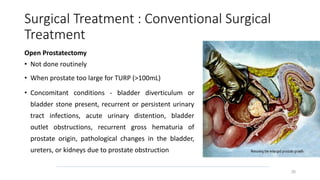
Surgical Treatment : Conventional Surgical
Treatment
Open Prostatectomy
• Not done routinely
• When prostate too large for TURP (>100mL)
• Concomitant conditions - bladder diverticulum or
bladder stone present, recurrent or persistent urinary
tract infections, acute urinary distention, bladder
outlet obstructions, recurrent gross hematuria of
prostate origin, pathological changes in the bladder,
ureters, or kidneys due to prostate obstruction
35
Minimally Invasive Surgical Treatment
• TUMT-transurethral microwave therapy
• TUNA- transurethral needle ablation
• Urinary Stents
36
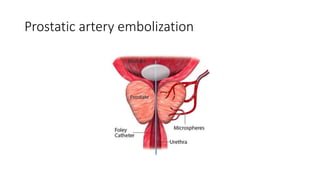
Prostatic artery embolization
PROSTATITIS
1
INTRODUCTION
• Prostatitis is an inflammation of the prostate gland, that is
caused by infectious agents(bacteria, fungi and
mycoplasma) or other conditions including urethral
stricture, prostatic hyperplasia.
• Overall prevalence in men is 5
%
• Higher risk age 20-50 years
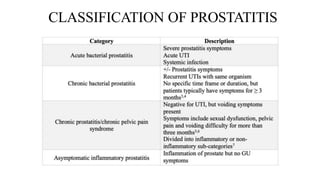
CLASSIFICATION OF PROSTATITIS
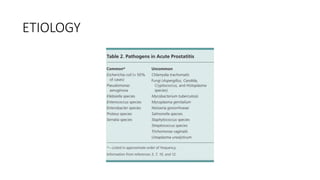
ETIOLOGY
Chronic Prostatitis causes ……
• A primary voiding dysfunction problem, either structural or
functional .
• E coli is responsible for 75-80% of chronic bacterial prostatitis cases.
• Enterococci
• Pseudomonas
• C trachomatis,
• Ureaplasma species,
• Uncommon organisms, such as M tuberculosis and
• Histoplasma, and Candida species , must also be considered.
• Tuberculous prostatitis may be
found in patients with………
• Renal tuberculosis
• Human immunodeficiency virus
• Cytomegalovirus
• Inflammatory conditions (eg,
sarcoidosis)
• Asymptomatic inflammatory
prostatitis is usually diagnosed in
individuals who have no
symptom, but are found to have
an inflammatory process in the
prostate.
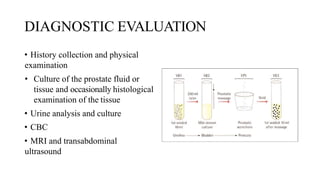
DIAGNOSTIC EVALUATION
• History collection and physical
examination
• Culture of the prostate fluid or
tissue and occasionally histological
examination of the tissue
• Urine analysis and culture
• CBC
• MRI and transabdominal
ultrasound
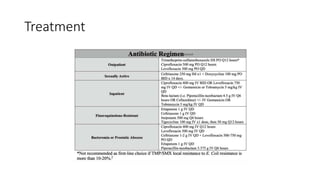
Treatment
Complications
• Bladder outlet obstruction/urinary retention
• Abscess - Typically in immunocompromised patients
• Infertility due to scarring of the urethra or ejaculatory ducts
• Recurrent cystitis
• Pyelonephritis
• Renal damage
• Sepsis
Prostate Cancer
Robert De
Niro
Warren Buffet
D. Rama
Naidu
John
Kerry
Roger
Moore
Epidemiology
• It’s the second most common cause of death from cancer in men
(following lung cancer)
• Nearly 3,00,000 men die every year from prostate cancer
• More than 12,00,000 men are diagnosed every year
• Average annual cancer incidence rate for prostate cancer in India
ranged 5.0-9.1 per 1,00,000/year
Clinical features
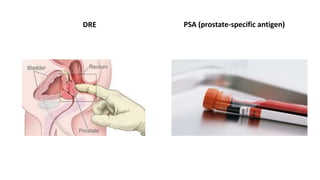
DRE PSA (prostate-specific antigen)
55
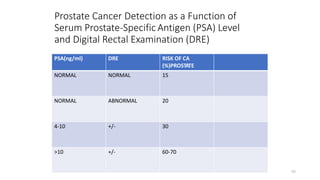
PSA(ng/ml) DRE RISK OF CA
(%)PROSTATE
NORMAL NORMAL 15
NORMAL ABNORMAL 20
4-10 +/- 30
>10 +/- 60-70
Prostate Cancer Detection as a Function of
Serum Prostate-Specific Antigen (PSA) Level
and Digital Rectal Examination (DRE)
• In summary, both PSA and DRE are used to assess the risk that
prostate cancer is present.
• The addition of PSAto DRE increases both the detection rate of
prostate cancer and the detection of cancers with a more favourable
prognosis.
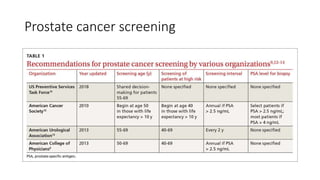
Prostate cancer screening
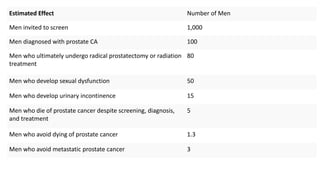
Estimated Effect Number of Men
Men invited to screen 1,000
Men diagnosed with prostate CA 100
Men who ultimately undergo radical prostatectomy or radiation
treatment
80
Men who develop sexual dysfunction 50
Men who develop urinary incontinence 15
Men who die of prostate cancer despite screening, diagnosis,
and treatment
5
Men who avoid dying of prostate cancer 1.3
Men who avoid metastatic prostate cancer 3
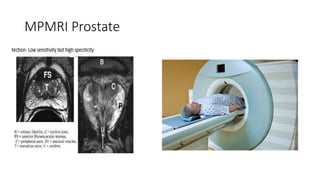
MPMRI Prostate
Prostate Imaging-Reporting and Data System
(PI-RADS)
• PI-RADS 1: very low (clinically significant cancer is highly unlikely to be present)
• PI-RADS 2: low (clinically significant cancer is unlikely to be present)
• PI-RADS 3: intermediate (the presence of clinically significant cancer is
equivocal)
• PI-RADS 4: high (clinically significant cancer is likely to be present)
• PI-RADS 5: very high (clinically significant cancer is highly likely to be present)
Prostate Biopsy
• > 1,20,00,000 prostate biopsies are performed yearly in the US
• Elevated PSA most frequently triggers biopsy
• 30% of men referred for biopsy are diagnosed with prostate cancer
• Relies on random sampling – 12 core biopsy
Indications
• Abnormal serum prostate-specific antigen (PSA) level.
• Abnormal digital rectal examination (DRE) include the presence of
nodules, induration, or asymmetry.
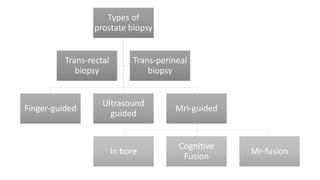
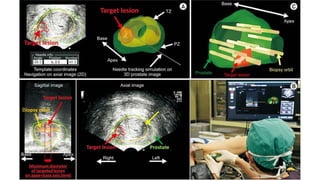
Types of
prostate biopsy
Finger-guided
Ultrasound
guided
Mri-guided
In bore
Cognitive
Fusion
Mr-fusion
Trans-rectal
biopsy
Trans-perineal
biopsy
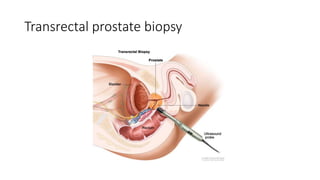
Transrectal prostate biopsy
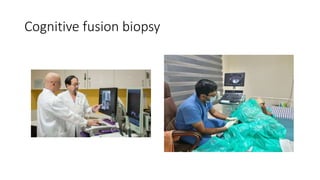
Cognitive fusion biopsy
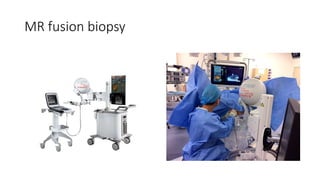
MR fusion biopsy
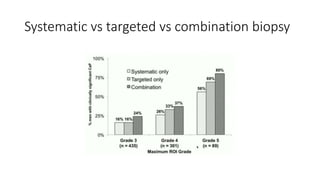
Systematic vs targeted vs combination biopsy
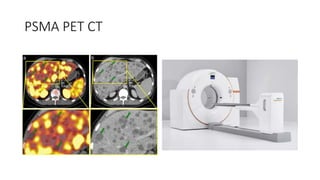
PSMA PET CT
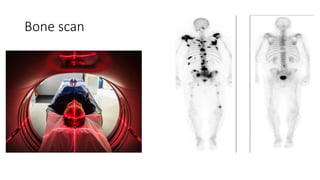
Bone scan
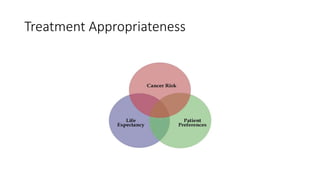
Treatment Appropriateness
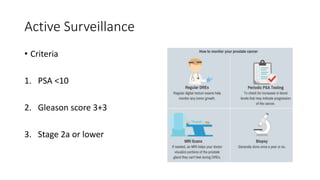
Active Surveillance
• Criteria
1. PSA <10
2. Gleason score 3+3
3. Stage 2a or lower
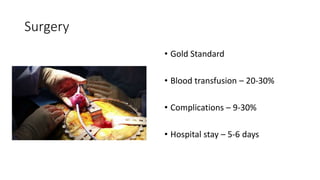
Surgery
• Gold Standard
• Blood transfusion – 20-30%
• Complications – 9-30%
• Hospital stay – 5-6 days
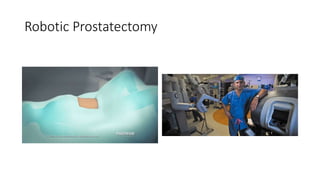
Robotic Prostatectomy
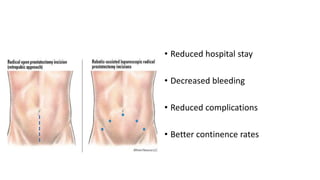
• Reduced hospital stay
• Decreased bleeding
• Reduced complications
• Better continence rates
Issues
• Erectile Dysfunction
• Pills
• Injections
• Pumps
• Implants
• Incontinence
• Pads
• Slings
• Artificial Sphincter
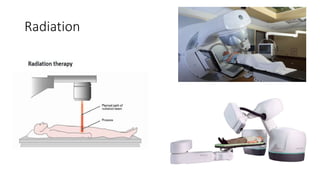
Radiation
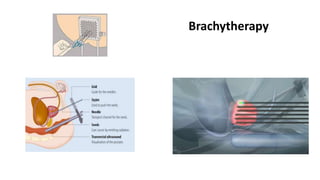
Brachytherapy
• Hormone therapy
• Orchidectomy
• Chemotherapy
• Radiation therapy to metastatic bone areas
• Targeted Radionuclide therapy
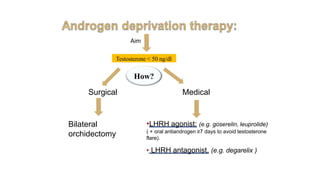
Testosterone < 50 ng/dl
Aim
Surgical Medical
Bilateral
orchidectomy
•LHRH agonist: (e.g. goserelin, leuprolide)
( + oral antiandrogen ≥7 days to avoid testosterone
flare).
• LHRH antagonist. (e.g. degarelix )
How?
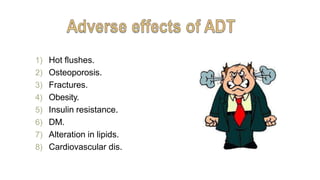
1) Hot flushes.
2) Osteoporosis.
3) Fractures.
4) Obesity.
5) Insulin resistance.
6) DM.
7) Alteration in lipids.
8) Cardiovascular dis.
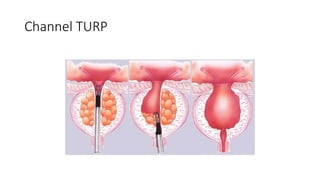
Channel TURP
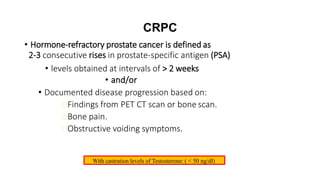
CRPC
• Hormone-refractory prostate cancer is defined as
2-3 consecutive rises in prostate-specific antigen (PSA)
• levels obtained at intervals of > 2 weeks
• and/or
• Documented disease progression based on:
Findings from PET CT scan or bone scan.
Bone pain.
Obstructive voiding symptoms.
With castration levels of Testosterone: ( < 50 ng/dl)
Secondary Hormonal treatment
 Abiraterone Acetate with Coricosteroids.
 Enzalutamide.
 Ketoconazole.
 DES: diethylstilbesterol
 Anti-androgens: non-steroidal:
 Bicalutammide.
 Flutamide.
 Nilutamide
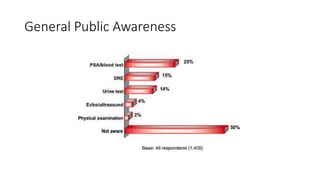
General Public Awareness
In Summary
• BPH (Benign prostatic hyperplasia) becomes increasingly common as men age
• Many men with BPH are asymptomatic or have only mild symptoms, and may not require therapy
• Alpha-adrenergic antagonists provide immediate therapeutic benefits and are first line treatment
for smaller prostates <40mL and mild symptoms
• 5-alpha-reductase inhibitors require long-term treatment for efficacy and are beneficial for larger
prostates >40 mL mild to moderate symptoms
• TURP is the GOLD STANDARD for men who require an invasive procedure and are in good health
• Routine bacterial prostatitis can be treated as an Outpatient
In Summary
• Lack of prostate cancer awareness & education about the disease/detection
• No symptoms until disease is advanced
• Once diagnosed, there’s no single “best” treatment
• Every treatment has side effects
• If detected early, it can be cured… There IS a cure for cancer – under the right circumstances!
• It is possible to lower the risk by limiting high-fat foods, increasing the intake of vegetables and
fruits and performing more exercise
Case scenarios
• 50 year old male presented to you with incidental finding of 50 cc
prostatomegaly on U/S
• What next?
• P/R?
• Refer to a Urologist?
• Serum PSA?
• 53 year old diabetic male presented to you with LUTS with history of
fever
• Serum PSA?
• U/S abdomen?
• Refer to a Urologist?
• 46 year old male with family history of prostate cancer
• Serum PSA?
• P/R
• Refer to a Urologist?
• 90 year old male who is bedridden comes to your OPD on a stretcher
with chief complaints of urinary incontinence
• Serum PSA?
• P/R?
• U/S abdomen?
• Refer to a Urologist?
• 66 year old male presented to your opd for second opinion whether
to continue tamsulosin + dutasteride (taking since 3 years) for LUTS
prescribed by another physician. His U/S shows 80 cc prostatomegaly,
PSA – 3 ng/dl
• P/R - Hard
• Refer to a Urologist?
Thank you
98

Prostate diseases for General practitioners

  • 1.
    Prostate diseases Dr.K.Priyatham MCh Urology,Fellowship in Uro-oncology(RGCI) Prashanth Hospital
  • 2.
  • 3.
  • 4.
  • 5.
    Zonal Anatomy(McNeal-1972) • PeripheralZone 70% of the young adult (60-70% of CaP) • Central Zone 25% (5-10% CaP) • Transition Zone 5% ( 10-20% CaP) BPH 5
  • 6.
  • 7.
    Definition • BPH isa nonmalignant enlargement of the prostate gland caused by cellular hyperplasia of both glandular and stromal elements that leads to troublesome lower urinary tract symptoms (LUTS) in some men • It is the most common benign tumor in men and is not a precancerous condition 7
  • 8.
    Prevalence of BPH •In men 20 to 30 years of age, the prostate weighs about 20 g; • However, the mean prostatic weight increases after the age of 50. • 20% of men age 41-50 • 50% of men age 51-60 • 65% of men age 61-70 • 80% of men age 71-80 • 90% of men age 81-90 lower urinary tract symptoms associated with BPH increase with age 8
  • 9.
    Etiology of BPH •Androgens • Estrogens • Lifestyle • Hereditary(genetic)/Race 9
  • 10.
    Berry SJ, etal. J Urol. 1984;132:474-479. CDC. 2003 National Diabetes Fact Sheet. Available at http://www.cdc.gov/diabetes/pubs/estimates.htm. Accessed May 16, 2003. CDC. 1998 Forecasted State-Specific Estimates of Self-Reported Asthma Prevalence. Available at http://www.cdc.gov/mmwr/preview/mmwrhtml/00055803.htm. Accessed January 8, 2003. Prevalence of BPH Versus Other Common Conditions 10 BPH (Men Ages 61 to 72) Diabetes (Adults Over 65) Asthma (Entire Population) 0 25 50 75
  • 11.
    Terminology 11 BPH Histologic diagnosis BPE Enlargement due to benigngrowth (can be without obstruction) BPO Urodynamically proven BOO (static/dynamic components) BPH = benign prostatic hyperplasia; BPE = benign prostatic enlargement; BPO = benign prostatic obstruction; BOO = bladder outlet obstruction
  • 12.
    Lower Urinary TractSymptoms-LUTS Voiding/Obstructive symptoms: • Hesitancy • Intermittency • Incomplete voiding • Weak urinary stream • Straining to pass urine • Prolonged micturition • Terminal dribbling Storage / Irritative symptoms: • Frequency of urination • Nocturia • Urgency (compelling need to void that can not be deferred) • Urge incontinence 12
  • 13.
    Differential Diagnosis Pre-prostatic • Urethralstricture • Bladder neck contracture • Bladder tumors • Neurogenic bladder • Bladder calculi • Urinary tract infections Prostatic • Prostatitis • Prostate Cancer 13
  • 14.
    Digital rectal exam •“If you don’t put your finger in, you might put your foot in it”
  • 15.
    Digital rectal exam •R/O Ca: nodules, asymmetry, hardened ridges, induration; • R/O prostatitis: tenderness, bogginess; • R/O anal malignancy and detect undiagnosed neurologic conditions by evaluating the sphincter tone and perianal sensation
  • 16.
    Approach to apatient with BPH • Urinalysis- by dipstick and routine microscopy, urine culture and sensitivity to R/O infections and hematuria • Serum PSA-optional to R/O Prostate Cancer 16
  • 17.
    Serum PSA andProstate Volume Increases Correlate with Age 17 Roehrborn CG et al. J Urol. 2000;163:13-20.
  • 18.
    Approach to aPatient with BPH Contd… Upper tract imaging (IVP,CT, U/S) only in presence of concomitant urinary tract disease or complications-hematuria, UTI, renal insufficiency, Hx of stone disease 18
  • 19.
  • 20.
    Cystoscopy • Cystoscopy- onlyfor patients who don’t respond to medical Trx to determine the need for surgical approach
  • 21.
    Treatment of BPH •Lifestyle modification • Watchful Waiting • Medical Therapy • Phytotherapy (alternative) • Surgical Treatment : Conventional Surgical or Minimally Invasive Treatment 21
  • 22.
    Lifestyle Changes • Enricheddiet with ample amounts of fresh fish, fruits and vegetables. • Reduce stress. • Exercise on a regular basis. • Weight within normal limits. • Limit fluid intake, decrease bladder irritants-caffeine, alcohol; • Avoid anticholinergic drugs, narcotics and skeletal muscle relaxants. 22
  • 23.
    Watchful Waiting • Therisk of progression or complications is uncertain • In men with symptomatic BPH, progression is not inevitable and some men undergo spontaneous improvement or resolution of their symptoms • Men with moderate or severe symptoms can also be managed in this fashion if they so choose • Neither the optimal interval for follow-up nor specific endpoints for intervention have been defined 23
  • 24.
    Medical Treatment • Alphablockers • 5α-Reductase inhibitors • Combination Therapy 24
  • 25.
    Medical Treatment :Alpha blockers Contd… • Side Effects: dizziness, postural hypotension, fatigue, retrograde ejaculation, rhinitis, and headaches. May potentiate other antihypertensive medications 25
  • 26.
    Silodosin • Preferred for •Initial management • Patients with cardiovascular co-morbidities • Effective in Nocturia • Patients on Phosphodiesterase type 5 inhibitors 26 Int J Clin Pract. 2013 Jun;67(6):544-51
  • 27.
    Medical Treatments :BPH, LUTS, BOO • -adrenergic blockers • Dynamic component • 5 -reductase inhibitors • Anatomic component • Anticholinergic Therapy • Storage Sx’s 27
  • 28.
    Guidelines 28 • No bothersomesymptoms : Watchful waiting • Bothersome symptoms and prostate volume <30 cc: 2nd and 3rd generation alpha 1 receptor antagonist • Significant bothersome and prostate >30 cc: 5-ARI • Combination of 5ARI and alpha 1 receptor antagonist : recommended • PDE-5: not recommended
  • 29.
    Guidelines 29 • Men withenlarged prostates >40 ml: 5α-reductase inhibitors (5-ARIs) • Phosphodiesterase type 5 inhibitor Tadalafil : • Reduce LUTS to a similar extent as α1-blockers • Improves erectile dysfunction
  • 30.
    Transurethral Resection ofthe Prostate (TURP): Overview Advantages • Availability of long-term outcomes data • Good clinical results • Treats prostates <150 g • Low retreatment rate • Low mortality 30 Borth CS et al. Urology. 2001;57:1082-1086. Mebust WK et al. J Urol. 1989;141:243-247. Wagner JR et al. Semin Surg Oncol. 2000;18:216-228.
  • 31.
    Transurethral Resection ofthe Prostate (TURP): Overview Disadvantages • Retrograde ejaculation • Bleeding • TUR Syndrome • Catheter time • Hospital Stay 31
  • 32.
    TURP: Efficacy • Symptomimprovement in 88% of patients • 82% decrease in AUA Symptom Score • 125% improvement in peak flow rate (Qmax) • Re-op rate approx. 1.5%/yr 32 Jepsen JV et al. Urology. 1998;51(suppl 4A):23-31.
  • 34.
    TURP: Complications Conventional TURP •Clot Retention 16% • Urethral Stricture 8.4% • Transfusions 7.0% • TUR Syndrome 0.9% • Incontinence Laser TURP • Clot Retention 1% • Urethral Stricture 5% • Transfusions 0% • TUR Syndrome 0% • Incontinence 3- 5% 34
  • 35.
    Surgical Treatment :Conventional Surgical Treatment Open Prostatectomy • Not done routinely • When prostate too large for TURP (>100mL) • Concomitant conditions - bladder diverticulum or bladder stone present, recurrent or persistent urinary tract infections, acute urinary distention, bladder outlet obstructions, recurrent gross hematuria of prostate origin, pathological changes in the bladder, ureters, or kidneys due to prostate obstruction 35
  • 36.
    Minimally Invasive SurgicalTreatment • TUMT-transurethral microwave therapy • TUNA- transurethral needle ablation • Urinary Stents 36
  • 37.
  • 38.
  • 39.
    INTRODUCTION • Prostatitis isan inflammation of the prostate gland, that is caused by infectious agents(bacteria, fungi and mycoplasma) or other conditions including urethral stricture, prostatic hyperplasia. • Overall prevalence in men is 5 % • Higher risk age 20-50 years
  • 40.
  • 41.
  • 42.
    Chronic Prostatitis causes…… • A primary voiding dysfunction problem, either structural or functional . • E coli is responsible for 75-80% of chronic bacterial prostatitis cases. • Enterococci • Pseudomonas • C trachomatis, • Ureaplasma species, • Uncommon organisms, such as M tuberculosis and • Histoplasma, and Candida species , must also be considered.
  • 43.
    • Tuberculous prostatitismay be found in patients with……… • Renal tuberculosis • Human immunodeficiency virus • Cytomegalovirus • Inflammatory conditions (eg, sarcoidosis) • Asymptomatic inflammatory prostatitis is usually diagnosed in individuals who have no symptom, but are found to have an inflammatory process in the prostate.
  • 44.
    DIAGNOSTIC EVALUATION • Historycollection and physical examination • Culture of the prostate fluid or tissue and occasionally histological examination of the tissue • Urine analysis and culture • CBC • MRI and transabdominal ultrasound
  • 45.
  • 46.
    Complications • Bladder outletobstruction/urinary retention • Abscess - Typically in immunocompromised patients • Infertility due to scarring of the urethra or ejaculatory ducts • Recurrent cystitis • Pyelonephritis • Renal damage • Sepsis
  • 47.
  • 48.
    Robert De Niro Warren Buffet D.Rama Naidu John Kerry Roger Moore
  • 49.
    Epidemiology • It’s thesecond most common cause of death from cancer in men (following lung cancer) • Nearly 3,00,000 men die every year from prostate cancer • More than 12,00,000 men are diagnosed every year • Average annual cancer incidence rate for prostate cancer in India ranged 5.0-9.1 per 1,00,000/year
  • 52.
  • 54.
  • 55.
    55 PSA(ng/ml) DRE RISKOF CA (%)PROSTATE NORMAL NORMAL 15 NORMAL ABNORMAL 20 4-10 +/- 30 >10 +/- 60-70 Prostate Cancer Detection as a Function of Serum Prostate-Specific Antigen (PSA) Level and Digital Rectal Examination (DRE)
  • 56.
    • In summary,both PSA and DRE are used to assess the risk that prostate cancer is present. • The addition of PSAto DRE increases both the detection rate of prostate cancer and the detection of cancers with a more favourable prognosis.
  • 57.
  • 59.
    Estimated Effect Numberof Men Men invited to screen 1,000 Men diagnosed with prostate CA 100 Men who ultimately undergo radical prostatectomy or radiation treatment 80 Men who develop sexual dysfunction 50 Men who develop urinary incontinence 15 Men who die of prostate cancer despite screening, diagnosis, and treatment 5 Men who avoid dying of prostate cancer 1.3 Men who avoid metastatic prostate cancer 3
  • 60.
  • 61.
    Prostate Imaging-Reporting andData System (PI-RADS) • PI-RADS 1: very low (clinically significant cancer is highly unlikely to be present) • PI-RADS 2: low (clinically significant cancer is unlikely to be present) • PI-RADS 3: intermediate (the presence of clinically significant cancer is equivocal) • PI-RADS 4: high (clinically significant cancer is likely to be present) • PI-RADS 5: very high (clinically significant cancer is highly likely to be present)
  • 62.
    Prostate Biopsy • >1,20,00,000 prostate biopsies are performed yearly in the US • Elevated PSA most frequently triggers biopsy • 30% of men referred for biopsy are diagnosed with prostate cancer • Relies on random sampling – 12 core biopsy
  • 63.
    Indications • Abnormal serumprostate-specific antigen (PSA) level. • Abnormal digital rectal examination (DRE) include the presence of nodules, induration, or asymmetry.
  • 64.
    Types of prostate biopsy Finger-guided Ultrasound guided Mri-guided Inbore Cognitive Fusion Mr-fusion Trans-rectal biopsy Trans-perineal biopsy
  • 65.
  • 66.
  • 67.
  • 69.
    Systematic vs targetedvs combination biopsy
  • 72.
  • 73.
  • 75.
  • 76.
    Active Surveillance • Criteria 1.PSA <10 2. Gleason score 3+3 3. Stage 2a or lower
  • 77.
    Surgery • Gold Standard •Blood transfusion – 20-30% • Complications – 9-30% • Hospital stay – 5-6 days
  • 78.
  • 79.
    • Reduced hospitalstay • Decreased bleeding • Reduced complications • Better continence rates
  • 80.
    Issues • Erectile Dysfunction •Pills • Injections • Pumps • Implants • Incontinence • Pads • Slings • Artificial Sphincter
  • 81.
  • 82.
  • 83.
    • Hormone therapy •Orchidectomy • Chemotherapy • Radiation therapy to metastatic bone areas • Targeted Radionuclide therapy
  • 84.
    Testosterone < 50ng/dl Aim Surgical Medical Bilateral orchidectomy •LHRH agonist: (e.g. goserelin, leuprolide) ( + oral antiandrogen ≥7 days to avoid testosterone flare). • LHRH antagonist. (e.g. degarelix ) How?
  • 85.
    1) Hot flushes. 2)Osteoporosis. 3) Fractures. 4) Obesity. 5) Insulin resistance. 6) DM. 7) Alteration in lipids. 8) Cardiovascular dis.
  • 86.
  • 87.
    CRPC • Hormone-refractory prostatecancer is defined as 2-3 consecutive rises in prostate-specific antigen (PSA) • levels obtained at intervals of > 2 weeks • and/or • Documented disease progression based on: Findings from PET CT scan or bone scan. Bone pain. Obstructive voiding symptoms. With castration levels of Testosterone: ( < 50 ng/dl)
  • 88.
    Secondary Hormonal treatment Abiraterone Acetate with Coricosteroids.  Enzalutamide.  Ketoconazole.  DES: diethylstilbesterol  Anti-androgens: non-steroidal:  Bicalutammide.  Flutamide.  Nilutamide
  • 89.
  • 90.
    In Summary • BPH(Benign prostatic hyperplasia) becomes increasingly common as men age • Many men with BPH are asymptomatic or have only mild symptoms, and may not require therapy • Alpha-adrenergic antagonists provide immediate therapeutic benefits and are first line treatment for smaller prostates <40mL and mild symptoms • 5-alpha-reductase inhibitors require long-term treatment for efficacy and are beneficial for larger prostates >40 mL mild to moderate symptoms • TURP is the GOLD STANDARD for men who require an invasive procedure and are in good health • Routine bacterial prostatitis can be treated as an Outpatient
  • 91.
    In Summary • Lackof prostate cancer awareness & education about the disease/detection • No symptoms until disease is advanced • Once diagnosed, there’s no single “best” treatment • Every treatment has side effects • If detected early, it can be cured… There IS a cure for cancer – under the right circumstances! • It is possible to lower the risk by limiting high-fat foods, increasing the intake of vegetables and fruits and performing more exercise
  • 92.
  • 93.
    • 50 yearold male presented to you with incidental finding of 50 cc prostatomegaly on U/S • What next? • P/R? • Refer to a Urologist? • Serum PSA?
  • 94.
    • 53 yearold diabetic male presented to you with LUTS with history of fever • Serum PSA? • U/S abdomen? • Refer to a Urologist?
  • 95.
    • 46 yearold male with family history of prostate cancer • Serum PSA? • P/R • Refer to a Urologist?
  • 96.
    • 90 yearold male who is bedridden comes to your OPD on a stretcher with chief complaints of urinary incontinence • Serum PSA? • P/R? • U/S abdomen? • Refer to a Urologist?
  • 97.
    • 66 yearold male presented to your opd for second opinion whether to continue tamsulosin + dutasteride (taking since 3 years) for LUTS prescribed by another physician. His U/S shows 80 cc prostatomegaly, PSA – 3 ng/dl • P/R - Hard • Refer to a Urologist?
  • 98.