Benign prostatic hyperplasia

         Presented by;
          Nour Fawzi
Epidemiology

• According to NIH, BPH affects 50% of
  men >60 years of age
• Affects >90% of men over 70 years of age
• Men who have undergone bilateral
  orchiectomies do not develop BPH
• Affects Blacks, Whites, Asians
• genetic predisposition
Pathology

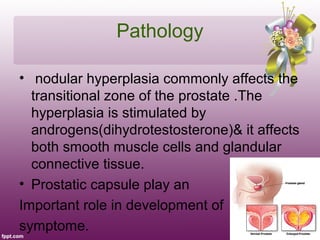
• nodular hyperplasia commonly affects the
  transitional zone of the prostate .The
  hyperplasia is stimulated by
  androgens(dihydrotestosterone)& it affects
  both smooth muscle cells and glandular
  connective tissue.
• Prostatic capsule play an
Important role in development of
symptome.
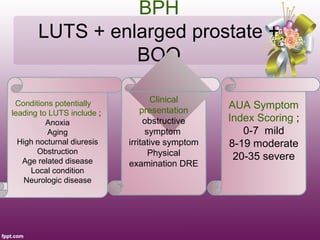
BPH
       LUTS + enlarged prostate +
                 BOO

 Conditions potentially            Clinical
                                presentation
                                                 AUA Symptom
leading to LUTS include ;
          Anoxia                 obstructive     Index Scoring ;
          Aging                   symptom           0-7 mild
  High nocturnal diuresis   irritative symptom   8-19 moderate
       Obstruction                 Physical
   Age related disease                            20-35 severe
                            examination DRE
      Local condition
    Neurologic disease
Investigations
• 1.urialysis (infection,hematuria)
• 2.renal function test :
  s.creatinine(obstruction)
• 3.serum PSA : elevated
• 4.rectal ultrasound
• 5. CBC/Coagulation studies
• 6.urodynamic studies for assessment of
  urine flow
• 7. cystoscopy
Medical Management
• A. observation
• B. medication :
  – 5-alpha reductase inhibitors
      • Inhibit production of DHT
      • Finasteride (Proscar)
      • Dutasteride (Avodart)
  – Alpha blockers
      •   Dilate blood vessels and relax smooth muscles in prostate and bladder neck
      •   Tamsulosin (Flomax)
      •   Terazosin (Hytrin)
      •   Doxazosin (Cardura)
      • *Combination therapy proven superior in treatment of
        BPH and is now recommended by American urologic
        association
Surgical treatment

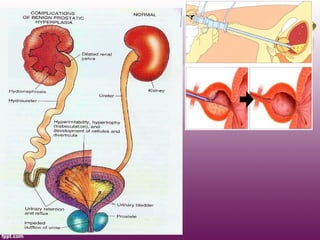
•   Transurethral resection of prostate (TURP)
     – Gold standard
     – Surgical procedure requiring spinal or general anesthesia
     – Resectoscope inserted through urethra
     – Gland removed in small chips by electrical cutting loop
     – Inpatient hospitalization required
•   TUIP (transurethral incision of prostate)
•   TUMT (transurethral microwave therapy
•   Other BPH Surgical Management :
•   Laser therapy , transurethral needle ablation , Balloon dilatation ,
•   Prostatic stents
• Open prostatectomy
benign prostatic hyperplasia

benign prostatic hyperplasia

  • 1.
    Benign prostatic hyperplasia Presented by; Nour Fawzi
  • 2.
    Epidemiology • According toNIH, BPH affects 50% of men >60 years of age • Affects >90% of men over 70 years of age • Men who have undergone bilateral orchiectomies do not develop BPH • Affects Blacks, Whites, Asians • genetic predisposition
  • 3.
    Pathology • nodular hyperplasiacommonly affects the transitional zone of the prostate .The hyperplasia is stimulated by androgens(dihydrotestosterone)& it affects both smooth muscle cells and glandular connective tissue. • Prostatic capsule play an Important role in development of symptome.
  • 4.
    BPH LUTS + enlarged prostate + BOO Conditions potentially Clinical presentation AUA Symptom leading to LUTS include ; Anoxia obstructive Index Scoring ; Aging symptom 0-7 mild High nocturnal diuresis irritative symptom 8-19 moderate Obstruction Physical Age related disease 20-35 severe examination DRE Local condition Neurologic disease
  • 5.
    Investigations • 1.urialysis (infection,hematuria) •2.renal function test : s.creatinine(obstruction) • 3.serum PSA : elevated • 4.rectal ultrasound • 5. CBC/Coagulation studies • 6.urodynamic studies for assessment of urine flow • 7. cystoscopy
  • 6.
    Medical Management • A.observation • B. medication : – 5-alpha reductase inhibitors • Inhibit production of DHT • Finasteride (Proscar) • Dutasteride (Avodart) – Alpha blockers • Dilate blood vessels and relax smooth muscles in prostate and bladder neck • Tamsulosin (Flomax) • Terazosin (Hytrin) • Doxazosin (Cardura) • *Combination therapy proven superior in treatment of BPH and is now recommended by American urologic association
  • 7.
    Surgical treatment • Transurethral resection of prostate (TURP) – Gold standard – Surgical procedure requiring spinal or general anesthesia – Resectoscope inserted through urethra – Gland removed in small chips by electrical cutting loop – Inpatient hospitalization required • TUIP (transurethral incision of prostate) • TUMT (transurethral microwave therapy • Other BPH Surgical Management : • Laser therapy , transurethral needle ablation , Balloon dilatation , • Prostatic stents • Open prostatectomy