Introduction
• Histopathologically BPH is characterized by an increased number of epithelial
and stromal cells in the periurethral area of the prostate and thus correctly
referred to as hyperplasia and not hypertrophy, a term often found in the older
literature.
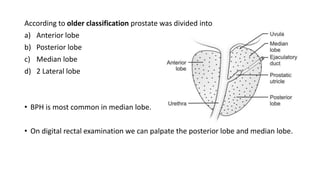
According to older classification prostate was divided into
a) Anterior lobe
b) Posterior lobe
c) Median lobe
d) 2 Lateral lobe
• BPH is most common in median lobe.
• On digital rectal examination we can palpate the posterior lobe and median lobe.
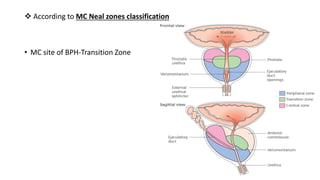
 According to MC Neal zones classification
• MC site of BPH-Transition Zone
Etiology
• The precise molecular etiology of this hyperplastic process is uncertain. The
observed increase in cell number may be due to epithelial and stromal
proliferation or to impaired programmed cell death leading to cellular
accumulation.
• Androgens, estrogens, stromal-epithelial interactions, growth factors, and
neurotransmitters may play a role, either singly or in combination, in the etiology
of the hyperplastic process.
Incidence
• 41-50 years = 20%
• 51-60 years = 50%
• >80 years = 90%
• It is also known that prostatic levels of dihydrotestosterone (DHT) as well as the
androgen receptor (AR) remain high with aging despite the fact that peripheral
levels of testosterone are decreasing.
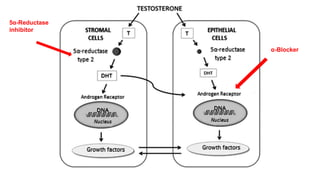
• In the prostate, the nuclear membrane bound enzyme steroid 5α-reductase
converts the hormone testosterone into DHT, the principal androgen in this
tissue.
• Ninety percent of total prostatic androgen is in the form of DHT, principally
derived from testicular androgens.
• Inside the cell, both testosterone and DHT bind to the same high-affinity
androgen receptor protein .
• DHT is a more potent androgen than testosterone because of its higher affinity
for the AR. Moreover, the DHT-receptor complex may be more stable than the
testosterone receptor complex.
• The hormone receptor then binds to specific DNA binding sites in the nucleus,
which results in increased transcription of androgen-dependent genes and
ultimately stimulation of protein synthesis .
5α-Reductase
inhibitor
α-Blocker
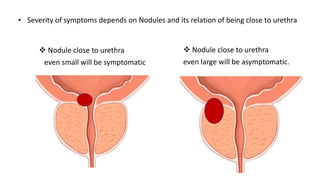
 Nodule close to urethra
even small will be symptomatic
 Nodule close to urethra
even large will be asymptomatic.
• Severity of symptoms depends on Nodules and its relation of being close to urethra
Symptoms:-
Symptoms related to voiding:-
• Poor flow/stream
• Hesitancy
• Intermittency
• Sensation of poor bladder emptying
• Dribbling of urine(including after micturition)
Symptoms related to storage:-
• Frequency
• Urgency
• Nocturia
• Urge incontinence
• Nocturnal incontinence
DIAGNOSIS
 Detailed medical History
Digital rectal examination(DRE)
In BPH smooth elastic enlargement
Urinalysis(to rule out infection)
Blood test
• S. urea,
• S. creat
• S. PSA(Prostate specific antigen)-Elevated PSA level can also be
secondary to infection,surgery or ca. prostate
S.PSA greater than 4 ng/mL are usually considered suspicious.
• S. PSA(Prostate specific antigen)-
• PSA is organ specific. Normal value is 4 ng/ml of plasma.
• More than 10 ng/ml is significant.
• PSA elevation occurs not only in carcinoma but also in prostatic
hyperplasia and prostatitis.But the increase is much more in carcinoma
than in benign conditions.
Neurological examination
to rule out cause other than BPH
USG
prostate PRV
Transrectal USG-To measure and evaluate prostate
Prostate biopsy
To rule out prostate cancer.
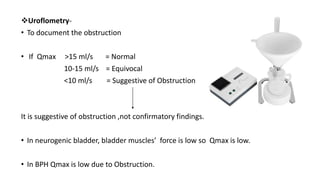
Uroflometry-
• To document the obstruction
• If Qmax >15 ml/s = Normal
10-15 ml/s = Equivocal
<10 ml/s = Suggestive of Obstruction
It is suggestive of obstruction ,not confirmatory findings.
• In neurogenic bladder, bladder muscles’ force is low so Qmax is low.
• In BPH Qmax is low due to Obstruction.
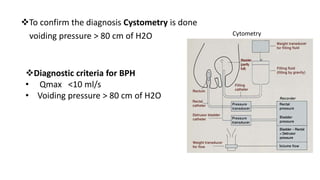
To confirm the diagnosis Cystometry is done
voiding pressure > 80 cm of H2O
Diagnostic criteria for BPH
• Qmax <10 ml/s
• Voiding pressure > 80 cm of H2O
Cytometry
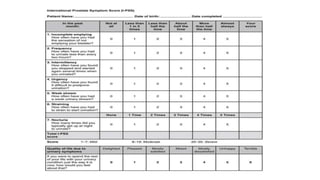
International Prostate Symptom Score
• The International Prostate Symptom Score (IPSS) is an eight-question
written screening tool used to screen for, rapidly diagnose, track the
symptoms of, and suggest management of the lower urinary tract
symptoms of benign prostatic hyperplasia (BPH).
• It was created in 1992 by the American Urological Association(AUA).
• IPSS can be performed multiple times to compare the progression of
symptoms and their severity over months and years.
• In addition to diagnosis and charting disease progression, the IPSS is
effective in helping to determine treatment for patients.
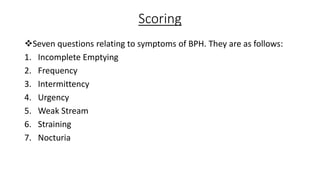
Scoring
Seven questions relating to symptoms of BPH. They are as follows:
1. Incomplete Emptying
2. Frequency
3. Intermittency
4. Urgency
5. Weak Stream
6. Straining
7. Nocturia
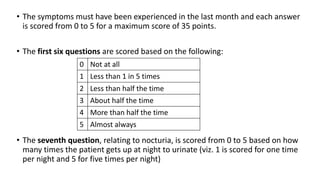
• The symptoms must have been experienced in the last month and each answer
is scored from 0 to 5 for a maximum score of 35 points.
• The first six questions are scored based on the following:
• The seventh question, relating to nocturia, is scored from 0 to 5 based on how
many times the patient gets up at night to urinate (viz. 1 is scored for one time
per night and 5 for five times per night)
0 Not at all
1 Less than 1 in 5 times
2 Less than half the time
3 About half the time
4 More than half the time
5 Almost always
• The eighth, and final question (not included in the main IPSS score),
relating to the patient's perceived quality of life, is assigned a score of
0 (delighted) to 6 (terrible).
IPSS Score(out of 35)
SCORE CORRELATION
0-7 Mildly symptomatic
8-19 Moderately symptomatic
20-35 Severely symptomatic
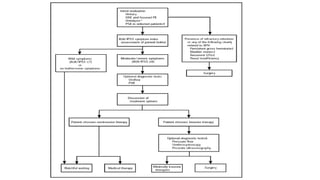
Watchful Waiting
• Watchful waiting is the preferred management strategy for patients with mild
symptoms.
• The level of symptom distress that individual patients are able to tolerate is highly
variable so that watchful waiting may be a patient's treatment of choice even if
he has a high AUA Symptom Index or IPSS score.
• Symptom distress may be reduced with such simple measures as decreasing fluid
intake at bedtime and decreasing caffeine and alcohol intake generally.
• Watchful-waiting patients usually are re-examined yearly.
• As prostate volume assessed by DRE and/or serum PSA predicts the
natural history of symptoms, flow rate, and risk for acute urinary
retention and surgery, patients may be advised as to their individual
risk depending on the outcomes of these assessments.
• Measures to reduce the risk, such as medical intervention, may be
offered depending on the circumstances.
Medical Treatment
• The medical therapies for BPH examined by the Panel were alpha-adrenergic blockers, 5
alpha-reductase inhibitors, combination therapies, and phytotherapy (use of plant
extracts).
• Medical therapies are not as efficacious as surgical therapies but may provide adequate
symptom relief with fewer and less serious associated adverse events
• Alpha-adrenergic blockers:
 Alfuzosin,
 doxazosin,
 tamsulosin and
 terazosin
are appropriate treatment options for patients with LUTS secondary to BPH.
Alpha-adrenergic blockers
• Alpha-adrenergic blockers:
 Alfuzosin,
 doxazosin,
 tamsulosin and
 terazosin
are appropriate treatment options for patients with LUTS secondary to BPH
• Alpha-blocker therapy is based on the hypothesis that clinical BPH is partly
caused by alpha1-adrenergic-mediated contraction of prostatic smooth muscle,
resulting in bladder outlet obstruction .
• Alpha-adrenergic receptor antagonists (blockers) such as doxazosin, tamsulosin,
alfuzosin, and terazosin inhibit this process and thus relieve the bladder outlet
obstruction.
• Efficacy is dose dependent for the titratable alpha blockers doxazosin and
terazosin —the higher the dose, the greater the observed improvement.
• Tamsulosin is most commonly used because
it is selective α-1A blocker.
• The primary adverse events reported with alpha-blocker therapy are
orthostatic hypotension,
dizziness,
 tiredness (asthenia),
ejaculatory problems, and
 nasal congestion
• The adverse event profile appears slightly different between the four alpha-
blocking agents, for example, tamsulosin appears to have a lower probability of
orthostatic hypotension but a higher probability of ejaculatory dysfunction than
the other alpha blockers.
• In men with hypertension and cardiac risk factors, doxazosin monotherapy was
associated with a higher incidence of congestive heart failure than seen with other
antihypertensive agents.
5 Alpha-reductase inhibitor
• The 5 alpha-reductase inhibitors
 finasteride and
dutasteride
are appropriate and effective treatments for patients with LUTS associated with
demonstrable prostatic enlargement.
• Patients with symptomatic prostatic enlargement but without signs of bother
may be offered a 5 alpha-reductase inhibitor to prevent progression of the
disease.
• However, the disadvantages of this therapeutic approach (e.g., side effects such
as sexual dysfunction) and the need for long term daily therapy should be
presented to the patient in comparison to a reasonable estimate of his baseline
risk of progression (i.e., retention and the risks associated with BPH-related
surgery) so that an informed decision can be made.
• Finasteride can reduce the size of the prostate, can increase peak urinary flow
rate, and can reduce BPH symptoms.
• With finasteride, the average patient experiences a 3-point improvement in the
AUA Symptom Index. In general, patients will perceive this level of symptom
improvement as a meaningful change.
• Reported adverse events are primarily sexually related and include :
decreased libido,
ejaculatory dysfunction, and
erectile dysfunction and are reversible and uncommon after the first year of therapy.
• 5 alpha-reductase inhibitor is effective in partially relieving symptoms but is less
effective for this purpose than alpha-blocker therapy.
• Finasteride reduces the risk of subsequent acute urinary retention and the need for
surgery with the absolute benefit increasing with rising prostate volume or serum PSA .
• The new 5 alpha-reductase inhibitor dutasteride has been shown to be of similar
efficacy as finasteride in terms of symptom score and flow-rate improvement, as well as
in the prevention of disease progression.
Combination therapy
• The combination of an alpha-adrenergic receptor blocker and a 5 alpha-reductase
inhibitor (combination therapy) is an appropriate and effective treatment for
patients with LUTS associated with prostatic enlargement.
• The addition of a 5 alpha-reductase inhibitor to an alpha blocker significantly
reduced the long-term risk of acute urinary retention and the need for BPH-
related surgery.
• The overall risk of progression, mostly due to symptomatic progression, was
reduced by 39% for doxazosin, 34% for finasteride and 67% for combination
therapy.
• The risk of retention was reduced by 31% for doxazosin, 67% for finasteride, and
79% for combination therapy .
• Patients most likely to benefit from combination therapy are those in
whom baseline risk of progression is significantly higher, in general,
than in patients with larger glands(>40 grams) and higher PSA values.
• Adverse events reported with the use of combination therapy reflect
the combined adverse-event profiles of both alpha blockers and 5
alpha-reductase inhibitors.
BPH Treatment Success measured by :-
• ↓ symptoms (IPSS/AUA)
• ↑ QOL (Quality of life)
• ↓ prostate size or arrest further growth
• ↑Increase in peak flow rate / Relieve obstruction
• Prevention of long-term outcomes/complications

BPH-medical management

  • 1.
    Introduction • Histopathologically BPHis characterized by an increased number of epithelial and stromal cells in the periurethral area of the prostate and thus correctly referred to as hyperplasia and not hypertrophy, a term often found in the older literature.
  • 2.
    According to olderclassification prostate was divided into a) Anterior lobe b) Posterior lobe c) Median lobe d) 2 Lateral lobe • BPH is most common in median lobe. • On digital rectal examination we can palpate the posterior lobe and median lobe.
  • 3.
     According toMC Neal zones classification • MC site of BPH-Transition Zone
  • 4.
    Etiology • The precisemolecular etiology of this hyperplastic process is uncertain. The observed increase in cell number may be due to epithelial and stromal proliferation or to impaired programmed cell death leading to cellular accumulation. • Androgens, estrogens, stromal-epithelial interactions, growth factors, and neurotransmitters may play a role, either singly or in combination, in the etiology of the hyperplastic process. Incidence • 41-50 years = 20% • 51-60 years = 50% • >80 years = 90%
  • 5.
    • It isalso known that prostatic levels of dihydrotestosterone (DHT) as well as the androgen receptor (AR) remain high with aging despite the fact that peripheral levels of testosterone are decreasing. • In the prostate, the nuclear membrane bound enzyme steroid 5α-reductase converts the hormone testosterone into DHT, the principal androgen in this tissue. • Ninety percent of total prostatic androgen is in the form of DHT, principally derived from testicular androgens. • Inside the cell, both testosterone and DHT bind to the same high-affinity androgen receptor protein .
  • 6.
    • DHT isa more potent androgen than testosterone because of its higher affinity for the AR. Moreover, the DHT-receptor complex may be more stable than the testosterone receptor complex. • The hormone receptor then binds to specific DNA binding sites in the nucleus, which results in increased transcription of androgen-dependent genes and ultimately stimulation of protein synthesis .
  • 7.
  • 8.
     Nodule closeto urethra even small will be symptomatic  Nodule close to urethra even large will be asymptomatic. • Severity of symptoms depends on Nodules and its relation of being close to urethra
  • 9.
    Symptoms:- Symptoms related tovoiding:- • Poor flow/stream • Hesitancy • Intermittency • Sensation of poor bladder emptying • Dribbling of urine(including after micturition) Symptoms related to storage:- • Frequency • Urgency • Nocturia • Urge incontinence • Nocturnal incontinence
  • 10.
    DIAGNOSIS  Detailed medicalHistory Digital rectal examination(DRE) In BPH smooth elastic enlargement Urinalysis(to rule out infection) Blood test • S. urea, • S. creat • S. PSA(Prostate specific antigen)-Elevated PSA level can also be secondary to infection,surgery or ca. prostate S.PSA greater than 4 ng/mL are usually considered suspicious.
  • 11.
    • S. PSA(Prostatespecific antigen)- • PSA is organ specific. Normal value is 4 ng/ml of plasma. • More than 10 ng/ml is significant. • PSA elevation occurs not only in carcinoma but also in prostatic hyperplasia and prostatitis.But the increase is much more in carcinoma than in benign conditions.
  • 12.
    Neurological examination to ruleout cause other than BPH USG prostate PRV Transrectal USG-To measure and evaluate prostate Prostate biopsy To rule out prostate cancer.
  • 13.
    Uroflometry- • To documentthe obstruction • If Qmax >15 ml/s = Normal 10-15 ml/s = Equivocal <10 ml/s = Suggestive of Obstruction It is suggestive of obstruction ,not confirmatory findings. • In neurogenic bladder, bladder muscles’ force is low so Qmax is low. • In BPH Qmax is low due to Obstruction.
  • 14.
    To confirm thediagnosis Cystometry is done voiding pressure > 80 cm of H2O Diagnostic criteria for BPH • Qmax <10 ml/s • Voiding pressure > 80 cm of H2O Cytometry
  • 15.
    International Prostate SymptomScore • The International Prostate Symptom Score (IPSS) is an eight-question written screening tool used to screen for, rapidly diagnose, track the symptoms of, and suggest management of the lower urinary tract symptoms of benign prostatic hyperplasia (BPH). • It was created in 1992 by the American Urological Association(AUA). • IPSS can be performed multiple times to compare the progression of symptoms and their severity over months and years. • In addition to diagnosis and charting disease progression, the IPSS is effective in helping to determine treatment for patients.
  • 17.
    Scoring Seven questions relatingto symptoms of BPH. They are as follows: 1. Incomplete Emptying 2. Frequency 3. Intermittency 4. Urgency 5. Weak Stream 6. Straining 7. Nocturia
  • 18.
    • The symptomsmust have been experienced in the last month and each answer is scored from 0 to 5 for a maximum score of 35 points. • The first six questions are scored based on the following: • The seventh question, relating to nocturia, is scored from 0 to 5 based on how many times the patient gets up at night to urinate (viz. 1 is scored for one time per night and 5 for five times per night) 0 Not at all 1 Less than 1 in 5 times 2 Less than half the time 3 About half the time 4 More than half the time 5 Almost always
  • 19.
    • The eighth,and final question (not included in the main IPSS score), relating to the patient's perceived quality of life, is assigned a score of 0 (delighted) to 6 (terrible). IPSS Score(out of 35) SCORE CORRELATION 0-7 Mildly symptomatic 8-19 Moderately symptomatic 20-35 Severely symptomatic
  • 21.
    Watchful Waiting • Watchfulwaiting is the preferred management strategy for patients with mild symptoms. • The level of symptom distress that individual patients are able to tolerate is highly variable so that watchful waiting may be a patient's treatment of choice even if he has a high AUA Symptom Index or IPSS score. • Symptom distress may be reduced with such simple measures as decreasing fluid intake at bedtime and decreasing caffeine and alcohol intake generally. • Watchful-waiting patients usually are re-examined yearly.
  • 22.
    • As prostatevolume assessed by DRE and/or serum PSA predicts the natural history of symptoms, flow rate, and risk for acute urinary retention and surgery, patients may be advised as to their individual risk depending on the outcomes of these assessments. • Measures to reduce the risk, such as medical intervention, may be offered depending on the circumstances.
  • 23.
    Medical Treatment • Themedical therapies for BPH examined by the Panel were alpha-adrenergic blockers, 5 alpha-reductase inhibitors, combination therapies, and phytotherapy (use of plant extracts). • Medical therapies are not as efficacious as surgical therapies but may provide adequate symptom relief with fewer and less serious associated adverse events • Alpha-adrenergic blockers:  Alfuzosin,  doxazosin,  tamsulosin and  terazosin are appropriate treatment options for patients with LUTS secondary to BPH.
  • 24.
    Alpha-adrenergic blockers • Alpha-adrenergicblockers:  Alfuzosin,  doxazosin,  tamsulosin and  terazosin are appropriate treatment options for patients with LUTS secondary to BPH • Alpha-blocker therapy is based on the hypothesis that clinical BPH is partly caused by alpha1-adrenergic-mediated contraction of prostatic smooth muscle, resulting in bladder outlet obstruction . • Alpha-adrenergic receptor antagonists (blockers) such as doxazosin, tamsulosin, alfuzosin, and terazosin inhibit this process and thus relieve the bladder outlet obstruction.
  • 25.
    • Efficacy isdose dependent for the titratable alpha blockers doxazosin and terazosin —the higher the dose, the greater the observed improvement. • Tamsulosin is most commonly used because it is selective α-1A blocker. • The primary adverse events reported with alpha-blocker therapy are orthostatic hypotension, dizziness,  tiredness (asthenia), ejaculatory problems, and  nasal congestion
  • 26.
    • The adverseevent profile appears slightly different between the four alpha- blocking agents, for example, tamsulosin appears to have a lower probability of orthostatic hypotension but a higher probability of ejaculatory dysfunction than the other alpha blockers. • In men with hypertension and cardiac risk factors, doxazosin monotherapy was associated with a higher incidence of congestive heart failure than seen with other antihypertensive agents.
  • 27.
    5 Alpha-reductase inhibitor •The 5 alpha-reductase inhibitors  finasteride and dutasteride are appropriate and effective treatments for patients with LUTS associated with demonstrable prostatic enlargement. • Patients with symptomatic prostatic enlargement but without signs of bother may be offered a 5 alpha-reductase inhibitor to prevent progression of the disease.
  • 28.
    • However, thedisadvantages of this therapeutic approach (e.g., side effects such as sexual dysfunction) and the need for long term daily therapy should be presented to the patient in comparison to a reasonable estimate of his baseline risk of progression (i.e., retention and the risks associated with BPH-related surgery) so that an informed decision can be made. • Finasteride can reduce the size of the prostate, can increase peak urinary flow rate, and can reduce BPH symptoms. • With finasteride, the average patient experiences a 3-point improvement in the AUA Symptom Index. In general, patients will perceive this level of symptom improvement as a meaningful change.
  • 29.
    • Reported adverseevents are primarily sexually related and include : decreased libido, ejaculatory dysfunction, and erectile dysfunction and are reversible and uncommon after the first year of therapy. • 5 alpha-reductase inhibitor is effective in partially relieving symptoms but is less effective for this purpose than alpha-blocker therapy. • Finasteride reduces the risk of subsequent acute urinary retention and the need for surgery with the absolute benefit increasing with rising prostate volume or serum PSA . • The new 5 alpha-reductase inhibitor dutasteride has been shown to be of similar efficacy as finasteride in terms of symptom score and flow-rate improvement, as well as in the prevention of disease progression.
  • 30.
    Combination therapy • Thecombination of an alpha-adrenergic receptor blocker and a 5 alpha-reductase inhibitor (combination therapy) is an appropriate and effective treatment for patients with LUTS associated with prostatic enlargement. • The addition of a 5 alpha-reductase inhibitor to an alpha blocker significantly reduced the long-term risk of acute urinary retention and the need for BPH- related surgery. • The overall risk of progression, mostly due to symptomatic progression, was reduced by 39% for doxazosin, 34% for finasteride and 67% for combination therapy. • The risk of retention was reduced by 31% for doxazosin, 67% for finasteride, and 79% for combination therapy .
  • 31.
    • Patients mostlikely to benefit from combination therapy are those in whom baseline risk of progression is significantly higher, in general, than in patients with larger glands(>40 grams) and higher PSA values. • Adverse events reported with the use of combination therapy reflect the combined adverse-event profiles of both alpha blockers and 5 alpha-reductase inhibitors.
  • 32.
    BPH Treatment Successmeasured by :- • ↓ symptoms (IPSS/AUA) • ↑ QOL (Quality of life) • ↓ prostate size or arrest further growth • ↑Increase in peak flow rate / Relieve obstruction • Prevention of long-term outcomes/complications