Sequence based genotyping
• Molecular techniques essential for lessening
the breeding cycle
• Genotyping
– Find DNA polymorphism
– Assaying markers across a full set of material
• Involves marker discovery ,assay design and
genotyping
• Sequence based genotyping-marker discovery
and genotyping together
Why to go for GBS ???
• Genotyping by sequencing : enzyme based
complexity reduction and multiplexing
approach
• Low cost
• Reduced sample handling
• Fewer PCR and purification steps
• No reference genome limit
• Efficient barcoding for multiplexing
RAD markers – An initial form of GBS
• Sequenced “ restriction site associated genomic
DNA” for SNP discovery and genotyping
• Restriction site used to reduce complexity of
genome
• Adapters with barcodes are used for cost
effectiveness
• Mapped induced mutations in Neurospora crassa
• Modified RAD- less complex and cost effective –
“GBS”
• In maize and Barley
• Works well with complex genomes and small
genomes (organellar, microbial and chloroplast)
Genotyping by sequencing
• Materials
– DNA samples
• From mapping populations like RILs or DH
• Extract using standard CTAB method
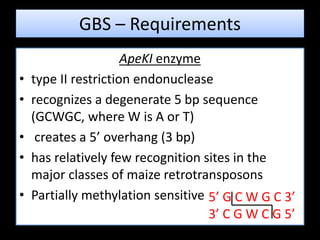
– Restriction enzymes
• that leave 2 to 3 bp overhangs
• do not cut frequently in the major repetitive fraction of
the genome
• ApeKI for maize
GBS – Requirements
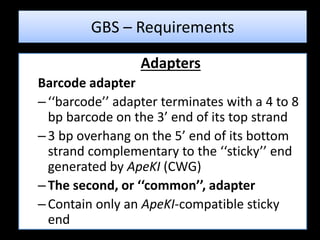
ApeKI enzyme
• type II restriction endonuclease
• recognizes a degenerate 5 bp sequence
(GCWGC, where W is A or T)
• creates a 5’ overhang (3 bp)
• has relatively few recognition sites in the
major classes of maize retrotransposons
• Partially methylation sensitive
GBS – Requirements
5’ G C W G C 3’
3’ C G W C G 5’
–Adapters
• Two different types of adapters
– Barcode adapter
– Common adapter
• Adapters were designed so that the ApeKI
recognition site did not occur in any adapter
sequence and was not regenerated after
ligation to genomic DNA
GBS – Requirements
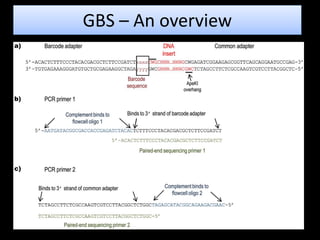
Adapters
Barcode adapter
–‘‘barcode’’ adapter terminates with a 4 to 8
bp barcode on the 3’ end of its top strand
–3 bp overhang on the 5’ end of its bottom
strand complementary to the ‘‘sticky’’ end
generated by ApeKI (CWG)
–The second, or ‘‘common’’, adapter
–Contain only an ApeKI-compatible sticky
end
GBS – Requirements
–Primers
• with primers for sequencing and flow cell
oligos
–Sequencers
• Next generation sequencers like Illumina
–Sequence filtering and alignment
softwares
• BLAST( Basic Local Alignment Search Tool)
GBS – Requirements
GBS – An overview
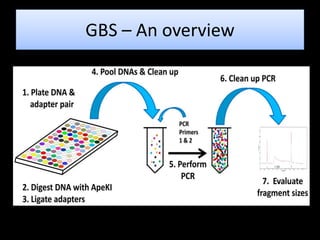
• Steps
–Preparation of DNA samples and select
adapters
–Preparation of Libraries for Next-Generation
Sequencing
–Filtering Raw Sequence Data
–DNA sequence alignments
–Mapping
GBS – An overview
GBS – An overview
• The reminder sequences except barcodes and
primers are trimmed out
• The rest of the sequences are aligned
according to reference genome data using
BLAST
• Mapping of SNPs is done using softwares like
TASSEL
GBS – An overview
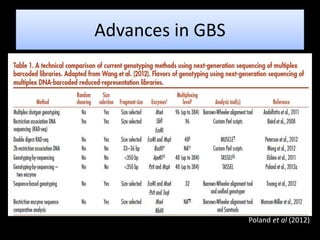
Advances in GBS
Poland et al (2012)
How GBS is useful???
• A large amount SNPs are discovered
• Identification of minor alleles or QTLs
• There is no requirement for a prior knowledge
of the species genomes
• SNP discovery and genotyping are completed
together
How GBS is useful???
• Rapid and low-cost tool to study
– Genotype of breeding populations
– GWAS- genome wide association studies
– genomic diversity study
– genetic linkage analysis
– molecular marker discovery
– genomic selection (GS)
– Phylogenetics
– Germplasm characterization
Genotyping by sequencing

Genotyping by sequencing

  • 2.
    Sequence based genotyping •Molecular techniques essential for lessening the breeding cycle • Genotyping – Find DNA polymorphism – Assaying markers across a full set of material • Involves marker discovery ,assay design and genotyping • Sequence based genotyping-marker discovery and genotyping together
  • 3.
    Why to gofor GBS ??? • Genotyping by sequencing : enzyme based complexity reduction and multiplexing approach • Low cost • Reduced sample handling • Fewer PCR and purification steps • No reference genome limit • Efficient barcoding for multiplexing
  • 4.
    RAD markers –An initial form of GBS • Sequenced “ restriction site associated genomic DNA” for SNP discovery and genotyping • Restriction site used to reduce complexity of genome • Adapters with barcodes are used for cost effectiveness • Mapped induced mutations in Neurospora crassa
  • 5.
    • Modified RAD-less complex and cost effective – “GBS” • In maize and Barley • Works well with complex genomes and small genomes (organellar, microbial and chloroplast) Genotyping by sequencing
  • 6.
    • Materials – DNAsamples • From mapping populations like RILs or DH • Extract using standard CTAB method – Restriction enzymes • that leave 2 to 3 bp overhangs • do not cut frequently in the major repetitive fraction of the genome • ApeKI for maize GBS – Requirements
  • 7.
    ApeKI enzyme • typeII restriction endonuclease • recognizes a degenerate 5 bp sequence (GCWGC, where W is A or T) • creates a 5’ overhang (3 bp) • has relatively few recognition sites in the major classes of maize retrotransposons • Partially methylation sensitive GBS – Requirements 5’ G C W G C 3’ 3’ C G W C G 5’
  • 8.
    –Adapters • Two differenttypes of adapters – Barcode adapter – Common adapter • Adapters were designed so that the ApeKI recognition site did not occur in any adapter sequence and was not regenerated after ligation to genomic DNA GBS – Requirements
  • 9.
    Adapters Barcode adapter –‘‘barcode’’ adapterterminates with a 4 to 8 bp barcode on the 3’ end of its top strand –3 bp overhang on the 5’ end of its bottom strand complementary to the ‘‘sticky’’ end generated by ApeKI (CWG) –The second, or ‘‘common’’, adapter –Contain only an ApeKI-compatible sticky end GBS – Requirements
  • 10.
    –Primers • with primersfor sequencing and flow cell oligos –Sequencers • Next generation sequencers like Illumina –Sequence filtering and alignment softwares • BLAST( Basic Local Alignment Search Tool) GBS – Requirements
  • 11.
    GBS – Anoverview • Steps –Preparation of DNA samples and select adapters –Preparation of Libraries for Next-Generation Sequencing –Filtering Raw Sequence Data –DNA sequence alignments –Mapping
  • 12.
    GBS – Anoverview
  • 13.
    GBS – Anoverview
  • 14.
    • The remindersequences except barcodes and primers are trimmed out • The rest of the sequences are aligned according to reference genome data using BLAST • Mapping of SNPs is done using softwares like TASSEL GBS – An overview
  • 15.
  • 16.
    How GBS isuseful??? • A large amount SNPs are discovered • Identification of minor alleles or QTLs • There is no requirement for a prior knowledge of the species genomes • SNP discovery and genotyping are completed together
  • 17.
    How GBS isuseful??? • Rapid and low-cost tool to study – Genotype of breeding populations – GWAS- genome wide association studies – genomic diversity study – genetic linkage analysis – molecular marker discovery – genomic selection (GS) – Phylogenetics – Germplasm characterization