MapbasedCloningof Genome
By
KAUSHAL KUMAR SAHU
Assistant Professor (Ad Hoc)
Department of Biotechnology
Govt. Digvijay Autonomous P. G. College
Raj-Nandgaon ( C. G. )
SYNOPSIS-
• Introduction
• History
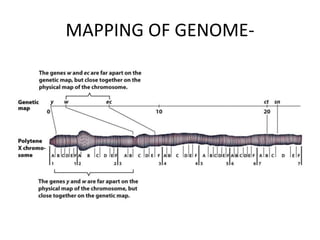
• Mapping of genome
• 1. genetic mapping
• 2. physical mapping
• Map based cloning
• Steps of MBC
• Uses
• Conclusion
• References
INTRODUCTION
Map based cloning of genome is a
method to identify and to make
unknown nucleotide sequence.
HISTORY-
• In 1990, clone region around markers, make
physical map(s), look for genes experimentally
• In 2000, use better physical maps, at least in
some organisms
• In 2010, use sequencing, bioinformatic
knowledge, experimental proof still necessary
MAPPING OF GENOME-
TYPES
• Genetic mapping is based on the use of genetic
techniques to construct maps showing the
positions of genes and other sequence features
on a genome.
• Physical mapping uses molecular biology
techniques to examine DNA molecules directly in
order to construct maps showing the positions of
sequence features, including genes.
© 2005 Prentice Hall Inc. / A
Pearson Education Company /
Upper Saddle River, New Jersey
Genetic mapping I
• Based on recombination frequencies
– The further away two points are on a
chromosome, the more recombination there is
between them
• Because recombination frequencies vary along
a chromosome, we can obtain a relative
position for the loci
• Distance between the markers
© 2005 Prentice Hall Inc. / A
Pearson Education Company /
Upper Saddle River, New Jersey
Genetic mapping II
• Genetic mapping requires that a cross be
performed between two related organisms
– The organism should have phenotypic differences
(contrasting characters like red and white or tall
and short etc) resulting from allele differences at
two or more loci
• The frequency of recombination is determined
by counting the F2 progeny with each
phenotype
© 2005 Prentice Hall Inc. / A Pearson Education Company / Upper Saddle River, New Jersey
07458
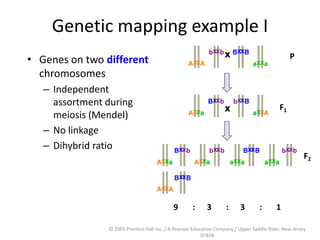
Genetic mapping example I
• Genes on two different
chromosomes
– Independent
assortment during
meiosis (Mendel)
– No linkage
– Dihybrid ratio
F1
9 : 3 : 3 : 1
F2
P
© 2005 Prentice Hall Inc. / A Pearson Education Company / Upper Saddle River, New Jersey
07458
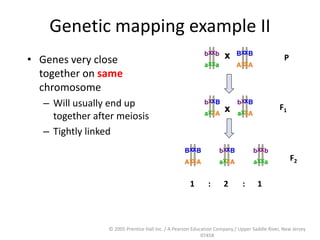
Genetic mapping example II
• Genes very close
together on same
chromosome
– Will usually end up
together after meiosis
– Tightly linked
F1
1 : 2 : 1
F2
P
© 2005 Prentice Hall Inc. / A Pearson Education Company / Upper Saddle River, New Jersey
07458
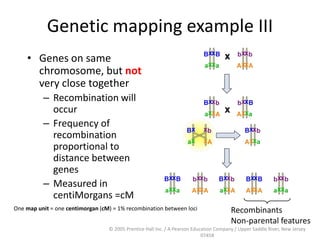
Genetic mapping example III
• Genes on same
chromosome, but not
very close together
– Recombination will
occur
– Frequency of
recombination
proportional to
distance between
genes
– Measured in
centiMorgans =cM
Recombinants
Non-parental features
One map unit = one centimorgan (cM) = 1% recombination between loci
© 2005 Prentice Hall Inc. / A
Pearson Education Company /
Upper Saddle River, New Jersey
Genetic markers
• Genetic mapping between positions on
chromosomes
– Positions can be genes
• Responsible for phenotype
– Examples: eye color or disease trait: limited
– Positions can be physical markers
• DNA sequence variation
© 2005 Prentice Hall Inc. / A
Pearson Education Company /
Upper Saddle River, New Jersey
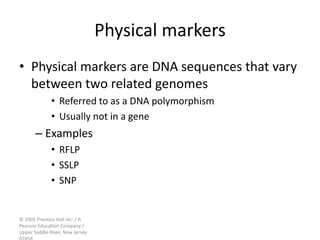
Physical markers
• Physical markers are DNA sequences that vary
between two related genomes
• Referred to as a DNA polymorphism
• Usually not in a gene
– Examples
• RFLP
• SSLP
• SNP
© 2005 Prentice Hall Inc. / A Pearson Education Company / Upper Saddle River, New Jersey
07458
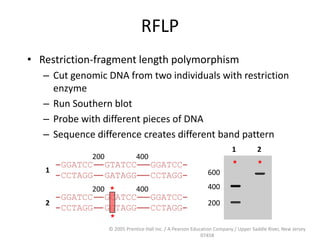
RFLP
• Restriction-fragment length polymorphism
– Cut genomic DNA from two individuals with restriction
enzyme
– Run Southern blot
– Probe with different pieces of DNA
– Sequence difference creates different band pattern
GGATCC
CCTAGG
GTATCC
GATAGG
GGATCC
CCTAGG
200 400
GGATCC
CCTAGG
GCATCC
GGTAGG
GGATCC
CCTAGG
200 400*
*
200
400
600
1 2
**
2
1
© 2005 Prentice Hall Inc. / A Pearson Education Company / Upper Saddle River, New Jersey
07458
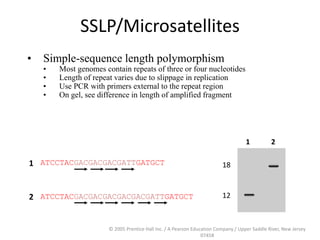
SSLP/Microsatellites
• Simple-sequence length polymorphism
• Most genomes contain repeats of three or four nucleotides
• Length of repeat varies due to slippage in replication
• Use PCR with primers external to the repeat region
• On gel, see difference in length of amplified fragment
ATCCTACGACGACGACGATTGATGCT
12
18
1 2
2
1
ATCCTACGACGACGACGACGACGATTGATGCT
© 2005 Prentice Hall Inc. / A Pearson Education Company / Upper Saddle River, New Jersey
07458
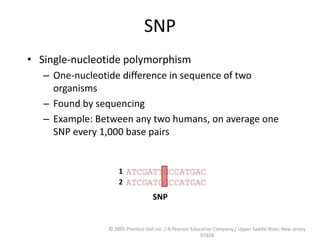
SNP
• Single-nucleotide polymorphism
– One-nucleotide difference in sequence of two
organisms
– Found by sequencing
– Example: Between any two humans, on average one
SNP every 1,000 base pairs
ATCGATTGCCATGAC
ATCGATGGCCATGAC2
1
SNP
© 2005 Prentice Hall Inc. / A
Pearson Education Company /
Upper Saddle River, New Jersey
Physical mapping
• Determination of physical distance between
two points on chromosome
– Distance in base pairs
• Example: between physical marker and a gene
• Need overlapping fragments of DNA
– Requires vectors that accommodate large inserts
• Examples: cosmids, YACs, and BACs
© 2005 Prentice Hall Inc. / A
Pearson Education Company /
Upper Saddle River, New Jersey
Restriction mapping applied to large-
insert clones
• Generates a large number of fragments
• Requires high-resolution separation of
fragments
– Can be done with gel electrophoresis
• FISH Technique-Fluorescent in situ
hybridization
• In FISH, the marker is a DNA sequence that is
visualized by hybridization with a fluorescent
probe.
• Sequence tagged site (STS) mapping-
• A sequence tagged site or STS is simply a short
DNA sequence, generally between 100 and
500 bp in length
© 2005 Prentice Hall Inc. / A Pearson Education Company / Upper Saddle River, New Jersey
07458
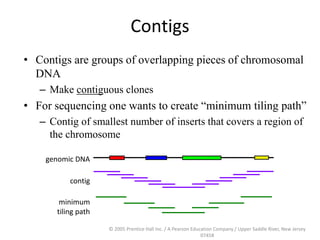
Contigs
• Contigs are groups of overlapping pieces of chromosomal
DNA
– Make contiguous clones
• For sequencing one wants to create “minimum tiling path”
– Contig of smallest number of inserts that covers a region of
the chromosome
genomic DNA
contig
minimum
tiling path
© 2005 Prentice Hall Inc. / A Pearson Education Company / Upper Saddle River, New Jersey
07458
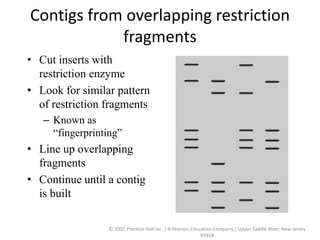
Contigs from overlapping restriction
fragments
• Cut inserts with
restriction enzyme
• Look for similar pattern
of restriction fragments
– Known as
“fingerprinting”
• Line up overlapping
fragments
• Continue until a contig
is built
MAP BASED CLONING-
What to Do Next?
• Identify genes in this region
• Then determine what is the gene of interest
Steps of MBC-
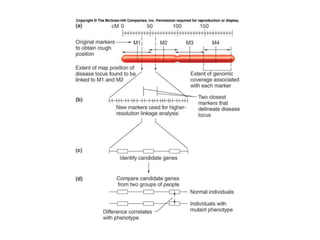
• Identify a marker tightly linked to your gene in a "large"
mapping population
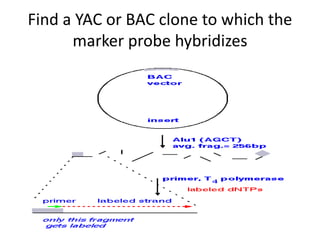
• Find a YAC or BAC clone to which the marker probe
hybridizes
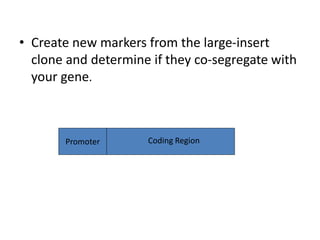
• Create new markers from the large-insert clone and
determine if they co-segregate with your gene
• If necessary, re-screen the large-insert genomic library for
other clones and search for co-segregating markers
• Identify a candidate gene from large-inset clone whose
markers co-segregate with the gene
• Perform genetic complementation (transformation) to
rescue the wild-type phenotype
• Sequence the gene and determine if the function is known
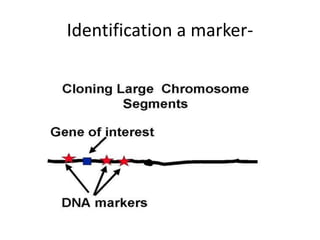
Identification a marker-
Find a YAC or BAC clone to which the
marker probe hybridizes
• Create new markers from the large-insert
clone and determine if they co-segregate with
your gene.
Promoter Coding Region
• If necessary, re-screen the large-insert
genomic library for other clones and search
for co-segregating markers.
• Identify a candidate gene from large-inset
clone whose markers co-segregate with the
gene .
• Perform genetic complementation
(transformation) to rescue the wild-type
phenotype .
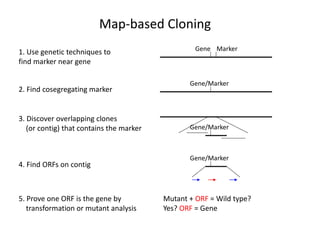
Map-based Cloning
1. Use genetic techniques to
find marker near gene
Gene Marker
2. Find cosegregating marker
Gene/Marker
3. Discover overlapping clones
(or contig) that contains the marker Gene/Marker
4. Find ORFs on contig
Gene/Marker
5. Prove one ORF is the gene by
transformation or mutant analysis
Mutant + ORF = Wild type?
Yes? ORF = Gene
USES-
• To make resistance in plants and animals.
• Diagnosis in diseases.
• To make vaccines.
CONCLUSION
• MBC is a new technology to create a clone of
necessary nucleotide sequence.
• It can be modified and changed , which
depends on the type of the species.
REFERENCES
• ta brown ,Genomes ,2nd edition
• Watson , Molecular Biology of the Gene (5th
edition, 2004)
• http://www.inia.org.uy/

Map based cloning of genome

  • 1.
    MapbasedCloningof Genome By KAUSHAL KUMARSAHU Assistant Professor (Ad Hoc) Department of Biotechnology Govt. Digvijay Autonomous P. G. College Raj-Nandgaon ( C. G. )
  • 2.
    SYNOPSIS- • Introduction • History •Mapping of genome • 1. genetic mapping • 2. physical mapping • Map based cloning • Steps of MBC • Uses • Conclusion • References
  • 3.
    INTRODUCTION Map based cloningof genome is a method to identify and to make unknown nucleotide sequence.
  • 4.
    HISTORY- • In 1990,clone region around markers, make physical map(s), look for genes experimentally • In 2000, use better physical maps, at least in some organisms • In 2010, use sequencing, bioinformatic knowledge, experimental proof still necessary
  • 5.
  • 6.
    TYPES • Genetic mappingis based on the use of genetic techniques to construct maps showing the positions of genes and other sequence features on a genome. • Physical mapping uses molecular biology techniques to examine DNA molecules directly in order to construct maps showing the positions of sequence features, including genes.
  • 7.
    © 2005 PrenticeHall Inc. / A Pearson Education Company / Upper Saddle River, New Jersey Genetic mapping I • Based on recombination frequencies – The further away two points are on a chromosome, the more recombination there is between them • Because recombination frequencies vary along a chromosome, we can obtain a relative position for the loci • Distance between the markers
  • 8.
    © 2005 PrenticeHall Inc. / A Pearson Education Company / Upper Saddle River, New Jersey Genetic mapping II • Genetic mapping requires that a cross be performed between two related organisms – The organism should have phenotypic differences (contrasting characters like red and white or tall and short etc) resulting from allele differences at two or more loci • The frequency of recombination is determined by counting the F2 progeny with each phenotype
  • 9.
    © 2005 PrenticeHall Inc. / A Pearson Education Company / Upper Saddle River, New Jersey 07458 Genetic mapping example I • Genes on two different chromosomes – Independent assortment during meiosis (Mendel) – No linkage – Dihybrid ratio F1 9 : 3 : 3 : 1 F2 P
  • 10.
    © 2005 PrenticeHall Inc. / A Pearson Education Company / Upper Saddle River, New Jersey 07458 Genetic mapping example II • Genes very close together on same chromosome – Will usually end up together after meiosis – Tightly linked F1 1 : 2 : 1 F2 P
  • 11.
    © 2005 PrenticeHall Inc. / A Pearson Education Company / Upper Saddle River, New Jersey 07458 Genetic mapping example III • Genes on same chromosome, but not very close together – Recombination will occur – Frequency of recombination proportional to distance between genes – Measured in centiMorgans =cM Recombinants Non-parental features One map unit = one centimorgan (cM) = 1% recombination between loci
  • 12.
    © 2005 PrenticeHall Inc. / A Pearson Education Company / Upper Saddle River, New Jersey Genetic markers • Genetic mapping between positions on chromosomes – Positions can be genes • Responsible for phenotype – Examples: eye color or disease trait: limited – Positions can be physical markers • DNA sequence variation
  • 13.
    © 2005 PrenticeHall Inc. / A Pearson Education Company / Upper Saddle River, New Jersey Physical markers • Physical markers are DNA sequences that vary between two related genomes • Referred to as a DNA polymorphism • Usually not in a gene – Examples • RFLP • SSLP • SNP
  • 14.
    © 2005 PrenticeHall Inc. / A Pearson Education Company / Upper Saddle River, New Jersey 07458 RFLP • Restriction-fragment length polymorphism – Cut genomic DNA from two individuals with restriction enzyme – Run Southern blot – Probe with different pieces of DNA – Sequence difference creates different band pattern GGATCC CCTAGG GTATCC GATAGG GGATCC CCTAGG 200 400 GGATCC CCTAGG GCATCC GGTAGG GGATCC CCTAGG 200 400* * 200 400 600 1 2 ** 2 1
  • 15.
    © 2005 PrenticeHall Inc. / A Pearson Education Company / Upper Saddle River, New Jersey 07458 SSLP/Microsatellites • Simple-sequence length polymorphism • Most genomes contain repeats of three or four nucleotides • Length of repeat varies due to slippage in replication • Use PCR with primers external to the repeat region • On gel, see difference in length of amplified fragment ATCCTACGACGACGACGATTGATGCT 12 18 1 2 2 1 ATCCTACGACGACGACGACGACGATTGATGCT
  • 16.
    © 2005 PrenticeHall Inc. / A Pearson Education Company / Upper Saddle River, New Jersey 07458 SNP • Single-nucleotide polymorphism – One-nucleotide difference in sequence of two organisms – Found by sequencing – Example: Between any two humans, on average one SNP every 1,000 base pairs ATCGATTGCCATGAC ATCGATGGCCATGAC2 1 SNP
  • 17.
    © 2005 PrenticeHall Inc. / A Pearson Education Company / Upper Saddle River, New Jersey Physical mapping • Determination of physical distance between two points on chromosome – Distance in base pairs • Example: between physical marker and a gene • Need overlapping fragments of DNA – Requires vectors that accommodate large inserts • Examples: cosmids, YACs, and BACs
  • 18.
    © 2005 PrenticeHall Inc. / A Pearson Education Company / Upper Saddle River, New Jersey Restriction mapping applied to large- insert clones • Generates a large number of fragments • Requires high-resolution separation of fragments – Can be done with gel electrophoresis
  • 19.
    • FISH Technique-Fluorescentin situ hybridization • In FISH, the marker is a DNA sequence that is visualized by hybridization with a fluorescent probe. • Sequence tagged site (STS) mapping- • A sequence tagged site or STS is simply a short DNA sequence, generally between 100 and 500 bp in length
  • 20.
    © 2005 PrenticeHall Inc. / A Pearson Education Company / Upper Saddle River, New Jersey 07458 Contigs • Contigs are groups of overlapping pieces of chromosomal DNA – Make contiguous clones • For sequencing one wants to create “minimum tiling path” – Contig of smallest number of inserts that covers a region of the chromosome genomic DNA contig minimum tiling path
  • 21.
    © 2005 PrenticeHall Inc. / A Pearson Education Company / Upper Saddle River, New Jersey 07458 Contigs from overlapping restriction fragments • Cut inserts with restriction enzyme • Look for similar pattern of restriction fragments – Known as “fingerprinting” • Line up overlapping fragments • Continue until a contig is built
  • 22.
    MAP BASED CLONING- Whatto Do Next? • Identify genes in this region • Then determine what is the gene of interest
  • 23.
    Steps of MBC- •Identify a marker tightly linked to your gene in a "large" mapping population • Find a YAC or BAC clone to which the marker probe hybridizes • Create new markers from the large-insert clone and determine if they co-segregate with your gene • If necessary, re-screen the large-insert genomic library for other clones and search for co-segregating markers • Identify a candidate gene from large-inset clone whose markers co-segregate with the gene • Perform genetic complementation (transformation) to rescue the wild-type phenotype • Sequence the gene and determine if the function is known
  • 24.
  • 25.
    Find a YACor BAC clone to which the marker probe hybridizes
  • 26.
    • Create newmarkers from the large-insert clone and determine if they co-segregate with your gene. Promoter Coding Region
  • 27.
    • If necessary,re-screen the large-insert genomic library for other clones and search for co-segregating markers.
  • 28.
    • Identify acandidate gene from large-inset clone whose markers co-segregate with the gene .
  • 29.
    • Perform geneticcomplementation (transformation) to rescue the wild-type phenotype .
  • 30.
    Map-based Cloning 1. Usegenetic techniques to find marker near gene Gene Marker 2. Find cosegregating marker Gene/Marker 3. Discover overlapping clones (or contig) that contains the marker Gene/Marker 4. Find ORFs on contig Gene/Marker 5. Prove one ORF is the gene by transformation or mutant analysis Mutant + ORF = Wild type? Yes? ORF = Gene
  • 32.
    USES- • To makeresistance in plants and animals. • Diagnosis in diseases. • To make vaccines.
  • 33.
    CONCLUSION • MBC isa new technology to create a clone of necessary nucleotide sequence. • It can be modified and changed , which depends on the type of the species.
  • 34.
    REFERENCES • ta brown,Genomes ,2nd edition • Watson , Molecular Biology of the Gene (5th edition, 2004) • http://www.inia.org.uy/