Page 1
Single Nucleotide Polymorphism Genotyping Using
Kompetitive Allele Specific PCR (KASP)
Manglam Arya
Msc.(Ag.) Biotechnology
CPBMB, COH.
Single Nucleotide Polymorphism
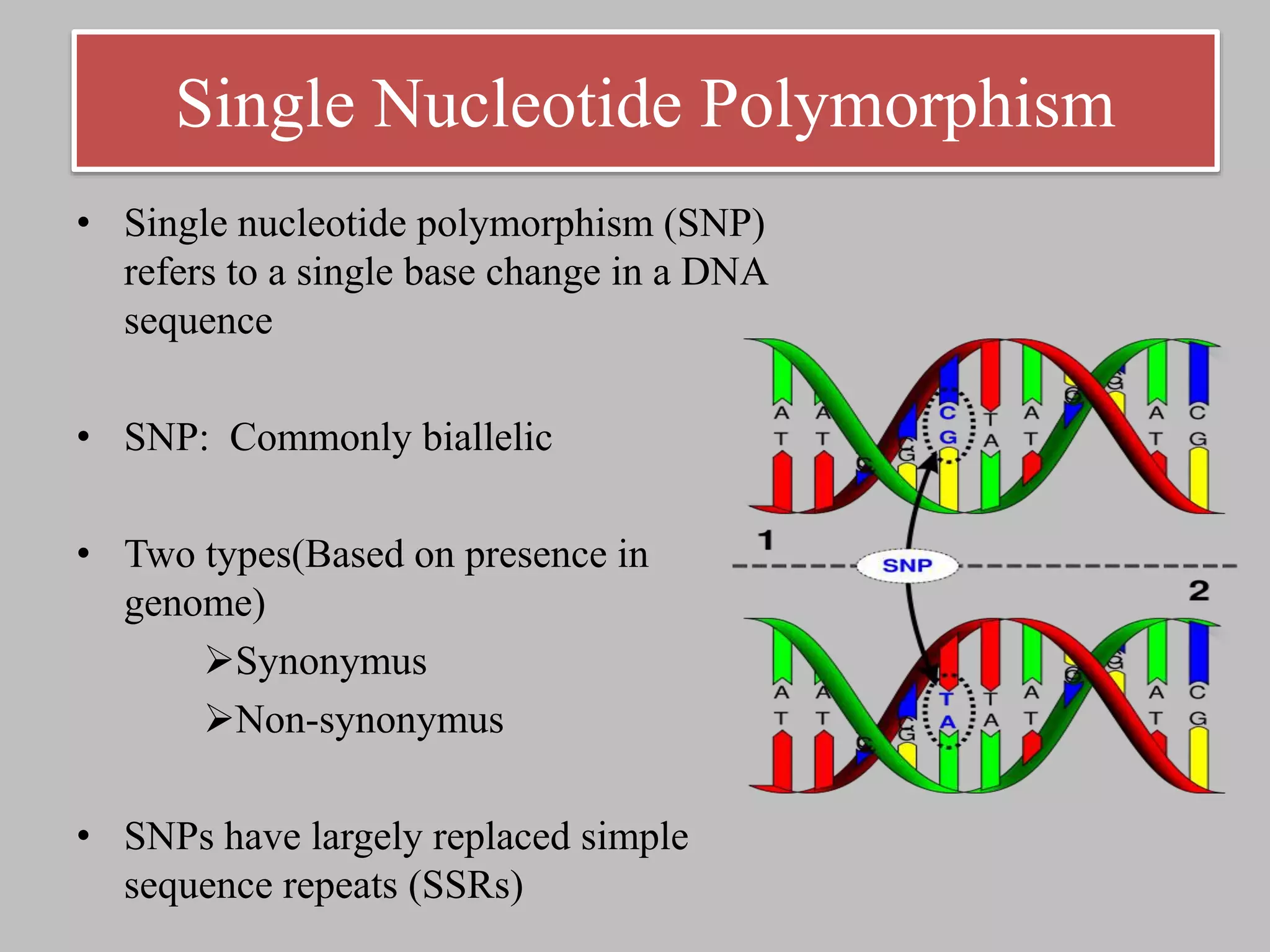
• Single nucleotide polymorphism (SNP)
refers to a single base change in a DNA
sequence
• SNP: Commonly biallelic
• Two types(Based on presence in
genome)
Synonymus
Non-synonymus
• SNPs have largely replaced simple
sequence repeats (SSRs)
Advantage of using SNPs
Low assay cost
High genomic abundance
Locus specificity
co-dominant inheritance
Simple documentation
Potential for high-throughput Analysis
 Relatively low genotyping error rates
• BeadXpressTM,GoldenGateTM
and Infinium from Illumina
• GeneChipTM and GenFlexTM Tag
array from Affimetrix
• SNaPshotTM and TaqManTM
from the Applied Biosystems
• SNPWaveTM from KeyGene
• iPLEX GoldTM Assay and Mass-
RRAYTM from Sequonome
4
• SNPstreamTM from Beckman
Coulter
• Pyrosequencing from Royal
Institute of Technology (Sweden)
• Molecular inversion probes from
ParAllele Biosciences
• Competitive allele-specific PCR
(currently called Kompetitive
Allele Specific PCR, or KASPTM)
from Kbioscience or LGC
Genomics
SNP genotyping platforms
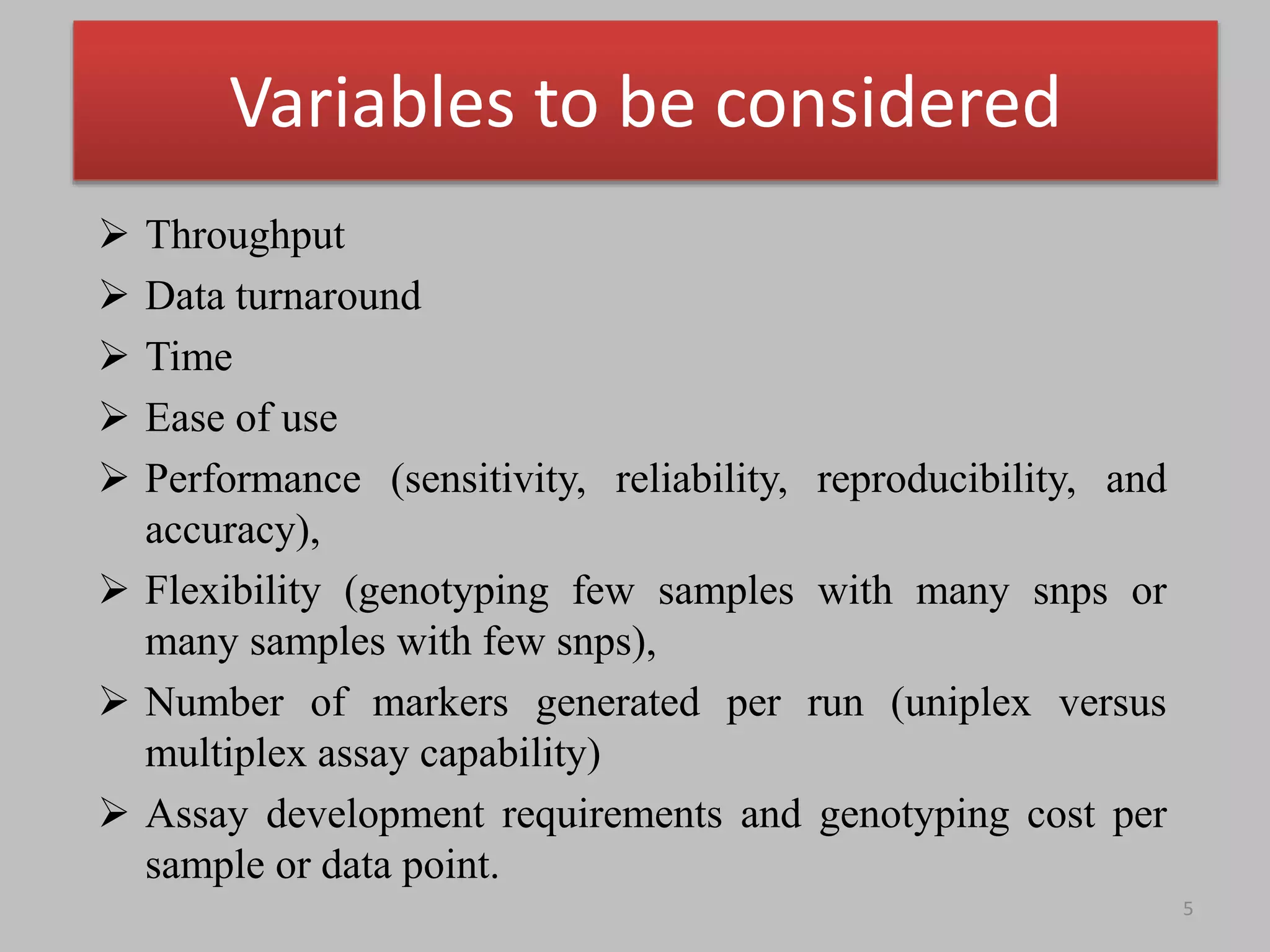
Variables to be considered
 Throughput
 Data turnaround
 Time
 Ease of use
 Performance (sensitivity, reliability, reproducibility, and
accuracy),
 Flexibility (genotyping few samples with many snps or
many samples with few snps),
 Number of markers generated per run (uniplex versus
multiplex assay capability)
 Assay development requirements and genotyping cost per
sample or data point.
5
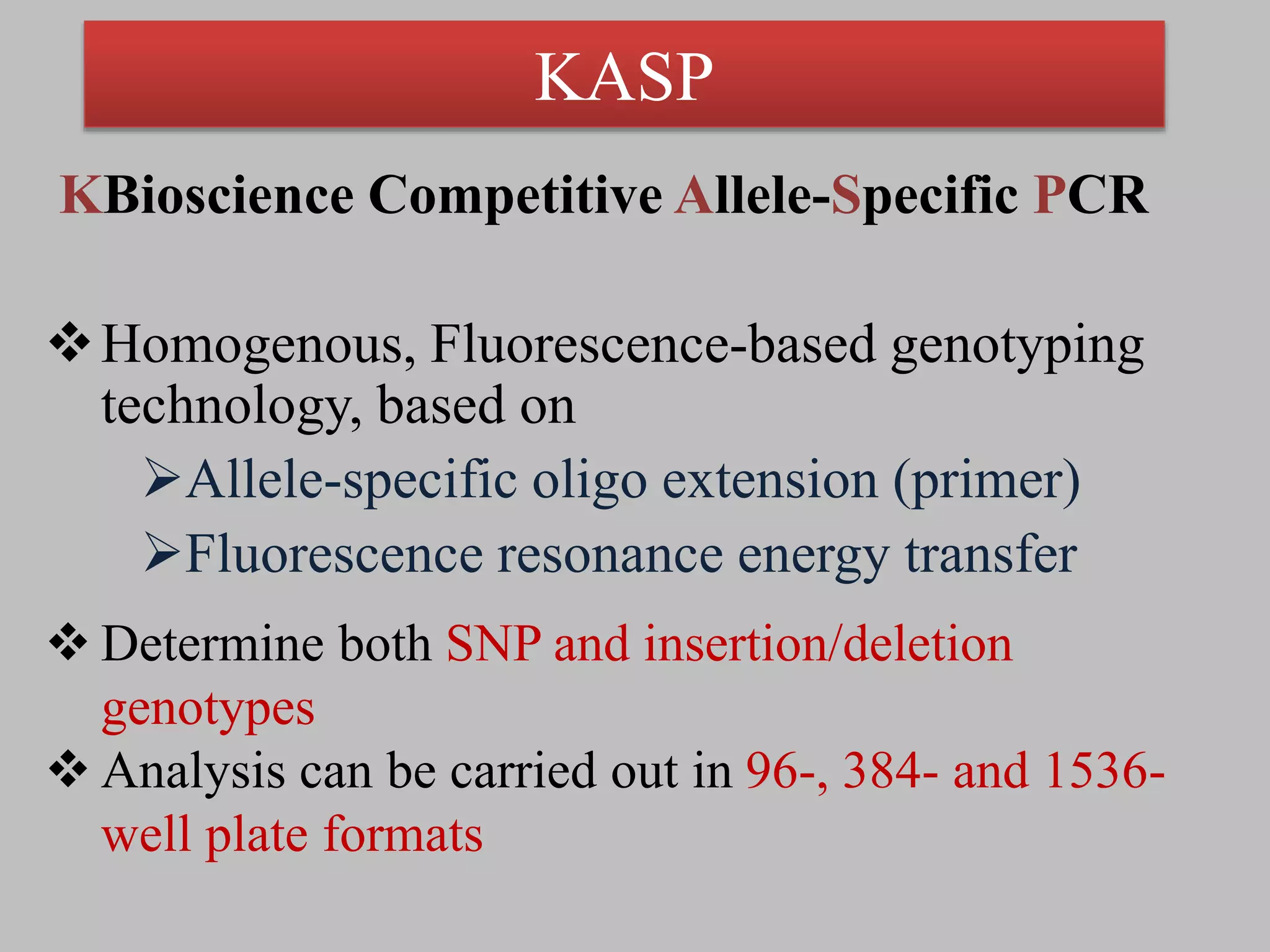
KASP
KBioscience Competitive Allele-Specific PCR
Homogenous, Fluorescence-based genotyping
technology, based on
Allele-specific oligo extension (primer)
Fluorescence resonance energy transfer
 Determine both SNP and insertion/deletion
genotypes
 Analysis can be carried out in 96-, 384- and 1536-
well plate formats
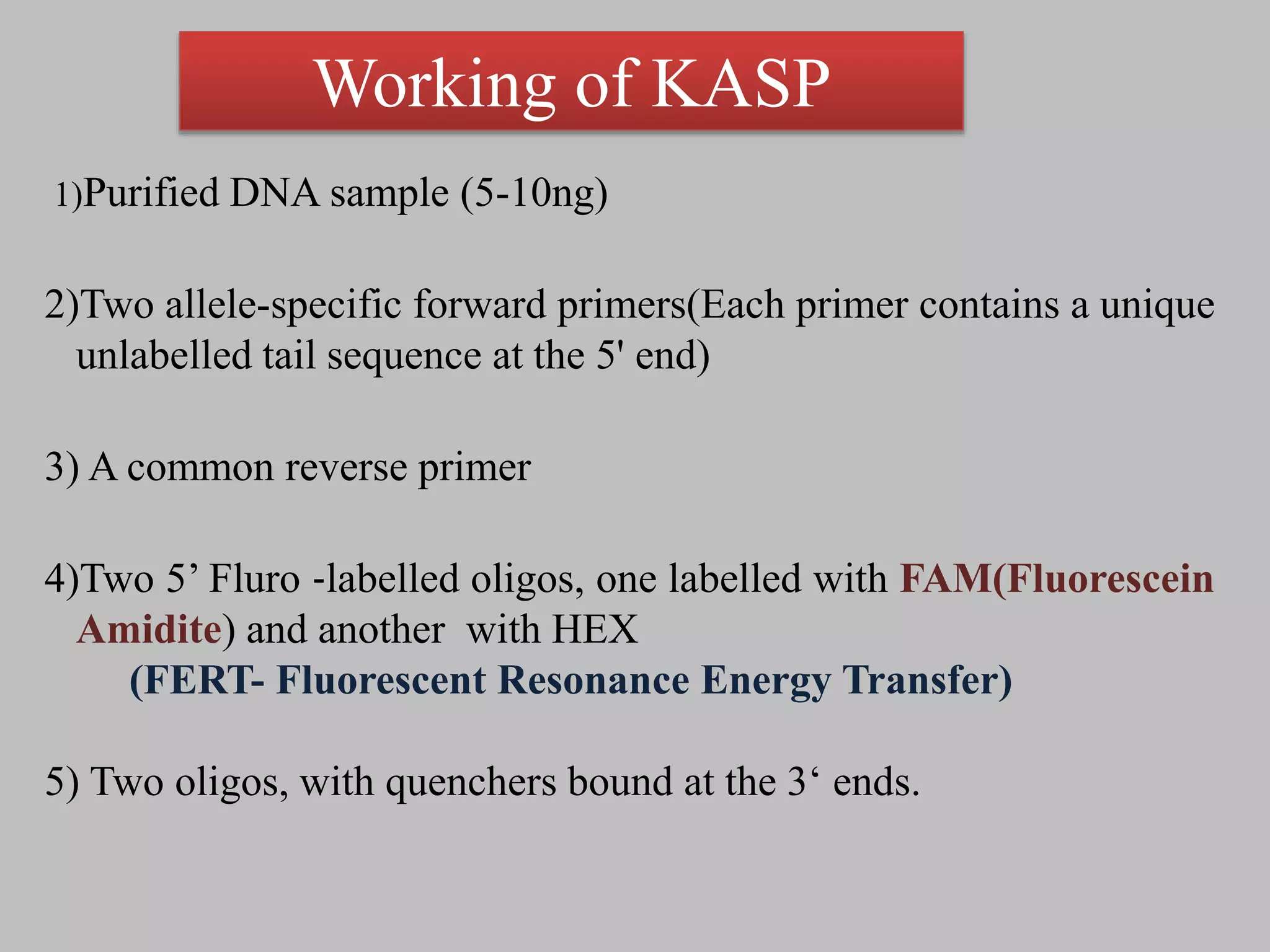
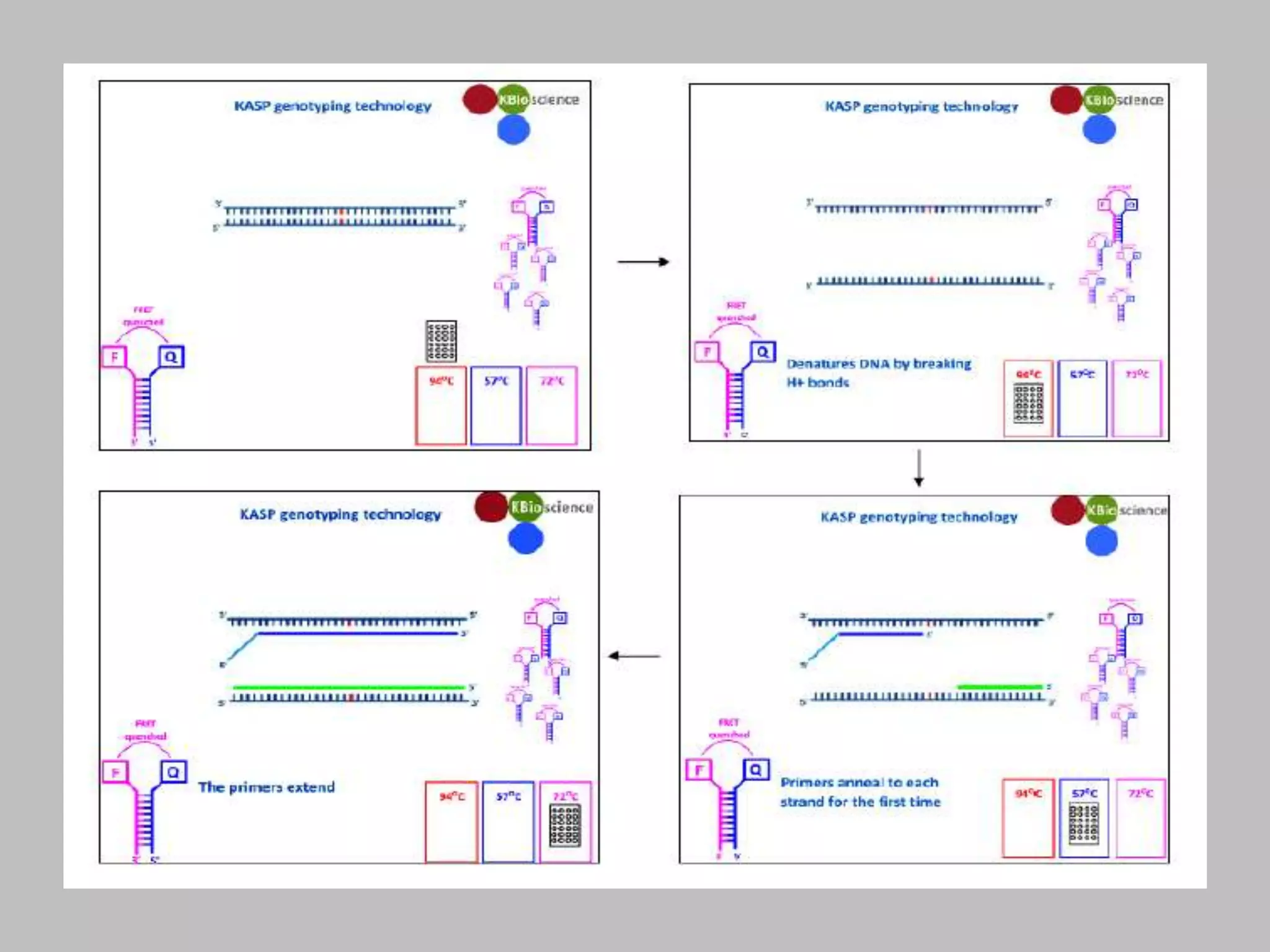
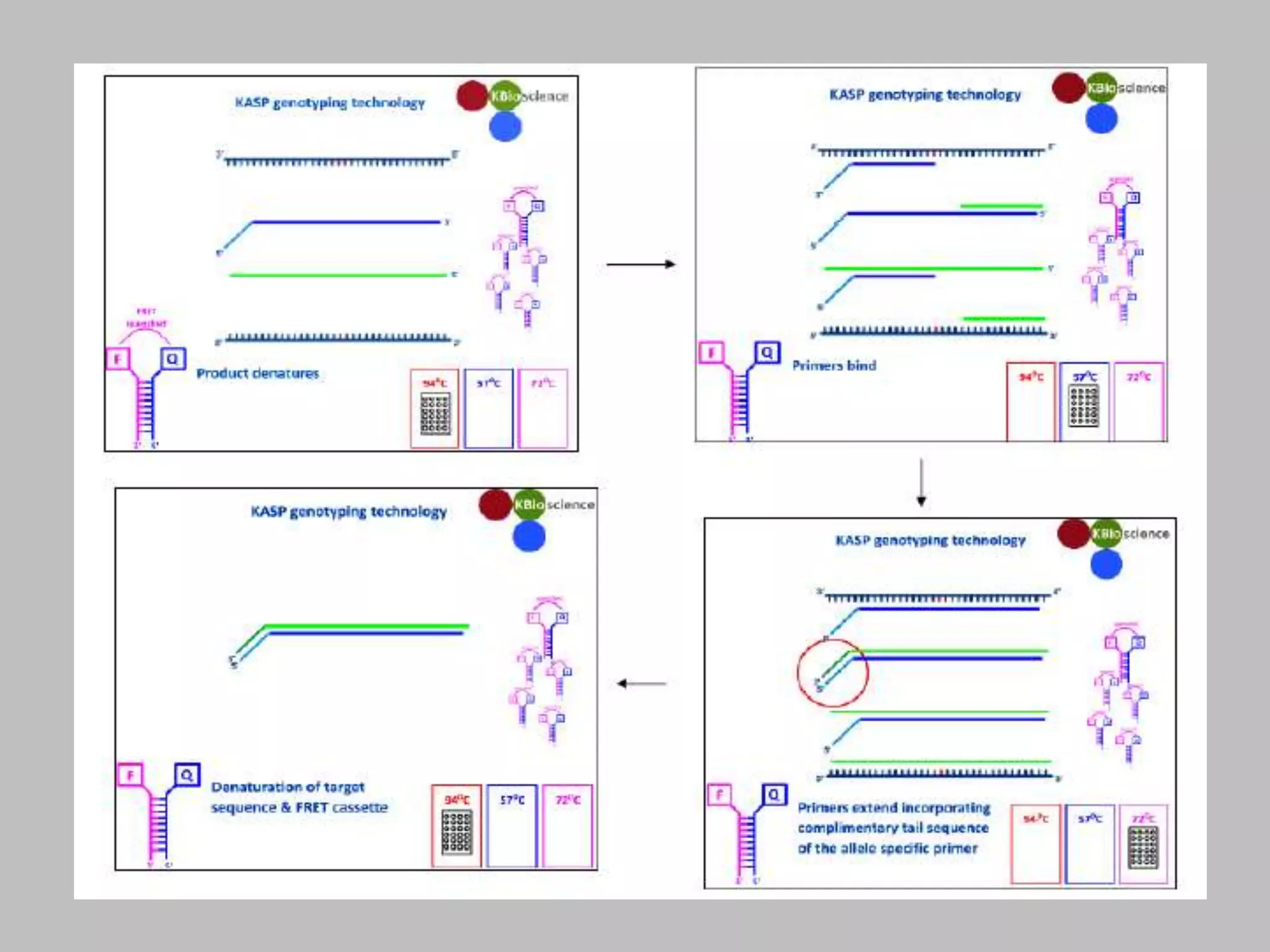
1)Purified DNA sample (5-10ng)
2)Two allele-specific forward primers(Each primer contains a unique
unlabelled tail sequence at the 5' end)
3) A common reverse primer
4)Two 5’ Fluro ‐labelled oligos, one labelled with FAM(Fluorescein
Amidite) and another with HEX
(FERT- Fluorescent Resonance Energy Transfer)
5) Two oligos, with quenchers bound at the 3‘ ends.
Working of KASP
8
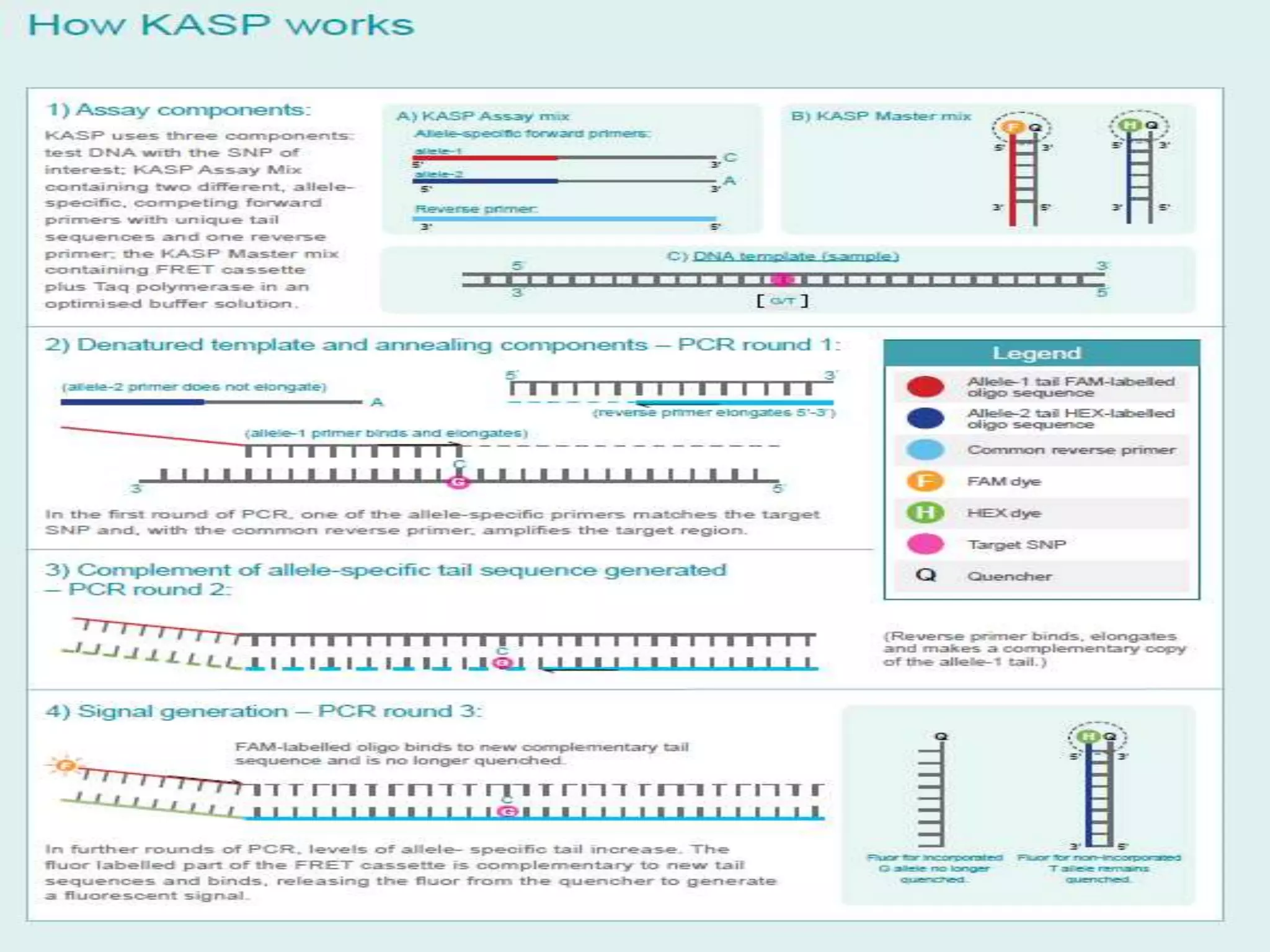
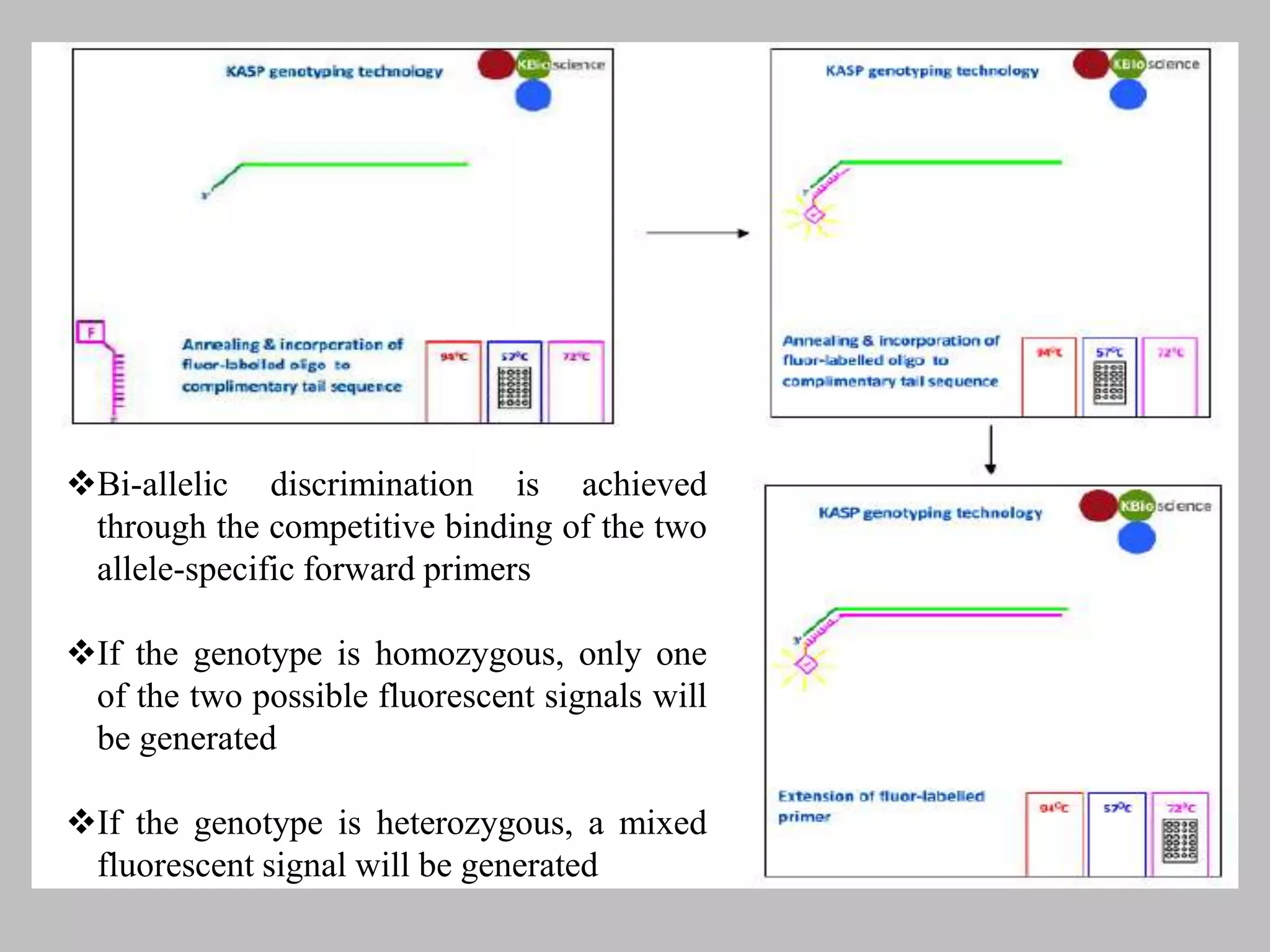
Bi-allelic discrimination is achieved
through the competitive binding of the two
allele-specific forward primers
If the genotype is homozygous, only one
of the two possible fluorescent signals will
be generated
If the genotype is heterozygous, a mixed
fluorescent signal will be generated
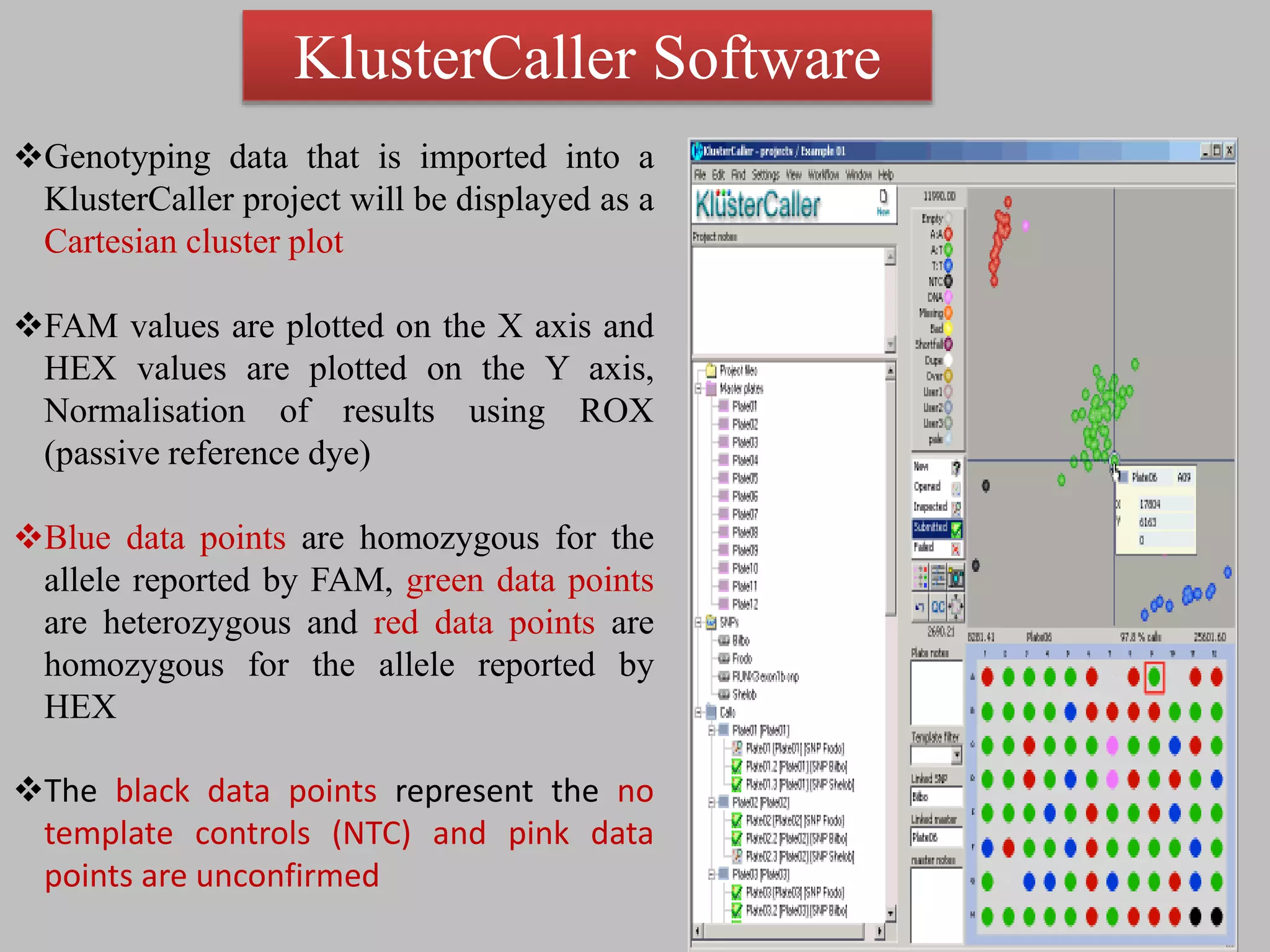
KlusterCaller Software
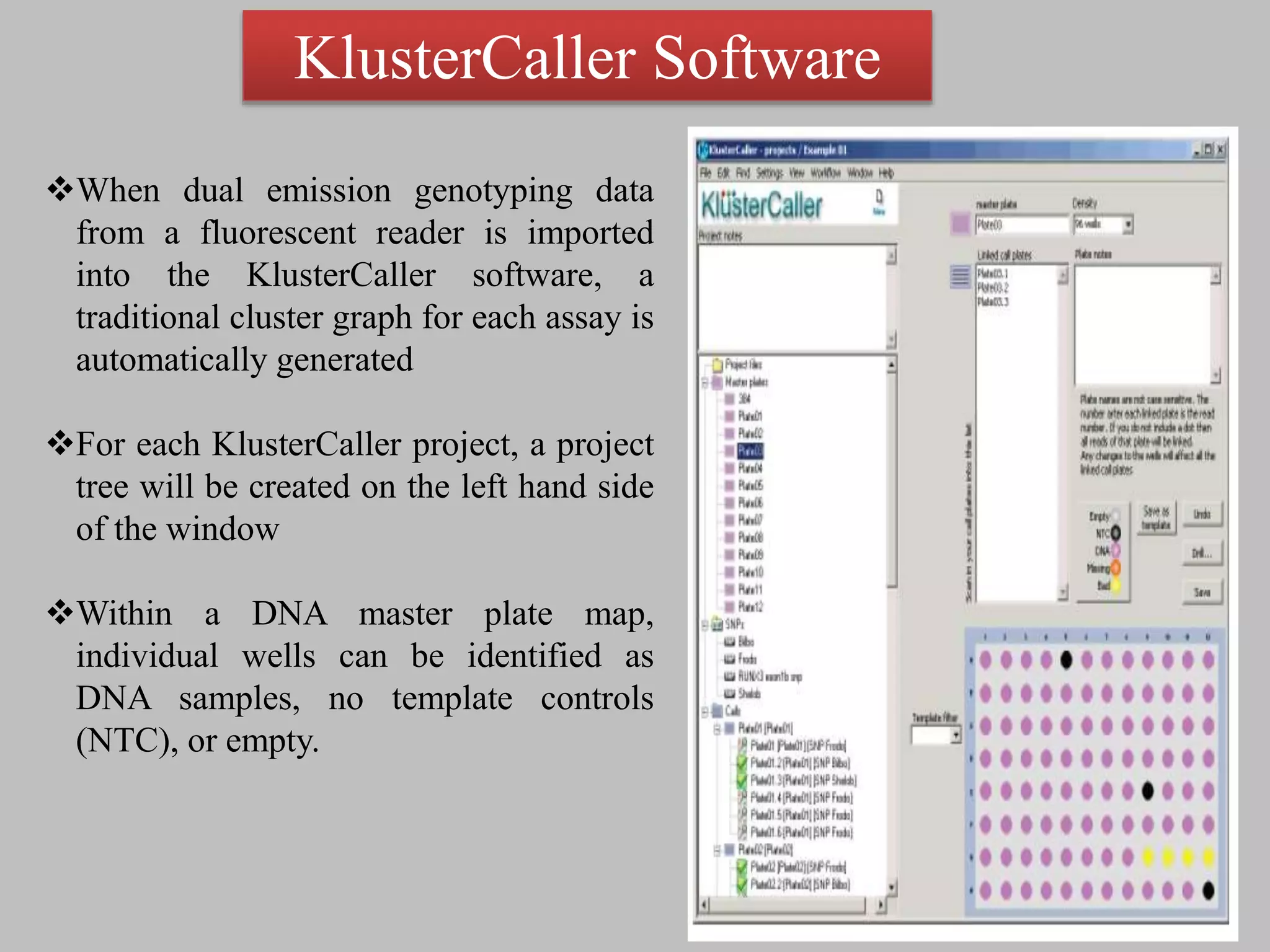
When dual emission genotyping data
from a fluorescent reader is imported
into the KlusterCaller software, a
traditional cluster graph for each assay is
automatically generated
For each KlusterCaller project, a project
tree will be created on the left hand side
of the window
Within a DNA master plate map,
individual wells can be identified as
DNA samples, no template controls
(NTC), or empty.
Genotyping data that is imported into a
KlusterCaller project will be displayed as a
Cartesian cluster plot
FAM values are plotted on the X axis and
HEX values are plotted on the Y axis,
Normalisation of results using ROX
(passive reference dye)
Blue data points are homozygous for the
allele reported by FAM, green data points
are heterozygous and red data points are
homozygous for the allele reported by
HEX
The black data points represent the no
template controls (NTC) and pink data
points are unconfirmed
KlusterCaller Software
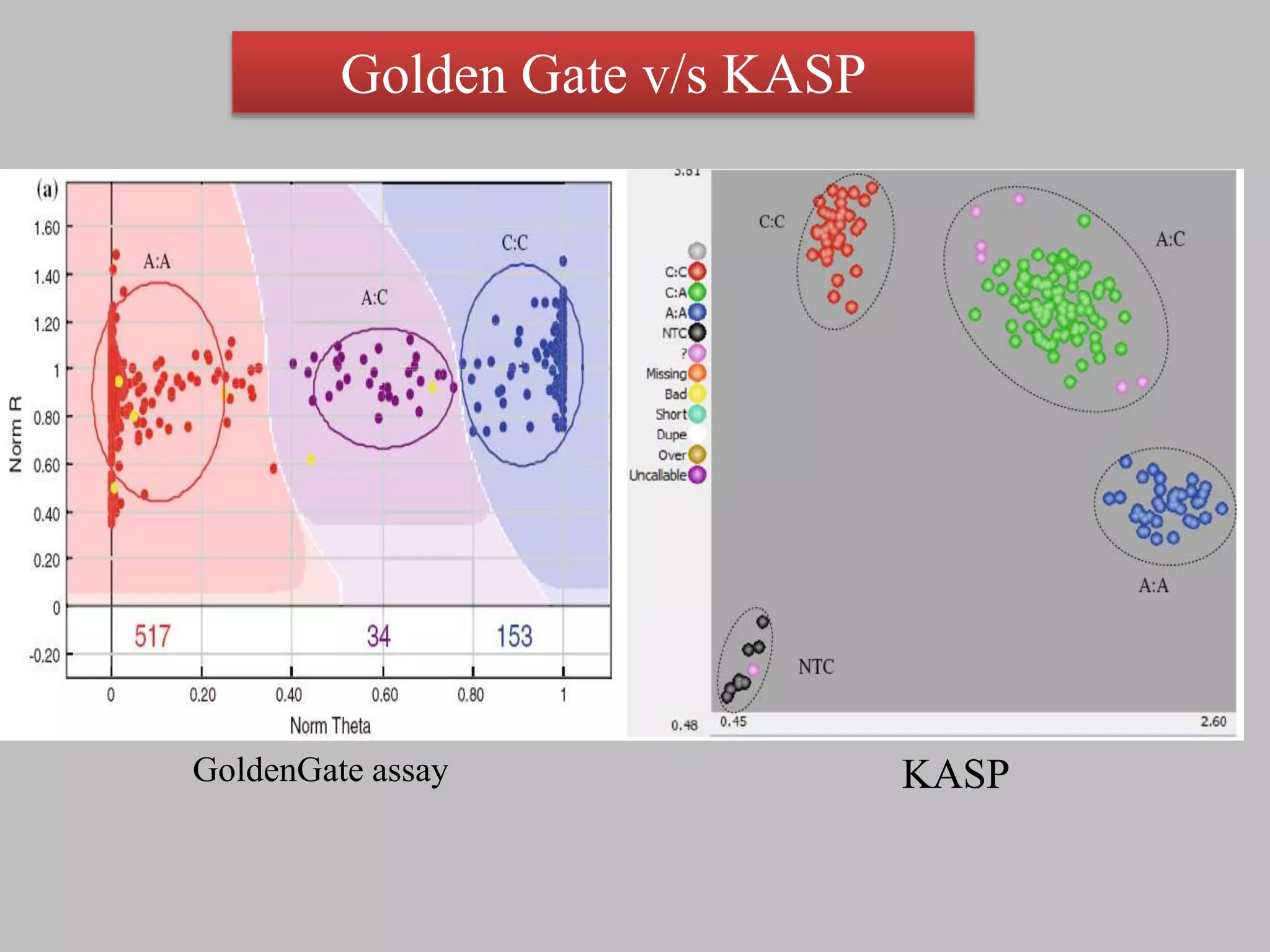
GoldenGate assay KASP
Golden Gate v/s KASP
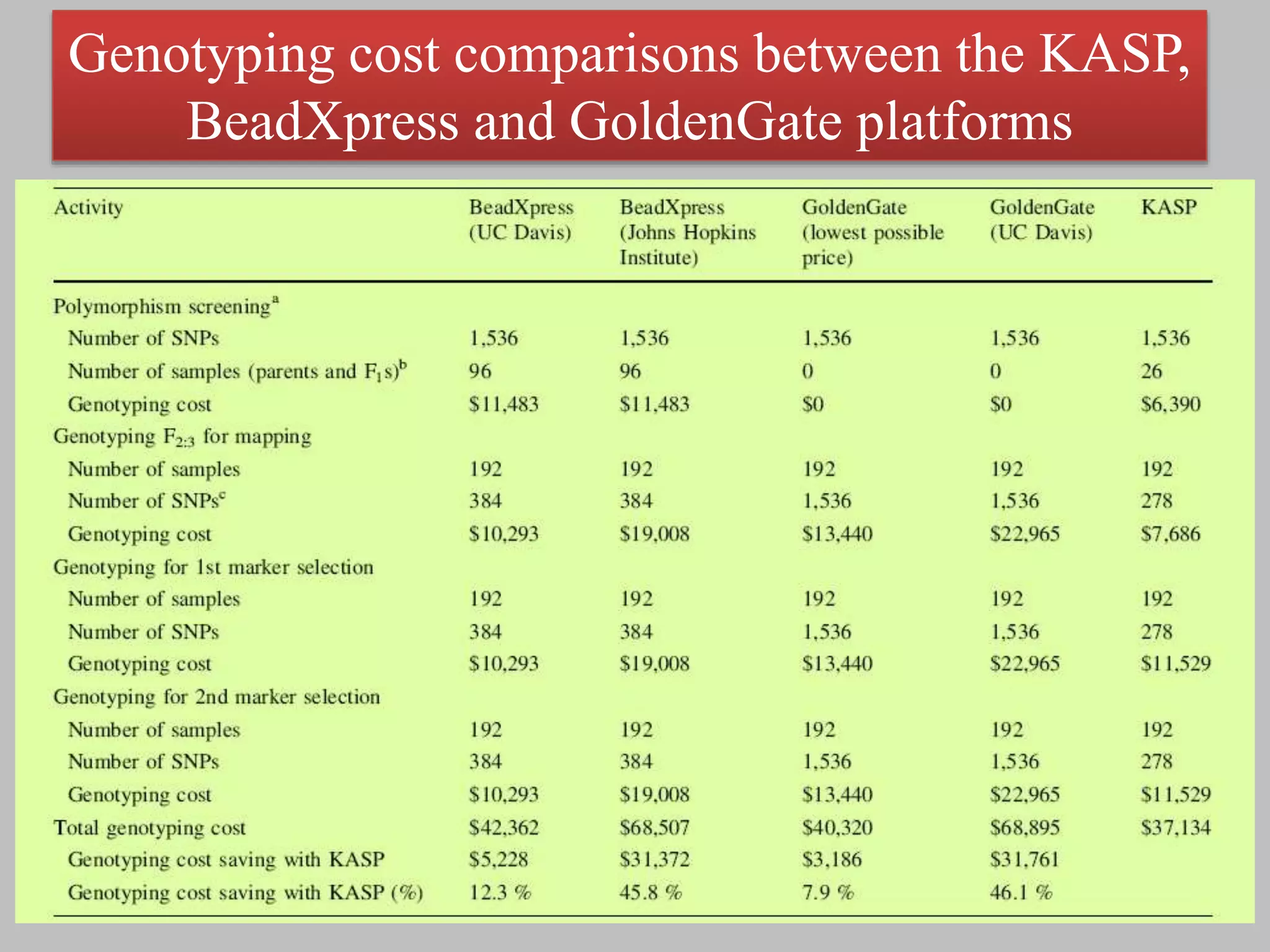
Genotyping cost comparisons between the KASP,
BeadXpress and GoldenGate platforms
KASP Applications
• Genotyping a wide range of species for various
purposes.
• KASP for Quality analysis, QTL mapping,
MARS, and allele mining
16
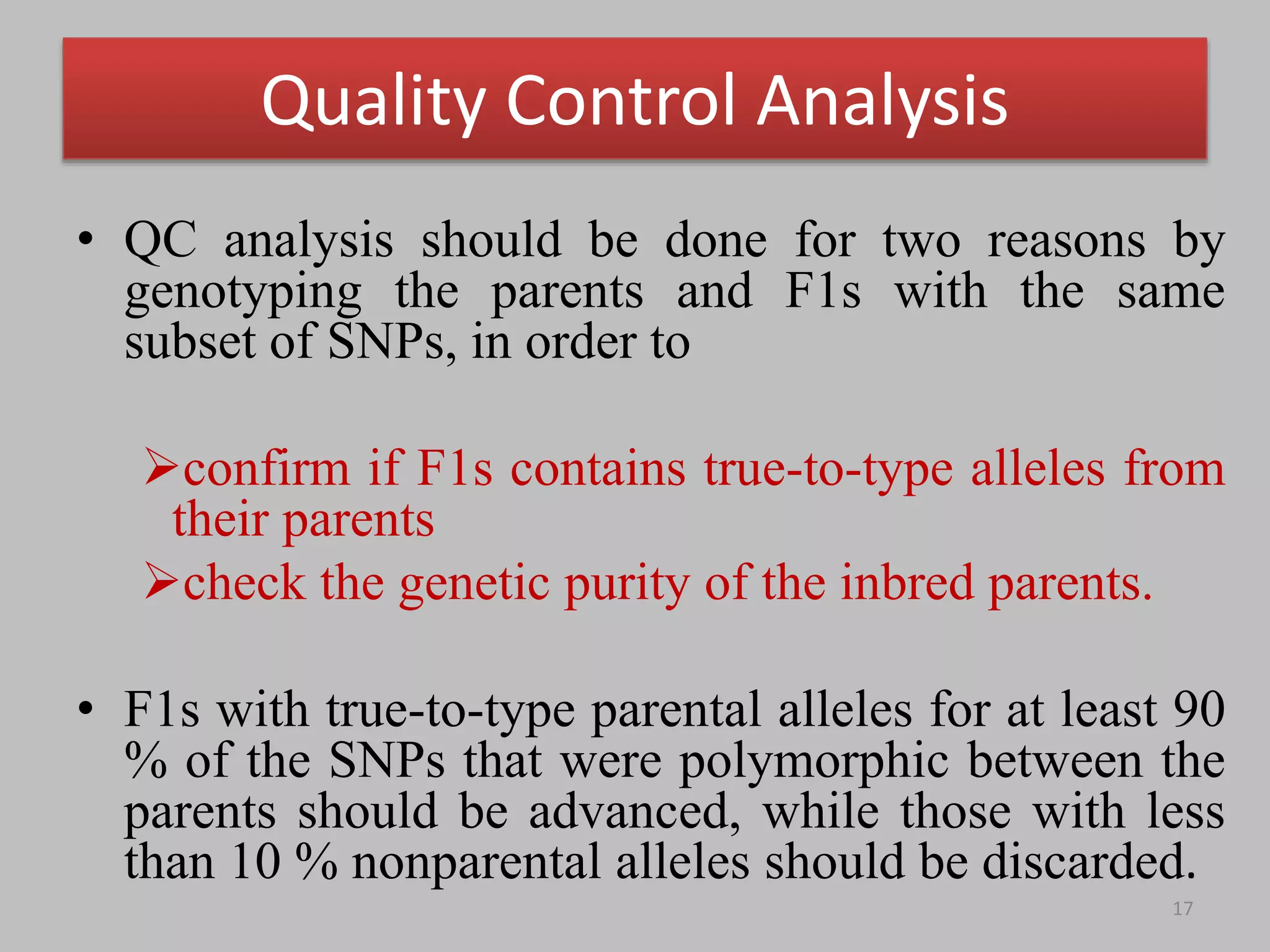
Quality Control Analysis
• QC analysis should be done for two reasons by
genotyping the parents and F1s with the same
subset of SNPs, in order to
confirm if F1s contains true-to-type alleles from
their parents
check the genetic purity of the inbred parents.
• F1s with true-to-type parental alleles for at least 90
% of the SNPs that were polymorphic between the
parents should be advanced, while those with less
than 10 % nonparental alleles should be discarded.
17
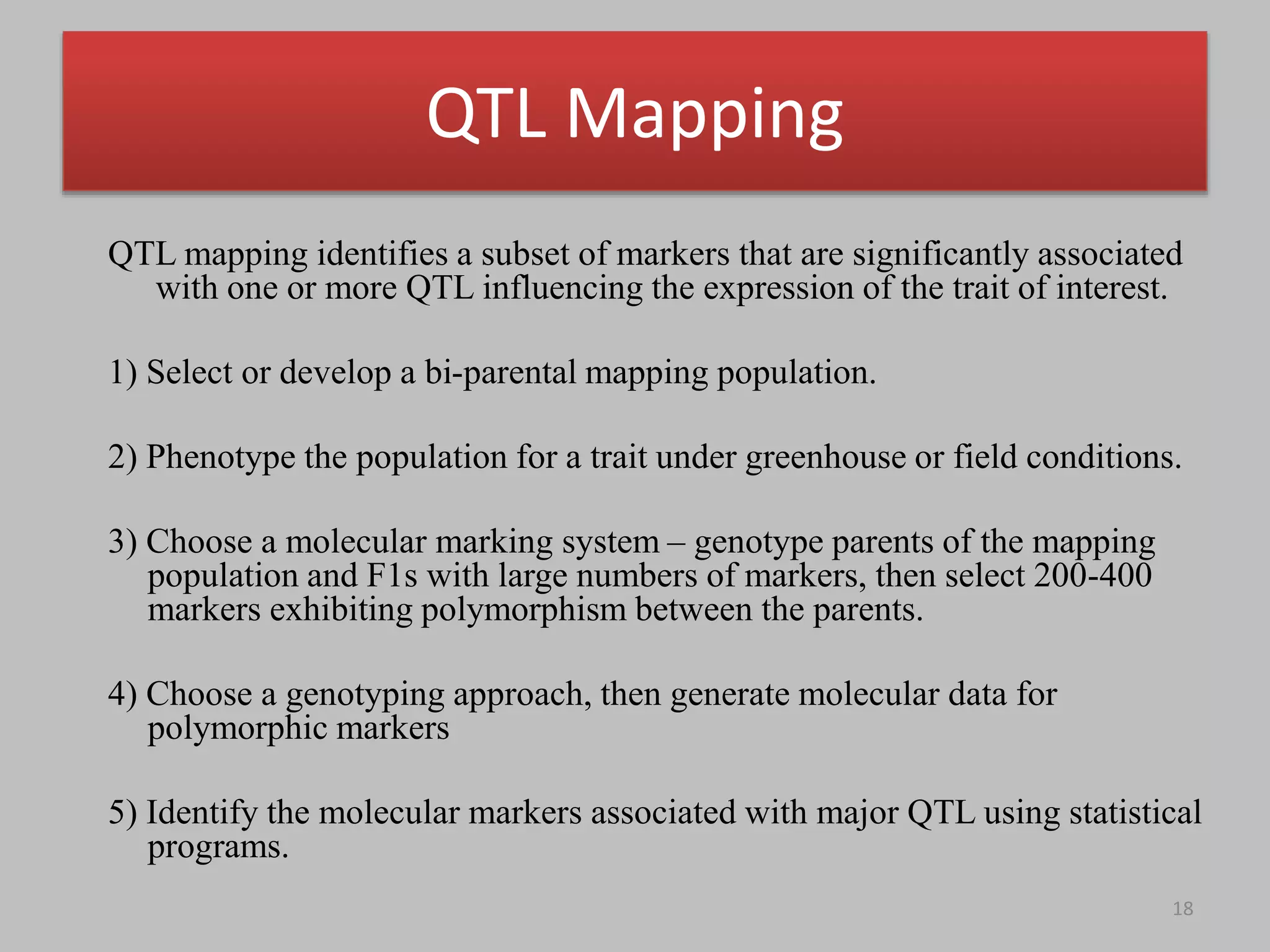
QTL Mapping
QTL mapping identifies a subset of markers that are significantly associated
with one or more QTL influencing the expression of the trait of interest.
1) Select or develop a bi-parental mapping population.
2) Phenotype the population for a trait under greenhouse or field conditions.
3) Choose a molecular marking system – genotype parents of the mapping
population and F1s with large numbers of markers, then select 200-400
markers exhibiting polymorphism between the parents.
4) Choose a genotyping approach, then generate molecular data for
polymorphic markers
5) Identify the molecular markers associated with major QTL using statistical
programs.
18
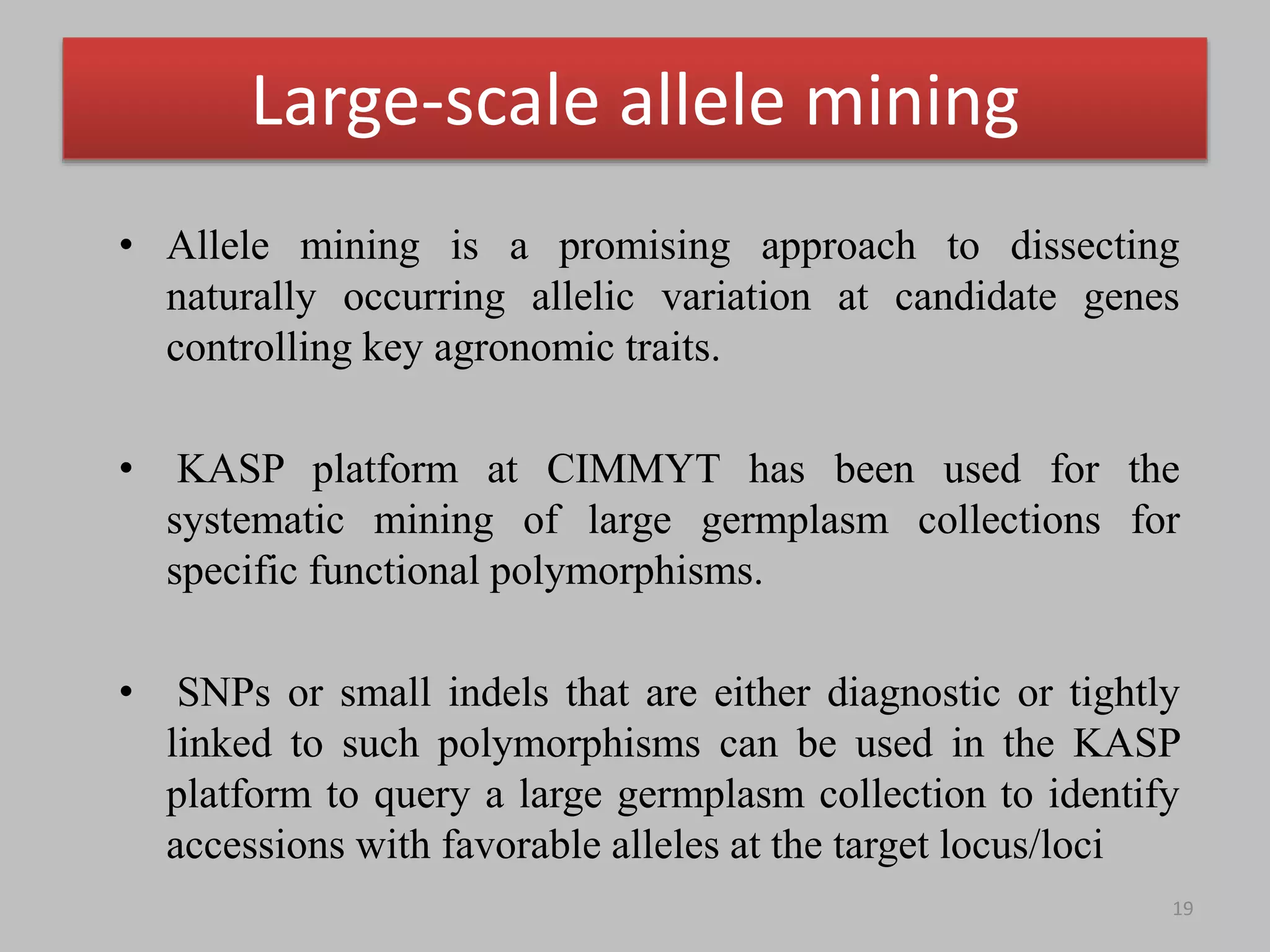
• Allele mining is a promising approach to dissecting
naturally occurring allelic variation at candidate genes
controlling key agronomic traits.
• KASP platform at CIMMYT has been used for the
systematic mining of large germplasm collections for
specific functional polymorphisms.
• SNPs or small indels that are either diagnostic or tightly
linked to such polymorphisms can be used in the KASP
platform to query a large germplasm collection to identify
accessions with favorable alleles at the target locus/loci
19
Large-scale allele mining
Reference
• www.cerealsdb.uk.net
• www.ksre.ksu.edu
• www.lgcgroup.com/_LGCGroup_media_PDFs_Products_Genotyping_KA
SP-genotyping-chemistry-User-guide.pdf_ext
• Semagn, K ., Raman Babu, Hearne, S. and Olsen, M. 2014. Single
nucleotide polymorphism genotyping usingKompetitive Allele
Specific PCR (KASP): overview of the technology and its
application in crop improvement. Mol Breeding 33:1–14
• http:/en.wikipedia.org/wiki/SNP_GENOTYPE
Page 21

Single Nucleotide Polymorphism Genotyping Using Kompetitive Allele Specific PCR (KASP)

  • 1.
    Page 1 Single NucleotidePolymorphism Genotyping Using Kompetitive Allele Specific PCR (KASP) Manglam Arya Msc.(Ag.) Biotechnology CPBMB, COH.
  • 2.
    Single Nucleotide Polymorphism •Single nucleotide polymorphism (SNP) refers to a single base change in a DNA sequence • SNP: Commonly biallelic • Two types(Based on presence in genome) Synonymus Non-synonymus • SNPs have largely replaced simple sequence repeats (SSRs)
  • 3.
    Advantage of usingSNPs Low assay cost High genomic abundance Locus specificity co-dominant inheritance Simple documentation Potential for high-throughput Analysis  Relatively low genotyping error rates
  • 4.
    • BeadXpressTM,GoldenGateTM and Infiniumfrom Illumina • GeneChipTM and GenFlexTM Tag array from Affimetrix • SNaPshotTM and TaqManTM from the Applied Biosystems • SNPWaveTM from KeyGene • iPLEX GoldTM Assay and Mass- RRAYTM from Sequonome 4 • SNPstreamTM from Beckman Coulter • Pyrosequencing from Royal Institute of Technology (Sweden) • Molecular inversion probes from ParAllele Biosciences • Competitive allele-specific PCR (currently called Kompetitive Allele Specific PCR, or KASPTM) from Kbioscience or LGC Genomics SNP genotyping platforms
  • 5.
    Variables to beconsidered  Throughput  Data turnaround  Time  Ease of use  Performance (sensitivity, reliability, reproducibility, and accuracy),  Flexibility (genotyping few samples with many snps or many samples with few snps),  Number of markers generated per run (uniplex versus multiplex assay capability)  Assay development requirements and genotyping cost per sample or data point. 5
  • 6.
    KASP KBioscience Competitive Allele-SpecificPCR Homogenous, Fluorescence-based genotyping technology, based on Allele-specific oligo extension (primer) Fluorescence resonance energy transfer  Determine both SNP and insertion/deletion genotypes  Analysis can be carried out in 96-, 384- and 1536- well plate formats
  • 7.
    1)Purified DNA sample(5-10ng) 2)Two allele-specific forward primers(Each primer contains a unique unlabelled tail sequence at the 5' end) 3) A common reverse primer 4)Two 5’ Fluro ‐labelled oligos, one labelled with FAM(Fluorescein Amidite) and another with HEX (FERT- Fluorescent Resonance Energy Transfer) 5) Two oligos, with quenchers bound at the 3‘ ends. Working of KASP
  • 8.
  • 11.
    Bi-allelic discrimination isachieved through the competitive binding of the two allele-specific forward primers If the genotype is homozygous, only one of the two possible fluorescent signals will be generated If the genotype is heterozygous, a mixed fluorescent signal will be generated
  • 12.
    KlusterCaller Software When dualemission genotyping data from a fluorescent reader is imported into the KlusterCaller software, a traditional cluster graph for each assay is automatically generated For each KlusterCaller project, a project tree will be created on the left hand side of the window Within a DNA master plate map, individual wells can be identified as DNA samples, no template controls (NTC), or empty.
  • 13.
    Genotyping data thatis imported into a KlusterCaller project will be displayed as a Cartesian cluster plot FAM values are plotted on the X axis and HEX values are plotted on the Y axis, Normalisation of results using ROX (passive reference dye) Blue data points are homozygous for the allele reported by FAM, green data points are heterozygous and red data points are homozygous for the allele reported by HEX The black data points represent the no template controls (NTC) and pink data points are unconfirmed KlusterCaller Software
  • 14.
  • 15.
    Genotyping cost comparisonsbetween the KASP, BeadXpress and GoldenGate platforms
  • 16.
    KASP Applications • Genotypinga wide range of species for various purposes. • KASP for Quality analysis, QTL mapping, MARS, and allele mining 16
  • 17.
    Quality Control Analysis •QC analysis should be done for two reasons by genotyping the parents and F1s with the same subset of SNPs, in order to confirm if F1s contains true-to-type alleles from their parents check the genetic purity of the inbred parents. • F1s with true-to-type parental alleles for at least 90 % of the SNPs that were polymorphic between the parents should be advanced, while those with less than 10 % nonparental alleles should be discarded. 17
  • 18.
    QTL Mapping QTL mappingidentifies a subset of markers that are significantly associated with one or more QTL influencing the expression of the trait of interest. 1) Select or develop a bi-parental mapping population. 2) Phenotype the population for a trait under greenhouse or field conditions. 3) Choose a molecular marking system – genotype parents of the mapping population and F1s with large numbers of markers, then select 200-400 markers exhibiting polymorphism between the parents. 4) Choose a genotyping approach, then generate molecular data for polymorphic markers 5) Identify the molecular markers associated with major QTL using statistical programs. 18
  • 19.
    • Allele miningis a promising approach to dissecting naturally occurring allelic variation at candidate genes controlling key agronomic traits. • KASP platform at CIMMYT has been used for the systematic mining of large germplasm collections for specific functional polymorphisms. • SNPs or small indels that are either diagnostic or tightly linked to such polymorphisms can be used in the KASP platform to query a large germplasm collection to identify accessions with favorable alleles at the target locus/loci 19 Large-scale allele mining
  • 20.
    Reference • www.cerealsdb.uk.net • www.ksre.ksu.edu •www.lgcgroup.com/_LGCGroup_media_PDFs_Products_Genotyping_KA SP-genotyping-chemistry-User-guide.pdf_ext • Semagn, K ., Raman Babu, Hearne, S. and Olsen, M. 2014. Single nucleotide polymorphism genotyping usingKompetitive Allele Specific PCR (KASP): overview of the technology and its application in crop improvement. Mol Breeding 33:1–14 • http:/en.wikipedia.org/wiki/SNP_GENOTYPE
  • 21.

Editor's Notes

  • #6 several aspects need be considered when selecting the most suitable genotyping platform for a specific application
  • #17 KASP can be used for genotyping a wide range of species for various purposes. CIMMYT routinely uses KASP for QC analysis, QTL mapping, MARS, and allele mining applications that require SNP data ranging from a few to several hundred data points per sample