Questions about MRIs
What are the
differences?
Closed Bore - Open MRI
Wide Bore
Closed Bore
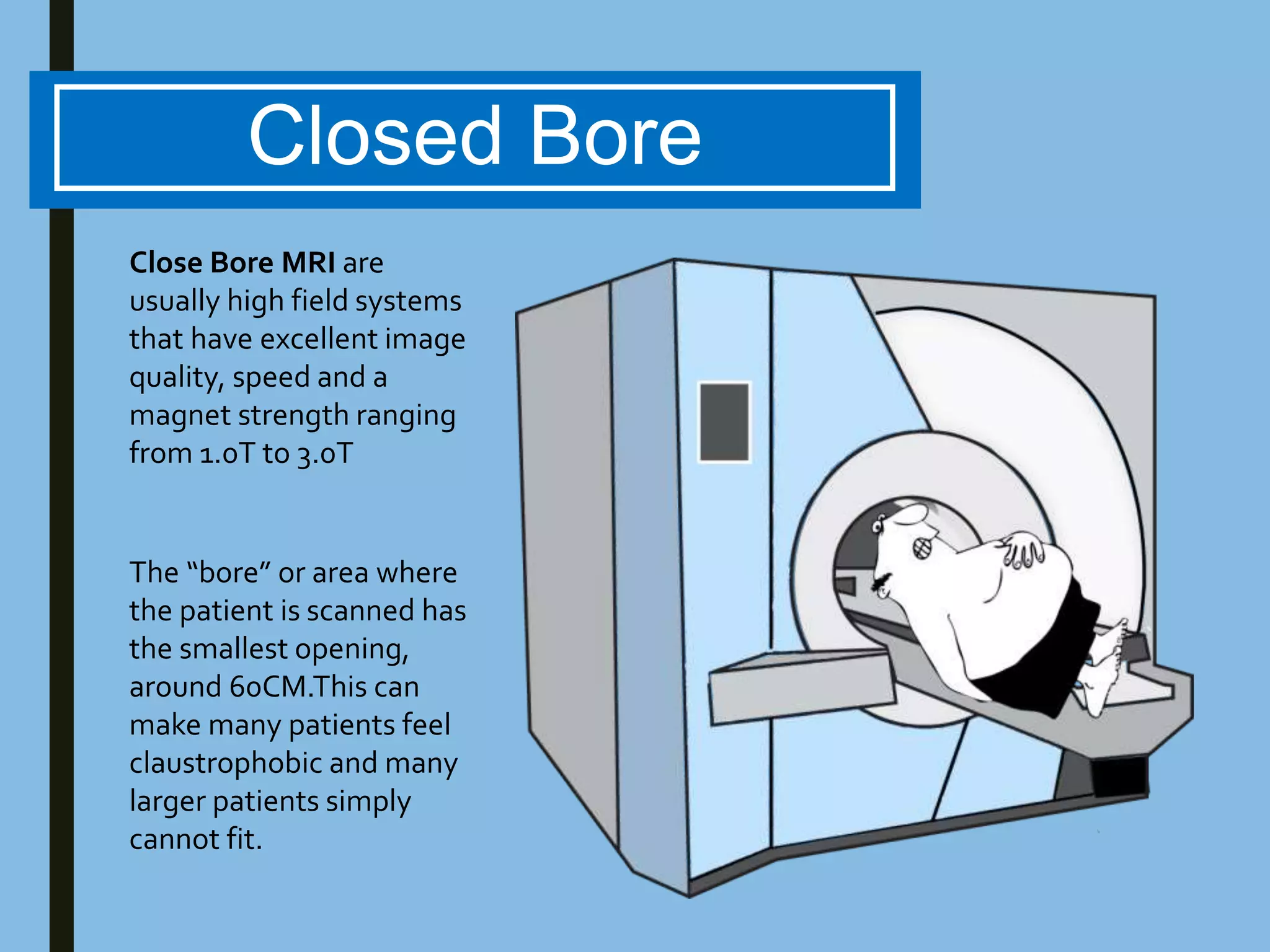
Close Bore MRI are
usually high field systems
that have excellent image
quality, speed and a
magnet strength ranging
from 1.0T to 3.0T
The “bore” or area where
the patient is scanned has
the smallest opening,
around 60CM.This can
make many patients feel
claustrophobic and many
larger patients simply
cannot fit.
Open MRI
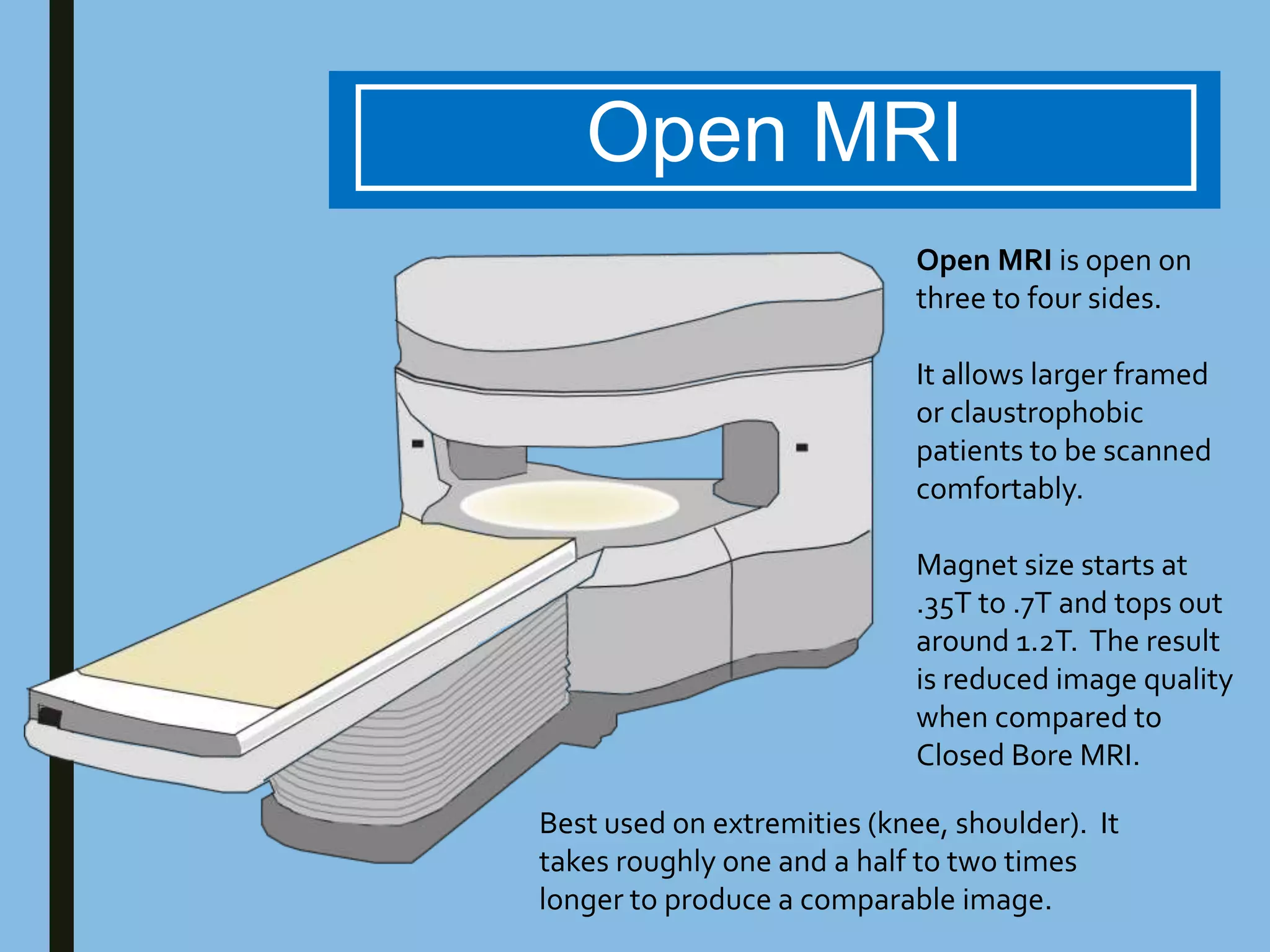
Open MRI is open on
three to four sides.
It allows larger framed
or claustrophobic
patients to be scanned
comfortably.
Magnet size starts at
.35T to .7T and tops out
around 1.2T. The result
is reduced image quality
when compared to
Closed Bore MRI.
Best used on extremities (knee, shoulder). It
takes roughly one and a half to two times
longer to produce a comparable image.
Wide Bore MRI
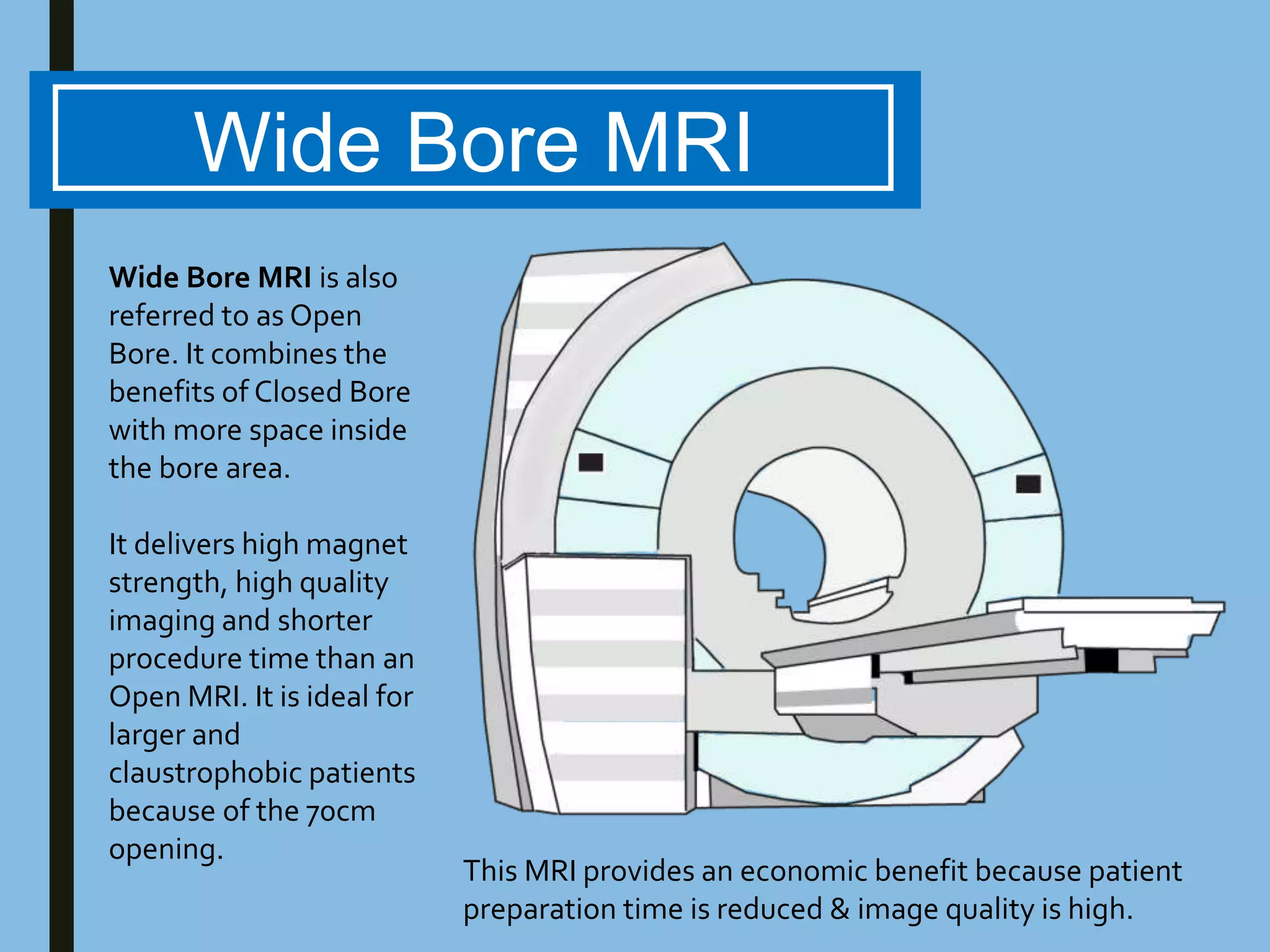
Wide Bore MRI is also
referred to as Open
Bore. It combines the
benefits of Closed Bore
with more space inside
the bore area.
It delivers high magnet
strength, high quality
imaging and shorter
procedure time than an
Open MRI. It is ideal for
larger and
claustrophobic patients
because of the 70cm
opening.
This MRI provides an economic benefit because patient
preparation time is reduced & image quality is high.
Comparing the Strength of an
MRI
Let’s say:
A .35T Magnet is a Nissan Maxima
A 1.5T Magnet is a Audi A5
A 3T Magnet is a Maserati
The Audi A5 and Nissan Maxima are
similar to each other but the Audi has
more features, a better reputation and
more advantages.
The Maserati is clearly in a league of its
own but not practical for all purposes:
• Can’t fit more then 2 people
• Can’t carry luggage
• Sits to Low to ground
• Goes so fast you might get a ticket
Today the 1.5T is considered the standard MRI in a clinical setting.
1.5T is ideal for abdomens and chests scans where a patient is asked to hold their
breath since it is faster than lower strength MRI machines. There is more signal with
a 1.5T magnet so you can run shorter times and have higher image quality.
High field no longer means better images while Open technology continues to
improve.You can achieve great images by setting up proper parameters and
protocols based on the MRI you chose.
If you have any questions please contact our expert team at Atlantis, we can guide
you through the process!
Choosing an MRI
info@atlantisworldwide.com 212-366-9100 www.atlantisworldwide.com
Sensible Solutions for Refurbished Radiology

MRI Differences: Closed Bore, Open MRI & Wide Bore

  • 1.
    Questions about MRIs Whatare the differences? Closed Bore - Open MRI Wide Bore
  • 2.
    Closed Bore Close BoreMRI are usually high field systems that have excellent image quality, speed and a magnet strength ranging from 1.0T to 3.0T The “bore” or area where the patient is scanned has the smallest opening, around 60CM.This can make many patients feel claustrophobic and many larger patients simply cannot fit.
  • 3.
    Open MRI Open MRIis open on three to four sides. It allows larger framed or claustrophobic patients to be scanned comfortably. Magnet size starts at .35T to .7T and tops out around 1.2T. The result is reduced image quality when compared to Closed Bore MRI. Best used on extremities (knee, shoulder). It takes roughly one and a half to two times longer to produce a comparable image.
  • 4.
    Wide Bore MRI WideBore MRI is also referred to as Open Bore. It combines the benefits of Closed Bore with more space inside the bore area. It delivers high magnet strength, high quality imaging and shorter procedure time than an Open MRI. It is ideal for larger and claustrophobic patients because of the 70cm opening. This MRI provides an economic benefit because patient preparation time is reduced & image quality is high.
  • 5.
    Comparing the Strengthof an MRI Let’s say: A .35T Magnet is a Nissan Maxima A 1.5T Magnet is a Audi A5 A 3T Magnet is a Maserati
  • 6.
    The Audi A5and Nissan Maxima are similar to each other but the Audi has more features, a better reputation and more advantages. The Maserati is clearly in a league of its own but not practical for all purposes: • Can’t fit more then 2 people • Can’t carry luggage • Sits to Low to ground • Goes so fast you might get a ticket
  • 7.
    Today the 1.5Tis considered the standard MRI in a clinical setting. 1.5T is ideal for abdomens and chests scans where a patient is asked to hold their breath since it is faster than lower strength MRI machines. There is more signal with a 1.5T magnet so you can run shorter times and have higher image quality. High field no longer means better images while Open technology continues to improve.You can achieve great images by setting up proper parameters and protocols based on the MRI you chose. If you have any questions please contact our expert team at Atlantis, we can guide you through the process! Choosing an MRI info@atlantisworldwide.com 212-366-9100 www.atlantisworldwide.com Sensible Solutions for Refurbished Radiology