• INTRODUCTION
• HISTORY
• BASIC PRINCIPLE
• TOUCH INTERFACE PANEL
• APPLICATIONS
• ADVANTAGES
• DISADVANTAGES
• TECHNICAL CONSIDERATION
• RADIATION DOSE
• CONCLUSION
:
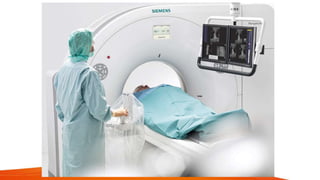
 CT fluoroscopy combines the cross-sectional image targeting provided
by CT with the real-time imaging, tracking and movement perception of
fluoroscopy for interventional procedures. It allows continuous update of
images at a fixed position and is commonly used for CT-guided biopsies
and fluid drainages.
 Computed tomography (CT) fluoroscopy combines the conventional
advantages of both CT and fluoroscopy and has an important role in
image-guided interventions where real-time imaging is required.
REF: https://doi.org/10.53347/rID-62860
The first scanner with CT fluoroscopic capability was developed in 1993
by Dr. Katada
 FDA approved the use of CTF in 1995.
 Since its introduction , real time CT has been used for optimization of
scan timing in contrast studies, as well as for guidance in biopsy or
drainage procedures.
https://thancguide.org/2021/03/the-journey/patients-journey/a-surprising-new-
imaging-technique-fluoroscopic-ct-scanning
:
Display of constantly updated images produced by continuous
rotation of CT tube
Couch position controlled by operator
Generally performed at same KV, but lower mA than
conventional CT scanning
@120kV, 50mA for CT fluoroscopy
@ 120kV, 200-300mA for conventional CT
Ref:CT History (slideshare.net)
• CT fluoroscopy can be an excellent tool for reducing radiation
dose and saving time on fluoroscopy procedures
• It also provides substantial dose reduction over conventional
CT guidance for procedures like lesion biopsy and drainage.
• CT fluoro is enabled through a combination of
A software suite and
A set of hardware
REF:https://info.blockimaging.com
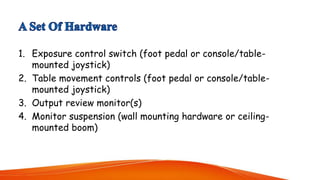
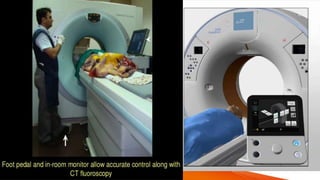
1. Exposure control switch (foot pedal or console/table-
mounted joystick)
2. Table movement controls (foot pedal or console/table-
mounted joystick)
3. Output review monitor(s)
4. Monitor suspension (wall mounting hardware or ceiling-
mounted boom)
How it works?
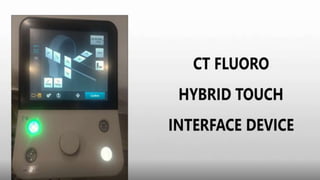
• Activation of touch interface panel
• Setting the couch speed and gantry position
• Setting the target
• Move in / Move out
• Activate laser
• Scan
• Fine Tuning with joystick
• Image or series review
Fluoroscopy software suite of real time CT is dependent on following
factors :
 Fast continuous scanning
 Fast image reconstruction
 Real time image display
REF:http://www.impactscan.org/slides/ctfluoroscopy/sld005.htm
The continuous scanning is possible because of Slip Ring Technology, with
no interscan delay for unwinding of connecting cables.
It thus reduces the scan time also and subsequently helps decrease the patient
dose
SYSTEM REQUIRMENTS :
 Slip rings for continuous scanning
 Fast tube rotation (1s or less)>>some newer systems have 0.5s rotation
 High heat capacity tube to allow extended scanning times if necessary
 Fast image reconstruction, capable of providing upwards of 6-12 frames per
second .
 At any given time, it provides 6 real time images ,that constitute a frame. Like,
for 1 rotation of CT (360°) takes about 1 second, and in every 60° one image
is produced. Therefore six images are produced for one gantry rotation.
 After one rotation in one second , the CT performs the second rotation and
produces the seventh real time image. Now, this image is added and the 1st image
is discarded .Thus 6 images or frames are obtained at a time.
 Sometimes motion artefacts may be seen on the images and appear as streaks ,
however these do not restrict the visualisation of important structure.
The data is collected on a defined matrix size of (256×256), which is then
interpolated to a larger matrix (1024×1024) for better resolution.
 Images are subsequently displayed on the monitor kept in the operating room
on the Cine mode with a frame rate of 6-12 per second.
 Biopsies
 Needle placement
 Fluid collection
 Aspiration
 Drainage
 PCNL
 Arthrography
 Nerve root blocks
 Vertebroplasty
 PCN
 Low MillIampher Technique for reduction in radiation dose.
 Reduction of procedure time.
 Quick Check Method
 Real Time Imaging
 Dedicated High Speed Array Processor
 Potential for increased procedure effeciency and accuracy leading to higher
diagnostics yeild .
Overlapping structures can be removed, providing accurate spatial information
Real-time display of images
Consequent reduction in complications through finer needle control
Reduced procedure time
Increased operator confidence
 Large radiation doses to both patient and operator.
 Limited FOV / scanning range.
 Poor image quality due to low mA , because of the appearance of noise.
 Increased investment in more powerful hardware and specialized software
needed.
The Doctor may want to obtain highly accurate imaging
They may wish to provide the patient with shorter intervention time which
may decrease the radiation exposure
Real time view of the body may give the doctor more information to make
better decisions
https://thancguide.org/2021/03/the-journey/patients-journey/a-surprising-new-imaging-
technique-fluoroscopic-ct-scanning
 Video monitor will need to be displayed in the scanning room
 An operator panel is required in the scanning room – with controls available for table
movement, gantry lift, laser light control and fluoroscopic factors. Exposures will
usually be activated using a footswitch
 Involves an x-ray tube current of 30-50 ma
 Need for additional beam filtration to decrease patient dose exposure.
 Multislice machines have finer z-axis resolution.
 CT fluoroscopy requires special techniques for image reconstruction, due to the need for
rapid imaging.
Manufacturer /
Model
CT Flouro
System
KV / ma Settings Rotation Time (s)
Patient Skin
Dose Rate
(mGy/s)
IGE HiSpeed CT/i Smart View 120 / 50 0.8 / 1.0 3.2
Picker UltraZ CCT / BolusPro 120 / 30 1 4.1
Siemens Somaton CARE Vision 120 / 50 0.75 / 1 4 .0
Toshiba Asteion* Aspire CI 120 / 50 0.75 / 1 3.3
REF: https://doi.org/10.53347/rID-62862
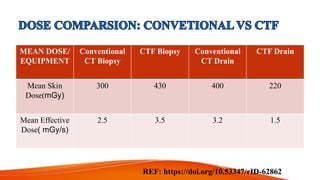
MEAN DOSE/
EQUIPMENT
Conventional
CT Biopsy
CTF Biopsy Conventional
CT Drain
CTF Drain
Mean Skin
Dose(mGy)
300 430 400 220
Mean Effective
Dose( mGy/s)
2.5 3.5 3.2 1.5
REF: https://doi.org/10.53347/rID-62862
• CT fluoroscopy is a recently developed acquisition mode that allows faster
imaging reconstruction, near continuous image update and convenient in room
table control and image viewing during procedure .
• Acceptable radiation dose rate to patient and operator, is user friendly and
guides interventional procedures with rapidity.
• Operators have to adopt techniques that will minimize the risk of putting their
fingers in the beam
Reference:
• https://doi.org/10.53347/rID-62862
• https://thancguide.org/2021/03/the-journey/patients-
journey/a-surprising-new-imaging-technique-fluoroscopic-
ct-scanning
• https://doi.org/10.53347/rID-62860
• http://www.impactscan.org/slides/ctfluoroscopy/sld005.htm
• https://info.blockimaging.com
Q&A
1. What are the Basic principle of CT Fluoroscopy?
2. Technique in CT Fluoroscopy?
3. Fast continuous scanning possible by?
Thanks u for great opportunity

CT fluoroscopy1 (1).pptx

  • 2.
    • INTRODUCTION • HISTORY •BASIC PRINCIPLE • TOUCH INTERFACE PANEL • APPLICATIONS • ADVANTAGES • DISADVANTAGES • TECHNICAL CONSIDERATION • RADIATION DOSE • CONCLUSION
  • 3.
    :  CT fluoroscopycombines the cross-sectional image targeting provided by CT with the real-time imaging, tracking and movement perception of fluoroscopy for interventional procedures. It allows continuous update of images at a fixed position and is commonly used for CT-guided biopsies and fluid drainages.  Computed tomography (CT) fluoroscopy combines the conventional advantages of both CT and fluoroscopy and has an important role in image-guided interventions where real-time imaging is required. REF: https://doi.org/10.53347/rID-62860
  • 4.
    The first scannerwith CT fluoroscopic capability was developed in 1993 by Dr. Katada  FDA approved the use of CTF in 1995.  Since its introduction , real time CT has been used for optimization of scan timing in contrast studies, as well as for guidance in biopsy or drainage procedures. https://thancguide.org/2021/03/the-journey/patients-journey/a-surprising-new- imaging-technique-fluoroscopic-ct-scanning
  • 6.
    : Display of constantlyupdated images produced by continuous rotation of CT tube Couch position controlled by operator Generally performed at same KV, but lower mA than conventional CT scanning @120kV, 50mA for CT fluoroscopy @ 120kV, 200-300mA for conventional CT Ref:CT History (slideshare.net)
  • 7.
    • CT fluoroscopycan be an excellent tool for reducing radiation dose and saving time on fluoroscopy procedures • It also provides substantial dose reduction over conventional CT guidance for procedures like lesion biopsy and drainage.
  • 8.
    • CT fluorois enabled through a combination of A software suite and A set of hardware REF:https://info.blockimaging.com
  • 9.
    1. Exposure controlswitch (foot pedal or console/table- mounted joystick) 2. Table movement controls (foot pedal or console/table- mounted joystick) 3. Output review monitor(s) 4. Monitor suspension (wall mounting hardware or ceiling- mounted boom)
  • 14.
    How it works? •Activation of touch interface panel • Setting the couch speed and gantry position • Setting the target • Move in / Move out • Activate laser • Scan • Fine Tuning with joystick • Image or series review
  • 15.
    Fluoroscopy software suiteof real time CT is dependent on following factors :  Fast continuous scanning  Fast image reconstruction  Real time image display REF:http://www.impactscan.org/slides/ctfluoroscopy/sld005.htm
  • 16.
    The continuous scanningis possible because of Slip Ring Technology, with no interscan delay for unwinding of connecting cables. It thus reduces the scan time also and subsequently helps decrease the patient dose SYSTEM REQUIRMENTS :  Slip rings for continuous scanning  Fast tube rotation (1s or less)>>some newer systems have 0.5s rotation  High heat capacity tube to allow extended scanning times if necessary
  • 17.
     Fast imagereconstruction, capable of providing upwards of 6-12 frames per second .  At any given time, it provides 6 real time images ,that constitute a frame. Like, for 1 rotation of CT (360°) takes about 1 second, and in every 60° one image is produced. Therefore six images are produced for one gantry rotation.  After one rotation in one second , the CT performs the second rotation and produces the seventh real time image. Now, this image is added and the 1st image is discarded .Thus 6 images or frames are obtained at a time.  Sometimes motion artefacts may be seen on the images and appear as streaks , however these do not restrict the visualisation of important structure.
  • 19.
    The data iscollected on a defined matrix size of (256×256), which is then interpolated to a larger matrix (1024×1024) for better resolution.  Images are subsequently displayed on the monitor kept in the operating room on the Cine mode with a frame rate of 6-12 per second.
  • 20.
     Biopsies  Needleplacement  Fluid collection  Aspiration  Drainage  PCNL  Arthrography  Nerve root blocks  Vertebroplasty  PCN
  • 21.
     Low MillIampherTechnique for reduction in radiation dose.  Reduction of procedure time.  Quick Check Method  Real Time Imaging  Dedicated High Speed Array Processor  Potential for increased procedure effeciency and accuracy leading to higher diagnostics yeild .
  • 22.
    Overlapping structures canbe removed, providing accurate spatial information Real-time display of images Consequent reduction in complications through finer needle control Reduced procedure time Increased operator confidence
  • 23.
     Large radiationdoses to both patient and operator.  Limited FOV / scanning range.  Poor image quality due to low mA , because of the appearance of noise.  Increased investment in more powerful hardware and specialized software needed.
  • 24.
    The Doctor maywant to obtain highly accurate imaging They may wish to provide the patient with shorter intervention time which may decrease the radiation exposure Real time view of the body may give the doctor more information to make better decisions https://thancguide.org/2021/03/the-journey/patients-journey/a-surprising-new-imaging- technique-fluoroscopic-ct-scanning
  • 25.
     Video monitorwill need to be displayed in the scanning room  An operator panel is required in the scanning room – with controls available for table movement, gantry lift, laser light control and fluoroscopic factors. Exposures will usually be activated using a footswitch  Involves an x-ray tube current of 30-50 ma  Need for additional beam filtration to decrease patient dose exposure.  Multislice machines have finer z-axis resolution.  CT fluoroscopy requires special techniques for image reconstruction, due to the need for rapid imaging.
  • 26.
    Manufacturer / Model CT Flouro System KV/ ma Settings Rotation Time (s) Patient Skin Dose Rate (mGy/s) IGE HiSpeed CT/i Smart View 120 / 50 0.8 / 1.0 3.2 Picker UltraZ CCT / BolusPro 120 / 30 1 4.1 Siemens Somaton CARE Vision 120 / 50 0.75 / 1 4 .0 Toshiba Asteion* Aspire CI 120 / 50 0.75 / 1 3.3 REF: https://doi.org/10.53347/rID-62862
  • 27.
    MEAN DOSE/ EQUIPMENT Conventional CT Biopsy CTFBiopsy Conventional CT Drain CTF Drain Mean Skin Dose(mGy) 300 430 400 220 Mean Effective Dose( mGy/s) 2.5 3.5 3.2 1.5 REF: https://doi.org/10.53347/rID-62862
  • 31.
    • CT fluoroscopyis a recently developed acquisition mode that allows faster imaging reconstruction, near continuous image update and convenient in room table control and image viewing during procedure . • Acceptable radiation dose rate to patient and operator, is user friendly and guides interventional procedures with rapidity. • Operators have to adopt techniques that will minimize the risk of putting their fingers in the beam
  • 32.
    Reference: • https://doi.org/10.53347/rID-62862 • https://thancguide.org/2021/03/the-journey/patients- journey/a-surprising-new-imaging-technique-fluoroscopic- ct-scanning •https://doi.org/10.53347/rID-62860 • http://www.impactscan.org/slides/ctfluoroscopy/sld005.htm • https://info.blockimaging.com
  • 33.
    Q&A 1. What arethe Basic principle of CT Fluoroscopy? 2. Technique in CT Fluoroscopy? 3. Fast continuous scanning possible by?
  • 34.
    Thanks u forgreat opportunity