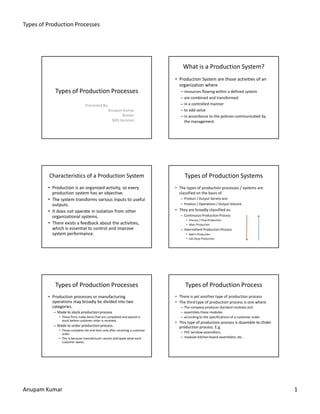
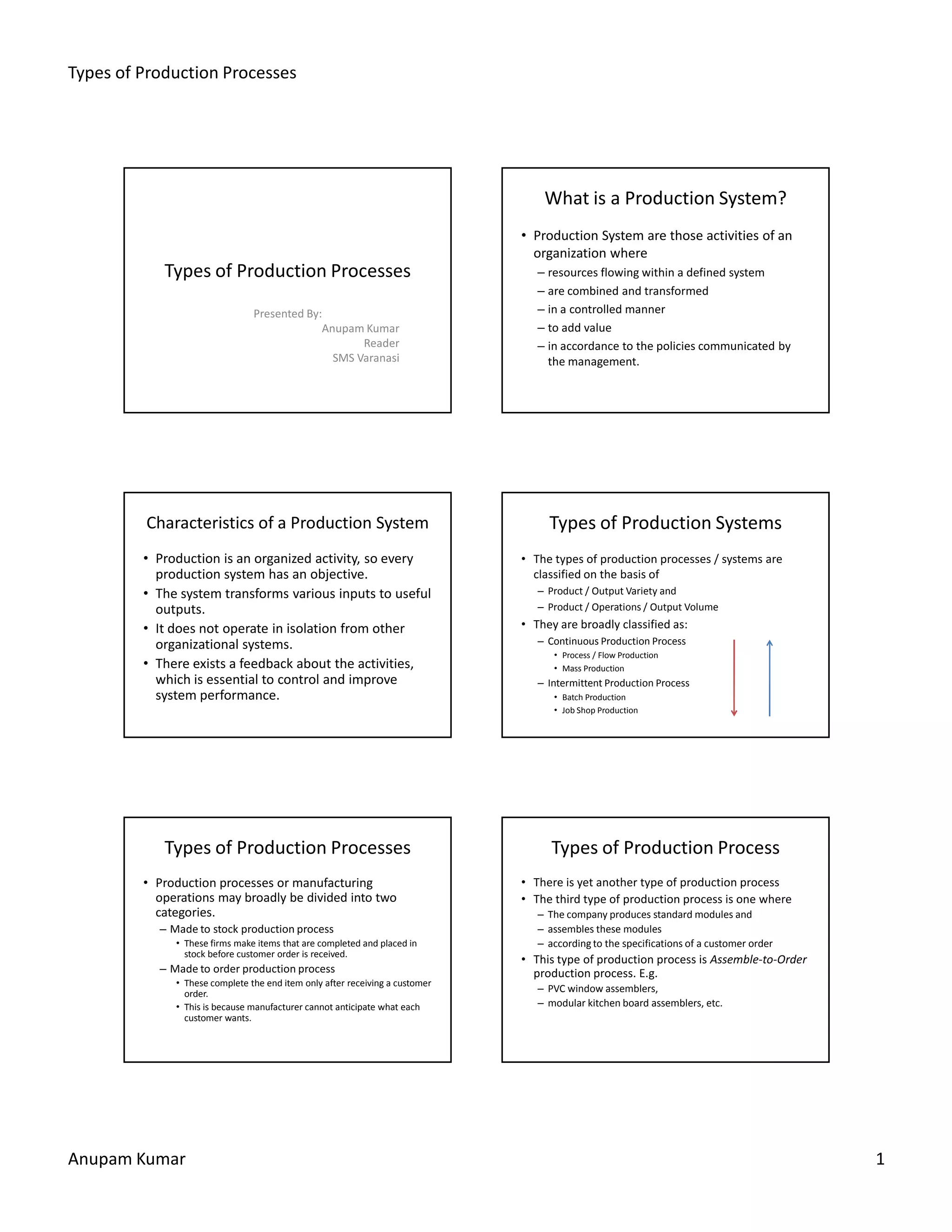
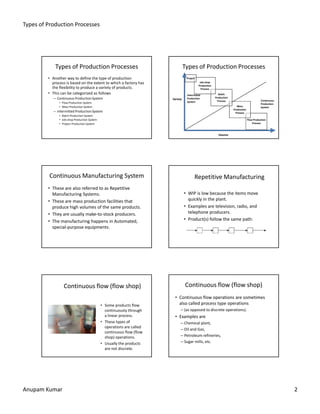
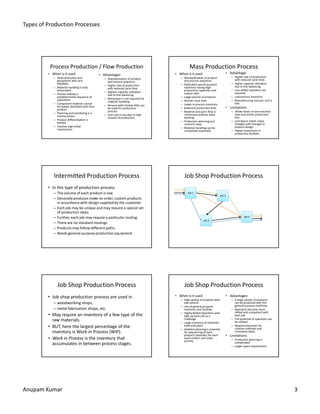
Types of Production Processes


                                                                                  What is a Production System?
                                                                              • Production System are those activities of an
                                                                                organization where
            Types of Production Processes                                        – resources flowing within a defined system
                                                                                 – are combined and transformed
                                Presented By:                                    – in a controlled manner
                                             Anupam Kumar                        – to add value
                                                    Reader                       – in accordance to the policies communicated by
                                               SMS Varanasi                        the management.


         Characteristics of a Production System                                    Types of Production Systems
         • Production is an organized activity, so every                      • The types of production processes / systems are
           production system has an objective.                                  classified on the basis of
         • The system transforms various inputs to useful                        – Product / Output Variety and
           outputs.                                                              – Product / Operations / Output Volume

         • It does not operate in isolation from other                        • They are broadly classified as:
           organizational systems.                                               – Continuous Production Process
                                                                                    • Process / Flow Production
         • There exists a feedback about the activities,                            • Mass Production
           which is essential to control and improve                             – Intermittent Production Process
           system performance.                                                      • Batch Production
                                                                                    • Job Shop Production


            Types of Production Processes                                           Types of Production Process
         • Production processes or manufacturing                              • There is yet another type of production process
           operations may broadly be divided into two                         • The third type of production process is one where
           categories.                                                           – The company produces standard modules and
           – Made to stock production process                                    – assembles these modules
              • These firms make items that are completed and placed in          – according to the specifications of a customer order
                stock before customer order is received.
                                                                              • This type of production process is Assemble-to-Order
           – Made to order production process                                   production process. E.g.
              • These complete the end item only after receiving a customer
                order.                                                           – PVC window assemblers,
              • This is because manufacturer cannot anticipate what each         – modular kitchen board assemblers, etc.
                customer wants.


Anupam Kumar                                                                                                                             1
Types of Production Processes


             Types of Production Processes                                        Types of Production Processes
         • Another way to define the type of production                            Project
           process is based on the extent to which a factory has                              Job-shop
                                                                                             Production
           the flexibility to produce a variety of products.                                   Process
         • This can be categorized as follows                                      Intermitted               Batch
            – Continuous Production System                                         Production             Production
                                                                        Variety                                                                Continuous
                                                                                   System                   Process
               • Flow Production System                                                                                                        Production
               • Mass Production System                                                                                   Mass                 System
                                                                                                                       Production
            – Intermitted Production System                                                                              Process
               • Batch Production System
               • Job-shop Production System                                                                                         Flow Production
               • Project Production System                                                                                              Process


                                                                                                            Volume


          Continuous Manufacturing System                                                Repetitive Manufacturing
         • These are also referred to as Repetitive
           Manufacturing Systems.                                                 • WIP is low because the items move
         • These are mass production facilities that                                quickly in the plant.
           produce high volumes of the same products.                             • Examples are television, radio, and
         • They are usually make-to-stock producers.                                telephone producers.
         • The manufacturing happens in Automated,                                • Product(s) follow the same path:
           special-purpose equipments.


                  Continuous flow (flow shop)                                     Continuous flow (flow shop)
                                                                         • Continuous flow operations are sometimes
                                              • Some products flow         also called process type operations
                                                continuously through          – (as opposed to discrete operations).
                                                a linear process.        • Examples are
                                              • These types of                – Chemical plant,
                                                operations are called
                                                                              – Oil and Gas,
                                                continuous flow (flow
                                                shop) operations.             – Petroleum refineries,
                                              • Usually the products          – Sugar mills, etc.
                                                are not discrete.


Anupam Kumar                                                                                                                                                2
Types of Production Processes


          Process Production / Flow Production                                                    Mass Production Process
         • When is it used:                                                             • When is it used:                        • Advantage:
                                                 • Advantages:
            – Dedicated plant and                                                          – Standardization of product              – Higher rate of production
                                                    – Standardization of product                                                       with reduced cycle time.
              equipment with zero                     and process sequence                   and process sequence
              flexibility                                                                  – Dedicated special purpose               – Higher capacity utilization
                                                    – Higher rate of production                                                        due to line balancing
            – Material handling is fully              with reduced cycle time.               machines having high
              automated.                                                                     production capacities and               – Less skilled operators are
                                                    – Highest capacity utilization           output rates                              required.
            – Process follows a                       due to line balancing
              predetermined sequence of                                                    – Large volume of products                – Low process inventory
              operations                            – Manpower is not required for
                                                      material handling.                   – Shorter cycle time                      – Manufacturing cost per unit is
            – Component material cannot                                                    – Lower in process inventory                low.
              be readily identified with final      – Persons with limited skills can
              product                                 be used for production               – Balanced production lines            • Limitations
                                                      process.                             – Material and parts flow is              – Break-down of one machine
            – Planning and scheduling is a                                                   continuous without back-                  may stop entire production
              routine action                        – Unit cost is low due to high
                                                      volume of production .                 tracking                                  line.
            – Product differentiation is                                                   – Production planning and                 – Line layout needs major
              limited.                                                                       control is easy                           changes with changes in
            – Involves high initial                                                        – Material handling can be                  product design.
              investments.                                                                   completely automatic                    – Higher investment in
                                                                                                                                       production facilities.


            Intermitted Production Process                                                    Job Shop Production Process
         • In this type of production process
            – The volume of each product is low.                                                Job 1
                                                                                                                          Job 2
            – Generally produces make-to-order, custom products
              in accordance with design supplied by the customer.
            – Each job may be unique and may require a special set
              of production steps.
            – Further, each job may require a particular routing.                                                                              Job 4
                                                                                                             Job 3
            – There are no standard routings.
            – Products may follow different paths.
            – Needs general-purpose production equipment


               Job Shop Production Process                                                    Job Shop Production Process
         • Job shop production process are used in                                      • When is it used:                        • Advantages:
                                                                                           – High variety of products with           – A large variety of products
            – woodworking shops,                                                             low volume                                can be produced with the
                                                                                           – Use of general purpose                    general purpose machines
            – metal fabrication shops, etc.                                                  machines and facilities                 – Operators become more
                                                                                           – Highly Skilled Operators who              skilled and competent with
         • May require an inventory of a few type of the                                     take up each job as a                     each job
           raw materials.                                                                    challenge                               – Full potential of operators can
                                                                                           – Large inventory of materials,             be utilized
         • BUT, here the largest percentage of the                                           tools and parts                         – Opportunity exists for
                                                                                           – Detailed planning is essential            creative methods and
           inventory is Work in Process (WIP).                                               for sequencing of each                    innovative ideas.
                                                                                             product Capacities for each          • Limitations:
         • Work in Process is the inventory that                                             work centers and order
                                                                                             priority                                – Production planning is
           accumulates in between process stages.                                                                                      complicated
                                                                                                                                     – Larger space requirement.


Anupam Kumar                                                                                                                                                             3
Types of Production Processes


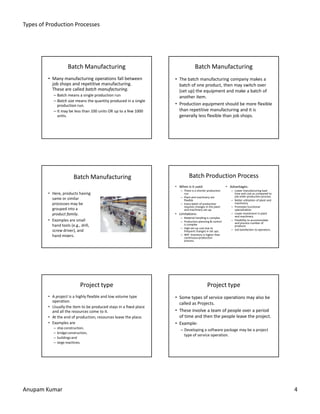
                       Batch Manufacturing                                        Batch Manufacturing
         • Many manufacturing operations fall between               • The batch manufacturing company makes a
           job shops and repetitive manufacturing.                    batch of one product, then may switch over
           These are called batch manufacturing.                      (set up) the equipment and make a batch of
            – Batch means a single production run                     another item.
            – Batch size means the quantity produced in a single
              production run.                                       • Production equipment should be more flexible
            – It may be less than 100 units OR up to a few 1000       than repetitive manufacturing and it is
              units.                                                  generally less flexible than job shops.


                          Batch Manufacturing                                Batch Production Process
                                                                    • When is it used:                   • Advantages:
                                                                       – There is a shorter production      – Lower manufacturing lead
         • Here, products having                                         run                                  time and cost as compared to
                                                                       – Plant and machinery are              job order production process.
           same or similar                                               flexible                           – Better utilization of plant and
           processes may be                                            – Every batch of production            machinery
                                                                         requires changes in the plant      – Promotes functional
           grouped into a                                                and machinery set-up.                specialization
           product family.                                          • Limitations:                          – Lower investment in plant
                                                                       – Material handling is complex         and machinery
         • Examples are small                                          – Production planning & control      – Flexibility to accommodate
                                                                         is complex                           and process number of
           hand tools (e.g., drill,                                                                           products
                                                                       – High set-up cost due to            – Job Satisfaction to operators.
           screw driver), and                                            frequent changes in set ups.
           hand mixers.                                                – WIP inventory is higher than
                                                                         continuous production
                                                                         process.


                               Project type                                                Project type
         • A project is a highly flexible and low volume type       • Some types of service operations may also be
           operation.
                                                                      called as Projects.
         • Usually the item to be produced stays in a fixed place
           and all the resources come to it.                        • These involve a team of people over a period
         • At the end of production, resources leave the place.       of time and then the people leave the project.
         • Examples are                                             • Example:
            –   ship construction,
                                                                       – Developing a software package may be a project
            –   bridge construction,
                                                                         type of service operation.
            –   buildings and
            –   large machines.


Anupam Kumar                                                                                                                                    4
Types of Production Processes


                                                                                               Basis for Comparison of
               Types of Production Process
                                                                                                Production Processes
         • Job Shop Production Process                                              • Manufacturing Cost         • Flexibility of Production
            – These are characterized by manufacturing of one or few quantity of
              products designed and produced as per the specification of the        • Capital Investment         • Types of Products
              customer within prefixed time and cost
         • Batch Production Process                                                    – Plant                     Produced
            – It is a form of manufacturing in which the job passes through the        – Inventory               • Material Handling
              functional departments in lots or batches and each lot may have a
              different routing.                                                    • Size of Plant                Equipment usage
         • Mass Production Process
            – Manufacture of “discrete parts” or assemblies using a continuous      • Technical Requirements     • Security of Job
              process is called mass production.                                                                    – To workers
         • Flow / Process Production System
                                                                                    • Organizational Structure
            – The production process in which the items are made to flow through                                    – To employees.
              the sequence of operations by various devices right from the first
              operation to the finished product stage is called a flow or process
              production system.


                To Objectives of Operations
                     Management …


Anupam Kumar                                                                                                                                   5

Types of production processes

  • 1.
    Types of ProductionProcesses What is a Production System? • Production System are those activities of an organization where Types of Production Processes – resources flowing within a defined system – are combined and transformed Presented By: – in a controlled manner Anupam Kumar – to add value Reader – in accordance to the policies communicated by SMS Varanasi the management. Characteristics of a Production System Types of Production Systems • Production is an organized activity, so every • The types of production processes / systems are production system has an objective. classified on the basis of • The system transforms various inputs to useful – Product / Output Variety and outputs. – Product / Operations / Output Volume • It does not operate in isolation from other • They are broadly classified as: organizational systems. – Continuous Production Process • Process / Flow Production • There exists a feedback about the activities, • Mass Production which is essential to control and improve – Intermittent Production Process system performance. • Batch Production • Job Shop Production Types of Production Processes Types of Production Process • Production processes or manufacturing • There is yet another type of production process operations may broadly be divided into two • The third type of production process is one where categories. – The company produces standard modules and – Made to stock production process – assembles these modules • These firms make items that are completed and placed in – according to the specifications of a customer order stock before customer order is received. • This type of production process is Assemble-to-Order – Made to order production process production process. E.g. • These complete the end item only after receiving a customer order. – PVC window assemblers, • This is because manufacturer cannot anticipate what each – modular kitchen board assemblers, etc. customer wants. Anupam Kumar 1
  • 2.
    Types of ProductionProcesses Types of Production Processes Types of Production Processes • Another way to define the type of production Project process is based on the extent to which a factory has Job-shop Production the flexibility to produce a variety of products. Process • This can be categorized as follows Intermitted Batch – Continuous Production System Production Production Variety Continuous System Process • Flow Production System Production • Mass Production System Mass System Production – Intermitted Production System Process • Batch Production System • Job-shop Production System Flow Production • Project Production System Process Volume Continuous Manufacturing System Repetitive Manufacturing • These are also referred to as Repetitive Manufacturing Systems. • WIP is low because the items move • These are mass production facilities that quickly in the plant. produce high volumes of the same products. • Examples are television, radio, and • They are usually make-to-stock producers. telephone producers. • The manufacturing happens in Automated, • Product(s) follow the same path: special-purpose equipments. Continuous flow (flow shop) Continuous flow (flow shop) • Continuous flow operations are sometimes • Some products flow also called process type operations continuously through – (as opposed to discrete operations). a linear process. • Examples are • These types of – Chemical plant, operations are called – Oil and Gas, continuous flow (flow shop) operations. – Petroleum refineries, • Usually the products – Sugar mills, etc. are not discrete. Anupam Kumar 2
  • 3.
    Types of ProductionProcesses Process Production / Flow Production Mass Production Process • When is it used: • When is it used: • Advantage: • Advantages: – Dedicated plant and – Standardization of product – Higher rate of production – Standardization of product with reduced cycle time. equipment with zero and process sequence and process sequence flexibility – Dedicated special purpose – Higher capacity utilization – Higher rate of production due to line balancing – Material handling is fully with reduced cycle time. machines having high automated. production capacities and – Less skilled operators are – Highest capacity utilization output rates required. – Process follows a due to line balancing predetermined sequence of – Large volume of products – Low process inventory operations – Manpower is not required for material handling. – Shorter cycle time – Manufacturing cost per unit is – Component material cannot – Lower in process inventory low. be readily identified with final – Persons with limited skills can product be used for production – Balanced production lines • Limitations process. – Material and parts flow is – Break-down of one machine – Planning and scheduling is a continuous without back- may stop entire production routine action – Unit cost is low due to high volume of production . tracking line. – Product differentiation is – Production planning and – Line layout needs major limited. control is easy changes with changes in – Involves high initial – Material handling can be product design. investments. completely automatic – Higher investment in production facilities. Intermitted Production Process Job Shop Production Process • In this type of production process – The volume of each product is low. Job 1 Job 2 – Generally produces make-to-order, custom products in accordance with design supplied by the customer. – Each job may be unique and may require a special set of production steps. – Further, each job may require a particular routing. Job 4 Job 3 – There are no standard routings. – Products may follow different paths. – Needs general-purpose production equipment Job Shop Production Process Job Shop Production Process • Job shop production process are used in • When is it used: • Advantages: – High variety of products with – A large variety of products – woodworking shops, low volume can be produced with the – Use of general purpose general purpose machines – metal fabrication shops, etc. machines and facilities – Operators become more – Highly Skilled Operators who skilled and competent with • May require an inventory of a few type of the take up each job as a each job raw materials. challenge – Full potential of operators can – Large inventory of materials, be utilized • BUT, here the largest percentage of the tools and parts – Opportunity exists for – Detailed planning is essential creative methods and inventory is Work in Process (WIP). for sequencing of each innovative ideas. product Capacities for each • Limitations: • Work in Process is the inventory that work centers and order priority – Production planning is accumulates in between process stages. complicated – Larger space requirement. Anupam Kumar 3
  • 4.
    Types of ProductionProcesses Batch Manufacturing Batch Manufacturing • Many manufacturing operations fall between • The batch manufacturing company makes a job shops and repetitive manufacturing. batch of one product, then may switch over These are called batch manufacturing. (set up) the equipment and make a batch of – Batch means a single production run another item. – Batch size means the quantity produced in a single production run. • Production equipment should be more flexible – It may be less than 100 units OR up to a few 1000 than repetitive manufacturing and it is units. generally less flexible than job shops. Batch Manufacturing Batch Production Process • When is it used: • Advantages: – There is a shorter production – Lower manufacturing lead • Here, products having run time and cost as compared to – Plant and machinery are job order production process. same or similar flexible – Better utilization of plant and processes may be – Every batch of production machinery requires changes in the plant – Promotes functional grouped into a and machinery set-up. specialization product family. • Limitations: – Lower investment in plant – Material handling is complex and machinery • Examples are small – Production planning & control – Flexibility to accommodate is complex and process number of hand tools (e.g., drill, products – High set-up cost due to – Job Satisfaction to operators. screw driver), and frequent changes in set ups. hand mixers. – WIP inventory is higher than continuous production process. Project type Project type • A project is a highly flexible and low volume type • Some types of service operations may also be operation. called as Projects. • Usually the item to be produced stays in a fixed place and all the resources come to it. • These involve a team of people over a period • At the end of production, resources leave the place. of time and then the people leave the project. • Examples are • Example: – ship construction, – Developing a software package may be a project – bridge construction, type of service operation. – buildings and – large machines. Anupam Kumar 4
  • 5.
    Types of ProductionProcesses Basis for Comparison of Types of Production Process Production Processes • Job Shop Production Process • Manufacturing Cost • Flexibility of Production – These are characterized by manufacturing of one or few quantity of products designed and produced as per the specification of the • Capital Investment • Types of Products customer within prefixed time and cost • Batch Production Process – Plant Produced – It is a form of manufacturing in which the job passes through the – Inventory • Material Handling functional departments in lots or batches and each lot may have a different routing. • Size of Plant Equipment usage • Mass Production Process – Manufacture of “discrete parts” or assemblies using a continuous • Technical Requirements • Security of Job process is called mass production. – To workers • Flow / Process Production System • Organizational Structure – The production process in which the items are made to flow through – To employees. the sequence of operations by various devices right from the first operation to the finished product stage is called a flow or process production system. To Objectives of Operations Management … Anupam Kumar 5