Unit 3 Production System By: Sarabjeet Singh
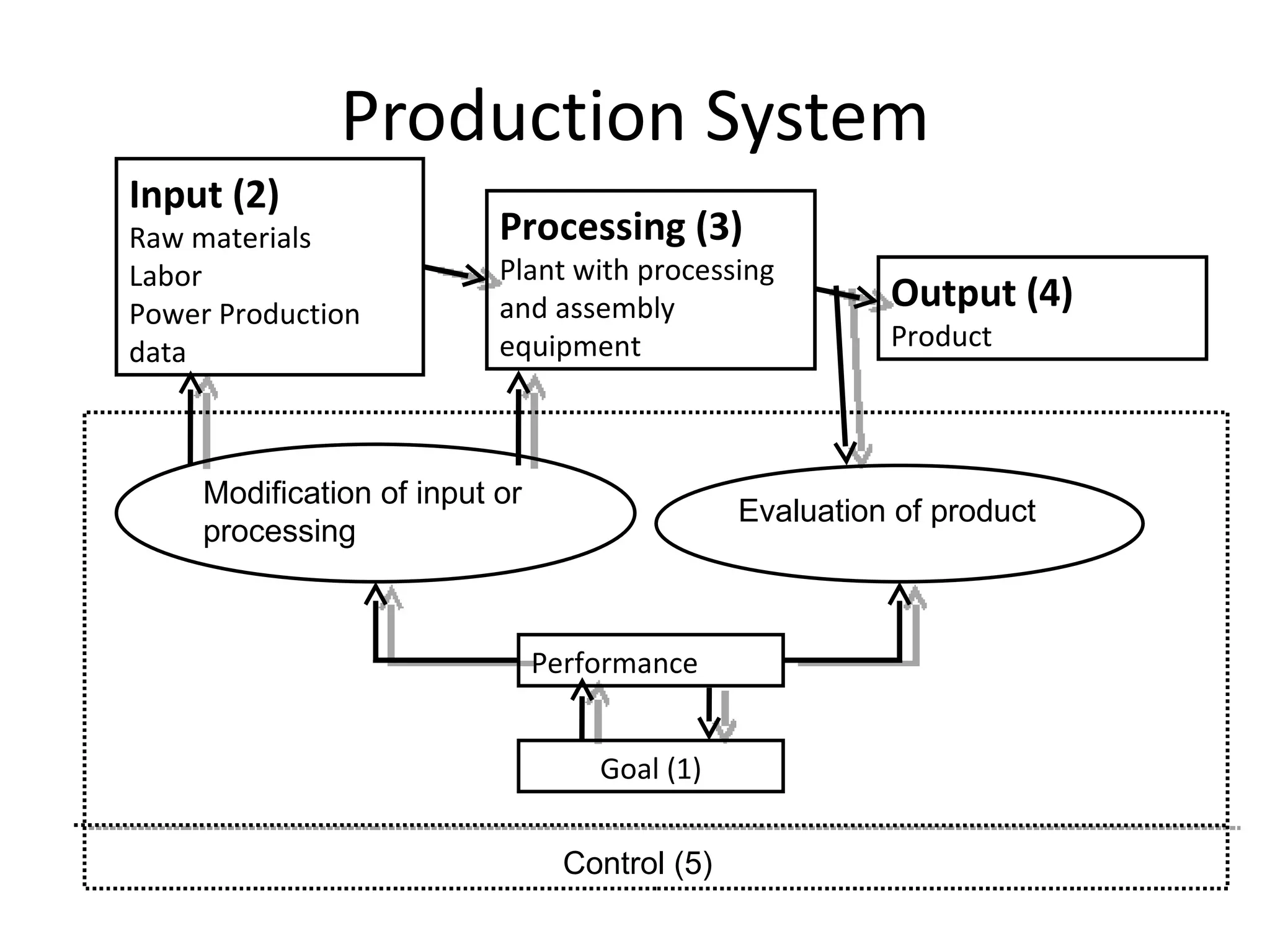
Production System Manufacturing subsystem that includes all functions required to design, produce, distribute, and service a manufactured product. Elements: Input Transformation Output
Characteristics System Discrimination: It is primarily concerned about input and output only Interrelationship: it exists on a close relationship with other systems of the organization Level formulation: it consists of various levels of corporate hierarchy like headquaters, administrative departments etc.
Characteristics  Specialization of functions: since there are large number of levels, each level performs a specialized function Renovation: in order to cope up with changes the production system needs to be renovated from time to time.
Production System Input (2) Raw materials Labor Power Production data Processing (3) Plant with processing and assembly equipment Output (4) Product Modification of input or processing Evaluation of product Performance Goal (1) Control (5)
Production System Controls Control is essential for production management. The ‘input-output’ relationship must be controlled whatever is the size of production system.
Types of control Feedback Control:  Output is obtained and it is measured with the target/goal Then if necessary, adjustments are made Forward Control:  Input is checked against the pre-decided standards Then if necessary, adjustments are made
Product design Design has a very great impact on the quality of a product If the design is poor, it may not satisfy the customers If the design is costly then the product will be overpriced If the design process is lengthy, the competitor may capture the market
Product design “ Product design is concerned with the determination of what a product would look like, how it will be made, what function the product will perform and how it will perform” Product design  is the process of creating a new product to be sold by a business or enterprise to its customers. It is concerned with the efficient and effective generation and development of ideas through a process that leads to new products
Objectives of product design To achieve the desired product quality To reduce the cost of the product To ensure the availability of the product according to the needs of customer To generate profit in the long run To implement the idea of a new product
Importance of the product design Product design is crucial for success in the global competition It directly affects product quality, production costs and customer satisfaction An appropriate design provides competitive advantage to the manufacturer
Importance of the product design It helps in bringing new ideas in the market It is a result of business strategy New products provide growth opportunities and a competitive advantage for the firm It has close relationship with marketing, finance and other functions It can be integrated with decisions regarding process, quality, capacity, and inventory
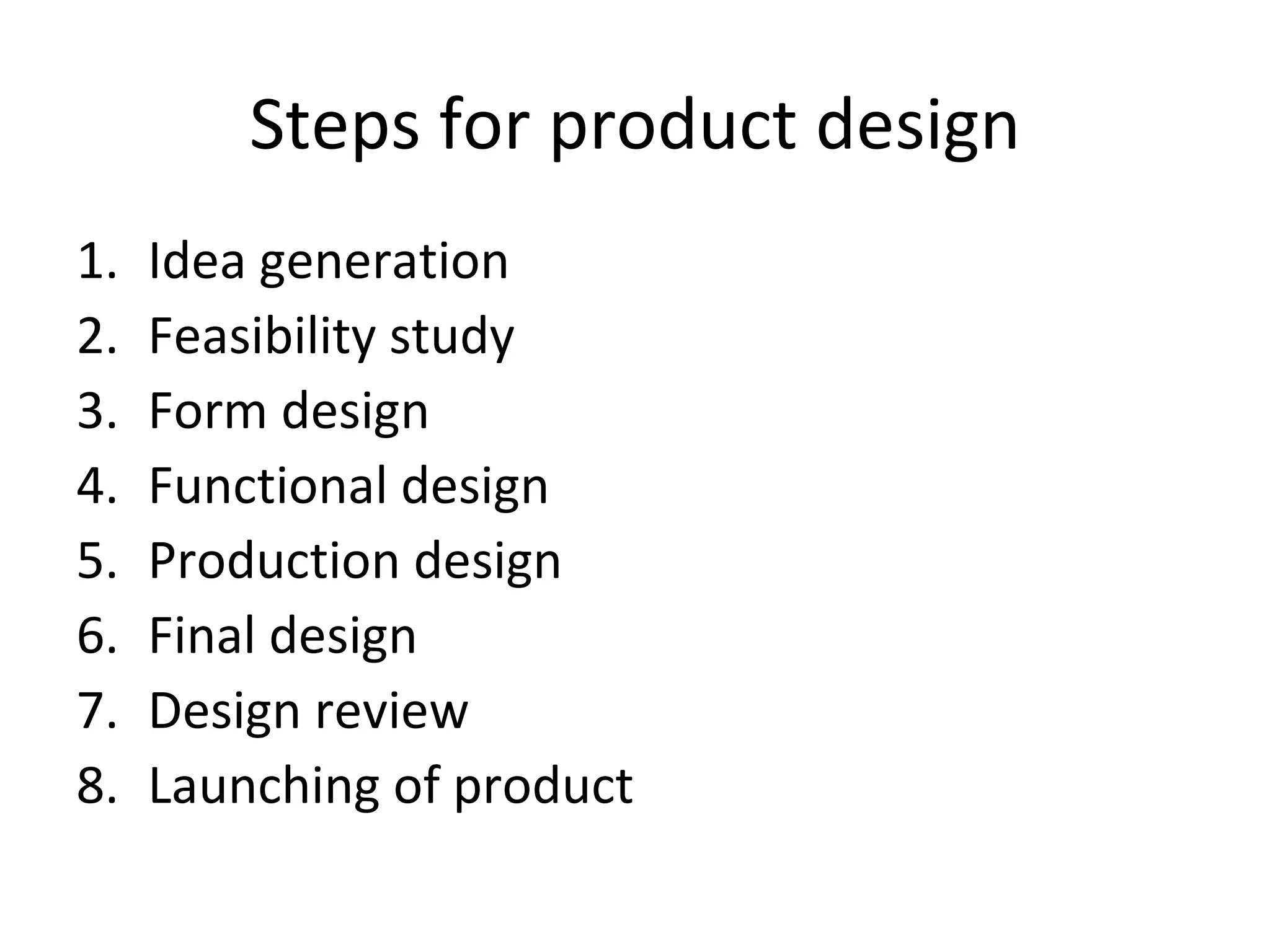
Steps for product design Idea generation Feasibility study Form design Functional design Production design Final design Design review Launching of product
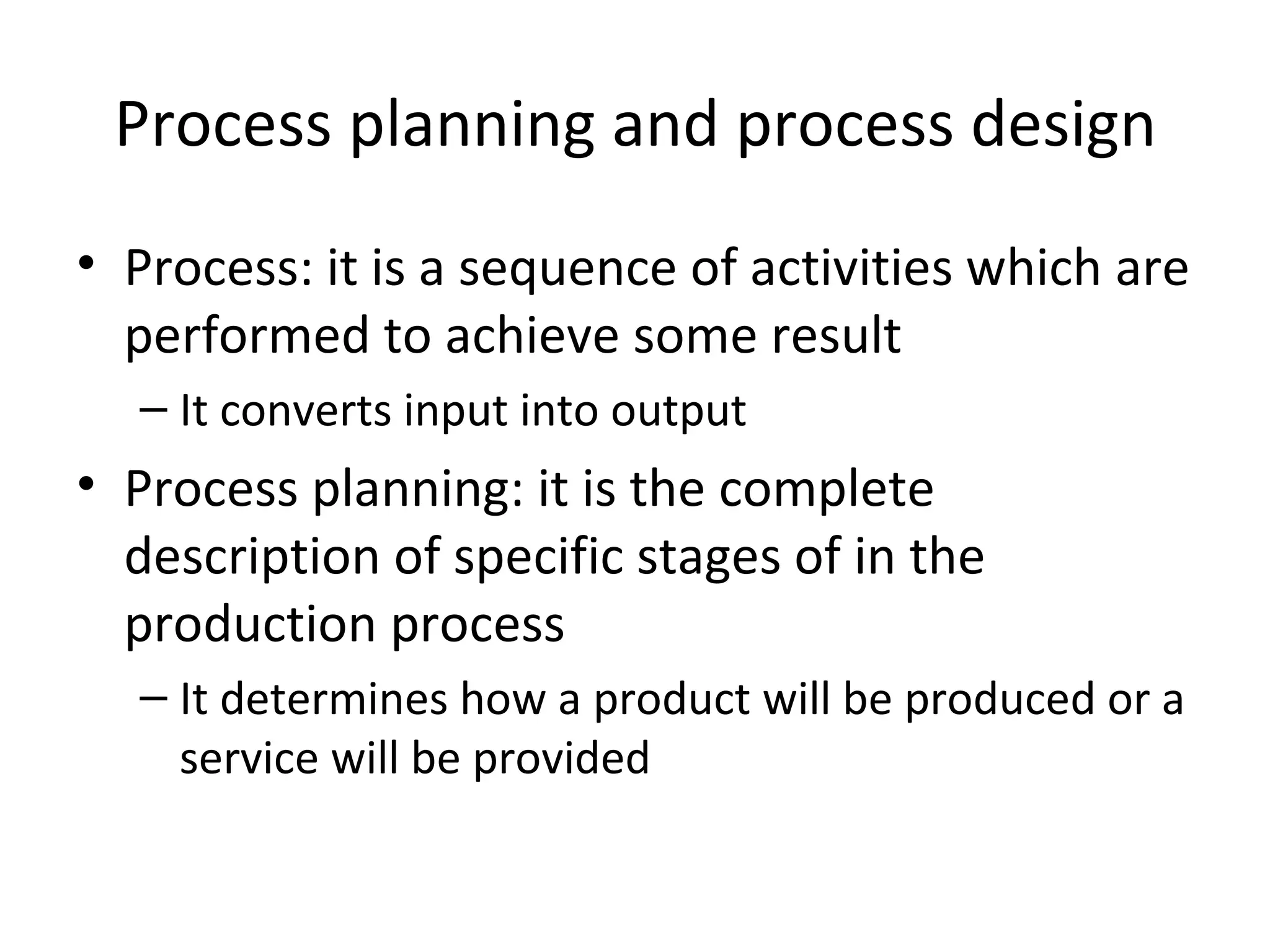
Process planning and process design Process: it is a sequence of activities which are performed to achieve some result It converts input into output Process planning: it is the complete description of specific stages of in the production process It determines how a product will be produced or a service will be provided
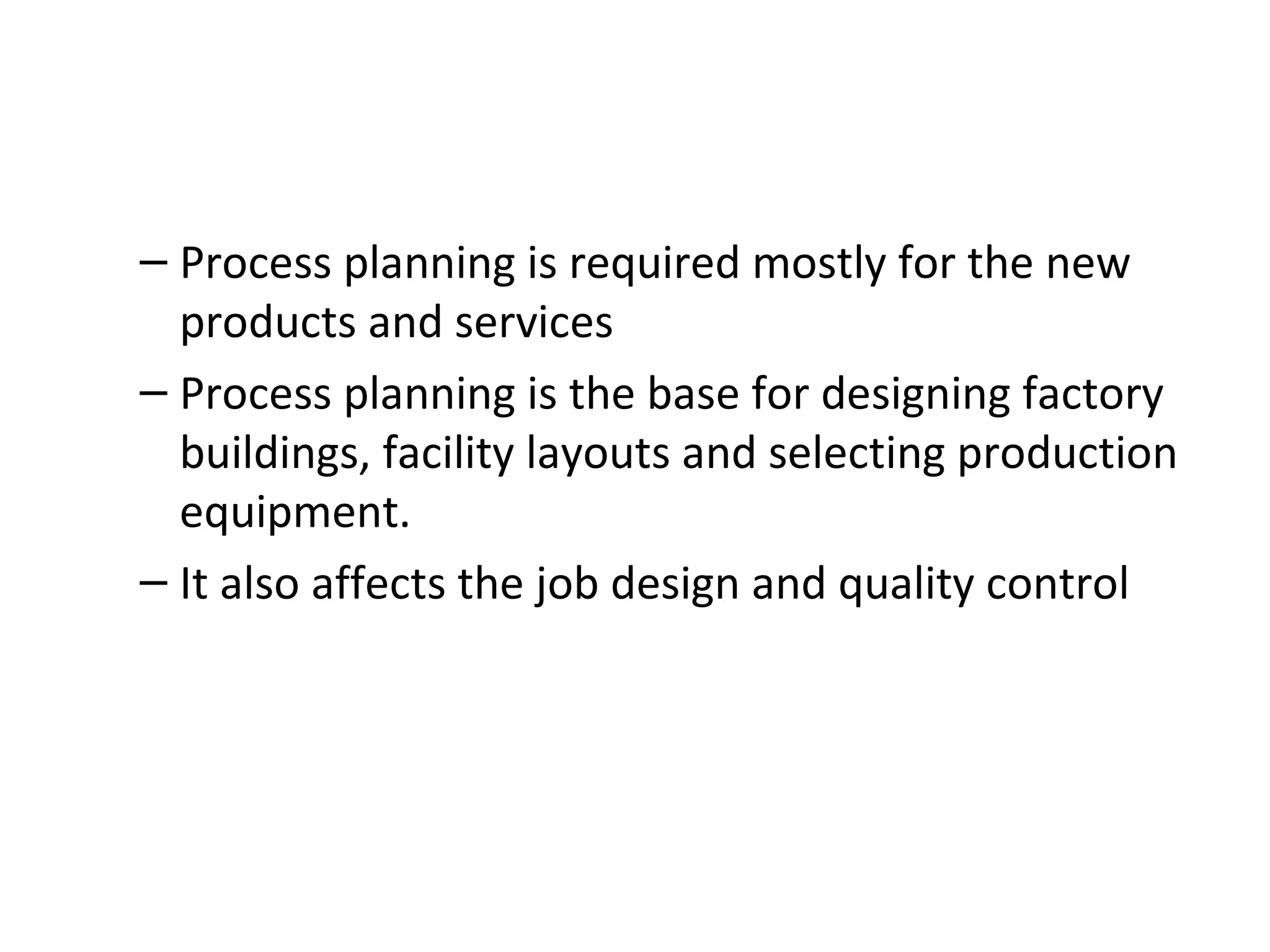
Process planning is required mostly for the new products and services Process planning is the base for designing factory buildings, facility layouts and selecting production equipment. It also affects the job design and quality control
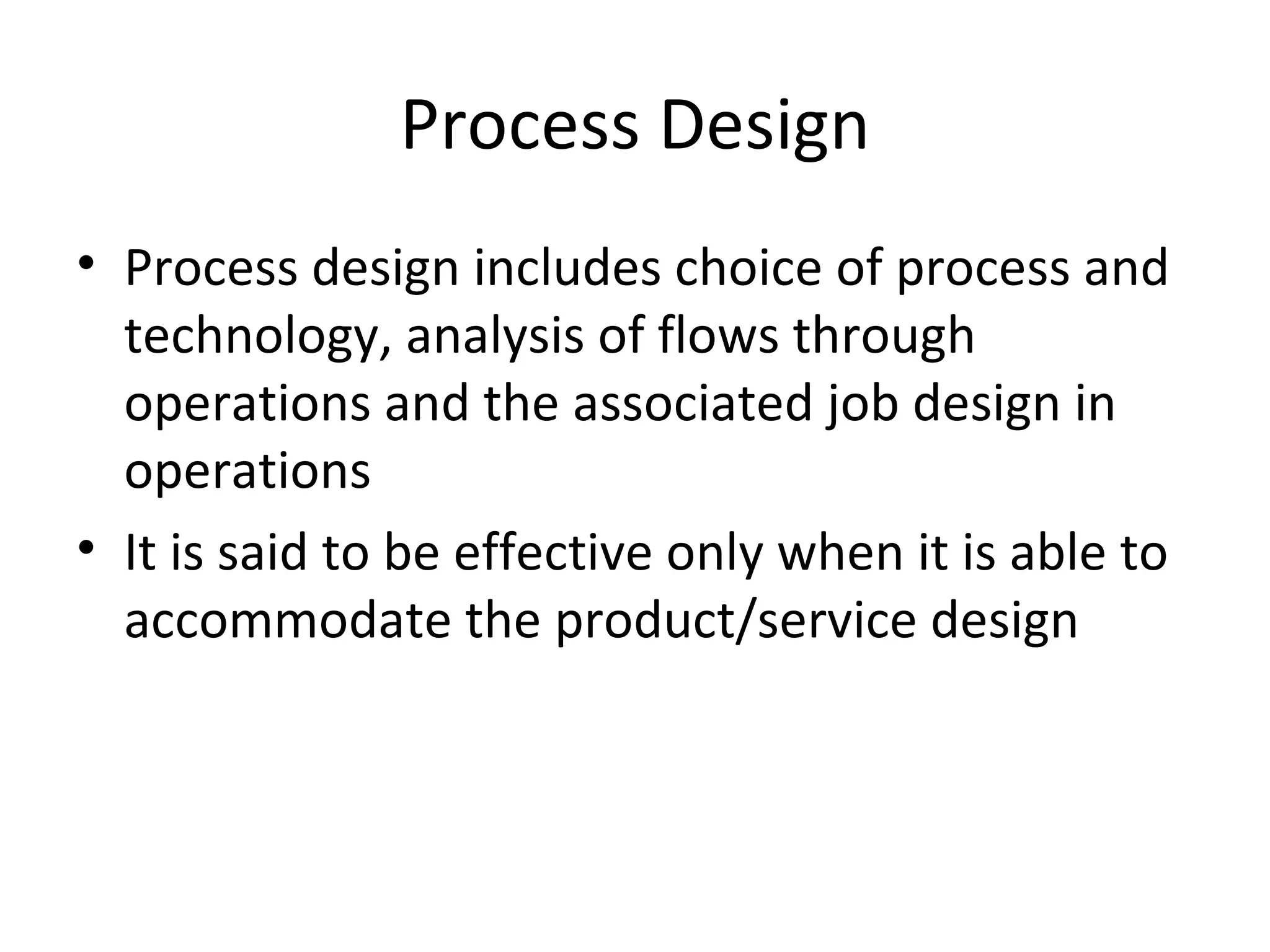
Process Design Process design includes choice of process and technology, analysis of flows through operations and the associated job design in operations It is said to be effective only when it is able to accommodate the product/service design
Factors affecting the process design decisions Nature of demand Degree of automation Desired quality level Flexibility Degree of customer contact
Types of process design Product – focused Process – focused Group technology
Product - focused In this type of process design, products or services flow along linear path. Items follow a similar production sequence. E.g. assembly line, pipeline  It is generally designed for three forms of production Discrete unit manufacturing Process manufacturing Delivery of service
It has many advantages like high volumes of production, low unit cost, and flexibility in planning But, such design requires huge investment because the processing equipments are expensive
Process - focused In process focused design, all the operations are grouped according to the type of process The system is also known as ‘job-shop’ as the products move from one department to other in small batches which are determined by the customer’s order It is generally used to produce small quantities of different items on general purpose machinary
Such designs are more flexible, and also requires less capital But, waiting time can be a problem if the system operates on more than one process at a time
Group Technology In group technology layout, different machines are grouped into work centers to work on products with similar processing requirements It is similar to both; product layout and process layout because each cell is dedicated to a limited range of products and designed to perform specific set of process
Process Selection It is a strategic decision for organizations It determines  the quality and quantity of employees The amount of capital required for the production These decisions are generally capital intensive and con not be changed easily Hence, process selection is a long term decision
Process Selection Process can be classified in two main categories: Product Flow Type of customer order
Product Flow There are three types of product flow Line flow: it is defined as a linear sequence of operations like an assembly line.  The product moves from one step to another in a sequential manner E.G. : automobiles, refrigerators, computers Batch Flow: it is the production of the product in batches or lots Each batch of the product flows from one operations or work center to another A work center is a group of similar machines
Product Flow Project: it is used for unique or creative products. Project itself is fixed, material and labor are brought to the project site Each unit is made individually and is different from other units Cost of production is high and sometimes difficult to control E.G. construction of building, Aircraft and ships
Type of customer order There are two types of customer orders Made to Stock (MTS): The MTS process has a standard product line specified by the producer, not by customer The products are carried in inventory to fulfill customer demand When the customer orders a product, it is delivered if product is available in the inventory,  If it is not available, a back order is generated
Made to order (MTO): In MTO, the cycle of production and order fulfillment begins with the customer order After receiving the order, the design must be completed The performance measures of an MTO are: time taken to complete the order (Lead Time) and percentage of orders completed on time
Process Selection The major considerations are: capacity, flexibility, lead-time, and efficiency in using resources The selection of process becomes a complex decision due to the existence of many trade-offs It is also influenced by the environment Therefore the attempt should be made to select a process which has acceptable levels of flexibility and cost
Process Management “ Process management is the application of knowledge, skills, tools, techniques and systems to define, visualize, measure, control, report and improve processes with the goal to meet customer requirements profitably”
Significance/Importance of Process Management It is the differentiator and source of competitive advantage It helps in the evaluation of processes and their analysis It helps in saving of important resources like money, labor etc. It improves the efficiency and effectiveness of the complete production system It helps in the identification and removal of inefficiencies
Major Process Decisions There are five major process decisions: Process Choice Vertical Integration Resource flexibility Customer involvement Capital intensity
Process Choice: it helps in determining whether the resources are organized around the products so that the flow strategy can be implemented. It depends on the volume of products and degree of customization. Five major process types are: Job Shop Process:  it is used when we need low volume of high variety products Each job requires different processing requirements
A job shop uses a flexible flow strategy, with resources organized around the product EG. Tools shop, Dye shop Batch Process:  it is used when a moderate volume and variety of goods are required In batch processing, same or similar products are repeatedly provided E.G. Oil Paints, Soft Drinks Repetitive Process:  this is used when higher volume standardized goods are needed. It is also known as line process It includes production lines or assembly lines for mass production E.G. Automobiles, computers
Continuous Process:  it is used when the product is highly standard and required in high volumes For such process type, capital is required at large scale It is operated round the clock for optimum utilization of resources and equipments E.G. Cement, Paper, Petroleum products Project Process:  each unit is individually made and is different from other units It is used when the customer desires customization and uniqueness  E.G. construction of shopping mall, Production of large aircraft
Vertical Integration: when the production and distribution chain i.e. from suppliers to the delivery of the products to the customers is brought under the ownership of the firm, it is known as vertical integration. It leads to the monopoly of the business The firm decide on the basis of cost-benefit analysis
Types of Vertical Integration Backward vertical integration:  when firm controls subsidiaries/suppliers that produce some of the inputs used in the production of its products E.G. an automobile company may own a tire company, a glass company, and a metal company. Control of these three subsidiaries is intended to create a stable supply of inputs and ensure a consistent quality in their final product. It was the main business approach of Ford and other car companies in the 1920s, who sought to minimize costs by centralizing the production of cars and car parts Forward vertical integration:  when firm controls distribution centers and retailers where its products are sold E.G. Eureka Forbes, sells it’s own products directly to the customers
Advantages of vertical integration Better control over the supply chain Increase in the  market share  It allows company to enter in the foreign markets Optimum utilization of resources Savings in production costs and production of better quality goods
Disadvantages of vertical integration Loss of flexibility to the changes in the customer demands and technology Capital investment and operating costs are higher Not suitable for low volumes
Resource Flexibility  Flexibility is desired by the firm about its resources The degree of flexibility depends upon the competitive priorities of the firm It is useful when there are fluctuations in the workload But it is advisable to have certain amount of permanent resources
Customer Involvement The level of customer interaction with the process is known as customer involvement It promotes customization of the process It also helps in gaining the competitive advantage over the competitors Firms are allowing customers to specify their requirements and even to be involved in the designing process of the product
Capital Intensity The level of capital resources used in the manufacturing like equipments and machines is known as capital intensity It is important for increasing productivity and quality But it also imposes a risk of higher investment cost for low volume operations
Thank You

Operations Management: Production System

  • 1.
    Unit 3 ProductionSystem By: Sarabjeet Singh
  • 2.
    Production System Manufacturing subsystem thatincludes all functions required to design, produce, distribute, and service a manufactured product. Elements: Input Transformation Output
  • 3.
    Characteristics System Discrimination:It is primarily concerned about input and output only Interrelationship: it exists on a close relationship with other systems of the organization Level formulation: it consists of various levels of corporate hierarchy like headquaters, administrative departments etc.
  • 4.
    Characteristics Specializationof functions: since there are large number of levels, each level performs a specialized function Renovation: in order to cope up with changes the production system needs to be renovated from time to time.
  • 5.
    Production System Input(2) Raw materials Labor Power Production data Processing (3) Plant with processing and assembly equipment Output (4) Product Modification of input or processing Evaluation of product Performance Goal (1) Control (5)
  • 6.
    Production System ControlsControl is essential for production management. The ‘input-output’ relationship must be controlled whatever is the size of production system.
  • 7.
    Types of controlFeedback Control: Output is obtained and it is measured with the target/goal Then if necessary, adjustments are made Forward Control: Input is checked against the pre-decided standards Then if necessary, adjustments are made
  • 8.
    Product design Designhas a very great impact on the quality of a product If the design is poor, it may not satisfy the customers If the design is costly then the product will be overpriced If the design process is lengthy, the competitor may capture the market
  • 9.
    Product design “Product design is concerned with the determination of what a product would look like, how it will be made, what function the product will perform and how it will perform” Product design  is the process of creating a new product to be sold by a business or enterprise to its customers. It is concerned with the efficient and effective generation and development of ideas through a process that leads to new products
  • 10.
    Objectives of productdesign To achieve the desired product quality To reduce the cost of the product To ensure the availability of the product according to the needs of customer To generate profit in the long run To implement the idea of a new product
  • 11.
    Importance of theproduct design Product design is crucial for success in the global competition It directly affects product quality, production costs and customer satisfaction An appropriate design provides competitive advantage to the manufacturer
  • 12.
    Importance of theproduct design It helps in bringing new ideas in the market It is a result of business strategy New products provide growth opportunities and a competitive advantage for the firm It has close relationship with marketing, finance and other functions It can be integrated with decisions regarding process, quality, capacity, and inventory
  • 13.
    Steps for productdesign Idea generation Feasibility study Form design Functional design Production design Final design Design review Launching of product
  • 14.
    Process planning andprocess design Process: it is a sequence of activities which are performed to achieve some result It converts input into output Process planning: it is the complete description of specific stages of in the production process It determines how a product will be produced or a service will be provided
  • 15.
    Process planning isrequired mostly for the new products and services Process planning is the base for designing factory buildings, facility layouts and selecting production equipment. It also affects the job design and quality control
  • 16.
    Process Design Processdesign includes choice of process and technology, analysis of flows through operations and the associated job design in operations It is said to be effective only when it is able to accommodate the product/service design
  • 17.
    Factors affecting theprocess design decisions Nature of demand Degree of automation Desired quality level Flexibility Degree of customer contact
  • 18.
    Types of processdesign Product – focused Process – focused Group technology
  • 19.
    Product - focusedIn this type of process design, products or services flow along linear path. Items follow a similar production sequence. E.g. assembly line, pipeline It is generally designed for three forms of production Discrete unit manufacturing Process manufacturing Delivery of service
  • 20.
    It has manyadvantages like high volumes of production, low unit cost, and flexibility in planning But, such design requires huge investment because the processing equipments are expensive
  • 21.
    Process - focusedIn process focused design, all the operations are grouped according to the type of process The system is also known as ‘job-shop’ as the products move from one department to other in small batches which are determined by the customer’s order It is generally used to produce small quantities of different items on general purpose machinary
  • 22.
    Such designs aremore flexible, and also requires less capital But, waiting time can be a problem if the system operates on more than one process at a time
  • 23.
    Group Technology Ingroup technology layout, different machines are grouped into work centers to work on products with similar processing requirements It is similar to both; product layout and process layout because each cell is dedicated to a limited range of products and designed to perform specific set of process
  • 24.
    Process Selection Itis a strategic decision for organizations It determines the quality and quantity of employees The amount of capital required for the production These decisions are generally capital intensive and con not be changed easily Hence, process selection is a long term decision
  • 25.
    Process Selection Processcan be classified in two main categories: Product Flow Type of customer order
  • 26.
    Product Flow Thereare three types of product flow Line flow: it is defined as a linear sequence of operations like an assembly line. The product moves from one step to another in a sequential manner E.G. : automobiles, refrigerators, computers Batch Flow: it is the production of the product in batches or lots Each batch of the product flows from one operations or work center to another A work center is a group of similar machines
  • 27.
    Product Flow Project:it is used for unique or creative products. Project itself is fixed, material and labor are brought to the project site Each unit is made individually and is different from other units Cost of production is high and sometimes difficult to control E.G. construction of building, Aircraft and ships
  • 28.
    Type of customerorder There are two types of customer orders Made to Stock (MTS): The MTS process has a standard product line specified by the producer, not by customer The products are carried in inventory to fulfill customer demand When the customer orders a product, it is delivered if product is available in the inventory, If it is not available, a back order is generated
  • 29.
    Made to order(MTO): In MTO, the cycle of production and order fulfillment begins with the customer order After receiving the order, the design must be completed The performance measures of an MTO are: time taken to complete the order (Lead Time) and percentage of orders completed on time
  • 30.
    Process Selection Themajor considerations are: capacity, flexibility, lead-time, and efficiency in using resources The selection of process becomes a complex decision due to the existence of many trade-offs It is also influenced by the environment Therefore the attempt should be made to select a process which has acceptable levels of flexibility and cost
  • 31.
    Process Management “Process management is the application of knowledge, skills, tools, techniques and systems to define, visualize, measure, control, report and improve processes with the goal to meet customer requirements profitably”
  • 32.
    Significance/Importance of ProcessManagement It is the differentiator and source of competitive advantage It helps in the evaluation of processes and their analysis It helps in saving of important resources like money, labor etc. It improves the efficiency and effectiveness of the complete production system It helps in the identification and removal of inefficiencies
  • 33.
    Major Process DecisionsThere are five major process decisions: Process Choice Vertical Integration Resource flexibility Customer involvement Capital intensity
  • 34.
    Process Choice: ithelps in determining whether the resources are organized around the products so that the flow strategy can be implemented. It depends on the volume of products and degree of customization. Five major process types are: Job Shop Process: it is used when we need low volume of high variety products Each job requires different processing requirements
  • 35.
    A job shopuses a flexible flow strategy, with resources organized around the product EG. Tools shop, Dye shop Batch Process: it is used when a moderate volume and variety of goods are required In batch processing, same or similar products are repeatedly provided E.G. Oil Paints, Soft Drinks Repetitive Process: this is used when higher volume standardized goods are needed. It is also known as line process It includes production lines or assembly lines for mass production E.G. Automobiles, computers
  • 36.
    Continuous Process: it is used when the product is highly standard and required in high volumes For such process type, capital is required at large scale It is operated round the clock for optimum utilization of resources and equipments E.G. Cement, Paper, Petroleum products Project Process: each unit is individually made and is different from other units It is used when the customer desires customization and uniqueness E.G. construction of shopping mall, Production of large aircraft
  • 37.
    Vertical Integration: whenthe production and distribution chain i.e. from suppliers to the delivery of the products to the customers is brought under the ownership of the firm, it is known as vertical integration. It leads to the monopoly of the business The firm decide on the basis of cost-benefit analysis
  • 38.
    Types of VerticalIntegration Backward vertical integration:  when firm controls subsidiaries/suppliers that produce some of the inputs used in the production of its products E.G. an automobile company may own a tire company, a glass company, and a metal company. Control of these three subsidiaries is intended to create a stable supply of inputs and ensure a consistent quality in their final product. It was the main business approach of Ford and other car companies in the 1920s, who sought to minimize costs by centralizing the production of cars and car parts Forward vertical integration:  when firm controls distribution centers and retailers where its products are sold E.G. Eureka Forbes, sells it’s own products directly to the customers
  • 39.
    Advantages of verticalintegration Better control over the supply chain Increase in the market share It allows company to enter in the foreign markets Optimum utilization of resources Savings in production costs and production of better quality goods
  • 40.
    Disadvantages of verticalintegration Loss of flexibility to the changes in the customer demands and technology Capital investment and operating costs are higher Not suitable for low volumes
  • 41.
    Resource Flexibility Flexibility is desired by the firm about its resources The degree of flexibility depends upon the competitive priorities of the firm It is useful when there are fluctuations in the workload But it is advisable to have certain amount of permanent resources
  • 42.
    Customer Involvement Thelevel of customer interaction with the process is known as customer involvement It promotes customization of the process It also helps in gaining the competitive advantage over the competitors Firms are allowing customers to specify their requirements and even to be involved in the designing process of the product
  • 43.
    Capital Intensity Thelevel of capital resources used in the manufacturing like equipments and machines is known as capital intensity It is important for increasing productivity and quality But it also imposes a risk of higher investment cost for low volume operations
  • 44.