Unsymmetrical	
  Bending	
  
Dr	
  Alessandro	
  Palmeri	
  
<A.Palmeri@lboro.ac.uk>	
  
Teaching	
  schedule	
  
Week Lecture 1 Staff Lecture 2 Staff Tutorial Staff
1 Beam Shear Stresses 1 A P Beam Shear Stresses 2 A P --- ---
2 Shear centres A P Basic Concepts J E-R Shear Centre A P
3 Principle of Virtual
forces
J E-R Indeterminate Structures J E-R Virtual Forces J E-R
4 The Compatibility
Method
J E-R Examples J E-R Virtual Forces J E-R
5 Examples J E-R Moment Distribution -
Basics
J E-R Comp. Method J E-R
6 The Hardy Cross
Method
J E-R Fixed End Moments J E-R Comp. Method J E-R
7 Examples J E-R Non Sway Frames J E-R Mom. Dist J E-R
8 Column Stability 1 A P Sway Frames J E-R Mom. Dist J E-R
9 Column Stability 2 A P Unsymmetric Bending 1 A P Colum Stability A P
10 Unsymmetric Bending 2 A P Complex Stress/Strain A P Unsymmetric
Bending
A P
11 Complex Stress/Strain A P Complex Stress/Strain A P Complex
Stress/Strain
A P
Christmas
Holiday
12 Revision
13
14 Exams
15
2	
  
Mo@va@ons	
  (1/2)	
  
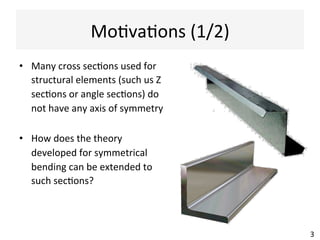
•  Many	
  cross	
  sec@ons	
  used	
  for	
  
structural	
  elements	
  (such	
  us	
  Z	
  
sec@ons	
  or	
  angle	
  sec@ons)	
  do	
  
not	
  have	
  any	
  axis	
  of	
  symmetry	
  
•  How	
  does	
  the	
  theory	
  
developed	
  for	
  symmetrical	
  
bending	
  can	
  be	
  extended	
  to	
  
such	
  sec@ons?	
  
3	
  
Mo@va@ons	
  (2/2)	
  
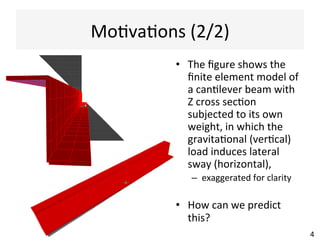
•  The	
  figure	
  shows	
  the	
  
finite	
  element	
  model	
  of	
  
a	
  can@lever	
  beam	
  with	
  
Z	
  cross	
  sec@on	
  
subjected	
  to	
  its	
  own	
  
weight,	
  in	
  which	
  the	
  
gravita@onal	
  (ver@cal)	
  
load	
  induces	
  lateral	
  
sway	
  (horizontal),	
  	
  
–  exaggerated	
  for	
  clarity	
  
•  How	
  can	
  we	
  predict	
  
this?	
  
4	
  
XY X
Z
Y
Z
X
Y
X
Z
Y
Z
Learning	
  Outcomes	
  
•  When	
  we	
  have	
  completed	
  this	
  unit	
  (2	
  lectures	
  
+	
  1	
  tutorial),	
  you	
  should	
  be	
  able	
  to:	
  
– Determine	
  the	
  principal	
  second	
  moments	
  of	
  area	
  
AND	
  the	
  principal	
  direc@ons	
  of	
  area	
  for	
  
unsymmetrical	
  beam’s	
  cross	
  sec@ons	
  
– Evaluate	
  the	
  normal	
  stress	
  σx	
  in	
  beams	
  subjected	
  
to	
  unsymmetric	
  bending	
  
5	
  
Further	
  reading	
  
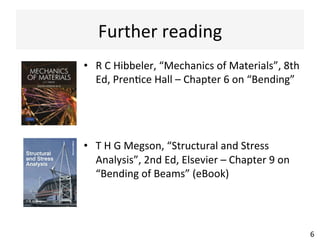
•  R	
  C	
  Hibbeler,	
  “Mechanics	
  of	
  Materials”,	
  8th	
  
Ed,	
  Pren@ce	
  Hall	
  –	
  Chapter	
  6	
  on	
  “Bending”	


•  T	
  H	
  G	
  Megson,	
  “Structural	
  and	
  Stress	
  
Analysis”,	
  2nd	
  Ed,	
  Elsevier	
  –	
  Chapter	
  9	
  on	
  
“Bending	
  of	
  Beams”	
  (eBook)	
  
6	
  
Symmetrical	
  Bending	
  (1/4)	
  
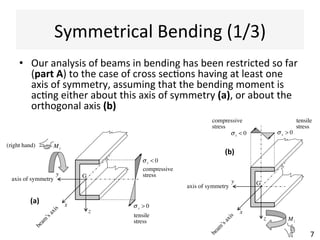
•  Our	
  analysis	
  of	
  beams	
  in	
  bending	
  has	
  been	
  restricted	
  so	
  far	
  
(part	
  A)	
  to	
  the	
  case	
  of	
  cross	
  sec@ons	
  having	
  at	
  least	
  one	
  
axis	
  of	
  symmetry,	
  assuming	
  that	
  the	
  bending	
  moment	
  is	
  
ac@ng	
  either	
  about	
  this	
  axis	
  of	
  symmetry	
  (a),	
  or	
  about	
  the	
  
orthogonal	
  axis	
  (b)	
  
7	
  
(a)	
   x
z
y
axis of symmetry
beam
’saxis
My
G
(right hand)
σ x > 0
σx < 0
tensile
stress
compressive
stress
(b)	
  
x
z
y
axis of symmetry
beam
’saxis
Mz
G
σ x > 0σx < 0
tensile
stress
compressive
stress
Symmetrical	
  Bending	
  (2/4)	
  
8	
  
x
z
y
axis of symmetry
beam
’saxis
Mz
My
G
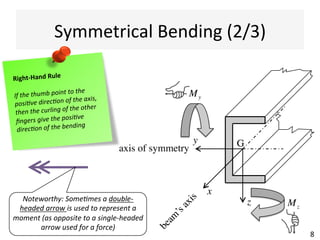
Right-­‐Hand	
  Rule	


If	
  the	
  thumb	
  point	
  to	
  the	
  
posi0ve	
  direc0on	
  of	
  the	
  axis,	
  
then	
  the	
  curling	
  of	
  the	
  other	
  
fingers	
  give	
  the	
  posi0ve	
  
direc0on	
  of	
  the	
  bending	
  
Noteworthy:	
  Some0mes	
  a	
  double-­‐
headed	
  arrow	
  is	
  used	
  to	
  represent	
  a	
  
moment	
  (as	
  opposite	
  to	
  a	
  single-­‐headed	
  
arrow	
  used	
  for	
  a	
  force)	


Symmetrical	
  Bending	
  (3/4)	
  
9	
  
x
z
y
axis of symmetry
beam
’saxis
My
G
(right hand)
σ x > 0
σx < 0
tensile
stress
compressive
stress
x
z
y
axis of symmetry
beam
’saxis
Mz
G
σ x > 0σx < 0
tensile
stress
compressive
stress
➡	
  
A	
  posi@ve	
  bending	
  moment	
  My>0,	
  
induces	
  tensile	
  stress	
  σx>0	
  in	
  the	
  
boiom	
  fibres	
  of	
  the	
  cross	
  sec@on	
  
A	
  posi@ve	
  bending	
  moment	
  Mz>0,	
  
induces	
  tensile	
  stress	
  σx>0	
  in	
  the	
  right	
  
fibres	
  of	
  the	
  cross	
  sec@on	
  (looking	
  at	
  it	
  
from	
  the	
  posi@ve	
  direc@on	
  of	
  the	
  x	
  axis)	


σ x =
My z
Iyy
Eq.	
  (1)	
  
Symmetrical	
  Bending	
  (4/4)	
  
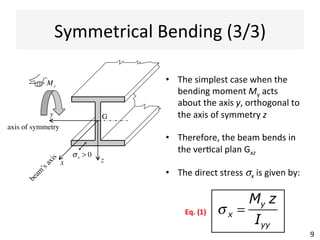
•  The	
  simplest	
  case	
  when	
  the	
  
bending	
  moment	
  My	
  acts	
  
about	
  the	
  axis	
  y,	
  orthogonal	
  to	
  
the	
  axis	
  of	
  symmetry	
  z	
  
•  Therefore,	
  the	
  beam	
  bends	
  in	
  
the	
  ver@cal	
  plan	
  Gxz	
  
•  The	
  direct	
  stress	
  σx	
  is	
  given	
  by:	
  
10	
  
x z
y
axis of symmetry
beam
’saxis
My
σx > 0
G
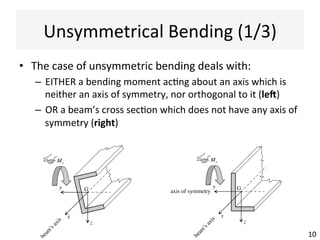
Unsymmetrical	
  Bending	
  (1/3)	
  
11	
  
•  The	
  case	
  of	
  unsymmetric	
  bending	
  deals	
  with:	
  
–  EITHER	
  a	
  bending	
  moment	
  ac@ng	
  about	
  an	
  axis	
  which	
  is	
  
neither	
  an	
  axis	
  of	
  symmetry,	
  nor	
  orthogonal	
  to	
  it	
  (le9)	
  
–  OR	
  a	
  beam’s	
  cross	
  sec@on	
  which	
  does	
  not	
  have	
  any	
  axis	
  of	
  
symmetry	
  (right)	
  
x
z
y
beam
’saxis
My
G
x
z
y
axis of symmetry
beam
’saxis
My
G
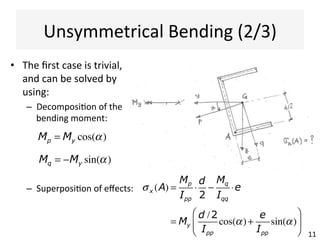
Unsymmetrical	
  Bending	
  (2/3)	
  
12	
  
•  The	
  first	
  case	
  is	
  trivial,	
  
and	
  can	
  be	
  solved	
  by	
  
using:	
  
–  Decomposi@on	
  of	
  the	
  
bending	
  moment:	


–  Superposi@on	
  of	
  effects:	
  
Mp = My cos(α)
Mq = −My sin(α)
σx (A) =
Mp
Ipp
⋅
d
2
−
Mq
Iqq
⋅e
= My
d /2
Ipp
cos(α)+
e
Ipp
sin(α)
⎛
⎝
⎜
⎞
⎠
⎟
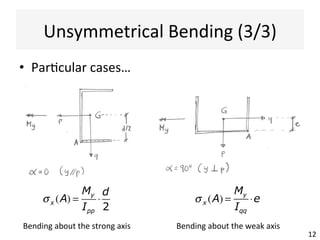
Unsymmetrical	
  Bending	
  (3/3)	
  
13	
  
•  Par@cular	
  cases…	
  
Bending	
  about	
  the	
  strong	
  axis	
  
σx (A) =
My
Ipp
⋅
d
2
Bending	
  about	
  the	
  weak	
  axis	
  
σ x (A) =
My
Iqq
⋅e
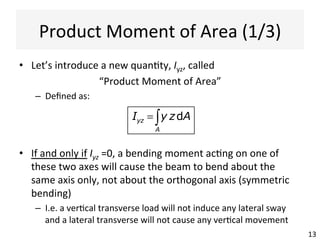
Product	
  Moment	
  of	
  Area	
  (1/3)	
  
14	
  
•  Let’s	
  introduce	
  a	
  new	
  quan@ty,	
  Iyz,	
  called	
  
“Product	
  Moment	
  of	
  Area”	
  
–  Defined	
  as:	
  
•  If	
  and	
  only	
  if	
  Iyz	
  =0,	
  a	
  bending	
  moment	
  ac@ng	
  on	
  one	
  of	
  
these	
  two	
  axes	
  will	
  cause	
  the	
  beam	
  to	
  bend	
  about	
  the	
  
same	
  axis	
  only,	
  not	
  about	
  the	
  orthogonal	
  axis	
  (symmetric	
  
bending)	
  
–  I.e.	
  a	
  ver@cal	
  transverse	
  load	
  will	
  not	
  induce	
  any	
  lateral	
  sway	
  
and	
  a	
  lateral	
  transverse	
  will	
  not	
  cause	
  any	
  ver@cal	
  movement	
  
= ∫ dyz
A
I y z A
Product	
  Moment	
  of	
  Area	
  (2/3)	
  
15	
  
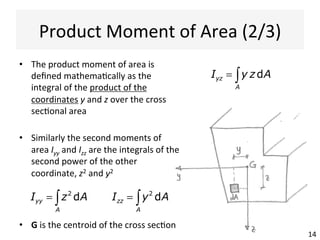
•  The	
  product	
  moment	
  of	
  area	
  is	
  
defined	
  mathema@cally	
  as	
  the	
  
integral	
  of	
  the	
  product	
  of	
  the	
  
coordinates	
  y	
  and	
  z	
  over	
  the	
  cross	
  
sec@onal	
  area	
  
•  Similarly	
  the	
  second	
  moments	
  of	
  
area	
  Iyy	
  and	
  Izz	
  are	
  the	
  integrals	
  of	
  the	
  
second	
  power	
  of	
  the	
  other	
  
coordinate,	
  z2	
  and	
  y2	
  
•  G	
  is	
  the	
  centroid	
  of	
  the	
  cross	
  sec@on	
  
Iyy = z2
dA
A
∫ Izz = y2
dA
A
∫
Iyz = y zdA
A
∫
Product	
  Moment	
  of	
  Area	
  (3/3)	
  
16	
  
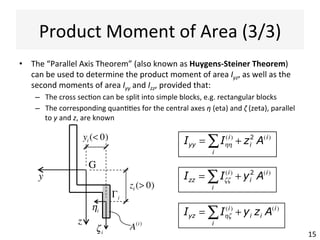
•  The	
  “Parallel	
  Axis	
  Theorem”	
  (also	
  known	
  as	
  Huygens-­‐Steiner	
  Theorem)	
  
can	
  be	
  used	
  to	
  determine	
  the	
  product	
  moment	
  of	
  area	
  Iyz,	
  as	
  well	
  as	
  the	
  
second	
  moments	
  of	
  area	
  Iyy	
  and	
  Izz,	
  provided	
  that:	
  
–  The	
  cross	
  sec@on	
  can	
  be	
  split	
  into	
  simple	
  blocks,	
  e.g.	
  rectangular	
  blocks	
  
–  The	
  corresponding	
  quan@@es	
  for	
  the	
  central	
  axes	
  η	
  (eta)	
  and	
  ζ	
  (zeta),	
  parallel	
  
to	
  y	
  and	
  z,	
  are	
  known	


Iyy = Iηη
(i)
+ zi
2
A(i)
i
∑
Izz = Iζζ
(i)
+ yi
2
A(i)
i
∑
Iyz = Iηζ
(i)
+ yi zi A(i)
i
∑z
y
G
ηi
ζi
Γi
A(i)
yi (< 0)
zi (> 0)
Moments	
  of	
  Area:	
  Worked	
  Example	
  
(1/5)	
  
17	
  
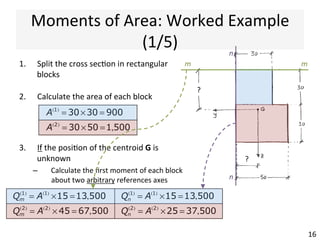
1.  Split	
  the	
  cross	
  sec@on	
  in	
  rectangular	
  
blocks	
  
2.  Calculate	
  the	
  area	
  of	
  each	
  block	
  
3.  If	
  the	
  posi@on	
  of	
  the	
  centroid	
  G	
  is	
  
unknown	
  
–  Calculate	
  the	
  first	
  moment	
  of	
  each	
  block	
  
about	
  two	
  arbitrary	
  references	
  axes	


A(1)
= 30×30 = 900
A(2)
= 30×50 =1,500
Qm
(1)
= A(1)
×15 =13,500 Qn
(1)
= A(1)
×15 =13,500
Qm
(2)
= A(2)
× 45 = 67,500 Qn
(2)
= A(2)
×25 = 37,500
?	
  
?	
  
m m
n
n
Moments	
  of	
  Area:	
  Worked	
  Example	
  
(2/5)	
  
18	
  
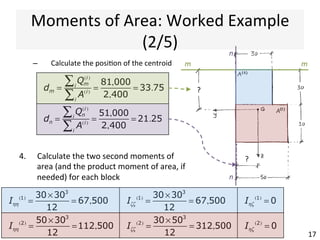
–  Calculate	
  the	
  posi@on	
  of	
  the	
  centroid	
  
4.  Calculate	
  the	
  two	
  second	
  moments	
  of	
  
area	
  (and	
  the	
  product	
  moment	
  of	
  area,	
  if	
  
needed)	
  for	
  each	
  block	


dm =
Qm
(i)
i∑
A(i)
i∑
=
81,000
2,400
= 33.75
dn =
Qn
(i)
i∑
A(i)
i∑
=
51,000
2,400
= 21.25
Iηη
(1)
=
30×303
12
= 67,500 Iζζ
(1)
=
30×303
12
= 67,500 Iηζ
(1)
= 0
Iηη
(2)
=
50×303
12
=112,500 Iζζ
(2)
=
30×503
12
= 312,500 Iηζ
(2)
= 0
m m
n
n
?	
  
?	
  
Moments	
  of	
  Area:	
  Worked	
  Example	
  
(3/5)	
  
19	
  
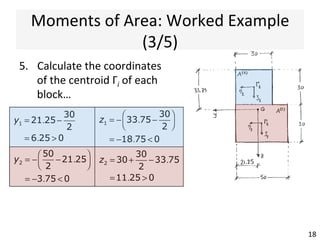
5.  Calculate	
  the	
  coordinates	
  
of	
  the	
  centroid	
  Γi	
  of	
  each	
  
block…	


y1 = 21.25−
30
2
= 6.25 > 0
z1 = − 33.75−
30
2
⎛
⎝⎜
⎞
⎠⎟
= −18.75 < 0
y2 = −
50
2
−21.25
⎛
⎝⎜
⎞
⎠⎟
= −3.75 < 0
z2 = 30+
30
2
−33.75
=11.25 > 0
Moments	
  of	
  Area:	
  Worked	
  Example	
  
(4/5)	
  
20	
  
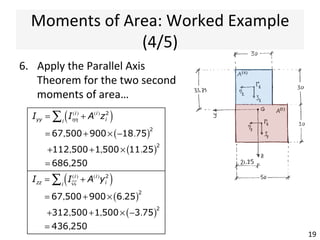
6.  Apply	
  the	
  Parallel	
  Axis	
  
Theorem	
  for	
  the	
  two	
  second	
  
moments	
  of	
  area…	


Iyy = Iηη
(i)
+ A(i)
zi
2
( )i∑
= 67,500+900× −18.75( )2
+112,500+1,500× 11.25( )2
= 686,250
Izz = Iζζ
(i)
+ A(i)
yi
2
( )i∑
= 67,500+900× 6.25( )2
+312,500+1,500× −3.75( )2
= 436,250
Moments	
  of	
  Area:	
  Worked	
  Example	
  
(5/5)	
  
21	
  
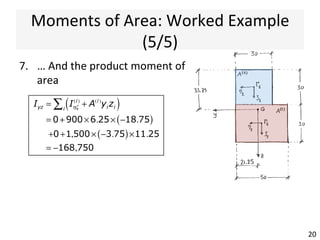
7.  …	
  And	
  the	
  product	
  moment	
  of	
  
area	


Iyz = Iηζ
(i)
+ A(i)
yi zi( )i∑
= 0+900×6.25× −18.75( )
+0+1,500× −3.75( )×11.25
= −168,750
Rota@ng	
  the	
  Central	
  Axes	
  
22	
  
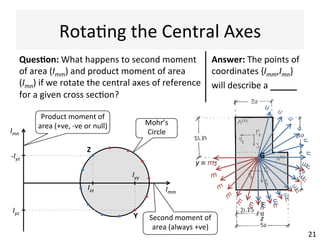
QuesBon:	
  What	
  happens	
  to	
  second	
  moment	
  
of	
  area	
  (Imm)	
  and	
  product	
  moment	
  of	
  area	
  
(Imn)	
  if	
  we	
  rotate	
  the	
  central	
  axes	
  of	
  reference	
  
for	
  a	
  given	
  cross	
  sec@on?	
  
m
n
m
n
m
n
m
n
m
n
m
n
Imm	
  
Imn	
  
Y	
  
Z	
  
Product	
  moment	
  of	
  
area	
  (+ve,	
  -­‐ve	
  or	
  null)	


Second	
  moment	
  of	
  
area	
  (always	
  +ve)	


Iyy	
  
Iyz	
  
-­‐Iyz	
  
Izz	
  
Mohr’s	
  
Circle	


G
y	
  ≡	

	
  ≡	

z	

Answer:	
  The	
  points	
  of	
  
coordinates	
  {Imm,Imn}	
  
will	
  describe	
  a	
  circle	
  
Mohr’s	
  Circle	
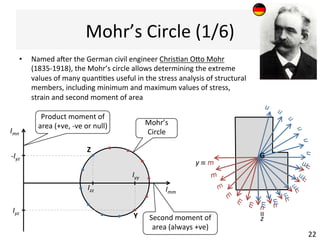
  (1/6)	
  
23	
  
•  Named	
  aser	
  the	
  German	
  civil	
  engineer	
  Chris@an	
  Oio	
  Mohr	
  
(1835-­‐1918),	
  the	
  Mohr’s	
  circle	
  allows	
  determining	
  the	
  extreme	
  
values	
  of	
  many	
  quan@@es	
  useful	
  in	
  the	
  stress	
  analysis	
  of	
  structural	
  
members,	
  including	
  minimum	
  and	
  maximum	
  values	
  of	
  stress,	
  
strain	
  and	
  second	
  moment	
  of	
  area	
  
m
n
m
n
m
n
m
n
m
n
m
n
Imm	
  
Imn	
  
Y	
  
Z	
  
Product	
  moment	
  of	
  
area	
  (+ve,	
  -­‐ve	
  or	
  null)	


Second	
  moment	
  of	
  
area	
  (always	
  +ve)	


Iyy	
  
Iyz	
  
-­‐Iyz	
  
Izz	
  
Mohr’s	
  
Circle	


G
y	
  ≡	

	
  ≡	

z
Mohr’s	
  Circle	
  (2/6)	
  
24	
  
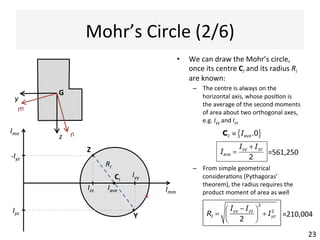
•  We	
  can	
  draw	
  the	
  Mohr’s	
  circle,	
  
once	
  its	
  centre	
  CI	
  and	
  its	
  radius	
  Ri	
  
are	
  known:	
  
–  The	
  centre	
  is	
  always	
  on	
  the	
  
horizontal	
  axis,	
  whose	
  posi@on	
  is	
  
the	
  average	
  of	
  the	
  second	
  moments	
  
of	
  area	
  about	
  two	
  orthogonal	
  axes,	
  
e.g.	
  Iyy	
  and	
  Izz	


–  From	
  simple	
  geometrical	
  
considera@ons	
  (Pythagoras’	
  
theorem),	
  the	
  radius	
  requires	
  the	
  
product	
  moment	
  of	
  area	
  as	
  well	


Imm	
  
Imn	
  
Y	
  
Z	
  
Iyy	
  
Iyz	
  
-­‐Iyz	
  
Izz	
  
y
z
G
m
n CI ≡ Iave,0{ }
Iave =
Iyy + Izz
2
RI =
Iyy − Izz
2
⎛
⎝⎜
⎞
⎠⎟
2
+ Iyz
2
CI	
  
Iave	
  
RI	
  
=561,250	
  
=210,004	
  
Mohr’s	
  Circle	
  (3/6)	
  
25	
  
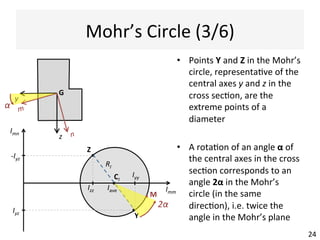
•  Points	
  Y	
  and	
  Z	
  in	
  the	
  Mohr’s	
  
circle,	
  representa@ve	
  of	
  the	
  
central	
  axes	
  y	
  and	
  z	
  in	
  the	
  
cross	
  sec@on,	
  are	
  the	
  
extreme	
  points	
  of	
  a	
  
diameter	
  
•  A	
  rota@on	
  of	
  an	
  angle	
  α	
  of	
  
the	
  central	
  axes	
  in	
  the	
  cross	
  
sec@on	
  corresponds	
  to	
  an	
  
angle	
  2α	
  in	
  the	
  Mohr’s	
  
circle	
  (in	
  the	
  same	
  
direc@on),	
  i.e.	
  twice	
  the	
  
angle	
  in	
  the	
  Mohr’s	
  plane	
  
Imm	
  
Imn	
  
Iyy	
  
Iyz	
  
-­‐Iyz	
  
Izz	
  
y
z
G
m
n
Y	
  
Z	
  
CI	
  
Iave	
  
RI	
  
α	
  
2α	
  
M	
  
Mohr’s	
  Circle	
  (4/6)	
  
26	
  
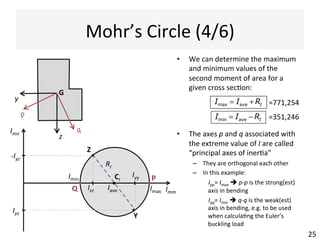
•  We	
  can	
  determine	
  the	
  maximum	
  
and	
  minimum	
  values	
  of	
  the	
  
second	
  moment	
  of	
  area	
  for	
  a	
  
given	
  cross	
  sec@on:	
  
•  The	
  axes	
  p	
  and	
  q	
  associated	
  with	
  
the	
  extreme	
  value	
  of	
  I	
  are	
  called	
  
“principal	
  axes	
  of	
  iner@a”	
  
–  They	
  are	
  orthogonal	
  each	
  other	
  
–  In	
  this	
  example:	
  
	
  Ipp=	
  Imax	
  è	
  p-­‐p	
  is	
  the	
  strong(est)	
  
axis	
  in	
  bending	
  
	
  Iqq=	
  Imin	
  è	
  q-­‐q	
  is	
  the	
  weak(est)	
  
axis	
  in	
  bending,	
  e.g.	
  to	
  be	
  used	
  
when	
  calcula@ng	
  the	
  Euler’s	
  
buckling	
  load	
  
Imm	
  
Imn	
  
Y	
  
Z	
  
Iyy	
  
Iyz	
  
-­‐Iyz	
  
Izz	
  
y
z
G
CI	
  
Iave	
  
RI	
  
Imin = Iave − RI
Imax = Iave + RI
Q	
  
Imin	
   P	
  
Imax	
  
=771,254	
  
=351,246	
  
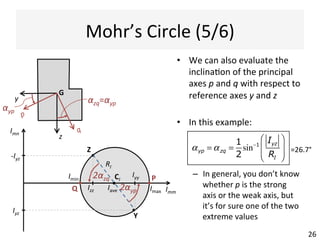
Mohr’s	
  Circle	
  (5/6)	
  
27	
  
•  We	
  can	
  also	
  evaluate	
  the	
  
inclina@on	
  of	
  the	
  principal	
  
axes	
  p	
  and	
  q	
  with	
  respect	
  to	
  
reference	
  axes	
  y	
  and	
  z	
  
•  In	
  this	
  example:	
  
–  In	
  general,	
  you	
  don’t	
  know	
  
whether	
  p	
  is	
  the	
  strong	
  
axis	
  or	
  the	
  weak	
  axis,	
  but	
  
it’s	
  for	
  sure	
  one	
  of	
  the	
  two	
  
extreme	
  values	
  	
  
Imm	
  
Imn	
  
Y	
  
Z	
  
Iyy	
  
Iyz	
  
-­‐Iyz	
  
Izz	
  
y
z
G
CI	
  
Iave	
  
RI	
  
αyp = αzq =
1
2
sin−1
Iyz
RI
⎛
⎝
⎜
⎜
⎞
⎠
⎟
⎟
Q	
  
Imin	
   P	
  
Imax	
  
αyp	
  
αzq=αyp	
  
2αyp	
  
2αzq	
  
=26.7°	
  
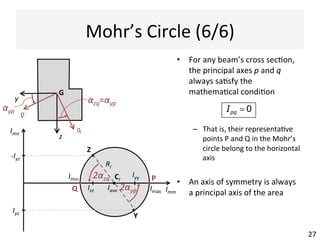
Mohr’s	
  Circle	
  (6/6)	
  
28	
  
•  For	
  any	
  beam’s	
  cross	
  sec@on,	
  
the	
  principal	
  axes	
  p	
  and	
  q	
  
always	
  sa@sfy	
  the	
  
mathema@cal	
  condi@on	
  
–  That	
  is,	
  their	
  representa@ve	
  
points	
  P	
  and	
  Q	
  in	
  the	
  Mohr’s	
  
circle	
  belong	
  to	
  the	
  horizontal	
  
axis	
  
•  An	
  axis	
  of	
  symmetry	
  is	
  always	
  
a	
  principal	
  axis	
  of	
  the	
  area	
  Imm	
  
Imn	
  
Y	
  
Z	
  
Iyy	
  
Iyz	
  
-­‐Iyz	
  
Izz	
  
y
z
G
CI	
  
Iave	
  
RI	
  
Q	
  
Imin	
   P	
  
Imax	
  
αyp	
  
αzq=αyp	
  
2αyp	
  
2αzq	
  
Ipq = 0
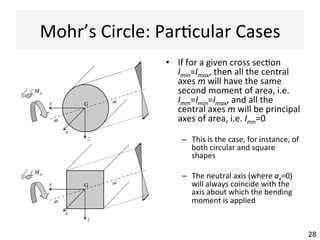
Mohr’s	
  Circle:	
  Par@cular	
  Cases	
  
•  If	
  for	
  a	
  given	
  cross	
  sec@on	
  
Imin=Imax,	
  then	
  all	
  the	
  central	
  
axes	
  m	
  will	
  have	
  the	
  same	
  
second	
  moment	
  of	
  area,	
  i.e.	
  
Imm=Imin=Imax,	
  and	
  all	
  the	
  
central	
  axes	
  m	
  will	
  be	
  principal	
  
axes	
  of	
  area,	
  i.e.	
  Imn=0	
  
–  This	
  is	
  the	
  case,	
  for	
  instance,	
  of	
  
both	
  circular	
  and	
  square	
  
shapes	
  
–  The	
  neutral	
  axis	
  (where	
  σx=0)	
  
will	
  always	
  coincide	
  with	
  the	
  
axis	
  about	
  which	
  the	
  bending	
  
moment	
  is	
  applied	
  
29	
  
z
y G
x
Mm
m
m
z
y G
x
Mm
m
m
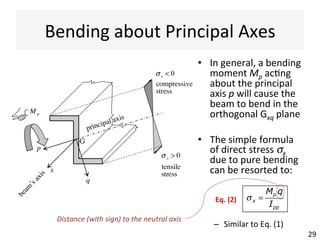
Bending	
  about	
  Principal	
  Axes	
  
•  In	
  general,	
  a	
  bending	
  
moment	
  Mp	
  ac@ng	
  
about	
  the	
  principal	
  
axis	
  p	
  will	
  cause	
  the	
  
beam	
  to	
  bend	
  in	
  the	
  
orthogonal	
  Gxq	
  plane	
  
•  The	
  simple	
  formula	
  
of	
  direct	
  stress	
  σx	
  
due	
  to	
  pure	
  bending	
  
can	
  be	
  resorted	
  to:	
  
–  Similar	
  to	
  Eq.	
  (1)	
  
	
   30	
  
x
beam
’s axis
G
q
p
M p
principal axis
σ x > 0
σx < 0
tensile
stress
compressive
stress
σx =
Mp q
Ipp
Eq.	
  (2)	
  
Distance	
  (with	
  sign)	
  to	
  the	
  neutral	
  axis	
  
Normal	
  Stress	
  due	
  to	
  Unsymmetrical	
  
Bending:	
  General	
  Procedure	
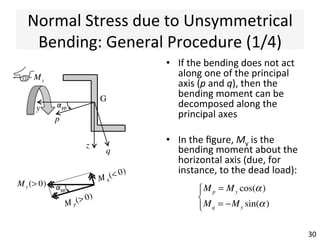
  (1/4)	
  
•  If	
  the	
  bending	
  does	
  not	
  act	
  
along	
  one	
  of	
  the	
  principal	
  
axis	
  (p	
  and	
  q),	
  then	
  the	
  
bending	
  moment	
  can	
  be	
  
decomposed	
  along	
  the	
  
principal	
  axes	
  
•  In	
  the	
  figure,	
  My	
  is	
  the	
  
bending	
  moment	
  about	
  the	
  
horizontal	
  axis	
  (due,	
  for	
  
instance,	
  to	
  the	
  dead	
  load):	


31	
  
My
z
y
G
q
p
ααyp	
  
Mp = My cos(α)
Mq = −My sin(α)
⎧
⎨
⎪
⎩⎪
My (> 0)
M p
(> 0)
M q
(< 0)
ααyp	
  
Normal	
  Stress	
  due	
  to	
  Unsymmetrical	
  
Bending:	
  General	
  Procedure	
  (2/4)	
  
•  If	
  the	
  bending	
  does	
  not	
  act	
  
along	
  one	
  of	
  the	
  principal	
  
axis	
  (p	
  and	
  q),	
  then	
  the	
  
bending	
  moment	
  can	
  be	
  
decomposed	
  along	
  the	
  
principal	
  axes	
  
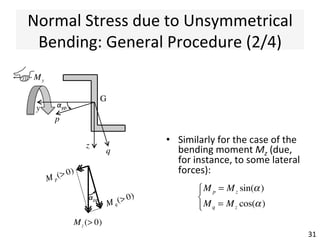
•  Similarly	
  for	
  the	
  case	
  of	
  the	
  
bending	
  moment	
  Mz	
  (due,	
  
for	
  instance,	
  to	
  some	
  lateral	
  
forces):	


32	
  
My
z
y
G
q
p
ααyp	
  
M p = Mz sin(α)
Mq = Mz cos(α)
⎧
⎨
⎪
⎩⎪
M p
(> 0)
α
Mz (> 0)
M q
(> 0)αzq	
  
Normal	
  Stress	
  due	
  to	
  Unsymmetrical	
  
Bending:	
  General	
  Procedure	
  (3/4)	
  
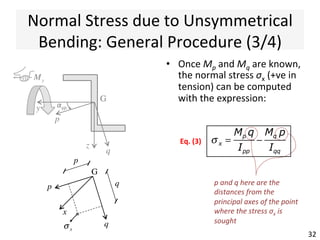
•  Once	
  Mp	
  and	
  Mq	
  are	
  known,	
  
the	
  normal	
  stress	
  σx	
  (+ve	
  in	
  
tension)	
  can	
  be	
  computed	
  
with	
  the	
  expression:	
  
33	
  
My
z
y
G
q
p
ααyp	
  
p	
  and	
  q	
  here	
  are	
  the	
  
distances	
  from	
  the	
  
principal	
  axes	
  of	
  the	
  point	
  
where	
  the	
  stress	
  σx	
  is	
  
sought	
  q
p
G
σ x
q
p
x
σ x =
Mp q
Ipp
−
Mq p
Iqq
Eq.	
  (3)	
  
Normal	
  Stress	
  due	
  to	
  Unsymmetrical	
  
Bending:	
  General	
  Procedure	
  (4/4)	
  
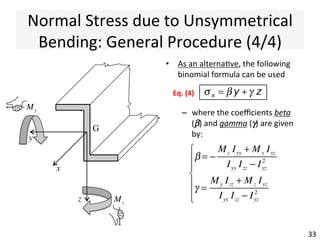
•  As	
  an	
  alterna@ve,	
  the	
  following	
  
binomial	
  formula	
  can	
  be	
  used	
  
–  where	
  the	
  coefficients	
  beta	
  
(β)	
  and	
  gamma	
  (γ)	
  are	
  given	
  
by:	
  
Mz
z
G
My
y
x
σ x = β y +γ z
β = −
Mz Iyy + My Iyz
Iyy Izz − Iyz
2
γ =
My Izz + Mz Iyz
Iyy Izz − Iyz
2
⎧
⎨
⎪
⎪
⎩
⎪
⎪
34	
  
Eq.	
  (4)	
  
Neutral	
  Axis	
  (1/2)	
  
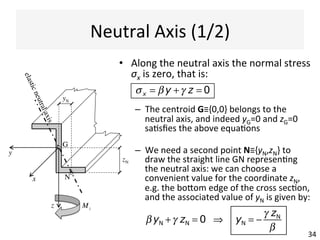
•  Along	
  the	
  neutral	
  axis	
  the	
  normal	
  stress	
  
σx	
  is	
  zero,	
  that	
  is:	


–  The	
  centroid	
  G≡{0,0}	
  belongs	
  to	
  the	
  
neutral	
  axis,	
  and	
  indeed	
  yG=0	
  and	
  zG=0	
  
sa@sfies	
  the	
  above	
  equa@ons	
  
–  We	
  need	
  a	
  second	
  point	
  N≡{yN,zN}	
  to	
  
draw	
  the	
  straight	
  line	
  GN	
  represen@ng	
  
the	
  neutral	
  axis:	
  we	
  can	
  choose	
  a	
  
convenient	
  value	
  for	
  the	
  coordinate	
  zN,	
  
e.g.	
  the	
  boiom	
  edge	
  of	
  the	
  cross	
  sec@on,	
  
and	
  the	
  associated	
  value	
  of	
  yN	
  is	
  given	
  by:	


z
G
y
x
Mz
N
zN
yN
elasticneutralaxis
σx = β y +γ z = 0
β yN +γ zN = 0 ⇒ yN = −
γ zN
β
35	
  
Neutral	
  Axis	
  (2/2)	
  
z
G
y
x
Mz
N
zN
yN
elasticneutralaxis
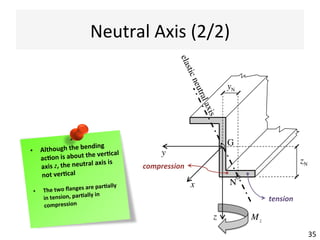
•  Although	
  the	
  bending	
  
acBon	
  is	
  about	
  the	
  verBcal	
  
axis	
  z,	
  the	
  neutral	
  axis	
  is	
  
not	
  verBcal	
  
•  The	
  two	
  flanges	
  are	
  parBally	
  
in	
  tension,	
  parBally	
  in	
  
compression	
  	
  
tension	
  
compression	
  
36	
  
Normal	
  Stress	
  Calcula@ons:	
  
Worked	
  Example	
  (1/3)	
  
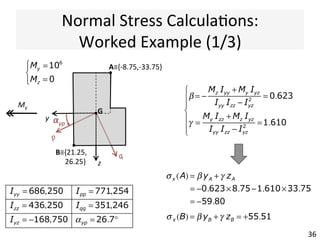
37	
  37	
  
y
z
G
αyp	
  
A≡{-­‐8.75,-­‐33.75}	
  
B≡{21.25,	
  	
  
26.25}	


My	
  
My =106
Mz = 0
⎧
⎨
⎪
⎩⎪
Iyy = 686,250 Ipp = 771,254
Izz = 436,250 Iqq = 351,246
Iyz = −168,750 αyp = 26.7°
β = −
Mz Iyy + My Iyz
Iyy Izz − Iyz
2
= 0.623
γ =
My Izz + Mz Iyz
Iyy Izz − Iyz
2
=1.610
⎧
⎨
⎪
⎪
⎩
⎪
⎪
σx (A) = β yA +γ zA
= −0.623×8.75−1.610×33.75
= −59.80
σ x (B) = β yB +γ zB = +55.51
Normal	
  Stress	
  Calcula@ons:	
  
Worked	
  Example	
  (2/3)	
  
38	
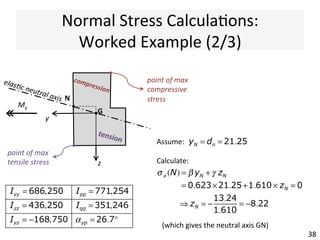
  38	
  
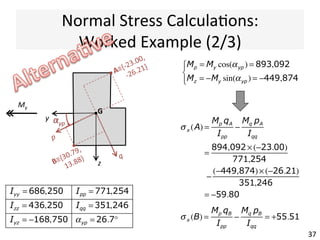
y
z
G
αyp	
  
My	
  
Iyy = 686,250 Ipp = 771,254
Izz = 436,250 Iqq = 351,246
Iyz = −168,750 αyp = 26.7°
Mp = My cos(αyp ) = 893,092
Mz = −My sin(αyp ) = −449,874
⎧
⎨
⎪
⎩⎪
σ x (A) =
Mp qA
Ipp
−
Mq pA
Iqq
=
894,092× (−23.00)
771,254
−
(−449,874)× (−26.21)
351,246
= −59.80
σ x (B) =
Mp qB
Ipp
−
Mq pB
Iqq
= +55.51
Normal	
  Stress	
  Calcula@ons:	
  
Worked	
  Example	
  (2/3)	
  
39	
  39	
  
y
z
G
My	
  
Iyy = 686,250 Ipp = 771,254
Izz = 436,250 Iqq = 351,246
Iyz = −168,750 αyp = 26.7°
yN = dn = 21.25
σ x (N) = β yN +γ zN
= 0.623×21.25+1.610× zN = 0
⇒ zN = −
13.24
1.610
= −8.22
N	
  
tension	
  
compression	
  
point	
  of	
  max	
  
tensile	
  stress	
  
point	
  of	
  max	
  
compressive	
  
stress	
  
Assume:	


Calculate:	
  
(which	
  gives	
  the	
  neutral	
  axis	
  GN)	
  	
  
elas0c	
  neutral	
  axis	
  
Key	
  Learning	
  Points	
  (1/2)	
  
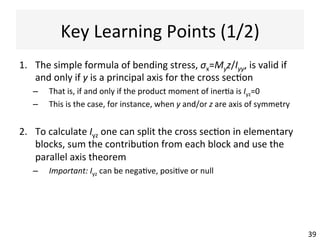
1.  The	
  simple	
  formula	
  of	
  bending	
  stress,	
  σx=Myz/Iyy,	
  is	
  valid	
  if	
  
and	
  only	
  if	
  y	
  is	
  a	
  principal	
  axis	
  for	
  the	
  cross	
  sec@on	
  
–  That	
  is,	
  if	
  and	
  only	
  if	
  the	
  product	
  moment	
  of	
  iner@a	
  is	
  Iyz=0	
  
–  This	
  is	
  the	
  case,	
  for	
  instance,	
  when	
  y	
  and/or	
  z	
  are	
  axis	
  of	
  symmetry	
  
2.  To	
  calculate	
  Iyz	
  one	
  can	
  split	
  the	
  cross	
  sec@on	
  in	
  elementary	
  
blocks,	
  sum	
  the	
  contribu@on	
  from	
  each	
  block	
  and	
  use	
  the	
  
parallel	
  axis	
  theorem	
  
–  Important:	
  Iyz	
  can	
  be	
  nega@ve,	
  posi@ve	
  or	
  null	
  
40	
  
Key	
  Learning	
  Points	
  (2/2)	
  
3.  Knowing	
  Iyy,	
  Izz	
  and	
  Iyz	
  ,	
  one	
  can	
  draw	
  the	
  Mohr’s	
  circle	
  for	
  the	
  
second	
  moment	
  of	
  area,	
  which	
  allows	
  determining	
  the	
  
extreme	
  values	
  (Imin	
  and	
  Imax)	
  and	
  their	
  direc@ons	
  
4.  In	
  the	
  general	
  case	
  of	
  unsymmetrical	
  bending,	
  the	
  normal	
  
stress	
  is	
  given	
  by	
  the	
  formula	
  
–  σx=	
  βy	
  +	
  γz	
  
•  where	
  β	
  and	
  γ	
  depend	
  on	
  the	
  components	
  of	
  the	
  bending	
  moments	
  (My	
  and	
  Mz)	
  
as	
  well	
  as	
  on	
  Iyy,	
  Izz	
  and	
  Iyz	
  
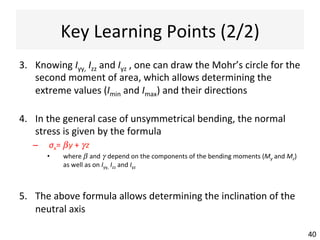
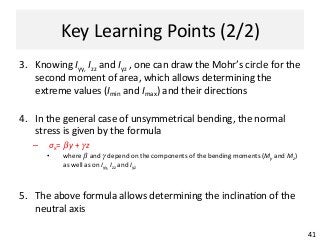
5.  The	
  above	
  formula	
  allows	
  determining	
  the	
  inclina@on	
  of	
  the	
  
neutral	
  axis	


41	
  

Unsymmetrical bending (2nd year)

  • 1.
    Unsymmetrical  Bending   Dr  Alessandro  Palmeri   <A.Palmeri@lboro.ac.uk>  
  • 2.
    Teaching  schedule   WeekLecture 1 Staff Lecture 2 Staff Tutorial Staff 1 Beam Shear Stresses 1 A P Beam Shear Stresses 2 A P --- --- 2 Shear centres A P Basic Concepts J E-R Shear Centre A P 3 Principle of Virtual forces J E-R Indeterminate Structures J E-R Virtual Forces J E-R 4 The Compatibility Method J E-R Examples J E-R Virtual Forces J E-R 5 Examples J E-R Moment Distribution - Basics J E-R Comp. Method J E-R 6 The Hardy Cross Method J E-R Fixed End Moments J E-R Comp. Method J E-R 7 Examples J E-R Non Sway Frames J E-R Mom. Dist J E-R 8 Column Stability 1 A P Sway Frames J E-R Mom. Dist J E-R 9 Column Stability 2 A P Unsymmetric Bending 1 A P Colum Stability A P 10 Unsymmetric Bending 2 A P Complex Stress/Strain A P Unsymmetric Bending A P 11 Complex Stress/Strain A P Complex Stress/Strain A P Complex Stress/Strain A P Christmas Holiday 12 Revision 13 14 Exams 15 2  
  • 3.
    Mo@va@ons  (1/2)   • Many  cross  sec@ons  used  for   structural  elements  (such  us  Z   sec@ons  or  angle  sec@ons)  do   not  have  any  axis  of  symmetry   •  How  does  the  theory   developed  for  symmetrical   bending  can  be  extended  to   such  sec@ons?   3  
  • 4.
    Mo@va@ons  (2/2)   • The  figure  shows  the   finite  element  model  of   a  can@lever  beam  with   Z  cross  sec@on   subjected  to  its  own   weight,  in  which  the   gravita@onal  (ver@cal)   load  induces  lateral   sway  (horizontal),     –  exaggerated  for  clarity   •  How  can  we  predict   this?   4   XY X Z Y Z X Y X Z Y Z
  • 5.
    Learning  Outcomes   • When  we  have  completed  this  unit  (2  lectures   +  1  tutorial),  you  should  be  able  to:   – Determine  the  principal  second  moments  of  area   AND  the  principal  direc@ons  of  area  for   unsymmetrical  beam’s  cross  sec@ons   – Evaluate  the  normal  stress  σx  in  beams  subjected   to  unsymmetric  bending   5  
  • 6.
    Further  reading   • R  C  Hibbeler,  “Mechanics  of  Materials”,  8th   Ed,  Pren@ce  Hall  –  Chapter  6  on  “Bending”     •  T  H  G  Megson,  “Structural  and  Stress   Analysis”,  2nd  Ed,  Elsevier  –  Chapter  9  on   “Bending  of  Beams”  (eBook)   6  
  • 7.
    Symmetrical  Bending  (1/4)   •  Our  analysis  of  beams  in  bending  has  been  restricted  so  far   (part  A)  to  the  case  of  cross  sec@ons  having  at  least  one   axis  of  symmetry,  assuming  that  the  bending  moment  is   ac@ng  either  about  this  axis  of  symmetry  (a),  or  about  the   orthogonal  axis  (b)   7   (a)   x z y axis of symmetry beam ’saxis My G (right hand) σ x > 0 σx < 0 tensile stress compressive stress (b)   x z y axis of symmetry beam ’saxis Mz G σ x > 0σx < 0 tensile stress compressive stress
  • 8.
    Symmetrical  Bending  (2/4)   8   x z y axis of symmetry beam ’saxis Mz My G Right-­‐Hand  Rule     If  the  thumb  point  to  the   posi0ve  direc0on  of  the  axis,   then  the  curling  of  the  other   fingers  give  the  posi0ve   direc0on  of  the  bending   Noteworthy:  Some0mes  a  double-­‐ headed  arrow  is  used  to  represent  a   moment  (as  opposite  to  a  single-­‐headed   arrow  used  for  a  force)    
  • 9.
    Symmetrical  Bending  (3/4)   9   x z y axis of symmetry beam ’saxis My G (right hand) σ x > 0 σx < 0 tensile stress compressive stress x z y axis of symmetry beam ’saxis Mz G σ x > 0σx < 0 tensile stress compressive stress ➡   A  posi@ve  bending  moment  My>0,   induces  tensile  stress  σx>0  in  the   boiom  fibres  of  the  cross  sec@on   A  posi@ve  bending  moment  Mz>0,   induces  tensile  stress  σx>0  in  the  right   fibres  of  the  cross  sec@on  (looking  at  it   from  the  posi@ve  direc@on  of  the  x  axis)    
  • 10.
    σ x = Myz Iyy Eq.  (1)   Symmetrical  Bending  (4/4)   •  The  simplest  case  when  the   bending  moment  My  acts   about  the  axis  y,  orthogonal  to   the  axis  of  symmetry  z   •  Therefore,  the  beam  bends  in   the  ver@cal  plan  Gxz   •  The  direct  stress  σx  is  given  by:   10   x z y axis of symmetry beam ’saxis My σx > 0 G
  • 11.
    Unsymmetrical  Bending  (1/3)   11   •  The  case  of  unsymmetric  bending  deals  with:   –  EITHER  a  bending  moment  ac@ng  about  an  axis  which  is   neither  an  axis  of  symmetry,  nor  orthogonal  to  it  (le9)   –  OR  a  beam’s  cross  sec@on  which  does  not  have  any  axis  of   symmetry  (right)   x z y beam ’saxis My G x z y axis of symmetry beam ’saxis My G
  • 12.
    Unsymmetrical  Bending  (2/3)   12   •  The  first  case  is  trivial,   and  can  be  solved  by   using:   –  Decomposi@on  of  the   bending  moment:     –  Superposi@on  of  effects:   Mp = My cos(α) Mq = −My sin(α) σx (A) = Mp Ipp ⋅ d 2 − Mq Iqq ⋅e = My d /2 Ipp cos(α)+ e Ipp sin(α) ⎛ ⎝ ⎜ ⎞ ⎠ ⎟
  • 13.
    Unsymmetrical  Bending  (3/3)   13   •  Par@cular  cases…   Bending  about  the  strong  axis   σx (A) = My Ipp ⋅ d 2 Bending  about  the  weak  axis   σ x (A) = My Iqq ⋅e
  • 14.
    Product  Moment  of  Area  (1/3)   14   •  Let’s  introduce  a  new  quan@ty,  Iyz,  called   “Product  Moment  of  Area”   –  Defined  as:   •  If  and  only  if  Iyz  =0,  a  bending  moment  ac@ng  on  one  of   these  two  axes  will  cause  the  beam  to  bend  about  the   same  axis  only,  not  about  the  orthogonal  axis  (symmetric   bending)   –  I.e.  a  ver@cal  transverse  load  will  not  induce  any  lateral  sway   and  a  lateral  transverse  will  not  cause  any  ver@cal  movement   = ∫ dyz A I y z A
  • 15.
    Product  Moment  of  Area  (2/3)   15   •  The  product  moment  of  area  is   defined  mathema@cally  as  the   integral  of  the  product  of  the   coordinates  y  and  z  over  the  cross   sec@onal  area   •  Similarly  the  second  moments  of   area  Iyy  and  Izz  are  the  integrals  of  the   second  power  of  the  other   coordinate,  z2  and  y2   •  G  is  the  centroid  of  the  cross  sec@on   Iyy = z2 dA A ∫ Izz = y2 dA A ∫ Iyz = y zdA A ∫
  • 16.
    Product  Moment  of  Area  (3/3)   16   •  The  “Parallel  Axis  Theorem”  (also  known  as  Huygens-­‐Steiner  Theorem)   can  be  used  to  determine  the  product  moment  of  area  Iyz,  as  well  as  the   second  moments  of  area  Iyy  and  Izz,  provided  that:   –  The  cross  sec@on  can  be  split  into  simple  blocks,  e.g.  rectangular  blocks   –  The  corresponding  quan@@es  for  the  central  axes  η  (eta)  and  ζ  (zeta),  parallel   to  y  and  z,  are  known     Iyy = Iηη (i) + zi 2 A(i) i ∑ Izz = Iζζ (i) + yi 2 A(i) i ∑ Iyz = Iηζ (i) + yi zi A(i) i ∑z y G ηi ζi Γi A(i) yi (< 0) zi (> 0)
  • 17.
    Moments  of  Area:  Worked  Example   (1/5)   17   1.  Split  the  cross  sec@on  in  rectangular   blocks   2.  Calculate  the  area  of  each  block   3.  If  the  posi@on  of  the  centroid  G  is   unknown   –  Calculate  the  first  moment  of  each  block   about  two  arbitrary  references  axes           A(1) = 30×30 = 900 A(2) = 30×50 =1,500 Qm (1) = A(1) ×15 =13,500 Qn (1) = A(1) ×15 =13,500 Qm (2) = A(2) × 45 = 67,500 Qn (2) = A(2) ×25 = 37,500 ?   ?   m m n n
  • 18.
    Moments  of  Area:  Worked  Example   (2/5)   18   –  Calculate  the  posi@on  of  the  centroid   4.  Calculate  the  two  second  moments  of   area  (and  the  product  moment  of  area,  if   needed)  for  each  block           dm = Qm (i) i∑ A(i) i∑ = 81,000 2,400 = 33.75 dn = Qn (i) i∑ A(i) i∑ = 51,000 2,400 = 21.25 Iηη (1) = 30×303 12 = 67,500 Iζζ (1) = 30×303 12 = 67,500 Iηζ (1) = 0 Iηη (2) = 50×303 12 =112,500 Iζζ (2) = 30×503 12 = 312,500 Iηζ (2) = 0 m m n n ?   ?  
  • 19.
    Moments  of  Area:  Worked  Example   (3/5)   19   5.  Calculate  the  coordinates   of  the  centroid  Γi  of  each   block…         y1 = 21.25− 30 2 = 6.25 > 0 z1 = − 33.75− 30 2 ⎛ ⎝⎜ ⎞ ⎠⎟ = −18.75 < 0 y2 = − 50 2 −21.25 ⎛ ⎝⎜ ⎞ ⎠⎟ = −3.75 < 0 z2 = 30+ 30 2 −33.75 =11.25 > 0
  • 20.
    Moments  of  Area:  Worked  Example   (4/5)   20   6.  Apply  the  Parallel  Axis   Theorem  for  the  two  second   moments  of  area…         Iyy = Iηη (i) + A(i) zi 2 ( )i∑ = 67,500+900× −18.75( )2 +112,500+1,500× 11.25( )2 = 686,250 Izz = Iζζ (i) + A(i) yi 2 ( )i∑ = 67,500+900× 6.25( )2 +312,500+1,500× −3.75( )2 = 436,250
  • 21.
    Moments  of  Area:  Worked  Example   (5/5)   21   7.  …  And  the  product  moment  of   area           Iyz = Iηζ (i) + A(i) yi zi( )i∑ = 0+900×6.25× −18.75( ) +0+1,500× −3.75( )×11.25 = −168,750
  • 22.
    Rota@ng  the  Central  Axes   22   QuesBon:  What  happens  to  second  moment   of  area  (Imm)  and  product  moment  of  area   (Imn)  if  we  rotate  the  central  axes  of  reference   for  a  given  cross  sec@on?   m n m n m n m n m n m n Imm   Imn   Y   Z   Product  moment  of   area  (+ve,  -­‐ve  or  null)     Second  moment  of   area  (always  +ve)     Iyy   Iyz   -­‐Iyz   Izz   Mohr’s   Circle     G y  ≡  ≡ z Answer:  The  points  of   coordinates  {Imm,Imn}   will  describe  a  circle  
  • 23.
    Mohr’s  Circle  (1/6)   23   •  Named  aser  the  German  civil  engineer  Chris@an  Oio  Mohr   (1835-­‐1918),  the  Mohr’s  circle  allows  determining  the  extreme   values  of  many  quan@@es  useful  in  the  stress  analysis  of  structural   members,  including  minimum  and  maximum  values  of  stress,   strain  and  second  moment  of  area   m n m n m n m n m n m n Imm   Imn   Y   Z   Product  moment  of   area  (+ve,  -­‐ve  or  null)     Second  moment  of   area  (always  +ve)     Iyy   Iyz   -­‐Iyz   Izz   Mohr’s   Circle     G y  ≡  ≡ z
  • 24.
    Mohr’s  Circle  (2/6)   24   •  We  can  draw  the  Mohr’s  circle,   once  its  centre  CI  and  its  radius  Ri   are  known:   –  The  centre  is  always  on  the   horizontal  axis,  whose  posi@on  is   the  average  of  the  second  moments   of  area  about  two  orthogonal  axes,   e.g.  Iyy  and  Izz     –  From  simple  geometrical   considera@ons  (Pythagoras’   theorem),  the  radius  requires  the   product  moment  of  area  as  well       Imm   Imn   Y   Z   Iyy   Iyz   -­‐Iyz   Izz   y z G m n CI ≡ Iave,0{ } Iave = Iyy + Izz 2 RI = Iyy − Izz 2 ⎛ ⎝⎜ ⎞ ⎠⎟ 2 + Iyz 2 CI   Iave   RI   =561,250   =210,004  
  • 25.
    Mohr’s  Circle  (3/6)   25   •  Points  Y  and  Z  in  the  Mohr’s   circle,  representa@ve  of  the   central  axes  y  and  z  in  the   cross  sec@on,  are  the   extreme  points  of  a   diameter   •  A  rota@on  of  an  angle  α  of   the  central  axes  in  the  cross   sec@on  corresponds  to  an   angle  2α  in  the  Mohr’s   circle  (in  the  same   direc@on),  i.e.  twice  the   angle  in  the  Mohr’s  plane   Imm   Imn   Iyy   Iyz   -­‐Iyz   Izz   y z G m n Y   Z   CI   Iave   RI   α   2α   M  
  • 26.
    Mohr’s  Circle  (4/6)   26   •  We  can  determine  the  maximum   and  minimum  values  of  the   second  moment  of  area  for  a   given  cross  sec@on:   •  The  axes  p  and  q  associated  with   the  extreme  value  of  I  are  called   “principal  axes  of  iner@a”   –  They  are  orthogonal  each  other   –  In  this  example:    Ipp=  Imax  è  p-­‐p  is  the  strong(est)   axis  in  bending    Iqq=  Imin  è  q-­‐q  is  the  weak(est)   axis  in  bending,  e.g.  to  be  used   when  calcula@ng  the  Euler’s   buckling  load   Imm   Imn   Y   Z   Iyy   Iyz   -­‐Iyz   Izz   y z G CI   Iave   RI   Imin = Iave − RI Imax = Iave + RI Q   Imin   P   Imax   =771,254   =351,246  
  • 27.
    Mohr’s  Circle  (5/6)   27   •  We  can  also  evaluate  the   inclina@on  of  the  principal   axes  p  and  q  with  respect  to   reference  axes  y  and  z   •  In  this  example:   –  In  general,  you  don’t  know   whether  p  is  the  strong   axis  or  the  weak  axis,  but   it’s  for  sure  one  of  the  two   extreme  values     Imm   Imn   Y   Z   Iyy   Iyz   -­‐Iyz   Izz   y z G CI   Iave   RI   αyp = αzq = 1 2 sin−1 Iyz RI ⎛ ⎝ ⎜ ⎜ ⎞ ⎠ ⎟ ⎟ Q   Imin   P   Imax   αyp   αzq=αyp   2αyp   2αzq   =26.7°  
  • 28.
    Mohr’s  Circle  (6/6)   28   •  For  any  beam’s  cross  sec@on,   the  principal  axes  p  and  q   always  sa@sfy  the   mathema@cal  condi@on   –  That  is,  their  representa@ve   points  P  and  Q  in  the  Mohr’s   circle  belong  to  the  horizontal   axis   •  An  axis  of  symmetry  is  always   a  principal  axis  of  the  area  Imm   Imn   Y   Z   Iyy   Iyz   -­‐Iyz   Izz   y z G CI   Iave   RI   Q   Imin   P   Imax   αyp   αzq=αyp   2αyp   2αzq   Ipq = 0
  • 29.
    Mohr’s  Circle:  Par@cular  Cases   •  If  for  a  given  cross  sec@on   Imin=Imax,  then  all  the  central   axes  m  will  have  the  same   second  moment  of  area,  i.e.   Imm=Imin=Imax,  and  all  the   central  axes  m  will  be  principal   axes  of  area,  i.e.  Imn=0   –  This  is  the  case,  for  instance,  of   both  circular  and  square   shapes   –  The  neutral  axis  (where  σx=0)   will  always  coincide  with  the   axis  about  which  the  bending   moment  is  applied   29   z y G x Mm m m z y G x Mm m m
  • 30.
    Bending  about  Principal  Axes   •  In  general,  a  bending   moment  Mp  ac@ng   about  the  principal   axis  p  will  cause  the   beam  to  bend  in  the   orthogonal  Gxq  plane   •  The  simple  formula   of  direct  stress  σx   due  to  pure  bending   can  be  resorted  to:   –  Similar  to  Eq.  (1)     30   x beam ’s axis G q p M p principal axis σ x > 0 σx < 0 tensile stress compressive stress σx = Mp q Ipp Eq.  (2)   Distance  (with  sign)  to  the  neutral  axis  
  • 31.
    Normal  Stress  due  to  Unsymmetrical   Bending:  General  Procedure  (1/4)   •  If  the  bending  does  not  act   along  one  of  the  principal   axis  (p  and  q),  then  the   bending  moment  can  be   decomposed  along  the   principal  axes   •  In  the  figure,  My  is  the   bending  moment  about  the   horizontal  axis  (due,  for   instance,  to  the  dead  load):         31   My z y G q p ααyp   Mp = My cos(α) Mq = −My sin(α) ⎧ ⎨ ⎪ ⎩⎪ My (> 0) M p (> 0) M q (< 0) ααyp  
  • 32.
    Normal  Stress  due  to  Unsymmetrical   Bending:  General  Procedure  (2/4)   •  If  the  bending  does  not  act   along  one  of  the  principal   axis  (p  and  q),  then  the   bending  moment  can  be   decomposed  along  the   principal  axes   •  Similarly  for  the  case  of  the   bending  moment  Mz  (due,   for  instance,  to  some  lateral   forces):         32   My z y G q p ααyp   M p = Mz sin(α) Mq = Mz cos(α) ⎧ ⎨ ⎪ ⎩⎪ M p (> 0) α Mz (> 0) M q (> 0)αzq  
  • 33.
    Normal  Stress  due  to  Unsymmetrical   Bending:  General  Procedure  (3/4)   •  Once  Mp  and  Mq  are  known,   the  normal  stress  σx  (+ve  in   tension)  can  be  computed   with  the  expression:   33   My z y G q p ααyp   p  and  q  here  are  the   distances  from  the   principal  axes  of  the  point   where  the  stress  σx  is   sought  q p G σ x q p x σ x = Mp q Ipp − Mq p Iqq Eq.  (3)  
  • 34.
    Normal  Stress  due  to  Unsymmetrical   Bending:  General  Procedure  (4/4)   •  As  an  alterna@ve,  the  following   binomial  formula  can  be  used   –  where  the  coefficients  beta   (β)  and  gamma  (γ)  are  given   by:   Mz z G My y x σ x = β y +γ z β = − Mz Iyy + My Iyz Iyy Izz − Iyz 2 γ = My Izz + Mz Iyz Iyy Izz − Iyz 2 ⎧ ⎨ ⎪ ⎪ ⎩ ⎪ ⎪ 34   Eq.  (4)  
  • 35.
    Neutral  Axis  (1/2)   •  Along  the  neutral  axis  the  normal  stress   σx  is  zero,  that  is:       –  The  centroid  G≡{0,0}  belongs  to  the   neutral  axis,  and  indeed  yG=0  and  zG=0   sa@sfies  the  above  equa@ons   –  We  need  a  second  point  N≡{yN,zN}  to   draw  the  straight  line  GN  represen@ng   the  neutral  axis:  we  can  choose  a   convenient  value  for  the  coordinate  zN,   e.g.  the  boiom  edge  of  the  cross  sec@on,   and  the  associated  value  of  yN  is  given  by:       z G y x Mz N zN yN elasticneutralaxis σx = β y +γ z = 0 β yN +γ zN = 0 ⇒ yN = − γ zN β 35  
  • 36.
    Neutral  Axis  (2/2)   z G y x Mz N zN yN elasticneutralaxis •  Although  the  bending   acBon  is  about  the  verBcal   axis  z,  the  neutral  axis  is   not  verBcal   •  The  two  flanges  are  parBally   in  tension,  parBally  in   compression     tension   compression   36  
  • 37.
    Normal  Stress  Calcula@ons:   Worked  Example  (1/3)   37  37   y z G αyp   A≡{-­‐8.75,-­‐33.75}   B≡{21.25,     26.25}     My   My =106 Mz = 0 ⎧ ⎨ ⎪ ⎩⎪ Iyy = 686,250 Ipp = 771,254 Izz = 436,250 Iqq = 351,246 Iyz = −168,750 αyp = 26.7° β = − Mz Iyy + My Iyz Iyy Izz − Iyz 2 = 0.623 γ = My Izz + Mz Iyz Iyy Izz − Iyz 2 =1.610 ⎧ ⎨ ⎪ ⎪ ⎩ ⎪ ⎪ σx (A) = β yA +γ zA = −0.623×8.75−1.610×33.75 = −59.80 σ x (B) = β yB +γ zB = +55.51
  • 38.
    Normal  Stress  Calcula@ons:   Worked  Example  (2/3)   38  38   y z G αyp   My   Iyy = 686,250 Ipp = 771,254 Izz = 436,250 Iqq = 351,246 Iyz = −168,750 αyp = 26.7° Mp = My cos(αyp ) = 893,092 Mz = −My sin(αyp ) = −449,874 ⎧ ⎨ ⎪ ⎩⎪ σ x (A) = Mp qA Ipp − Mq pA Iqq = 894,092× (−23.00) 771,254 − (−449,874)× (−26.21) 351,246 = −59.80 σ x (B) = Mp qB Ipp − Mq pB Iqq = +55.51
  • 39.
    Normal  Stress  Calcula@ons:   Worked  Example  (2/3)   39  39   y z G My   Iyy = 686,250 Ipp = 771,254 Izz = 436,250 Iqq = 351,246 Iyz = −168,750 αyp = 26.7° yN = dn = 21.25 σ x (N) = β yN +γ zN = 0.623×21.25+1.610× zN = 0 ⇒ zN = − 13.24 1.610 = −8.22 N   tension   compression   point  of  max   tensile  stress   point  of  max   compressive   stress   Assume:     Calculate:   (which  gives  the  neutral  axis  GN)     elas0c  neutral  axis  
  • 40.
    Key  Learning  Points  (1/2)   1.  The  simple  formula  of  bending  stress,  σx=Myz/Iyy,  is  valid  if   and  only  if  y  is  a  principal  axis  for  the  cross  sec@on   –  That  is,  if  and  only  if  the  product  moment  of  iner@a  is  Iyz=0   –  This  is  the  case,  for  instance,  when  y  and/or  z  are  axis  of  symmetry   2.  To  calculate  Iyz  one  can  split  the  cross  sec@on  in  elementary   blocks,  sum  the  contribu@on  from  each  block  and  use  the   parallel  axis  theorem   –  Important:  Iyz  can  be  nega@ve,  posi@ve  or  null   40  
  • 41.
    Key  Learning  Points  (2/2)   3.  Knowing  Iyy,  Izz  and  Iyz  ,  one  can  draw  the  Mohr’s  circle  for  the   second  moment  of  area,  which  allows  determining  the   extreme  values  (Imin  and  Imax)  and  their  direc@ons   4.  In  the  general  case  of  unsymmetrical  bending,  the  normal   stress  is  given  by  the  formula   –  σx=  βy  +  γz   •  where  β  and  γ  depend  on  the  components  of  the  bending  moments  (My  and  Mz)   as  well  as  on  Iyy,  Izz  and  Iyz   5.  The  above  formula  allows  determining  the  inclina@on  of  the   neutral  axis     41