Heizer and Render 2010, forecasting is the art and science of predicting the
future events.
 Forecasting is the art because subjective assessment coupled with historical
and contemporary is required to improve the accuracy of forecasts.
 It is a science because a wide variety of numerical methods are used to
obtain a number or several number and further analysed using
mathematical models to ascertain the accuracy of forecast.
Thursday, January 29, 2015 1
Thursday, January 29, 2015 2
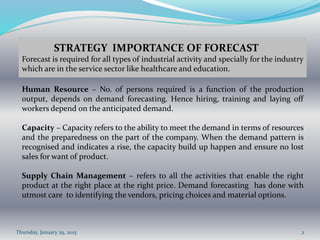
STRATEGY IMPORTANCE OF FORECAST
Forecast is required for all types of industrial activity and specially for the industry
which are in the service sector like healthcare and education.
Human Resource – No. of persons required is a function of the production
output, depends on demand forecasting. Hence hiring, training and laying off
workers depend on the anticipated demand.
Capacity – Capacity refers to the ability to meet the demand in terms of resources
and the preparedness on the part of the company. When the demand pattern is
recognised and indicates a rise, the capacity build up happen and ensure no lost
sales for want of product.
Supply Chain Management – refers to all the activities that enable the right
product at the right place at the right price. Demand forecasting has done with
utmost care to identifying the vendors, pricing choices and material options.
Thursday, January 29, 2015 3
WHY FORECASTING IS REQUIRED ?
Forecasting is required for:
 Production planning.
 Financial planning.
 Personnel planning.
 Scheduling planning
 Facilities planning.
 Process design and planning.
 Benefits from forecast - Forecasting overcome the uncertainty about the
demand and provides a workable solution. Without the forecast, no production
function can be taken up.
• Improve employee relations.
• Improve material management
• Better use of capital and facilities.
• Improve customer service
 Cost Implications of forecasting – Total cost of forecasting to a minimum,
certain uncertainty is acceptable in forecasting. Hence, preparedness for some
possible loss.
Thursday, January 29, 2015 4
WHY FORECASTING IS REQUIRED ?
 Decision making using forecasting – Forecast are subject to uncertainty because
of the changing environment, any attempt to improve the forecast accuracy
increase the cost but not the accuracy.
Actual decision = Decision assuming forecasting is correct + Allowance for
forecast error.
To account the uncertainty and provide allowance, forecast output contains two
numbers as follows
1) Best estimates of demand.
2) Error. ( Error in forecast is easy to calculate once the actual demand is known).
Forecast error = Actual demand - Forecast demand.
Thursday, January 29, 2015 5
WHY FORECASTING IS REQUIRED ?
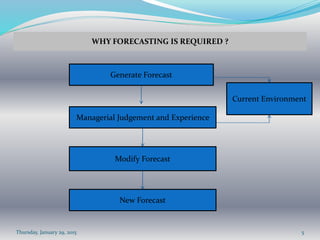
Generate Forecast
Managerial Judgement and Experience
Current Environment
Modify Forecast
New Forecast
Thursday, January 29, 2015 6
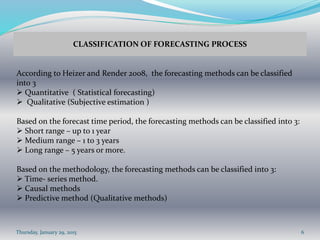
CLASSIFICATION OF FORECASTING PROCESS
According to Heizer and Render 2008, the forecasting methods can be classified
into 3
 Quantitative ( Statistical forecasting)
 Qualitative (Subjective estimation )
Based on the forecast time period, the forecasting methods can be classified into 3:
 Short range – up to 1 year
 Medium range – 1 to 3 years
 Long range – 5 years or more.
Based on the methodology, the forecasting methods can be classified into 3:
 Time- series method.
 Causal methods
 Predictive method (Qualitative methods)
Thursday, January 29, 2015 7
METHOD OF FORECASTING
 Qualitative methods
• Market surveys – In this method, the number of respondents and how response
are gathered like through oral interviews, personal talks, internet based, Postal
ballots etc have to be established before surveys.
• Nominal group testing – The product and services may be given a trial use to a
specified group like employees, neighbours etc and their response are collected
and analysed.
• Historical analysis – is based on the fact that the past is an indicator of future.
• Jury of executive opinion – The opinion of a group of experts is collected and used
as an estimate to obtain the forecast.
• Life cycle analysis – an assessment of the life cycle stage in which the product lies
is made first and an opinion is formed.
Thursday, January 29, 2015 8
METHOD OF FORECASTING
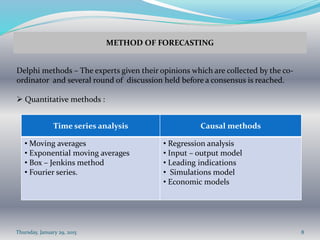
Delphi methods – The experts given their opinions which are collected by the co-
ordinator and several round of discussion held before a consensus is reached.
 Quantitative methods :
Time series analysis Causal methods
• Moving averages
• Exponential moving averages
• Box – Jenkins method
• Fourier series.
• Regression analysis
• Input – output model
• Leading indications
• Simulations model
• Economic models
Thursday, January 29, 2015 9
SELECTION OF THE FORECASTING METHOD
The right methods of forecasting is based on cost, time and skills are involved, the
choice of a forecasting method on several factors are L
 Form of forecast required.
 Forecast horizon, period and interval.
 Data availability.
 Accuracy required.
 Behaviour of process being forecasted
 Cost of development , installation and operation.
 Case of operation
 Management comprehension and cooperation.

FORECASTING

  • 1.
    Heizer and Render2010, forecasting is the art and science of predicting the future events.  Forecasting is the art because subjective assessment coupled with historical and contemporary is required to improve the accuracy of forecasts.  It is a science because a wide variety of numerical methods are used to obtain a number or several number and further analysed using mathematical models to ascertain the accuracy of forecast. Thursday, January 29, 2015 1
  • 2.
    Thursday, January 29,2015 2 STRATEGY IMPORTANCE OF FORECAST Forecast is required for all types of industrial activity and specially for the industry which are in the service sector like healthcare and education. Human Resource – No. of persons required is a function of the production output, depends on demand forecasting. Hence hiring, training and laying off workers depend on the anticipated demand. Capacity – Capacity refers to the ability to meet the demand in terms of resources and the preparedness on the part of the company. When the demand pattern is recognised and indicates a rise, the capacity build up happen and ensure no lost sales for want of product. Supply Chain Management – refers to all the activities that enable the right product at the right place at the right price. Demand forecasting has done with utmost care to identifying the vendors, pricing choices and material options.
  • 3.
    Thursday, January 29,2015 3 WHY FORECASTING IS REQUIRED ? Forecasting is required for:  Production planning.  Financial planning.  Personnel planning.  Scheduling planning  Facilities planning.  Process design and planning.  Benefits from forecast - Forecasting overcome the uncertainty about the demand and provides a workable solution. Without the forecast, no production function can be taken up. • Improve employee relations. • Improve material management • Better use of capital and facilities. • Improve customer service  Cost Implications of forecasting – Total cost of forecasting to a minimum, certain uncertainty is acceptable in forecasting. Hence, preparedness for some possible loss.
  • 4.
    Thursday, January 29,2015 4 WHY FORECASTING IS REQUIRED ?  Decision making using forecasting – Forecast are subject to uncertainty because of the changing environment, any attempt to improve the forecast accuracy increase the cost but not the accuracy. Actual decision = Decision assuming forecasting is correct + Allowance for forecast error. To account the uncertainty and provide allowance, forecast output contains two numbers as follows 1) Best estimates of demand. 2) Error. ( Error in forecast is easy to calculate once the actual demand is known). Forecast error = Actual demand - Forecast demand.
  • 5.
    Thursday, January 29,2015 5 WHY FORECASTING IS REQUIRED ? Generate Forecast Managerial Judgement and Experience Current Environment Modify Forecast New Forecast
  • 6.
    Thursday, January 29,2015 6 CLASSIFICATION OF FORECASTING PROCESS According to Heizer and Render 2008, the forecasting methods can be classified into 3  Quantitative ( Statistical forecasting)  Qualitative (Subjective estimation ) Based on the forecast time period, the forecasting methods can be classified into 3:  Short range – up to 1 year  Medium range – 1 to 3 years  Long range – 5 years or more. Based on the methodology, the forecasting methods can be classified into 3:  Time- series method.  Causal methods  Predictive method (Qualitative methods)
  • 7.
    Thursday, January 29,2015 7 METHOD OF FORECASTING  Qualitative methods • Market surveys – In this method, the number of respondents and how response are gathered like through oral interviews, personal talks, internet based, Postal ballots etc have to be established before surveys. • Nominal group testing – The product and services may be given a trial use to a specified group like employees, neighbours etc and their response are collected and analysed. • Historical analysis – is based on the fact that the past is an indicator of future. • Jury of executive opinion – The opinion of a group of experts is collected and used as an estimate to obtain the forecast. • Life cycle analysis – an assessment of the life cycle stage in which the product lies is made first and an opinion is formed.
  • 8.
    Thursday, January 29,2015 8 METHOD OF FORECASTING Delphi methods – The experts given their opinions which are collected by the co- ordinator and several round of discussion held before a consensus is reached.  Quantitative methods : Time series analysis Causal methods • Moving averages • Exponential moving averages • Box – Jenkins method • Fourier series. • Regression analysis • Input – output model • Leading indications • Simulations model • Economic models
  • 9.
    Thursday, January 29,2015 9 SELECTION OF THE FORECASTING METHOD The right methods of forecasting is based on cost, time and skills are involved, the choice of a forecasting method on several factors are L  Form of forecast required.  Forecast horizon, period and interval.  Data availability.  Accuracy required.  Behaviour of process being forecasted  Cost of development , installation and operation.  Case of operation  Management comprehension and cooperation.