Manufacturing
Systems
Learning Objectives
To be able to understand and explain:
• The scales of production in manufacturing
• Some of the different manufacturing systems
used today
2.
Starter
Match the
description to the
words
You can use your
notes!
3.
Answers
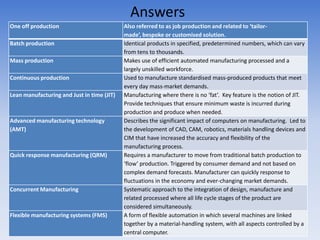
One off production Also referred to as job production and related to ‘tailor-
made’, bespoke or customised solution.
Batch production Identical products in specified, predetermined numbers, which can vary
from tens to thousands.
Mass production Makes use of efficient automated manufacturing processed and a
largely unskilled workforce.
Continuous production Used to manufacture standardised mass-produced products that meet
every day mass-market demands.
Lean manufacturing and Just in time (JIT) Manufacturing where there is no ‘fat’. Key feature is the notion of JIT.
Provide techniques that ensure minimum waste is incurred during
production and produce when needed.
Advanced manufacturing technology Describes the significant impact of computers on manufacturing. Led to
(AMT) the development of CAD, CAM, robotics, materials handling devices and
CIM that have increased the accuracy and flexibility of the
manufacturing process.
Quick response manufacturing (QRM) Requires a manufacturer to move from traditional batch production to
‘flow’ production. Triggered by consumer demand and not based on
complex demand forecasts. Manufacturer can quickly response to
fluctuations in the economy and ever-changing market demands.
Concurrent Manufacturing Systematic approach to the integration of design, manufacture and
related processed where all life cycle stages of the product are
considered simultaneously.
Flexible manufacturing systems (FMS) A form of flexible automation in which several machines are linked
together by a material-handling system, with all aspects controlled by a
central computer.
4.
Answers
Computer integrated manufacture(CIM) Takes FMS a step further by bringing together all aspects of a
company’s operations. All teams can share the same information and
communicate with one another.
Product Data Management (PDM) An information system used to manage the data for a product as it
passes from design to manufacture, it ensures that changes are made to
one database.
Enterprise resource planning system (ERP) Integrate all departments and data across a company onto a single
computer system that can serve all of those departments’ particular
needs by using a unified database
Flexible manufacturing cells A group of workstations, machines or equipment arranged such that a
product can be processed progressively from one workstation to another
without having to wait for a batch to be completed and without
additional handling between operations.
Computer aided quality control systems Achieved within a manufacturing cell using a coordinate measuring
(CAQ) machine (CMM) for extremely accurate dimensional measurement.
Automated materials handling system Provide transportation and storage of materials, components and
assemblies.
Automated storage and retrieval systems Automated robotic system for sorting, storing and retrieving items in a
(ASRS) warehouse. Within CIM a computer controls the transportation of
materials and components to the required points.
Automated guided vehicles (AGV) Small, independently powered vehicles that are usually guided by radio
frequency wires that are buried in the floor, or use optical sensors in a
laser-guided navigation system.
5.
Activity
In groups, usethe worksheet
to analyse the product and
components of the product
according to the:
• Scale of production it fits
into
• The manufacturing system/s
that were used to produce it
6.
Activity
Individually, design andexplain (using
annotations) how you could adapt this product
to make it a one-off product.
Explain the difference
of this one-off product
that you have
designed compared to
the one bought in a
store.
7.
Plenary
Think of aproduct
Decide:
• What scale it was produced at
• What manufacturing system could have
been used to make it