
PRODUCTION PROCESS
Presented By: Amandeep
Punias Consulting
WHAT PRODUCTION SYSTEM IS ?
• Production System are those activities of any organization where :
 Resources flowing within a defined system
 Are combined and transformed
 In a controlled manner
 To add value
 In accordance to the policies communicated by the management.
CHARACTERSTICS OF A PRODUCTION SYSTEM
 Production is an organized activity, so every production system has an objective.
 The system transforms various I/P to Valuable O/P.
 Doesn’t operates in isolation from other Organizational systems : Integrated system it is.
 There exists a feedback about the activities , which is essential to control and improve system
performance.
TYPES OF A PRODUCTION PROCESS
Types of Production Process is broadly Divided into :
 Made to Stock Production Process
 Firms produces their products and stores in plan before receiving any customer order
 Made to Order Production Process
 Completes the end Products only after Receiving a confirmation from the customer.
 Because their may be different variants for the products that a customer requires
TYPES OF A PRODUCTION PROCESS
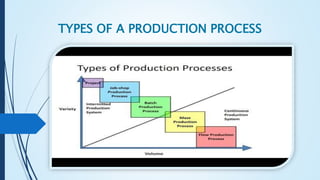
Another way to define Production Process is based on extent to which a factory has the
flexibility to produce a variety of products.
 Continues Production System
 Flow Production system
 Mass Production System
 Intermittent Production System
 Batch Production System
 Job Shop Production System
 Project Production System
TYPES OF A PRODUCTION PROCESS
CONTINUOUS MANUFACTURING SYSTEM
 These are also referred to as Repetitive Manufacturing system.
 These are mass Production facilities that produces high volume of same product.
 They are usually MTS producers.
 The manufacturing happens in automated , Special purpose equipment.
REPITITIVE MANUFACTURING SYSTEM
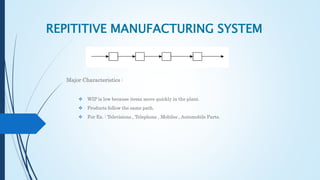
Major Characteristics :
 WIP is low because items move quickly in the plant.
 Products follow the same path.
 For Ex. : Televisions , Telephone , Mobiles , Automobile Parts.
CONTINUOUS FLOW (FLOW SHOP)
Major Characteristics :
 Products flow continuously through a Linear Process.
 Usually products are not Discrete.
 Also called Process Type Operations.
 For Ex. : Chemical Plant
Oil &Gas
Sugar mills.
Petroleum Refineries
MASS PRODUCTION PROCESS
WHEN IT IS USED ?
 Standardization of products and sequence.
 Dedicated SPMs having high production capacities and O/P.
 Large volume of products.
 Shorter Cycle Time.
 Lower in Process Inventory.
 Balanced Production Lines.
 Material and parts flow is continuous without back tracking.
 Material Handling can be Fully automated.
MASS PRODUCTION PROCESS
ADVANTAGES :
 Higher rate of Production with reduced Cycle Time.
 Higher Capacity Utilization due to Line Balancing.
 Less skilled Operators are required.
 Low Process Inventory.
 Manufacturing cost per unit is low.
MASS PRODUCTION PROCESS
LIMITATIONS :
 Breakdown of one Work Center may stop entire production line.
 Line Layout required major changes with changes in Product Design.
 Higher Investment in production facilities.
INTERMITTED PRODUCTION PROCESS
MAJOR CHARACTERSTICS :
 The volume of each product is low.
 Generally produces MTO , customized products in accordance with design supplied by
the customer.
 Each job may be unique and may requires a special production setup.
 Each job may require a particular routing.
 There are no standard routings.
 Products may follow a different paths.
 Needs general purpose production equipment.
JOB SHOP PRODUCTION PROCESS
MAJOR CHARACTERSTICS :
 May require an inventory of few types of RM.
 Largest amount of Inventory is on WIP.
 WIP is Work in process -: an inventory that accumulates in between Process stages.
JOB SHOP PRODUCTION PROCESS
WHEN IT IS USED ?
 High variety of products with low Volume.
 Use of General Purpose machines and facilities.
 Highly skilled operators who take up their job as a challenge.
 Large inventory of materials , tools and parts.
 Detailed planning is necessary for sequence of each product , for every work center and
Order priority.
JOB SHOP PRODUCTION PROCESS
ADVANTAGES :
 A large variety of products can be manufactured using General purpose Machines.
 Operators become more skilled and competent with every passing Job done.
 Full potential of operators can be utilized.
 Opportunity exists for creative methods and innovative ideas.
LIMITATIONS :
 Production Plan is complicated.
 Larger Space required.
BATCH MANUFACTURING PROCESS
MAJOR CHARACTERISTICS :
 Manufacturing Operations that falls in between Job Shop and Repetitive
Manufacturing are BATCH Manufacturing.
 Batch means Single Production run.
 Batch size means the qty. produced in single production run.
 Manufacturing industries setup for one batch and after completion have to switch to
another batch.
 Production equipment should be more flexible than repetitive manufacturing but less
than Job Shop manufacturing.
 For Ex. : hand tools , hand mixers , books etc.
BATCH MANUFACTURING PROCESS
WHEN IT IS USED :
 When there is Shorter Production runs.
 Plant and Machinery are flexible.
 Every Batch of production requires changes in plant and machinery set up.
BATCH MANUFACTURING PROCESS
ADVANTAGES :
 Lower manufacturing Lead time and cost as compared to Job Order Production process.
 Better utilization of plant and machinery.
 Promotes functional specialization.
 Lower investment in plant and machinery.
 Flexible to accommodate and process number of products.
 Job satisfaction to operators.
BATCH MANUFACTURING PROCESS
LIMITATIONS :
 Material Handling is complex.
 Production planning and control is complex.
 High set up cost due to frequent changes in set ups.
 WIP Inventory is higher than Continues Production Process.
PROJECT MANUFACTURING PROCESS
MAJOR CHARACTERISTICS :
 A project is highly flexible and low volume type operation.
 Usually the item to be produced stays in a fixed place and all the required resources
comes to it.
 At the end of production, resources leaves the place.
 For Ex. : Ship construction
Bridge Construction
Buildings and large machinery.
THANK YOU


Production Process

  • 1.
    PRODUCTION PROCESS Presented By:Amandeep Punias Consulting
  • 2.
    WHAT PRODUCTION SYSTEMIS ? • Production System are those activities of any organization where :  Resources flowing within a defined system  Are combined and transformed  In a controlled manner  To add value  In accordance to the policies communicated by the management.
  • 3.
    CHARACTERSTICS OF APRODUCTION SYSTEM  Production is an organized activity, so every production system has an objective.  The system transforms various I/P to Valuable O/P.  Doesn’t operates in isolation from other Organizational systems : Integrated system it is.  There exists a feedback about the activities , which is essential to control and improve system performance.
  • 4.
    TYPES OF APRODUCTION PROCESS Types of Production Process is broadly Divided into :  Made to Stock Production Process  Firms produces their products and stores in plan before receiving any customer order  Made to Order Production Process  Completes the end Products only after Receiving a confirmation from the customer.  Because their may be different variants for the products that a customer requires
  • 5.
    TYPES OF APRODUCTION PROCESS Another way to define Production Process is based on extent to which a factory has the flexibility to produce a variety of products.  Continues Production System  Flow Production system  Mass Production System  Intermittent Production System  Batch Production System  Job Shop Production System  Project Production System
  • 6.
    TYPES OF APRODUCTION PROCESS
  • 7.
    CONTINUOUS MANUFACTURING SYSTEM These are also referred to as Repetitive Manufacturing system.  These are mass Production facilities that produces high volume of same product.  They are usually MTS producers.  The manufacturing happens in automated , Special purpose equipment.
  • 8.
    REPITITIVE MANUFACTURING SYSTEM MajorCharacteristics :  WIP is low because items move quickly in the plant.  Products follow the same path.  For Ex. : Televisions , Telephone , Mobiles , Automobile Parts.
  • 9.
    CONTINUOUS FLOW (FLOWSHOP) Major Characteristics :  Products flow continuously through a Linear Process.  Usually products are not Discrete.  Also called Process Type Operations.  For Ex. : Chemical Plant Oil &Gas Sugar mills. Petroleum Refineries
  • 10.
    MASS PRODUCTION PROCESS WHENIT IS USED ?  Standardization of products and sequence.  Dedicated SPMs having high production capacities and O/P.  Large volume of products.  Shorter Cycle Time.  Lower in Process Inventory.  Balanced Production Lines.  Material and parts flow is continuous without back tracking.  Material Handling can be Fully automated.
  • 11.
    MASS PRODUCTION PROCESS ADVANTAGES:  Higher rate of Production with reduced Cycle Time.  Higher Capacity Utilization due to Line Balancing.  Less skilled Operators are required.  Low Process Inventory.  Manufacturing cost per unit is low.
  • 12.
    MASS PRODUCTION PROCESS LIMITATIONS:  Breakdown of one Work Center may stop entire production line.  Line Layout required major changes with changes in Product Design.  Higher Investment in production facilities.
  • 13.
    INTERMITTED PRODUCTION PROCESS MAJORCHARACTERSTICS :  The volume of each product is low.  Generally produces MTO , customized products in accordance with design supplied by the customer.  Each job may be unique and may requires a special production setup.  Each job may require a particular routing.  There are no standard routings.  Products may follow a different paths.  Needs general purpose production equipment.
  • 14.
    JOB SHOP PRODUCTIONPROCESS MAJOR CHARACTERSTICS :  May require an inventory of few types of RM.  Largest amount of Inventory is on WIP.  WIP is Work in process -: an inventory that accumulates in between Process stages.
  • 15.
    JOB SHOP PRODUCTIONPROCESS WHEN IT IS USED ?  High variety of products with low Volume.  Use of General Purpose machines and facilities.  Highly skilled operators who take up their job as a challenge.  Large inventory of materials , tools and parts.  Detailed planning is necessary for sequence of each product , for every work center and Order priority.
  • 16.
    JOB SHOP PRODUCTIONPROCESS ADVANTAGES :  A large variety of products can be manufactured using General purpose Machines.  Operators become more skilled and competent with every passing Job done.  Full potential of operators can be utilized.  Opportunity exists for creative methods and innovative ideas. LIMITATIONS :  Production Plan is complicated.  Larger Space required.
  • 17.
    BATCH MANUFACTURING PROCESS MAJORCHARACTERISTICS :  Manufacturing Operations that falls in between Job Shop and Repetitive Manufacturing are BATCH Manufacturing.  Batch means Single Production run.  Batch size means the qty. produced in single production run.  Manufacturing industries setup for one batch and after completion have to switch to another batch.  Production equipment should be more flexible than repetitive manufacturing but less than Job Shop manufacturing.  For Ex. : hand tools , hand mixers , books etc.
  • 18.
    BATCH MANUFACTURING PROCESS WHENIT IS USED :  When there is Shorter Production runs.  Plant and Machinery are flexible.  Every Batch of production requires changes in plant and machinery set up.
  • 19.
    BATCH MANUFACTURING PROCESS ADVANTAGES:  Lower manufacturing Lead time and cost as compared to Job Order Production process.  Better utilization of plant and machinery.  Promotes functional specialization.  Lower investment in plant and machinery.  Flexible to accommodate and process number of products.  Job satisfaction to operators.
  • 20.
    BATCH MANUFACTURING PROCESS LIMITATIONS:  Material Handling is complex.  Production planning and control is complex.  High set up cost due to frequent changes in set ups.  WIP Inventory is higher than Continues Production Process.
  • 21.
    PROJECT MANUFACTURING PROCESS MAJORCHARACTERISTICS :  A project is highly flexible and low volume type operation.  Usually the item to be produced stays in a fixed place and all the required resources comes to it.  At the end of production, resources leaves the place.  For Ex. : Ship construction Bridge Construction Buildings and large machinery.
  • 22.