TRANSDUCERS
PRESENTATION BY:

PRESENTATION TO:
WHAT IS A TRANSDUCER ?




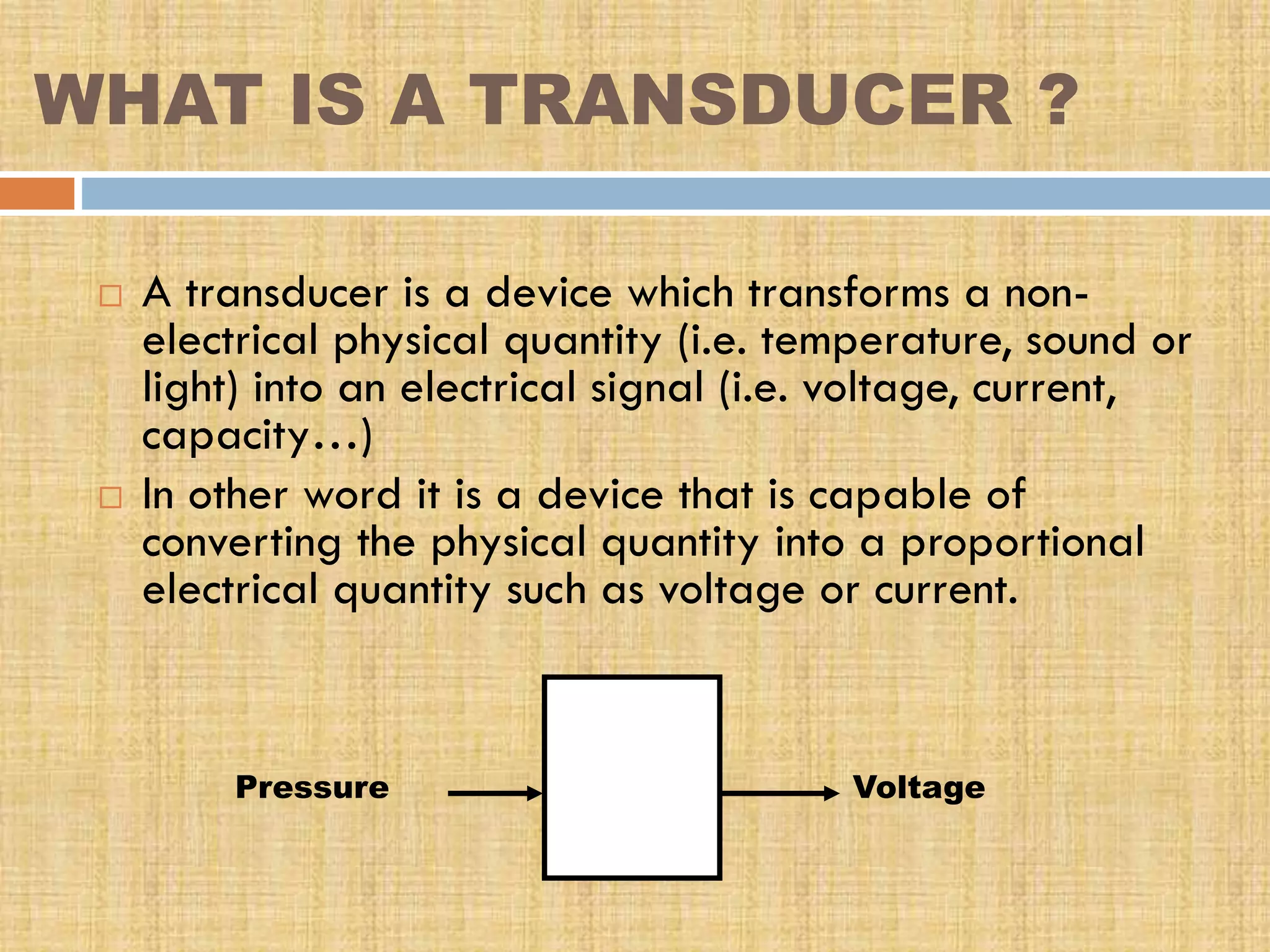
A transducer is a device which transforms a nonelectrical physical quantity (i.e. temperature, sound or
light) into an electrical signal (i.e. voltage, current,
capacity…)
In other word it is a device that is capable of
converting the physical quantity into a proportional
electrical quantity such as voltage or current.

Pressure

Voltage
BLOCK DIAGRAM OF
TRANSDUCERS
•

•

•

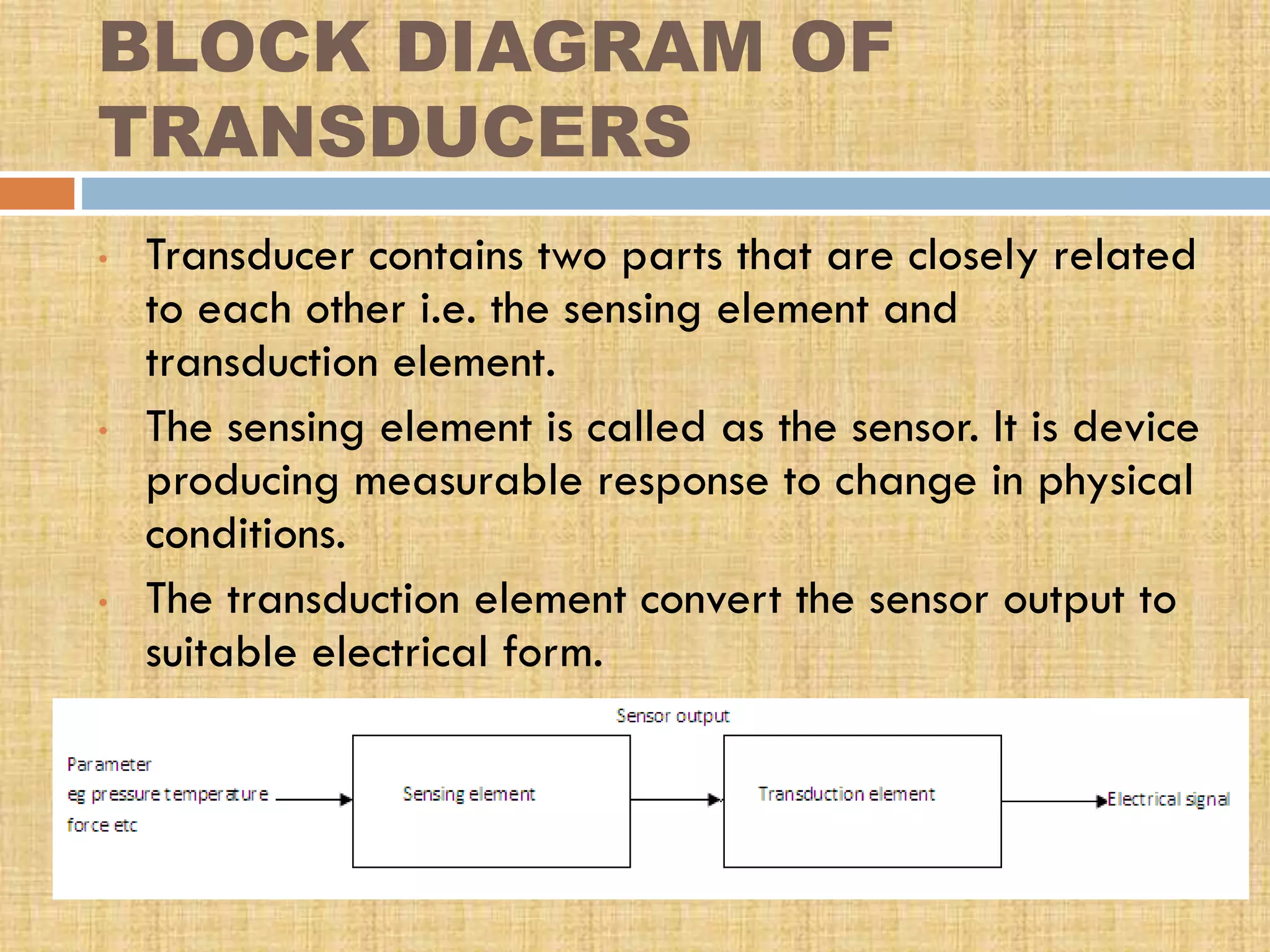
Transducer contains two parts that are closely related
to each other i.e. the sensing element and
transduction element.
The sensing element is called as the sensor. It is device
producing measurable response to change in physical
conditions.
The transduction element convert the sensor output to
suitable electrical form.
TRANSDUCERS SELECTION
FACTORS
1.

2.
4.
5.

6.

1.

Sensitivity: The transducer must be sensitive enough to produce
detectable output.
Operating Range: The transducer should maintain the range requirement
and have a good resolution over the entire range.
Accuracy: High accuracy is assured.
Cross sensitivity: It has to be taken into account when measuring
mechanical quantities. There are situation where the actual quantity is
being measured is in one plane and the transducer is subjected to
variation in another plan.
Errors: The transducer should maintain the expected input-output
relationship as described by the transfer function so as to avoid errors.
Operating Principle: The transducer are many times selected on the
basis of operating principle used by them. The operating principle used
may be resistive, inductive, capacitive , optoelectronic, piezo electric etc.
7.

8.

9.

10.

Transient and frequency response : The transducer should meet
the desired time domain specification like peak overshoot, rise
time, setting time and small dynamic error.
Loading Effects: The transducer should have a high input
impedance and low output impedance to avoid loading effects.
Environmental Compatibility: It should be assured that the
transducer selected to work under specified environmental
conditions maintains its input- output relationship and does not
break down.
Insensitivity to unwanted signals: The transducer should be
minimally sensitive to unwanted signals and highly sensitive to
desired signals.
CLASSIFICATION OF
TRANSDUCERS
•
•
•
•
•

Analog and digital transducers.
Primary and secondary transducer.
Transducers and inverse transducers.
On the basis of transduction principle
used.
Active and Passive Transducers
ANALOG AND DIGITAL TRANSDUCERS
Transducers ,on the basis of nature of output signal, may be classified into
analog and digital transducers.





Analog transducers converts input signal into output
signal, which is a continuous function of time such as
THERMISTOR ,strain gauge, LVDT , thermocouple etc.
Digital transducers converts input signal into the
output signal in the form of pulses e.g. it gives
discrete output. These transducers are becoming more
popular nowadays because of advantages
associated with digital measuring instruments and also
due to the fact that digital signals can be transmitted
over a long distance without causing much distortion
due to amplitude variation and phase shift.
PRIMARY TRANSDUCERS
transducers on the basis of methods of applications, may be classified into
primary and secondary transducers.




When the input signal is directly sensed by the
transducers and physical phenomenon is converted
into the electrical form directly then such a
transducer is called the primary transducer.
For example: A THERMISTOR used for the
measurement of temperature fall I this category.
The THERMISTOR senses the temperature directly
and causes the change in resistor with the change
in temperature.
SECONDARY TRANDUCERS




When the input signal is sensed first by some detector
or sensor and then its output being of some form other
than input signal is given as input to a transducer for
conversion into electrical from, them such a transducer
falls in the category of secondary transducers.
For example , in case of pressure measurement ,
bourdon tube is a primary sensor which converts
pressure first into displacement, then the displacement is
converted into an output voltage by an LVDT. In this
case LVDT is a secondary transducer.
TRANSDUCERS




Transducers as already defined , is a device that
converts a non electrical quantity into an electrical
quantity. Normally a transducer and associated
circuit has a non electrical input and an electrical
output.
For example : a thermocouple , photo conductive
cell pressure gauge , strain gauge.
INVERSE TRANSDUCERS




It is a device that converts an elkectrical quantity
into a non electrical quantity .it is a precision
actuator having an electrical input and a low power
non electrical output.
For example a piezoelectric crystal and
translational and angular moving coil elements can
be employed as inverse transducers. A most useful
application of inverse transducers is in feed back
measuring systems.
ON THE BASIS OF TRANSDUCTION
PRICIPLE USED






Resistive Transducers.
Capacitive Transducers.
Inductive Transducers.
Voltage and current Generating Transducers.
ACTIVE TRANSDUCERS
Transducers on the basis of methods of energy conversion used, may be
classified into active and passive transducers.






Self generating type transducers i.e the transducers
which develop their output in the form of electrical
voltage or current without any auxiliary source.
Normally such transducers give very small output,
therefore, use of amplifier becomes essential.
For example TACHO generators used for
measurements of angular velocity, thermocouples
used for measurement of temperature,
piezoelectric crystal used for measurement of
force.
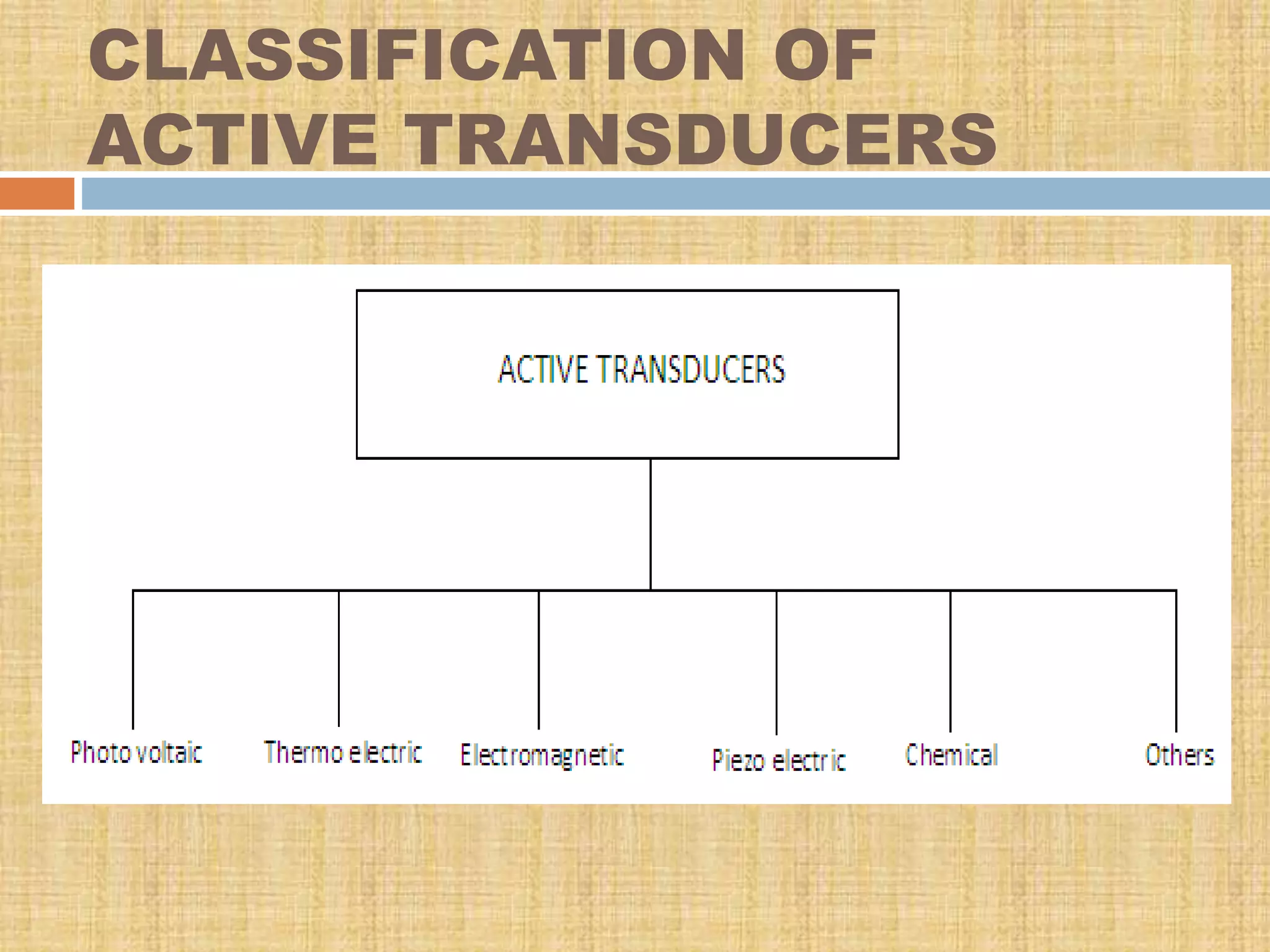
CLASSIFICATION OF
ACTIVE TRANSDUCERS
PASSIVE TRANSDUCERS




Transducers in which electrical parameters i.e
resistance, inductance or capacitance changes with
the change in input signal, are called the passive
transducers. These transducers require external power
source for energy conversion. In such transducers
electrical parameters i.e resistance inductance or
capacitance causes a change in voltage ,current or
frequency of the external power source.
For example resistive capacitive inductive transducers.
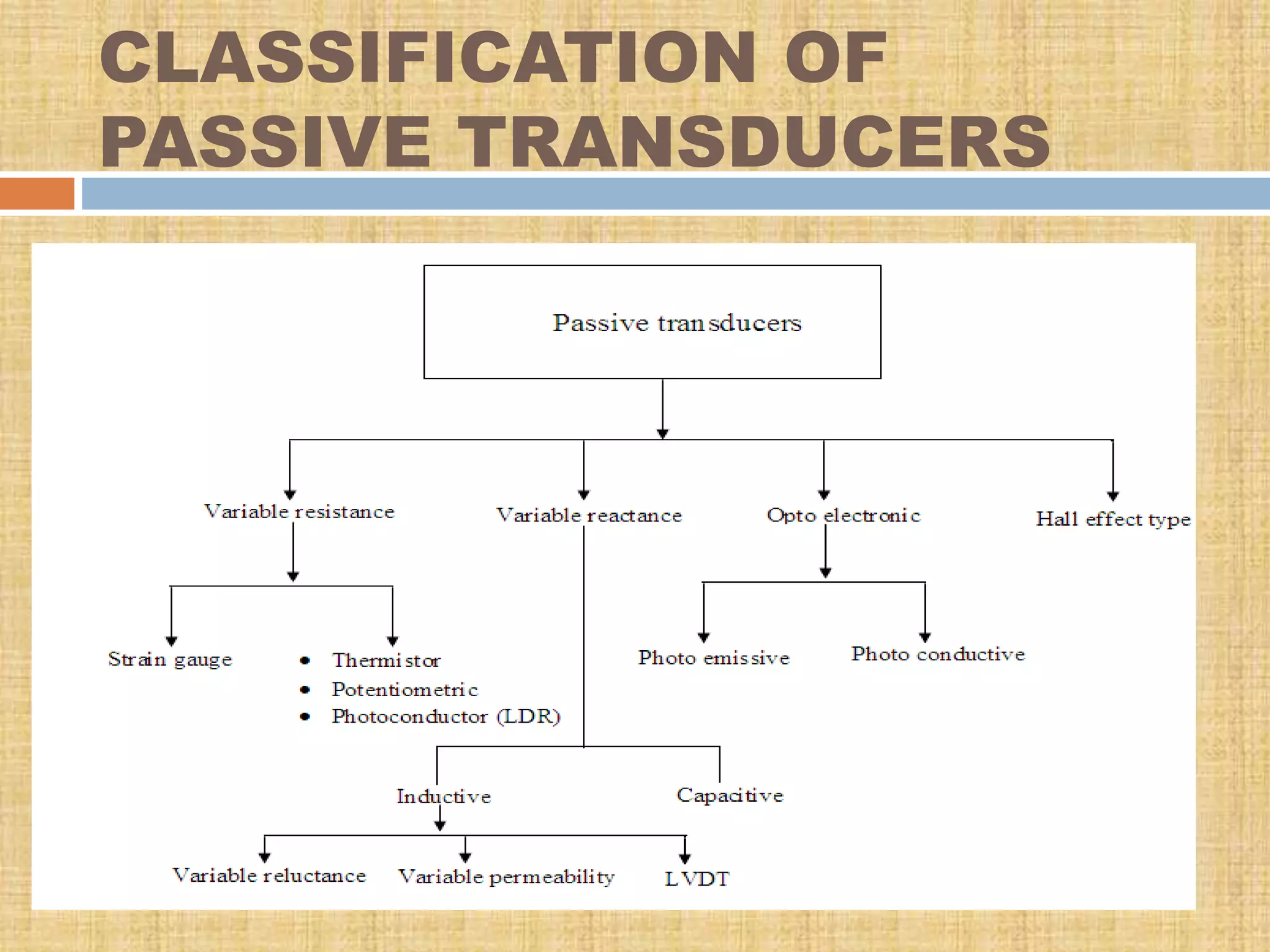
CLASSIFICATION OF
PASSIVE TRANSDUCERS
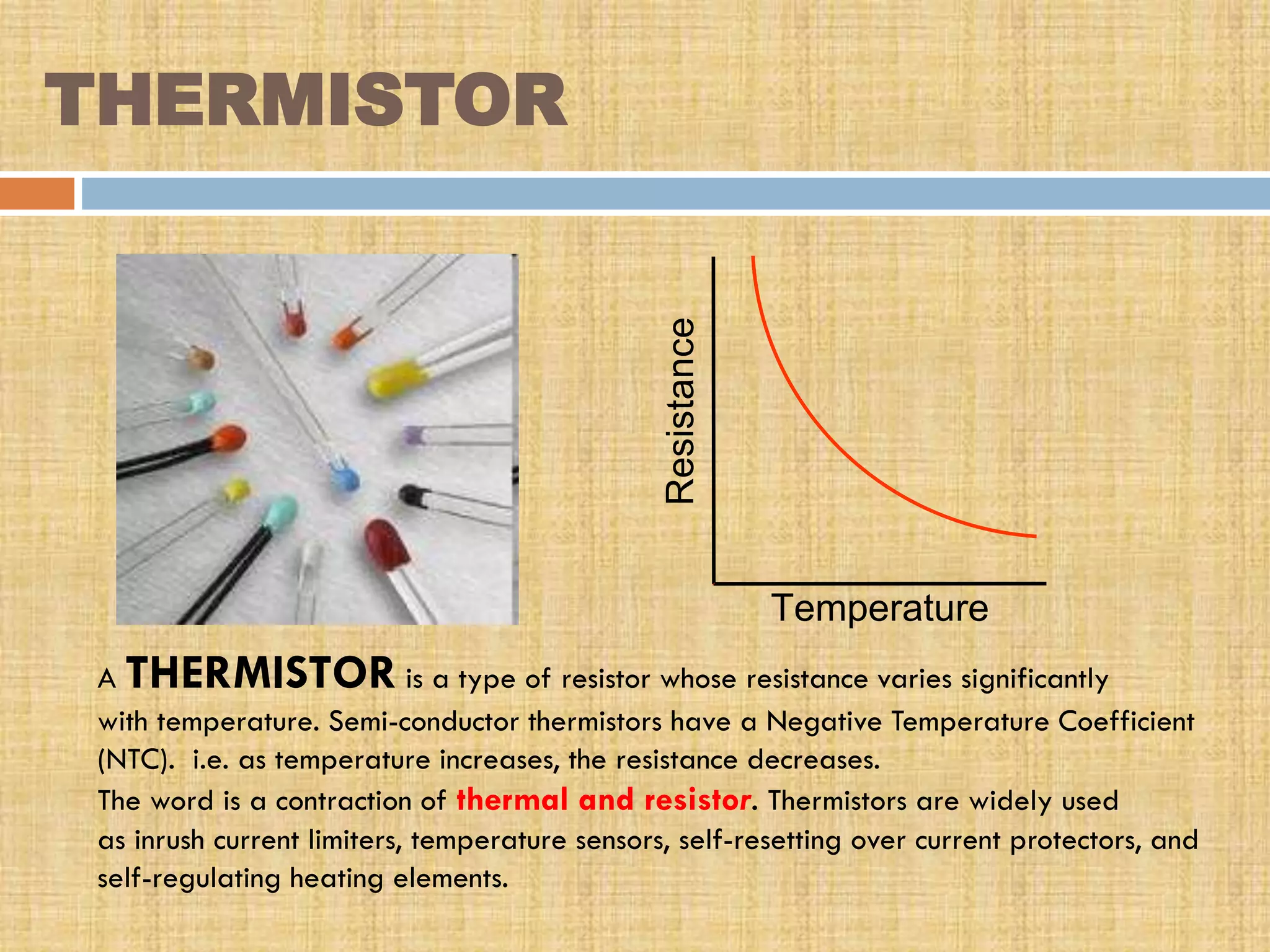
Resistance

THERMISTOR

Temperature
A THERMISTOR is a type of resistor whose resistance varies significantly
with temperature. Semi-conductor thermistors have a Negative Temperature Coefficient
(NTC). i.e. as temperature increases, the resistance decreases.
The word is a contraction of thermal and resistor. Thermistors are widely used
as inrush current limiters, temperature sensors, self-resetting over current protectors, and
self-regulating heating elements.
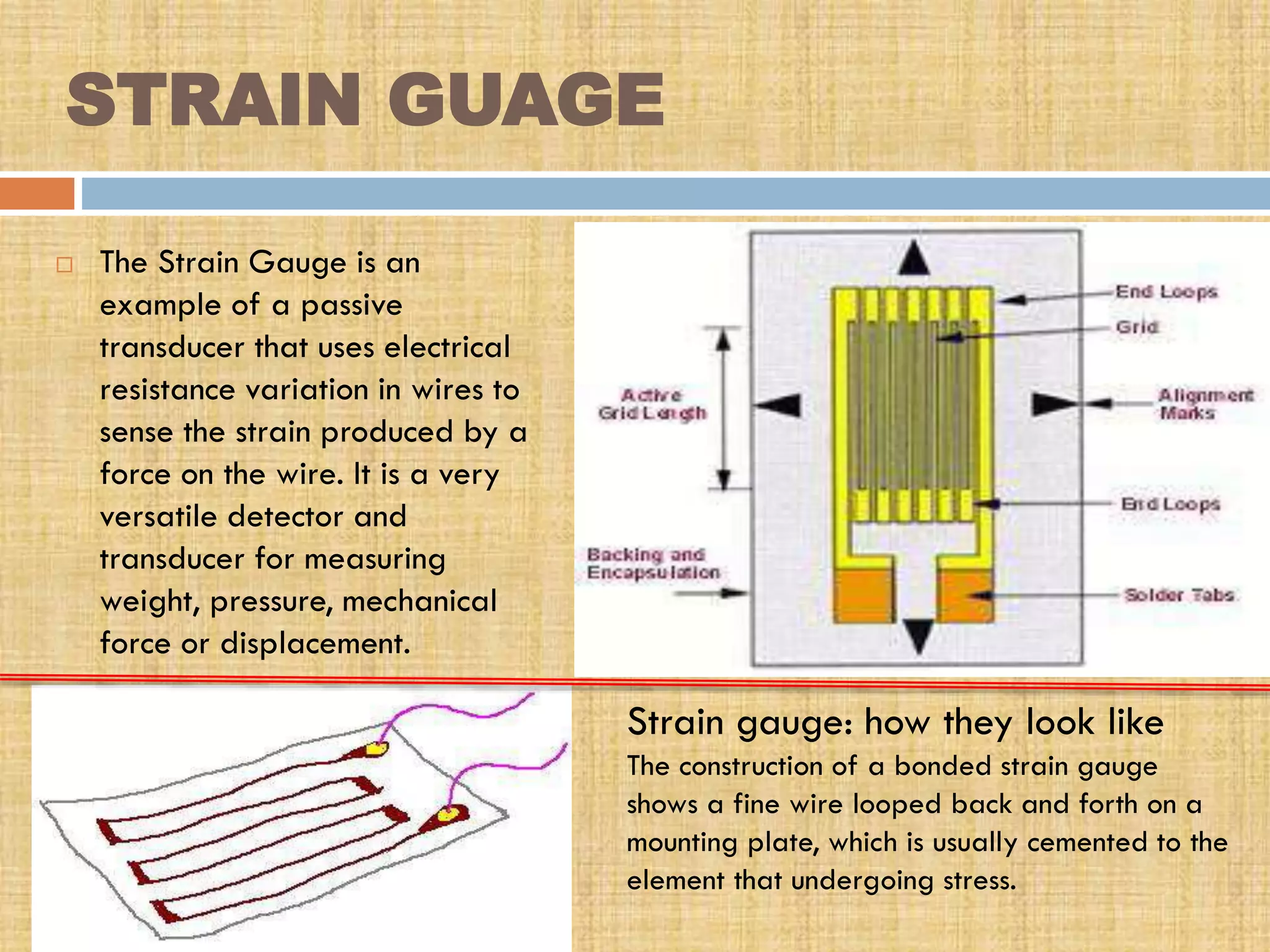
STRAIN GUAGE


The Strain Gauge is an
example of a passive
transducer that uses electrical
resistance variation in wires to
sense the strain produced by a
force on the wire. It is a very
versatile detector and
transducer for measuring
weight, pressure, mechanical
force or displacement.

Strain gauge: how they look like
The construction of a bonded strain gauge
shows a fine wire looped back and forth on a
mounting plate, which is usually cemented to the
element that undergoing stress.
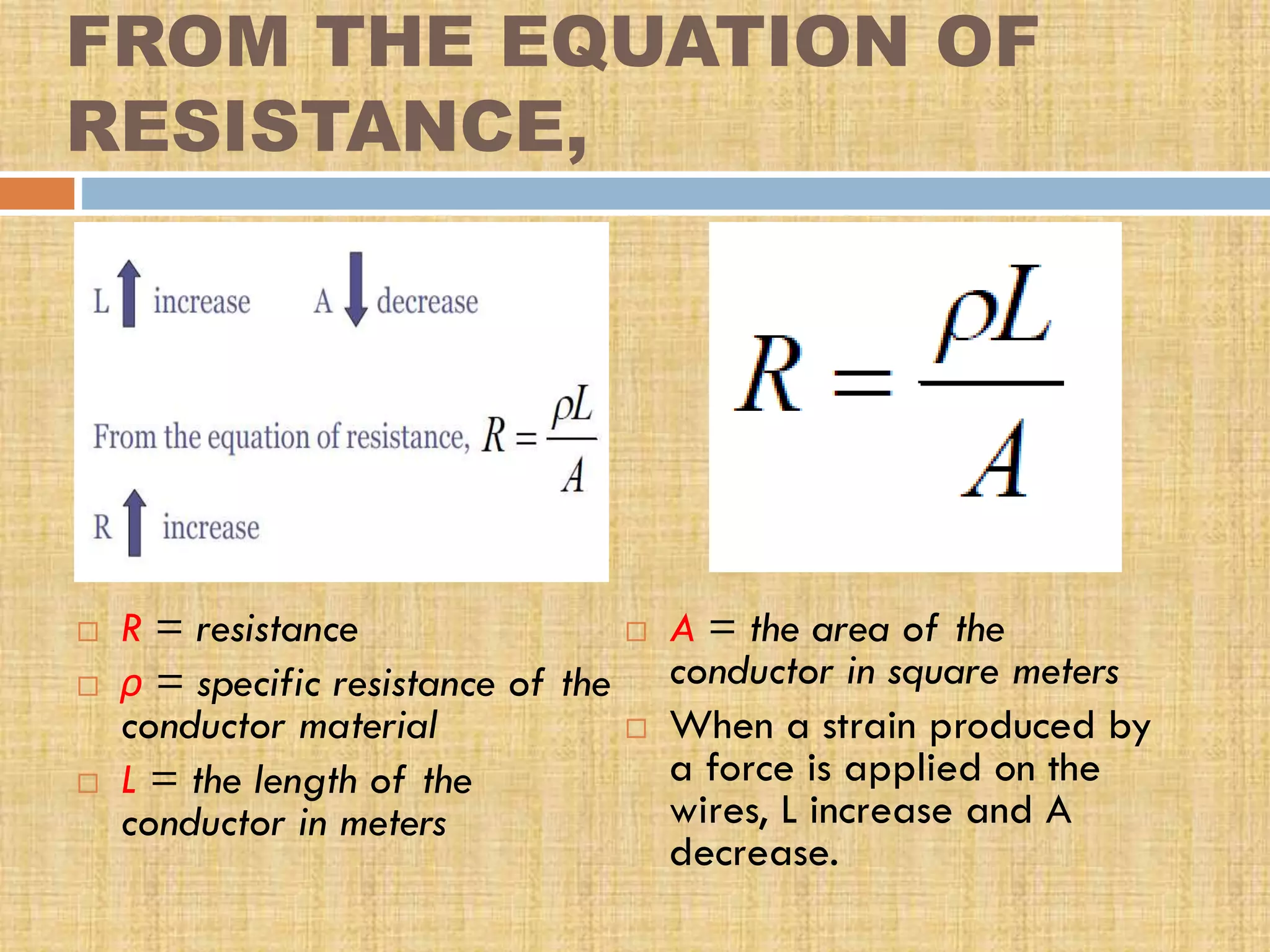
FROM THE EQUATION OF
RESISTANCE,






R = resistance
ρ = specific resistance of the
conductor material
L = the length of the
conductor in meters





A = the area of the
conductor in square meters
When a strain produced by
a force is applied on the
wires, L increase and A
decrease.
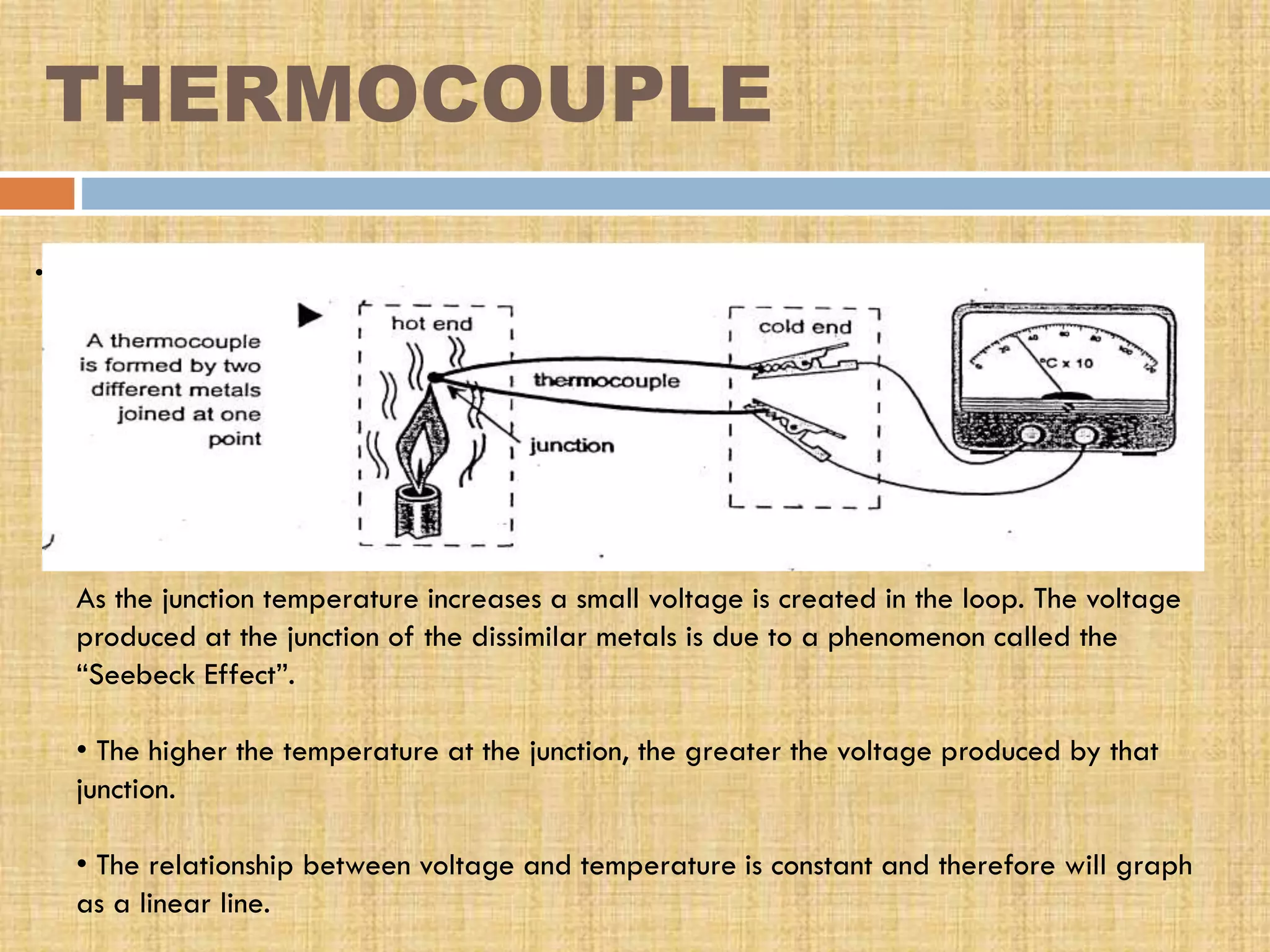
THERMOCOUPLE
.

As the junction temperature increases a small voltage is created in the loop. The voltage
produced at the junction of the dissimilar metals is due to a phenomenon called the
“Seebeck Effect”.
• The higher the temperature at the junction, the greater the voltage produced by that
junction.
• The relationship between voltage and temperature is constant and therefore will graph
as a linear line.
PROS AND CONS
Pros
 ▫ They are inexpensive.
 ▫ They are rugged and reliable.
 ▫ They can be used over a wide temperature range.
Cons
 ▫ low output voltage
 ▫ low sensitivity
 ▫ non-linearity
 ▫ electrical connections
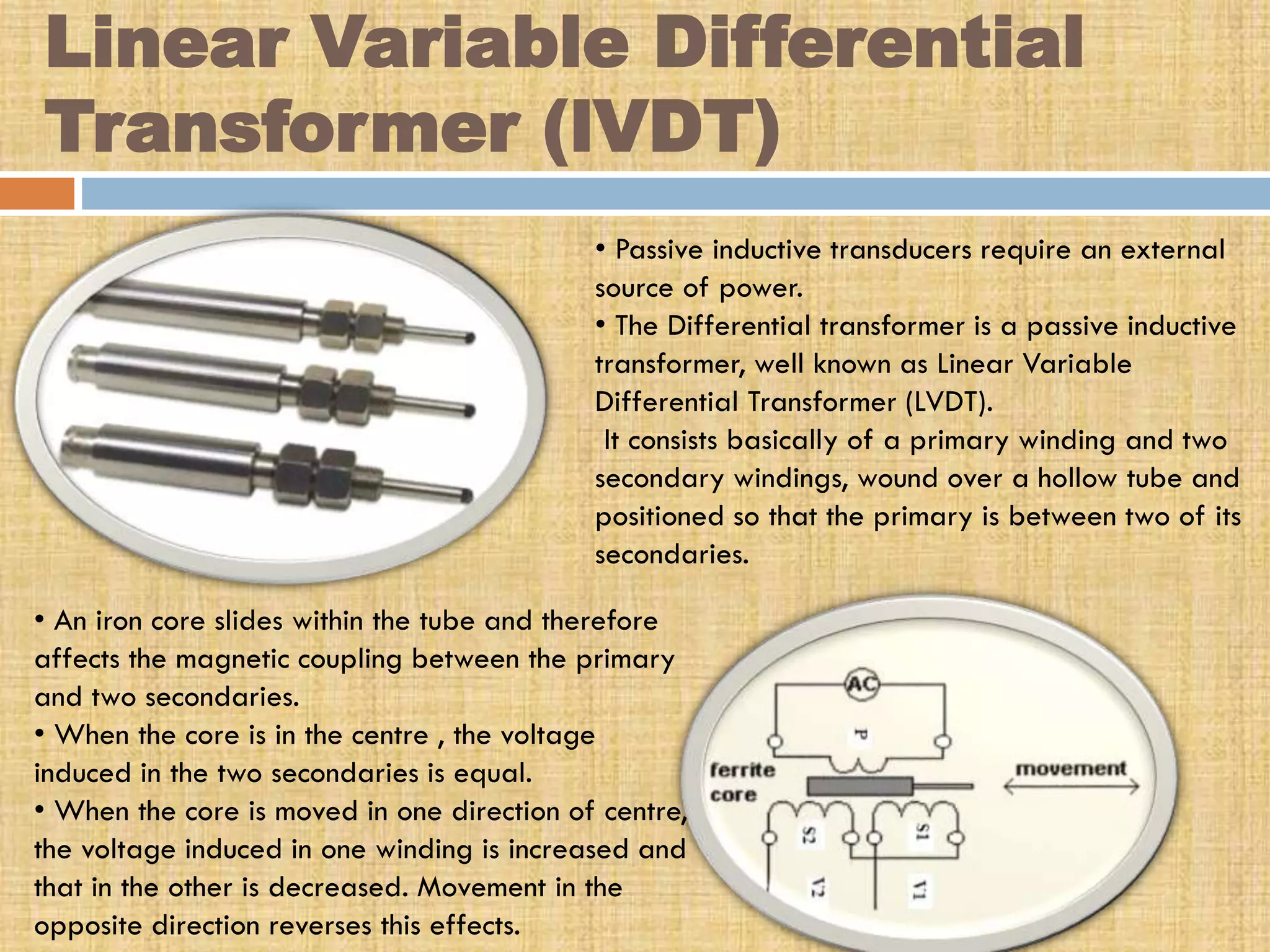
Linear Variable Differential
Transformer (lVDT)
• Passive inductive transducers require an external
source of power.
• The Differential transformer is a passive inductive
transformer, well known as Linear Variable
Differential Transformer (LVDT).
It consists basically of a primary winding and two
secondary windings, wound over a hollow tube and
positioned so that the primary is between two of its
secondaries.
• An iron core slides within the tube and therefore
affects the magnetic coupling between the primary
and two secondaries.
• When the core is in the centre , the voltage
induced in the two secondaries is equal.
• When the core is moved in one direction of centre,
the voltage induced in one winding is increased and
that in the other is decreased. Movement in the
opposite direction reverses this effects.
ADVANTAGES










It has high accuracy and good stability.
Easy to fabricate and install.
The transfer characteristics is linear.
Input is directly proportional to output.
They can withstand high temperature.
It consume very less power.
It has low hysteresis loss and good repeatability.
Rugged construction.
Its output is very high.
DISADVANTAGES






LVDT is proof to errors due to temperature.
For getting the appreciable differential output
relatively large displacement is required .
LVDT is sensitive to straight magnetic fields.
The dynamic response is limited for LVDT due to
mass of core.
THANK YOU
Queries

Transducers

  • 1.
  • 2.
    WHAT IS ATRANSDUCER ?   A transducer is a device which transforms a nonelectrical physical quantity (i.e. temperature, sound or light) into an electrical signal (i.e. voltage, current, capacity…) In other word it is a device that is capable of converting the physical quantity into a proportional electrical quantity such as voltage or current. Pressure Voltage
  • 3.
    BLOCK DIAGRAM OF TRANSDUCERS • • • Transducercontains two parts that are closely related to each other i.e. the sensing element and transduction element. The sensing element is called as the sensor. It is device producing measurable response to change in physical conditions. The transduction element convert the sensor output to suitable electrical form.
  • 4.
    TRANSDUCERS SELECTION FACTORS 1. 2. 4. 5. 6. 1. Sensitivity: Thetransducer must be sensitive enough to produce detectable output. Operating Range: The transducer should maintain the range requirement and have a good resolution over the entire range. Accuracy: High accuracy is assured. Cross sensitivity: It has to be taken into account when measuring mechanical quantities. There are situation where the actual quantity is being measured is in one plane and the transducer is subjected to variation in another plan. Errors: The transducer should maintain the expected input-output relationship as described by the transfer function so as to avoid errors. Operating Principle: The transducer are many times selected on the basis of operating principle used by them. The operating principle used may be resistive, inductive, capacitive , optoelectronic, piezo electric etc.
  • 5.
    7. 8. 9. 10. Transient and frequencyresponse : The transducer should meet the desired time domain specification like peak overshoot, rise time, setting time and small dynamic error. Loading Effects: The transducer should have a high input impedance and low output impedance to avoid loading effects. Environmental Compatibility: It should be assured that the transducer selected to work under specified environmental conditions maintains its input- output relationship and does not break down. Insensitivity to unwanted signals: The transducer should be minimally sensitive to unwanted signals and highly sensitive to desired signals.
  • 6.
    CLASSIFICATION OF TRANSDUCERS • • • • • Analog anddigital transducers. Primary and secondary transducer. Transducers and inverse transducers. On the basis of transduction principle used. Active and Passive Transducers
  • 7.
    ANALOG AND DIGITALTRANSDUCERS Transducers ,on the basis of nature of output signal, may be classified into analog and digital transducers.   Analog transducers converts input signal into output signal, which is a continuous function of time such as THERMISTOR ,strain gauge, LVDT , thermocouple etc. Digital transducers converts input signal into the output signal in the form of pulses e.g. it gives discrete output. These transducers are becoming more popular nowadays because of advantages associated with digital measuring instruments and also due to the fact that digital signals can be transmitted over a long distance without causing much distortion due to amplitude variation and phase shift.
  • 8.
    PRIMARY TRANSDUCERS transducers onthe basis of methods of applications, may be classified into primary and secondary transducers.   When the input signal is directly sensed by the transducers and physical phenomenon is converted into the electrical form directly then such a transducer is called the primary transducer. For example: A THERMISTOR used for the measurement of temperature fall I this category. The THERMISTOR senses the temperature directly and causes the change in resistor with the change in temperature.
  • 9.
    SECONDARY TRANDUCERS   When theinput signal is sensed first by some detector or sensor and then its output being of some form other than input signal is given as input to a transducer for conversion into electrical from, them such a transducer falls in the category of secondary transducers. For example , in case of pressure measurement , bourdon tube is a primary sensor which converts pressure first into displacement, then the displacement is converted into an output voltage by an LVDT. In this case LVDT is a secondary transducer.
  • 10.
    TRANSDUCERS   Transducers as alreadydefined , is a device that converts a non electrical quantity into an electrical quantity. Normally a transducer and associated circuit has a non electrical input and an electrical output. For example : a thermocouple , photo conductive cell pressure gauge , strain gauge.
  • 11.
    INVERSE TRANSDUCERS   It isa device that converts an elkectrical quantity into a non electrical quantity .it is a precision actuator having an electrical input and a low power non electrical output. For example a piezoelectric crystal and translational and angular moving coil elements can be employed as inverse transducers. A most useful application of inverse transducers is in feed back measuring systems.
  • 12.
    ON THE BASISOF TRANSDUCTION PRICIPLE USED     Resistive Transducers. Capacitive Transducers. Inductive Transducers. Voltage and current Generating Transducers.
  • 13.
    ACTIVE TRANSDUCERS Transducers onthe basis of methods of energy conversion used, may be classified into active and passive transducers.    Self generating type transducers i.e the transducers which develop their output in the form of electrical voltage or current without any auxiliary source. Normally such transducers give very small output, therefore, use of amplifier becomes essential. For example TACHO generators used for measurements of angular velocity, thermocouples used for measurement of temperature, piezoelectric crystal used for measurement of force.
  • 14.
  • 15.
    PASSIVE TRANSDUCERS   Transducers inwhich electrical parameters i.e resistance, inductance or capacitance changes with the change in input signal, are called the passive transducers. These transducers require external power source for energy conversion. In such transducers electrical parameters i.e resistance inductance or capacitance causes a change in voltage ,current or frequency of the external power source. For example resistive capacitive inductive transducers.
  • 16.
  • 17.
    Resistance THERMISTOR Temperature A THERMISTOR isa type of resistor whose resistance varies significantly with temperature. Semi-conductor thermistors have a Negative Temperature Coefficient (NTC). i.e. as temperature increases, the resistance decreases. The word is a contraction of thermal and resistor. Thermistors are widely used as inrush current limiters, temperature sensors, self-resetting over current protectors, and self-regulating heating elements.
  • 18.
    STRAIN GUAGE  The StrainGauge is an example of a passive transducer that uses electrical resistance variation in wires to sense the strain produced by a force on the wire. It is a very versatile detector and transducer for measuring weight, pressure, mechanical force or displacement. Strain gauge: how they look like The construction of a bonded strain gauge shows a fine wire looped back and forth on a mounting plate, which is usually cemented to the element that undergoing stress.
  • 19.
    FROM THE EQUATIONOF RESISTANCE,    R = resistance ρ = specific resistance of the conductor material L = the length of the conductor in meters   A = the area of the conductor in square meters When a strain produced by a force is applied on the wires, L increase and A decrease.
  • 20.
    THERMOCOUPLE . As the junctiontemperature increases a small voltage is created in the loop. The voltage produced at the junction of the dissimilar metals is due to a phenomenon called the “Seebeck Effect”. • The higher the temperature at the junction, the greater the voltage produced by that junction. • The relationship between voltage and temperature is constant and therefore will graph as a linear line.
  • 21.
    PROS AND CONS Pros ▫ They are inexpensive.  ▫ They are rugged and reliable.  ▫ They can be used over a wide temperature range. Cons  ▫ low output voltage  ▫ low sensitivity  ▫ non-linearity  ▫ electrical connections
  • 22.
    Linear Variable Differential Transformer(lVDT) • Passive inductive transducers require an external source of power. • The Differential transformer is a passive inductive transformer, well known as Linear Variable Differential Transformer (LVDT). It consists basically of a primary winding and two secondary windings, wound over a hollow tube and positioned so that the primary is between two of its secondaries. • An iron core slides within the tube and therefore affects the magnetic coupling between the primary and two secondaries. • When the core is in the centre , the voltage induced in the two secondaries is equal. • When the core is moved in one direction of centre, the voltage induced in one winding is increased and that in the other is decreased. Movement in the opposite direction reverses this effects.
  • 23.
    ADVANTAGES          It has highaccuracy and good stability. Easy to fabricate and install. The transfer characteristics is linear. Input is directly proportional to output. They can withstand high temperature. It consume very less power. It has low hysteresis loss and good repeatability. Rugged construction. Its output is very high.
  • 24.
    DISADVANTAGES     LVDT is proofto errors due to temperature. For getting the appreciable differential output relatively large displacement is required . LVDT is sensitive to straight magnetic fields. The dynamic response is limited for LVDT due to mass of core.
  • 25.
  • 26.