CONTENTS 
WHAT IS TRANSDUCER 
 CLASSIFICATION OF TRANSDUCERS 
 SELECTION CRITERIA OF THE TRANSDUCERS 
 BASIC CONSTRUCTION OF TRANSDUCERS 
 APPLICATIONS 
 ADVANTAGES AND DISADVANTAGES
WHAT IS 
TRANSDUCER ?! 
The transducer is defined as the device which 
convert the one form of energy into another form 
of the energy 
Example: 
 Temperature transducers 
 Thermocouples 
Displacement transducers 
 Thermistors
CLASSIFICATION OF 
TRANSDUCERS 
 On the basis of transduction form used. 
 Primary and secondary transducers. 
 Passive and active transducers. 
 Analog and digital transducers. 
 Transducers and inverse transducers
On the basis of transduction form 
used 
 Resistive Transducers. 
 Capacitive Transducers. 
 Inductive Transducers. 
 Voltage and current Generating Transducers.
Primary and secondary 
transducers 
Primary transducer: 
The Mechanical device which 
converts physical quantity to be measured into a 
mechanical signal. 
Secondary transducer: 
The Electrical device which 
converts this mechanical signal to the electrical 
signal. 
Example: 
LVDT and bourdon tube
Passive and Active 
Transducers 
 If transducers derive the power require for 
transduction from an power source, then this 
kind of transducer are known as passive 
transducer 
Example 
 LVDT (Linear voltage differential 
transformer) 
 RVDT (Rotary voltage differential 
transformer)
CONT… 
When there is no need for any source then 
these type of transducers are Active 
transducers 
Example are : 
Thermocouple 
Piezoelectric crystal
THERMOCOUPLE 
 A device for measuring temperature in 
which a pair of wires of dissimilar metals (as 
copper and iron) are joined and the free ends 
of the wires are connected to an instrument 
(as a voltmeter) that measures the difference 
in potential created at the junction of the two 
metals.
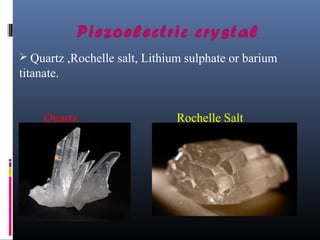
Piezoelectric crystal 
 Quartz ,Rochelle salt, Lithium sulphate or barium 
titanate. 
Quartz Rochelle Salt
Inverse Transducers 
These type of transducers convert a electrical 
quantity into non-electrical quantity 
Example 
Piezoelectric crystal 
Analog ammeter 
voltmeter
SELECTION CRITERIA OF THE 
TRANSDUCERS 
 Operating principle 
 Sensitivity 
 Operating range 
 Accuracy 
 Errors 
 Environmental capability 
 Insensitive to unwanted Signal 
 Stability
Transducers selection 
factors 
Operating Principle: The transducer are many 
times selected on the basis of operating principle 
used by them. The operating principle used may 
be inductive, resistive, capacitive , piezo-electric, 
optoelectronics etc. 
Sensitivity: The transducer must be sensitive 
enough to produce detectable output. 
Operating Range: The transducer should maintain 
the range requirement and have a good resolution 
over the entire range. 
Accuracy: High accuracy is assured
Contd…… 
Errors: The transducer should maintain the expected 
input-output relationship as described by the transfer 
function so as to avoid errors. 
 Environmental Compatibility: It should be assured 
that the transducer selected to work under specified 
environmental conditions maintains its input- output 
relationship and does not break down. 
 Insensitive to unwanted signal: : The transducer 
should be minimally sensitive to unwanted signals and 
highly sensitive to desired signals. 
 Stability: The ability of sensor to retain its 
characteristics over a relatively long period of time
BASIC CONSTRUCTION OF 
TRANSDUCERS 
It consist of two important parts 
 Sensing element: Also known as SENSOR .It 
is a device producing measurable response to 
change in physical condition. 
 Transduction element: The transduction 
element convert the sensor output to suitable 
electrical form.
APPLICATION 
 Audio/video equipment 
 Pressure indication 
 Measurement of displacement 
 Alarms
ADVANTAGES 
 Power requirement is very low for controlling 
the electrical or electronic system. 
 Output can be indicated and recorded remotely 
from the sensing element. 
 Electrical amplification and attenuation can be 
easily done. 
 An amplifier may be used to amplify the 
electrical signal according to requirement.
DISADVANTAGES 
 Their cost is high 
 Thermistors are unsuitable for wide 
temperature 
 Relative large displacement is 
required for appreciable output for 
LVDT 
 Bourdon tubes do not provide the 
precise measurement.
Transducers

Transducers

  • 2.
    CONTENTS WHAT ISTRANSDUCER  CLASSIFICATION OF TRANSDUCERS  SELECTION CRITERIA OF THE TRANSDUCERS  BASIC CONSTRUCTION OF TRANSDUCERS  APPLICATIONS  ADVANTAGES AND DISADVANTAGES
  • 3.
    WHAT IS TRANSDUCER?! The transducer is defined as the device which convert the one form of energy into another form of the energy Example:  Temperature transducers  Thermocouples Displacement transducers  Thermistors
  • 4.
    CLASSIFICATION OF TRANSDUCERS  On the basis of transduction form used.  Primary and secondary transducers.  Passive and active transducers.  Analog and digital transducers.  Transducers and inverse transducers
  • 5.
    On the basisof transduction form used  Resistive Transducers.  Capacitive Transducers.  Inductive Transducers.  Voltage and current Generating Transducers.
  • 6.
    Primary and secondary transducers Primary transducer: The Mechanical device which converts physical quantity to be measured into a mechanical signal. Secondary transducer: The Electrical device which converts this mechanical signal to the electrical signal. Example: LVDT and bourdon tube
  • 7.
    Passive and Active Transducers  If transducers derive the power require for transduction from an power source, then this kind of transducer are known as passive transducer Example  LVDT (Linear voltage differential transformer)  RVDT (Rotary voltage differential transformer)
  • 8.
    CONT… When thereis no need for any source then these type of transducers are Active transducers Example are : Thermocouple Piezoelectric crystal
  • 9.
    THERMOCOUPLE  Adevice for measuring temperature in which a pair of wires of dissimilar metals (as copper and iron) are joined and the free ends of the wires are connected to an instrument (as a voltmeter) that measures the difference in potential created at the junction of the two metals.
  • 10.
    Piezoelectric crystal Quartz ,Rochelle salt, Lithium sulphate or barium titanate. Quartz Rochelle Salt
  • 11.
    Inverse Transducers Thesetype of transducers convert a electrical quantity into non-electrical quantity Example Piezoelectric crystal Analog ammeter voltmeter
  • 12.
    SELECTION CRITERIA OFTHE TRANSDUCERS  Operating principle  Sensitivity  Operating range  Accuracy  Errors  Environmental capability  Insensitive to unwanted Signal  Stability
  • 13.
    Transducers selection factors Operating Principle: The transducer are many times selected on the basis of operating principle used by them. The operating principle used may be inductive, resistive, capacitive , piezo-electric, optoelectronics etc. Sensitivity: The transducer must be sensitive enough to produce detectable output. Operating Range: The transducer should maintain the range requirement and have a good resolution over the entire range. Accuracy: High accuracy is assured
  • 14.
    Contd…… Errors: Thetransducer should maintain the expected input-output relationship as described by the transfer function so as to avoid errors.  Environmental Compatibility: It should be assured that the transducer selected to work under specified environmental conditions maintains its input- output relationship and does not break down.  Insensitive to unwanted signal: : The transducer should be minimally sensitive to unwanted signals and highly sensitive to desired signals.  Stability: The ability of sensor to retain its characteristics over a relatively long period of time
  • 15.
    BASIC CONSTRUCTION OF TRANSDUCERS It consist of two important parts  Sensing element: Also known as SENSOR .It is a device producing measurable response to change in physical condition.  Transduction element: The transduction element convert the sensor output to suitable electrical form.
  • 16.
    APPLICATION  Audio/videoequipment  Pressure indication  Measurement of displacement  Alarms
  • 17.
    ADVANTAGES  Powerrequirement is very low for controlling the electrical or electronic system.  Output can be indicated and recorded remotely from the sensing element.  Electrical amplification and attenuation can be easily done.  An amplifier may be used to amplify the electrical signal according to requirement.
  • 18.
    DISADVANTAGES  Theircost is high  Thermistors are unsuitable for wide temperature  Relative large displacement is required for appreciable output for LVDT  Bourdon tubes do not provide the precise measurement.