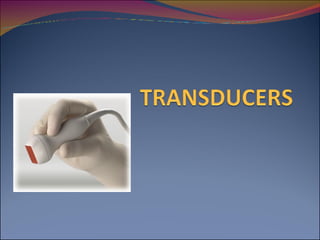
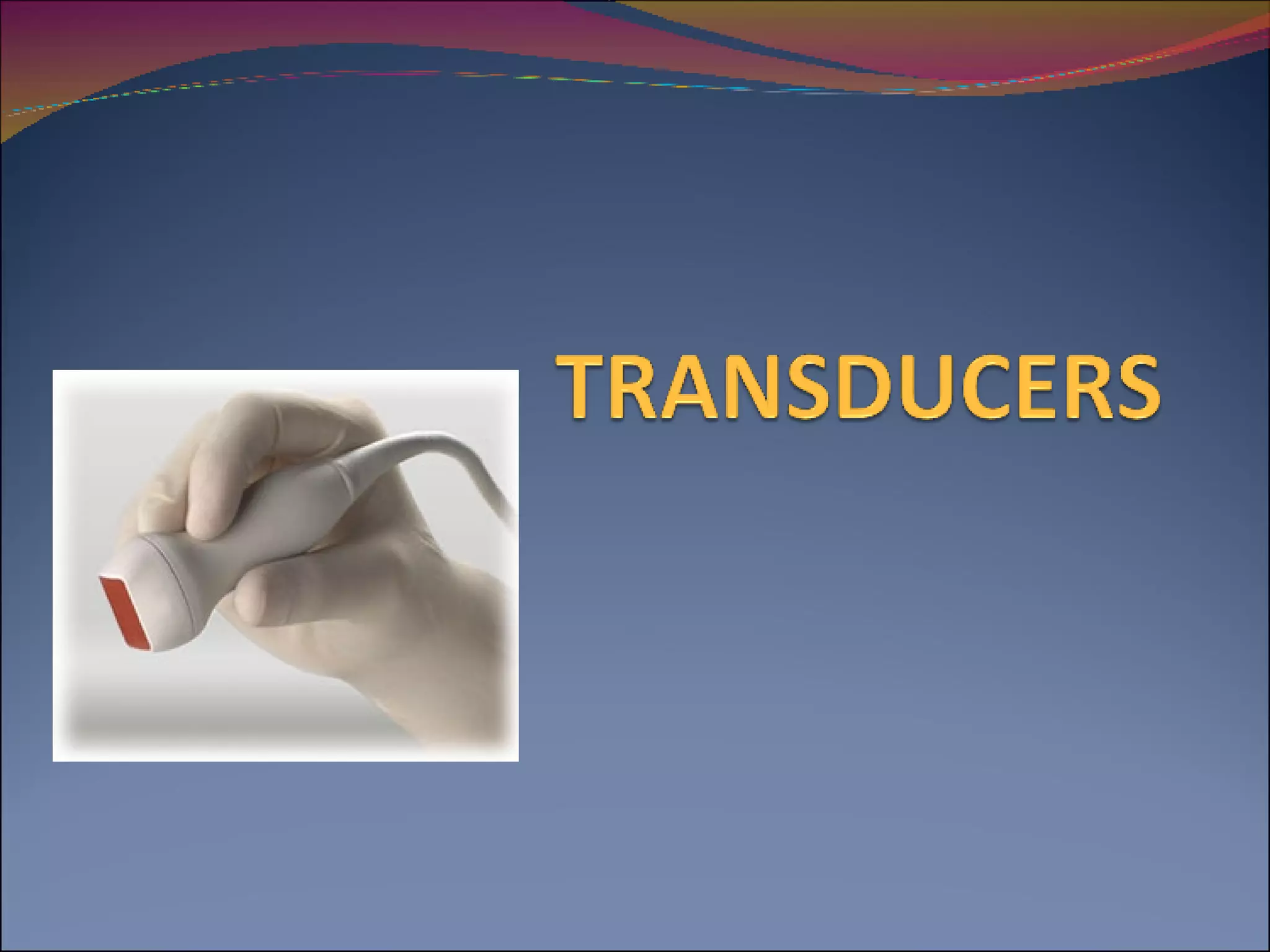
Introduction A transducer is an electronic device that converts energy from one form to another for various purposes like measurement or Information transfer eg.,Pressure sensors. Common examples include microphones, loudspeakers, thermometers, position and pressure sensors, and antenna.
Transducer efficiency Efficiency is an important consideration in any transducer. Transducer efficiency is defined as the ratio of the power output in the desired form to the total power input. Mathematically, if P represents the total power input and Q represents the power output in the desired form, then the efficiency E is given by: E = Q/P
Contd.. No transducer is 100-percent efficient; some power is always lost in the conversion process. Usually this loss is manifested in the form of heat. Some antennas approach 100-percent efficiency. The worst transducers, in terms of efficiency, are incandescent lamps. A 100-watt bulb radiates only a few watts in the form of visible light. Most of the power is dissipated as heat
Transducer Types Electromagnetic Electrochemical Electromechanical  Electro acoustic Photoelectric Electrostatic Thermoelectric Radio acoustic
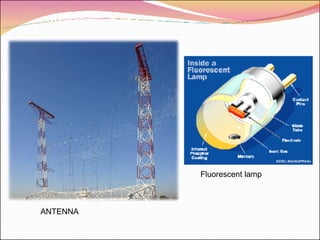
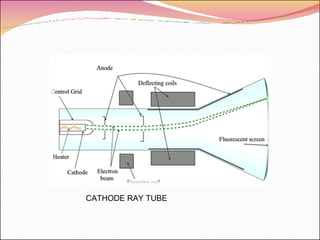
Electromagnetic transducers Antenna - converts electromagnetic waves into electric current and vice versa.  Cathode ray tube (CRT) - converts electrical signals into visual form  Fluorescent lamp, light bulb - converts electrical power into visible light  Tape head - converts changing magnetic fields into electrical form
ANTENNA Fluorescent lamp
CATHODE RAY TUBE
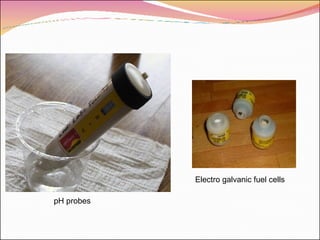
Electrochemical Transducers pH probes-an electronic instrument used to measure the pH (acidity or basicity) of a liquid. An electro galvanic fuel cell- an electrical device used to measure the concentration of oxygen gas in medical equipment.
pH probes Electro galvanic fuel cells
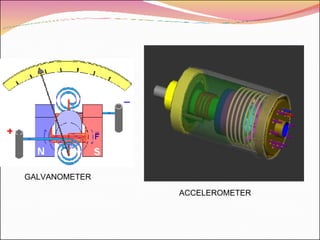
Electromechanical transducers Galvanometer-an instrument for detecting and measuring electric current. It is an analog electromechanical transducer that produces a rotary deflection, through a limited arc, in response to electric current flowing through its coil. Accelerometer- a device for measuring acceleration and gravity induced reaction forces. Rotary motor, linear motor , Vibration powered generator are some examples of this type.
GALVANOMETER ACCELEROMETER
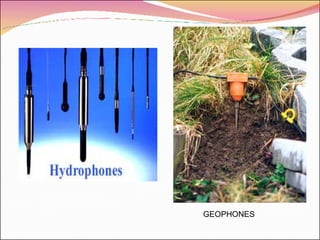
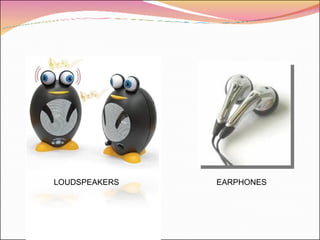
Electroacoustic transducers Geophone - convert a ground movement (displacement) into voltage . Hydrophone - converts changes in water pressure into an electrical form. Loudspeaker, earphone - converts changes in electrical signals into acoustic form.  Microphone - converts changes in air pressure into an electrical signal.
GEOPHONES
LOUDSPEAKERS EARPHONES
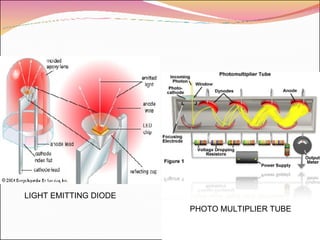
Photoelectric transducers Laser diode, light-emitting diode - convert electrical power into forms of light  Photodiode, photo resistor, phototransistor, photomultiplier tube - converts changing light levels into electrical form.
LIGHT EMITTING DIODE PHOTO MULTIPLIER TUBE
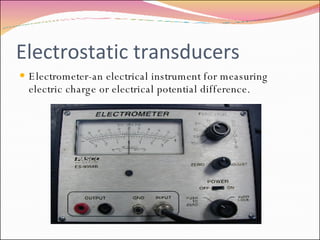
Electrostatic transducers Electrometer-an electrical instrument for measuring electric charge or electrical potential difference.
Thermoelectric transducers RTD(Resistance Temperature Detector)-To predict change in electrical resistance of some materials with changing temperature. Thermocouple-to convert thermal potential difference into electric potential difference.  Thermistor are some of the examples of this type of  transducers.
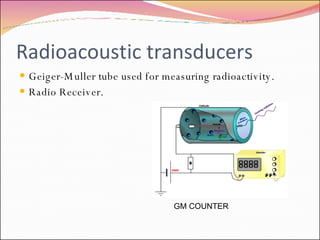
Radioacoustic transducers Geiger-Muller tube used for measuring radioactivity.  Radio Receiver. GM COUNTER
BY

Transducers

  • 1.
  • 2.
    Introduction A transduceris an electronic device that converts energy from one form to another for various purposes like measurement or Information transfer eg.,Pressure sensors. Common examples include microphones, loudspeakers, thermometers, position and pressure sensors, and antenna.
  • 3.
    Transducer efficiency Efficiencyis an important consideration in any transducer. Transducer efficiency is defined as the ratio of the power output in the desired form to the total power input. Mathematically, if P represents the total power input and Q represents the power output in the desired form, then the efficiency E is given by: E = Q/P
  • 4.
    Contd.. No transduceris 100-percent efficient; some power is always lost in the conversion process. Usually this loss is manifested in the form of heat. Some antennas approach 100-percent efficiency. The worst transducers, in terms of efficiency, are incandescent lamps. A 100-watt bulb radiates only a few watts in the form of visible light. Most of the power is dissipated as heat
  • 5.
    Transducer Types ElectromagneticElectrochemical Electromechanical Electro acoustic Photoelectric Electrostatic Thermoelectric Radio acoustic
  • 6.
    Electromagnetic transducers Antenna- converts electromagnetic waves into electric current and vice versa. Cathode ray tube (CRT) - converts electrical signals into visual form Fluorescent lamp, light bulb - converts electrical power into visible light Tape head - converts changing magnetic fields into electrical form
  • 7.
  • 8.
  • 9.
    Electrochemical Transducers pHprobes-an electronic instrument used to measure the pH (acidity or basicity) of a liquid. An electro galvanic fuel cell- an electrical device used to measure the concentration of oxygen gas in medical equipment.
  • 10.
    pH probes Electrogalvanic fuel cells
  • 11.
    Electromechanical transducers Galvanometer-aninstrument for detecting and measuring electric current. It is an analog electromechanical transducer that produces a rotary deflection, through a limited arc, in response to electric current flowing through its coil. Accelerometer- a device for measuring acceleration and gravity induced reaction forces. Rotary motor, linear motor , Vibration powered generator are some examples of this type.
  • 12.
  • 13.
    Electroacoustic transducers Geophone- convert a ground movement (displacement) into voltage . Hydrophone - converts changes in water pressure into an electrical form. Loudspeaker, earphone - converts changes in electrical signals into acoustic form. Microphone - converts changes in air pressure into an electrical signal.
  • 14.
  • 15.
  • 16.
    Photoelectric transducers Laserdiode, light-emitting diode - convert electrical power into forms of light Photodiode, photo resistor, phototransistor, photomultiplier tube - converts changing light levels into electrical form.
  • 17.
    LIGHT EMITTING DIODEPHOTO MULTIPLIER TUBE
  • 18.
    Electrostatic transducers Electrometer-anelectrical instrument for measuring electric charge or electrical potential difference.
  • 19.
    Thermoelectric transducers RTD(ResistanceTemperature Detector)-To predict change in electrical resistance of some materials with changing temperature. Thermocouple-to convert thermal potential difference into electric potential difference. Thermistor are some of the examples of this type of transducers.
  • 20.
    Radioacoustic transducers Geiger-Mullertube used for measuring radioactivity. Radio Receiver. GM COUNTER
  • 21.